Apartment Furniture Packages for Property Developers in Indonesia: A Complete Procurement Guide
13 min read

Furnishing hundreds of units simultaneously is an operational problem, not a design problem. Yet most procurement teams approach apartment furniture packages with a retail mindset. They select pieces unit by unit rather than at scale. They typically manage multiple vendor relationships and react…
Furnishing hundreds of units simultaneously is an operational problem, not a design problem. Yet most procurement teams approach apartmentfurniture packageswith a retail mindset. They select pieces unit by unit rather than at scale. They typically manage multiple vendor relationships and react to delivery failures rather than preventing them. The result is cost overruns, mismatched fitouts, and handover delays.
This guide addresses the full procurement lifecycle for multi-unit residential projects. It also covers serviced apartment projects. It focuses specifically on sourcing furniture from Indonesia. It covers unit-type standardisation, commercial durability specifications, phased delivery logistics, and supplier evaluation. It also addresses cost modelling and asset replacement at scale. The target reader is a development director or FF&E manager.
Indonesia occupies a specific and defensible position in the global furniture supply chain. Its manufacturer clusters in Jepara, Semarang, Surabaya, Cirebon, and Bali produce solid wood, rattan, engineered board, and upholstered product. They cover mid-market and luxury specifications. Indonesia offers developers a broad range of furniture production capabilities. It also has established export infrastructure to support procurement.
Why Indonesian Furniture Manufacturers Offer a Structural Advantage for Multi-Unit Developers
Material depth and manufacturing clusters
Indonesia's competitive position in natural materials is well established. Jepara (Central Java) is the primary cluster for solid teak and mahogany furniture. Semarang handles mid-volume outdoor and contract production. Surabaya anchors mid-market residential and hospitality supply. Cirebon leads in rattan.
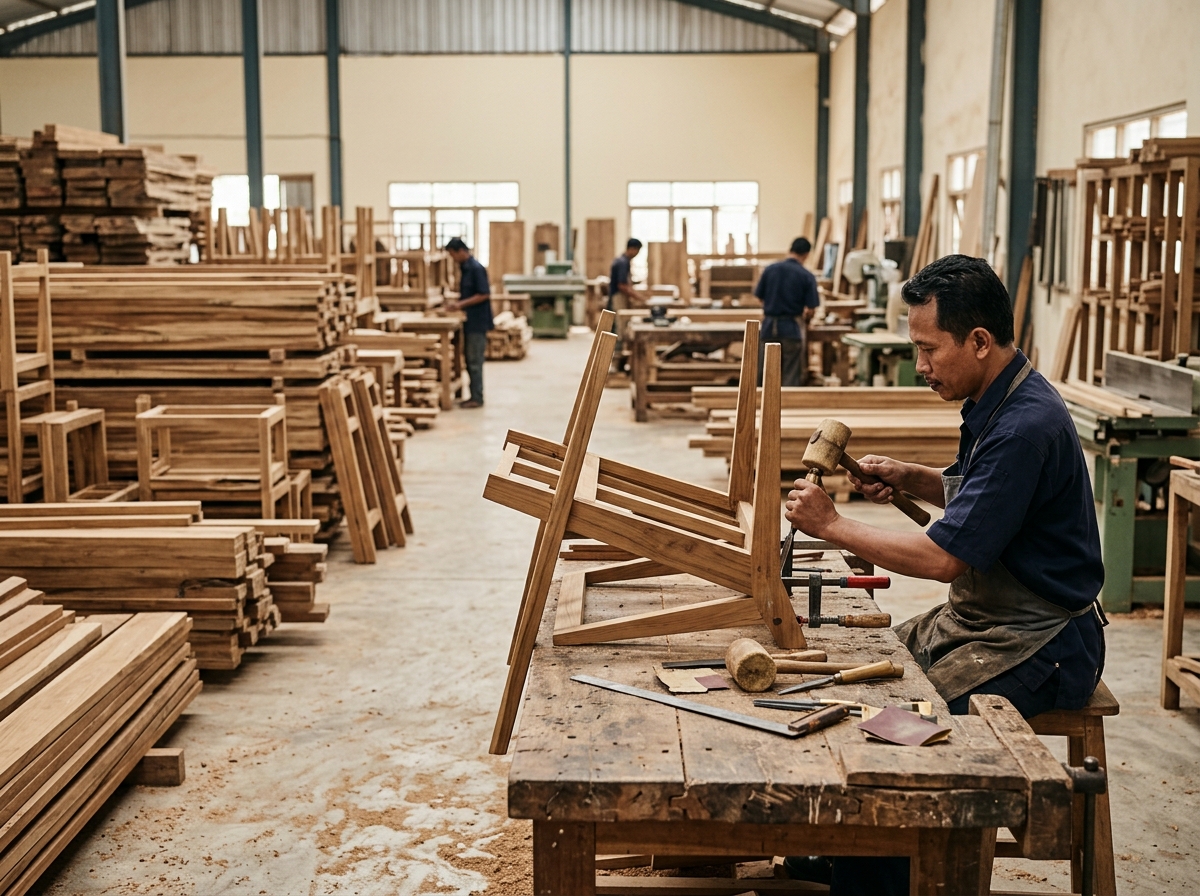
Developers specifying furniture across multiple unit types can consolidate production. This can be done within a manageable supplier network. Solid wood casegoods, upholstered seating, and engineered panel storage can all be sourced from one geographic cluster. This simplifies logistics and coordination. There is no need to source across five countries.
Export infrastructure and certification alignment
Indonesian manufacturers with export track records operate through established freight corridors. These run from Semarang, Surabaya, and Tanjung Priok in Jakarta. Container consolidation, third-party inspection, and customs documentation are routine at this level. Indonesian timber suppliers hold SVLK certification. This satisfies EU Timber Regulation requirements and supports FSC chain-of-custody claims. This is critical for developers selling into regulated markets.
Scale economics at the development level
Direct factory procurement — bypassing trading intermediaries — becomes viable at typical MOQ levels. These are the MOQ levels typical of multi-unit residential projects. A 100-unit development with standardised studio and one-bedroom packages generates enough volume. That volume allows direct negotiation with a manufacturer. Standardised packages are key to reaching that threshold. Mid-cycle or full-cycle Indonesian factories are accessible at this scale.
How to Build Unit-Type Furniture Packages That Scale Across Hundreds of Apartments
Creating tiered package structures
Standardisation starts with a bill-of-materials (BOM) template for each unit type. A typical multi-unit residential project defines four tiers:
| Unit Type | Key Furniture Categories | Approximate SKU Count per Unit |
|---|---|---|
| Studio | Bed, bedside, desk, chair, compact sofa, storage unit | 8–12 SKUs |
| One-bedroom | Bed, bedside x2, wardrobe, dining set, sofa, coffee table, storage | 14–18 SKUs |
| Two-bedroom | As above plus second bedroom set, additional storage | 20–26 SKUs |
| Penthouse | Full above plus bespoke or upgraded specification items | 28–40+ SKUs |
Each tier has its own BOM. Every SKU is tagged with a manufacturer code, material specification, finish reference, and lead time. This structure lets you place bulk orders against confirmed unit counts, track delivery against each floor plate, and reorder replacements against the same SKU without redesign costs.
Balancing brand aesthetics with interchangeable components
Branded apartment schemes — build-to-rent operators in particular — need visual consistency across the entire building. Every unit must match the scheme's overall look. This applies to all units. The procurement discipline is to achieve that consistency through a shared material palette and finish standard, not through bespoke one-off pieces. Design interchangeability into the BOM from the outset.
Coordinating with architects during schematic design
The BOM template must be drafted during schematic design, not after construction drawings are issued. FF&E managers who engage Indonesian suppliers at concept stage can influence timber species. They can also shape dimensional standards. They can also shape finish options. This must happen before the design is locked. Changes after the production order is placed carry cost penalties and timeline risk.
Commercial Durability Specifications That Rental and Serviced Apartment Furniture Must Meet
Residential retail furniture is not built for rental environments. Apartment furniture packages for Indonesia property developer projects must meet commercial durability standards. This applies across all specified items in the package. Failure to define these upfront is the single most common cause of premature furniture replacement.
Upholstery: Martindale rub count minimums
Martindale rub count is the standard abrasion test for upholstered fabric in commercial interiors. It measures how well fabric resists wear. For serviced apartments and build-to-rent with high tenant turnover:
- Minimum acceptable: 25,000 Martindale rubs for low-traffic pieces (headboards, accent chairs) - Standard rental specification: 40,000 rubs for sofas and dining chairs - High-turnover serviced apartments: 50,000+ rubs recommended
Specify Martindale rating in the purchase order as a contractual requirement. Request test certificates from the fabric mill, not self-declarations from the furniture manufacturer.
Solid wood versus engineered board in tropical climates
Indonesia's humidity profile — typically 70–90% relative humidity in coastal cities — is a material specification issue, not just a climate fact. Solid teak performs well in high-humidity conditions due to its natural oil content. Untreated solid timber from other species, or low-grade MDF, will swell, warp, or delaminate. This happens in poorly air-conditioned apartments. This typically occurs within twelve to eighteen months.
| Material | Humidity Resistance | Recommended Use | Risk in Tropical Climate |
|---|---|---|---|
| Solid teak | High | Casegoods, dining, bedframes | Low — natural oil provides inherent resistance |
| Suar (rain tree) | Moderate-High | Decorative tables, accents | Low with proper sealing |
| Marine-grade engineered board | Moderate | Wardrobe carcasses, panel furniture | Low if moisture-resistant adhesive specified |
| Standard MDF | Low | Avoid for humid environments | High — swelling and delamination risk |
| Low-grade particleboard | Very Low | Not recommended | Very High |
Specify moisture-resistant (MR) or exterior-grade adhesive for all engineered board components. Require humidity cycling test results for engineered products if the project site is coastal or poorly ventilated.
Hardware and joinery standards
Hinges, drawer runners, and connecting hardware on rental furniture absorb far more cycle use than in owner-occupied apartments. This makes hardware selection critical. Specify soft-close drawer runners to a minimum load rating appropriate for the drawer depth. Specify concealed hinges from recognised hardware suppliers. Require tensile test documentation for structural joints on casegoods.
Phased Delivery Planning Aligned to Construction Handover Schedules in Indonesia
No competitor content addresses this adequately. It is where most developer procurement teams lose money.
Aligning production lead times with construction milestones
Indonesian furniture production lead times typically range from ten to sixteen weeks. This is measured from order placement to factory-ready goods. This varies depending on material, complexity, and factory load. Add three to five weeks for FCL sea freight to regional destinations. Also allow for port clearance and last-mile delivery. Total procurement-to-installation timeline: commonly sixteen to twenty-four weeks.
Map this against your construction programme. If floor-plate handover begins in month twelve, purchase orders must be issued no later than month eight. This assumes a sixteen-week production cycle and a four-week logistics tail. Build contingency for production slippage.
Warehouse and staging strategies near project sites
Large apartment developments in Jakarta, Bali, and Surabaya benefit from bonded warehouse staging. Third-party logistics staging is also an option. This staging should be near the project site. Goods arrive from the port in consolidated shipments and are held in a staging facility. Floor-by-floor installation teams draw stock as each floor plate is handed over by the main contractor.
Partial-floor delivery sequencing
Issue a floor-by-floor delivery schedule to the supplier and logistics partner at contract stage. Sequence deliveries so that soft furnishings and upholstered pieces arrive after hard floor and wall finishes are signed off. Casegoods can be installed earlier if lift access is confirmed. Protective floor coverings must also be in place. Never allow open-backed container deliveries directly into finished corridors.
Contractual terms for phased procurement
Structure the purchase order as a phased release against a master agreement. A common structure:
- Deposit: 30–40% on order placement to secure production slot - Progress payment: 30–40% at pre-shipment inspection sign-off - Balance: 20–30% on delivery and acceptance at destination
Include explicit phased delivery dates tied to construction milestone dates in the contract. Define delay penalties calibrated to the cost of holding an unfurnished apartment. Base them on the rental commencement date.
Evaluating and Shortlisting Indonesian Furniture Package Suppliers for Apartment Developments
Manufacturer cluster selection
| Cluster | Primary Specialisation | Best Suited For |
|---|---|---|
| Jepara, Central Java | Solid teak, mahogany casegoods | Premium and mid-market bedroom, dining |
| Cirebon, West Java | Rattan, wicker, natural fibre | Accent pieces, resort-style units |
| Semarang, Central Java | Contract outdoor, mid-volume mixed | High-volume apartment packages |
| Surabaya, East Java | Mid-market residential, panel furniture | Cost-efficient large-scale projects |
| Bali | Luxury artisan, villa furniture | Boutique serviced apartments, penthouses |
Factory audit criteria
For apartment furniture packages property developers Indonesia projects, a factory audit must verify:
- ✓Production capacity in containers per month — verify against your required volume
- ✓Quality control process: in-line inspection, final inspection, sample retention policy
- ✓SVLK and FSC chain-of-custody certificates — request originals and verify registry numbers
- ✓Export compliance: experience with customs documentation for your target destination
- ✓Upholstery fabric sourcing: confirm Martindale-rated fabric suppliers are in use
- ✓Engineered board suppliers: verify MR or exterior-grade adhesive specification
- ✓Sample room and finish library availability for developer approval
- ✓References from comparable multi-unit residential or hospitality clients
- ✓Financial stability indicators: years in operation, export volume, bank references
- ✓Third-party audit history: BSCI, Sedex, or equivalent social compliance
MOQ considerations for smaller developments
Full-cycle Indonesian manufacturers typically expect MOQs calibrated to container economics. A 40-foot high-cube container holds roughly 20–35 bedroom sets depending on packaging density. Developers with fewer than fifty units can combine multiple SKUs across unit types into a single container. This mixed-container strategy helps meet minimum order thresholds without excess stock.
Pricing Structures and Total Cost of Ownership for Apartment Furniture Packages
Avoid comparing per-unit furniture package costs without including freight, duties, staging, and installation. The total cost of ownership calculation for a five-year rental cycle must account for all of the following. Each cost element below should be included.
- Ex-factory unit cost: varies significantly by specification, material, and unit type - Freight (FOB to CIF destination): typically add 8–15% of goods value for sea freight to regional Asian destinations; more for longer haul - Import duties: depend entirely on destination country HS code classification and applicable trade agreements - Last-mile and installation: typically 5–10% of goods value depending on site access and project location - Warranty and after-sales: Indonesian suppliers commonly offer twelve to twenty-four month manufacturing defect warranties; negotiate replacement part availability as a contractual term - Replacement frequency: mid-market rental furniture with correct Martindale and joinery specifications should achieve a five to seven year replacement cycle; under-specified product often requires replacement within two to three years, doubling lifecycle cost
Furniture Replacement Programmes and Asset Lifecycle Management at Scale
Build-to-rent operators managing hundreds of apartments need a systematic replacement programme, not reactive purchasing. Ad-hoc replacement creates specification drift, meaning new pieces no longer match the original BOM. It also complicates insurance valuations.
Rolling replacement cycle based on occupancy data
Establish a replacement trigger based on unit turnover count, not calendar time. High-turnover serviced apartments may require soft furnishing replacement at two to three years. Long-stay build-to-rent units with lower churn may sustain a five to seven year cycle. Integrate furniture condition reporting into the end-of-tenancy inspection workflow. Flag units that require furniture replacement before re-listing.
Living SKU catalogue with guaranteed reorder availability
Negotiate a living catalogue agreement with your Indonesian supplier at the point of initial order. This supports future reorders and replacements. This commits the supplier to maintain the ability to reorder your specific SKUs — same timber species, same fabric, same finish — for a defined period, typically three to five years. Without this, reorder items will not match original units, creating visible inconsistency across the building.
Integration with property management software
Export furniture asset data into your property management platform. This should include SKU, unit location, installation date, and condition rating. This enables automated replacement scheduling, spend forecasting, and insurance documentation without manual reconciliation.
Sustainable disposal and refurbishment options
Indonesian-manufactured solid teak and suar furniture has residual value at end of first rental life. Establish a refurbishment protocol: refinish solid wood surfaces and reupholster frames where the joinery is sound. Dispose only of irreparable items. Refurbished furniture can be reallocated to lower-specification units or sold through secondary channels. This reduces net replacement cost and supports ESG reporting.
Contract and Logistics Checklist for Developers Procuring Indonesian Furniture
Incoterms and inspection strategy
FOB from Semarang or Surabaya gives the developer's freight forwarder control over ocean freight and insurance. This arrangement is preferable for experienced procurement teams with established carrier relationships. CIF to the destination port is simpler to manage. However, it reduces visibility into freight cost and carrier selection. For large projects, FOB from the Indonesian load port is generally preferable.
Conduct pre-shipment inspection at origin using a third-party inspection agency. Inspection at destination after a twelve-week sea voyage is a weaker contractual position. By that point, damage may be disputed.
Export documentation for wood products
- ✓SVLK certificate — mandatory for teak and regulated timber species exports
- ✓FSC chain-of-custody certificate — required if FSC-certified product is specified
- ✓CITES permit — required for species listed under Convention on International Trade in Endangered Species (check applicable HS codes)
- ✓Phytosanitary certificate — required by most destination countries for solid wood products
- ✓Certificate of Origin — required for preferential duty treatment under applicable trade agreements
- ✓Commercial invoice and packing list with HS code classification
- ✓Bill of lading or airway bill
- ✓Pre-shipment inspection certificate from approved third-party agency
Force majeure and delay penalty clauses
Construction-linked delivery contracts carry elevated force majeure risk on the construction side. Site delays are a key example of this risk. They also carry supply-side risk, including factory disruption and port congestion. Include mutual force majeure definitions and notification timeframes in supplier contracts. Also include a mechanism to extend delivery windows without penalty when delays originate on the construction side.
Frequently Asked Questions: Indonesian Furniture Packages for Apartment Developers
What is the typical minimum order quantity for an apartment furniture package from Indonesia?
MOQs vary by supplier type. Full-cycle factories in Jepara and Semarang typically work at container-level minimums. That is approximately one 40-foot container per SKU family. For mixed apartment packages, consolidated container orders allow developers to combine multiple SKUs. Projects below fifty units should discuss mixed-container strategies with the supplier upfront.
How long does production and shipping take for a multi-unit furniture package from Indonesia?
Production lead time is commonly ten to sixteen weeks from confirmed purchase order. Sea freight to regional Asian destinations adds three to five weeks. Developers should plan for a procurement-to-installation window of sixteen to twenty-four weeks. Allow additional time for customs clearance and last-mile logistics.
What wood certifications should Indonesian furniture suppliers hold for export?
At minimum: SVLK (Timber Legality Verification System) for all regulated timber species. FSC chain-of-custody certification for projects with sustainability requirements. CITES documentation where applicable to the timber species specified. Request original certificates and verify against the issuing body's public registry.
How do property developers handle furniture replacement across hundreds of units?
Best practice includes a SKU catalogue agreement with the original supplier. It also includes condition tracking in property management software. Replacement cycles should be triggered by occupancy turnover data. Fixed calendar intervals should not drive this decision. Solid wood frames should be assessed for refurbishment before disposal.
Can Indonesian suppliers customise furniture packages to match branded apartment schemes?
Yes. Mid-cycle and full-cycle factories in Jepara, Semarang, and Surabaya routinely produce to developer-supplied design briefs. This applies across all three locations. This is standard practice across those locations. These briefs can include custom dimensions, timber species, stain references, and fabric specifications. Engage during schematic design to avoid post-production change costs.
What are the import duty implications for developers bringing Indonesian furniture into other markets?
Import duties depend on destination country and HS code classification. Applicable bilateral trade agreements also affect them. Indonesia has preferential trade arrangements with several ASEAN partner countries. Developers importing outside ASEAN — including the US and EU — should commission a tariff classification review. This step helps avoid unexpected duty costs. This is a formal review, not an informal check.
Procuring apartment furniture packages property developers Indonesia projects is a supply chain management discipline. Success depends on specification rigour, supplier verification, logistics sequencing, and lifecycle planning. Product selection alone is not enough. Developers who treat furniture procurement as a programme consistently outperform others. That programme should include BOMs, phased orders, durability standards, and replacement cycles.
You now have the framework to structure procurement from the first BOM template. It covers through to the five-year replacement cycle. The logical next step is translating that framework into a costed, supplier-confirmed package for your specific project.
You understand your unit types, durability requirements, and delivery schedule. Put those specifications to work — request a custom furniture package quote tailored to your multi-unit development today.
Request a Custom Package Quote →Need eyes on the ground in Indonesia?
MTS is an execution partner — supplier verification, manufacturing management, quality control and export logistics across Indonesia, Vietnam and China.
Related services
Related articles
Receive furniture sourcing insights across Asia.
One email per week. No spam.