Commercial Interior Products Indonesia Hotel Fit-Out: The Procurement Buyer's Specification Guide
13 min read
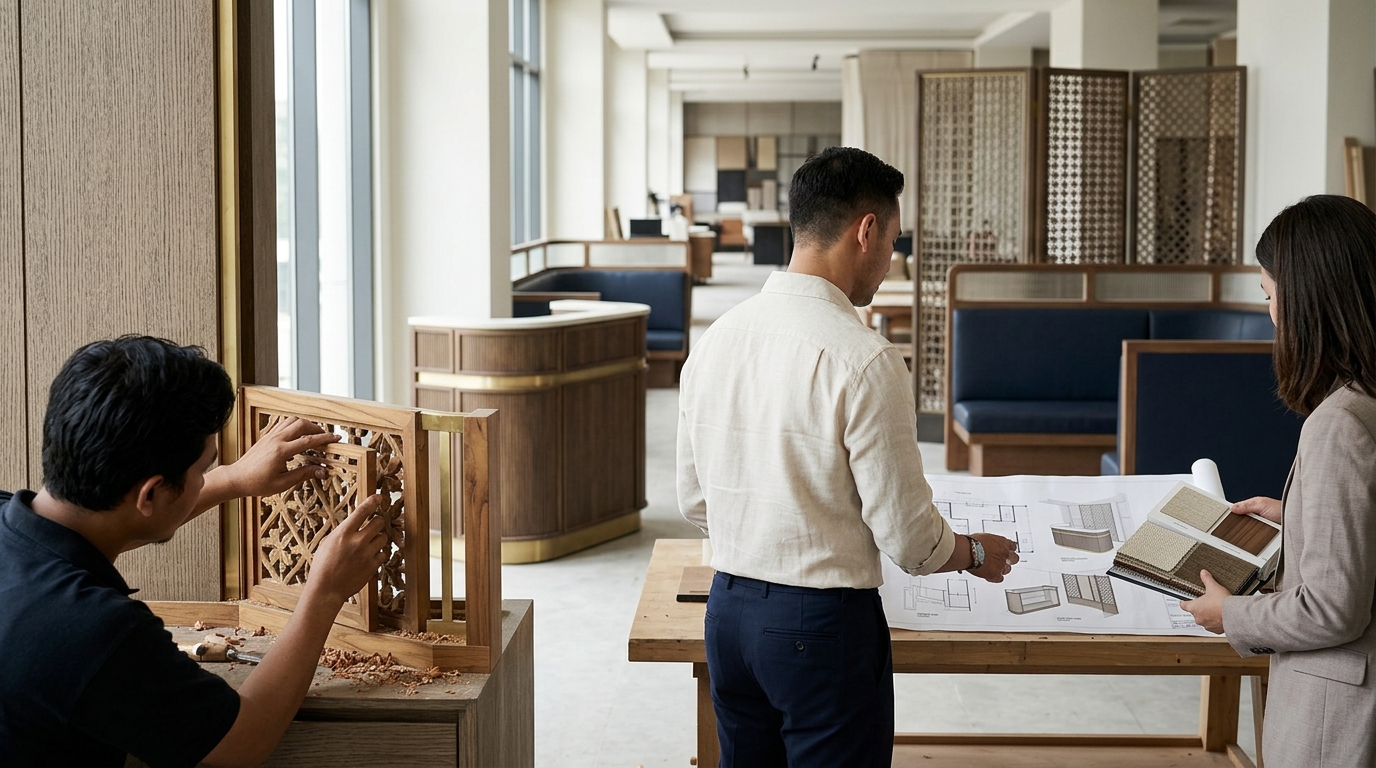
Sourcing commercial interior products for a hotel fit-out project demands precision. Lead times, fire compliance, shop drawing coordination, and material specifications all compound simultaneously. A missed ASTM E84 certificate or an ambiguous FOB quote can derail an entire FF&E schedule.
Sourcing commercial interior products for a hotel fit-out project demands precision. Lead times, fire compliance, shop drawing coordination, and material specifications all compound simultaneously. A missed ASTM E84 certificate or an ambiguous FOB quote can derail an entire FF&E schedule.
This guide is written for the buyer side — not the supplier side. It addresses what specification standards apply, how to structure phased delivery around construction milestones, how to qualify factories, and what compliant commercial interior products from Indonesia actually cost. It does not list contractors. It equips you to evaluate them.
Indonesia has emerged as a serious source of premium commercial interior products for hotel fit-out projects globally, particularly for US-based hospitality developers. The combination of hardwood access, skilled joinery labour, and competitive FOB pricing makes it difficult to ignore. But unlocking that value requires understanding the compliance, logistics, and coordination frameworks that separate successful sourcing programmes from expensive failures.
Why Indonesia Outperforms China and Vietnam for Hospitality Joinery Sourcing
Indonesia occupies a distinct position in the Asian commercial interior supply chain. Unlike China, which dominates panel furniture and volume production, or Vietnam, which has scaled rapidly on bedroom and dining furniture since approximately 2018, Indonesia's competitive edge sits in natural hardwood joinery, artisan finishing, and hospitality-specific product expertise.
Material Advantages That Drive Hotel Specification Decisions
The Indonesian material palette is uniquely suited to hotel interiors. Teak, sourced from government-managed plantations in Java, offers exceptional dimensional stability and natural oil content that resists moisture — a critical property in hotel bathrooms and spa environments. Suar wood provides a wide-grain aesthetic suited to reception desk feature panels. Reclaimed teak carries provenance narrative that supports high-end resort positioning.
Key material options available from Indonesian commercial interior suppliers:
| Material | Typical Application | Moisture Resistance | FSC Available |
|---|---|---|---|
| Plantation teak | Fixed joinery, doors, feature panels | High | Yes |
| Suar (rain tree) | Reception desks, decorative panels | Medium | Varies |
| Reclaimed teak | Feature walls, room dividers, screens | High | Verify per batch |
| Rattan (engineered) | Screens, room dividers, headboards | Medium | Yes |
| MDF core + veneer | Wardrobe carcasses, minibar units | Low–Medium | Yes (MDF core) |
| HPL-faced MDF | High-traffic joinery, host stations | High | Yes (MDF core) |
Cost Position Versus Regional Alternatives
Indonesian factory pricing for contract joinery typically sits below European production by a significant margin and remains competitive against Chinese suppliers — particularly in the custom hardwood segment where Chinese factories lack comparable wood access. Vietnam has closed the gap on volume joinery, but struggles to match Indonesian finishing quality on solid hardwood hotel pieces.
Indonesia's commercial interior fit-out sector is growing. Market projections cited in regional industry analyses estimate the domestic fit-out market could reach approximately USD 627 million by 2032 (approximate figure; verify with current market reports). That growth is driving factory investment in CNC capacity, quality management systems, and export compliance infrastructure — which directly benefits international buyers.
Product Categories for Commercial Interior Products Indonesia Hotel Fit-Out
Hotel fit-out procurement typically spans five or six distinct joinery and panelling categories. Each carries different specification requirements.
Reception Desks and Check-In Counters
Standard hotel reception desk heights run between 1050mm and 1150mm for staff-side counters. ADA-compliant guest-approach sections require a maximum height of 865mm (approximately 34 inches) with a minimum clear knee space. Indonesian factories can produce ADA-configured reception desks in teak, suar, or veneer-faced MDF. Confirm substrate clearly in your specification — solid hardwood and MDF-core veneer carry different moisture and impact resistance profiles.
Host Stations and Restaurant Podiums
Host stations in hotel restaurants face heavy daily contact. Specify HPL-faced or lacquered hardwood surfaces with a minimum abrasion resistance rating of AC3 or equivalent for front-facing panels. Edge profiles matter: sharp MDF edges delaminate under impact. Specify solid hardwood edge banding or bullnose hardwood lipping on all HPL-faced pieces.
Fixed Joinery: Wardrobes, Headboards, Vanity Units, Minibar Carcasses
Fixed joinery represents the largest volume category in a typical guestroom fit-out. Wardrobe carcasses are commonly produced in E0-rated MDF or moisture-resistant particleboard with veneer or lacquer finish. Headboards may combine upholstered panels with teak or suar framing. Minibar carcasses require ventilation cut-outs and internal melamine lining specified to resist condensation.
Wall Panelling, Decorative Screens, and Room Dividers
Acoustic performance of wall panelling is a frequently overlooked specification. Solid timber panelling with air gaps provides limited acoustic benefit without a backing absorber layer. Confirm with your acoustic consultant whether the panel system requires a mineral wool backing.
Contract-Grade Specifications Every Fit-Out Buyer Must Understand
The term "contract-grade" is often used loosely. In hospitality procurement, it has a specific meaning.
Contract-grade versus residential-grade refers primarily to durability under commercial use cycles. A residential wardrobe might face one or two daily open-close cycles. A hotel guestroom wardrobe faces 300+ annually. Contract-grade joinery uses:
- Higher-density substrates (minimum 700 kg/m³ MDF) - Concealed hinges rated to 100,000+ cycles - Abrasion-resistant topcoats (typically PU lacquer or catalysed lacquer) - Moisture-resistant glue lines (Type II or Type I waterproof adhesive per relevant ANSI standards)
Surface durability for public-space joinery should be defined against measurable standards:
| Performance Criterion | Minimum Specification | Test Reference |
|---|---|---|
| Abrasion resistance (surface) | AC3 or 400 cycles Taber (minimum) | EN 13329 / ASTM D4060 |
| Moisture resistance | Type II adhesive; MR-grade substrate | ANSI A208.1 |
| UV stability (veneer finishes) | Class 4 minimum | EN ISO 105-B02 |
| Impact resistance | Medium duty (hotel lobby) | EN 15186 |
| Formaldehyde emissions | CARB Phase 2 / E0 | CARB 93120 / JIS A 5908 |
Joinery tolerances from Indonesian workshops vary by factory. Acceptable tolerances for site-fit joinery are typically ±1mm on carcass dimensions and ±0.5mm on face frame reveals. Request tolerance statements in your shop drawing approval package and confirm these against your site survey data before production release.
Fire Safety and Building Code Compliance for US Hotel Projects
This is the area where most sourcing guidance from competitor content fails entirely. Fire compliance is not optional for US hotel installations.
ASTM E84 and NFPA 101 Requirements
NFPA 101 (Life Safety Code) governs interior finish requirements in US hotels. For most public spaces — lobbies, corridors, and assembly areas — wall and ceiling finishes must meet Class A (Flame Spread Index 0–25, Smoke Developed Index 0–450) or Class B (FSI 26–75, SDI 0–450) requirements under ASTM E84.
Timber panelling and decorative screens in natural wood finish will not meet Class A without treatment. Indonesian factories can apply flame-retardant coatings and pressure-impregnated treatments that allow tested panels to achieve Class A or Class B ratings. The critical requirement: the test must be conducted on the finished assembly, not the substrate alone.
Requesting and Verifying Fire Test Certificates
Relevant standards for fire-test documentation:
- ASTM E84 — required for US AHJ submissions - NFPA 101 Class A/B — interior finish classification - EN 13501-1 — European equivalent (B-s1,d0 or better for hotel lobbies); accepted as supporting data but not a substitute for ASTM E84 in US projects
Your FF&E schedule submitted to the Authority Having Jurisdiction (AHJ) must include the ASTM E84 test report number, testing laboratory name (must be NRTL-accredited), and confirmation that the tested assembly matches the installed product. Request this documentation from the Indonesian supplier before production — not after shipment.
Documentation Checklist for AHJ Submission
- ✓ASTM E84 full test report (NRTL-accredited lab)
- ✓NFPA 101 classification statement (Class A or B)
- ✓Flame-retardant treatment specification and application method
- ✓Substrate species, thickness, and finish details matching the tested assembly
- ✓Supplier letter of conformance tying production batch to test report
Site-Measure Coordination and Shop Drawing Approval with Indonesian Factories
Remote coordination between US design teams and Indonesian factories is manageable with the right workflow. Most failures result from inadequate documentation, not geography.
Transmitting Site Dimensions Accurately
Provide site dimensions in DWG format where possible. Indonesian factories working at contract scale typically operate AutoCAD or SolidWorks. PDF with dimensioned elevations is acceptable for initial quotation but insufficient for production release. BIM exports (IFC format) are increasingly supported by larger Jepara and Semarang factories but confirm capability before assuming it.
A site dimension survey conducted by a local contractor or architect should be transmitted within 48 hours of survey completion. Include:
- Floor-to-ceiling heights at each installation point - Wall-to-wall widths with plumb and level deviations noted - Mechanical, electrical, and plumbing (MEP) cut-out positions - Door and window reveal dimensions where joinery abuts openings
Shop Drawing Review Cycles and Approval Timelines
A typical shop drawing cycle for hotel fit-out joinery runs two to three rounds of review. Allow a minimum of two weeks per round when coordinating across US–Indonesia time zones. Build these weeks into your programme before production release.
The approval chain should include: design architect sign-off → interior designer sign-off → FF&E coordinator approval → factory production release. Never allow factories to proceed to production on verbal approval.
Phased Delivery Logistics Aligned to Hotel Fit-Out Construction Schedules
Phased delivery is a procurement discipline, not a logistics afterthought. Indonesian factories work best when purchase orders are structured around construction milestones rather than issued as a single bulk order.
Structuring Orders by Fit-Out Phase
| Fit-Out Phase | Typical Product Categories | Recommended Lead Time Buffer |
|---|---|---|
| Shell and core complete | Fixed partitions, door frames, feature wall backing | 16–20 weeks from PO |
| Back-of-house fit-out | Staff area joinery, BOH storage, host stations | 12–16 weeks from PO |
| Guestroom soft strip | Wardrobe carcasses, headboards, vanity units | 14–18 weeks from PO |
| Public area finishing | Reception desks, lobby panels, decorative screens | 16–20 weeks from PO |
Custom joinery from Indonesian workshops typically carries a lead time of 10 to 20 weeks from production release, depending on complexity, species, and factory capacity. This window does not include sea freight transit time. Sea freight from Indonesian ports (Tanjung Priok, Tanjung Perak) to US West Coast ports runs approximately 20–28 days; East Coast ports add 5–10 days via transhipment.
Sea Freight Versus Air Freight Decisions
Air freight for commercial joinery is rarely economical given volumetric weight. It is justified only for time-critical small items — hardware, replacement panels, or punch-list pieces — where a construction delay cost exceeds freight cost. For standard fit-out programmes, sea freight in 20ft or 40ft containers is the default.
Port Entry and Last-Mile Considerations
US Customs requires an Importer of Record (IOR). Confirm IOR responsibility in your purchase contract. Joinery shipped under HS codes for wooden furniture (HS 9403) may attract anti-dumping duties depending on country of origin rulings — verify current CBP guidance for Indonesian-origin joinery.
Evaluating and Qualifying Indonesian Commercial Interior Suppliers
Factory Audit Checklist
Do not rely on Alibaba Gold Supplier status or online profile completeness as qualification signals. For contract-grade hospitality procurement, conduct or commission a physical factory audit covering:
- ✓ISO 9001 certification (current, scope covers joinery or furniture manufacture)
- ✓FSC Chain of Custody certification (if specifying certified timber)
- ✓Production capacity: minimum monthly output aligned to your project volume
- ✓CNC and finishing equipment condition and vintage
- ✓Finishing room environmental controls (temperature, humidity for lacquer application)
- ✓Quality control checkpoints: in-process and pre-shipment inspection records
- ✓Export packaging capability: fumigated crating, corner protection, moisture barriers
- ✓Fire-test documentation: ASTM E84 reports held on file
- ✓Previous hotel project references with verifiable contact details
Red Flags in Supplier Quotations
Several signals indicate a supplier is not equipped for contract-grade hotel fit-out:
- Material specifications listed as "hardwood" or "solid wood" without species identification - No flame-retardant treatment option offered or no ASTM E84 documentation available - Lead times quoted at under 8 weeks for complex custom joinery (unrealistic for compliant production) - Payment terms requiring 100% advance with no milestone inspection provisions - Shop drawing capability absent — factory only works from photos or mood boards
Contract Structure and Milestone Payments
Structure contracts with payment tied to verifiable milestones: typically 30% on purchase order, 40% on pre-shipment inspection approval, and 30% on receipt and acceptance at site. Pre-shipment inspections should be conducted by an independent third party or your Indonesia-based coordinator, not self-reported by the factory.
Cost Benchmarks for Indonesian Hotel Fit-Out Products
How much does it cost to fit out a hotel in Indonesia? For internationally branded hotels developed in Indonesia, total fit-out costs (FF&E plus joinery) commonly represent 15–25% of total construction cost, which itself varies widely by property type and location. Budget hotel construction in Indonesia may run from approximately USD 500 to USD 1,000 per square metre; luxury resort development can exceed USD 3,000 per square metre. These are approximate figures — always validate against current quantity surveyor estimates for your specific project.
For Indonesian-manufactured products exported to the US, indicative FOB pricing ranges (approximate):
| Product | FOB Price Range (Approximate) | Key Cost Drivers |
|---|---|---|
| Reception desk (teak veneer, 2.4m) | USD 1,800–4,500 | Species, veneer grade, ADA configuration |
| Wall panelling (solid teak, per m²) | USD 85–220 | Thickness, profile, fire treatment |
| Decorative laser-cut screen (per m²) | USD 120–350 | Cut complexity, species, framing |
| Wardrobe carcass (guestroom, MDF) | USD 450–1,100 | Size, internal fittings, finish |
| Banquette frame (per linear metre) | USD 180–420 | Frame material, upholstery not included |
| Interior door (solid core, teak) | USD 320–850 | Fire-rating, hardware prep, species |
Cost drivers across all categories include: material species selection, finish complexity (PU lacquer versus HPL), order quantity, export packaging specification, and whether ASTM fire-testing is required on the production batch. FSC certification adds a modest premium — typically 5–12% — but reduces compliance risk on US projects.
Interior Design Trends Shaping Indonesian Hotel Products in 2025
Warm minimalism is the dominant aesthetic direction in hotel interior design entering 2025. It combines natural material warmth — teak, suar, linen, stone — with restrained profiles and low visual clutter. Indonesian commercial interior products align naturally with this direction.
Biophilic design integration is driving demand for reclaimed teak feature panels and suar wood reception desks with live-edge detailing. These elements require careful specification: live-edge profiles must be sealed against moisture ingress, and reclaimed timber must carry chain of custody documentation for Lacey Act compliance.
Decorative timber screens — laser-cut or hand-carved — are increasingly specified as functional room dividers in hotel lobbies, restaurant waiting areas, and spa reception zones. They provide partial acoustic separation and visual interest without full partition walls. Indonesian factories produce these in teak, suar, and engineered bamboo. Specify maximum panel deflection, fixing centres, and fire treatment clearly in your package.
Mid-century modern and tropical modernist aesthetics continue to influence FF&E product design for resort properties. Tapered legs, cane infill panels, and brass hardware combinations are high-volume requests from US hospitality designers sourcing from Indonesia. Confirm hardware sourcing — many Indonesian factories import European or South Korean hardware for contract-grade specifications.

Frequently Asked Questions: Indonesian Commercial Interior Sourcing
What is the difference between contract-grade and residential-grade hotel interior products? Contract-grade products are engineered for commercial use cycles — higher substrate density, cycle-rated hardware, abrasion-resistant finishes, and compliance-ready documentation. Residential-grade products are not designed or tested for hotel conditions and will fail prematurely in commercial environments.
What fire safety certifications are required for hotel interior products exported to the US? US hotel projects require ASTM E84 flame spread testing for interior wall and ceiling finishes, with NFPA 101 Class A or Class B classification depending on the space type. Certificates must come from an NRTL-accredited laboratory. EN 13501 certificates are useful supporting data but are not accepted as substitutes by US AHJs.
How long does it take to manufacture and ship custom joinery from Indonesia? Production typically runs 10–20 weeks from approved shop drawings. Add 20–28 days for sea freight to US West Coast ports, or approximately 35+ days to East Coast ports via transhipment. Total programme from PO to site delivery is commonly 16–26 weeks for complex custom pieces.
How do I coordinate site measurements with an Indonesian supplier remotely? Transmit DWG files with dimensioned elevations and noted deviations in plumb and level. PDF is acceptable for quotation only. Appoint a local coordinator in Indonesia to attend shop drawing reviews and pre-shipment inspections. Build two-week review cycles into your programme for each shop drawing round.
Why is Indonesia emerging as a top source for affordable luxury hospitality interiors? Indonesia combines access to premium hardwood species — particularly teak and suar — with skilled joinery labour and competitive FOB pricing. The manufacturing ecosystem in clusters such as Jepara (solid wood), Bali (luxury artisan), and Semarang (mid-market) supports a wide range of hotel fit-out product categories with growing compliance infrastructure.
How much does it cost to build or fit out a hotel in Indonesia? Hotel construction costs in Indonesia vary considerably. Budget properties may fall in the range of USD 500–1,000 per square metre of constructed area; luxury resort developments often exceed USD 3,000 per square metre. These are approximate market references — engage a local quantity surveyor for project-specific estimates.
Sourcing commercial interior products for a hotel fit-out from Indonesia is a viable, cost-effective strategy — provided the procurement process is built around compliance documentation, phased delivery discipline, and rigorous supplier qualification. Buyers who treat Indonesian sourcing as a specification exercise rather than a price exercise consistently achieve better outcomes on both quality and schedule.
You now have the specification frameworks, compliance checkpoints, and logistics structure to proceed with confidence. The next step is putting verified suppliers to the test with physical samples and a delivery programme tied to your actual construction milestones.
You understand the compliance requirements, specification standards, and sourcing risks involved in commercial interior products for hotel fit-out from Indonesia. Now put verified Indonesian suppliers to the test. Request a contract-grade sample pack — including finish boards, fire-test documentation, and material species confirmation — alongside a phased delivery quote structured to your fit-out programme.
Request Sample Pack and Quote →Need eyes on the ground in Indonesia?
MTS is an execution partner — supplier verification, manufacturing management, quality control and export logistics across Indonesia, Vietnam and China.
Related services
Related articles
Receive furniture sourcing insights across Asia.
One email per week. No spam.