Manufacturing in Southeast Asia: Country-by-Country B2B Comparison
12 min read
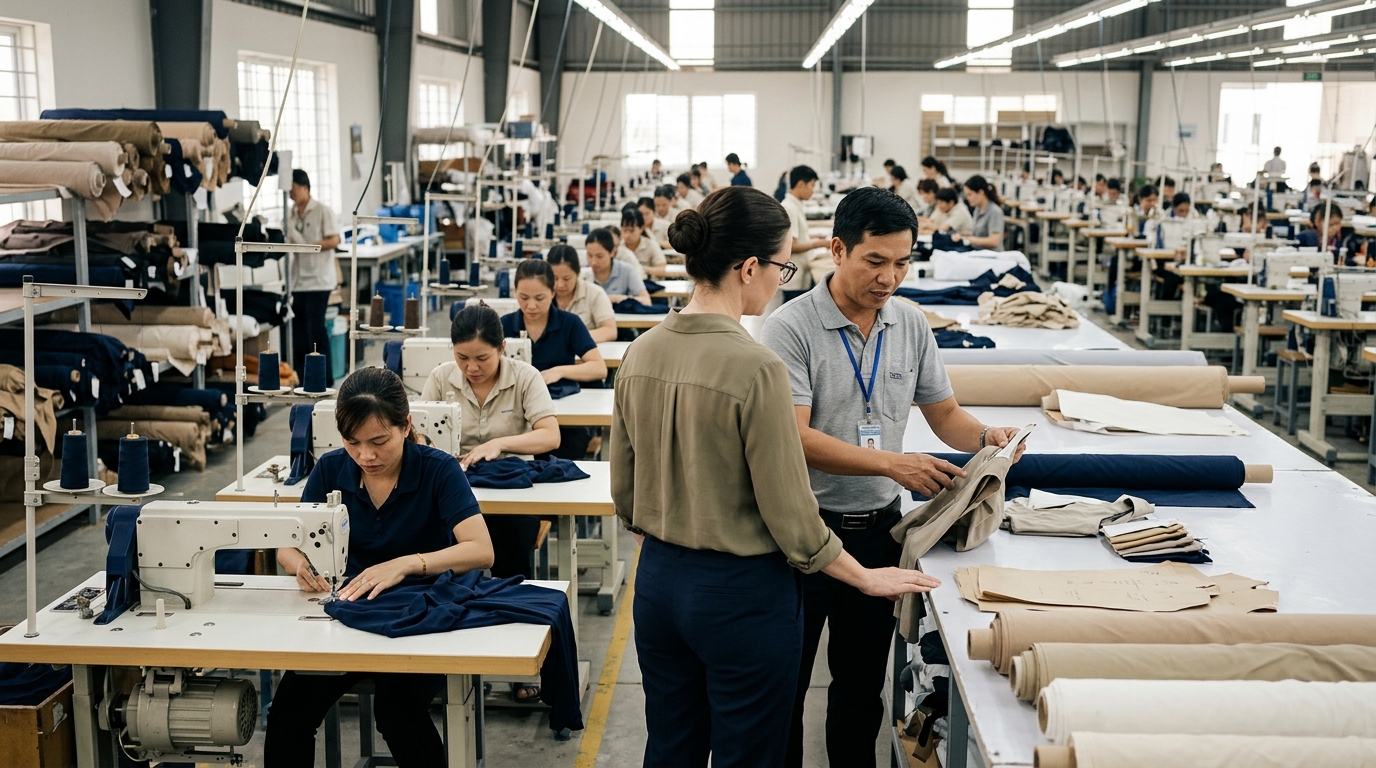
Vietnam, Indonesia, Thailand, Malaysia, and the Philippines each offer a distinct manufacturing profile — different cost structures, sector strengths, trade-deal exposure, and IP environments. This guide cuts through the surface-level comparisons to help procurement managers and brand owners match the right country to their specific sourcing brief.
For international buyers evaluating manufacturing in Southeast Asia, the region presents five meaningfully different options — not five variations on the same theme. Vietnam has built a formidable export-manufacturing base over the past fifteen years. Thailand has operated a mature industrial economy since the 1980s. Malaysia offers sector depth in electronics and chemicals that few emerging markets can match. Indonesia commands attention through sheer domestic scale and a growing export orientation. The Philippines brings English-language capability, PEZA-zone incentives, and specific sector strengths that are often underweighted in regional comparisons. Each country has a distinct cost structure, regulatory environment, logistics profile, and trade-agreement footprint.
The practical challenge for procurement managers is that surface-level rankings — ranking countries by average labour cost or headline FDI figures — rarely translate into actionable sourcing decisions. The right country for a high-mix, low-volume precision components programme looks very different from the right country for a mass-market garment or furniture programme. What matters is the match between your production requirements and a country's actual industrial capability, compliance infrastructure, and supply-chain maturity in your specific category.
This comparison is structured to give buyers a working framework across five dimensions: sector capability, cost profile, trade-deal exposure, IP environment, and logistics. Use it as a starting point for country shortlisting, then validate assumptions against actual factory assessments and compliance requirements at the product level. For a deeper look at how to structure the commercial and governance frameworks that sit behind any country choice, the guideBuild a Durable Manufacturing Partnership in Asia That Scalescovers that ground in full.
Country Capability Matrix: Where Each Southeast Asian Hub Wins
| Country | Sector Strengths | Relative Labour Cost | Trade Agreement Highlight | IP Environment |
|---|---|---|---|---|
| Vietnam | Electronics, apparel, footwear, furniture | Lower | CPTPP, UKVFTA, EVFTA | Moderate — registration improving |
| Indonesia | Textiles, footwear, food processing, chemicals | Lower to moderate | RCEP, CEPA with UAE and others | Moderate — INSW improving customs transparency |
| Thailand | Automotive, electronics, plastics, food processing | Moderate | RCEP, ASEAN FTAs, bilateral agreements | Moderate to higher — stronger enforcement than regional peers |
| Malaysia | Semiconductors, precision electronics, chemicals, medical devices | Moderate to higher | CPTPP, RCEP, strong bilateral network | Higher — most consistent enforcement in ASEAN |
| Philippines | Garments, wiring harnesses, furniture, business-process-linked manufacturing | Lower to moderate | RCEP, GSP access in some markets | Moderate — PEZA zone compliance strong within zones |
Vietnam: Export-Oriented Depth and Preferential Access
Vietnam has positioned itself as a primary alternative to China-based manufacturing for buyers under supply-chain diversification pressure. The country's membership in CPTPP, the EU-Vietnam Free Trade Agreement (EVFTA), and the UK-Vietnam FTA gives exporters preferential tariff access to markets that China-origin goods do not enjoy. For buyers shipping to the EU or UK, origin compliance through VNACCS and proper ATIGA Form D or CPTPP certificate-of-origin documentation can deliver material duty savings.
The garment, footwear, furniture, and consumer electronics sectors are most developed. Northern provinces around Hanoi and Hai Phong handle a high proportion of electronics assembly; southern provinces around Ho Chi Minh City remain strong in garments and leather goods. Lead times from major export ports have improved, though port congestion during peak periods remains a planning variable.
The primary risk for new entrants is that Vietnam's labour cost advantage over China has narrowed in some categories, and finding factories with consistent quality systems for technically demanding products requires thorough vetting. IP enforcement lags behind Malaysia and Thailand; buyers should treat robust contractual protections and split-disclosure approaches as non-negotiable.
Indonesia: Domestic Scale Meets Export Ambition
Indonesia's manufacturing base is large, but it has historically been more oriented toward domestic consumption than export. That balance is shifting, driven by investment in industrial estates on Java, and increasingly in Sumatra and Sulawesi. Sectors with the strongest export track record include textiles and apparel, footwear, processed food and agri-products, chemicals, and basic metals.
For buyers, Indonesia's main practical challenges are logistics variability across an archipelago of over 17,000 islands, and a regulatory environment that — despite improvements through the INSW single-window system — can still introduce unpredictability around import licences, local-content requirements, and product certification. Buyers importing inputs for re-export should map bonded-zone and KITE (Kemudahan Impor Tujuan Ekspor) relief mechanisms early in their programme design.
On cost, Indonesia remains competitive for labour-intensive categories. RCEP membership broadens its trade connectivity, and CEPA agreements with the UAE and several other markets continue to expand. For buyers who can work through the logistics complexity, Indonesia offers both manufacturing scale and a domestic market optionality that none of the other four countries matches.
Thailand: Industrial Maturity and Automotive Dominance
Thailand's manufacturing economy is the most mature in this comparison. The automotive sector, centred on the Eastern Seaboard and central provinces, is the clearest example: Thailand is one of the largest vehicle-assembly locations in Asia outside China, and the tier-1 and tier-2 supplier network that has grown around it offers depth in metalworking, plastics, rubber, and electronic sub-assemblies that is difficult to replicate elsewhere in the region.
For buyers outside automotive, Thailand offers strong food-processing capability (including export-grade certified facilities), mature electronics contract manufacturing, and a chemicals and petrochemicals sector with significant capacity. The BOI (Board of Investment) provides structured incentive programmes for qualifying investments, and Thailand's bilateral and multilateral agreement network — including RCEP and ASEAN FTAs — provides solid market access.
Labour costs are higher than Vietnam or Indonesia in most categories, and Thailand is not typically the first choice for pure cost-minimisation programmes. It earns its position through process consistency, supply-chain depth, and a regulatory environment that, while not without complexity, is generally more predictable than Indonesia's. IP enforcement is taken more seriously here than in most ASEAN peers.
Malaysia: Precision, Compliance, and High-Specification Sectors
Malaysia punches above its population weight in manufacturing. The Penang corridor is a globally recognised cluster for semiconductor packaging, precision electronics, and medical device sub-assembly. Kuala Lumpur and Selangor host chemicals, industrial equipment, and a growing aerospace manufacturing segment. For buyers with quality and regulatory requirements that demand process maturity — medical devices under FDA or CE frameworks, for example — Malaysia's manufacturing base offers a level of systems documentation and audit-readiness that is uncommon in lower-cost locations.
CPTPP membership is a significant trade-access asset for Malaysian-origin goods entering Japan, Canada, Australia, and other member markets. SSM (Companies Commission of Malaysia) and MITI (Ministry of International Trade and Industry) both operate with reasonable transparency. IP protection and enforcement are the strongest in ASEAN outside Singapore.
The cost trade-off is real: Malaysian labour costs and facility overheads are among the highest in the region. For commodity or labour-intensive manufacturing, buyers will pay a premium that may not be justified by the quality differential. Malaysia's competitive position is clearest for technically complex, compliance-sensitive, or high-mix programmes where process maturity directly drives risk reduction.
The Philippines: PEZA Incentives, English Capability, and Niche Depth
The Philippines is frequently underweighted in Southeast Asian manufacturing comparisons, partly because its export manufacturing base is smaller in absolute terms, and partly because the logistics complexity of an archipelago geography is a genuine operational constraint. Within the right categories, however, it offers a differentiated proposition.
PEZA (Philippine Economic Zone Authority)-registered export zones provide duty-free importation of inputs, simplified customs procedures, and a framework that has attracted investment in garments, wiring harnesses, furniture components, and electronics sub-assembly. DTI (Department of Trade and Industry) programmes support SME manufacturers outside the zones. English is the working language of business and manufacturing management, which reduces communication friction for Western buyers and shortens quality-specification alignment cycles.
The main operational constraints are energy cost (among the highest in ASEAN), inter-island logistics, and a smaller overall supplier ecosystem than Vietnam, Thailand, or Indonesia. Buyers who find a strong factory match in the Philippines often report excellent relationship quality and lower-than-expected rework rates, but should model full landed cost including energy and freight premiums before committing.
Trade Agreement Exposure and Origin Compliance Across the Region
All five countries are RCEP signatories, which creates a baseline of intra-regional and broader Asia-Pacific tariff connectivity. Beyond RCEP, the differentiation matters:
- CPTPP (Vietnam, Malaysia): opens preferential access to Japan, Canada, Mexico, Australia, New Zealand, and others. For buyers shipping to these markets, CPTPP-origin goods from Vietnam or Malaysia can carry a tariff advantage over non-CPTPP origins. - EVFTA and UKVFTA (Vietnam): direct preferential access to EU and UK markets. Origin rules require meeting specific value-content or process thresholds; buyers should verify at the HS code level. - ASEAN FTAs (all five, as ASEAN members): ATIGA Form D provides intra-ASEAN tariff preferences and can be relevant when components move between countries within the region.
IP Protection Realities: What Buyers Can Actually Rely On
Every country in this comparison has statutory IP protection frameworks. The more useful question for buyers is: what does enforcement actually look like, and what self-protective measures should you take regardless?
Malaysia offers the most consistent enforcement environment. Thailand has strengthened enforcement over the past decade. Vietnam, Indonesia, and the Philippines have functional registration systems — particularly for trademarks and industrial designs — but enforcement actions tend to be slower and less predictable.
The practical baseline for any programme across the region: - Register trademarks and key designs in-country before tooling or sample development begins. - Use NNN (non-disclosure, non-use, non-circumvention) agreements drafted under the applicable local law. - Split technical disclosure across production stages; do not hand a single supplier a complete bill of materials and process specification simultaneously. - Retain tooling ownership contractually and physically where possible.
These measures matter more than any country's headline IP ranking. Buyers who rely on statutory protection alone, in any of these five countries, routinely find that enforcement timelines make statutory remedies impractical.
Choosing the Right Country for Your Manufacturing Programme
No single country in Southeast Asia wins across all dimensions. The right match depends on your product category, quality specification level, target export markets, volume, and tolerance for operational complexity.
For buyers exploringMTS's pan-Asian manufacturing services, the starting point is always a capability and compliance fit assessment before any country recommendation is made. Country selection driven by reputation or headline cost figures — without validating supplier depth, logistics feasibility, and origin compliance in your specific category — is one of the most common sources of avoidable programme risk.
Manufacturing in Southeast Asia offers genuine diversity of options, and that diversity is an asset when used strategically. The companies that extract the most value from the region are those that match their operational requirements to each country's actual industrial strengths, build the right contractual infrastructure from the start, and plan for the logistics and compliance realities of their chosen location rather than assuming they are uniform across ASEAN.
Frequently Asked Questions
Which Southeast Asian country is best for electronics manufacturing?
Malaysia and Vietnam are typically the strongest choices for electronics. Malaysia has a long-established semiconductor and precision electronics base, particularly in Penang, with a workforce experienced in high-specification assembly. Vietnam has grown rapidly as a destination for consumer electronics and component manufacturing, attracting significant investment from major contract manufacturers. Thailand handles mid-range electronics and automotive electronics well, while Indonesia and the Philippines are less developed in this sector at scale.
How does RCEP change the calculus for sourcing across Southeast Asia?
RCEP creates a common rules-of-origin framework covering ASEAN members plus China, Japan, South Korea, Australia, and New Zealand. For buyers, this means inputs sourced from China can in many cases count toward the regional value content threshold for a finished good exported from Vietnam or Indonesia to a RCEP partner market. This reduces the penalty for mixed-origin supply chains and opens more flexible regional procurement options. Buyers should verify product-specific rules at the HS code level, as thresholds and methods vary.
What are realistic IP protection expectations in Southeast Asia?
IP protection across the region is uneven and largely depends on your own contractual and operational safeguards rather than enforcement alone. Malaysia and Singapore consistently score highest on IP enforcement frameworks, while Vietnam, Indonesia, and the Philippines have strengthened registration systems but enforcement remains slower and less predictable. Practical measures — split tooling ownership, NNN agreements under local law, staggered technical disclosure — matter more than any country's statutory framework in isolation. Registering trademarks and designs in-country before production starts is a baseline requirement regardless of destination.
Is manufacturing in the Philippines competitive on cost compared with Vietnam?
For labour-intensive assembly and certain niche sectors such as garments, wiring harnesses, and furniture components, the Philippines can be cost-competitive with Vietnam, particularly in PEZA-registered export zones where import-duty exemptions apply. However, logistics costs are higher due to the archipelago geography, and energy costs are among the highest in ASEAN, which narrows the landed-cost advantage for energy-intensive processes. The Philippines' main competitive edge often comes from English-language capability, a culturally aligned workforce for Western buyers, and PEZA incentive structures.
How do lead times typically compare across these five countries?
Thailand and Malaysia generally offer the most predictable lead times, supported by mature port infrastructure and established freight lanes. Vietnam's lead times have improved significantly as logistics infrastructure at ports like Cat Lai and Hai Phong has expanded, though congestion during peak export periods can add days. Indonesia's inter-island logistics and the INSW customs clearance system can introduce variability, particularly for buyers sourcing from factories outside Java. The Philippines carries an inherent buffer due to island-to-island transit before international consolidation. As a practical guide, buyers should build country-specific lead-time buffers into their planning models rather than assuming uniformity across the region.
Which country in Southeast Asia is best suited for automotive component manufacturing?
Thailand is the established regional hub for automotive manufacturing, with a supplier ecosystem built over decades around major OEM assembly plants in the Eastern Seaboard and central provinces. It offers depth in metal stamping, rubber components, injection-moulded plastics, and tier-2 supply across most vehicle categories. Indonesia has a growing domestic automotive assembly base and rising component capability, but the export-oriented automotive supply chain is less mature than Thailand's. Vietnam and Malaysia have niche pockets of automotive capability but cannot match Thailand's breadth for buyers requiring volume and supplier redundancy.
When does it make sense to split production across more than one Southeast Asian country?
Multi-country production makes most sense when a buyer needs to optimise trade-deal access simultaneously for different destination markets, manage category-specific capability gaps, or reduce concentration risk after a disruption event. A common structure is to use Vietnam or Thailand as a primary production base and Malaysia or the Philippines for a specific sub-component or finishing process that attracts a preferential tariff in the buyer's home market. The added complexity in quality governance and logistics coordination is real, and buyers should work through a structured partnership model before splitting production without a clear margin or compliance rationale.
The five countries covered here collectively represent one of the most capable and commercially accessible manufacturing corridors in the world, but they are not interchangeable. A disciplined country-selection process — grounded in product category, compliance requirements, and target-market trade exposure — consistently outperforms decisions made on reputation or cost headline alone. Treat country selection as a strategic input to your programme architecture, not an afterthought to supplier identification.
Planning a sourcing project in Asia?
MTS is an execution partner — supplier verification, manufacturing management, quality control and export logistics across Indonesia, Vietnam and China.
Related services
Receive furniture sourcing insights across Asia.
One email per week. No spam.