Office Furniture Manufacturers Indonesia: Sourcing Guide for Corporate Buyers
14 min read
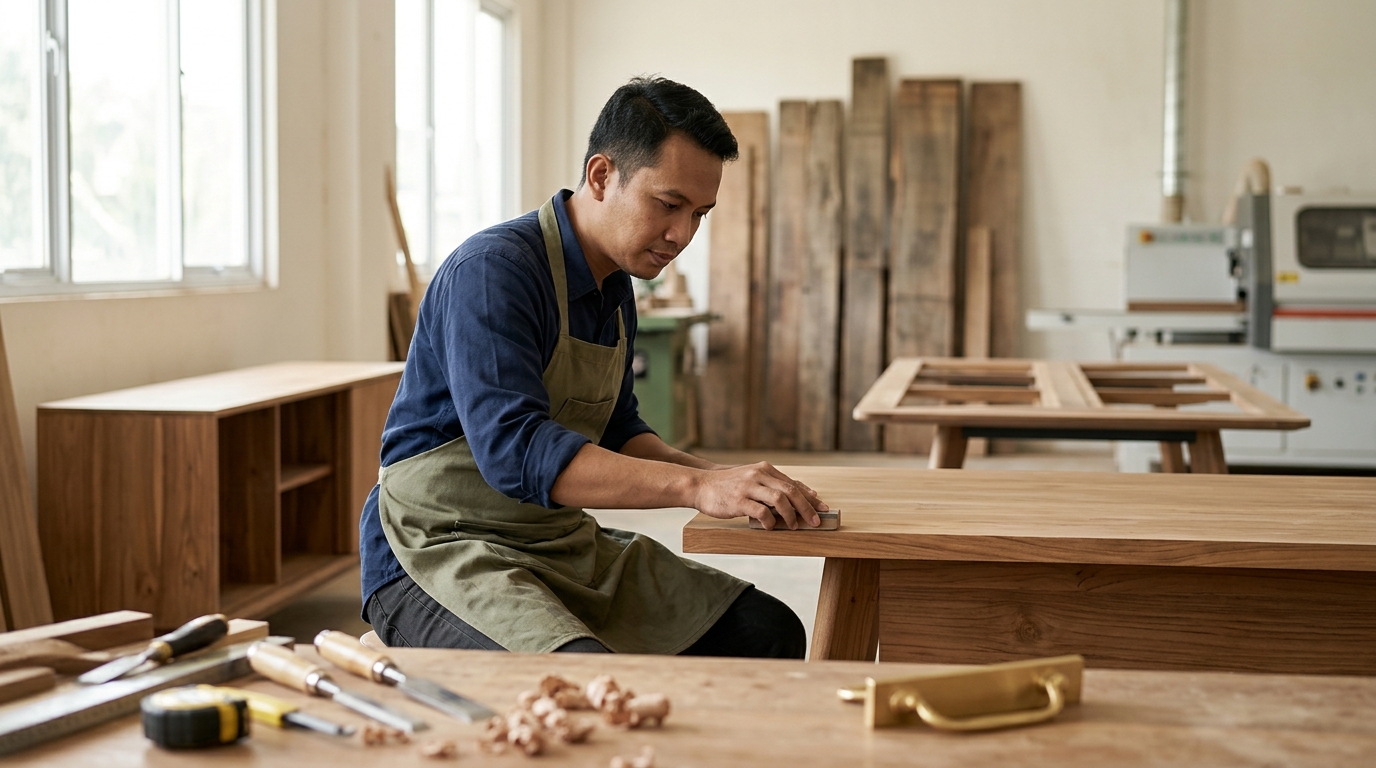
US corporate buyers and fit-out contractors face a direct trade-off when specifying solid wood commercial furniture: pay European or North American fabrication premiums, absorb Chinese volume-market inconsistencies, or evaluate Indonesia's mature hardwood manufacturing base.
US corporate buyers and fit-out contractors face a direct trade-off when specifying solid wood commercial furniture: pay European or North American fabrication premiums, absorb Chinese volume-market inconsistencies, or evaluate Indonesia's mature hardwood manufacturing base.
This guide addresses the full procurement decision for buyers sourcing desks, meeting tables, credenzas, and reception pieces from officefurniture manufacturersIndonesia. It covers material specifications, ergonomic constraints, production models, MOQs, logistics, certifications, and supplier vetting signals.
Indonesia's manufacturing base is concentrated in Java and Bali, with distinct production clusters serving different commercial segments. Understanding which cluster to target — and which supplier type to engage — determines whether your first container meets project spec or requires costly rework.
Why Indonesian Manufacturers Outperform on Commercial Solid Wood Office Furniture
Hardwood Supply Chain Advantages
Indonesia holds one of the world's most commercially significant tropical hardwood reserves. Three species dominate commercial office furniture production: teak (Tectona grandis), suar (rain tree, Samanea saman), and merbau (Intsia bijuga). Each offers distinct characteristics relevant to commercial specification.
- Teak: High natural oil content, dimensional stability, resistance to humidity fluctuation. First-choice for executive desks and conference tables requiring long service life. - Suar: Wide slab availability, distinctive grain, lower cost than premium teak. Common in live-edge meeting tables and reception counters. - Merbau: Dense, interlocked grain, high hardness rating. Suited for high-traffic credenzas and storage units.
Domestic access to these species — combined with established kiln-drying infrastructure — gives Indonesian manufacturers a supply chain advantage that Chinese competitors sourcing imported hardwood cannot replicate at equivalent price points.
Production Clusters and Workforce Capability
Four clusters matter for commercial office furniture procurement:
| Cluster | Primary Output | Commercial Relevance |
|---|---|---|
| Jepara (Central Java) | Solid teak, carved and plain executive furniture | Executive desks, reception pieces, custom millwork |
| Surabaya (East Java) | Mid-market mixed-material, engineered wood | Workstations, storage, volume catalog orders |
| Cirebon (West Java) | Rattan, mixed-material seating and accent pieces | Lobby and breakout furniture |
| Bali | Luxury artisan, hospitality-grade | High-end fit-out, bespoke reception counters |
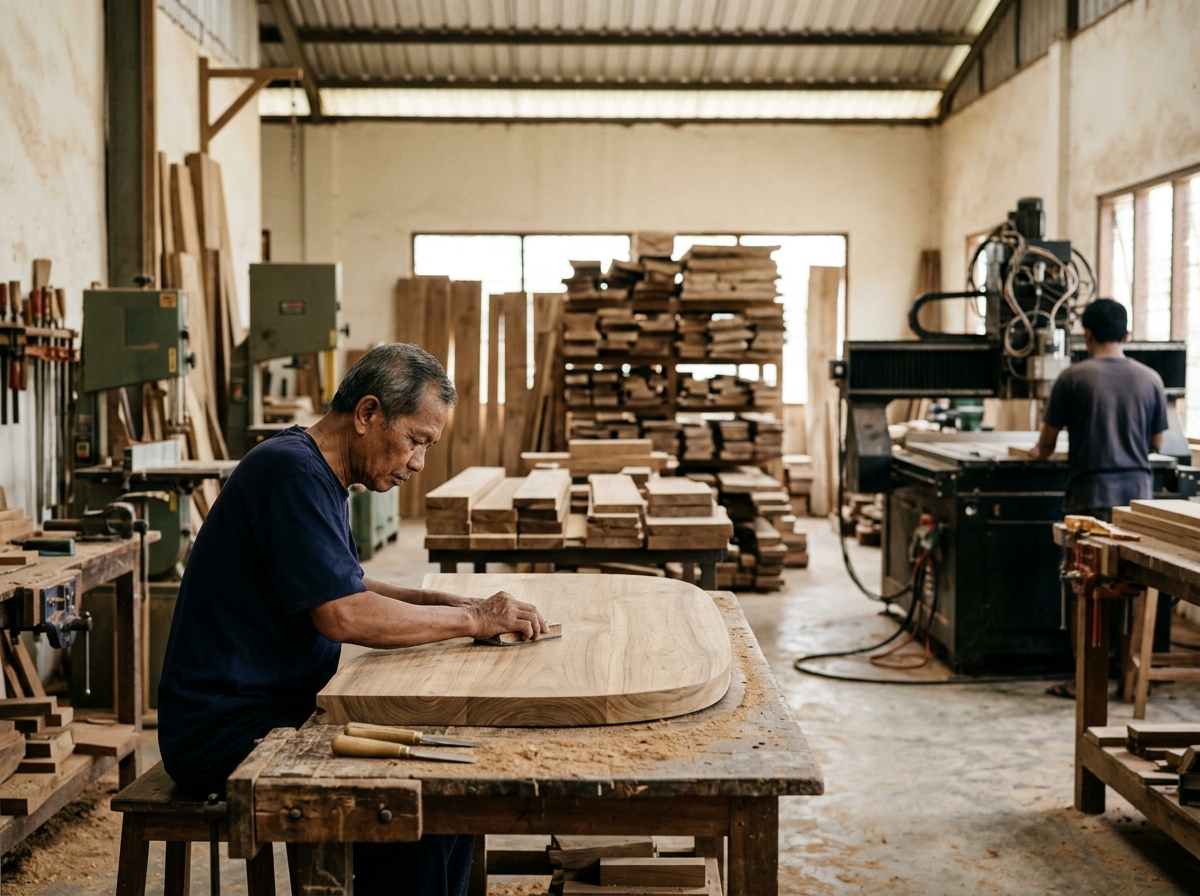
Jepara alone hosts a dense cluster of export-oriented factories ranging from 20-worker artisan shops to 500+ worker facilities with CNC routing, controlled spray booths, and kiln-drying chambers. This concentration creates competitive pricing pressure and a broad capability range within a single sourcing region.
Cost Position Versus Alternatives
Indonesian solid hardwood office furniture typically prices below equivalent European fabrication and is cost-competitive with Chinese hardwood imports for comparable species and finish quality. Chinese manufacturers in Dongguan and Foshan lead on panel furniture and laminate-finished office systems.
Core Product Categories Available from Indonesian Office Furniture Manufacturers
Executive Desks and Workstations
Indonesian factories produce executive desks in solid teak, suar, and engineered wood cores with hardwood veneer. Common commercial constructions include:
- Solid plank tops (50–80mm thick) on steel or solid wood bases - Frame-and-panel pedestals with dovetailed or box-jointed drawer construction - Engineered wood cores (MDF or plywood substrate) with hardwood veneer for cost-sensitive workstation runs
Workstation systems — open-plan benching and panel-based configurations — are available from larger Surabaya factories with more industrial production setups.
Meeting and Conference Tables
Conference tables represent a high-value category for Indonesian manufacturers. Options include:
- Live-edge suar slab tables: Single or bookmatched slabs on steel bases. Lengths up to approximately 4–5 meters are achievable from single-slab stock, though availability depends on timber yield. - Frame-and-panel teak tables: Consistent grain-matched tops on teak or steel apron frames. More predictable for large-quantity orders. - Mixed-material tops: Teak or merbau surface with steel inlays, glass inserts, or reclaimed wood accents.
Credenzas, Storage, and Filing Units
Solid and veneered credenzas are well within Indonesian factory capability. Buyers should specify:
- Drawer slide grade (commercial vs. residential load ratings) - Soft-close mechanism brand or equivalent specification - Lock cylinder type if security is required
Filing cabinet production is less common as a primary category — most Indonesian factories treat it as a secondary line. Verify sample quality carefully before committing to volume.
Reception Counters and Lobby Furniture
Reception counters are a strong category for Jepara and Bali factories. Custom dimensions, curved fronts, and mixed-material combinations (teak face with stone or steel cap) are achievable.
Material Specifications Corporate Buyers Must Evaluate Before Ordering
Solid Hardwood Grades
Not all teak is equivalent. Three construction types appear in Indonesian commercial office furniture:
| Grade | Construction | Commercial Suitability |
|---|---|---|
| First-quality solid teak | Kiln-dried, FAS or select grade, consistent grain | Executive desks, boardroom tables — highest durability |
| Reclaimed teak | Recovered from old structures, variable density | Feature pieces, reception counters — verify moisture content |
| Finger-joint teak | Short off-cuts glued into blanks | Budget workstations — structurally adequate, visible joints |
Require documentation of moisture content at time of shipment. Kiln-dried hardwood for US import should target approximately 6–8% moisture content to prevent movement after installation in climate-controlled interiors.
Commercial-Grade Hardware Requirements
Hardware is where Indonesian office furniture frequently falls short of commercial specification without explicit buyer direction. Require:
- Drawer slides rated to commercial load standards (typically 45kg+ per pair for executive desk pedestals) - Soft-close undermount or side-mount slides from recognized suppliers (Blum, Hettich, Grass, or equivalent) - Hinge load ratings appropriate to door size and weight - Lock cylinders with keyed-alike options if specified
Factories using unbranded hardware sourced locally should be treated as a risk flag unless samples are tested.
Surface Finishes
Three finish categories are relevant for commercial office furniture:
- Catalyzed lacquer (CV or NC): Most common in Indonesian factories. Good durability, available in matte, satin, gloss. Verify VOC compliance for US market if required. - Natural oil (Rubio Monocoat, Osmo, or equivalent): Penetrating finish, repairable in the field. Lower abrasion resistance than lacquer — appropriate for lower-traffic pieces. - UV-cured coatings: Available at larger, more industrial factories. Highest scratch and chemical resistance. Specify this for workstation tops in high-use environments.
Kiln-Drying and Phytosanitary Certification
All solidwood furnitureentering the US must comply with USDA APHIS phytosanitary requirements. Factories should provide:
- Kiln-drying certificates confirming treatment to ISPM 15 standards for any solid wood packaging - Commercial invoice describing wood species by scientific name - Phytosanitary certificate issued by Indonesian agricultural authorities (BKSDA or equivalent)
Ergonomic Constraints When Specifying Solid Wood Office Furniture from Indonesia
Desk Height and Adjustability
Fixed-height solid wood desks from Indonesian factories are typically produced at standard commercial heights (approximately 720–760mm). Custom heights are achievable at no significant cost premium for project orders.
Sit-Stand Limitations and Hybrid Frame Solutions
Solid hardwood construction is not compatible with integrated electric sit-stand mechanisms. The weight of solid wood tops — often 40–80kg for an executive desk — exceeds the safe lifting capacity of standard dual-motor sit-stand frames. Two practical solutions exist:
- Hybrid frame construction: A solid wood top (25–40mm thick) mounted on a commercial steel sit-stand frame (Linak, Logicdata, or equivalent). Indonesian factories can produce the top; the frame is typically sourced separately and integrated on-site or at a local assembly point. - Engineered wood top with hardwood veneer: Significantly lighter. Compatible with sit-stand frames and maintains an authentic wood surface. This is the more scalable solution for ergonomic fit-out projects.
Factories claiming to produce fully integrated solid teak sit-stand desks should be asked to provide structural load documentation before ordering.
Cable Management and Wire Integration
Commercial desk specification requires cable management. Indonesian factories can integrate:
- Wire grommets (specify diameter — 60mm or 80mm are standard) - Undersurface cable trays (specify position relative to pedestals) - Power module cutouts (specify module brand or cutout dimensions)
These must be specified in production drawings. Retrofitting grommets after lacquering damages the finish and weakens the top at the cutout point.
Structural Load for Conference Tables
Large conference tables in solid suar or teak can exceed 150–200kg for an 8–10 person piece. Specify:
- Base type and leg cross-section (solid wood or steel) - Shipping knock-down options to reduce per-piece freight cost and installation risk - On-site assembly hardware (confirm type and instructions are included)
Project Production vs. Catalog Orders: Choosing the Right Model for Your Fit-Out
Catalog Production
Catalog orders use fixed SKUs with pre-engineered dimensions, finishes, and hardware specifications. Advantages:
- Lower MOQs (often 5–20 units per SKU depending on factory) - Faster lead times (approximately 30–45 days ex-factory for in-production SKUs) - Reduced sample cost — factories have existing samples - Predictable pricing with published or negotiated price lists
Catalog orders suit smaller fit-outs, dealer stock programs, and buyers who need faster delivery windows.
Custom Project Production
Full project production allows complete specification control: custom dimensions, proprietary finishes, bespoke hardware, and branded details. Trade-offs:
- Higher MOQs — typically 20–50 units per SKU at minimum for cost-effective project runs - Longer lead times: 60–120 days ex-factory including sample approval cycles - Sample production cost (typically USD 200–600 per piece, credited against order) - Design drawing submission required before production can begin
Phased Delivery for Large Commercial Fit-Outs
Large US fit-out projects sourcing from Indonesia can structure phased delivery to match construction schedules. A practical phased model:
- Phase 1: Reception, executive offices, and boardroom (custom project production, longest lead time — start first) - Phase 2: Open-plan workstations and storage (catalog or semi-custom, shorter lead time) - Phase 3: Breakout and collaborative furniture (catalog, fastest)
Confirm with the factory that phased orders can be invoiced and shipped separately under a master purchase order. Not all factories have the administrative infrastructure to manage split shipments against a single contract.
MOQs, Lead Times, and Logistics for US Import Buyers
MOQs and Lead Times by Product Category
| Product Category | Typical MOQ (Units) | Ex-Factory Lead Time | Notes |
|---|---|---|---|
| Executive desk (catalog) | 5–10 | 30–45 days | Fixed dimensions and finish |
| Executive desk (custom) | 20–50 | 60–90 days | Includes sample approval cycle |
| Conference table (custom slab) | 1–5 | 45–75 days | Timber yield dependent |
| Credenza / storage unit | 10–20 | 30–60 days | Hardware spec critical |
| Reception counter (custom) | 1–3 | 60–120 days | Curved or mixed-material adds time |
| Open-plan workstation (catalog) | 20–50 | 30–45 days | Frame type affects timeline |
All figures are approximate and vary by factory size, production schedule, and order complexity.
Port Lead Times and Ocean Freight Transit
Primary export ports for Indonesian office furniture:
- Surabaya (Tanjung Perak): Closest to Jepara and East Java factories. Most common export point for solid wood office furniture. - Semarang (Tanjung Emas): Alternative for Central Java factories. Growing container throughput. - Jakarta (Tanjung Priok): Largest port, best connectivity for international shipping lines.
Ocean freight transit times (approximate):
| Route | Transit Time |
|---|---|
| Surabaya → US West Coast (Los Angeles) | 18–24 days |
| Surabaya → US East Coast (New York) | 28–35 days (via Suez) |
| Jakarta → US West Coast | 16–22 days |
| Jakarta → US East Coast | 26–33 days |
Incoterms Selection
| Incoterm | Risk Transfer | Best For |
|---|---|---|
| FOB (named Indonesian port) | At port rail, origin | Buyers with established US freight forwarder |
| CIF (named US port) | At destination port | Buyers without freight infrastructure |
| DAP (named US address) | At delivery point | Dealers or contractors needing door delivery |
FOB is the most common term for experienced US importers. It gives the buyer full control over freight cost and carrier selection.
HTS Codes and Import Duties
Indonesian office furniture falls primarily under HTS Chapter 94. Key classifications:
- 9403.30 — Wooden office furniture (other than seats) - 9403.90 — Parts of furniture
Indonesia is not subject to the Section 301 tariffs applied to Chinese goods. This gives Indonesian-origin office furniture a significant landed cost advantage over Chinese-made equivalents in comparable product categories.
Fumigation certificates and phytosanitary documentation are required for solid wood shipments. Verify that your factory works with a licensed export handler experienced in US-bound wood furniture shipments.
Certifications and Compliance Standards to Require from Suppliers
SVLK and FSC Wood Legality
SVLK (Sistem Verifikasi Legalitas Kayu — Timber Legality Verification System) is Indonesia's mandatory timber legality framework, regulated by the Ministry of Environment and Forestry. AllIndonesian furnitureexporters should hold a valid SVLK certificate. It confirms that the wood used is legally sourced under Indonesian forestry law.
Is SVLK sufficient for US customs compliance? SVLK satisfies the Lacey Act's due care requirement for Indonesian-origin timber when paired with accurate species documentation on the commercial invoice. It does not replace phytosanitary certification or CITES documentation (relevant for certain protected species). FSC chain-of-custody certification provides an additional layer of assurance and is increasingly specified by US corporate buyers with sustainability reporting requirements.
CARB Phase 2 Compliance
CARB Phase 2 (California Air Resources Board) applies to composite wood products — hardwood plywood, particleboard, and MDF — used in furniture sold or manufactured in the US. This is distinct from SVLK and addresses formaldehyde emissions from composite panels, not timber legality.
Any Indonesian office furniture containing MDF drawer bottoms, particleboard shelving, or plywood substrate must use CARB Phase 2 compliant panels. Require written confirmation from the factory specifying the panel supplier and their CARB certification status.
BIFMA Structural Testing
BIFMA X5.5 establishes structural and durability test protocols for desks and tables in commercial office environments. It is the primary reference standard used by US commercial furniture specifiers and facility managers.
Indonesian factories producing commercial office furniture are not automatically BIFMA tested. However, a factory can commission third-party BIFMA X5.5 testing on specific SKUs through accredited labs (SGS, Intertek, Bureau Veritas).
BIFMA testing is a differentiated requirement. Few competitors in the Indonesian market proactively address it. Buyers should raise it explicitly in RFQ documentation.
ISO 9001 Quality Management
ISO 9001 certification confirms that a factory operates a documented quality management system — covering production planning, incoming material inspection, in-process checks, and non-conformance handling. It does not guarantee product quality directly, but it indicates process discipline.
How to Vet and Shortlist Indonesian Office Furniture Manufacturers
Factory Audit Checklist
Before placing a first commercial order, conduct or commission a factory audit covering:
- ✓Kiln-drying chambers on-site (confirm capacity and temperature logging)
- ✓Spray booth type: open-air vs. enclosed, filtered, temperature-controlled
- ✓CNC routing capability vs. hand-only production
- ✓QC station presence and documented inspection records
- ✓Sample lead time commitment (target: 15–25 days for a standard desk)
- ✓SVLK certificate validity date
- ✓CARB-compliant panel supplier documentation
- ✓Hardware supplier names and grade specifications
- ✓Export experience: US-bound shipments in the past 24 months
- ✓Phytosanitary and fumigation handling process
Evaluating Commercial vs. Residential Focus
Indonesian furniture exports cover both residential and commercial segments. A factory optimized for residential production — holiday villa furniture, decorative carved pieces — may not have the dimensional accuracy, hardware grade, or surface finish consistency required for commercial office fit-out.
Red Flags in Supplier Assessment
- Inconsistent grain or color matching across a 10-piece set of desk photos - Inability to name the hardware supplier or provide load ratings - No SVLK certificate or an expired one - Refusal to provide panel supplier information for hybrid construction pieces - No prior experience with US customs documentation (commercial invoice, packing list, phytosanitary certificate) - Sample lead times exceeding 45 days for a standard catalog desk
Sourcing Channels: Trade Platforms and Trade Shows
Primary sourcing channels for Indonesian office furniture manufacturers:
- IFEX (Indonesia International Furniture Expo), Jakarta: Held approximately annually. The primary domestic trade show forIndonesian furniture manufacturerstargeting export markets. Strong representation from Jepara, Surabaya, and Bali factories. - IFFS (International Furniture Fair Singapore): Regional show with strong Indonesian manufacturer participation. Useful for meeting factory principals in a neutral venue. - Trade platforms (Alibaba, Thomasnet, Global Sources): Useful for initial identification. Do not rely on platform verification status as a substitute for an independent factory audit.
Independent factory audits — either self-conducted or through an operational sourcing partner — remain the most reliable verification method. Online platform ratings do not confirm production capability, compliance status, or export experience.
Frequently Asked Questions
What is the typical MOQ for custom office desks from Indonesian manufacturers?
For fully custom executive desks, most Indonesian export factories set MOQs in the range of 20–50 units per SKU. Smaller artisan workshops in Jepara may accept lower quantities — sometimes 5–10 units — at higher per-unit cost. Catalog SKUs commonly require 5–10 units minimum.
How long does ocean freight take from Indonesian ports to US East and West Coast?
Approximately 18–24 days from Surabaya or Jakarta to the US West Coast (Los Angeles, Long Beach). US East Coast destinations (New York, Savannah) take approximately 28–35 days via the Suez Canal routing. Add 7– approximately 14 days for US customs clearance and inland delivery.
Do Indonesian office furniture manufacturers offer BIFMA-tested products?
Most do not proactively test to BIFMA X5.5. However, factories with export experience can commission third-party BIFMA testing through accredited labs.
What wood species are most commonly used for commercial office furniture in Indonesia?
Teak, suar, and merbau are the primary commercial species. Reclaimed teak is also widely used for reception and feature pieces. Mahogany is available but less common in office furniture than in residential lines.
Can Indonesian factories produce sit-stand desk frames or only fixed-height desks?
Indonesian factories primarily produce fixed-height solid wood desks. Sit-stand capability is best achieved through a hybrid approach: an Indonesian-made wood top (in engineered wood or a lighter solid wood construction) combined with a commercial steel sit-stand frame sourced separately.
Is SVLK certification sufficient for US customs import compliance on wood furniture?
SVLK satisfies the Lacey Act due care requirement for Indonesian timber when paired with accurate species documentation. It does not replace phytosanitary certification, CARB compliance documentation for composite components, or HTS classification accuracy.
Sourcing commercial officefurniture from Indonesiarequires disciplined pre-qualification: the right production cluster for your product category, explicit material and certification specifications in your RFQ, and factory audit verification before first-order commitment.
You now have the specification framework to evaluate Indonesian manufacturers against commercial-grade standards. The logical next step is direct supplier engagement with those criteria in hand.
Connect with vetted office furniture manufacturers in Indonesia — Jepara, Surabaya, and Bali — through a structured sourcing consultation. Get factory-level quotes matched to your commercial fit-out specifications, MOQ requirements, and certification needs.
Request a Factory Quote →Need eyes on the ground in Indonesia?
MTS is an execution partner — supplier verification, manufacturing management, quality control and export logistics across Indonesia, Vietnam and China.
Related services
Related articles
Receive furniture sourcing insights across Asia.
One email per week. No spam.