Vietnam Factory Audit Checklist for First Orders
11 min read
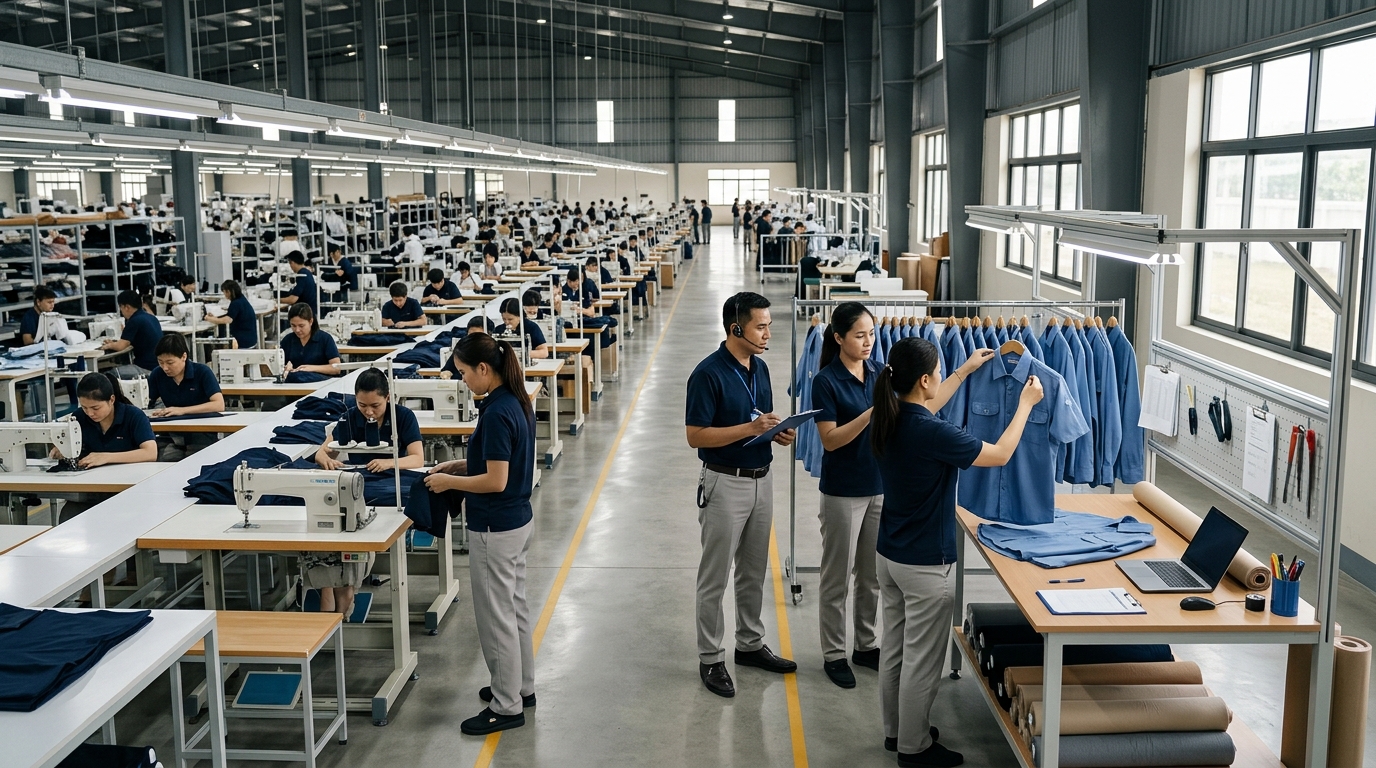
Before committing purchase capital to a Vietnamese supplier, a structured factory audit gives you verified evidence of capacity, compliance, and export readiness — not a polished sales deck. This checklist covers every layer of a credible manufacturing capability assessment.
Entering a first production run with a Vietnamese supplier without independent verification is one of the more avoidable risks in Asia sourcing. Vietnam's manufacturing sector spans a wide capability spectrum — from internationally certified facilities serving major global brands in the Binh Duong and Dong Nai industrial zones to smaller workshops with unverified capacity claims and undisclosed subcontracting arrangements. A properly scoped vietnam factory audit cuts through that ambiguity by producing documented evidence of what the facility can actually deliver, under what labour and environmental conditions, and with what track record.
The audit protocol described here is structured for buyers preparing to place a first commercial order — the point at which production commitment is imminent but exit costs are still manageable. It draws on the same assessment logic used across MTS'ssourcing and verification work in Vietnam, adapted into a checklist format procurement managers can apply directly or use to brief an independent auditor. Coverage includes physical capacity mapping, machinery and tooling verification, worker compliance against the Vietnam Labour Code, environmental permit status, and export history validation through VNACCS customs records.
This checklist does not replace an experienced auditor's judgment — on-site conditions, worker behaviour during interviews, and maintenance culture are things trained eyes read in real time. What it does is ensure no assessment domain is skipped and that the evidence collected is specific enough to support a purchase decision rather than simply produce a pass/fail grade. For a broader view of how capability audits fit into Asia-wide supplier qualification, seeFactory Inspection Services in Asia: Independent Audits That Produce Actionable Evidence.
Pre-Audit Preparation: Documents to Request Before Arrival
A significant share of audit findings can be anticipated before the auditor sets foot on the factory floor. Requesting a defined document package in advance serves two purposes: it gives you a baseline to cross-check against what you observe on-site, and it signals to the supplier that the audit will be substantive rather than ceremonial.
Core Documents to Request
- Business registration certificate issued by the provincial Department of Planning and Investment - Factory layout plan showing production areas, warehousing, and utility infrastructure - List of production equipment with model numbers and acquisition dates - Current headcount by department (production, QC, management) - ISO or product certification copies with issuing body and expiry dates - Environmental Impact Assessment approval or Environmental Protection Plan registration - Most recent labour inspection report from the Department of Labour, Invalids and Social Affairs - Sample export customs declarations processed through VNACCS for shipments in the prior twelve months - Customer reference list with product categories and approximate annual volumes
Capacity Mapping: Translating Floor Space Into Real Output
Supplier capacity claims in quotation documents are typically stated as monthly unit figures with no methodology behind them. A vietnam factory audit replaces that unverified number with a capacity estimate derived from observable inputs: production floor area, number of operational lines or workstations, shift structure, and actual cycle times for a representative product.
What to Measure on the Production Floor
Production floor area and line configuration. Walk every production area and confirm it matches the factory layout plan. Unused or mothballed lines should be noted — they do not contribute to available capacity unless staffing and maintenance can be confirmed.
Shift structure and daily working hours. Confirm how many shifts the factory currently operates and what its maximum surge capacity is. Under the Vietnam Labour Code, standard working hours are capped at eight hours per day and forty-eight hours per week, with overtime subject to annual limits. A factory claiming twelve-hour, seven-day output without documented overtime agreements is flagging a labour compliance risk alongside a capacity claim.
Work-in-progress inventory and throughput evidence. Ask to see production records from the prior month — output logs, batch completion records, or ERP reports. Cross-referencing these against headcount and shift hours gives a ground-level output per labour-hour figure you can use to stress-test the capacity claim.
Subcontracting arrangements. Directly ask whether any production processes are outsourced to sub-suppliers, and if so, which ones and under what quality oversight. Undisclosed subcontracting is among the most common sources of quality variance on first orders.
Machinery and Tooling: Assessing Precision, Age, and Maintenance
Equipment condition is a leading indicator of output consistency. A factory with modern machinery that runs poor maintenance schedules often underperforms one with older equipment that is well-calibrated and regularly serviced.
Key Assessment Points
- Equipment age and specification match. Verify that the machinery on the floor corresponds to the list provided pre-audit. Note any equipment that appears significantly older or different in specification from what was declared. - Calibration records. For measurement and testing equipment — gauges, scales, tensile testers, spectrometers — confirm calibration logs are current. Gaps in calibration records directly affect quality consistency. - Preventive maintenance schedule. Request the maintenance log for a representative piece of critical equipment. A factory operating without a formal preventive maintenance programme typically carries higher unplanned downtime risk. - Tooling ownership and condition. If your product requires proprietary tooling (moulds, dies, jigs), confirm who owns the tooling, where it is stored, and its current condition. Tooling stored on-site and owned by you is an asset that needs protection in the supplier contract.
Worker Compliance Under the Vietnam Labour Code
Vietnam's Labour Code, most recently updated in 2019 and effective from 2021, sets out specific requirements for contracts, wages, working hours, and social insurance that factories serving export markets are expected to meet. A compliance-focused vietnam factory audit examines documentation and worker interviews in parallel — paperwork alone is insufficient.
Document Review Checklist
| Compliance Area | What to Verify |
|---|---|
| Labour contracts | Signed contracts on file for all production workers, including term and job scope |
| Minimum wage | Payroll records show compliance with the applicable regional wage zone (Vietnam has four zones) |
| Overtime records | Overtime hours logged and within annual legal limits; overtime premium rates applied correctly |
| Social insurance | Registration with the Vietnam Social Security system and contribution records |
| Internal labour regulations | Registered with the local Department of Labour, Invalids and Social Affairs |
| Health and safety | Fire evacuation plans posted, emergency exits unobstructed, PPE available and in use |
Worker Interviews
Conduct brief, private interviews with a small sample of production workers — typically six to twelve individuals selected without factory management involvement. Key questions focus on whether workers understand their contract terms, whether wages are paid on time, whether overtime is voluntary, and whether they are aware of grievance channels. Discrepancies between interview responses and documented records warrant deeper investigation.
Environmental Permits and Waste Management Verification
Vietnam's Law on Environmental Protection classifies industrial projects by environmental impact category, and the corresponding permit requirements vary. Factories in sectors such as textile dyeing, electroplating, chemical processing, and food production carry higher environmental compliance obligations than light assembly operations.
During the audit, verify:
- Environmental Impact Assessment (EIA) approval for facilities above the threshold scale, or an Environmental Protection Plan (EPP) registration for smaller operations - Wastewater discharge licence and on-site treatment records, particularly for wet-process industries - Solid and hazardous waste disposal contracts with licensed waste management companies, including disposal manifests - Air emissions monitoring records where applicable (paint booths, coating lines, diesel generators) - Provincial environmental compliance certificates if the facility has undergone recent regulatory inspection
Absence of required permits is not just an ethical concern — it creates supply chain continuity risk if enforcement action or facility closure follows.
Export History Validation: Verifying Claims Through VNACCS Records
A factory's claimed export track record is one of the most commonly overstated elements in supplier qualification. The standard validation method for a vietnam factory audit is to cross-reference the factory's stated client history against actual customs export records.
Vietnam's VNACCS (Vietnam Automated Cargo and Port Consolidated System) maintains export declaration records that registered exporters can access. Request that the factory demonstrate live access to their customs history during the audit visit, and review declarations covering the prior twelve months. Assess:
- Destination countries — do they match the claimed customer geographies? - HS codes declared — do they correspond to the product categories the factory claims to manufacture? - Declared quantities and shipment frequency — are they consistent with the claimed volume capacity? - Consignee names — while full verification requires consignee confirmation, gross mismatches between declared consignees and claimed brand relationships are a signal worth pursuing
For factories claiming CPTPP or RCEP preferential tariff eligibility on exports, also confirm that origin documentation (Form D under ATIGA, or RCEP Form) has been issued and is on file, as this indicates engagement with the formal certification of origin process.
Scoring and Decision Thresholds After the Audit
Raw audit findings need to translate into a structured decision. A simple scoring approach assigns each audit domain (capacity, machinery, labour compliance, environmental, export history) a status of Verified, Conditional, or Disqualifying. Disqualifying findings — undisclosed subcontracting of core processes, absence of mandatory environmental permits, systematic wage underpayment, or export records that contradict stated history — should halt the order regardless of scores in other areas. Conditional findings define a corrective action plan with timelines before production begins. Verified findings provide the positive evidence base that supports commitment.
For buyers managing multiple potential suppliers in Vietnam simultaneously, this scoring structure allows direct comparison across facilities using consistent criteria rather than subjective impressions.
A thorough manufacturing capability audit conducted before a first order is substantially cheaper than the cost of managing a production failure, a forced reorder, or a supply chain disruption caused by a factory shutdown. The checklist above is designed to be comprehensive without being bureaucratic — every element serves a specific evidentiary purpose. MTS conducts independent factory audits across Vietnam and broader Asia; details of our inspection services are available at/services.
Frequently Asked Questions
How long does a Vietnam factory audit typically take to complete?
A standard manufacturing capability audit for a single facility commonly takes one to two full working days on-site, depending on factory size, product complexity, and the number of production lines being assessed. Document verification, worker interviews, and machinery inspection each require dedicated time blocks. Auditors typically add a half-day if environmental permits and social compliance records need detailed cross-referencing.
Which certifications should a Vietnamese factory hold before a first order?
The specific certifications required depend on your product category and target market. For general manufacturing, ISO 9001 quality management certification is a common baseline. If you are exporting to the EU or North America, product-specific conformity marks such as CE, UL, or CPSC compliance documentation may be required from the outset. Under CPTPP and RCEP, factories involved in claiming preferential tariff treatment also need to maintain records supporting origin declarations.
What does the Vietnam Labour Code require factories to document for auditors?
Under the Vietnam Labour Code, factories must maintain signed labour contracts for all employees, payroll records showing compliance with the applicable regional minimum wage tier, records of working hours and overtime ceilings, and documentation of social insurance contributions. Auditors also check that internal labour regulations have been registered with the local Department of Labour, Invalids and Social Affairs, as this is a legal requirement for facilities above a threshold headcount.
Can a factory pass a quality audit but still be a poor fit for my order?
Yes, and this is a common outcome when audits focus only on ISO compliance rather than actual production capability. A factory may hold valid certifications but lack the machinery precision, skilled operator headcount, or raw material sourcing relationships needed for your specific product. Capability audits go beyond certificate checks to assess whether the facility can reliably execute your technical requirements at your target volume.
What environmental permits should be visible during a Vietnam factory audit?
Vietnamese factories are required to hold an Environmental Impact Assessment approval or Environmental Protection Plan registration, depending on the scale and category of their operations under the Law on Environmental Protection. Wastewater discharge licences, waste disposal contracts with licensed third parties, and any provincial environmental compliance certificates should all be available for review. Absence of these documents is a significant red flag, particularly for factories in chemical, textile dyeing, or surface finishing sectors.
How do I verify a Vietnamese factory's actual export history rather than relying on their claims?
The most reliable method is requesting copies of actual export customs declarations processed through VNACCS, Vietnam's automated customs clearance system, along with corresponding commercial invoices and bills of lading. Cross-referencing shipment dates, declared quantities, and consignee countries against the factory's stated client list reveals discrepancies quickly. Third-party auditors can also request that the factory log into the customs portal during the visit to demonstrate live shipment records.
Is it necessary to audit a factory if a previous buyer has already shared their audit report?
Shared audit reports provide useful background but should not replace your own assessment. Factory conditions, staffing, subcontracting arrangements, and financial stability can change substantially in six to twelve months. An audit conducted for a different buyer may also have used criteria that do not match your product category or compliance requirements. Commissioning an independent audit calibrated to your specific order scope remains the lower-risk approach.
A well-executed vietnam factory audit converts supplier selection from a confidence exercise into an evidence-based decision. The checklist domains covered here — capacity, machinery, labour compliance, environmental permits, and export history — form a complete picture of whether a facility is genuinely ready to execute your order at the quality and volume you require. Applied consistently before first orders, this protocol removes the most common sources of first-production surprises.
Need eyes on the ground in Vietnam?
MTS is an execution partner — supplier verification, manufacturing management, quality control and export logistics across Indonesia, Vietnam and China.
Related services
Receive furniture sourcing insights across Asia.
One email per week. No spam.