Importing Furniture from Indonesia to Australia: The Complete Retailer Guide
23 min read
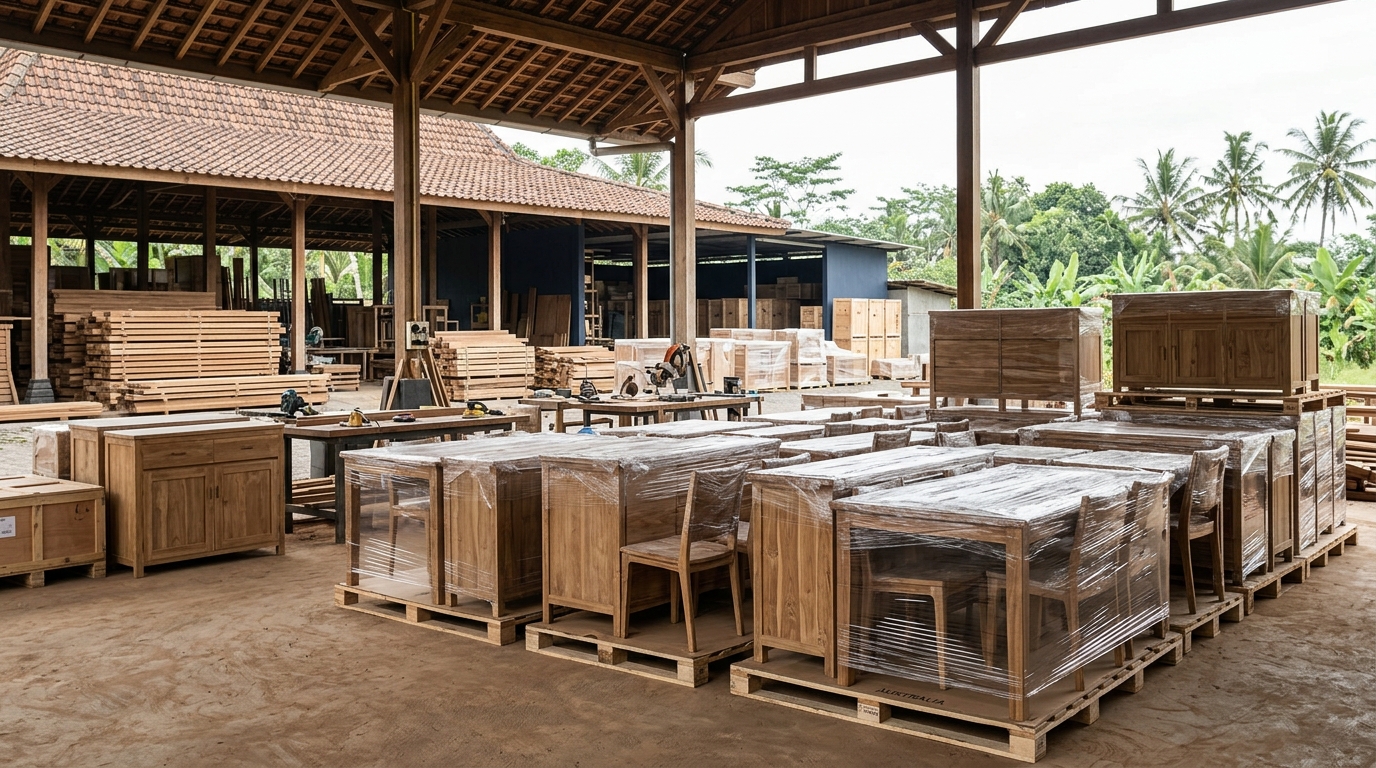
Australian furniture retailers are discovering what hospitality buyers and interior designers have known for years: Indonesia offers a combination of craftsmanship, material quality, and price competitiveness that is difficult to match through domestic sourcing or even Chinese alternatives. Teak…
Australian furniture retailers are discovering what hospitality buyers and interior designers have known for years: Indonesia offers a combination of craftsmanship, material quality, and price competitiveness that is difficult to match through domestic sourcing or even Chinese alternatives. Teak dining sets from Jepara, handwoven rattan pieces from Cirebon, and artisan resort furniture from Bali are appearing in showrooms across Sydney, Melbourne, and Brisbane — and demand is growing. But importing furniture from Indonesia to Australia is not simply a matter of placing an order and waiting for a container to arrive.
The regulatory landscape is genuinely complex. Australia's biosecurity framework is among the strictest in the world, and wooden furniture shipments face specific treatment, certification, and declaration requirements that trip up even experienced importers. Get them wrong and you face goods held at port, compulsory fumigation at your own expense, or outright destruction of your consignment — none of which are recoverable costs you can pass to a supplier. Understanding what Australian Border Force (ABF) and the Department of Agriculture, Fisheries and Forestry (DAFF) require before your goods leave Indonesia is the single most important step you can take to protect your margins.
This guide covers everything an Australian furniture retailer or commercial buyer needs to know: import duties and the preferential tariff opportunities under the Indonesia–Australia Comprehensive Economic Partnership Agreement (IA-CEPA), biosecurity and fumigation compliance in precise detail, how to vet Indonesian suppliers, shipping and customs clearance timelines, and a realistic landed-cost model. Whether you are placing your first order or scaling an existing supplier relationship, the compliance detail here will save you money and prevent delays.
Why Indonesian Furniture Is Winning Over Australian Retailers
Indonesia's Manufacturing Regions and What They Produce
Indonesia's furniture industry is geographically concentrated in clusters that have developed deep specialisations over decades. Jepara, in Central Java, is arguably the most important — it is widely regarded as the teak furniture capital of the world, producing solid wood dining tables, bedroom sets, carved pieces, and outdoor furniture that are exported globally. The Cirebon region of West Java dominates rattan production. Bali, particularly around Denpasar and Gianyar, hosts a concentration of luxury artisan workshops producing resort, villa, and hospitality furniture with high design value. Surabaya in East Java serves a broader mid-market export base.
For Australian retailers, this geographic diversity is commercially useful. A buyer can source a teak outdoor range from a Jepara manufacturer, pair it with artisan accent pieces from a Bali workshop, and consolidate both into a single container — a logistics approach explored later in this guide.
Cost, Quality, and the IA-CEPA Advantage
Compared with domestically manufactured furniture or goods sourced through established Chinese supply chains, Indonesian furniture offers a distinctive value proposition: premium natural materials combined with skilled handcraft at competitive ex-factory prices. Teak, mahogany, rattan, and reclaimed timber are materials that Indonesian manufacturers handle with generations of expertise. The finish quality on solid teak furniture from established Jepara exporters is routinely comparable to what European buyers pay significantly more to obtain from other origins.
The trade relationship between Indonesia and Australia has also become structurally more favourable. The Indonesia–Australia Comprehensive Economic Partnership Agreement (IA-CEPA) entered into force in 2020 and provides preferential tariff treatment on a wide range of Indonesian goods entering Australia. For furniture retailers, this is a material advantage that most competitors in this space have not yet factored into their sourcing models — more on exactly how to claim these rates in the next section.
Australian demand for handcrafted teak, rattan, and reclaimed wood furniture has grown substantially as consumers prioritise natural materials, sustainability narratives, and individual character over mass-produced flat-pack alternatives. For retailers positioned in the mid-to-premium segment, Indonesian sourcing directly supports both their product story and their margin structure.
Understanding Import Duties and GST When Importing Furniture from Indonesia to Australia
Standard Duty Rates Under Harmonised System Chapter 94
Most furniture products are classified under Harmonised System (HS) Chapter 94, which covers furniture, bedding, mattresses, and related items. Under Australia's Most Favoured Nation (MFN) tariff schedule, the standard import duty rate on furniture is commonly around 5% of the customs value. However, this is the rate that applies in the absence of a preferential trade agreement — and for Indonesian goods, a preferential alternative is available.
How IA-CEPA Can Reduce or Eliminate Your Duty Liability
Under IA-CEPA, many furniture tariff lines that previously attracted the standard MFN rate have been reduced or entirely eliminated for qualifying Indonesian-origin goods. To claim the preferential rate, your Indonesian supplier must be able to provide documentation confirming the goods meet the rules-of-origin requirements set out under the agreement — typically a back-to-back certificate of origin or a declaration on a commercial invoice.
This is a genuinely underused advantage. Many Australian retailers sourcing from Indonesia are still paying the MFN rate simply because neither they nor their freight forwarder has prompted the supplier to issue the correct origin documentation. Verifying IA-CEPA eligibility before your first shipment — not after — can meaningfully reduce your duty exposure on every order going forward.
GST, CIF Value, and Calculating Your True Landed Cost
Australia's Goods and Services Tax (GST) applies at 10% to imported furniture. Critically, GST is not calculated on the customs value alone — it is applied to the Cost, Insurance, and Freight (CIF) value, which means the total of your FOB price plus international freight plus insurance before the goods reach an Australian port. Import duty, where payable, is then added to the customs value first, and GST is calculated on the aggregate.
A simplified landed-cost formula looks like this:
| Cost Component | Basis |
|---|---|
| FOB price (ex-factory Indonesia) | Supplier invoice |
| International sea freight | Per shipment quote |
| Marine insurance | Typically a small percentage of cargo value |
| CIF value | FOB + freight + insurance |
| Import duty | Approximately 5% of customs value (or reduced/nil under IA-CEPA) |
| GST | 10% of (CIF value + duty) |
| Customs broker fees | Per declaration |
| Port handling and unpacking | Per container or per consignment |
| Fumigation / treatment costs | Per shipment where required |
| Last-mile delivery | Per delivery address |
A detailed sample cost model with approximate figures appears later in this guide.
Australia's Biosecurity Rules: What Every Furniture Importer Must Know
Why Biosecurity Is the Non-Negotiable Priority
Australia's biosecurity framework exists to protect unique agricultural and natural ecosystems from exotic pests and diseases. For furniture importers, the Department of Agriculture, Fisheries and Forestry (DAFF) is the primary regulatory authority, and wooden furniture is one of the higher-risk import categories. The risk is not theoretical — timber and rattan products can harbour wood-boring insects, fungal spores, bark fragments, and soil residues that, if introduced into Australia, could cause serious ecological or agricultural harm.
DAFF biosecurity officers at Australian ports of entry have the authority to inspect, treat, re-export, or destroy consignments that do not comply. There is no grace period for non-compliance, and the costs of remedial treatment or destruction are borne by the importer, not the supplier.
What Is Prohibited and What Requires Treatment
The following materials in furniture consignments require mandatory treatment or are prohibited outright:
- Untreated raw timber: Any solid wood furniture that has not been adequately treated to eliminate pest risk must be treated before or at the border. - Bark: Furniture incorporating bark, or timber that still has bark attached, is a high-risk biosecurity item and is typically prohibited unless accompanied by specific documentation demonstrating treatment. - Soil residues: Any soil contamination on furniture, packaging, or pallets will trigger immediate biosecurity intervention. - Live insects or insect evidence: Active infestation discovered at inspection will result in treatment or destruction of the consignment. - Untreated rattan: Natural rattan furniture requires treatment documentation; synthetic rattan does not carry the same risk profile.
Sustainability and Timber Legality: Australia's Illegal Logging Laws
Beyond biosecurity, Australian importers of wood-based furniture must be aware of the Illegal Logging Prohibition Act 2012. This legislation prohibits the importation of timber products that have been illegally logged, and it places a due-diligence obligation on importers to take reasonable steps to verify the legality of the timber in their supply chain. For Indonesian teak and mahogany furniture, this means requesting documentation from your supplier confirming the timber's legal origin — ideally Forest Stewardship Council (FSC) or Programme for the Endorsement of Forest Certification (PEFC) chain-of-custody certification, or at minimum, Indonesian government-issued timber legality verification documentation (known as SVLK — Sistem Verifikasi Legalitas Kayu). DAFF administers both biosecurity and timber legality compliance, so both obligations are examined together.
Fumigation and Treatment Certificates: Step-by-Step Requirements for Wooden Furniture
Methyl Bromide Fumigation vs. Heat Treatment
Two treatment methods are primarily used for wooden furniture exported from Indonesia to Australia:
Methyl bromide (MB) fumigation is a gas treatment applied to sealed consignments over a defined exposure period and concentration. It is effective against a wide range of insects and is widely used by Indonesian exporters. However, methyl bromide is being phased out internationally under the Montreal Protocol for most non-quarantine uses, and its availability and regulatory status may change over time. Currently, it remains an accepted treatment method for quarantine purposes under Australian biosecurity requirements.
Heat treatment (HT) involves raising the core temperature of timber to a specified level for a minimum duration, sufficient to kill pests at all life stages. Heat treatment is increasingly preferred as a long-term compliant option and is the basis of the ISPM 15 standard for timber packaging materials.
Both methods must be performed by a provider authorised or recognised under Indonesian export phytosanitary protocols, and the treatment must be documented with a certificate that meets Australian import requirements.
ISPM 15 Compliance for Timber Packaging
Even if your furniture itself is certified as treated, any timber used in the packaging — pallets, crating, dunnage — must comply with ISPM 15, the International Standard for Phytosanitary Measures governing wood packaging material used in international trade. ISPM 15-compliant packaging must be:
- Treated using an approved method (heat treatment or methyl bromide fumigation) - Marked with the official ISPM 15 mark, which includes the country code, producer/treatment provider code, and treatment abbreviation (HT or MB)
Unmarked or non-compliant timber packaging is one of the most common triggers for DAFF biosecurity intervention on furniture shipments. Instruct your Indonesian supplier and freight forwarder explicitly that all timber packaging must carry the ISPM 15 mark before the goods are loaded.
Obtaining and Verifying Treatment Certificates
A valid fumigation or heat treatment certificate for furniture exported from Indonesia to Australia should include:
- The name and address of the treatment provider - The treatment method applied (MB or HT) and the specific parameters (concentration/temperature and duration) - A description of the goods treated, including quantity and container or package identification numbers - The date of treatment - The signature or official stamp of the authorised treatment provider
Before accepting a certificate from your Indonesian supplier, verify that the treatment provider is recognised under Indonesian phytosanitary export protocols administered by the Indonesian Ministry of Agriculture (Kementerian Pertanian). Your Australian customs broker can assist in confirming whether a specific certificate format will be accepted by ABF and DAFF at the port of entry.
How to Find and Vet Reliable Indonesian Furniture Suppliers
Identifying the Right Manufacturing Hub for Your Category
Matching your product category to the right Indonesian manufacturing cluster is the first step in building a reliable supply relationship:
| Furniture Category | Primary Indonesian Hub |
|---|---|
| Solid teak and carved wood | Jepara, Central Java |
| Rattan and natural fibre | Cirebon, West Java |
| Luxury artisan and resort pieces | Bali (Denpasar, Gianyar) |
| Outdoor and garden furniture | Semarang, Central Java |
| Mid-market mixed categories | Surabaya, East Java |
Verifying Supplier Legitimacy and Export Capability
Not every business presenting itself as a furniture manufacturer in Indonesia is a direct factory. The supplier ecosystem includes genuine manufacturers, trader-exporters who aggregate production from workshops, and intermediaries who may lack direct production visibility. For Australian retailers, working with a verified manufacturer — or at minimum a reputable merchant exporter with audited supply chain — reduces quality and compliance risk substantially.
Key verification steps include:
- Business registration: Confirm the supplier holds a valid Nomor Induk Berusaha (NIB), which is Indonesia's integrated business registration number, and an active export licence. - Physical audit: If order volumes justify it, commission a factory audit by an independent inspection firm before committing to a bulk order. Look for evidence of a functioning lumber yard, kiln-drying equipment, finishing lines, and a genuine production workforce. - Material sourcing transparency: Ask explicitly how your supplier sources its timber, and request SVLK documentation or FSC certification. A supplier unwilling to provide this should be viewed cautiously given Australia's illegal logging obligations. - Export track record: Request references from other international buyers, particularly those who have shipped to Australia or other markets with strict biosecurity requirements.
Trade shows such as IFEX (Indonesian International Furniture Expo) in Jakarta provide direct access to a concentrated pool of export-ready manufacturers and are worth attending for retailers building or diversifying their supplier base.
- ✓Confirm valid NIB business registration
- ✓Verify active export licence
- ✓Request SVLK or FSC timber legality documentation
- ✓Commission factory audit for orders above your risk threshold
- ✓Confirm familiarity with Australian biosecurity and fumigation requirements
- ✓Request samples before bulk order commitment
- ✓Agree on quality control inspection access during production
- ✓Check export history and buyer references
Shipping Options and Transit Times from Indonesia to Australia
LCL vs. FCL: Choosing the Right Container Strategy
Two primary shipping modes are relevant for Australian furniture retailers:
Less than Container Load (LCL) consolidates your goods with other shippers' cargo into a shared container. It is suited to smaller initial orders or trial shipments but carries higher per-cubic-metre freight costs and longer effective transit times due to consolidation and deconsolidation handling. LCL shipments also carry a marginally higher risk of damage through handling and may complicate biosecurity documentation.
Full Container Load (FCL) gives you exclusive use of a 20-foot or 40-foot container. FCL is more cost-effective per unit at higher volumes and offers cleaner biosecurity documentation because the entire container's contents and treatment certificates relate to a single importer's goods. Most retailers who reach a consistent ordering rhythm with Indonesian suppliers transition to FCL.
| Shipping Mode | Best For | Typical Cost Basis | Transit Time |
|---|---|---|---|
| LCL | Trial orders, small volumes | Per cubic metre (CBM) | Longer due to consolidation |
| FCL 20ft | Medium volumes | Per container | Approximately 7–14 days |
| FCL 40ft | High volumes or bulky items | Per container | Approximately 7–14 days |
Ports, Destinations, and Realistic Transit Times
Sea freight from Indonesian ports — primarily Tanjung Priok (Jakarta), Tanjung Perak (Surabaya), or Benoa (Bali) — to Australian destination ports typically takes between approximately 7 and 14 days for direct services, depending on the specific origin and destination port pair and the shipping line's schedule. Transhipment services via Singapore or other regional hubs may extend this to around 14 to 21 days.
Major Australian destination ports for furniture imports include Sydney (Port Botany), Melbourne (Webb Dock and Swanson Dock), Brisbane, and Fremantle (Perth). Your choice of destination port should account for proximity to your warehouse or distribution centre, as port handling and drayage costs vary.
Customs Broker vs. Freight Forwarder: Know the Difference
A licensed Australian customs broker is a legally authorised agent who lodges import declarations on your behalf through the Integrated Cargo System (ICS) and manages your compliance obligations with ABF and DAFF. A freight forwarder manages the physical movement of goods and may offer customs brokerage as an additional service. For furniture imports with biosecurity certificate requirements, engaging a broker with specific experience in timber and wooden goods from Southeast Asia is strongly advisable. Do not assume your freight forwarder is automatically handling your import declaration — confirm this explicitly and in writing.
The Australian Customs Clearance Process Explained for Furniture Importers
Lodging Your Import Declaration Through the Integrated Cargo System
All commercial furniture imports into Australia above the low-value threshold require a formal Import Declaration lodged through the Integrated Cargo System (ICS), which is ABF's electronic cargo management platform. Your customs broker lodges this declaration on your behalf, providing goods description, HS classification, customs value, and all relevant compliance documentation.
The ICS declaration triggers an automated risk assessment. Depending on the risk profile of your consignment — including origin country, commodity type, and importer history — the system may direct the shipment to documentary examination, physical inspection by DAFF biosecurity officers, or free release. First-time importers and new importer-supplier combinations are statistically more likely to be directed to examination.
Documents Required for Clearance
Prepare the following documents for every Indonesian furniture shipment:
- Commercial invoice: Must accurately describe goods, quantities, unit prices, and total value in the currency of transaction. - Packing list: Itemised description of contents by carton or package, including cubic metres and weights. - Bill of Lading (or Air Waybill): The shipping carrier's document confirming receipt of goods. - Certificate of treatment / fumigation certificate: Covering all wooden components of the furniture and all timber packaging materials. - ISPM 15 compliance evidence: Either via the mark on packaging or accompanying documentation. - Certificate of Origin (IA-CEPA): Required if claiming preferential tariff treatment. - SVLK or timber legality documentation: Required under Australia's Illegal Logging Prohibition Act for wood-based furniture.
DAFF Inspection Triggers and Hold Fee Budgeting
DAFF biosecurity inspections can be triggered by the ICS risk profile, random selection, or a specific concern about a commodity or origin. When a consignment is placed on hold for biosecurity inspection, the importer is responsible for:
- DAFF inspection officer time and attendance costs - Any mandatory treatment ordered at the border (fumigation or other) - Port storage or demurrage costs incurred during the hold period
These costs are not trivial. A container held for several days at a major Australian port while awaiting inspection and treatment can accumulate port handling, storage, and treatment costs that materially affect the economics of that shipment. The most effective mitigation is ensuring that all treatment has been conducted at origin and that all certificates are complete, correctly formatted, and presented to your broker before the vessel arrives.
True Cost Breakdown: What Indonesian Furniture Really Costs Landed in Australia
Sample Landed-Cost Model
The following illustrative model uses approximate figures to demonstrate cost structure. Actual figures will vary depending on supplier pricing, shipping route, volume, and current market conditions.
| Cost Component | Approximate Indicative Range | Notes |
|---|---|---|
| FOB price (ex-Jepara, 40ft FCL) | Varies by product range | Negotiate directly with supplier |
| International sea freight (40ft FCL) | Typically several thousand AUD | Varies significantly by route and season |
| Marine insurance | Around 0.3–0.5% of cargo value | Approximate industry range |
| Import duty at MFN rate (~5%) | On customs value | May be reduced or nil under IA-CEPA |
| GST (10%) | On CIF + duty | Non-recoverable for non-registered buyers; claimable as input tax credit for GST-registered businesses |
| Customs broker fees | Hundreds of AUD per declaration | Varies by broker and complexity |
| Port handling / unpacking charges | Hundreds to low thousands AUD | Destination-port variable |
| Fumigation at origin | Hundreds of AUD per container | Far cheaper than border treatment |
| Warehousing (if not direct delivery) | Variable | Budget per pallet per week |
| Last-mile delivery | Variable | Dependent on volume and destination |
When Importing Becomes Cost-Effective vs. Buying Through a Distributor
Direct importation from Indonesia becomes economically compelling when your order volume is sufficient to justify a container load, when the product category you require is well-served by Indonesian manufacturers, and when you have the operational capacity — or a reliable broker — to manage compliance. At lower volumes, buying through an Australian distributor who has already absorbed the compliance infrastructure cost may be more efficient. The tipping point varies by business, but many retailers find that once they are placing consistent orders that fill a 20-foot container, the economics of direct importation are favourable.
Minimum order quantities (MOQs) from Indonesian manufacturers vary significantly. Artisan workshops in Bali may work with relatively small quantities by negotiation, while larger Jepara factories typically set container-based MOQs. Understanding how MOQ affects per-unit landed cost is essential when comparing direct sourcing against distributor pricing.
Compliance Checklist: Avoiding the Most Common Import Mistakes
- ✓Confirm correct HS Chapter 94 subheading with your customs broker before ordering
- ✓Verify supplier holds a valid export licence and NIB
- ✓Request SVLK or FSC timber legality documentation for all wood products
- ✓Confirm fumigation or heat treatment is booked with an approved Indonesian provider
- ✓Obtain and review fumigation certificate before container seals
- ✓Confirm all timber packaging (pallets, crates) is ISPM 15 marked
- ✓Obtain IA-CEPA certificate of origin if claiming preferential duty rate
- ✓Provide complete commercial invoice and packing list to customs broker at least 48 hours before vessel arrival
- ✓Budget for potential DAFF inspection hold fees in your landed-cost projection
- ✓Confirm customs broker is lodging a formal Import Declaration via the ICS
The four mistakes that most commonly delay or add cost to Indonesian furniture shipments into Australia are:
1. Missing or incorrectly formatted fumigation certificates. The certificate must match the specific container and goods described in the Bill of Lading. A certificate issued for a different consignment will not be accepted.
2. Incorrect HS code classification. Chapter 94 contains numerous subheadings distinguished by material type (wood, metal, plastic, rattan), intended use (domestic, office, outdoor), and whether the item is upholstered. An incorrect subheading can result in either overpayment of duty or an underpayment that triggers a compliance review.
3. Failing to declare timber packaging separately. Wooden pallets and crating must be declared as wood packaging material and must carry ISPM 15 marks. Many first-time importers focus on the furniture itself and overlook the packaging — a common and costly oversight.
4. Not budgeting for DAFF hold fees. If your consignment is inspected and held, the associated fees are unavoidable. Including a contingency allowance for inspection costs in your landed-cost model is prudent, particularly for your first several shipments from a new supplier.
Frequently Asked Questions About Importing Furniture from Indonesia to Australia
What is the import duty rate on furniture imported into Australia?
Most furniture imported into Australia is classified under HS Chapter 94 and is subject to a standard Most Favoured Nation (MFN) import duty rate of approximately 5% of the customs value. However, under IA-CEPA, goods of Indonesian origin may qualify for a reduced or nil duty rate. The exact rate depends on the specific HS subheading and whether the goods satisfy the agreement's rules-of-origin requirements. A licensed customs broker can confirm the applicable rate for your specific product.
Can you ship wooden furniture from Bali or Indonesia to Australia?
Yes, wooden furniture can be legally imported from Bali and other parts of Indonesia into Australia, provided it meets DAFF biosecurity requirements. This means the furniture must have been treated — typically through methyl bromide fumigation or heat treatment — and must be accompanied by a valid fumigation or treatment certificate. All timber packaging must comply with ISPM 15. Untreated wooden furniture will be subject to mandatory treatment at the Australian border at the importer's cost, or may be refused entry.
How much does it cost to ship a container of furniture from Indonesia to Australia?
Sea freight costs for a container of furniture from Indonesia to Australia vary with global shipping market conditions, the specific origin and destination port, the shipping line, and seasonal demand. Costs are dynamic and should be quoted by a licensed freight forwarder for your specific shipment. In addition to the freight rate itself, importers should budget for origin charges, destination port handling, customs clearance fees, and any biosecurity inspection costs.
What fumigation or treatment is required to bring wooden furniture into Australia?
Wooden furniture imported into Australia must be treated to manage biosecurity risk. The two accepted methods are methyl bromide (MB) fumigation and heat treatment (HT). Treatment must be performed by an approved provider in Indonesia before the goods are shipped, and a valid treatment certificate must accompany the consignment. All timber used in packaging — pallets, crates, dunnage — must also comply with ISPM 15, which requires approved treatment and the ISPM 15 mark on all wood packaging materials.
Does the Indonesia–Australia free trade agreement (IA-CEPA) reduce furniture import duties?
Yes. IA-CEPA, which entered into force in 2020, provides preferential tariff treatment for qualifying Indonesian-origin goods entering Australia. Many furniture tariff lines under HS Chapter 94 benefit from reduced or eliminated duty rates under the agreement compared with the standard MFN rate. To claim the preferential rate, importers must ensure their Indonesian supplier provides a valid certificate of origin or approved origin declaration confirming the goods meet IA-CEPA rules-of-origin criteria.
How long does sea freight from Indonesia to Australia take?
Sea freight transit from Indonesian ports such as Tanjung Priok (Jakarta), Tanjung Perak (Surabaya), or Benoa (Bali) to major Australian ports typically takes approximately 7 to 14 days for direct services. Shipments routed via transhipment hubs such as Singapore may take longer — commonly in the range of 14 to 21 days. These times represent vessel transit only and do not include the customs clearance and biosecurity inspection period at the Australian port, which can add additional days depending on whether your shipment is selected for examination.
Importing furniture from Indonesia to Australia offers Australian retailers genuine commercial advantages — in material quality, craftsmanship, and price competitiveness — but those advantages are only fully realised when biosecurity compliance, duty optimisation under IA-CEPA, and customs clearance are managed correctly from the outset. The retailers who build sustainable, profitable Indonesian sourcing programmes are those who treat compliance not as a bureaucratic afterthought but as a core part of their commercial planning.
You now have a detailed picture of every compliance obligation, cost component, and operational step involved in importing furniture from Indonesia to Australia. The natural next step is making sure your specific shipment — your suppliers, your product mix, your container configuration — is fully covered before goods leave Indonesian shores.
Request our free import compliance checklist tailored for Australian retailers sourcing furniture from Indonesia. It covers fumigation certificate requirements, ISPM 15 packaging obligations, IA-CEPA origin documentation, and the full customs clearance document set — everything you need to protect your consignment and your margins on your next shipment.
Request Your Free Checklist →Need eyes on the ground in Indonesia?
MTS is an execution partner — supplier verification, manufacturing management, quality control and export logistics across Indonesia, Vietnam and China.
Related services
Related articles
Receive furniture sourcing insights across Asia.
One email per week. No spam.