Importing Furniture from Indonesia to UK: The Complete Retailer Guide
23 min read
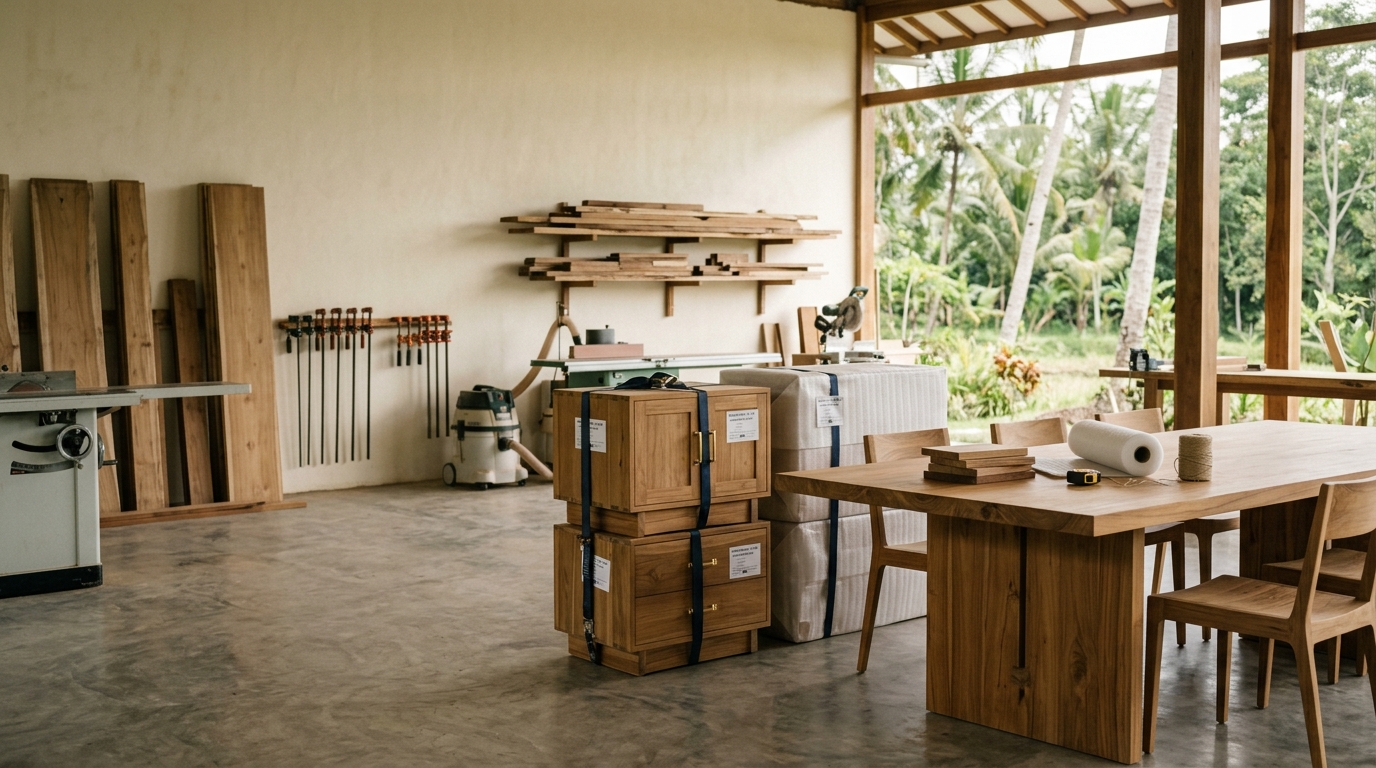
For UK-based retailers, the decision to source [furniture from Indonesia](/blog/teak-dining-tables-wholesale-indonesia-the-complete-b2b-sourcing-guide-70748e15) is rarely a simple one. Navigating production timelines, quality control, and supplier relationships is complex enough — but layering on…
For UK-based retailers, the decision to sourcefurniture from Indonesiais rarely a simple one. Navigating production timelines, quality control, and supplier relationships is complex enough — but layering on post-Brexit customs compliance, HMRC procedures, UK-specific product safety rules, and timber legality obligations turns a straightforward procurement strategy into a regulatory minefield. Get it wrong, and you risk shipments held at UK Border Force, unexpected duty bills, or products that cannot legally be sold on the British market.
This guide is written for UK retailers, buying managers, and small business owners who are either already importing furniture from Indonesia to UK ports or are actively evaluating that route. It covers the full picture: why Indonesia continues to rank among the world's most compelling furniture sourcing destinations, how Brexit changed the import rules that govern your operation, what duty and VAT obligations you owe HMRC, which documents UK customs requires, how product safety and timber legality compliance functions under current UK law, and how to build a realistic landed cost model before committing to a first container. We also address the questions buyers most commonly raise when starting out on this route.
Whether you are shipping a single Less than Container Load of rattan occasional chairs from Bali or a full 40-foot container of teak dining furniture from Jepara, the frameworks in this article apply directly to your situation. Read it end to end before you place your next order.
Why Thousands of UK Retailers Are Sourcing Furniture from Indonesia Right Now
Indonesia has built one of the most distinctive furniture manufacturing bases in the world, and its appeal to UK buyers goes well beyond price. The country sits on some of the most commercially valuable tropical timber resources globally, and its manufacturing clusters have spent decades translating those raw materials into export-ready product.
The Three Materials That Define Indonesian Furniture
Teak is Indonesia's flagship export material. Plantation-grown teak from Java — particularly from the Jepara cluster in Central Java — is prized for its density, natural oil content, and resistance to weathering. For UK retailers selling indoor dining furniture, garden furniture, or statement bedroom pieces, Jeparan teak represents a quality tier that domestic or EU suppliers simply cannot match at equivalent price points.
Rattan is the second pillar. Cirebon in West Java is the global epicentre of rattan furniture production, and Indonesian workshops supply a significant share of the world's woven rattan chairs, sofas, and decorative pieces. With rattan experiencing sustained demand growth in the UK interiors market, sourcing directly from Indonesian producers gives retailers a margin advantage over buying through European intermediaries.
Reclaimed and tropical hardwoods, including mahogany and mixed tropical species, are a speciality of Bali-based workshops. Bali's furniture sector is oriented towards luxury, artisan, and hospitality segments — resort furniture, handcrafted side tables, and bespoke pieces that command premium retail prices in the UK market.
How Post-Brexit Procurement Shifts Have Benefited Indonesian Suppliers
Before Brexit, many UK retailers defaulted to EU suppliers for speed and simplicity — no customs declarations, no import duty, VAT handled through existing accounting processes. Post-Brexit, every shipment from an EU country now involves customs procedures, EORI numbers, and import duty where applicable. The additional administrative burden has meaningfully reduced the EU's convenience advantage, prompting many buying managers to reconsider whether the cost savings available from longer-haul sourcing in Indonesia now justify the logistics.
For teak, rattan, and reclaimed wood categories specifically, there is often no credible EU alternative anyway. Indonesia's combination of material heritage, skilled craft labour, competitive manufacturing costs, and ODM capability — particularly in the rattan and teak categories from Jepara, Bali, and Lombok — makes it a category-defining source rather than merely a cheap one.
Post-Brexit Import Rules Every UK Retailer Must Understand Before Shipping
Brexit fundamentally changed how UK businesses import goods from every country outside Great Britain, including Indonesia. It is critical that retailers do not apply EU customs logic to UK procedures — the two systems are now entirely separate.
Your EORI Number: The Non-Negotiable Starting Point
A valid Economic Operators Registration and Identification (EORI) number issued by HMRC is a legal requirement for importing any commercial goods into the UK. This identifier underpins every UK customs declaration — without a GB EORI number, neither your freight forwarder nor UK Border Force is able to process your consignment. Registration is free and is handled through the gov.uk portal, with most applications approved within a few working days.
The UK Global Tariff and Furniture Commodity Codes
There is currently no preferential trade agreement between Indonesia and the UK that would automatically reduce duty rates on furniture imports. Consequently, allIndonesian furnitureshipments are assessed under the UK Global Tariff — the framework that replaced the EU's Common External Tariff after Brexit. Each product must be assigned a 10-digit commodity code from the UK Trade Tariff, which determines the applicable duty rate, any relevant licensing requirements, and VAT treatment. Wooden furniture classifications fall within HS Chapter 94. Getting the classification right before shipment is critical; wrong commodity codes are one of the leading causes of customs holds and HMRC post-clearance audits.
You can look up commodity codes and duty rates directly on gov.uk using the UK Trade Tariff tool, which is the authoritative source for all classification and rate queries.
GB and NI Rules Are Not the Same
The Windsor Framework, which replaced the Northern Ireland Protocol, establishes a dual-track system governing goods entering Northern Ireland. In general terms, qualifying goods moving from Great Britain into Northern Ireland for sale within NI are not subject to additional EU tariffs under the framework's provisions — however, the rules are product-specific and involve considerable complexity. Retailers whose distribution operations extend to warehousing or retail outlets in Northern Ireland should seek tailored professional advice on their obligations before routing Indonesian furniture through NI.
UK Import Duty and VAT on Indonesian Furniture: What You Will Actually Owe HMRC
Tariff Rates for Wooden Furniture Under the UK Global Tariff
Wooden furniture — covering dining tables, chairs, bedroom pieces, and occasional items — is classified under HS Chapter 94. Under the UK Global Tariff, duty rates across the main wooden furniture commodity codes generally fall between 0% and approximately 5.5%, with some categories carrying no duty and others sitting at the lower end of that range. Rates are code-specific, so each SKU in your range must be checked individually against the UK Trade Tariff. Applying a single assumed rate across all furniture product types is not a reliable approach.
Import VAT and How VAT-Registered Businesses Reclaim It
A standard 20% import VAT charge applies to all commercial goods entering the UK, calculated against the CIF (Cost, Insurance, and Freight) customs value and levied on top of any import duty already due. VAT-registered businesses can recover this amount as input tax through their VAT return, provided the goods are used in VATable activities. The practical mechanism enabling this is Postponed VAT Accounting (PVA), a system HMRC introduced in the wake of Brexit to eliminate the cash flow burden of paying import VAT at the port of entry. Instead of an upfront payment, the VAT liability is accounted for on the periodic VAT return — an arrangement that offers a tangible working capital benefit for retailers importing large container loads.
Preferential Tariff Status: Indonesia and UK Trade Agreements
At the time of writing, Indonesia is included within the UK's Developing Countries Trading Scheme (DCTS), which replaced the EU's GSP (Generalised Scheme of Preferences) as part of the UK's post-Brexit trade policy — formalised under the UK-DSEPA (UK-Developing Countries: Sustainable, Enhanced Preferences and Access framework). As a qualifying country, Indonesia may be eligible for reduced or zero tariff rates on certain commodity categories, though this depends on the specific product code and whether your supplier can provide a valid proof of origin. Both rates and scheme coverage can change, so always verify the applicable preferential rate using the UK Trade Tariff tool on gov.uk before finalising your cost model.
Mandatory Documents Required to Clear UK Customs Successfully
Getting your documentation right before the goods depart Indonesia is far easier than resolving discrepancies once a container is sitting at Felixstowe. UK Border Force and HMRC require a specific set of documents for every commercial import, and additional documents apply specifically to furniture made from wood or protected materials.
Core Customs Documents
| Document | Purpose | Common Mistakes |
|---|---|---|
| Commercial Invoice | Declares goods value, description, quantity | Undervaluing goods; vague product descriptions |
| Packing List | Details weight, dimensions, carton counts | Discrepancy with invoice quantities |
| Bill of Lading | Proof of shipment contract with carrier | Consignee details incorrect for customs entry |
| Certificate of Origin | Determines duty rate and preferential eligibility | Not obtaining Form A / origin declaration where needed |
| Insurance Certificate | Required for CIF valuation confirmation | Often omitted on FOB shipments |
CITES Permits and Protected Species
Certain timber species commonly used in Indonesian furniture — including some rattan varieties and particular tropical hardwoods — are subject to controls under CITES (the Convention on International Trade in Endangered Species). Where a species is listed on CITES Appendix I or II, both a CITES export permit from Indonesian authorities and a corresponding import permit from the UK's Animal and Plant Health Agency (APHA) must be in place before the goods can legally enter the UK. A shipment arriving without the required CITES documentation is liable to be seized in its entirety. Before placing any order, establish the exact species used in each product with your supplier and verify them against the current CITES appendices.
UK Timber Regulation (UKTR) Due Diligence Obligations
This is one of the most frequently overlooked compliance requirements when importing furniture from Indonesia to UK ports, and it is an area where many retailers are unknowingly non-compliant.
The UK Timber Regulation (UKTR) — which replaced the EU Timber Regulation (EUTR) after Brexit and is enforced by the Office for Product Safety and Standards (OPSS) — prohibits UK operators from placing timber or timber-derived products on the UK market where those products originate from illegally harvested sources. The responsibility to conduct due diligence before market placement lies with UK operators — in this context, that means the importer.
Due diligence under the UKTR requires three elements: access to information about the timber (species, country of harvest, supplier details, quantity), a risk assessment, and — where risk is not negligible — risk mitigation measures.
SVLK certification is your primary mitigation tool. The Sistem Verifikasi Legalitas Kayu (SVLK) is Indonesia's national timber legality assurance system, through which certified suppliers have undergone independent auditing for compliance with Indonesian timber harvesting and trading law. The UK government recognises SVLK as a credible basis for meeting due diligence obligations under UKTR. Whether you are sourcing from Jepara, Bali, or another Indonesian production cluster, always request your supplier's SVLK certificate number and verify that it is still current. Holding this document significantly reduces your regulatory exposure and serves as the principal evidence of due diligence should OPSS ever examine your timber procurement records.
UKCA Marking and Product Safety Compliance for Furniture Imports
Product safety compliance is another area where importing furniture from Indonesia to UK differs significantly from what EU rules require, and where most sourcing guides — including those written by freight forwarders — offer almost no useful guidance.
When Does UKCA Marking Apply to Furniture?
After Brexit, UKCA (UK Conformity Assessed) marking replaced CE marking for products placed on the market in Great Britain (England, Scotland, and Wales). However, UKCA requirements do not apply universally to all furniture — they are confined to specific regulated product categories and do not cover furniture as a broad class. The majority of solid wood or rattan furniture sits outside the scope of mandatory UKCA marking. The requirement becomes relevant where furniture incorporates regulated components or falls within specific legislation — examples include pieces fitted with integral electrical elements, certain outdoor play equipment, or products captured by defined supply regulations.
Fire Safety: The Furniture and Furnishings (Fire Safety) Regulations 1988
For UK furniture importers, the Furniture and Furnishings (Fire Safety) Regulations 1988, as amended, represent the most commercially significant product safety obligation they are required to meet. These regulations establish legally binding fire resistance standards for filling materials, fabric, and cover materials used in upholstered domestic furniture placed on the UK market, and cover sofas, chairs, sofa beds, nursery furniture, and any product incorporating upholstered elements.
If you are importing upholstered furniture from Indonesian suppliers, every product must meet the ignition resistance and filling material standards set out in the regulations. Your supplier in Bali or Jepara may be unaware of these UK-specific requirements unless you brief them explicitly. Key obligations include:
- Filling materials must pass the specified cigarette and match tests - Cover fabrics must meet the specified ignitability requirements - Permanent labels must be attached to the product before retail sale
Work with your supplier to obtain test reports from an accredited laboratory and ensure labelling is applied at the point of manufacture, not retrospectively in your UK warehouse.
Conformity Documentation and Supplier Briefing
Before placing an initial production order, provide your Indonesian supplier with a written product specification that includes the UK regulatory requirements applicable to your product category. Request test reports, material data sheets, and — where relevant — declarations of conformity. Keep these on file, as they form part of your due diligence record if your products are ever inspected by Trading Standards.
Choosing the Right Shipping Method for Your Indonesia Furniture Consignment
FCL vs LCL: The Core Trade-Off for Furniture Retailers
| Factor | FCL (Full Container Load) | LCL (Less than Container Load) |
|---|---|---|
| Best suited for | Orders filling 20ft or 40ft container | Smaller orders, trial shipments |
| Cost per CBM | Lower at scale | Higher per CBM due to handling |
| Transit time | Faster — no consolidation delays | Slower — consolidation and deconsolidation adds time |
| Damage risk | Lower — goods not handled with other cargo | Slightly higher — goods share space and handling |
| Minimum volume | Typically 20+ CBM | As little as 1–2 CBM |
| Cash flow impact | Higher upfront freight cost | Lower per shipment but higher unit cost |
For most UK retailers placing a meaningful first order — say, a full dining room range or an outdoor furniture collection — a 20-foot container (FCL) is typically the most cost-efficient choice once volumes exceed around 12–15 CBM. Below that threshold, LCL consolidation through an Indonesian freight forwarder is generally more practical.
Sea Freight Transit Times and UK Port Arrival
Sea freight from Bali (Benoa port) or Jakarta (Tanjung Priok port) to UK ports generally takes between 25 and 35 days, depending on the routing, transhipment ports used, and carrier schedule. Felixstowe and Southampton are the main arrival ports for container traffic originating from Southeast Asia. Budget additional time for UK customs clearance — typically one to three working days for a routine declaration, though this can lengthen if documentation is questioned or UK Border Force directs a physical examination.
Air freight is viable only for very small, high-value consignments — sample sets, urgent replacement stock, or bespoke pieces where the cost per unit justifies the premium. For standard furniture volumes, air freight is rarely economically rational.
The Step-by-Step Process of Shipping Furniture from Indonesia to a UK Port
From Order Confirmation to Container Stuffing
Once your purchase order is confirmed, your Indonesian supplier will begin production against agreed specifications and lead times. For bespoke or semi-custom teak furniture from Jepara, production lead times of eight to fourteen weeks are typical; simpler rattan items from Cirebon may be produced more quickly. Build pre-shipment inspection time into your schedule — either through a third-party quality control agent based in Indonesia or through your freight forwarder's local partner network.
Before container loading takes place, all wooden packaging materials — including pallets, crates, and dunnage — must have been treated in accordance with ISPM 15 (the International Standard for Phytosanitary Measures No. 15), through either heat treatment or methyl bromide fumigation. Compliance is demonstrated by the ISPM 15 stamp marked directly on the packaging. UK Border Force actively checks for this mark, and any non-compliant wood packaging is subject to refusal of entry or immediate destruction at the importer's cost.
Export Customs in Indonesia and Bill of Lading Issuance
On the Indonesian export side, your supplier or their appointed customs agent will submit export declarations to Indonesian customs (Direktorat Jenderal Bea dan Cukai). This process produces the export documentation package, including the Pemberitahuan Ekspor Barang (PEB), which is part of the origin documentation you will need for UK clearance. Once the container has been loaded and sealed, the shipping line will issue a Bill of Lading — the principal transport document your UK customs agent requires to advance the import clearance process.
UK Customs Entry via the Customs Declaration Service (CDS)
All UK import declarations are now required to be submitted through HMRC's Customs Declaration Service (CDS), which replaced the legacy CHIEF system. Your appointed UK freight forwarder or customs broker will file this declaration on your behalf, recording the commodity codes, customs value, country of origin, and applicable duty rates. Once HMRC accepts the declaration and import duty along with import VAT has been settled or deferred under Postponed VAT Accounting, UK Border Force authorises the release of goods for delivery to your warehouse.
A Realistic Cost Breakdown: What to Budget When Importing Indonesian Furniture
Indicative Freight and Duty Costs
Sea freight rates fluctuate with market conditions and are best confirmed with your freight forwarder at the time of booking. As a general planning benchmark, LCL rates are typically quoted per cubic metre (CBM), while FCL rates are quoted per container. A 20-foot container and a 40-foot container have different capacity profiles — approximately 25–28 CBM and 55–60 CBM usable space respectively for furniture, accounting for the irregular shapes involved.
Worked Example: A 20-Foot Container of Teak Dining Furniture from Jepara to Felixstowe
This example uses illustrative figures to demonstrate the cost structure. Always obtain actual quotes from your forwarder and confirm duty rates on gov.uk before committing.
| Cost Element | Basis | Illustrative Amount (£) |
|---|---|---|
| FOB value (goods at Indonesian port) | Invoice value | £18,000 |
| Sea freight (Tanjung Priok to Felixstowe) | Per container, indicative | £2,200 |
| Marine insurance | Approx. 0.5% of CIF value | £102 |
| **CIF Value (customs value)** | FOB + freight + insurance | **£20,302** |
| Import duty at approx. 2.7% of CIF | Illustrative wooden furniture rate | £548 |
| Import VAT at 20% of (CIF + duty) | £(20,302 + 548) × 20% | £4,170 |
| UK port handling and THC | Indicative | £380 |
| Customs clearance fee (broker) | Typical single entry | £250 |
| Drayage (Felixstowe to warehouse) | Indicative, varies by location | £450 |
| **Total Landed Cost** | — | **£26,100** |
In this example, a VAT-registered retailer reclaims the £4,170 import VAT through Postponed VAT Accounting on their next VAT return, reducing the effective cash cost to approximately £21,930. The import duty of £548 is a permanent cost — it cannot be reclaimed. The landed cost per CBM works out at roughly £850–£900 for a 25 CBM load, before any warehousing or last-mile costs.
How to Vet Indonesian Furniture Suppliers and Protect Your Business
Trade Shows Worth Attending for UK Buyers
Two events stand out for UK buyers sourcing in Indonesia. IFEX (Indonesia International Furniture and Craft Fair) in Jakarta is the country's largest furniture trade show, drawing manufacturers from Jepara, Cirebon, Semarang, and across Java. The Bali Collection showcases Bali's premium and artisan segment. Attending either event allows you to assess product quality, meet factory owners directly, and gather the supplier credentials you need for UKTR due diligence before committing to a commercial relationship.
Verifying Supplier Credentials: SVLK and Beyond
Beyond SVLK certification — which, as discussed above, is your primary UKTR due diligence tool — look for:
- NIB (Nomor Induk Berusaha): Indonesia's business registration number, which confirms the supplier operates as a legally registered entity - Export licence: confirms the supplier holds the legal authority to export goods from Indonesia - FSC or PEFC Chain of Custody certification: internationally recognised forest management certifications that go further than SVLK and are increasingly required by UK retail buyers with sustainability commitments
- ✓Request and verify current SVLK certificate number
- ✓Confirm NIB business registration
- ✓Check export licence validity
- ✓Request FSC or PEFC CoC certificate where applicable
- ✓Obtain CITES documentation for any regulated species
- ✓Request fire safety test reports for upholstered furniture
- ✓Arrange third-party pre-shipment inspection
- ✓Review payment terms and include quality dispute resolution clause in contract
Using a Sourcing Agent or Buying House
For retailers new to importing furniture from Indonesia, engaging a sourcing agent or buying house based in Jepara or Bali can significantly reduce supplier risk. A credible local agent will conduct factory visits, negotiate pricing, oversee production, and manage pre-shipment inspection on your behalf. They typically charge a commission on the FOB value of your order. Ensure any agent you appoint has a demonstrable track record with UK buyers specifically — market knowledge that covers UKTR, fire safety, and ISPM 15 requirements is non-negotiable.
Working with UK Freight Forwarders and Customs Agents Effectively
Why a Licensed Customs Broker Is Not Optional for First-Time Importers
Submitting declarations through HMRC's Customs Declaration Service requires either specialist software, substantial technical expertise, or — as is the case for the overwhelming majority of retailers — the appointment of a licensed customs broker to manage the process. A competent broker will establish the correct commodity classification, calculate the duty liability, prepare and submit the CDS declaration, and address any queries raised by UK Border Force. The broker's fee is negligible when weighed against the financial and operational consequences of a misclassified shipment that prompts an HMRC audit or results in a penalty.
What Your Freight Forwarder Manages — and What They Do Not
| Responsibility | Freight Forwarder | You (the Importer) |
|---|---|---|
| Booking cargo space with carrier | ✓ | — |
| Coordinating container stuffing | ✓ | — |
| Bill of Lading management | ✓ | — |
| Customs declaration (CDS) | ✓ (with customs broker) | — |
| UKTR due diligence records | — | ✓ |
| Fire safety compliance documentation | — | ✓ |
| Product labelling compliance | — | ✓ |
| CITES import permit application | — | ✓ |
| VAT reclaim via PVA | — | ✓ |
Key Questions to Ask When Selecting a UK Freight Forwarder for Indonesia Routes
- Do you have an established agent network in Jepara, Jakarta, and Bali specifically? - Are you authorised to submit CDS declarations, or do you subcontract to a third-party broker? - Can you handle ISPM 15 verification checks at origin? - What is your experience with UKTR documentation requirements for timber furniture? - What is your process if UK Border Force directs a physical examination of the container?
Frequently Asked Questions
How much does it cost to ship furniture from Indonesia to the UK?
Sea freight costs vary with market conditions, container type, and routing. As a general guide, LCL shipments are priced per CBM, while a full 20-foot container from Indonesian ports to Felixstowe or Southampton is typically quoted in the low thousands of pounds. Costs can rise significantly during periods of peak demand or global shipping disruption. Always obtain current quotes from at least two freight forwarders before budgeting.
What is the import duty rate on wooden furniture imported into the UK?
Under the UK Global Tariff, duty rates for wooden furniture classified within HS Chapter 94 vary by commodity code and typically range from 0% to approximately 5.5%. Where a valid proof of origin is provided, certain categories may be eligible for zero duty under the UK Developing Countries Trading Scheme. The exact rate applicable to each product should be verified using the UK Trade Tariff tool on gov.uk.
What import fees and charges apply when importing from Indonesia?
Beyond import duty, your landed cost will include import VAT at 20% (reclaimable for VAT-registered businesses), port handling charges, a customs clearance fee charged by your broker, drayage from the UK port to your warehouse, and potentially storage costs if clearance is delayed. Refer to the worked cost example above for a realistic breakdown of these figures.
Can you ship furniture from Bali to the UK, and how does it work?
Yes. Furniture shipped from Bali typically departs via Benoa port and is transhipped through Singapore or another hub before onward routing to UK ports. The process follows the same customs and documentation requirements as any other Indonesian shipment. Bali's artisan and premium furniture segment is well set up for UK export, and many Bali-based suppliers have experience with UK documentation requirements.
Do I need a special licence or permit to import wooden furniture into the UK?
Most wooden furniture does not require a general import licence. However, UKTR due diligence must be completed before any timber product is placed on the UK market. Where furniture contains species listed under CITES, a CITES import permit from APHA must be secured prior to shipment. Upholstered furniture is governed by the Furniture and Furnishings (Fire Safety) Regulations 1988, which represent a statutory product safety requirement rather than a licensing or permit condition.
How does post-Brexit customs procedure affect Indonesian furniture imports?
Since Brexit, all goods entering the UK — including shipments from Indonesia — are processed through a fully independent UK customs regime, entirely separate from EU procedures. A GB EORI number is a legal requirement, declarations must be submitted via the Customs Declaration Service, and duty is calculated under the UK Global Tariff rather than the EU Common External Tariff. Import VAT is handled through Postponed VAT Accounting. Frameworks that applied under EU membership — among them EU GSP, EUTR, and CE marking — carry no legal weight for goods sold in Great Britain.
Importing furniture from Indonesia to UK ports is both achievable and commercially attractive — but it rewards retailers who treat it as a regulated business activity rather than a straightforward logistics exercise. Those who build lasting, profitable Indonesian supply chains do so by establishing compliance foundations from day one: accurate commodity codes, thorough UKTR due diligence, fire safety conformity for upholstered ranges, and a customs broker with genuine experience on this trade lane.
Now that you have a complete picture of the regulatory landscape, cost structure, documentation requirements, and supplier vetting process involved, your next step is to translate this knowledge into an operational workflow for every future shipment.
You now have the regulatory and commercial framework for importing furniture from Indonesia to UK ports with confidence. Use our free checklist to make sure every shipment — from supplier vetting in Jepara to customs clearance at Felixstowe — follows the right steps in the right order.
Download the Free Checklist →Need eyes on the ground in Indonesia?
MTS is an execution partner — supplier verification, manufacturing management, quality control and export logistics across Indonesia, Vietnam and China.
Related services
Related articles
Receive furniture sourcing insights across Asia.
One email per week. No spam.