Indonesian Ceramic and Porcelain Tiles Suppliers: Complete Importer Guide
14 min read
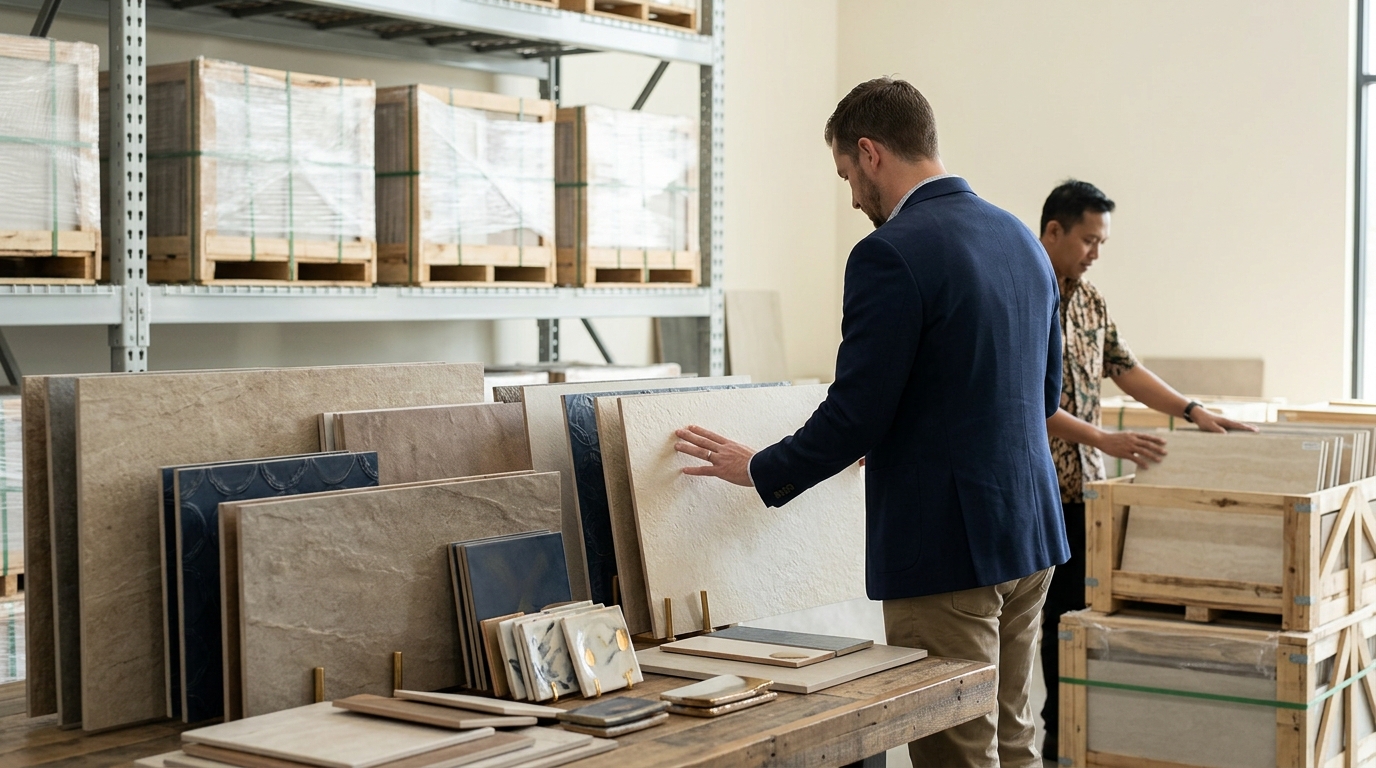
Sourcing ceramic and porcelain tiles from Indonesia is a serious procurement decision. US importers face a crowded field of suppliers, inconsistent quality signals, and limited visibility into factory credentials. The wrong choice means delayed shipments, failed inspections, or products that don't…
Sourcing ceramic and porcelain tiles from Indonesia is a serious procurement decision. US importers face a crowded field of suppliers, inconsistent quality signals, and limited visibility into factory credentials. The wrong choice means delayed shipments, failed inspections, or products that don't meet American building codes or customer expectations.
This guide is written for tile importers, building materials distributors, and procurement managers actively evaluating Indonesia as a sourcing origin. It covers the leading manufacturers, product categories, quality certifications, MOQ structures, export logistics, and a side-by-side comparison against competing sourcing countries. It also details how to remotely audit a supplier before committing capital.
Indonesia's role in tile manufacturing is far from recent. The country has accumulated decades of investment in industrial-scale ceramic and porcelain production. Its access to raw materials, cost-competitive labor, and steadily maturing export infrastructure mean that every serious indonesian ceramic porcelain tiles supplier warrants careful consideration. The sections that follow provide a structured framework to carry out that assessment.
Why Indonesia Competes at the Top of Global Tile Production
Indonesia ranks among the world's top five ceramic tile producing nations by output volume (approximate industry consensus, per regional trade reporting). That position is not accidental. It reflects decades of investment in industrial-scale manufacturing, access to domestic raw materials, and deliberate development of export channels toward North America and Europe.
Raw Material Advantages Driving Cost Competitiveness
Indonesia's geology supports tile manufacturing directly. The country holds significant deposits of kaolin, feldspar, silica, and ball clay — the core inputs for both ceramic and porcelain body formulations. Proximity to raw materials reduces input costs compared to manufacturers in China or Spain who depend more heavily on imported minerals.
Labor costs in Indonesian tile factories remain competitive relative to Chinese and European counterparts, though the gap with China has narrowed over the past decade. The cost advantage today is most pronounced in mid-range porcelain and specialty handcrafted categories.
Export Infrastructure Targeting US and Global Markets
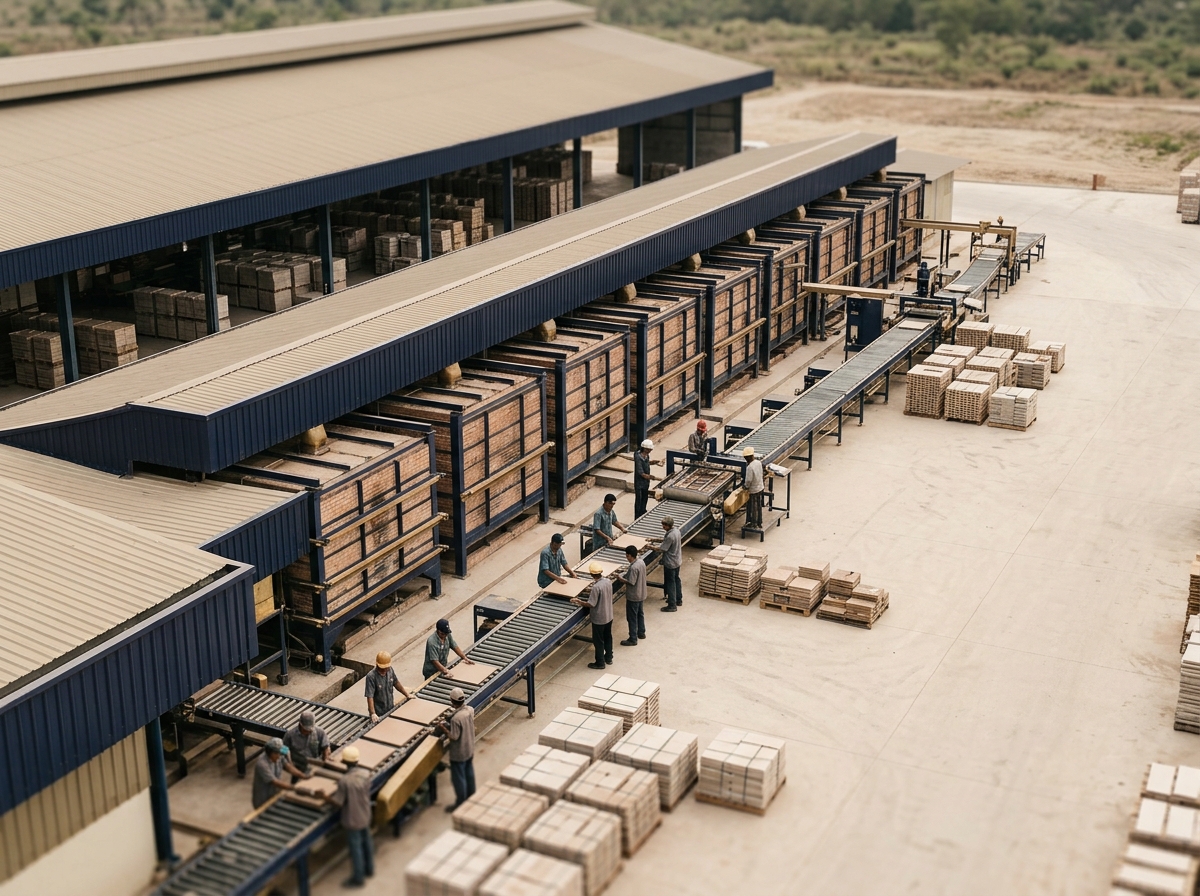
Indonesia's government has actively supported the tile export sector through industrial zone development and port modernization. Major tile manufacturers operate within industrial estates near Tanjung Priok (Jakarta) and Tanjung Perak (Surabaya), the two primary export gateways. Both ports have regular container service to US West Coast and East Coast ports.
Indonesian floor tiles and porcelain slabs now appear in US distribution catalogs from mid-market to premium segments. The export supply chain is mature enough to support full-container and LCL shipments with standard commercial documentation.
Directory of Leading Indonesian Ceramic and Porcelain Tile Manufacturers
US buyers evaluating an indonesian ceramic porcelain tiles supplier need a starting point beyond generic trade directories. The table below maps the major producers by product type, known certifications, and export orientation.
| Company | Primary Product Types | Key Certifications | Export Capability |
|---|---|---|---|
| Arwana Citramulia (PT) | Ceramic floor and wall tiles | SNI, ISO 9001, green-certified range | Large-scale, listed company, US and EU export history |
| Platinum Ceramics Industry | Ceramic and glazed porcelain tiles | SNI, ISO 9001 | Mid-to-large export volumes, Asia and Middle East focus |
| KIA Keramik | Ceramic floor tiles, homogeneous tiles | SNI, ISO 9001 | Established export program, multiple continents |
| Roman Ceramic International | Ceramic wall and floor tiles, decorative | SNI, ISO 9001 | Strong Asia-Pacific export network |
| Mulia Keramik Indahraya | Porcelain, granite-effect, large-format | SNI, ISO 13006 alignment | Premium segment, container exports |
| Indogress | Vitrified and full-body porcelain tiles | SNI, ISO-aligned specs | Growing US market presence |
| PT. Asri Pancawarna | Specialty and decorative ceramic | SNI | Regional and niche export |
| Bali/Sukabumi regional makers | Handcrafted mosaic, Sukabumi green tiles, Balinese decorative | Variable — verify individually | Typically via export merchants, smaller volumes |
How to Vet Manufacturers Beyond Name Recognition
Brand recognition is a starting signal, not a verification. Use the following approach to move from name to confirmed supplier status.
First, check Indonesian business registration. Every legitimate manufacturer holds a Nomor Induk Berusaha (NIB) — Indonesia's unified business identification number. Request it and cross-reference with the Online Single Submission (OSS) system.
Second, pull shipment records. Platforms such as ImportGenius and Seair index Indonesian customs export data. Search by company name to confirm actual shipment history to the US or other target markets. A manufacturer claiming large export volumes should show consistent bill-of-lading activity.
Third, request SNI certification documents specific to the tile types you are sourcing. SNI numbers are product-specific. A factory may hold SNI for ceramic wall tiles but not for porcelain floor tiles.
Indonesian Tile Product Categories Available for US Import
Ceramic Wall and Floor Tiles
Indonesian factories produce standard ceramic tiles across a broad range of formats: floor tiles commonly span 20×20 cm to 60×60 cm, while wall tile formats typically run from 25×40 cm to 40×80 cm. Available surface finishes include matte, gloss, rustic, and lappato options. Body construction is predominantly red-body and white-body earthenware, fired at temperatures that align with the ISO 13006 Group BIII classification, which corresponds to water absorption exceeding approximately 10%.
Porcelain and Vitrified Tiles
Porcelain tiles manufactured by producers such as Indogress and Mulia Keramik undergo firing at elevated temperatures, yielding water absorption rates under 0.5% — which satisfies the ISO 13006 Group BIa classification. This specification makes them appropriate for high-traffic commercial flooring, outdoor installations, and wet-area environments. Larger Indonesian factories are progressively expanding their output to include large-format porcelain slabs in 60×120 cm and 80×160 cm dimensions.
Granite tiles Indonesia — meaning porcelain tiles with granite-effect surface treatments — are a growing export category. These products use digital printing and structured surface textures to replicate natural stone at lower cost.
Specialty Tiles: Sukabumi, Balinese, and Mosaic
This is precisely where Indonesian tile export establishes a real point of difference from suppliers in China or India.
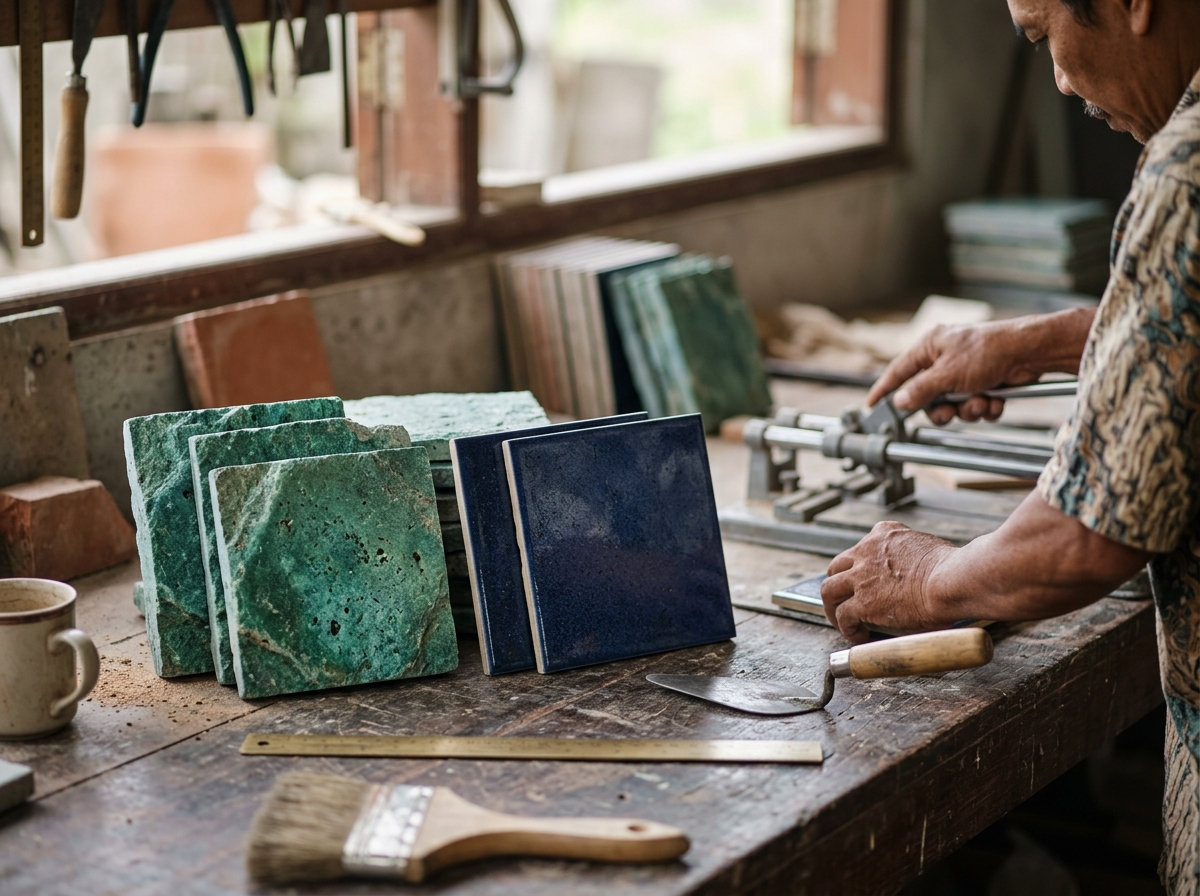
Sukabumi tiles are extracted from natural zeolite stone deposits located in the Sukabumi region of West Java. This material is distinguished by a blue-green hue that visibly changes shade when the surface is underwater — a characteristic that commands significant demand in luxury pool and spa construction. Sukabumi tiles belong to the natural stone category, not ceramic or porcelain. Despite this distinction, they are routinely shipped together with ceramic pool tile consignments. Minimum order quantities from Sukabumi suppliers tend to be considerably smaller than those of industrial ceramic manufacturers, frequently beginning at a few hundred square meters.
Balinese tiles encompass handcrafted terracotta, encaustic cement tiles, and decorative mosaics produced by artisan workshops concentrated across Bali. These products occupy a low-volume, high-value niche well suited to boutique hospitality projects, luxury residential builds, and architectural accent work. Export arrangements are generally managed through Bali-based merchant exporters rather than through direct relationships with individual production workshops.
Ceramic mosaic tiles from Indonesian factories are available in glass, ceramic, and mixed-material formats for pool linings, feature walls, and bathroom applications.
Quality Standards and Certifications Every Importer Must Verify
Ceramic tiles destined for the US market must satisfy documented performance standards. Indonesian manufacturers operate within a layered certification framework when producing for export. Each layer of that framework should be verified prior to shipment.
SNI Certification
SNI (Standar Nasional Indonesia) is the compulsory national standard governing ceramic tiles produced and sold within Indonesia. SNI 03-2094 specifically addresses ceramic floor tiles, with related SNI standards applying to wall tiles and homogeneous tiles. Meeting SNI requirements establishes a baseline of compliance — it demonstrates conformance with Indonesian national minimums but does not automatically fulfill US-specific import requirements.
ISO 13006 / EN 14411 Alignment
ISO 13006 is the internationally recognized ceramic tile standard, classifying tiles by water absorption and forming method. It maps directly to EN 14411 (European equivalent). US importers sourcing porcelain tiles should confirm the product's ISO 13006 group classification from the manufacturer's technical data sheet.
ASTM Standards Relevant for US Import
US distributors and commercial project specifiers commonly require compliance with:
- ASTM C373: Measures water absorption in tile bodies - ASTM C648: Evaluates breaking strength for floor tile applications - ASTM C1026: Assesses freeze-thaw resistance for tiles intended for use in freeze-prone climates
- ✓SNI certificate specific to tile type (floor, wall, porcelain)
- ✓ISO 13006 product classification confirmed in technical data sheet
- ✓ASTM C373 water absorption test report (for porcelain claims)
- ✓ASTM C648 breaking strength report (for floor tile)
- ✓ASTM C1026 freeze-thaw report (if product destined for cold climates)
- ✓Factory ISO 9001 quality management certification
- ✓Green/eco certification if sustainability claims are made
MOQ, Pricing Structures, and Payment Terms for Indonesian Tile Exports
Minimum Order Quantities by Product Type
Minimum order quantities for Indonesian tile exports differ considerably depending on the manufacturer's scale and the specific product category involved:
| Tile Type | Typical MOQ Range | Notes |
|---|---|---|
| Standard ceramic floor/wall tiles | Approximately 1,000–3,000 m² | Large factories may require full 20' or 40' container (~18–22 m³ capacity) |
| Porcelain and vitrified tiles | Approximately 500–2,000 m² | Higher-value product allows smaller m² minimums |
| Large-format porcelain slabs | Approximately 300–1,000 m² | Fragile packaging increases per-unit logistics cost |
| Sukabumi tiles | Approximately 50–500 m² | Smaller quarry operations, lower minimums |
| Balinese handcrafted tiles | Often no fixed MOQ by m² | Priced by piece or lot; coordinate via export merchant |
FOB, CIF, and EXW Pricing in Indonesian Tile Exports
Indonesian tile exporters typically quote under three Incoterms:
- EXW (Ex Works): The buyer takes responsibility for all freight from the factory gate onward. This produces the lowest quoted price, but the buyer absorbs the entire logistics risk and cost. - FOB (Free on Board): The seller delivers goods to the export port, after which the buyer assumes ocean freight and insurance obligations. This is the most widely used term among experienced importers. - CIF (Cost, Insurance, Freight): Freight and insurance to the destination port are covered by the seller. This arrangement is the most straightforward for first-time importers, though it limits the buyer's ability to control freight costs.
FOB pricing from Indonesian ports serves as the standard reference point when benchmarking costs. Any time quotes are collected from multiple suppliers, normalizing all figures to the same Incoterm is essential for a valid comparison.
Payment Terms
Standard payment structures in Indonesian tile trade:
| Term | Structure | Risk Level for Buyer |
|---|---|---|
| Irrevocable LC | Documentary letter of credit via bank | Low — payment contingent on compliant documents |
| TT 30/70 | 30% advance, 70% before shipment | Medium — advance at risk if supplier defaults |
| TT 50/50 | 50% advance, 50% on B/L copy | Medium-high for large orders |
| Full TT Advance | 100% before production | High — only appropriate with audited, trusted suppliers |
First-time importers sourcing from an unaudited Indonesian tiles supplier should prioritize LC terms or use a trade finance intermediary to reduce prepayment exposure.
Shipping Indonesian Tiles to the United States: Logistics and Customs
Export Ports and Lead Times
The two primary export ports for Indonesian ceramic and porcelain tiles are:
- Tanjung Priok (Jakarta): Primary port for West Java manufacturers including most large ceramic factories - Tanjung Perak (Surabaya): Key port for East Java production
Ocean transit time from either port to US West Coast (Los Angeles/Long Beach) is approximately 18–25 days. East Coast destinations (New York, Savannah) via all-water routing add approximately 8–12 additional days, or similar via transshipment through Singapore or Port Klang.
Production lead times from order confirmation typically range from 4 to 8 weeks for standard catalog products. Custom colors, formats, or private-label specifications can extend lead time to 10– approximately 14 weeks.
Packaging and Container Loading
Tiles must be palletized and strapped. Standard export packaging uses cardboard boxes with inner foam or paper wrapping per tile. Pallets are shrink-wrapped. Container loading for tiles requires careful weight distribution — a standard 40' container can carry approximately 20–25 metric tons of tile.
US Import Duties and HS Codes
Ceramic and porcelain tiles from Indonesia are subject to US import duties under the following HS code structure:
| Product Category | HS Code (US HTS) | General Duty Rate |
|---|---|---|
| Ceramic mosaic cubes and tiles | 6907.21 | Typically 0–10% (verify current schedule) |
| Ceramic floor/wall tiles | 6907.22 / 6907.23 | Typically 0–10% |
| Porcelain tiles | 6907.21.10 / related | Variable by subheading |
Importers are additionally required to furnish a commercial invoice, packing list, bill of lading, and a certificate of origin confirming that the goods were manufactured in Indonesia. Certain US buyers or individual project specifications may also call for third-party test reports to be submitted at the point of customs entry.
How to Remotely Qualify an Indonesian Tile Supplier Before Committing
Document Verification Checklist
Before issuing an RFQ or sample request, collect and verify:
- ✓NIB (Nomor Induk Berusaha) — Indonesian business registration
- ✓Export license or export history documentation
- ✓SNI certificates for specific tile product codes
- ✓ISO 9001 certificate with scope matching tile manufacturing
- ✓ASTM or ISO 13006 third-party test reports for relevant tile types
- ✓Bank reference or trade reference from existing export customers
- ✓Proof of factory ownership or lease (not a trader presenting another factory's credentials)
Using Trade Data to Verify Shipment History
Platforms including ImportGenius and Seair provide Indonesian customs export records indexed by exporter name, destination country, and product description. Search the supplier's exact legal entity name. A credible Indonesian tiles supplier for US export will show a pattern of shipments to US or EU ports over multiple years.
A supplier with no verifiable export history to developed markets is a higher-risk engagement regardless of what their catalog or sales team claims.
Requesting Samples: Process and Costs
Sample requests from Indonesian tile manufacturers typically involve:
- A formal sample request specifying tile code, size, finish, and quantity - Sample cost: often waived or invoiced at cost for established catalog items; custom samples typically charged - Sample lead time: approximately 2–4 weeks for catalog items - Shipping cost: buyer typically bears international courier cost (DHL/FedEx) from Indonesian factory
Evaluate samples against your ASTM requirements before approving bulk production.
Third-Party Factory Audits
If you cannot visit the factory in person, engage a third-party inspection company operating in Indonesia. Established international inspection firms operate in Jakarta, Surabaya, and Bali. An audit should cover: factory floor verification, equipment capability, quality control systems, workforce headcount verification, and export documentation review.
An audit report from a recognized third-party firm is a strong risk mitigation tool, particularly for orders above approximately USD 50,000.
Indonesia vs. Other Tile Sourcing Origins: A Direct Comparison for US Distributors
| Criteria | Indonesia | China | India | Vietnam | Spain / Italy |
|---|---|---|---|---|---|
| Price (mid-range porcelain) | Competitive | Often lower for volume | Competitive for basic grades | Emerging, limited range | Significantly higher |
| Quality consistency | Good to high at major factories | High at Tier-1, variable at SMEs | Variable | Improving but limited range | Very high |
| Product range | Strong in standard and specialty | Broadest globally | Strong in basic ceramic | Narrower range | Premium and design focus |
| Section 301 tariffs (US) | Not applicable | Applicable (25%+) | Not applicable | Not applicable | Not applicable |
| Specialty categories | Sukabumi, Balinese, handcrafted mosaic | Mass production strength | Handmade terracotta | Limited | Designer rectified porcelain |
| Typical lead time to US | 6–12 weeks total | 5–10 weeks total | 8–14 weeks total | 7–12 weeks total | 10–16 weeks total |
| Supplier verification ease | Moderate (NIB, trade data available) | High (extensive data) | Moderate (fragmented base) | Improving | High |
| Best for | Mid-premium, specialty, Section 301 diversification | High volume, broad catalog | Entry-level, artisan terracotta | Growing mid-range | Premium design projects |
Indonesia offers the clearest advantage for US importers who need to move volume away from Chinese suppliers due to Section 301 tariff exposure, while maintaining product quality above the Indian baseline. It is also the only major sourcing origin for Sukabumi pool tiles and authentic Balinese handcrafted mosaics.
Spain and Italy continue to set the quality standard for premium rectified porcelain in contemporary large formats — though at a price level that Indonesia is not positioned to compete with from the other end of the market.
Frequently Asked Questions
Which country is the largest manufacturer of ceramic tiles in the world? China holds this position by a considerable margin, dominating both production and export volumes globally. The majority of Chinese output originates from the Foshan cluster in Guangdong province.
Which country produces the best quality porcelain tiles? Italy and Spain set the global standard for premium rectified porcelain tile, especially in large-format and through-body designs. In the mid-market segment — where solid technical performance meets competitive pricing — both Indonesia and China present credible alternatives, provided procurement is focused on verified Tier-1 factories.
What is the best country to buy tiles for import into the US? The right answer varies by product category, target price tier, and tariff exposure. For mid-range ceramic and porcelain, specialty tile categories, and shipments structured to sidestep China's Section 301 tariffs, Indonesia represents a compelling option. China provides the widest product selection and strong pricing at high volumes. Spain and Italy are the preferred sources for premium specification projects.
Who are the top Indonesian porcelain tile manufacturers? The large-scale manufacturers most recognized in export markets are Arwana Citramulia, Mulia Keramik Indahraya, Platinum Ceramics Industry, KIA Keramik, Roman Ceramic International, and Indogress. Niche export segments are served by regional specialty producers operating out of Bali and Sukabumi.
What are the typical MOQs when sourcing tiles from Indonesia? For standard ceramic tiles, expect approximately 1,000–3,000 m² per order. Porcelain tiles typically require approximately 500–2,000 m². Sukabumi natural stone tiles carry a much lower threshold at approximately 50–500 m². For Balinese handcrafted tiles, order quantities are negotiated by lot or piece count through export merchants.
What certifications should Indonesian tile suppliers hold for US import? At minimum: SNI certification for the specific tile type, ISO 9001 for the factory, and product-specific ASTM test reports (C373 for water absorption, C648 for breaking strength, C1026 for freeze-thaw where applicable). ISO 13006 classification should be confirmed in the technical data sheet. Green certifications are optional but increasingly requested for LEED-qualifying projects.
Indonesia's tile manufacturing sector combines industrial scale, raw material access, and genuine specialty categories that no other single sourcing origin replicates. US importers who verify supplier credentials systematically — using trade data, SNI documentation, and ASTM test reports — can build reliable supply chains at competitive landed costs without the tariff burden that applies to Chinese imports.
The key variables are supplier verification, certification specificity, and logistics planning from the correct export port.
You now have the specifications, certification benchmarks, and sourcing criteria to evaluate Indonesian ceramic and porcelain tile suppliers with confidence. The next step is engaging manufacturers who can provide documentation and samples that match your project requirements.
Request a Free Quote Today →Need eyes on the ground in Indonesia?
MTS is an execution partner — supplier verification, manufacturing management, quality control and export logistics across Indonesia, Vietnam and China.
Related services
Related articles
Receive furniture sourcing insights across Asia.
One email per week. No spam.