Indonesian Teak Wood Suppliers: The Complete Export Buying Guide
14 min read
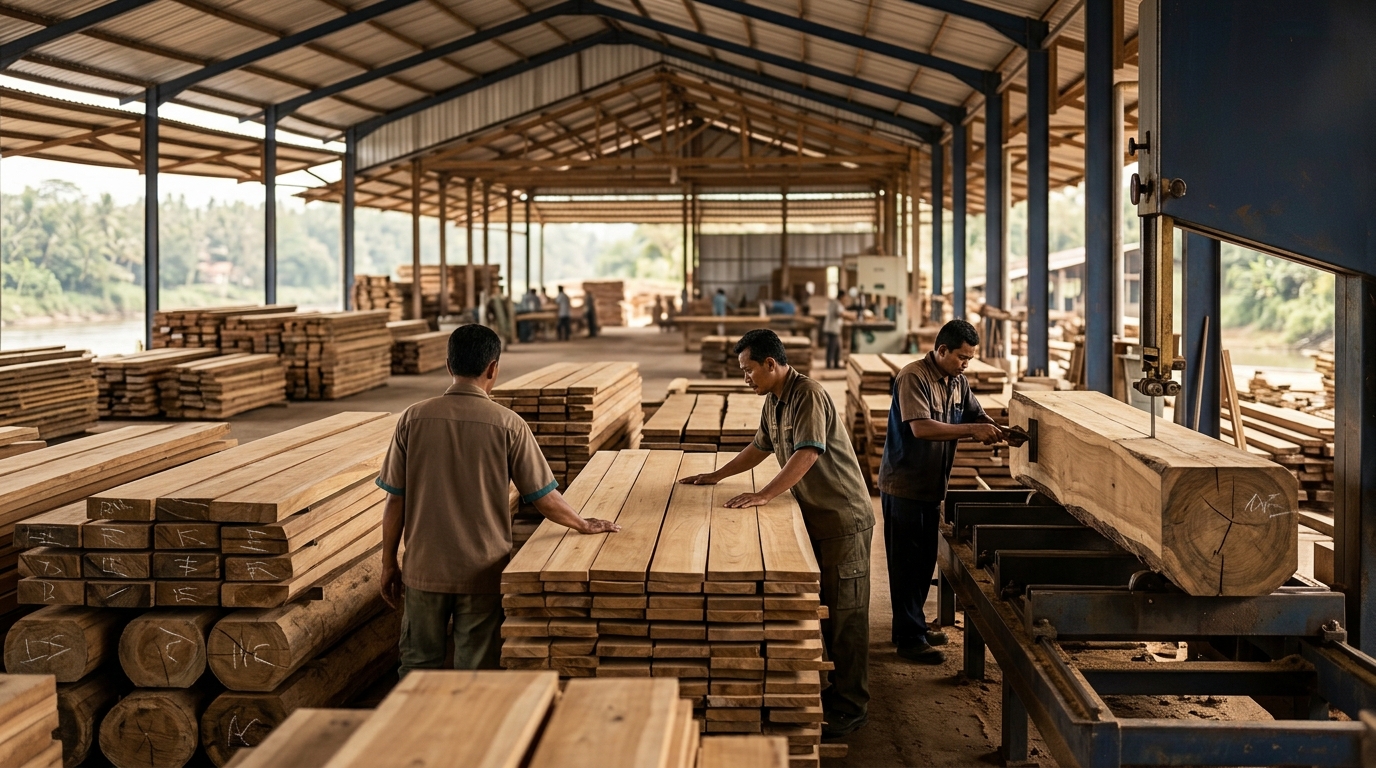
Sourcing teak wood from Indonesia involves more than finding a mill with available stock. US importers, furniture factories, and joinery businesses face a layered decision: which supply source, which grade, which documentation, and which Incoterm structure delivers the best landed-cost outcome.…
Sourcing teak wood from Indonesia involves more than finding a mill with available stock. US importers, furniture factories, and joinery businesses face a layered decision: which supply source, which grade, which documentation, and which Incoterm structure delivers the best landed-cost outcome. Getting any of these wrong at contract stage creates expensive corrections at the port or on the shop floor.
This guide works through every critical variable — from Perhutani versus private plantation origins, through FEQ and lower-grade definitions, to SVLK legality documentation, moisture specs, container yield, and supplier vetting. It is written for buyers placing bulk orders, not for casual inquirers. Every section maps to a procurement decision you will face before signing a purchase order.
Indonesia is the dominant origin for teak wood suppliers in the Indonesia export market, and that dominance is built on plantation scale, legal traceability, and processing infrastructure that no other country currently matches at volume. Understanding exactly why — and where the trade-offs sit — is the foundation of a sound sourcing strategy. Start there.
Why Indonesia Leads the Global Teak Export Market
Indonesia is the largest exporter of teak wood in the world. That position rests on plantation scale, not historical accident.
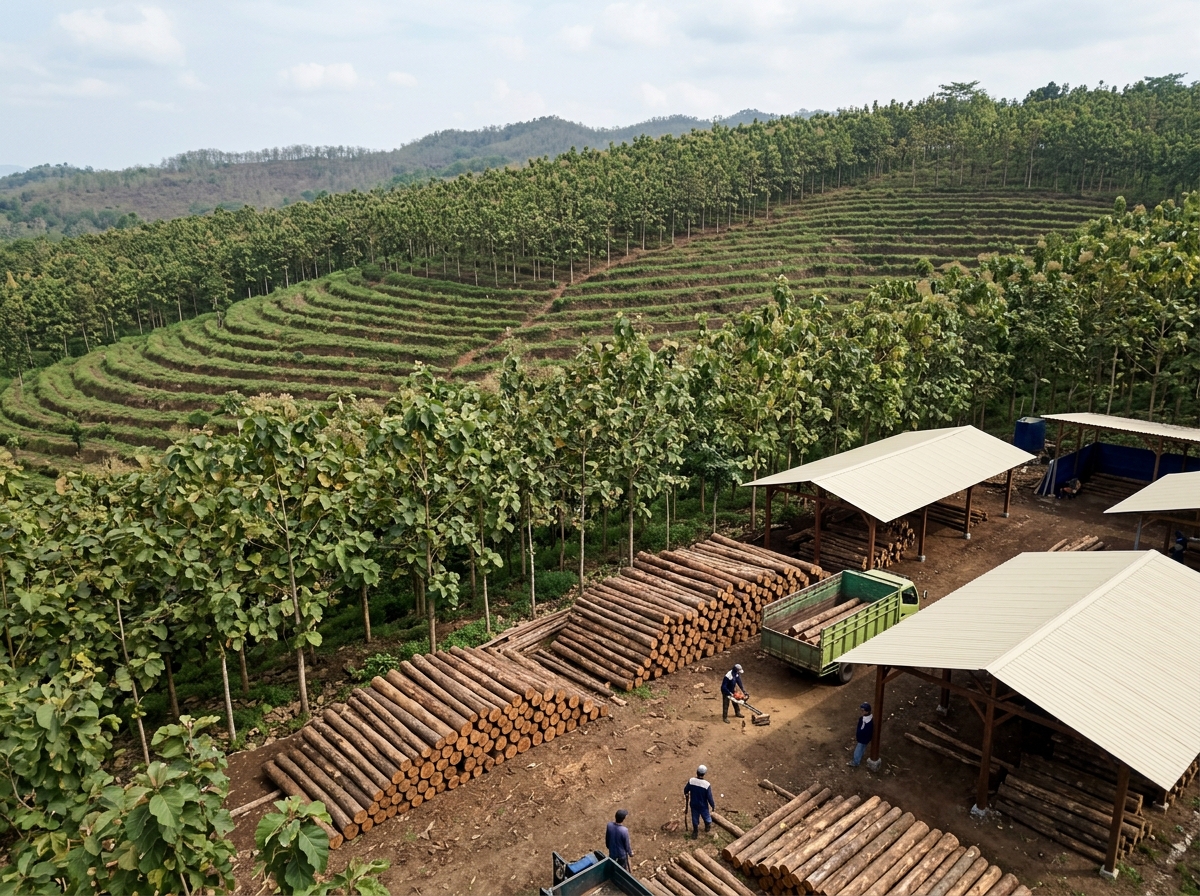
Tectona grandis, the botanical species behind commercial teak, grows across tropical Asia. But Indonesia — specifically the island of Java — hosts the world's largest managed teak plantation system. Estimates from forestry sector publications put Java's state-managed teak plantation area at well over one million hectares, a resource base that dwarfs Myanmar's remaining natural teak stands and India's limited plantation output.
The Role of Perhutani in Supply Volume
Perum Perhutani is Indonesia's state forestry enterprise. It manages the Java plantation system under a government mandate, controlling harvesting schedules, log auctions, and downstream processing through its own sawmills and approved industry partners. Perhutani teak is the benchmark reference for Indonesian plantation teak in international trade.
Myanmar once supplied the world's premier natural-growth teak. Today, sanctions, export restrictions, and forest depletion have dramatically reduced Myanmar's accessible supply. India's teak output serves primarily its domestic market. Thailand banned teak logging decades ago. That leaves Indonesia as the only large-scale, legally documented teak origin available to US and European buyers without compliance risk.
Why Buyers Prefer Indonesian Plantation Teak
Plantation teak from Java offers three specific advantages that natural-forest origins cannot reliably match:
- Consistent log dimensions from managed rotation cycles - Traceable chain-of-custody through SVLK and, where required, FSC certification - Predictable supply volume through scheduled harvests and auction cycles
The trade-off versus old-growth Burmese teak is real: plantation-grown Tectona grandis typically shows lower natural oil content and wider sapwood bands compared to centuries-old natural forest trees. But for most joinery and furniture applications, plantation teak at the correct grade and moisture specification performs to specification.
Perhutani vs Private Plantation Teak: Key Sourcing Differences
Not all Indonesian teak comes from Perhutani. A growing private plantation sector operates alongside the state system, particularly in Java and parts of Sulawesi. The sourcing implications are significant.
Perhutani Supply: Auctions, Quotas, and Price Floors
Perhutani releases logs through a structured auction system. Registered buyers bid on lot allocations at periodic sales. Price floors are set by the state, which means Perhutani teak rarely trades at distressed prices. The auction process creates price transparency but also limits negotiation room. Buyers sourcing Perhutani-certified material should expect to pay a premium over private plantation equivalents — typically a meaningful margin difference at the FEQ and Grade A levels.
Perhutani's chain-of-custody documentation is well-established and widely recognised by EU and US compliance auditors. For importers whose customers demand the strongest possible legal origin evidence, Perhutani-sourced timber with full V-Legal documentation is the lower-risk choice.
Private Plantation Teak: Characteristics and Trade-offs
Private plantation operators run shorter rotation cycles — commonly around 20–25 years versus Perhutani's longer managed cycles. Shorter rotations produce:
- Smaller average log diameters - Lower heartwood-to-sapwood ratios - Reduced natural oil content
These are measurable quality differences, not marketing claims. A private plantation log at 20-year rotation will yield a smaller clear-heartwood sawn board than a 40-year Perhutani log of equivalent diameter class. For end-uses requiring wide, clear FEQ boards — high-end joinery, yacht decking components, architectural elements — Perhutani or longer-rotation private plantation material is the correct specification.
For furniture components, smaller dimension S4S parts, or finger-jointed products, private plantation teak at Grade A or Grade B is cost-effective and functionally appropriate.
| Factor | Perhutani Teak | Private Plantation Teak |
|---|---|---|
| Rotation cycle | Longer (approx. 40+ years typical) | Shorter (approx. 20–30 years typical) |
| Heartwood ratio | Higher | Lower |
| Natural oil content | Higher | Moderate |
| Log diameter | Larger average | Smaller average |
| Price level | Higher (auction floor pricing) | More negotiable |
| CoC documentation | Strong, established | Variable — verify carefully |
| FSC availability | Available through certified mills | Available but less consistent |
Teak Grade Definitions Every Importer Must Understand Before Ordering
Grade labelling in the Indonesian teak trade is not universally standardised. Different suppliers use overlapping terminology. Specify grades by technical definition in your purchase order, not by label alone.
FEQ: The Benchmark Grade
FEQ — First European Quality — is the top commercial grade for teak sawn timber on the international market. The defining criteria are:
- 100% heartwood — no sapwood permitted - Clear faces — no knots, checks, splits, or discolouration on graded faces - Minimum dimensions typically 50mm+ thickness, 100mm+ width, 1.8m+ length (confirm with supplier) - Kiln-dried to specified moisture content
FEQ commands the highest price per m³. It is the correct specification for exposed joinery, high-grade furniture tops, decking, and architectural applications where visual and dimensional stability are critical.
Grade A, Grade B, and Grade C Defined
| Grade | Heartwood | Face Quality | Typical End Use | Relative Price vs FEQ |
|---|---|---|---|---|
| FEQ | 100% | Fully clear, both faces | Fine joinery, yacht decking, premium furniture | Baseline (highest) |
| Grade A | Predominantly heartwood | Minor sound knots allowed | Furniture frames, outdoor structures | Approximately 15–25% lower |
| Grade B | Mixed heartwood/sapwood | Sound knots, minor splits | Garden furniture, structural components | Approximately 35–50% lower |
| Grade C | Sapwood present | Defects permitted | Utility construction, low-grade components | Approximately 55–70% lower |
Note: Price differentials above are indicative market estimates and vary by volume, origin, and market conditions. Verify current pricing with suppliers.
Product Forms: Sawn, S4S, and Finger-Jointed
- Sawn timber (rough sawn): timber cut to nominal dimensions, surfaces not planed. Standard commercial form for bulk import. - S4S (surfaced four sides): planed on all four faces to finished dimensions. Ready for direct use in joinery or furniture production. - Finger-jointed components: short off-cuts joined with structural finger joints. Lower raw material cost. Acceptable for painted or non-exposed applications. Not suitable for clear-finish FEQ applications.
Specify the product form explicitly in the purchase order. A supplier quoting "teak sawn timber" and delivering rough-sawn when you needed S4S creates downstream milling cost and schedule delay.
SVLK and Lacey Act Compliance: What Every US Importer Must Document
Legal compliance is non-negotiable for teak wood suppliers Indonesia export transactions entering the US market. Two frameworks govern the obligation: Indonesia's SVLK system on the export side, and the US Lacey Act on the import side.
What SVLK Requires
SVLK — Sistem Verifikasi Legalitas dan Kelestarian — is Indonesia's mandatory timber legality verification system. All Indonesian timber and timber product exporters must hold SVLK certification. The system covers:
- Legal land tenure of the plantation or forest management unit - Harvesting rights and approved cutting plans - Transport documentation from forest to mill - Mill processing records - Export licensing
The V-Legal mark is the visible output of SVLK compliance. It appears on the export documentation — specifically the Dokumen V-Legal (DV-Legal) — which accompanies each shipment. This document is issued by an accredited conformity assessment body, not self-declared by the exporter.
FSC Certification: When Is It Required?
FSC (Forest Stewardship Council) chain-of-custody certification is not legally mandatory for Indonesian teak exports. SVLK satisfies Indonesia's legal export requirements and is recognised under the EU Timber Regulation's equivalence framework.
However, FSC certification is increasingly required by:
- US retailers with published sustainability procurement policies - EU buyers under voluntary sourcing commitments - Architects and specifiers on LEED or BREEAM-rated projects
If your end customer requires FSC, specify it in your purchase order and verify the supplier's current FSC CoC certificate number against the FSC public database before committing.
US Lacey Act Due Diligence Checklist
The Lacey Act (amended 2008) prohibits importing plants and plant products harvested in violation of source-country law. Indonesian teak imports require a Plant and Plant Product Declaration filed with US Customs.
- ✓Obtain supplier SVLK certificate number and verify against Indonesia's SILK online database
- ✓Confirm V-Legal (DV-Legal) document accompanies each shipment
- ✓File USDA APHIS Plant and Plant Product Declaration (PPQ Form 505) at US port of entry
- ✓Record species: Tectona grandis — confirm on all shipping documents
- ✓Record country of harvest: Indonesia — plantation-grown, Java
- ✓Document plantation origin and chain-of-custody back to harvest unit
- ✓Retain all compliance records for minimum 5 years
- ✓Verify supplier export licence (ETPIK — Eksportir Terdaftar Produk Industri Kehutanan) is current
- ✓Commission third-party pre-shipment inspection if first order or new supplier
- ✓Document due diligence review in internal procurement record
Moisture Content, Dimension Tolerances, and Processing Standards
Specification errors at the purchase order stage create production problems at the factory. Get the technical parameters right before order confirmation.
Moisture Content Specifications
| Application | Moisture Content | Designation | Testing Standard |
|---|---|---|---|
| Indoor joinery, fine furniture | 8–12% | KD (Kiln Dried) | ASTM D4442 or ISO 3130 |
| Outdoor furniture, structural | 12–18% | AD (Air Dried) or KD | ASTM D4442 or ISO 3130 |
| Green/rough stock for further drying | >19% | Green | Not for direct use |
Specify the moisture content range in the purchase order with a tolerance (e.g., 8–12% ± 2%). Require the supplier to provide kiln drying records and mill-point moisture readings. On arrival, independent testing with a calibrated resistance meter (pin-type) or dielectric meter against ASTM D4444 protocols is recommended for first shipments.
Standard Sawn Dimensions and Tolerances
Indonesian mills work to nominal metric dimensions. Common commercial sawn teak dimensions include:
- Thickness: 25mm, 38mm, 50mm, 75mm, 100mm nominal - Width: 75mm, 100mm, 150mm, 200mm, 250mm nominal - Length: 1.8m, 2.1m, 2.4m, 3.0m common; random lengths also available
Allowable dimensional tolerances for sawn timber are typically ±2mm on thickness and width for rough sawn, and ±0.5mm for S4S. Specify tolerances explicitly and reference them in the quality inspection protocol.
Indonesian Teak Pricing, Incoterms, and Landed Cost for US Buyers
Pricing for teak wood suppliers Indonesia export transactions varies by grade, volume, product form, and market timing. The figures below are indicative market estimates — not live quotes — and subject to change with exchange rates, harvest cycles, and freight markets.
Indicative Price Ranges by Grade (FOB Surabaya/Semarang)
| Grade/Form | Indicative FOB Range (USD/m³) | Notes |
|---|---|---|
| FEQ sawn timber | USD 800–1,400+ | Highly variable by dimension and heartwood spec |
| Grade A sawn timber | USD 500–800 | Volume and origin dependent |
| Grade B sawn timber | USD 300–500 | Private plantation, mixed heartwood |
| S4S FEQ components | USD 1,000–1,600+ | Processing premium over rough sawn |
| Finger-jointed panels | USD 400–700 | Grade B raw material basis |
These are approximate market estimates based on publicly available trade data patterns. Obtain current FOB price lists directly from verified suppliers.
Volume Thresholds and MOQs
Most Indonesian teak exporters set minimum order quantities at one full 20-foot container, approximately 18–22 m³ of sawn timber depending on dimension mix. Full 40-foot HC containers yield approximately 28–35 m³. Volume discounts typically apply at three-container and ten-container thresholds — confirm with individual suppliers.
Incoterms and Landed Cost Framework
| Incoterm | Seller's Obligation | Buyer's Risk Transfer | Best For |
|---|---|---|---|
| FOB Surabaya | Loaded on vessel | At ship's rail, origin port | Buyers with freight forwarder relationships |
| CFR Los Angeles | Freight included to US port | At destination port | Buyers wanting freight consolidated |
| CIF Los Angeles | Freight + insurance to US port | At destination port | Smaller buyers, first shipments |
For landed cost calculation, add to the FOB price: ocean freight (approximately USD 2,500–4,500 per 40HC to US West Coast, subject to market rates), US import duty, Customs brokerage, inland freight, and any inspection fees. US Customs HS codes for Indonesian teak: sawn timber typically under HTS 4407.29 (tropical wood sawn); S4S under 4409.29. Import duty rates depend on the specific HTS subheading — verify current rates with a licensed Customs broker.
Payment Terms
Standard terms in the Indonesian teak export market:
- LC (Letter of Credit): preferred by most established exporters for first transactions - TT (Telegraphic Transfer): 30% deposit, 70% against Bill of Lading copy — common for established relationships - DP (Documents against Payment): less common; used in some broker-facilitated transactions
USD is the dominant invoice currency. Exchange rate fluctuation against IDR affects supplier costs; multi-shipment contracts benefit from price review clauses tied to IDR/USD movements.
How to Qualify Indonesian Teak Suppliers Before Your First Order
Supplier qualification is where most procurement errors originate. A documented vetting process protects your supply chain.
Core Vetting Criteria
Evaluate every potential teak wood supplier against these verified criteria before requesting a price list:
- SVLK certification: current, verified against Indonesia's SILK database (publicly searchable online) - ETPIK export licence: valid and in the supplier's company name - FSC CoC certificate: required if your end-customer specifies FSC — verify certificate number on FSC database - Export history: request Bill of Lading samples to US or EU destinations from the past 24 months - Production capacity: confirm monthly m³ output and current order backlog - Mill inspection access: legitimate exporters welcome pre-shipment inspection; refusal is a red flag
Red Flags That Disqualify a Supplier
- Offering certified-looking documents with no verifiable certificate number - Pricing significantly below market range without a credible explanation - Unable to provide plantation origin documentation - Refusing third-party pre-shipment inspection - No export history to regulated markets (US, EU, Australia)
Pre-Shipment Inspection and Sample Process
For new suppliers, commission an independent pre-shipment inspection through SGS, Bureau Veritas, or an equivalent accredited inspection agency. The inspection scope should cover:
- Species verification (Tectona grandis confirmation) - Grade conformance against purchase order specification - Moisture content testing per agreed standard - Dimension check against PO tolerances - Document verification (SVLK, V-Legal, packing list cross-reference)
Before committing to a full container order, request a graded sample pack — typically 5–10 pieces per grade/dimension — with accompanying moisture certificates and plantation origin documentation.
Logistics, Lead Times, and Container Yield for US Importers
Export Ports and Transit Times
Indonesia's primary teak export ports are Surabaya (Tanjung Perak), Semarang, and Jakarta (Tanjung Priok). For Central Java teak production clusters around Jepara and Semarang, the port of Semarang is typically the most efficient loading point. Surabaya handles the largest volume of timber export overall.
Approximate ocean transit times to US ports:
| Origin Port | US West Coast (LA/Long Beach) | US East Coast (Savannah/Charleston) |
|---|---|---|
| Surabaya (Tanjung Perak) | Approx. 20–28 days | Approx. 35–45 days |
| Semarang | Approx. 22–30 days | Approx. 37–47 days |
Transit times are approximate and subject to routing, carrier, and transshipment hub schedules.
Production Lead Times by Product Form
- Rough sawn timber (KD): approximately 4–8 weeks from order confirmation, depending on kiln capacity and grade availability - S4S finished timber: approximately 6–10 weeks - Finger-jointed panels or components: approximately 8–12 weeks
Factor in the pre-shipment inspection window (typically 3–5 working days) when calculating total order-to-shipment lead time.
Container Stuffing and m³ Yield
Container yield varies by timber dimension. Longer, larger-dimension boards pack more efficiently.
| Container Type | Approx. m³ Capacity (Sawn Timber) | Notes |
|---|---|---|
| 20-foot standard | 18–22 m³ | Dependent on dimension mix and stacking efficiency |
| 40-foot HC (High Cube) | 28–35 m³ | Preferred for sawn and S4S bulk shipments |
S4S and components with consistent dimensions pack more efficiently than mixed rough sawn. Suppliers typically provide a container loading plan (CLP) with the shipping documents. Review the CLP against the packing list before accepting the Bill of Lading.
Frequently Asked Questions from US Teak Importers
Who is the largest exporter of teak wood in the world? Indonesia is the world's largest teak exporter, driven by the Java plantation system managed by Perhutani and a growing private plantation sector.
What is the current price of Indonesian teak wood per cubic meter? FOB prices vary significantly by grade. FEQ sawn timber is approximately USD 800–1,400+ per m³ FOB. Grade A runs approximately USD 500–800/m³. These are market estimates — request current price lists directly from verified suppliers.
Is Indonesian plantation teak good quality compared to Burmese teak? Old-growth Burmese teak has historically had higher natural oil content and denser heartwood. Indonesian plantation teak at longer rotation cycles approaches these characteristics. For most commercial furniture and joinery applications, properly graded and kiln-dried Indonesian plantation teak performs to specification. Burmese teak supply is now severely restricted by sanctions and export controls.
Which country produces the best quality teak wood? Myanmar (Burma) is historically cited for old-growth natural teak quality. Indonesia is the global leader for commercially available, legally certified plantation teak at scale. For most international buyers today, Indonesian teak is the viable benchmark.
What is SVLK certification and why do US importers need it? SVLK (Sistem Verifikasi Legalitas dan Kelestarian) is Indonesia's mandatory timber legality verification framework. Every Indonesian teak exporter must hold SVLK certification, and each shipment must be accompanied by a V-Legal document. US importers need SVLK documentation to satisfy Lacey Act due diligence requirements when filing Plant and Plant Product Declarations at US Customs.
What is the difference between FEQ teak and Grade A teak? FEQ (First European Quality) requires 100% heartwood and fully clear faces — no knots, sapwood, or defects on graded faces. Grade A permits predominantly heartwood with minor sound knots. FEQ commands a higher price and is the correct specification for exposed, clear-finish applications. Grade A is appropriate for furniture frames and components where minor knots are acceptable or concealed.
Indonesian plantation teak remains the most reliable, legally documented, and commercially scalable teak origin available to US buyers today. Sourcing success depends on matching grade specification to end-use, verifying SVLK and Lacey Act compliance before shipment, and qualifying suppliers through documented inspection protocols rather than on price alone.
You now have the specification framework, the compliance checklist, and the pricing structure to evaluate suppliers and structure your purchase orders with precision. The logical next step is putting verified supplier options in front of you.
You have the specification knowledge — now compare it against real samples and current pricing. Request a graded teak sample pack (FEQ, Grade A, Grade B) with accompanying SVLK documentation and FOB Surabaya/Semarang price lists from verified Indonesian exporters today.
Request Samples and FOB Pricing →Need eyes on the ground in Indonesia?
MTS is an execution partner — supplier verification, manufacturing management, quality control and export logistics across Indonesia, Vietnam and China.
Related services
Receive furniture sourcing insights across Asia.
One email per week. No spam.