Reclaimed Teak Wood Suppliers Indonesia: The Complete Sourcing Guide
14 min read

Sourcing reclaimed teak from Indonesia is not a simple commodity purchase. You are acquiring material from a finite, aging feedstock — colonial-era structures, railway infrastructure, and working vessels — that cannot be replicated.
Sourcing reclaimed teak from Indonesia is not a simple commodity purchase. You are acquiring material from a finite, aging feedstock — colonial-era structures, railway infrastructure, and working vessels — that cannot be replicated.
This guide addresses the full sourcing chain. It covers feedstock origins, grading logic, re-milled dimension yields, certification requirements under Indonesian and US law, container planning, and supplier vetting signals.
The market rewards buyers who understand the material at a technical level. Suppliers quote better prices, offer better yield guarantees, and prioritize shipment slots for buyers who speak the language of moisture content, grade yield, and chain-of-custody documentation. That is the frame for everything that follows.
Why Indonesia Remains the World's Premier Source for Reclaimed Teak
No other country in Southeast Asia offers comparable volume, species density, or feedstock diversity for reclaimed teak. Indonesia's colonial infrastructure — built extensively across Java during Dutch administration — embedded enormous quantities of old-growth teak into bridges, railway systems, government buildings, and residential structures over several centuries.
Myanmar has teak reserves, but export restrictions and sanctions limit reliable access for US buyers. Plantation teak from other regional markets lacks the density and silica content of old-growth Javanese timber. Indonesia, specifically Central Java, remains the dominant sourcing geography for reclaimedteak wood suppliersoperating at export scale.
The environmental argument is direct. Reclaimed teak does not require new forest clearing. It recovers embodied carbon already fixed in existing timber. Old-growth teak harvested centuries ago grew for 60 to 150 years before felling — that growth cycle cannot be replicated by 20-to-30-year plantation cycles.
Jepara and the Central Java Production Hub
Jepara is the operational center of Indonesian reclaimed teak processing. The cluster combines access to feedstock sourcing networks across Central Java, a dense labor pool skilled in de-nailing and re-milling, and established export infrastructure through the ports of Semarang and Surabaya.
Smaller satellite operations exist around Yogyakarta and Solo. These tend to specialize in specific feedstock types — particularly Joglo house beams — and often supply larger Jepara processors rather than exporting directly.
The Feedstock Sources That Give Reclaimed Teak Its Commercial Character
Understanding feedstock origin is not background information. It directly determines density, color stability, nail hole frequency, dimensional consistency, and the provenance narrative your end market will pay for.
Dutch-Era Javanese Houses: Joglo and Limasan Structures
Joglo and Limasan are traditional Javanese architectural forms built predominantly with large-section teak posts and beams. Joglo structures feature a distinctive tiered roof supported by four central columns — soko guru — typically milled from single old-growth teak logs of exceptional diameter. Limasan houses use a simpler hip-roof form with similarly dense structural timber.
Demolition of these structures yields wide-faced boards, large-section beams, and post material with a rich surface patina developed over decades of interior exposure. Nail hole density is relatively low compared to floor board feedstock. This material commands the highest per-unit price in the reclaimed market.
Railway Sleepers and Bridge Timbers
Javanese railway infrastructure used teak extensively for sleepers and structural bridge elements. This material is characterized by extreme density — compressed from decades under load — and dark oxidized coloration. Sleeper timber is typically narrow in width but long in length and highly consistent in thickness.
Bridge timbers offer larger cross-sections but carry heavier weathering, checking, and biological marking. Yield losses during re-milling are higher than for house timber, but the remaining material is exceptionally dense.
Fishing Boats, River Vessels, and Industrial Floors
Boat timber introduces salt exposure and cyclical wetting as defining characteristics. The marine environment accelerates surface weathering while leaving interior wood fibers largely intact. Color variation is pronounced. This feedstock suits rustic and industrial aesthetic applications.
Factory floors and warehouse beams represent the highest-volume reclaimed source in active production. Dimensional consistency is better than other sources because original milling was often standardized. However, nail density, bolt holes, and oil saturation from industrial use require thorough processing.
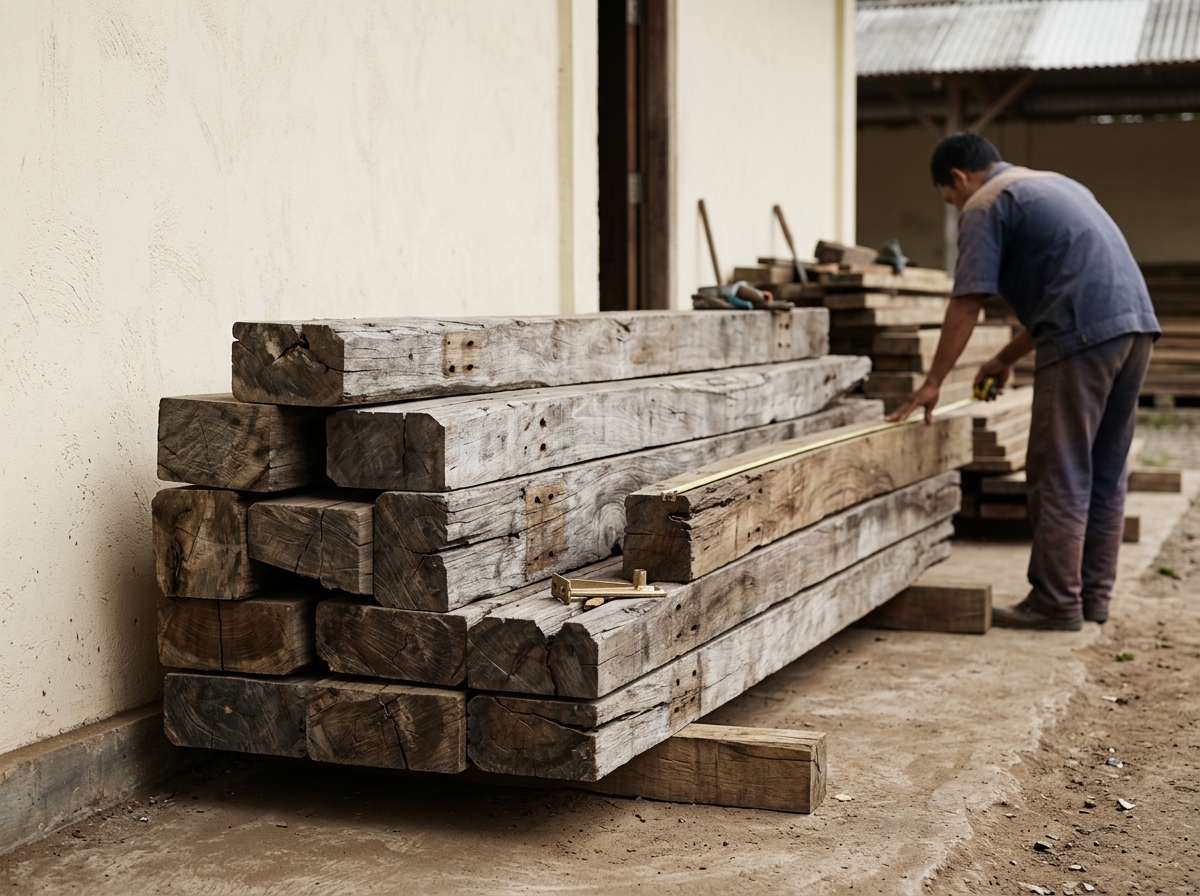
Grading Systems Used by Indonesian Reclaimed Teak Suppliers: What Each Level Means for Your Margin
No universal Indonesian government standard governs reclaimed teak grading. Suppliers apply their own systems, and terminology varies. The table below reflects the industry-common three-tier framework used by most export-oriented processors. Confirm that any supplier you engage defines grades in writing before sampling.
| Grade | Common Label | Face Quality | Nail Holes | Checks / Saw Marks | Typical Net Yield from Raw Stock |
|---|---|---|---|---|---|
| A | Select / Clear | Tight grain, minimal defects, near-clear face | Rare, filled or absent | Minimal | Approximately 35–50% |
| B | Character | Visible nail holes, minor checks accepted | Present, consistent | Light saw marks acceptable | Approximately 50–65% |
| C | Rustic / Industrial | Heavy patina, bold weathering, large voids | Frequent, unfilled | Heavy saw marks, splits | Approximately 65–75% raw recovery, but significant trim loss |
Grade directly determines your container economics. A 40-foot high-cube container of Grade A flooring blanks will contain fewer board feet of usable finished product than the same container of Grade B, because tighter face requirements increase off-cut volume during final surfacing. Build this into your landed cost model before comparing supplier quotes across grades.
The De-Nailing and Re-Milling Process Every Importer Must Audit
Processing quality is where supplier capability separates. Reclaimed teak that has not been properly processed creates downstream problems — blade damage at your facility, moisture-related installation failures, and grading disputes after delivery. Understand each stage before you sign a purchase order.
Manual De-Nailing and Metal Detection
The first processing stage is manual extraction of nails, bolts, and embedded metal. Skilled workers use pry bars and chisels to remove hardware without splitting the wood face. After manual de-nailing, boards pass through a metal detector — typically a handheld or conveyor-mounted unit — that identifies remaining ferrous and non-ferrous fragments.
Ask every prospective supplier to confirm that metal detection is a standard production step, not an occasional check. Request records showing detection frequency and rejection rates. Suppliers who cannot provide this data are a sourcing risk.
Gang-Saw and Band-Saw Re-Milling to Target Dimensions
Re-milled reclaimed teak is processed through gang saws for initial breakdown and band saws for final dimensioning. Band saws produce a narrower kerf than circular saws, reducing waste on high-value material. The choice of saw type affects your dimension yield — ask specifically which equipment a supplier uses for final sizing.
Common target dimensions for US flooring imports include thicknesses of 19mm, 22mm, and 25mm finished, with widths ranging from approximately 90mm to 200mm depending on feedstock source and grade. Longer lengths — typically 1.2m to 2.4m — command a premium because old-growth boards naturally split and check as they age, reducing available clear length.
Kiln-Drying Reclaimed Teak to US Market Moisture Standards
This is the single most common failure point in reclaimed teak shipments to the United States. Reclaimed timber that has been air-dried outdoors in a tropical climate typically carries moisture content between 15% and 25%.
Require kiln-drying to a moisture content of 6– approximately 10% EMC before shipment. Request kiln charge records showing time, temperature, and final moisture readings for each batch. A calibrated pin or pinless moisture meter reading on samples, conducted at time of inspection, provides independent verification.
Surface Finishing Options and Their Specification Impact
Four surface finishes are standard among Indonesian reclaimed teak exporters:
- Skip-planed: light pass that removes loose fiber and dirt while preserving tool marks and surface texture. Common for character and rustic grades. - Wire-brushed: mechanical brushing that opens grain and emphasizes texture. Popular for hospitality and residential flooring. - Smooth-planed: full surface removal to a consistent face. Reduces character but maximizes dimensional uniformity. Required for Grade A select applications. - Rough-sawn / re-sawn face: no surface finishing beyond re-milling. Used for structural or cladding applications.
Specify finish in writing. Finish type affects thickness tolerance and final dimension yield.
Certification and Documentation Requirements for Reclaimed Teak Origin Verification
SVLK, FSC, and Chain-of-Custody Requirements
Indonesia's Sistem Verifikasi Legalitas Kayu (SVLK), translated as the Timber Legality Verification System, is a mandatory government framework governing all timber products exported from Indonesia. SVLK certification is required for legal export — not optional. However, its application to reclaimed material involves a nuance that many importers miss.
SVLK's standard framework was designed primarily for timber harvested from forests. For reclaimed material — wood sourced from demolished structures rather than from living trees — the verification pathway focuses on chain-of-custody documentation rather than harvest permits.
FSC Reclaimed Wood certification is a separate, voluntary standard. Very few Indonesian suppliers hold it, because the auditing cost and documentation burden for reclaimed material is significant. If FSC is a procurement requirement for your project, verify supplier status directly through the FSC certificate database. Do not accept photocopied certificates without database confirmation.
The US Lacey Act (16 U.S.C. §§ 3371-3378) requires that importers declare the scientific name, country of harvest, and quantity of all plants and plant products entering the United States. For reclaimed teak — material sourced from demolished structures rather than harvested from forests — the Lacey Act still applies.
- ✓Valid SVLK certificate (verify against Indonesian Ministry of Environment database)
- ✓Demolition source affidavits or permit records for each feedstock batch
- ✓Kiln-drying records with moisture content readings
- ✓Phytosanitary certificate issued by Indonesian quarantine authority
- ✓Commercial invoice with species name (Tectona grandis) declared
- ✓Packing list with HTS code declared by exporter
- ✓ISPM-15 compliant packaging confirmation
Realistic Dimension Yields and Container Planning for Bulk Reclaimed Teak Orders
Yield loss in reclaimed teak processing is cumulative across stages. Buyers who model container economics on raw board footage before processing will systematically underestimate their cost per finished unit.
Approximate stage-by-stage yield losses from raw demolition material to finished flooring blank:
- De-nailing and initial sort: 5–10% loss (split boards, structurally compromised pieces removed) - Re-milling to target thickness and width: 15–25% loss depending on original section size and target dimension - Kiln-drying (shrinkage and degrade): 3–8% additional loss, primarily from checking and end-splits - Final surfacing and grading sort: 5–15% loss, heavily grade-dependent
Total yield from raw demolition timber to Grade A finished flooring blank: approximately 35–50%. For Grade B: approximately 50–65%. These are commonly cited industry approximations and will vary by feedstock source and target dimension.
For container planning:
- A 20-foot container holds approximately 20–22 cubic meters of loose-packed flooring blanks. - A 40-foot high-cube (HQ) container holds approximately 65–70 cubic meters. - Structural beams and thick panels pack less efficiently — plan for approximately 15–18 cubic meters in a 20-foot container.
Minimum order quantities vary by supplier scale. Smaller Jepara workshops typically require a minimum of one 20-foot container. Mid-scale export processors generally have a one 40HQ minimum for mixed-grade orders.
Why Reclaimed Teak Costs More Than New Plantation Teak — And Why That Premium Holds
The price premium for reclaimed teak is not a marketing surcharge. It reflects real cost structure at every stage of the supply chain.
Labor-intensive sourcing begins before any wood reaches the mill. Locating and negotiating access to demolition sites, coordinating manual dismantling, transporting irregular-sized structural elements, and sorting by feedstock type all occur before the first nail is pulled. This sourcing layer does not exist in plantation teak supply chains.
Processing costs for reclaimed material are higher per unit than for new timber. Metal detection, manual de-nailing, variable-dimension re-milling, and higher kiln-drying cycle times (due to density and pre-existing moisture variation) increase conversion cost significantly compared to processing uniform plantation logs.
Feedstock scarcity operates as a structural price floor. The stock of old-growth Javanese structures is finite and declining. As demolition activity continues, the most accessible and highest-quality sources are consumed first. This is not a recoverable resource. Pricing reflects that reality.
For design-focused buyers — hospitality developers, high-end residential architects, boutique retail — provenance storytelling carries measurable commercial value. A floor that can be documented as sourced from 150-year-old Javanese Joglo houses commands a price premium from end users that exceeds the additional sourcing cost. Importers who can supply verifiable chain-of-custody documentation capture this margin differential.
Approximate FOB price benchmarks by grade (flagged as approximate market ranges, subject to change):
| Grade | Typical FOB Range (Semarang/Surabaya) | Primary Application |
|---|---|---|
| A — Select | Higher end of market | Architectural flooring, premium paneling |
| B — Character | Mid-range | Residential flooring, commercial interiors |
| C — Rustic/Industrial | Lower per unit | Cladding, accent walls, structural elements |
Request current pricing from multiple verified suppliers. FOB benchmarks shift with feedstock availability, exchange rates, and seasonal demolition activity.
How to Vet and Qualify Reclaimed Teak Wood Suppliers Indonesia Before Committing to a Container
Factory Audit Priorities
A physical or third-party audit of a prospective supplier's facility should confirm the following operational capabilities:
- Functioning kiln capacity with calibrated controls and batch logging - Metal detection equipment integrated into the processing line - Covered, organized timber storage (segregated by feedstock type and grade) - Re-milling equipment appropriate to the dimensions you require - Sample showroom or documented photo library of recent export batches
Suppliers without on-site kilns are outsourcing drying — which is not automatically a disqualifier, but requires you to audit the third-party drying facility and obtain its records independently.
Documentation Audit
Request the following before sampling:
- Current SVLK certificate with expiry date - Export license (ETPIK — Eksportir Terdaftar Produk Industri Kehutanan) - Representative certificate of analysis (COA) or inspection report from a recent shipment - Sample demolition source records from at least two recent feedstock batches
Sampling Protocol Before Container Commitment
Do not commit to a full container order without receiving and approving physical samples. A standard sampling process should include:
1. Request a sample pack of 5–10 boards per grade across your target dimensions 2. Verify moisture content on arrival with a calibrated meter 3. Assess face quality against the supplier's written grade definition 4. Confirm species via visual grain assessment or, for high-value orders, laboratory species verification 5.
Navigating US Import Logistics and Tariff Considerations for Indonesian Teak
HTS Codes and Current Tariff Rates
The correct Harmonized Tariff Schedule (HTS) code for your product determines your duty rate. Common classifications for reclaimed teak imports from Indonesia include:
- 4407.29 — Wood sawn or chipped lengthwise, of tropical wood (covers reclaimed teak structural timber and flooring blanks) - 4409.29 — Wood continuously shaped, of tropical wood (covers profiled flooring with tongue and groove or similar) - 4418.xx — Builders' joinery and carpentry of wood (may apply to assembled panel products)
Indonesia is not subject to Section 301 tariffs, which were imposed on China. Standard Most Favored Nation (MFN) duty rates apply. Verify current rates through the US International Trade Commission (USITC) HTS database, as rates are subject to change.
Port Requirements: Fumigation and ISPM-15
All wood packaging materials — pallets, dunnage, crating — must comply with ISPM-15 (International Standards for Phytosanitary Measures No. 15), which requires heat treatment or methyl bromide treatment of solid wood packaging. The packaging must bear the official ISPM-15 mark. Non-compliant packaging can result in shipment holds or destruction at US ports of entry.
Reclaimed teak itself may be subject to phytosanitary inspection at the port of entry. A phytosanitary certificate issued by the Indonesian Plant Quarantine Authority (BBKP) should accompany every shipment.
Work with a customs broker who has handled Indonesian wood product imports previously. The intersection of SVLK documentation, Lacey Act declarations, and HTS classification creates compliance complexity that general customs brokers often handle poorly.
Frequently Asked Questions from B2B Reclaimed Teak Buyers
Is reclaimed teak from Indonesia legal to import into the United States under the Lacey Act? Yes, provided you file an accurate Lacey Act plant declaration. For reclaimed material, declare species as Tectona grandis, country of harvest as Indonesia, and describe the product as reclaimed structural timber.
What certifications should I require from an Indonesian reclaimed teak supplier? A valid SVLK certificate is mandatory for legal Indonesian timber export. FSC Reclaimed Wood certification is desirable but rare. Require demolition source affidavits and kiln-drying records as supplementary documentation.
How does reclaimed teak grading affect price and yield for flooring projects? Grade A material yields approximately 35–50% of raw feedstock volume but commands the highest FOB price. Grade B yields approximately 50–65% at a mid-range price.
What is the typical lead time from order to FOB shipment for bulk reclaimed teak? Commonly 8–14 weeks for standard flooring dimensions from confirmed order. Custom profiles or non-standard thicknesses extend lead times. Confirm production capacity and queue position with your supplier before placing orders against a project deadline.
How can I verify that wood sold as reclaimed is genuinely old-growth and not new teak? Genuine old-growth reclaimed teak shows tight annual ring spacing, high natural oil content, and surface characteristics inconsistent with plantation-grown material. Request demolition source records and cross-reference against the supplier's SVLK chain-of-custody documentation.
What are the moisture content requirements for reclaimed teak shipped to the US market? Target 6–10% EMC for interior flooring applications. Verify with calibrated moisture meter readings on samples at time of pre-shipment inspection. Do not accept air-dried material for flooring without confirmed kiln-drying records.
Qualifying reclaimed teak wood suppliers in Indonesia requires technical rigor at every stage — from feedstock verification through certification review to container yield modeling. Buyers who invest in that rigor before their first container order consistently outperform those who rely on price alone as a selection signal.
Ready to move from research to supplier engagement? You now have the framework to evaluate what suppliers send you and ask the right questions. The logical next step is direct material comparison.
You have the sourcing framework. Now match it against real material. Request a curated shortlist of verified Indonesian reclaimed teak exporters and a graded sample pack — covering Grade A, B, and C flooring blanks — so you can evaluate face quality, moisture content, and dimension accuracy against your project specifications before committing to a container order.
Request Supplier Shortlist and Samples →Need eyes on the ground in Indonesia?
MTS is an execution partner — supplier verification, manufacturing management, quality control and export logistics across Indonesia, Vietnam and China.
Related services
Related articles
Receive furniture sourcing insights across Asia.
One email per week. No spam.