Indonesian Wooden Doors and Window Frames: Complete B2B Export Guide
13 min read
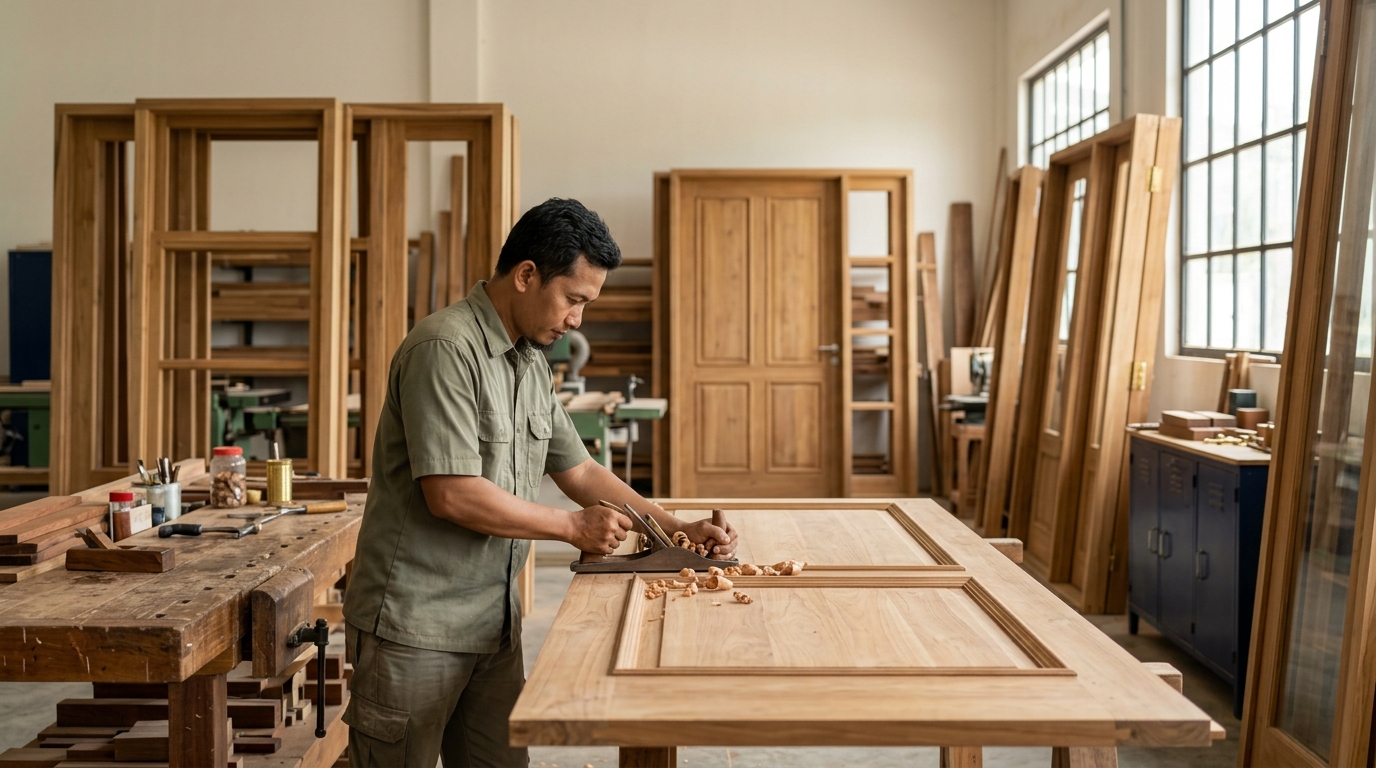
Indonesia supplies roughly a third of the world's tropical hardwood and has built a multi-generational craft infrastructure around that raw material advantage. For B2B buyers sourcing at scale — hospitality developers, construction firms, specification-led interior designers — the indonesian…
Indonesia supplies roughly a third of the world's tropical hardwood and has built a multi-generational craft infrastructure around that raw material advantage. For B2B buyers sourcing at scale — hospitality developers, construction firms, specification-led interior designers — the indonesian wooden doors window frames export market offers a combination of species diversity, artisan capability, and FOB price positioning that neither China nor Europe can match simultaneously.
This guide covers every decision layer in that process. You will find species comparison data, custom millwork capability benchmarks, certification requirements for the US market, real-world pricing context, container loading specifications, and a supplier qualification framework. The FAQ section at the end addresses the most common compliance questions US importers raise about Lacey Act exposure and phytosanitary documentation.
The export opportunity is real and growing. Trade data tracking platforms have recorded average export values for solid wooden doors from Indonesia at approximately $39.78 per unit FOB (source: Zauba trade data, approximate). World Bank trade figures show Indonesia exporting over approximately $458,000 in doors, windows, and frames annually at the HS code level — and that figure understates total value because many shipments consolidate across HS categories.
Why Indonesia Outcompetes Other Sourcing Origins for Wooden Doors and Frames
Tropical hardwood supply and craft infrastructure
Indonesia sits on one of the largest tropical forest estates on earth. Teak plantations in Java have operated for over a century under government and private management. Kalimantan supplies dense hardwoods including Merbau and Ulin. Sumatra contributes plantation-grown species suited for paint-grade millwork.
The craft infrastructure built around this supply chain is commercially significant. Jepara in Central Java concentrates carving and joinery workshops with decades of export experience. Bali hosts design-oriented producers serving luxury hospitality. These are not cottage industries — they are export-calibrated production clusters with container-load capacity.
Competitive positioning versus China and Europe
| Factor | Indonesia | China | Europe |
|---|---|---|---|
| Hardwood species access | Teak, Merbau, Ulin, Bengkirai native | Limited tropical hardwood | Oak, Pine, engineered wood |
| Custom carving capability | High — active craft workforce | Medium — mostly CNC | Low at price parity |
| FOB price per solid door (approx.) | $40–$150 depending on species | $35–$90 softwood/engineered | $200–$600+ |
| Lead time custom millwork | 45–90 days | 30–60 days | 60–120 days |
| Timber legality certification | SVLK mandatory | CITES dependent | CE/EUTR standard |
| FSC availability | Yes — growing coverage | Selective | Widespread |
For US hospitality developers and specification buyers, Indonesia's sweet spot is custom hardwood doors and window frames where China cannot supply the species or the carving quality, and Europe cannot match the price.
Wood Species That Define Indonesian Door and Window Frame Export Quality
Species comparison by application and price tier
| Species | Janka Hardness (approx.) | Best Use Case | Price Tier | FSC/SVLK Available |
|---|---|---|---|---|
| Teak (Tectona grandis) | ~1,000 lbf | Exterior doors, premium frames | High | Yes |
| Merbau (Intsia bijuga) | ~1,900 lbf | Exterior frames, thresholds | Medium-High | Selective |
| Bengkirai (Shorea laevis) | ~1,500 lbf | Structural frames, heavy doors | Medium | Selective |
| Ulin / Ironwood (Eusideroxylon zwageri) | ~3,000 lbf | High load structural frames | Medium-High | Limited |
| Suar (Albizia saman) | ~900 lbf | Interior doors, decorative panels | Low-Medium | Yes |
| Reclaimed Teak | Varies | Boutique doors, eco projects | Medium-High | Chain of custody required |
Moisture content and kiln-drying standards
Moisture content (MC) is a critical export specification that most buyers under-specify. Incorrect MC causes warping, joint failure, and paint adhesion problems after installation.
- Teak for export: Target MC 10–12% for US destinations. Kiln-dried, not air-dried. - Merbau: Dense and naturally oily. Target MC typically 12–15%. Requires longer kiln cycles. - Bengkirai/Ulin: Structural applications. MC typically below 15% preferred. Verify kiln equipment capacity. - Suar/Reclaimed Teak: Higher natural variation. Specify MC tolerance in purchase order — typically ±2%.
Always request a moisture content test report with each production batch. Reputable factories issue this as standard. If a factory cannot provide one, treat it as a qualification failure.
Indonesian teak wood: the benchmark export species
Indonesian teak remains the benchmark species in indonesian wooden doors window frames export for good reason. Its natural silica content and high oil content make it dimensionally stable and resistant to moisture, insects, and UV degradation. Plantation-grown teak from Java is commercially available with SVLK and FSC chain-of-custody documentation.
Custom Millwork Capabilities Available from Indonesian Manufacturers
Door types and production methods
Indonesian factories operating at export scale can produce the full range of door configurations:
- Solid panel doors — traditional stile-and-rail construction in teak or merbau - Louvered doors — suited for tropical ventilation needs, common in resort projects - Bi-fold and sliding barn doors — hardware-coordinated, requires factory pre-drilling specification - Pivot doors — large-format, requires structural reinforcement at pivot point - French doors — glass rebate profiles, specify glazing bead separately - Flush interior doors — solid or hollow core, paint-grade or veneer-faced
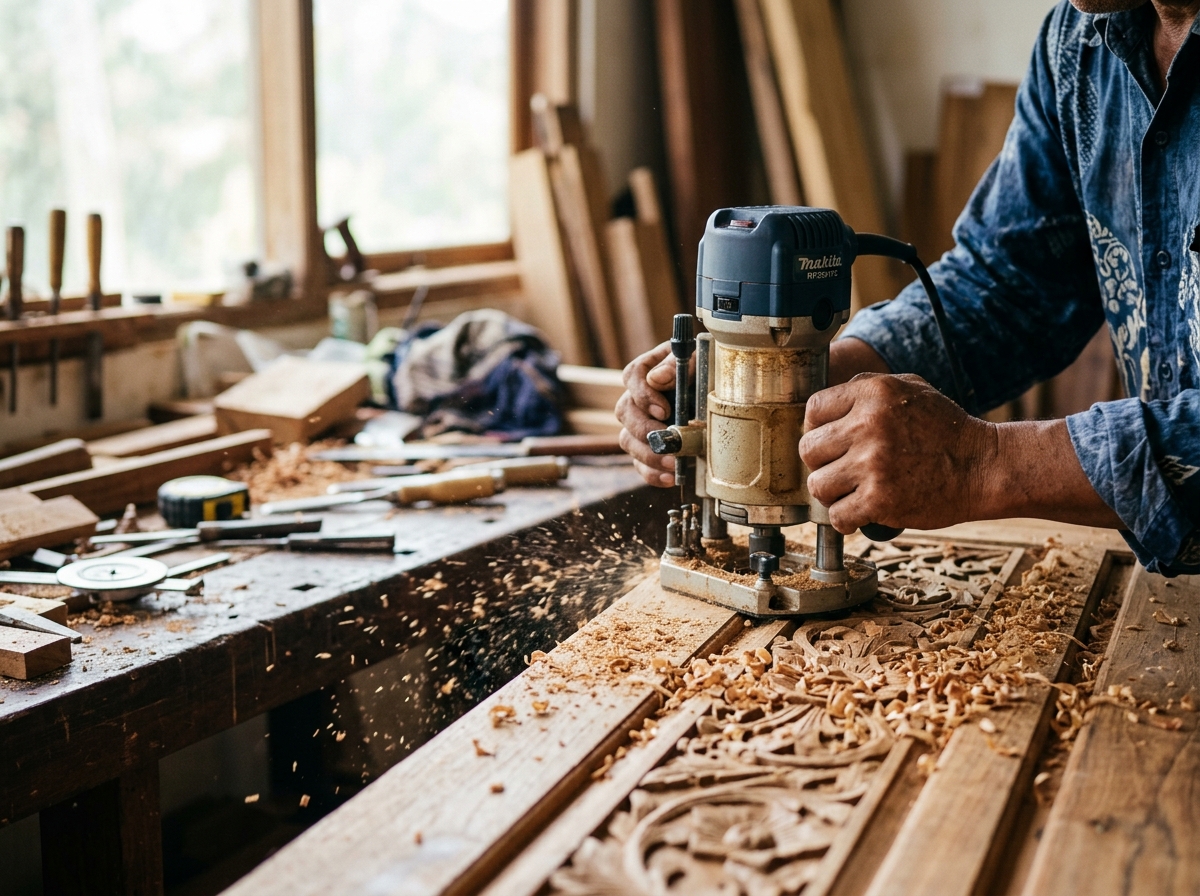
CNC routing capability is widespread in Jepara and larger Surabaya-area factories. Hand carving remains commercially available for Balinese motifs and Javanese geometric patterns — at a price premium and longer lead time.
Window frame profiles and finish options
Window frames from Indonesian producers cover casement, fixed-light, awning, and jalousie configurations. For US market specifications, confirm that frame profiles match your rough opening tolerances. Indonesian millwork uses metric dimensioning by default — request imperial conversion in your shop drawings.
Available finishes: - Natural oil finish (teak oil, linseed variants) - Penetrating stain with UV-resistant topcoat - Lacquer — polyurethane or nitrocellulose - Paint-grade priming — for site-painted applications
Specify finish before production begins. Switching finish type mid-production adds cost and delay.
Certification and Compliance Requirements for US-Bound Wooden Doors and Frames
This section is where most first-time importers of wooden doors indonesia make expensive mistakes. Three compliance frameworks apply simultaneously to US-bound shipments.
SVLK, FSC, and PEFC — timber legality documentation
SVLK (Sistem Verifikasi Legalitas Kayu) is Indonesia's mandatory timber legality verification system. All Indonesian wood product exporters must hold SVLK certification. It is the baseline — not a premium. Verify the SVLK certificate number on the Ministry of Environment and Forestry's official online registry before placing an order.
FSC (Forest Stewardship Council) chain-of-custody certification goes further. It documents that wood was harvested from responsibly managed forests and tracked through processing. FSC is increasingly required by US hotel brands and institutional buyers with sustainability mandates.
PEFC (Programme for the Endorsement of Forest Certification) is the European-led equivalent. Less common in Indonesia but recognised by some EU buyers.
Lacey Act requirements for US importers
The Lacey Act places legal responsibility on the US importer — not the supplier — to declare the species, country of harvest, and quantity of plant material in imported wood products. Non-compliance carries significant civil and criminal penalties.
For every shipment of hardwood doors or window frames, US importers must file a Lacey Act Plant and Plant Product Declaration (PPQ 505 form) with US Customs. Required information:
- Scientific name of each wood species (e.g., Tectona grandis for teak) - Country of harvest (Indonesia) - Quantity and unit of measure - Value of the importation
Require your Indonesian supplier to provide a species declaration on factory letterhead for every order. Cross-reference it against the Bill of Lading. If the supplier cannot or will not provide species-level documentation, do not proceed.
CARB Phase 2 for composite-core doors
If your door order includes MDF cores, plywood panels, or any composite wood component, CARB Phase 2 formaldehyde emission limits apply for US market sale. Solid teak or merbau doors without composite components are generally outside CARB scope. For any door with engineered core materials, request a CARB Phase 2 compliance declaration and the associated third-party test report from your supplier.
Export Pricing Benchmarks and MOQ Structures for Indonesian Wooden Doors
Price tiers by species and order structure
Trade data from platforms tracking indonesian wooden doors window frames export shows average FOB prices approximately as follows (treat as directional, not contractual):
| Product Type | Species | Approx. FOB Price Per Unit | Notes |
|---|---|---|---|
| Solid panel door | Reclaimed teak | $80–$150 | Visual character premium |
| Solid panel door | New-growth teak | $60–$120 | Most common export product |
| Solid panel door | Merbau | $50–$100 | Dense, heavy — affects freight |
| Interior flush door | Suar / paint-grade | $35–$65 | Budget tier, high volume |
| Carved Balinese door | Teak | $150–$400+ | Hand-carving premium |
| Window frame set | Teak | $40–$90 per opening | Species and profile dependent |
The Zauba-reported average of approximately $39.78 per solid door represents a blended average across species and configurations — not a target price for teak carved doors.
MOQ structures and Incoterms
- Full container orders (40ft or 40ft HC): Most factories set MOQ at one full container. This typically means 80–120 door units depending on size and crating. - Consolidated shipments (LCL): Available through freight forwarders. MOQ at factory level may drop to 20–30 units, but per-unit logistics cost increases significantly. - FOB Surabaya/Semarang: Supplier delivers to named port, clears Indonesian export customs. Buyer arranges ocean freight from that point forward. - CIF named US port: Supplier includes ocean freight and insurance to destination port. Useful for first orders but reduces buyer's visibility into freight cost components.
Lead times for custom millwork orders typically run 45–90 days from approved drawings and deposit receipt. Standard catalogue designs with no customisation may ship in 30–45 days.
Container Loading Specifications and Phytosanitary Requirements for Door and Frame Shipments
Container capacity planning for doors and window frames
| Container Type | Approx. Door Units (standard 2100×900mm) | Usable CBM | Estimated Gross Weight |
|---|---|---|---|
| 20ft Standard | 40–55 units | ~25 CBM | 8,000–12,000 kg |
| 40ft Standard | 80–100 units | ~55 CBM | 15,000–22,000 kg |
| 40ft High Cube | 90–120 units | ~65 CBM | 16,000–24,000 kg |
These figures assume standard solid teak doors with crating. Carved doors with irregular profiles reduce unit count. Merbau doors increase gross weight materially due to species density.
Crating, stacking, and moisture protection
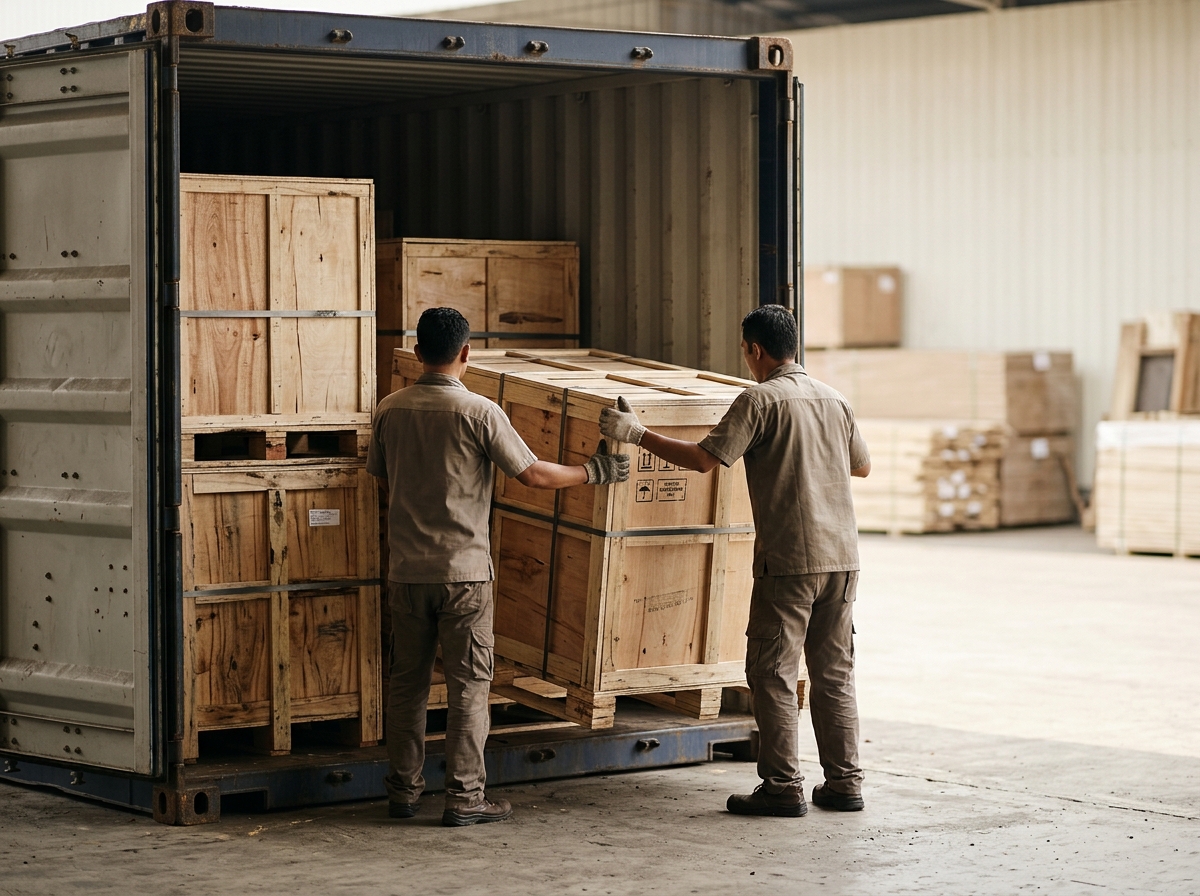
- Stand doors vertically where possible. Horizontal stacking under load causes bow. - Use corner protectors — foam or timber block — on all carved or profiled edges. - Wrap each door or frame set in moisture barrier film (polyethylene). Ocean freight humidity causes surface staining on unsealed wood. - Secure crates to container floor with strapping — do not rely on stack pressure alone. - Label each crate with item number, species, moisture content, and destination room reference for hospitality projects.
ISPM 15 phytosanitary compliance
All wooden packaging materials — pallets, crates, dunnage — entering the United States must comply with ISPM 15. This requires heat treatment (HT) or methyl bromide fumigation of the wood packaging, marked with the IPPC stamp showing country code, producer code, and treatment method.
Key points for buyers: - The product itself (the doors) does not require ISPM 15 treatment — only the packaging timber. - Request the ISPM 15 fumigation certificate from your supplier before shipment. - US Customs can detain or destroy non-compliant shipments at importer cost. - Confirm with your freight forwarder that fumigation is completed before container sealing.
- ✓Commercial invoice with species scientific names
- ✓Packing list with CBM and gross weight per crate
- ✓SVLK certificate — verified against official registry
- ✓FSC certificate if specified — verified via info.fsc.org
- ✓CARB Phase 2 declaration if composite cores present
- ✓Lacey Act species declaration on supplier letterhead
- ✓ISPM 15 fumigation certificate for all wooden packaging
- ✓Bill of Lading with accurate HS code (HS 4418 for windows/frames, HS 4421 or specific)
- ✓Moisture content test report per production batch
- ✓Insurance certificate if CIF Incoterms apply
How to Qualify and Vet Indonesian Door and Window Frame Manufacturers
Factory audit criteria
A factory audit for indonesian wooden doors window frames export sourcing should assess:
- Kiln-drying capacity: Does the factory operate its own kilns? What is the chamber capacity and cycle control capability? Outsourced kiln-drying reduces MC control. - Production capacity: Monthly output in units. Can they absorb your volume without subcontracting? - QC protocols: Is there a documented inspection process at rough milling, machining, assembly, and finish stages? - Export documentation experience: Does the factory have its own export licence, or does it route through an export company? Both are legitimate, but you need to know. - Sample production: Will the factory produce a golden sample (approved reference unit) before full production begins? This is non-negotiable for first orders.
Payment terms and trade association references
Standard payment terms in Indonesian B2B door export trade run approximately 30% deposit on order confirmation, 70% balance before shipment release. Wire transfer (T/T) is standard. Letters of Credit are accepted by larger factories but add processing time.
Indonesian trade associations worth referencing during supplier qualification: - ASMINDO (Asosiasi Industri Permebelan dan Kerajinan Indonesia) — furniture and craft industry association - HIMKI (Himpunan Industri Mebel dan Kerajinan Indonesia) — industry body with member directories
Membership is not a guarantee of quality, but non-members in established production clusters warrant additional scrutiny.
Design Customization for Hospitality and Luxury Residential Door Programs
Boutique resort developers and luxury residential project managers use bali doors and Javanese-produced millwork as a design differentiator. The operational challenge is coordinating a complete door set — door leaf, frame, architrave, sill board, and hardware prep — across multiple room types and sizes, all from the same production run.
Coordinating full door sets for FF&E schedules
Hospitality FF&E procurement for door programs typically follows this sequence:
1. Design intent drawings — buyer provides elevation drawings with profile details 2. Shop drawing review — factory produces metric shop drawings for buyer approval 3. Sample production — one or two golden samples shipped for approval (allow 3–6 weeks) 4. Sample approval and PO issuance — deposit triggers production scheduling 5. Production and QC — mid-production DUPRO inspection recommended for orders over 50 units 6. Pre-shipment inspection — third-party inspector verifies against golden sample 7.
For a 60-room resort with three door types, expect the full cycle from brief to FOB loading to run 16– approximately 24 weeks. Build this into your FF&E schedule, not against it.
Balinese carved panels and Javanese motifs — commercial reality
Hand-carved decorative elements add 40– approximately 100% to unit cost and 2–4 weeks to lead time. They are commercially viable for feature doors — villa entry doors, spa reception doors — but impractical for every door unit in a large project. A common approach: carved panels for public area doors, plain stile-and-rail solid teak for guest room doors. Both can be produced in the same Jepara or Bali-sourced order.
Frequently Asked Questions: Indonesian Wooden Doors and Window Frame Export
What wood species are best for exporting Indonesian doors and window frames to the US? Teak is the primary choice for premium exterior doors and frames. Merbau suits exterior structural frames. Bengkirai and Ulin offer high load-bearing performance for heavy-duty applications. Suar works for interior doors at a lower price point. All should be kiln-dried to 10– approximately 15% MC depending on species.
Does Indonesia export wood products legally and what certifications apply? Yes. Indonesia's SVLK system is mandatory for all wood product exporters. FSC and PEFC certification is available from qualified factories. These certifications are verifiable through official online registries — always verify, never accept a PDF alone.
Is Indonesian teak wood a quality choice for exterior door frames? Indonesian teak is among the best choices available globally for exterior door frames. Its natural oil content provides dimensional stability and moisture resistance. Plantation-grown Javanese teak with SVLK documentation is commercially available at scale.
What are the container loading and phytosanitary requirements for Indonesian wooden doors? A 40ft HC container holds approximately 90–120 standard door units. All wooden packaging must comply with ISPM 15 (heat treatment or fumigation with IPPC marking). The doors themselves do not require treatment — only the packaging timber. Obtain a fumigation certificate before shipment.
What is the typical export price range for solid wooden doors from Indonesia? FOB prices range from approximately $35–$65 for basic interior doors in Suar, to $60–$120 for solid teak panel doors, to $150–$400+ for hand-carved Balinese teak doors. Zauba trade data records a blended average of approximately $39.78 per unit across all door types.
How do I comply with the US Lacey Act when importing Indonesian wooden doors? File a PPQ 505 Plant and Plant Product Declaration with US Customs for each shipment. Include the scientific species name, country of harvest (Indonesia), quantity, and value. Require your supplier to provide a written species declaration with each order.
Sourcing indonesian wooden doors window frames export at B2B scale is operationally achievable when buyers control three variables: species specification with verified MC, certification chain from SVLK through Lacey Act documentation, and container logistics planned before production begins. Factories in Java and Bali have the capacity and craft depth to deliver complex custom programs — the risk lies in supplier qualification, not production capability.
You now have the specification framework to brief an Indonesian manufacturer with precision. The logical next step is connecting with verified producers who can confirm species availability, FSC status, and container capacity for your project timeline. Request a custom quote and container loading plan from qualified Indonesian door and window frame manufacturers.
Get Your Custom Quote →Need eyes on the ground in Indonesia?
MTS is an execution partner — supplier verification, manufacturing management, quality control and export logistics across Indonesia, Vietnam and China.
Related services
Related articles
Receive furniture sourcing insights across Asia.
One email per week. No spam.