Wooden Windows Manufacturers Indonesia Export: The US Importer's Sourcing Guide
14 min read
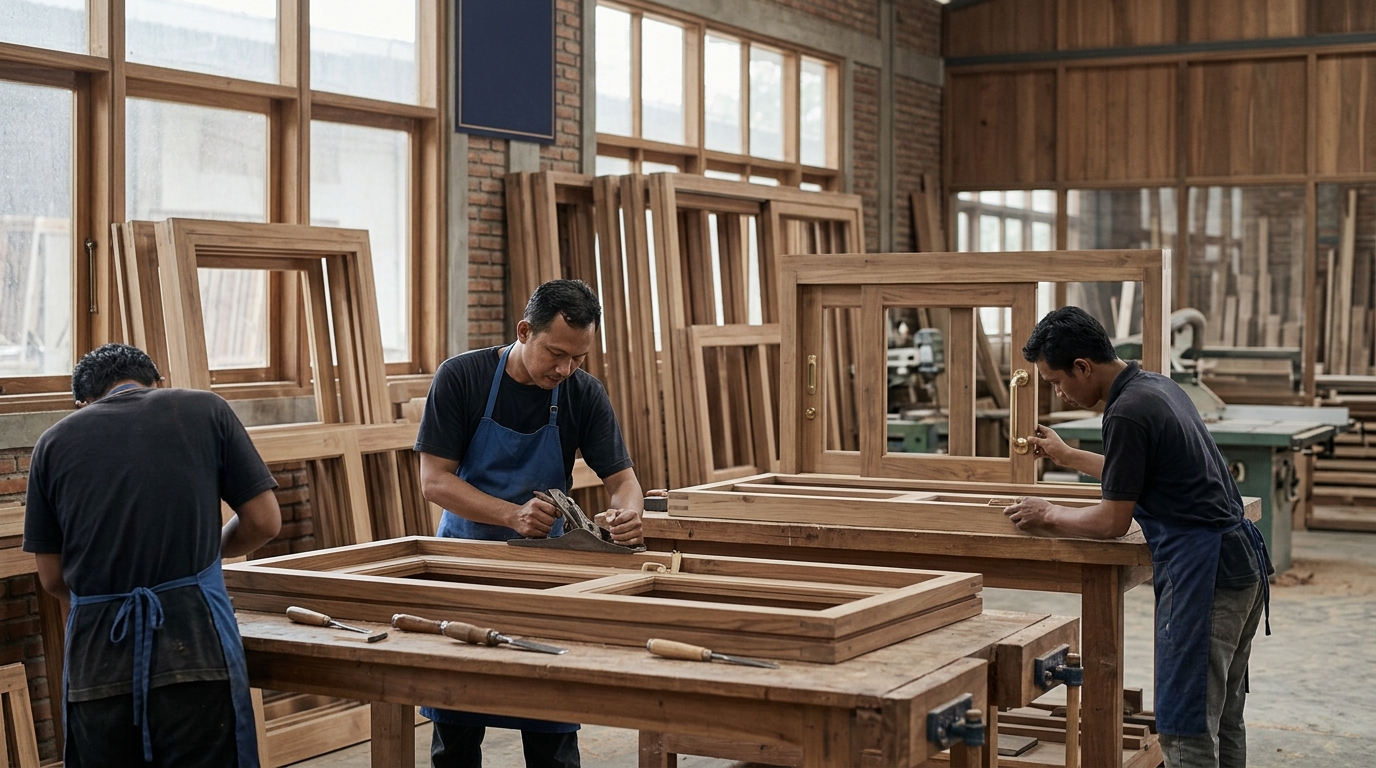
Sourcing hardwood window joinery from overseas demands more than a low unit price. US importers, heritage renovation contractors, and architectural procurement managers face a layered decision: species selection, glazing specifications, timber legality compliance, landed cost, and supplier…
Sourcing hardwood window joinery from overseas demands more than a low unit price. US importers, heritage renovation contractors, and architectural procurement managers face a layered decision: species selection, glazing specifications, timber legality compliance, landed cost, and supplier verification — all before a single container ships. Indonesia sits at the centre of this decision for a growing number of buyers.
This guide addresses the full sourcing lifecycle for wooden windows manufacturers Indonesia export. It covers species performance, window formats, glazing options, weather sealing, US import regulations, logistics, supplier qualification, and pricing benchmarks. Each section targets a specific decision point. The goal is to give procurement professionals the technical and commercial intelligence needed to evaluate Indonesian manufacturers with confidence.
Indonesia's wooden window export sector has matured significantly. Factories in Central Java, West Java, and East Java now supply export-grade casement, sliding, and fixed windows to buyers across North America, Europe, and Australia. The US market, driven partly by heritage renovation demand, is an increasingly important destination. Understanding what separates a qualified Indonesian exporter from a high-risk one is the starting point.
Why Indonesian Manufacturers Lead Global Wooden Window Exports
Indonesia's dominance in tropical hardwood joinery is structural, not accidental. Three factors converge: abundant raw material supply, deep craft traditions, and competitive skilled-labour costs relative to European and North American alternatives.
Production Clusters and Their Specialisations
Central Java — particularly the Jepara district — is the most established furniture and joinery manufacturing cluster in Southeast Asia. Factories here have supplied teak window frames, doors, and structural joinery to export markets for decades. West Java, anchored around Cirebon and the greater Bandung area, handles mid-market production with access to port infrastructure at Tanjung Priok (Jakarta). East Java, centred on Surabaya, concentrates on mid-to-large scale operations with direct access to Tanjung Perak port.
Each cluster has different strengths. Jepara factories typically excel in solid teak and merbau joinery with handcraft finishing. West Java manufacturers often operate more industrialised lines suited to higher-volume, standardised window formats.
Heritage Renovation Demand as a US Growth Driver
US heritage renovation contractors represent a distinct and growing buyer segment for wooden windows manufacturers Indonesia export. Historic preservation projects — particularly in the Northeast, Mid-Atlantic, and Pacific Coast states — require timber species and profile options that domestic US suppliers increasingly struggle to provide at competitive prices. Indonesian teak and merbau windows match the dimensional stability, grain character, and finishing quality required for landmark and period-accurate renovation work.
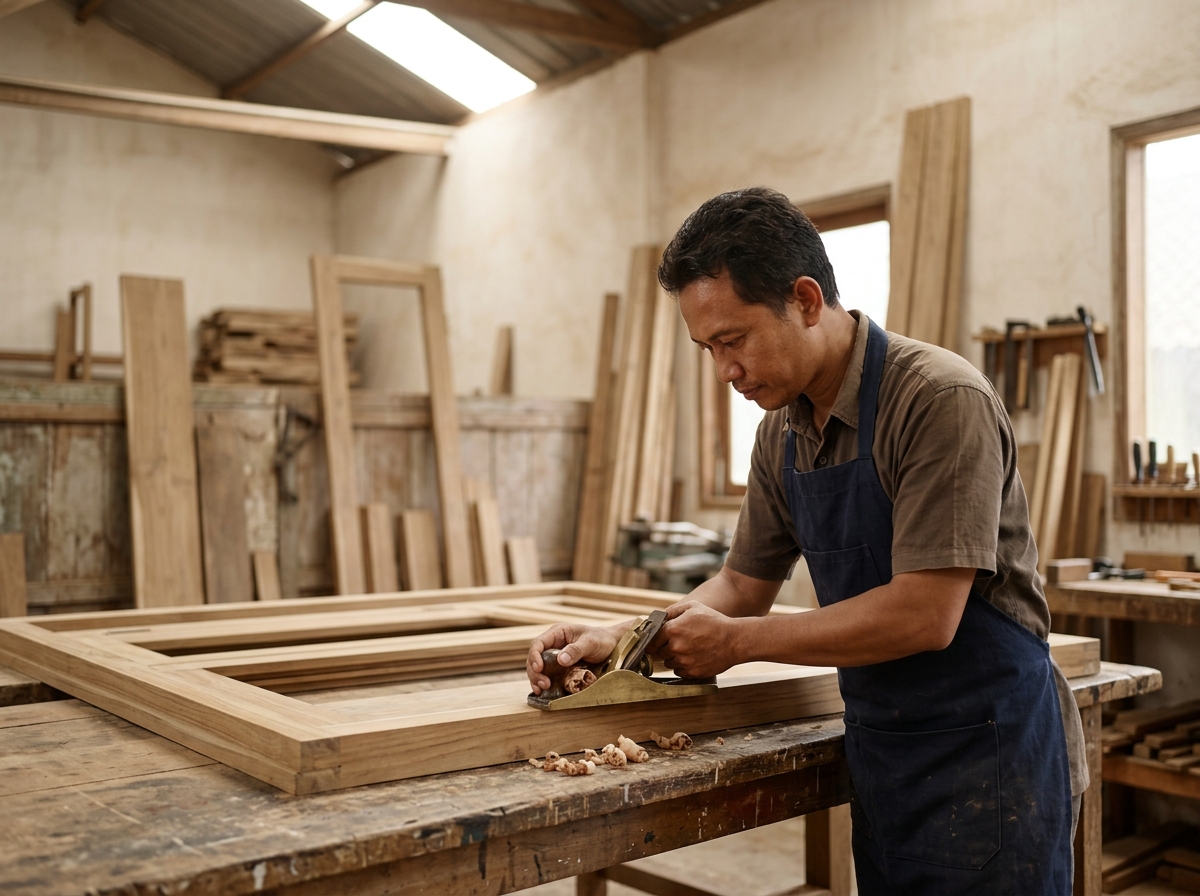
Hardwood Species Used in Indonesian Wooden Windows: Performance by Climate Zone
Species selection is the most consequential technical decision in sourcing wooden windows from Indonesia. Each species performs differently under US climate conditions.
Species Comparison Table
| Species | Scientific Name | Janka Hardness (approx.) | Natural Oil | Termite Resistance | Typical Use |
|---|---|---|---|---|---|
| Teak | *Tectona grandis* | ~1,070 lbf | High | Excellent | Exterior casement, heritage |
| Merbau | *Intsia bijuga* | ~1,925 lbf | Moderate | Excellent | Exterior sliding, commercial |
| Bengkirai | *Shorea laevifolia* | ~1,630 lbf | Low-moderate | Good | Casement, sliding, budget |
| Ulin / Ironwood | *Eusideroxylon zwageri* | ~3,000 lbf (approx.) | High | Outstanding | High-humidity, coastal |
Teak (Tectona grandis) is the benchmark species for export joinery. Its high natural oil content resists moisture penetration without requiring heavy surface treatment. Dimensional stability under seasonal humidity swings — common across US climate zones 4 through 7 — is excellent. Teak is the preferred choice for heritage renovation and premium residential projects.
Merbau (Intsia bijuga) is denser and harder than teak. It performs well in exterior applications where structural rigidity matters, such as large sliding window frames. Its moderate natural oil content requires a proper primer system for North American exterior conditions. Merbau is often cost-competitive with teak while delivering comparable durability.
Bengkirai (Shorea laevifolia) is the volume-production alternative. It is widely used in casement and sliding window frames where budget is a primary constraint. Surface finishing requirements are higher than teak. Buyers should specify kiln-drying to below 12% moisture content to reduce warping risk in transit.
Ulin / Ironwood (Eusideroxylon zwageri) is exceptional in high-humidity and coastal environments. Its hardness makes machining more demanding, which drives up production costs. CITES listing considerations apply — see the compliance section below.
Window Formats Available From Indonesian Factories: Casement, Sliding, and Fixed
Casement Windows
Indonesian manufacturers produce casement windows in both single and double-leaf configurations. Hinge options include surface-mounted and concealed butt hinges, with friction-stay hardware available from European hardware suppliers (Roto, Siegenia) commonly specified by US-bound factories. Standard size ranges typically run up to approximately 1,200mm width per leaf and 2,400mm height, though custom sizing is routine.
Frame profiles are typically mortise-and-tenon jointed at corners, with a rebated sill for drainage. Factories in Jepara commonly offer ogee, ovolo, and flat-profile options to match heritage or contemporary specifications.
Sliding Wooden Windows
Sliding window frames use either bottom-roller or top-hung track systems. Export-grade sill design incorporates a sloped drainage groove and EPDM brush-pile seals on the meeting stile. For US buyers, specifying stainless-steel track hardware is advisable to prevent galvanic corrosion in coastal climates.
Fixed-Light and Feature Glazing
Fixed wooden windows are common in heritage facade restoration. They require no hardware beyond glazing beads, which reduces cost and simplifies compliance documentation. Indonesian factories can produce shaped fixed lights — arched, circular, or polygonal — to match existing period profiles. This capability makes them particularly relevant for landmark building restoration projects.
Custom Profiles and Mullion Options
Most mid-to-large Indonesian factories offer CNC-routed custom profiles. Provide a technical drawing in DXF or PDF format. Factories typically produce a sample profile within two to four weeks before full production confirmation.
Glazing Options Offered by Indonesian Wooden Window Exporters
Indonesian factories increasingly offer glazed units as part of the export package. Understanding what is available — and what must be sourced separately — is critical for landed-cost calculations.
Single glazing remains common in heritage restoration work where double glazing would compromise sight-line authenticity. Typical thickness is 4mm or 6mm float glass. For US imports, single glazing does not meet IECC energy code requirements for new construction but is permissible in historic preservation contexts under the Secretary of Interior Standards.
Double glazing (IGU) is available from a growing number of Indonesian exporters. Units are typically 24mm or 28mm overall, with 4mm glass / 16mm argon-filled spacer / 4mm glass configurations. Warm-edge spacer bars (Swisspacer or equivalent) are available on request. Buyers should confirm that the IGU is manufactured by a certified glass unit supplier — most Indonesian joinery factories source IGUs from local glass fabricators rather than producing them in-house.
Laminated safety glass (6.38mm minimum, PVB interlayer) is relevant for US projects subject to CPSC 16 CFR Part 1201 or local building code safety glazing requirements. Confirm laminated glass availability and certification documentation before ordering.
Low-E glass compatibility is increasingly common. Most Indonesian exporters can source Low-E coated glass (typically coating #2 or #3 position) from regional glass suppliers. Lead times for Low-E IGU production add approximately two to three weeks to standard schedules.
Weather Sealing and Finishing Standards for Export-Grade Wooden Windows
Perimeter Seals
Export-grade Indonesian wooden windows typically use EPDM compression seals on the frame-to-sash interface. Silicone seals are used at glass-to-glazing-bead joints. For US North American climates, verify that the EPDM specification is rated for UV exposure and temperature cycling from approximately -30°C to +80°C.
Factory Finishing Systems
Indonesian exporters offer three common finishing approaches for wooden windows destined for the US market:
- Clear penetrating oil (teak oil or modified linseed): suitable for teak and merbau; leaves the grain visible; requires field top-coating on arrival. - Water-based stain and primer system: lower VOC, faster flash times; compatible with field-applied topcoats. - Full factory finish (solvent-based alkyd or polyurethane primer plus topcoat): highest protection; specify UV-resistant topcoat for exterior North American conditions.
For any factory-finished window, request a finish data sheet specifying the product used, number of coats, and dry-film thickness. This information is necessary for warranty and maintenance documentation.
Moisture Content Requirements
Kiln-dried hardwood for export joinery should reach a moisture content (MC) of approximately 10% to 12% before finishing and packing. Wood shipped above approximately 15% MC risks warping, joint failure, and finish adhesion problems on arrival. Request kiln-drying records (date, chamber temperature profile, and final MC readings) as part of your pre-shipment documentation package.
US Import Regulations, Indonesia Tariffs, and Timber Legality Compliance
Lacey Act: Species Declaration and Chain-of-Custody
The Lacey Act (16 U.S.C. §§ 3371–3378) requires US importers to declare the plant species, country of harvest, quantity, and value for all imported wood products. For Indonesian wooden windows, this means:
- Declaring each timber species by scientific name (e.g., Tectona grandis for teak, Intsia bijuga for merbau). - Obtaining a chain-of-custody document from your Indonesian supplier tracing wood back to the harvesting concession. - Filing a Plant and Plant Product Declaration (PPQ Form 505) with US Customs and Border Protection (CBP) at the time of import entry.
- ✓Scientific species name for each timber component
- ✓Country of harvest (Indonesia, with province if available)
- ✓Harvest concession or forest management unit reference
- ✓SVLK certificate number and validity date
- ✓Volume in cubic metres per species
- ✓Supplier-signed chain-of-custody declaration
SVLK Certification and US Customs Relevance
Indonesia's SVLK (Sistem Verifikasi Legalitas Kayu) is the government-mandated Timber Legality Verification System. SVLK-certified exporters can issue a V-Legal document, which serves as evidence of legal timber origin under Lacey Act due-care requirements. While SVLK is not a legal substitute for a PPQ 505 declaration, it substantially satisfies the due-diligence standard that Lacey Act enforcement expects.
Require SVLK documentation from any Indonesian supplier. Non-SVLK exporters represent a compliance risk.
HTS Codes and Import Tariffs
Wooden windows from Indonesia are classified under the US Harmonized Tariff Schedule as follows:
| HTS Code | Description | General Rate of Duty |
|---|---|---|
| 4418.10 | Windows, French windows, and their frames, of wood | Free (Column 1, General) |
| 4418.10.90 | Other wooden windows and frames | Free |
As of the time of writing, Indonesian wooden windows generally enter the US duty-free under the standard Most Favoured Nation (MFN) rate. Confirm current rates with a licensed US customs broker before importing, as tariff schedules are subject to revision.
CITES Considerations
Ulin (Eusideroxylon zwageri) is listed under CITES Appendix II, meaning export requires a CITES permit from Indonesian authorities. Certain teak stocks sourced from non-plantation origins may also attract scrutiny. Plantation-grown teak (Tectona grandis) from certified Indonesian sources is not CITES-restricted but requires documentation confirming plantation origin.
Export Packing, Shipping Logistics, and Lead Times to the US
Standard Export Crating
Export-grade wooden windows from Indonesia are typically packed in:
- Individual units wrapped in PE foam and polyethylene film (moisture barrier). - Grouped in timber-framed wooden crates, often heat-treated to ISPM 15 standard (required for US entry). - Foam corner protection on frame edges. - Desiccant sachets inside crates for ocean transit humidity control.
Request ISPM 15 phytosanitary treatment certificates for all wooden crating. US CBP can refuse entry for non-compliant packing materials.
FCL vs. LCL Container Options
| Shipment Type | Typical Order Size | Cost Efficiency | Transit Risk |
|---|---|---|---|
| FCL (20-ft container) | Approximately 80–150 window units (size-dependent) | High | Lower (no co-loading) |
| FCL (40-ft container) | Approximately 180–300 window units | Highest | Lowest |
| LCL (Less than Container Load) | Small batch, under ~30 units | Lower per-unit efficiency | Higher (co-loading, more handling) |
For heritage renovation projects with small unit counts, LCL is often the only practical option. Consolidation services through Semarang or Surabaya freight forwarders are widely available.
Lead Times and Port Options
| Stage | Typical Duration |
|---|---|
| Sample development and approval | 2–4 weeks |
| Production (standard order) | 6–10 weeks |
| Ocean freight (Surabaya to US West Coast) | 18–25 days (approx.) |
| Ocean freight (Jakarta to US East Coast via Suez) | 28–35 days (approx.) |
| US customs clearance | 3–7 business days |
| **Total: Order to delivery (US warehouse)** | **Approximately 12–18 weeks** |
Primary ports of departure are Tanjung Perak (Surabaya) for East and Central Java factories, and Tanjung Priok (Jakarta) for West Java manufacturers. Use a freight forwarder with direct Indonesia experience — general Asian freight forwarders sometimes lack the inland transport and export documentation knowledge specific to Indonesian joinery shipments.
How to Qualify and Audit Indonesian Wooden Window Manufacturers
Key Certifications to Verify
- FSC (Forest Stewardship Council): confirms responsible forest management in the supply chain. Relevant for US buyers with sustainability mandates. - SVLK: mandatory baseline for legal timber export from Indonesia. Non-negotiable. - ISO 9001: indicates a documented quality management system. More common among larger Indonesian factories.
Pre-Shipment Inspection Checkpoints
Commission a third-party pre-shipment inspection (PSI) from a qualified inspection company operating in Indonesia. Inspection should cover:
- Frame dimensions against approved drawings (tolerance: typically ±1.5mm). - Moisture content spot-check (pin or pinless meter on multiple units). - Finish coat coverage, colour consistency, and surface defects. - Glazing seal integrity (visual and light pressure test). - Hardware function (hinge operation, lock engagement on casements). - Packing condition before container loading.
Sample Order Process and MOQ
Most mid-size Indonesian factories accept sample orders of one to five units for approval before full production. Expect to pay full cost for samples, with no offset against production pricing. Typical MOQs for production orders range from approximately 20 to 50 units per window type for standard formats. Custom profiles or species may carry higher MOQs — confirm per factory.
Red Flags in Supplier Qualification
- Refusal to provide SVLK documentation or kiln-drying records. - Species descriptions using only common names with no scientific name confirmation. - No verifiable factory address or resistance to third-party audit. - Price quotes significantly below market range for the specified species (a signal of species substitution). - No sample lead time — immediate bulk availability claims are unrealistic for custom joinery.
Pricing Benchmarks and Total Landed Cost for Indonesian Wooden Windows
Ex-Works Price Ranges by Species and Format
The following ranges are approximate and vary by factory scale, profile complexity, glazing specification, and order volume.
| Window Type | Teak (Ex-Works, approx.) | Merbau (Ex-Works, approx.) | Bengkirai (Ex-Works, approx.) |
|---|---|---|---|
| Standard casement (900×1200mm, single glazed) | Mid-to-upper range | Mid range | Lower-mid range |
| Sliding window (1800×1200mm, single glazed) | Upper range | Mid-upper range | Mid range |
| Fixed light (600×900mm, single glazed) | Mid range | Mid range | Lower range |
| IGU upgrade (per unit, add-on) | +20–35% (approx.) | +20–35% (approx.) | +20–35% (approx.) |
Exact dollar values are omitted here because they shift with raw material markets and exchange rates. Request current ex-works pricing directly from shortlisted manufacturers.
Total Landed Cost Calculation: Cost Layers
| Cost Component | Notes |
|---|---|
| Ex-works unit price | Varies by species, format, glazing |
| Export packing | Typically 3–6% of ex-works |
| Inland freight to port (Indonesia) | Varies by factory location |
| Ocean freight (FCL or LCL) | Surabaya to Los Angeles: variable by market |
| US customs entry and brokerage | Typically a few hundred USD per shipment |
| Import duty | Currently 0% for HTS 4418.10 |
| US port handling and drayage | Market rate |
| Third-party inspection (PSI) | Typically a few hundred USD per inspection visit |
| Warehousing (if applicable) | Project-specific |
Indonesian wooden windows typically land at a significantly lower cost than equivalent European hardwood window joinery (UK, German, or Scandinavian manufacturers) and are cost-competitive against US domestic hardwood window producers, particularly for teak and merbau species not widely available domestically.
Volume Discounts and OEM/Private Label
Factories in Central and West Java commonly offer tiered pricing with meaningful discounts at order volumes of approximately 100 units and above. OEM and private-label programs — including custom hardware, branded packaging, and bespoke profile development — are available from mid-to-large factories with established export programs.
Frequently Asked Questions From US Importers
What hardwood species are best for exterior wooden windows sourced from Indonesia? Teak (Tectona grandis) is the benchmark for exterior joinery. It combines natural oil content, dimensional stability, and finish longevity. Merbau (Intsia bijuga) is a strong alternative with higher density. For coastal and high-humidity US climates, ulin is exceptional but carries CITES documentation requirements.
Does Indonesia require SVLK or FSC certification for wooden window exports to the US? SVLK is required under Indonesian law for all timber product exports. FSC certification is voluntary but increasingly expected by US buyers with sustainability policies. Both should be requested as baseline documentation.
What US import tariff (HTS code) applies to wooden windows from Indonesia? Wooden windows and frames from Indonesia are classified under HTS 4418.10. The current MFN general duty rate is free (0%). Confirm with a licensed customs broker before shipment, as tariff classifications can be disputed on complex or composite products.
Can Indonesian manufacturers supply double-glazed wooden windows with Low-E glass? Yes. A growing number of Indonesian exporters offer IGU glazing with Low-E coatings. Confirm the glass supplier's certification, spacer specification, and argon-fill availability. Add approximately two to three weeks to standard lead times for Low-E IGU sourcing.
What is the typical lead time from order to delivery for Indonesian wooden windows to the US? Approximately 12 to 18 weeks total, including production (6–10 weeks), ocean freight (18–35 days depending on destination port), and US customs clearance.
How should I verify the timber legality of wooden windows imported from Indonesia under the Lacey Act? Request SVLK documentation, a chain-of-custody declaration by species and scientific name, and harvesting concession references. File a PPQ Form 505 at import entry. Use a customs broker experienced with wood product imports to manage the declaration workflow.
Indonesian wooden windows offer a compelling combination of species diversity, joinery craft, glazing flexibility, and cost efficiency. The supply chain is navigable for US importers who establish clear specifications, demand proper compliance documentation, and conduct pre-shipment inspection as standard practice.
Qualified manufacturers — particularly those holding SVLK, FSC, and ISO 9001 credentials — deliver export-grade hardwood window joinery that meets US heritage renovation standards and commercial project requirements at landed costs that domestic and European alternatives rarely match.
You now have the sourcing framework to evaluate Indonesian wooden window manufacturers against your project requirements.
Request a quote from verified Indonesian wooden window manufacturers today — including species specifications, glazing options, SVLK documentation, and ex-works pricing for your project volume.
Request a Manufacturer Quote →Need eyes on the ground in Indonesia?
MTS is an execution partner — supplier verification, manufacturing management, quality control and export logistics across Indonesia, Vietnam and China.
Related services
Related articles
Receive furniture sourcing insights across Asia.
One email per week. No spam.