Philippines Customs: Bureau of Customs Import Compliance Guide
12 min read
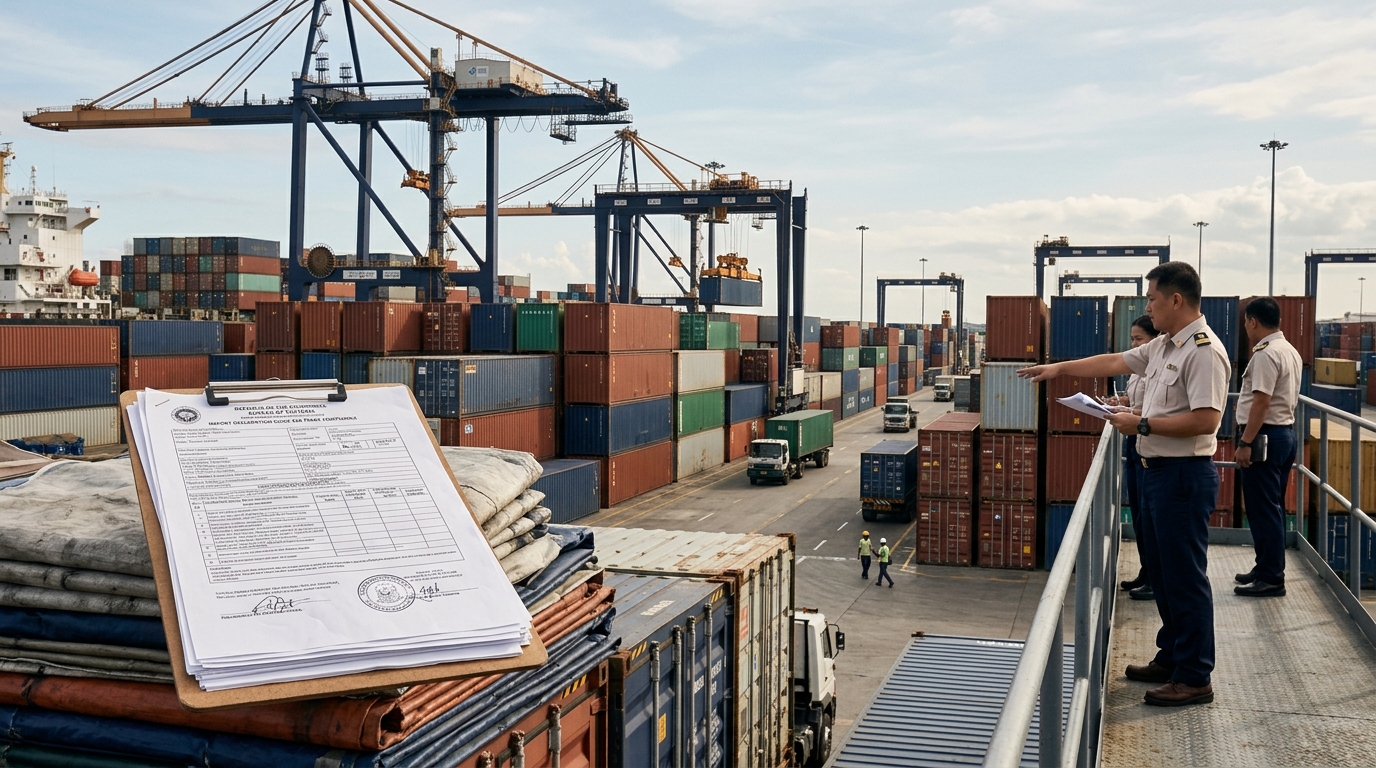
Importing through the Philippines Bureau of Customs requires accurate declarations, correct preferential origin forms, and familiarity with the e2m system — errors at any stage trigger holds, re-examination fees, or duty reassessment. This guide covers the declaration process, ATIGA and RCEP certificate requirements, restricted commodity controls, and how to work with accredited filers.
For procurement teams and brand owners routing product through the Philippines, navigating customs philippines-side demands more preparation than many first-time importers anticipate. The Philippines Bureau of Customs (BOC) operates an electronic processing environment, a risk-based selectivity system, and a network of other government agency (OGA) permit requirements that all intersect at the point of entry. A shipment that is correctly manufactured, properly insured, and on-time at the port can still be held for days or weeks if the documentation set is incomplete or the entry is incorrectly lodged. Understanding the system before the cargo moves is the most cost-effective form of risk management available.
The BOC is the primary authority administering import and export controls under the Customs Modernization and Tariff Act (CMTA). Its mandate covers tariff assessment, physical and documentary examination, and enforcement of import restrictions on behalf of multiple Philippine government agencies. For B2B importers, the practical interface with BOC happens almost entirely through the e2m Customs system, which requires all formal import entries to be transmitted electronically by an accredited intermediary. There is no walk-in or paper-based filing pathway for commercial shipments. Every party in the supply chain — importer, broker, freight forwarder — needs to understand which accreditations are current and which system roles each party fills.
This guide addresses the specific compliance tasks that matter most for companies importing manufactured goods, components, or raw materials through Philippine ports of entry including Manila (Port of Manila and Manila International Container Terminal), Cebu, Subic, and Clark. It covers the declaration process under e2m, how to correctly claim preferential duty rates under ATIGA and RCEP, which commodity categories face the most friction at customs philippines entry points, and how working with properly accredited filers reduces exposure to preventable delays.
Import Export Documentation Support for Asia-Origin Shipmentsprovides a broader framework for managing documentation across Asia-origin supply chains — the Philippines-specific detail below sits within that wider context.
How the e2m Electronic Customs System Structures Every Import Entry
The e2m system is the BOC's end-to-end electronic processing environment. Import entries, duty payments, examination instructions, and release orders all flow through it. For an importer, the most important practical point is that access to e2m is restricted to BOC-accredited customs brokers and Value-Added Service Providers (VASPs). The importer does not interact with e2m directly; instead, they supply the required commercial documents and declarations to their broker or VASP-linked agent, who then transmits the formal entry.
Once transmitted, the system assigns the entry to a selectivity lane — green, yellow, or red — based on automated risk criteria. Green-lane entries proceed to assessment and payment with document review only. Yellow-lane entries trigger a documentary audit by an examiner before assessment. Red-lane entries require physical inspection of the cargo. The assigned lane can change if discrepancies are identified at any stage.
Importers should also note that the BOC requires importer accreditation as a prerequisite for lodging entries. A company that has not previously imported into the Philippines must complete BOC importer accreditation before the first shipment arrives. This process involves submission of business registration, tax identification, and other corporate documents, and typically takes several weeks to complete.
Completing the Import Entry and Internal Revenue Declaration Correctly
The core declaration document for Philippine imports is the Import Entry and Internal Revenue Declaration (IEIRD), sometimes referred to as a Single Administrative Document equivalent. The IEIRD captures the tariff classification (HS code), customs value, country of origin, quantity, and applicable duties and taxes. All of these elements are subject to BOC verification and potential reassessment.
Tariff Classification and Valuation
The Philippines uses the ASEAN Harmonized Tariff Nomenclature, which aligns with the WCO Harmonized System at the six-digit level and extends to eight digits for national specificity. Incorrect tariff classification is one of the most common sources of duty underpayment findings in post-clearance audits. Importers bringing in new product categories should obtain a binding ruling from the BOC's Tariff Commission before the first shipment if there is genuine ambiguity about classification.
Customs valuation follows the WTO Customs Valuation Agreement, with transaction value as the primary method. The BOC maintains reference prices for certain product categories, and declared values that fall significantly below those references are likely to trigger yellow or red lane assignment. When the declared price genuinely reflects a legitimate transaction — for example, on a related-party transfer — supporting documentation demonstrating arm's-length pricing should accompany the entry.
Duties, VAT, and Other Import Taxes
In addition to customs duties, imports into the Philippines are subject to value-added tax (VAT) assessed on the dutiable value plus duty. Certain products also attract excise tax. For companies importing regularly, understanding the full landed-cost stack — duty rate, VAT base, and any applicable excise — is essential for accurate product costing. The applicable MFN duty rate depends on the HS code; rates vary considerably across product categories.
Claiming Preferential Duty Rates with ATIGA Form D and RCEP Certificates
The Philippines is party to multiple free trade agreements that offer reduced duty rates for qualifying goods. For companies sourcing from other ASEAN member states, the ASEAN Trade in Goods Agreement (ATIGA) and the Regional Comprehensive Economic Partnership (RCEP) are the two most relevant instruments.
ATIGA Form D Requirements
ATIGA Form D is the certificate of origin that unlocks preferential tariff treatment for goods originating in ASEAN countries. It must be issued by the designated competent authority in the exporting country — for example, the relevant ministry of trade or chamber of commerce authorized for that purpose — and presented to Philippine customs at the time the entry is lodged. The form must accurately reflect the HS code, the origin criterion met (wholly obtained or substantial transformation), and the FOB value of the goods.
Common errors that cause ATIGA Form D rejection at customs philippines include: HS code on the form that does not match the IEIRD, FOB value discrepancies, missing or illegible issuing authority stamp, and submission after cargo release without an advance ruling covering retroactive claims. Where Form D is not available at entry, importers may lodge under the MFN rate and subsequently apply for a refund upon securing the certificate, though this process involves administrative complexity and is better avoided.
RCEP Certificate of Origin
The RCEP Certificate of Origin (Form RCEP) is an alternative origin instrument available for goods from ASEAN members and non-ASEAN RCEP parties such as China, Japan, South Korea, Australia, and New Zealand. For goods from ASEAN origins, both ATIGA and RCEP preferences may be available, and the applicable duty rate under each agreement can differ by HS code. Importers should compare both rate schedules before deciding which certificate to request from their supplier. The decision is made per shipment and per HS code; a blanket preference for one agreement over the other without rate verification leaves potential duty savings on the table.
Restricted Commodities and Other Government Agency Clearances
Beyond customs duties, a significant number of product categories require clearance from Philippine government agencies other than the BOC before or alongside customs release. The BOC enforces these OGA requirements at the border; goods without the required permits are held regardless of how accurately the customs entry itself is completed.
The table below summarizes the most commonly encountered OGA clearance categories for B2B importers:
| Product Category | Primary Regulating Agency | Key Requirement |
|---|---|---|
| Food, drugs, cosmetics, medical devices | Food and Drug Administration (FDA-PH) | Product registration or LTO, import permit |
| Agricultural products, seeds, plants | Bureau of Plant Industry / Bureau of Animal Industry | Phytosanitary or veterinary import permit |
| Chemicals under Chemical Control Order | DENR-EMB | Chemical Import Clearance Certificate |
| Consumer products under mandatory standards | DTI – Bureau of Philippine Standards | Import clearance or product certification |
| Firearms, explosives, radioactive materials | PNP / PNRI / DND | Specific authority-to-import permits |
For companies importing into PEZA-accredited economic zones or BOI-registered enterprises, additional tax and duty incentive frameworks apply. PEZA-registered entities importing capital equipment or raw materials for export production operate under a separate clearance protocol, and the BOC has dedicated PEZA desks at major ports. Understanding whether a business qualifies for PEZA or BOI treatment — and maintaining compliance with the registration conditions — is a separate but connected compliance track that affects overall duty exposure.
Post-Clearance Audit Exposure and How to Manage It
The BOC's Post-Clearance Audit Group (PCAG) has authority to audit importers for periods going back several years from the date of assessment. Post-clearance audits examine tariff classification, customs valuation, origin claims, and compliance with OGA permit conditions. The exposure is not limited to duty underpayments; surcharges and compromise penalties can substantially exceed the original duty differential.
The most effective risk-management approach is consistency and documentation at the time of entry. Importers should maintain complete commercial files — including supplier invoices, proof of payment, cost breakdowns for valuation purposes, and origin documentation — for each shipment. Where there is any classification or valuation uncertainty, a formal advance ruling request to the BOC or Tariff Commission before the first import creates a defensible record. Companies with high-volume regular imports to the Philippines may benefit from a periodic internal compliance review to identify and correct systemic issues before they become audit findings.
Working with Accredited Brokers and Execution Partners for Philippines Imports
Given the electronic-only filing environment, the OGA permit matrix, and the post-clearance audit risk, choosing the right execution partners for Philippines imports is a compliance decision as much as a commercial one. A licensed customs broker with current VASP linkage handles the e2m entry transmission; they must also have experience with the specific product category and familiarity with the relevant OGA permit processes.
For companies sourcing manufactured goods through Asia and routing them through the Philippines, an integrated execution partner who can coordinate the documentation set — commercial invoice alignment, certificate of origin origination at the supplier's export stage, permit pre-application — reduces the number of handoff points where errors accumulate. MTS provides exactly this coordination layer for Asia-origin shipments. For companies exploring sourcing options within the Philippines itself, additional context on the manufacturing landscape is available at [/blog/sourcing-from-philippines-hub].
You can also review the full scope of documentation and customs coordination services MTS provides across Asian markets at [/services].
Frequently Asked Questions
What is the e2m Customs system and who is required to use it?
The e2m (Electronic-to-Mobile) system is the Philippines Bureau of Customs' primary electronic processing platform for import and export entries. All formal import declarations must be lodged electronically through e2m by a bureau-accredited customs broker or Value-Added Service Provider (VASP). Direct electronic self-filing by importers is not permitted; the importer must engage an accredited intermediary to transmit the entry on their behalf.
What documents are required for a standard commercial import shipment into the Philippines?
A standard commercial import typically requires a commercial invoice, packing list, bill of lading or airway bill, Certificate of Origin where preferential duty is claimed, an Import Entry and Internal Revenue Declaration (IEIRD), and any commodity-specific permits or clearances from agencies such as the FDA, DTI, or Department of Agriculture. For regulated products, the permit must be obtained and its reference number lodged in the e2m entry before goods arrive, not after.
How does ATIGA Form D reduce import duty for goods sourced from ASEAN countries?
ATIGA Form D is the ASEAN Trade in Goods Agreement certificate of origin that entitles qualifying goods to preferential tariff rates under the ASEAN Common Effective Preferential Tariff schedule. To claim the preference at Philippine customs, the Form D must be issued by a competent authority in the exporting ASEAN member state, presented at the time of entry lodgment, and correctly reference the HS code, origin criterion, and FOB value. If the form contains errors or is submitted late, the preferential rate is disallowed and the standard MFN duty applies.
Can importers use RCEP Form RCEP instead of ATIGA Form D for ASEAN-origin goods?
Yes. The Philippines acceded to the Regional Comprehensive Economic Partnership, and importers may choose to use the RCEP Certificate of Origin (commonly referred to as Form RCEP) as an alternative to ATIGA Form D for goods from ASEAN members that are also RCEP parties. The choice of which agreement to invoke is made per shipment at the time of entry, and the importer should compare the applicable duty rate under each agreement for the specific HS code before deciding. Both certificates must meet origin and documentary criteria; they are not interchangeable after entry lodgment.
Which commodities are commonly subject to restrictions or additional permits at Philippines Customs?
A range of product categories require clearance from other government agencies before or alongside customs clearance. These include food, drugs, cosmetics, and medical devices regulated by the Food and Drug Administration (FDA-PH); agricultural products subject to Bureau of Plant Industry or Bureau of Animal Industry clearance; chemicals covered by the Chemical Control Order under the Department of Environment and Natural Resources; and certain consumer products under DTI standards. Importers of these goods should confirm permit requirements before the shipment departs origin to avoid costly holds at the port.
What triggers a physical examination or post-clearance audit at the Bureau of Customs?
The Bureau of Customs uses a risk-management selectivity system that routes entries into green (documents only), yellow (document verification), or red (physical examination) lanes. Factors that increase the likelihood of examination include mismatches between declared value and BOC reference prices, inconsistent HS code histories for an importer, low declared dutiable values on high-value product categories, and irregular origin documentation. Post-clearance audits can be initiated up to several years after release, making accurate declaration at entry critical rather than optional.
What is a VASP and why does it matter for importers filing through e2m?
A Value-Added Service Provider (VASP) is a BOC-accredited technology intermediary authorized to transmit customs entries and supporting documents through the e2m platform. Importers must work either through a VASP directly or through a licensed customs broker who has a VASP arrangement. Choosing a broker or filing agent without active VASP accreditation will result in entry rejection at the system level. When evaluating freight forwarders or brokers for Philippines shipments, confirming their current VASP or VASP-linked status is a practical due-diligence step.
Compliance with Philippines customs requirements is not a one-time exercise; it is a continuous process that evolves as tariff schedules are updated, OGA permit conditions change, and trade agreement preference rates are phased. Companies that build documentation discipline and accredited-partner selection into their standard procurement and logistics process consistently experience fewer holds, lower post-clearance audit exposure, and more predictable landed costs. Getting the fundamentals right at each shipment is the most reliable way to protect margins and delivery timelines on Philippines-bound cargo.
Need eyes on the ground in the Philippines?
MTS is an execution partner — supplier verification, manufacturing management, quality control and export logistics across Indonesia, Vietnam and China.
Related services
Related articles
Receive furniture sourcing insights across Asia.
One email per week. No spam.