Malaysia Import & Export Customs: Declaration Guide for B2B Traders
17 min read
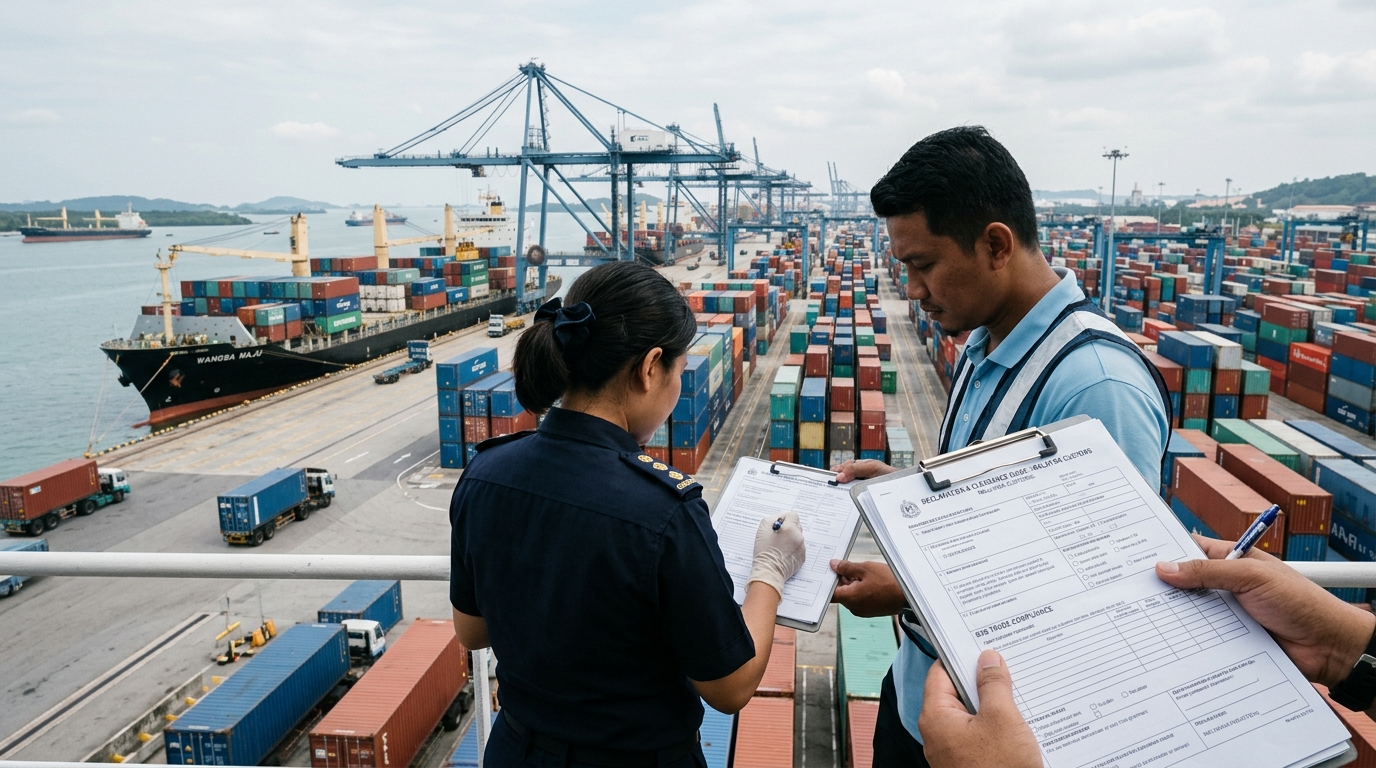
Clearing goods through Malaysian customs requires accurate declarations via SMK Dagang.Net, correctly completed K1 and K2 forms, and a clear understanding of preferential tariff schemes such as ATIGA Form D and CPTPP. This guide covers the process end to end for procurement managers and supply-chain teams.
Malaysia sits at the centre of several major global trade routes, and its customs framework reflects that position — structured, increasingly digitalised, and embedded in a network of preferential trade agreements. For procurement managers and supply-chain teams, understanding malaysia customs is not optional background knowledge; it directly affects landed cost, lead time, and cash flow. Errors in classification, origin documentation, or permit compliance routinely cause holds at Port Klang, Penang, or Johor Bahru that cost more to resolve than they would have cost to prevent.
Administered by the Royal Malaysian Customs Department (RMCD), the national electronic single-window portal known as SMK Dagang.Net serves as the mandatory processing hub for all import and export activity across the country. Whether a shipment arrives by sea at Westports, moves through air cargo channels at KLIA, or crosses the northern land border at Bukit Kayu Hitam, every commercial declaration must be routed through this centralized platform. Within a single transaction record, the system consolidates customs duties, excise obligations, sales and service tax (SST) assessments, and permit verification requirements drawn from several government agencies simultaneously. For B2B operators navigating malaysia customs compliance, a working knowledge of how SMK Dagang.Net processes data — and what constitutes accurate input — translates directly into faster clearance times and fewer surprise costs at the border.
Malaysian trade policy extends well beyond domestic declaration procedures, operating within a framework of overlapping preferential agreements that include ATIGA — governing commerce among ASEAN member states — and CPTPP, which covers eligible trading partners beyond the regional bloc. For qualifying shipments, these arrangements can meaningfully reduce duty liability, yet businesses should not treat those reductions as guaranteed. Accessing preferential rates depends on submitting valid certificates of origin, properly completed and lodged at the point of entry into Malaysia customs clearance. Companies face tangible commercial risk on two fronts: missing a valid preference claim at the border, or applying one to goods that fall outside the agreement's qualifying criteria.
This guide covers the declaration process, key forms, preferential tariff mechanisms, halal import considerations, and restricted-goods classifications for anyone managing B2B trade through Malaysia. It is written for operational use, not as a substitute for licensed customs advice on specific shipments.
How SMK Dagang.Net Processes Malaysian Import and Export Declarations
Operated as the country's unified trade facilitation platform, SMK Dagang.Net integrates port authorities, licensed customs agents, traders, and government regulatory bodies within a single digital environment. Electronic submission through this system is mandatory for all commercial declarations covering inbound and outbound shipments, and no cargo may be loaded onto a vessel or released from a facility until an approved response is generated by the platform confirming clearance by malaysia customs authorities.
When importers and exporters lodge entries via the SMK Dagang.Net system, each submission passes through an automated risk-scoring framework maintained by malaysia customs authorities. Consignments rated as low-risk generally clear with little to no manual intervention, whereas those flagged at higher risk levels are routed toward document verification or physical examination. Several variables feed into this scoring process: the sensitivity of the applicable HS tariff code, how the declared value compares against benchmark reference prices, the country of origin, and the filing track record of the business concerned. Companies that demonstrate a sustained history of precise and compliant declarations progressively benefit from more efficient clearance cycles.
Getting the information right before submission is essential. While the Royal Malaysian Customs Department does allow corrections to accepted declarations, such amendments draw regulatory attention and can trigger a post-clearance compliance review. Based on patterns observed across client shipments, the filing mistakes that arise most frequently involve the wrong tariff classification being applied to goods, discrepancies between the commercial invoice value and the figure recorded in the declaration, and import permits that had either lapsed or were never obtained—problems that only come to light after the carrying vessel has already reached port.
Understanding K1 and K2 Customs Declaration Forms in Malaysia
Inside the SMK Dagang.Net platform, each commercial declaration must be submitted under a designated form category. For businesses handling general cargo through Malaysia customs, the K1 and K2 forms represent the two most commonly used declaration types.
K1: Import Declaration Form
When goods arrive in Malaysia destined for the domestic market rather than a bonded or transit arrangement, importers lodge a K1 declaration to formally release those goods into home consumption. This submission must capture the HS classification code, customs-assessed value, country of origin, applicable tariff rate, and any relevant permit references, along with excise duty obligations where they arise and SST liability. Critically, businesses seeking reduced duty rates under preferential trade agreements such as ATIGA or CPTPP cannot attach the origin certificate reference after the fact — that reference must appear on the K1 at the point of declaration. The only exceptions are where a formal declaration amendment or a recognised post-importation preferential claim procedure is properly initiated through the relevant Malaysia customs authority channels.
K2: Export Declaration Form
Commercial exporters shipping goods out of Malaysia are required to submit the K2 form, which serves as the official export declaration for all trade consignments. This document captures several critical data points: the applicable HS tariff code, the shipment's FOB-based export value, the intended destination country, and any export permits associated with controlled or regulated products. Businesses operating manufacturing facilities within free trade zones in Penang, Johor, or Selangor will find that the K2 declaration also functions as the instrument through which claims for export duty exemptions—where such relief is available—are formally recorded and substantiated for Malaysian customs authority purposes.
When an incorrect declaration form is submitted to Malaysia Customs — such as lodging a K9 for goods that are destined for local distribution rather than re-export — a formal compliance gap is created that cannot resolve itself. Rectifying such a discrepancy requires the importer or declarant to initiate a structured correction procedure, which generally involves submitting substantiating documentation and may also trigger the assessment of outstanding duties or financial penalties.
ATIGA Form D: Claiming Preferential Tariff Rates Within ASEAN
When bilateral or multilateral trade occurs between Malaysia and fellow ASEAN nations, businesses can access significantly reduced duty rates through the ASEAN Trade in Goods Agreement (ATIGA) — rates that often fall well below the standard most-favoured-nation (MFN) benchmark applicable to numerous product classifications. To activate this tariff benefit, exporters must obtain an ATIGA Form D, which functions as an officially recognised Certificate of Origin and must be issued by a designated competent authority within the country of export.
For a Form D to be considered legally valid under ATIGA procedures, it must be issued no later than the moment of shipment—barring a narrow set of permissible exceptions—and the document must provide an accurate description of both the goods and their country of origin, with the relevant reference captured on the K1 declaration at the point of importation into Malaysia. Eligibility for preferential tariff treatment hinges on the applicable rules of origin, which vary by product and may require goods to be wholly obtained within the exporting member state, or alternatively to satisfy either a value-addition threshold or a change in tariff classification. Where third-country materials are incorporated into the manufacturing process, those goods can still attract ATIGA preference provided the transformation or processing carried out within the ASEAN member state meets the requisite standard under the governing rules.
Under ATIGA provisions, importers who failed to submit Form D at the point of entry retain the right to pursue a post-importation preferential tariff claim, provided they do so within one year of the original importation date. To secure such a claim, the importer must engage directly with the Royal Malaysian Customs Department, compiling the necessary supporting documentation and obtaining formal written approval before any reimbursement of excess duties paid can be released.
CPTPP Benefits for Malaysian Importers and Exporters
Ratified under the banner of the Comprehensive and Progressive Agreement for Trans-Pacific Partnership, the CPTPP broadens Malaysia's reach for preferential duty treatment well beyond the ASEAN bloc, encompassing trading partners such as Japan, Australia, Canada, New Zealand, Mexico, Chile, Peru, Vietnam, Singapore, and Brunei. Malaysian producers operating in sectors like electronics, industrial machinery, textiles, and processed food stand to gain measurable reductions in landed costs when shipping into these markets, where standard MFN tariff rates would otherwise represent a substantial commercial burden.
To benefit from CPTPP preferential tariff rates, businesses must substantiate the origin of their goods through accepted documentation. While ATIGA mandates a government-issued Form D as proof of origin, CPTPP operates under a more flexible framework: depending on the exporting member country, certified exporters may submit a self-declaration of origin, or alternatively, an authorised body can issue a formal Certificate of Origin. It is worth noting that CPTPP origin criteria are not uniform across product categories — each item is governed by product-specific rules detailed in Annex 3-D of the agreement. Before concluding that their merchandise qualifies for preferential treatment, B2B traders engaged in malaysia customs compliance processes should first confirm which rule applies to their specific HS code to avoid costly declaration errors.
Duty relief under the CPTPP framework does not take effect all at once — instead, applicable rates step down on an annual basis until the final bound rate, whether zero or an agreed minimum, is fully phased in. Companies building landed-cost models should consult the official CPTPP tariff schedule for the rate that corresponds to the current year, rather than treating the eventual end-stage rate as though it is already in force.
Halal Import Considerations Under Malaysian Customs and Regulatory Requirements
As a leading global hub for halal trade, Malaysia regularly sees importers sourcing products destined for halal-certified supply chains. It is worth noting that the country's customs framework does not establish a distinct import classification for halal goods — all products continue to be assessed under their relevant HS codes and subjected to standard duty rates and SST obligations. That said, halal certification introduces an additional compliance dimension that converges with the broader import process across multiple touchpoints.
Imported food, beverages, cosmetics, and health supplements intended for sale under a halal designation within Malaysia must hold certification from an authority that JAKIM — the Department of Islamic Development Malaysia — formally recognises. Through a bilateral mutual recognition arrangement, JAKIM evaluates and approves select foreign certification bodies, and only those organisations appear on its official recognised-bodies register. Any halal claim attached to a product certified outside this framework cannot be lawfully used in the Malaysian market. Before committing to a product launch, B2B importers operating within the malaysia customs environment should verify that their overseas supplier's certifying organisation is actively listed on JAKIM's register, as that status can change and an outdated approval could expose the entire shipment to compliance risk.
A distinct compliance requirement applies to food and pharmaceutical goods: many such products must be registered with, or cleared by, the Food Safety and Quality Division or the Ministry of Health before they are permitted to enter Malaysia. The corresponding permit or registration reference is ordinarily mandatory within the SMK Dagang.Net K1 declaration submitted at the point of filing. Importers who allow a shipment of regulated food items to reach Port Klang without that authorisation already secured will face a detention that tends to be both protracted and operationally costly to unwind.
Restricted and Controlled Goods: What Requires a Licence to Import or Export
Within Malaysia's import and export regulatory system, a fundamental distinction separates two categories of controlled goods: those that are entirely barred from crossing the border regardless of circumstances, and those that may lawfully enter or leave the country provided the trader first obtains the relevant licence, permit, or official approval from the designated governing authority.
Items barred from entry into Malaysia under the Customs (Prohibition of Imports) Order encompass forged banknotes and fraudulent securities, merchandise that violates intellectual property protections, and specific classes of armaments along with related materials. That regulatory instrument establishes the definitive and binding enumeration of all goods denied importation.
Restricted goods cover a far wider range and include:
Several product categories demand additional regulatory clearance before goods can move through Malaysian customs channels. Agricultural commodities and foodstuffs—particularly those of animal origin—must be backed by permits issued through the Ministry of Agriculture or the Veterinary Services Department. Pharmaceutical products and medical devices are subject to oversight by the Medical Device Authority (MDA) and must satisfy registration obligations under the Control of Drugs and Cosmetics Regulations. Exporters dealing in chemicals that carry dual-use potential need to evaluate whether a Strategic Trade Authorisation (STA) is mandatory under the Strategic Trade Act, which governs controlled technologies and related substances. Trade in wildlife and wildlife-derived products falls under CITES obligations, with PERHILITAN serving as the administering body in Malaysia. Finally, any telecommunications or radio frequency equipment intended for import or export requires prior approval from the Malaysian Communications and Multimedia Commission (MCMC) before it may legally enter commerce.
Whether a product falls under regulatory controls within Malaysia customs procedures depends on its specific HS code and the exact technical description of the goods. Because a single HS heading can encompass items that are subject to restrictions alongside others that are entirely uncontrolled, compliance determination must be made at the individual product classification level rather than at the broader chapter level.
Working With Licensed Customs Agents and Documentation Requirements
Businesses that procure raw materials or operate production facilities in Malaysia will find that engaging a qualified, licensed forwarding agent delivers the greatest reduction in filing inaccuracies and port-clearance bottlenecks. That agent carries the professional obligation to examine all supporting trade documentation—including the commercial invoice, packing list, bill of lading, and any applicable certificates of origin—and translate those records into a compliant, error-free declaration submitted through SMK Dagang.Net.
The core commercial document set for a standard Malaysian import typically includes:
Shipments moving through Malaysian customs clearance typically require a core set of trade documents: a commercial invoice that accurately states the applicable Incoterms, transaction currency, and a thorough description of the goods; a packing list that aligns precisely with the invoice in terms of item counts and declared weights; either a bill of lading or an airway bill depending on the mode of transport; proof of qualifying origin such as Form D, a CPTPP origin declaration, or another recognized certificate; any import permit or licence reference number mandated for controlled goods; and, where the shipment is valued on a CIF basis, a valid insurance certificate covering the consignment.
When submitting an export declaration through malaysia customs, traders must prepare a documentation set comparable to the import process, though it additionally incorporates any required export permits for restricted or controlled commodities, along with phytosanitary certificates or health documentation where the shipment involves agricultural produce or food items.
Maintaining coherence across the entire document set matters just as much as the accuracy of any single record. When processing declarations, Malaysia Customs authorities — including post-clearance audit teams — cross-reference values, item counts, and goods descriptions between multiple submission documents. A mismatch between figures on the commercial invoice and those on the packing list, or a discrepancy between the declared cargo value and the freight charges stated on the bill of lading, frequently prompts inspections or formal queries from officials.
For teams managing multiple Malaysian shipments, the Import Export Documentation Support for Asia-Origin Shipments guide provides a broader framework for managing the full document set across different Asian sourcing origins. Traders specifically evaluating Malaysia as a production or sourcing base can also review MTS's Malaysia sourcing and manufacturing services.
Frequently Asked Questions
What is SMK Dagang.Net and is it mandatory for all Malaysian customs declarations?
Operated by the Royal Malaysian Customs Department (RMCD), SMK Dagang.Net serves as the country's centralized electronic single-window platform for lodging customs declarations. All commercial shipments moving through sea ports, airports, and land border crossings are required to process their import and export documentation through this system. Goods cannot be released until the relevant declarations have been successfully submitted and granted approval within the platform. Those authorized to file directly include licensed customs agents, freight forwarders, and registered businesses that hold UCD (User Commercial Declaration) access credentials — a key consideration for any organization managing malaysia customs compliance in-house.
When should I use a K1 form versus a K2 form in Malaysia?
When goods arrive in Malaysia destined for local consumption, importers must lodge a K1 declaration covering both dutiable and non-dutiable cargo through the SMK Dagang.Net electronic platform. Outbound commercial shipments, by contrast, require submission of a K2 export declaration before clearance can proceed. Filing the incorrect form—or supplying inaccurate incoterms, HS codes, or declared values—invites scrutiny from Malaysian customs authorities, typically resulting in a formal query or an amendment request that holds cargo at the border until the discrepancy is resolved.
How does ATIGA Form D reduce import duties for goods traded within ASEAN?
Issued under the ASEAN Trade in Goods Agreement, the ATIGA Form D serves as the official Certificate of Origin that unlocks preferential duty treatment at Malaysian customs checkpoints. Importers presenting a valid Form D for goods that genuinely originate within an ASEAN member state can access reduced tariff rates that frequently fall well below the standard most-favoured-nation rate. To be recognised, the certificate must come from a government-authorised issuing body in the country of export and must be submitted alongside the corresponding commercial invoice and bill of lading. Where an importer was unable to present the certificate at the time of entry, ATIGA provisions allow retrospective preferential claims for up to 12 months following importation, provided that supplementary documentation is furnished to support the application.
What tariff benefits does CPTPP offer for goods imported into or exported from Malaysia?
As a signatory to the CPTPP agreement, Malaysia grants businesses the opportunity to benefit from reduced duty rates when trading with fellow member countries such as Japan, Australia, Canada, and Mexico, among others. Accessing these concessions requires the importing party to present a valid certificate of origin demonstrating that the shipment satisfies the prescribed rules of origin criteria for the relevant goods. Because the agreement operates on a phased tariff reduction schedule, the duty rate that applies will differ depending on when the goods enter the importing country. Companies engaged in cross-border trade under this framework should always consult the current CPTPP tariff schedule directly, rather than depending on outdated rate information that may no longer reflect the applicable figures.
What permits or documentation are required to import halal-certified goods into Malaysia?
Halal certification alone does not trigger import restrictions under Malaysian customs regulations, yet specific product sectors — including food and beverages, cosmetics, and pharmaceutical goods — are subject to mandatory import permits or registration requirements enforced by bodies such as the Food Safety and Quality Division or the Ministry of Health. Where products are positioned in the Malaysian market under a halal claim, the accompanying certification must originate from JAKIM or a recognised foreign authority that holds accreditation status. Before any shipment departs, importers are strongly advised to verify applicable permit obligations with a licensed customs agent, given that many such permits must be submitted through SMK Dagang.Net prior to the physical arrival of goods at the border.
Which goods are classified as restricted or prohibited under Malaysian customs regulations?
Under Malaysia's customs framework, goods subject to regulatory control fall into two distinct classifications: those that are outright banned from entering or leaving the country, and those that may move across borders only when accompanied by the appropriate licence or official permit. Items that fall within the absolute prohibition category include forged banknotes, certain categories of armaments, and publications or materials deemed offensive under public morality statutes. The restricted classification is considerably wider in scope, encompassing controlled chemical substances, select agricultural commodities, fauna and flora protected under the CITES convention, and designated electronic communications devices. Responsibility for maintaining the definitive schedule of controlled goods rests with the RMCD in coordination with the relevant line ministries, and that schedule is subject to periodic revision. Before confirming any shipment booking, B2B exporters and importers should conduct a current-status check on the applicable HS code to ensure full regulatory compliance.
Can a foreign company without a Malaysian entity file customs declarations directly?
Foreign businesses operating without a local Malaysian entity cannot submit trade declarations independently. Under Malaysian customs requirements, all import and export filings must be lodged through either a licensed customs agent or a locally registered company holding access to the SMK Dagang.Net electronic system. Any overseas organization lacking a physical presence in Malaysia is therefore obligated to engage a licensed freight forwarder or customs broker to represent its interests. That appointed intermediary carries legal responsibility for the accuracy of each declaration submitted, which means shippers must furnish thorough and precise commercial documentation well before the vessel reaches port or clears for departure — encompassing the commercial invoice, packing list, bill of lading, and all relevant certificates of origin.
Malaysia's customs framework is comprehensive but navigable for traders who invest in accurate classification, correct form selection, and properly executed origin documentation. The preference schemes available through ATIGA and CPTPP represent genuine cost opportunities, but they only materialise when the underlying paperwork is prepared correctly and presented on time. For companies managing regular import or export volumes through Port Klang, Penang, or across the land border with Thailand, building a reliable documentation process is a straightforward way to protect margins and reduce clearance risk.
Related resources
Read the parent pillar guide onImport & Export Support. Explore the full country hub:Sourcing from Malaysia. Overview of every offering:Manufacturing & Trading Services.
Need eyes on the ground in Malaysia?
MTS is an execution partner — supplier verification, manufacturing management, quality control and export logistics across Indonesia, Vietnam and China.
Related services
Related articles
Receive furniture sourcing insights across Asia.
One email per week. No spam.