Sukabumi Green Stone Pool Tiles: The US Importer's Complete Supplier Guide
14 min read
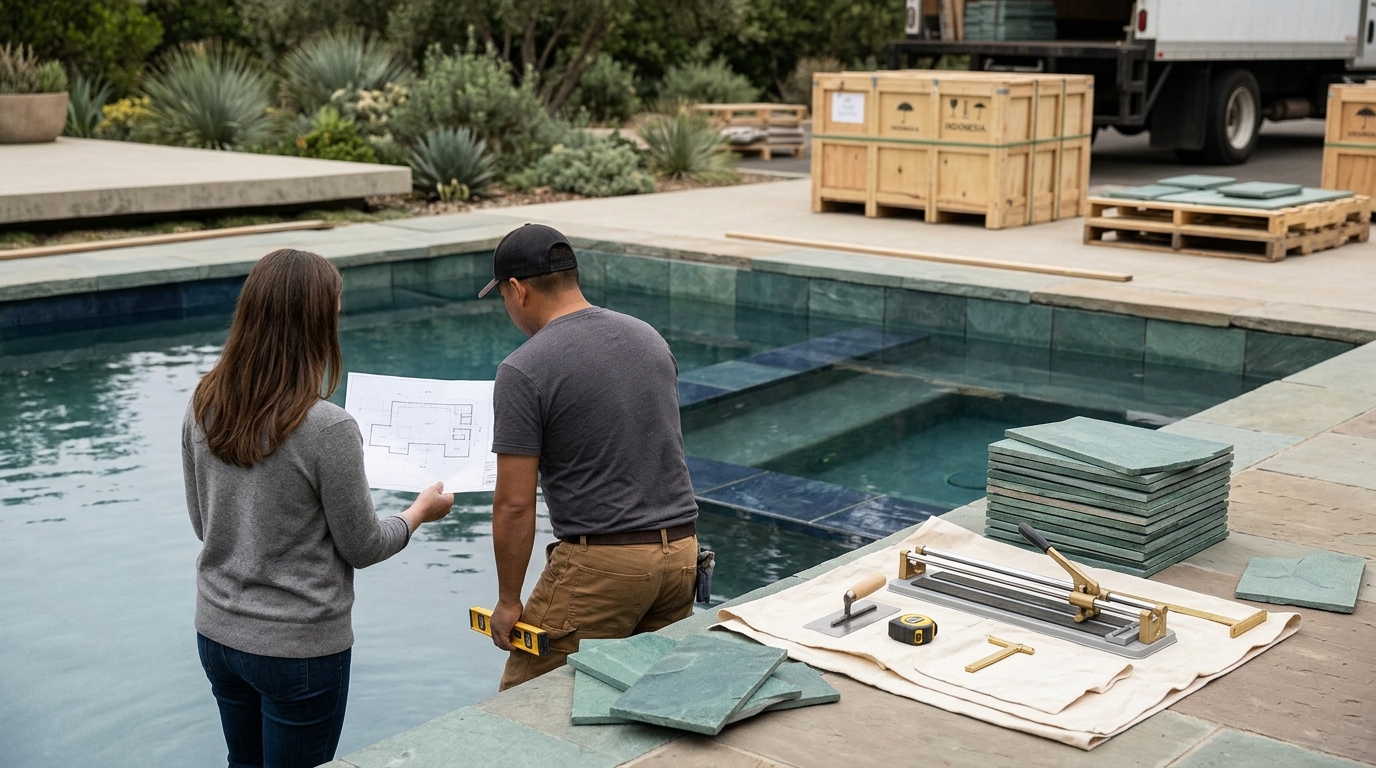
US pool builders and stone importers face a specific sourcing challenge. Sukabumi green stone delivers a visual result that ceramic and glass tiles cannot replicate. Yet the supply chain runs through a single geographic zone in West Java, Indonesia, and the quality, documentation, and logistics…
US pool builders and stone importers face a specific sourcing challenge. Sukabumi green stone delivers a visual result that ceramic and glass tiles cannot replicate. Yet the supply chain runs through a single geographic zone in West Java, Indonesia, and the quality, documentation, and logistics variables are substantial.
This guide addresses the full sourcing decision. It covers the mineralogy behind the stone's signature water-color effect, tile formats and surface finishes, quality grading criteria, sealing and maintenance requirements, supply chain structure from quarry to US jobsite, and cost benchmarking for project budgeting.
The Indonesian natural stone export sector operates through a layered ecosystem of quarry owners, processing facilities, and trading companies. Understanding which layer you are buying from determines your price, your quality control leverage, and your lead time reliability. That distinction starts with understanding the stone itself.
What Makes Sukabumi Green Stone the Premium Choice for Pool Cladding
Sukabumi green stone is quarried exclusively in Sukabumi Regency, West Java, Indonesia. It is a zeolitic andesite — a volcanic rock formed under specific hydrothermal conditions that deposited chlorite, zeolite, and other secondary minerals within the stone matrix. This mineral composition is geologically localised.
The Mineralogy Behind the Turquoise Effect
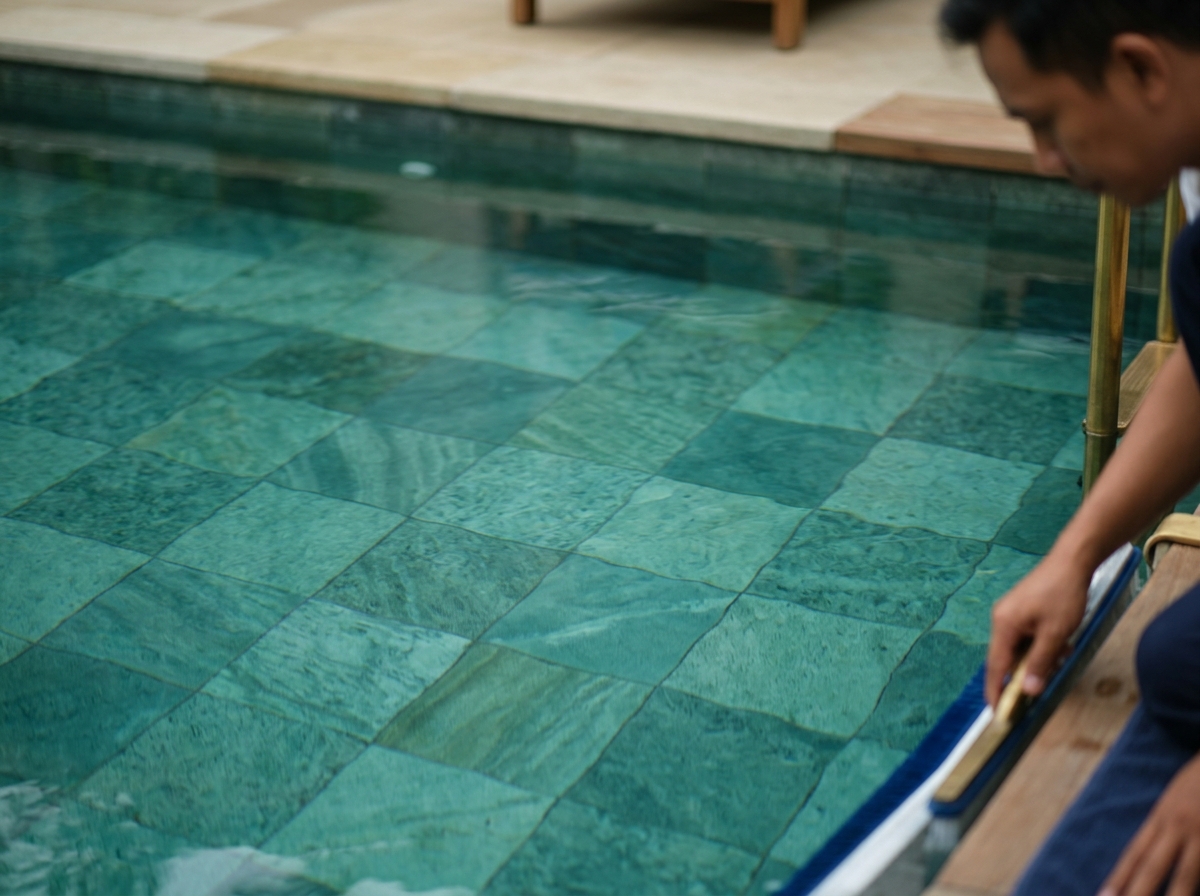
The signature visual effect of sukabumi pool tiles is not a coating or a stain. It is a structural optical phenomenon. Chlorite minerals within the zeolitic andesite absorb certain wavelengths of light and reflect others. Underwater, this interaction with refracted sunlight produces the turquoise-to-teal hue that has made the stone commercially significant for luxury pool projects.
The effect is depth-dependent. At approximately 1.2–1.5 metres (4–5 feet) of water depth, the turquoise hue is most saturated under direct sun. Shallower installations produce a lighter aqua tone. Deeper pools shift toward a blue-green. Pool shape, surrounding surface colour, and regional sun angle all modulate the final visual outcome. This means a Bali villa pool and a Phoenix resort pool using identical stone will read differently under local light conditions.
Comparison with Ceramic and Glass Mosaic
| Feature | Sukabumi Green Stone | Ceramic Tile | Glass Mosaic |
|---|---|---|---|
| Water-color effect | Natural optical effect via mineral composition | Colour fixed by glaze | Reflective, not refractive |
| Surface texture | Natural variation | Uniform | Uniform |
| Slip resistance | Moderate to high (honed finish) | Variable | Low (polished) |
| Thermal mass | High — stays cooler underfoot | Moderate | Low |
| Repair replaceability | Batch colour-matching required | Easier with stock | Easier with stock |
| Price range (approx. FOB) | Higher | Lower | Variable |
Glass mosaic produces a reflective shimmer. Sukabumi stone produces a refractive depth. The two effects are fundamentally different and not interchangeable in design intent.
Why Luxury Projects Specify It
Bali resort developers standardised on sukabumi stone for villa pools in the early 2000s. US resort and residential specification followed as bali swimming pool stone imagery circulated internationally. The material now appears in high-end residential and hospitality pool projects across California, Florida, Hawaii, and the Gulf Coast. Specification is driven by design architects, not tile contractors.
Tile Formats, Thickness Options, and Surface Finishes for Pool Applications
Standard Formats and Thickness
Sukabumi pool tiles ship in a range of standard formats. Custom cuts are available but increase lead time and unit cost.
| Format | Common Use | Recommended Thickness |
|---|---|---|
| 10 × 10 cm (4 × 4 in) | Waterline band, curved walls | 1.0 cm |
| 15 × 15 cm (6 × 6 in) | Pool walls, steps | 1.0–1.5 cm |
| 20 × 20 cm (8 × 8 in) | Pool floors and walls | 1.5 cm |
| 30 × 30 cm (12 × 12 in) | Pool floors, large format walls | 2.0 cm |
| Custom cuts | Coping, step treads | 2.0–3.0 cm |
For submerged pool floors, 1.5 cm is the practical minimum. Thinner tiles on flat horizontal surfaces increase the risk of cracking under hydrostatic pressure and foot traffic. Pool walls tolerate 1.0 cm where the tile is fully bonded to a stable substrate. Coping and step-tread profiles should be cut at 2.0 cm minimum for structural integrity at exposed edges.
Surface Finish Options
- Honed: Flat, matte surface. Most common finish for pool floors and walls. Provides moderate slip resistance. - Brushed: Light wire-brushed texture. Enhances slip resistance. Slightly more tactile than honed. - Sandblasted: Coarser texture, higher slip resistance. Used for step treads and wet surround areas. - Natural split: Irregular cleft surface. Used primarily for feature walls and waterfall panels. Not recommended for pool floors.
Bullnose edges, coping profiles, and step-tread nosings are available from most processing facilities in Sukabumi Regency. These are cut-to-order items. Include profile drawings in your purchase order to avoid interpretation errors.
Quality Grading: How to Evaluate Indonesian Green Stone Pool Tiles Before Ordering
Grade Definitions
Indonesian quarry exporters typically use a three-tier grading system. Definitions vary slightly between suppliers, so always request a written grade specification in the purchase contract.
| Grade | Colour Consistency | Defect Tolerance | Typical Application |
|---|---|---|---|
| Grade A | Tight — minimal tonal variation within batch | No pinholes, no visible fissures, max hairline calcium veining | Luxury residential and resort pools |
| Grade B | Moderate variation acceptable | Minor pinholes, minor calcium veining | Commercial pools, budget residential |
| Commercial/Garden Grade | Wide variation | Visible fissures, irregular sizing, significant veining | Landscape walls, non-pool applications |
For pool projects, Grade A is the correct specification in almost all cases. Grade B is acceptable for secondary surfaces or large commercial projects where cost is a primary driver. Commercial grade should not be specified for any submerged pool surface.
Key Defects to Identify
- Pinholes: Small voids in the stone surface. Absorb pool chemicals unevenly. Accelerate degradation in saltwater pools. - Fissures: Structural cracks, not surface scratches. A fissure running more than halfway through tile thickness is a rejection criterion. - Calcium veining: White calcium carbonate deposits within the stone. Minor veining is characteristic and acceptable in Grade A. Heavy veining indicates lower-grade material. - Colour inconsistency: Tiles from different extraction zones within the quarry can vary significantly. A single production batch should show consistent green-grey tone.
Verifying Colour Consistency Before Shipment
Request a pre-shipment photo set showing tiles from multiple crates laid flat together under natural light. This reveals tonal drift across the batch. Better suppliers will send a physical sample panel — typically 0.5–1.0 sqm — representing the full production run. For orders above approximately 200 sqm, consider commissioning a third-party pre-shipment inspection through a recognised inspection company operating in West Java. The inspection cost is small relative to the cost of receiving an off-spec shipment.
- ✓Written grade specification in purchase contract
- ✓Physical sample panel from production batch
- ✓Pre-shipment photos showing multiple crates together
- ✓Third-party inspection report for orders above ~200 sqm
- ✓Rejection and replacement terms documented in contract
Sealing, Long-Term Maintenance, and Pool Chemical Compatibility
Why Sealing Is Non-Negotiable
Zeolitic andesite is a porous stone. Unsealed, it absorbs pool water, chlorine compounds, and dissolved minerals. This accelerates surface degradation and promotes efflorescence — the white mineral salt deposits that appear on stone surfaces when water migrates through and evaporates.
Sealing must occur at two stages: before grouting during installation, and again after pool commissioning once the stone has dried fully. A penetrating impregnating sealer — not a topical coating — is the correct product for submerged pool surfaces. Topical coatings peel under hydrostatic pressure. Penetrating sealers fill the pore structure without altering the surface appearance.
Chlorine and Saltwater Compatibility
Sukabumi stone performs well in standard chlorinated pools when correctly sealed and maintained at a pH of approximately 7.2–7.6. pH values consistently below 7.0 are mildly acidic and will etch the stone surface over time. This is not unique to Sukabumi stone — all natural calcium-bearing stones are vulnerable to low pH environments.
Saltwater chlorinator pools present a different challenge. Salt itself does not damage the stone. However, saltwater pools tend to operate at slightly higher pH, which promotes calcium scale buildup on stone surfaces. Regular brushing and appropriate calcium hardness management — typically 200–400 ppm — minimises scale accumulation.
Managing Efflorescence
Efflorescence is common in the first 12– approximately 18 months after installation as residual installation moisture works out of the substrate. It does not indicate a defective stone. Treat with a diluted acid wash specifically formulated for natural stone — not generic muriatic acid, which can damage the stone surface. After treatment, re-seal the affected area.
Sukabumi Stone Supply Chain: From Indonesian Quarry to US Jobsite
Quarry to Port: The Processing Flow
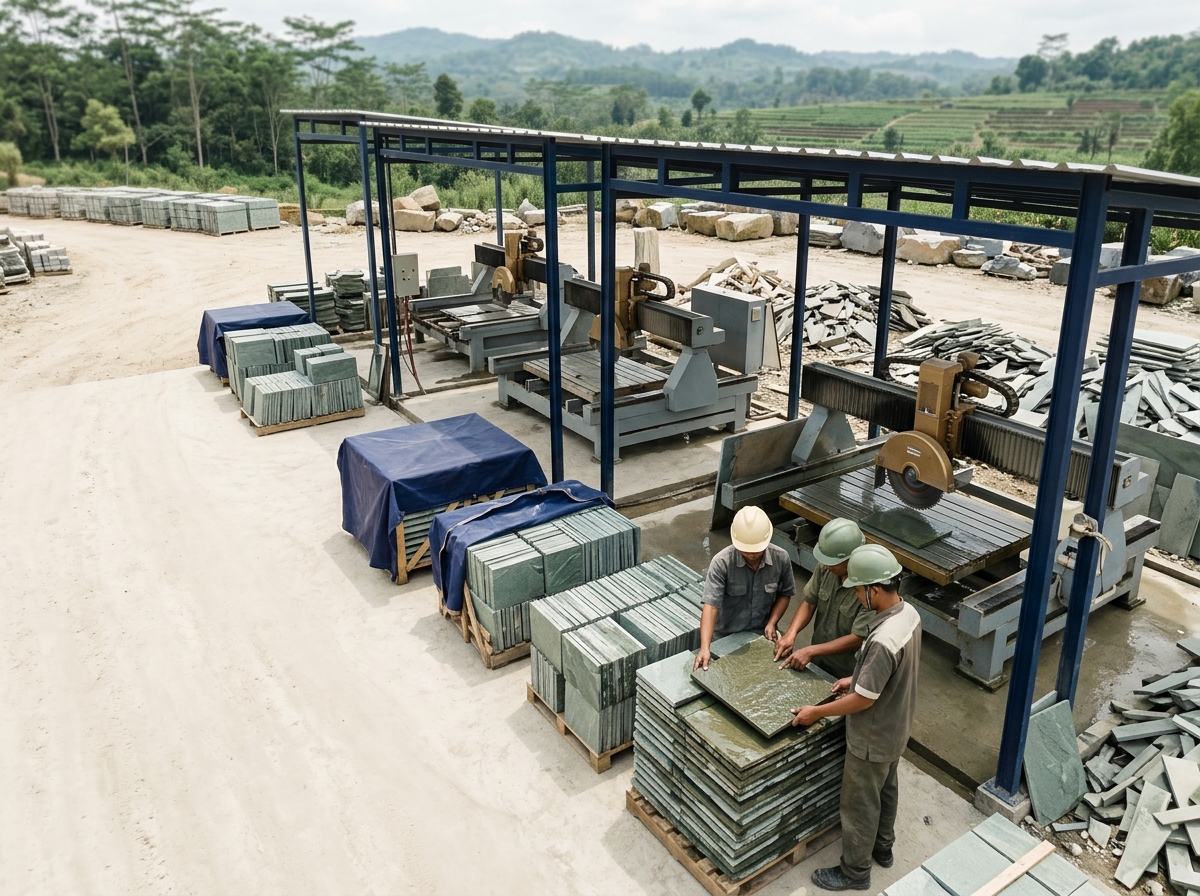
Active quarrying in Sukabumi Regency concentrates in several extraction zones within the regency. The stone is extracted in rough blocks and transported to processing facilities. Most facilities sit within or near Sukabumi town or the broader West Java industrial zone. There, it is sawn, honed, finished to specification, quality-checked, and packed for export.
The processing sequence is:
1. Block extraction and rough sorting by colour zone 2. Gang saw or bridge saw cutting to slab or tile blank 3. Surface finishing (honing, brushing, sandblasting) 4. QC sorting by grade 5. Packing into wooden crates with foam interleaving 6. Transport to Tanjung Priok Port, Jakarta
Tanjung Priok is Indonesia's primary container port and the standard export point for West Java stone. Transit time from Tanjung Priok to US West Coast ports (Los Angeles/Long Beach) is typically approximately 18–22 days. US East Coast ports (New York/Savannah) run approximately 25–30 days, routing through the Suez Canal or Panama Canal depending on carrier.
Direct Quarry Versus Trading Company: A Practical Comparison
| Criteria | Direct Quarry Supplier | Indonesian Trading Company |
|---|---|---|
| Price | Lower FOB per sqm | Markup of approximately 10–25% |
| MOQ | Higher — often full FCL minimum | More flexible — LCL orders possible |
| Quality control leverage | Direct — you can specify batch parameters | Indirect — trader sources from multiple quarries |
| Colour consistency | Higher when quarry zone is fixed | Variable if trader switches quarry source |
| Documentation support | Variable — quarry admin capacity varies | Usually stronger — traders handle export paperwork routinely |
| Risk | Higher if quarry has no export experience | Lower logistics risk, higher quality variability risk |
For US importers placing repeat project orders above approximately 100 sqm, direct quarry relationships offer better value and quality control. For first-time importers or small-volume orders, a reputable trading company with verifiable export history reduces operational risk. The key verification step either way is confirming the supplier holds a valid Indonesian export licence (the Nomor Induk Berusaha / NIB is the base business registration; export authority is a separate certification).
Packing Standards, Minimum Order Quantities, and Import Documentation
Packing and Container Logistics
Standard export packing uses timber crates with foam interleaving between tile layers. Crates are palletised for container loading. A standard 20-foot FCL (Full Container Load) carries approximately 500–700 sqm of 20×20 cm tiles at 1.5 cm thickness, depending on packing density. A 40-foot container handles proportionally more.
LCL (Less than Container Load) shipments are viable for sample orders or small-volume projects — typically below approximately 150 sqm. LCL adds consolidation time at origin and deconsolidation time at destination, adding approximately 5–10 days to transit.
Lead Times
| Order Type | Typical Lead Time (Order to Port) |
|---|---|
| Stock grades, standard finishes | 3–4 weeks |
| Non-stock grades or custom finishes | 4–6 weeks |
| Custom profiles (coping, bullnose) | 5–7 weeks |
| Large volume (multiple FCL) | 6–8 weeks |
These are approximate ranges based on normal production capacity. Lead times extend during Indonesian public holidays (Eid al-Fitr in particular, when factories close for up to two weeks).
US Import Documentation Requirements
Natural stone from Indonesia falls under HTS (Harmonized Tariff Schedule) Chapter 68, specifically headings covering worked monumental or building stone. Your customs broker will confirm the applicable subheading based on tile dimensions and surface finish. Key documents required for US Customs and Border Protection (CBP) clearance:
- Commercial invoice with declared FOB value, HS code, and full material description - Packing list matching crate-by-crate contents - Bill of lading or air waybill - Certificate of Origin (Indonesia) — required for tariff classification - Phytosanitary certificate — required for timber packing materials (wooden crates) per USDA APHIS regulations - Material Safety Data Sheet — sometimes requested for stone with chemical treatment or sealer pre-applied at factory
How to Vet and Select a Reliable Sukabumi Green Stone Pool Tiles Supplier in Indonesia
Selecting among sukabumi green stone pool tiles suppliers indonesia requires structured verification, not just price comparison. The following signals distinguish reliable suppliers from brokers and opportunistic traders.
Verification criteria:
- Quarry ownership or long-term supply agreement: Ask directly. A quarry owner has direct control over extraction zone, which determines colour consistency batch to batch. A broker may source from whichever quarry has stock available. - Valid export licence: Request a copy of the NIB and export authorisation documentation. A legitimate exporter will provide this without hesitation. - Production capacity statement: Ask for monthly output in sqm. Cross-reference against your project volume to assess whether the supplier can deliver without compromising other orders. - Sample policy: Any credible supplier ships samples. Paid samples (with cost credited against order) are standard practice. A supplier refusing to send samples is a disqualifying signal. - Factory visit option: Reliable suppliers welcome factory visits, either in person or via video call during production. Resistance to this is a risk indicator. - References from US buyers: Request contact details for previous US importers. Follow up by phone or email.
Red flags:
- Prices significantly below market FOB benchmarks (see cost section below) - No clear answer on which quarry zone the stone originates from - Inability to provide grade specification in writing - No rejection or replacement policy in the purchase agreement
Cost Benchmarks and Landed Cost Calculation for US Pool Projects
FOB Price Ranges by Grade
These are approximate market ranges. Actual FOB prices vary with volume, finish complexity, and supplier type.
| Grade | Format | Approx. FOB Tanjung Priok (USD/sqm) |
|---|---|---|
| Grade A | 20×20 cm, honed | USD 35–55 |
| Grade A | 30×30 cm, honed | USD 40–60 |
| Grade B | 20×20 cm, honed | USD 20–35 |
| Custom profiles (coping) | Per linear metre | USD 15–30 |
Prices below USD 20/sqm FOB for claimed Grade A material warrant scrutiny. This typically indicates Grade B or commercial-grade stone being sold under Grade A labelling.
Landed Cost Calculation Methodology
A US importer's landed cost has the following components:
1. FOB cost (price at Tanjung Priok, Indonesia) 2. Ocean freight — approximately USD 2,000–4,000 per 20-foot FCL to US West Coast; approximately USD 3,000–5,000 to East Coast (these are approximate ranges and fluctuate with market conditions) 3. Marine insurance — typically approximately 0.5–1.0% of cargo value 4.
Illustrative calculation (approximate):
A 300 sqm pool project ordering Grade A 20×20 cm honed tiles via FCL:
- FOB value: 300 sqm × USD 45 = USD 13,500 - Add 12% waste → order 336 sqm → FOB USD 15,120 - Ocean freight (20-ft FCL to LA): approximately USD 3,000 - Insurance (0.75% of USD 15,120): approximately USD 115 - Duty (confirm rate — assume low, approximately 2–5%): approximately USD 300–750 - Customs/brokerage/drayage: approximately USD 800–1,200 - Approximate landed cost: USD 19,335–20,185 for 336 sqm - Approximate landed cost per sqm (net coverage 300 sqm): USD 64–67
These figures are illustrative. Use them as a budgeting framework, not as a fixed quote.
Frequently Asked Questions
Is Sukabumi green stone safe for saltwater pools? Yes, with correct sealing and maintenance. The stone is chemically compatible with saltwater pool systems. Maintain calcium hardness at approximately 200–400 ppm to minimise scale formation. Re-seal more frequently than in standard chlorinated pools — approximately every 2–3 years.
What is the minimum order quantity for importing Sukabumi pool tiles to the United States? There is no universal minimum. Most direct quarry suppliers require a full FCL order — approximately 500–700 sqm depending on tile size and thickness. Trading companies often accept LCL orders from approximately 50–150 sqm, with higher unit costs.
How do I verify the colour grade consistency of Sukabumi stone before shipment? Request a physical sample panel from the production batch, pre-shipment photographs showing multiple crates laid together, and a written grade specification in the purchase contract. For orders above approximately 200 sqm, commission a third-party pre-shipment inspection in West Java.
Does Sukabumi stone need to be sealed before or after pool filling? Both. Apply a penetrating impregnating sealer before grouting during installation. Apply a second application after the pool structure has fully dried and cured, before filling. This two-stage sealing process is the industry-standard approach for submerged natural stone surfaces.
How long does it take to receive a Sukabumi stone order from Indonesia to the US? Allow 3–6 weeks production lead time from order confirmation to Tanjung Priok Port, plus approximately 18–22 days ocean transit to US West Coast or 25–30 days to East Coast. Total timeline from order to US port arrival is typically 6–10 weeks under normal conditions.
What makes Sukabumi stone more expensive than ceramic pool tiles? Several factors: limited geographic supply (Sukabumi Regency only), natural material processing with higher labour input, ocean freight from Indonesia, and import logistics costs. Ceramic pool tiles are manufactured at industrial scale globally. The Sukabumi premium reflects scarcity of the mineralogical source and the visual outcome that ceramic cannot replicate.
Sourcing authentic sukabumi green stone pool tiles from verified indonesian quarry stone suppliers requires discipline at every stage — from grade specification and pre-shipment verification through to US import documentation and landed cost budgeting. The supply chain is manageable when the right verification steps are applied consistently.
Ready to move from specification to sourcing? You now have the framework to evaluate suppliers, calculate landed costs, and prepare your import documentation. Request a sample kit and project quote from a verified Indonesian Sukabumi stone supplier today to confirm grade availability, current FOB pricing, and lead times for your specific pool project.
Get a verified sample panel from a Grade A production batch, a current FOB price sheet by format and finish, and a project-specific lead time estimate from an Indonesian supplier with confirmed export credentials.
Request Sample Kit and Quote →Planning a sourcing project in Asia?
MTS is an execution partner — supplier verification, manufacturing management, quality control and export logistics across Indonesia, Vietnam and China.
Related services
Related articles
Receive furniture sourcing insights across Asia.
One email per week. No spam.