Indonesian Andesite Stone Suppliers: Paving and Cladding Sourcing Guide
12 min read
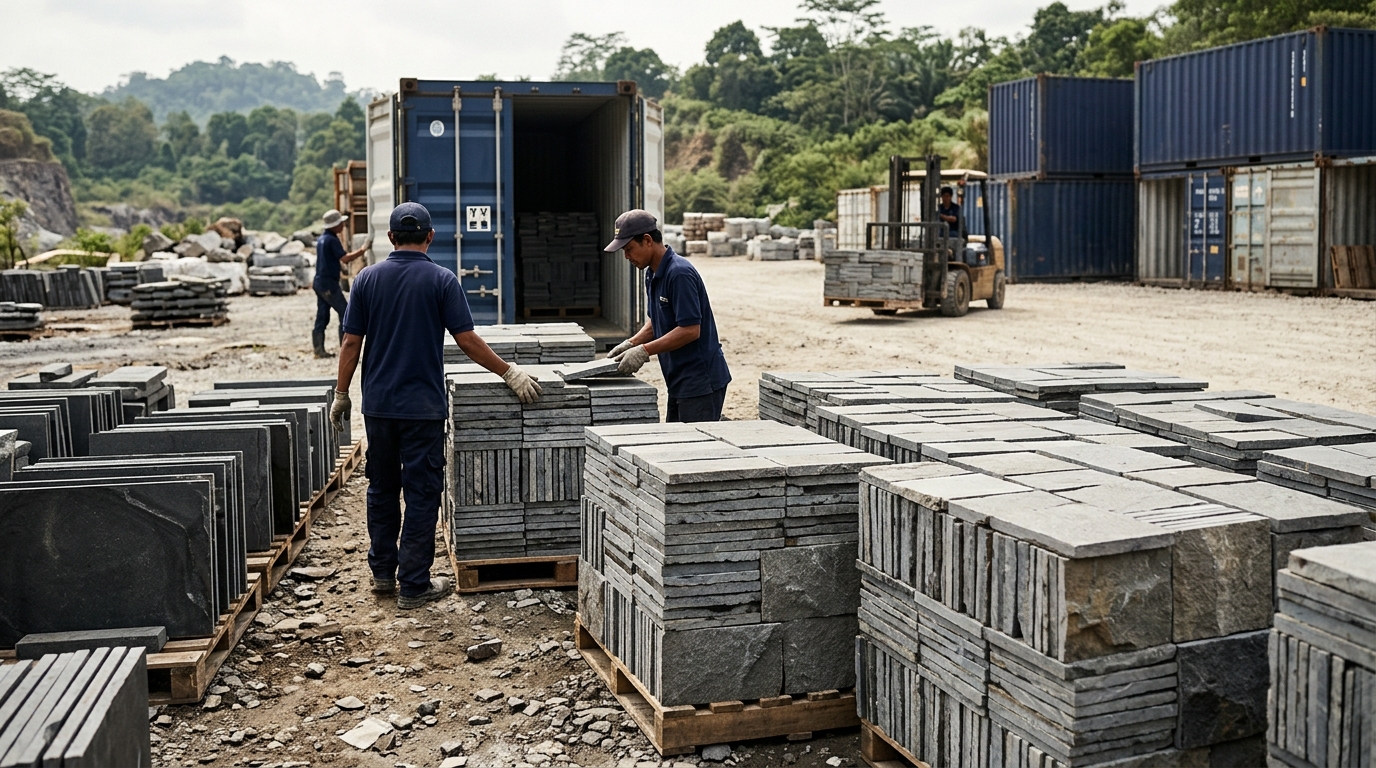
Sourcing andesite stone suppliers indonesia paving cladding projects from overseas requires more than a price list. US hardscape contractors and stone distributors face a specific set of decisions: which surface finish meets ADA slip resistance thresholds, whether Indonesian grey or black andesite…
Sourcing andesite stone suppliers indonesia paving cladding projects from overseas requires more than a price list. US hardscape contractors and stone distributors face a specific set of decisions: which surface finish meets ADA slip resistance thresholds, whether Indonesian grey or black andesite will hold colour consistency across multiple containers, and how to verify a supplier's quality control before committing to a full shipment.
Indonesia is the dominant global source for volcanic andesite. Quarry operations across Java and Bali produce material with consistent mineralogy, competitive pricing, and a manufacturing base capable of custom cutting, surface finishing, and container-ready packing. That combination explains why US commercial project specs increasingly call out Indonesian andesite by origin.
This guide covers the technical specifications contractors need for project submittals, finish types and their slip resistance ratings, container logistics with practical yield calculations, and a supplier qualification checklist. It is structured for procurement decisions, not general reading.
Why Indonesian Andesite Dominates the Global Paving and Cladding Market
Indonesia sits on the Pacific Ring of Fire. That geology produces extensive andesite deposits across Central Java, East Java, and Bali. Quarrying operations in these regions extract material with relatively uniform mineralogy, allowing exporters to supply large project volumes with manageable colour variance.
Andesite outperforms several competing paving materials on key metrics. Compared to sandstone, it offers significantly lower water absorption. Compared to standard concrete pavers, it delivers superior compressive strength and natural aesthetics that hold long-term project value. Compared to granite, Indonesian andesite typically prices lower per square metre at equivalent thickness.
US distributors sourcing natural stone cladding from Indonesia cite three primary drivers: consistent export infrastructure centred on Surabaya and Denpasar ports, a supplier base experienced in US container documentation requirements, and material properties that satisfy commercial hardscape specifications without premium pricing.
Demand from North American commercial projects — hospitality, civic plazas, mixed-use retail — has grown steadily. Grey andesite from Java and black andesite variants from select quarries now appear regularly in US project submittals for exterior paving and feature wall cladding.
Andesite Physical Properties and Technical Specifications Contractors Must Know
Density, Compressive Strength, and Hardness
Indonesian andesite typically registers a bulk density of approximately 2.4–2.8 g/cm³ (source: general volcanic igneous rock data). Compressive strength commonly falls in the range of 100–200 MPa, depending on quarry location and mineral composition. That places it well above the threshold for heavy-traffic exterior paving applications.
Mohs hardness is typically 5.5–6.5. This gives andesite good abrasion resistance under pedestrian and light vehicular traffic. It is significantly harder than limestone and comparable to many granites at the lower end of the hardness scale.
Water Absorption and Freeze-Thaw Performance
Water absorption is commonly below 1% by weight — a critical figure for US northern climate projects. Low absorption directly affects freeze-thaw performance. When water penetration into stone pores is minimal, freeze-thaw cycling causes less internal stress and reduces spalling risk.
For projects in USDA hardiness zones with sustained sub-freezing winters — the upper Midwest, New England, the Mountain West — this matters. Specify andesite with absorption rates tested to ASTM C97 (Standard Test Methods for Absorption and Bulk Specific Gravity of Dimension Stone). Request the test report from the supplier before finalising your spec.
Relevant ASTM and EN Standards
| Standard | Application |
|---|---|
| ASTM C97 | Water absorption and bulk specific gravity |
| ASTM C170 | Compressive strength of dimension stone |
| ASTM C241 | Abrasion resistance of stone flooring |
| ASTM C1028 | Static coefficient of friction (slip resistance) |
| EN 1341 | Slabs of natural stone for external paving |
| EN 12372 | Flexural strength under concentrated load |
Suppliers with export experience in US commercial projects should provide test reports referencing ASTM standards. EN certifications are acceptable supplementary documentation.
Surface Finishes for Indonesian Andesite Paving and Cladding: A Contractor's Reference
Flamed Finish
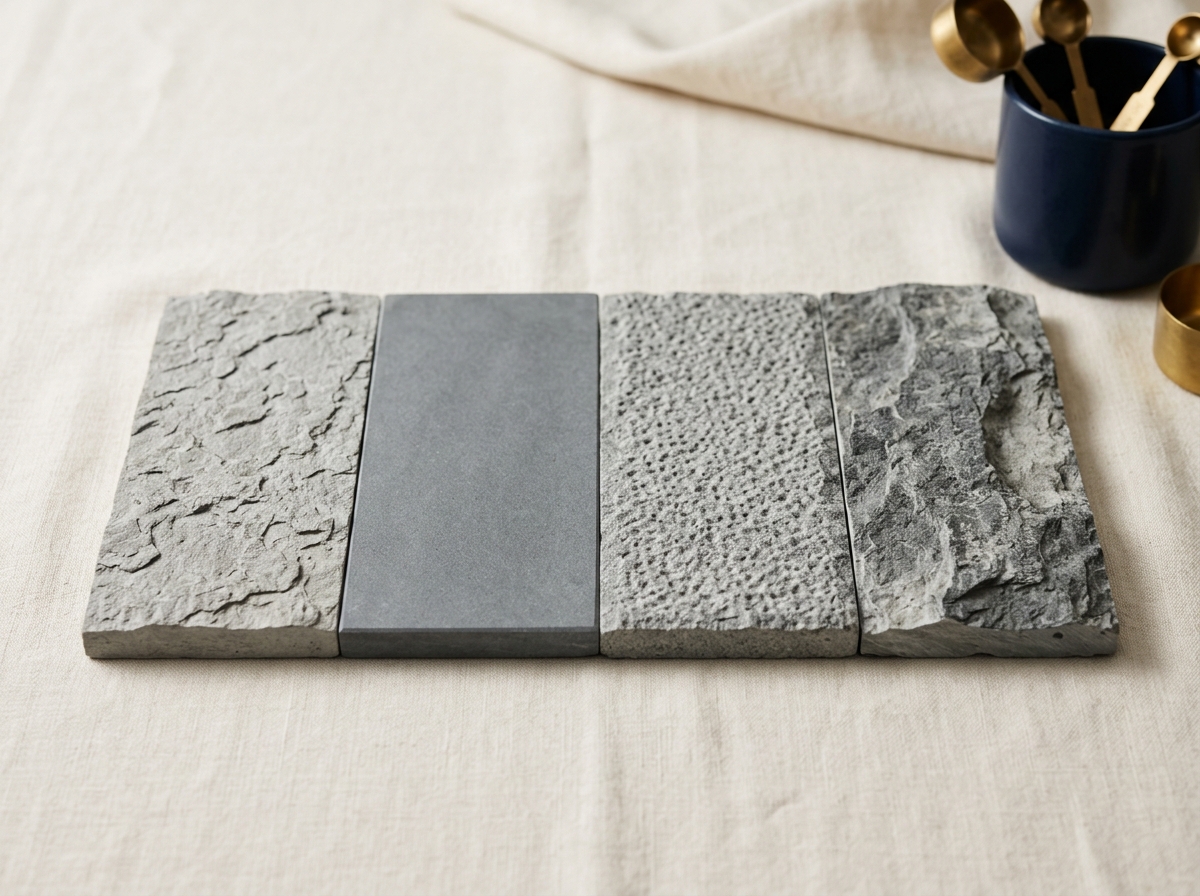
Flaming applies intense heat to the stone surface. Thermal shock causes micro-fracturing of surface minerals, producing a rough, matte texture. The result is a non-reflective surface with moderate to high slip resistance.
Best-use scenarios: driveways, public plazas, commercial entry areas, poolside perimeter paths where the aesthetic calls for a matte volcanic look. Flamed andesite pavers are among the most specified formats for Indonesian andesite paving stone in commercial exterior work.
Honed Finish
Honing grinds the surface to a flat, smooth finish with low reflectivity — smoother than flamed but not polished. It enhances colour depth, bringing out the grey or near-black tones characteristic of Indonesian andesite.
Honed finish suits interior flooring, covered exterior areas, and feature wall cladding where a cleaner aesthetic is required. For fully exposed outdoor applications in wet climates, honed surfaces require slip resistance verification before specification.
Bush-Hammered Finish
A pneumatic tool with a grid of hardened points strikes the surface repeatedly, creating a pitted, uniform texture. Bush-hammered andesite tiles achieve the highest slip resistance of the standard finish options. Surface texture depth is visually consistent, making it suitable for pool decks, ramps, and ADA-designated paths.
Sandblasted and Natural Split Finishes
Sandblasting propels abrasive media across the surface, producing a texture between honed and bush-hammered in slip resistance. Natural split (cleaved along natural fracture planes) yields an irregular surface used primarily for wall cladding panels, ledgestone, and stacked stone feature walls.
Slip Resistance Ratings for Andesite Paving in US Commercial Applications
Slip resistance is a specification item, not an afterthought. For US commercial projects, two rating systems are relevant: the ASTM C1028 static coefficient of friction (SCOF) and the German DIN 51130 R-value scale, which many international suppliers reference.
| Finish | Approximate R-Value | Approximate SCOF (dry) | Suitable Application |
|---|---|---|---|
| Honed | R9–R10 | ~0.5–0.6 | Interior floors, covered areas |
| Flamed | R10–R11 | ~0.6–0.7 | Exterior paving, plazas, driveways |
| Sandblasted | R11–R12 | ~0.65–0.75 | Exterior paths, light commercial |
| Bush-hammered | R11–R13 | ~0.75–0.90 | Pool decks, ramps, ADA paths |
| Natural split | R12–R13 | ~0.75+ | Cladding, stepping stones |
Note: Values are approximate ranges based on general volcanic stone finish data. Request third-party test reports from your supplier for project-specific verification.
ADA Compliance Considerations
The US Americans with Disabilities Act (ADA) requires a minimum SCOF of 0.6 for accessible routes on level surfaces and 0.8 on ramps. Bush-hammered and natural split finishes generally meet these thresholds. Flamed finish on Indonesian andesite typically meets the 0.6 threshold but confirm with supplier test data.
Honed finish should not be specified for ADA-designated exterior paths without verified wet SCOF data.
Colour Ranges, Grey and Black Andesite from Indonesian Quarries
Grey Andesite
Grey andesite from Central and East Java is the most widely exported variant. Tone ranges from light grey to medium charcoal, depending on quarry depth and mineral iron content. Within a single quarry, colour consistency across one production run is generally manageable.
Across multiple containers from the same quarry, expect minor batch variation — approximately one to two shades within the grey spectrum. This is normal for natural volcanic stone paving contractor supply operations. The key is sourcing from a supplier who documents quarry coordinates and batch codes per shipment.
Black Andesite
Black andesite is a darker, basaltic-mineral-rich variant available from specific Java and Bali quarries. It commands a modest price premium. It is specified for high-end hospitality cladding, feature pool surrounds, and luxury residential paving where a near-monolithic dark aesthetic is required.
Black andesite from Bali quarries tends toward warm dark brown-grey undertones. Java-sourced black andesite is typically cooler and closer to true charcoal-black. Specify quarry origin when colour matching is critical.
Managing Colour Consistency Across Multi-Container Orders
For projects requiring more than two containers, batch-level colour management is essential. Request the following from suppliers:
- Quarry block reference per production batch - Pre-shipment photo documentation under consistent lighting - Physical sample retention by supplier for batch comparison - QC sign-off sheet with batch ID attached to packing list
Paving and Cladding Format Options: Sizes, Thicknesses, and Custom Cuts
Standard paving formats from Indonesian andesite stone suppliers include:
- Cobblestones: approximately 10×10 cm, 15×15 cm — typical thickness 5–8 cm - Pavers (rectangular): 30×15 cm, 40×20 cm, 60×30 cm — thickness 2–4 cm for pedestrian, 4–6 cm for driveways - Large-format tiles: 60×60 cm, 60×30 cm, 80×40 cm — thickness 2–3 cm for cladding and light-traffic paving
Wall cladding formats include split face panels, ledgestone strips (typically 60×15 cm or random length), and stacked stone cladding in both natural split and bush-hammered andesite tiles.
Most mid-to-large Indonesian factories operate CNC bridge saws capable of custom profiling. Bespoke sizes, mitre cuts, and step nosing profiles are feasible at commercial order quantities.
Thickness by application:
| Application | Recommended Thickness |
|---|---|
| Feature wall cladding | 1.5–2.5 cm |
| Pedestrian path / plaza | 2.5–3 cm |
| Driveway (passenger vehicles) | 4–5 cm |
| Heavy vehicular (commercial) | 6 cm+ |
Project-Quantity Supply Planning and Container Logistics from Indonesia
Container Yield Estimates
Accurate container planning prevents costly under-ordering and excess freight spend.
20-foot container (approximately 25–28 CBM usable): - 30×30×2.5 cm tiles: approximately 550–620 m² - 60×30×3 cm pavers: approximately 480–540 m² - Cobblestones (10×10×6 cm): approximately 300–350 m²
40-foot container (approximately 55–60 CBM usable): - 30×30×2.5 cm tiles: approximately 1,200–1,400 m² - 60×30×3 cm pavers: approximately 1,050–1,200 m² - Cobblestones (10×10×6 cm): approximately 650–750 m²
All figures are approximate. Final yield depends on packing method, wood crating, and exact stone dimensions. Request a formal packing plan from the supplier based on your confirmed product spec.
Minimum Order Quantities
Most established andesite stone suppliers in Indonesia set MOQ at one full container (20ft) for standard formats. Custom sizes and finishes may require higher MOQ to justify production setup.
Lead Times
| Stage | Approximate Duration |
|---|---|
| Sample approval | 2–4 weeks |
| Production (standard formats) | 3–5 weeks |
| Quality inspection + packing | 1–2 weeks |
| Sea freight (Indonesia to US West Coast) | 18–25 days |
| Sea freight (Indonesia to US East Coast) | 25–35 days |
| **Total (approx.)** | **10–14 weeks from PO** |
Export Documentation
Required documents for container orders of andesite stone suppliers indonesia paving cladding imports:
- Commercial invoice and packing list - Bill of lading - Certificate of origin (for tariff purposes) - Phytosanitary certificate (if wood packing material is used — required by USDA APHIS) - Material test reports (density, absorption, compressive strength)
- ✓Commercial invoice with HS code
- ✓Packing list with batch/quarry references
- ✓Certificate of origin (Indonesia)
- ✓Bill of lading (FCL or LCL)
- ✓Phytosanitary certificate (if wood crating used)
- ✓ASTM lab test reports (C97, C170, C241)
- ✓Pre-shipment inspection certificate (if third-party QC engaged)
- ✓COF / slip resistance test report by finish type
How to Evaluate and Qualify an Indonesian Andesite Stone Supplier
Supplier Credentials to Verify
Not every exporter advertising andesite wall cladding indonesia exports from their own quarry or factory. The supply chain includes quarry operators, processing factories, trading companies, and export agents. Each layer adds cost and reduces your quality control visibility.
Key verification signals:
- Confirmed quarry ownership or exclusive sourcing agreement with a named quarry - In-house cutting and finishing equipment (not outsourced to third-party factories) - Export history to the US, EU, or Australia — verifiable through freight forwarder references - ISO 9001 certification or equivalent factory quality management system - Batch-level QC documentation as standard practice, not on request
Lab Test Reports: What to Request
Every reputable supplier of grey black andesite indonesia export should provide, on request:
- ASTM C97 water absorption and bulk specific gravity - ASTM C170 compressive strength - ASTM C241 abrasion resistance - Slip resistance test (ASTM C1028 or DIN 51130) per finish type
If a supplier cannot produce third-party lab results, treat that as a disqualifying signal for commercial project sourcing.
Sample Ordering Before Container Commitment
Request a physical sample pack — minimum 3–5 pieces per finish and format — before placing a container order. A credible supplier will provide samples at cost or free for qualified buyers. Evaluate samples against your project spec under the lighting conditions of the installation environment.
Installation Best Practices for Andesite Paving and Cladding in US Projects
Substrate and Mortar Bed Requirements
For exterior andesite paving, a compacted aggregate base of 100–150 mm under a 30–40 mm sand-cement mortar bed is standard. Full mortar bed installation is strongly preferred over point-bonding for commercial applications.
In freeze-thaw climates, ensure adequate drainage fall (minimum 1.5% gradient) to prevent water pooling beneath the stone. Standing water that freezes under pavers accelerates bedding failure regardless of stone quality.
Adhesive and Grout for Wall Cladding
For andesite wall cladding indonesia-sourced material on exterior facades, use a polymer-modified cementitious adhesive rated for natural stone and exterior exposure. In climates with temperature cycling above 30°C differential, flexible adhesive (deformability class S1 or S2 per EN 12002) is advisable.
Grout joints of 3–5 mm allow for thermal movement in large-format cladding panels. Unsanded grout suits joints under 3 mm; sanded or epoxy grout for wider joints in high-traffic paving.
Sealing Recommendations by Finish
| Finish | Sealing Recommendation |
|---|---|
| Honed | Penetrating impregnator sealer — essential for exterior use |
| Flamed | Penetrating sealer recommended; reduces biological growth |
| Bush-hammered | Penetrating sealer optional but beneficial in wet environments |
| Natural split (cladding) | Penetrating sealer for exterior cladding — protects against efflorescence |
Apply sealer after installation and grouting are complete and the stone has dried fully. Re-apply per manufacturer schedule, typically every 3–5 years depending on exposure.
Maintenance
Clean andesite with pH-neutral stone cleaners. Avoid acids (including vinegar-based products) and strong alkalis, which can etch the surface or degrade sealers. For heavy commercial use, annual professional cleaning and sealer inspection is standard practice.
Frequently Asked Questions
What is the difference between andesite and basalt for paving applications? Both are volcanic igneous rocks with similar visual profiles. Basalt typically has slightly higher density and compressive strength. Andesite has marginally higher silica content, which can mean slightly lighter colour tones and comparable hardness. For most paving applications, the practical performance difference is minimal. Availability and consistent supply volume favour Indonesian andesite for large US project orders.
What slip resistance rating does flamed andesite achieve and is it ADA compliant? Flamed andesite typically achieves R10–R11 on the DIN 51130 scale and an approximate SCOF of 0.6–0.7 (dry) to ASTM C1028. This generally meets the ADA minimum of 0.6 SCOF for level exterior surfaces. Always request wet SCOF data from your supplier for ADA-designated paths.
How many square metres of andesite paving fit in a standard 40-foot container? Approximately 1,050–1,400 m² depending on format and thickness. A 60×30×3 cm paver yields around 1,050–1,200 m² per 40ft container. A thinner 30×30×2.5 cm tile can yield 1,200–1,400 m². Request a formal packing plan from your supplier based on confirmed dimensions.
What is the typical lead time for a container order from an Indonesian andesite supplier? Plan for approximately 10–14 weeks from purchase order to US port arrival. Production takes 3–5 weeks for standard formats, plus 1–2 weeks for QC and packing, plus 18–35 days sea freight depending on destination port.
Does Indonesian andesite require sealing before installation outdoors? Sealing is strongly recommended, particularly for honed and flamed finishes in exterior applications. Andesite's water absorption is low (typically below 1%), but a penetrating impregnator sealer further reduces biological staining and efflorescence risk. Apply after installation is complete and stone is fully dry.
What colour variation should I expect between production batches of grey andesite? Expect minor variation — typically one to two shades within the grey spectrum between production runs. Variation is greater between quarries than within a single quarry source. Require batch-coded documentation and pre-shipment photos from your supplier. Order a 10–15% overage on the first shipment to avoid mid-project colour mismatch.
Specifying andesite stone suppliers indonesia paving cladding for commercial projects requires matching material properties to application demands, verifying finish-specific slip resistance against US ADA thresholds, and managing container logistics with realistic yield and lead time figures. Supplier qualification — centred on batch-level QC documentation, verifiable ASTM test reports, and confirmed quarry sourcing — is the difference between a successful multi-container project and a costly specification failure.
You now have the technical framework to evaluate Indonesian andesite suppliers against objective procurement criteria. The logical next step is putting verified material in your hands before committing to container quantities.
You have the specifications. Now verify the material matches them. Contact verified Indonesian andesite suppliers to request a project-specific quote and a finish sample pack covering flamed, honed, and bush-hammered options in your preferred format and colour range.
Request Quote and Sample Pack →Need eyes on the ground in Indonesia?
MTS is an execution partner — supplier verification, manufacturing management, quality control and export logistics across Indonesia, Vietnam and China.
Related services
Related articles
Receive furniture sourcing insights across Asia.
One email per week. No spam.