Teak vs Eucalyptus Outdoor Furniture: Which Wood Wins for Your Business?
17 min read
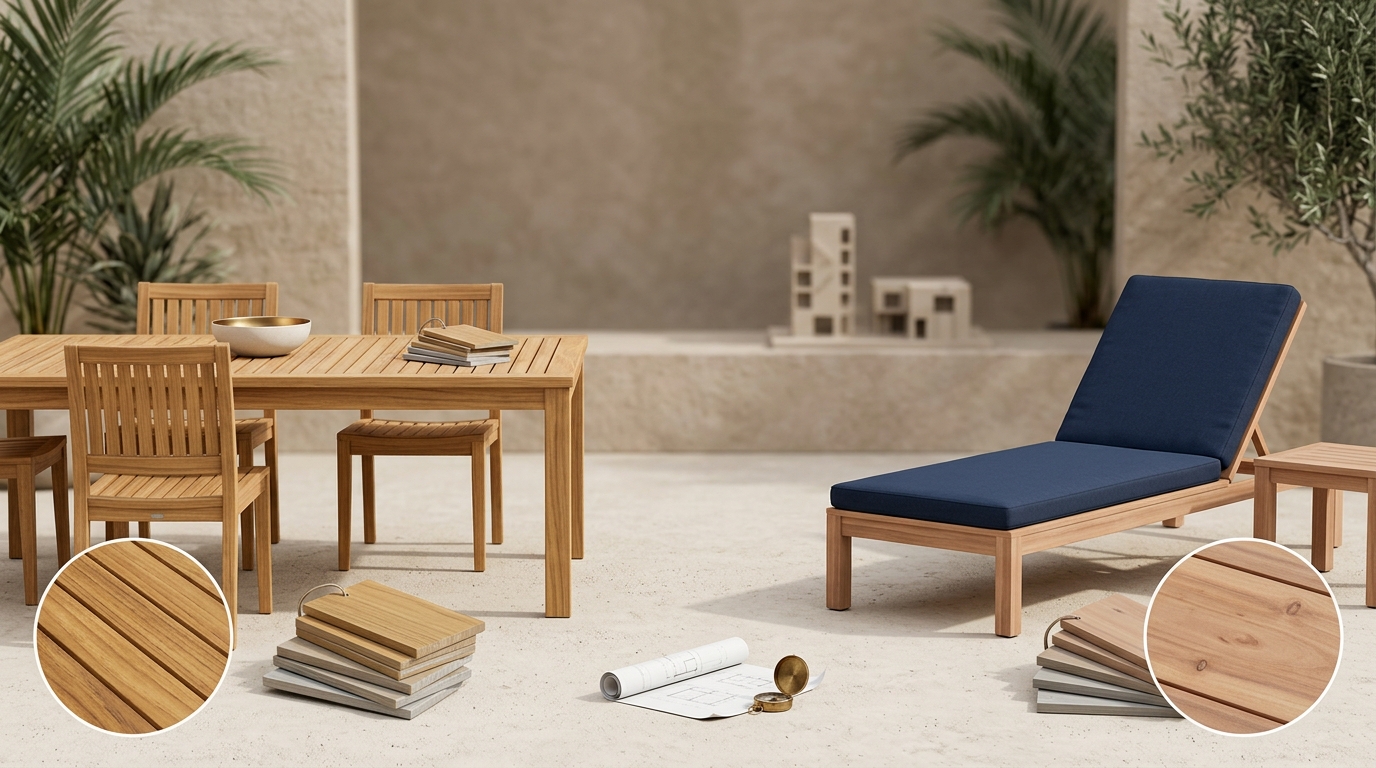
For retail category managers building or refreshing an outdoor furniture range, the choice of timber is rarely just an aesthetic decision. It is a margin decision, a sourcing risk decision, and increasingly a sustainability compliance decision. When it comes to teak vs eucalyptus outdoor…
For retail category managers building or refreshing an outdoor furniture range, the choice of timber is rarely just an aesthetic decision. It is a margin decision, a sourcing risk decision, and increasingly a sustainability compliance decision. When it comes to teak vs eucalyptus outdoor furniture, the stakes are particularly high: both woods command consumer respect, both can anchor a credible outdoor range, and both carry distinct cost structures that will define how your category performs at the gross margin line.
This article gives outdoor furniture buyers a rigorous, commercially framed comparison of teak and eucalyptus — covering durability, wholesale cost positioning, sustainability credentials, supply chain risk, and how each wood fits within a broader good-better-best category architecture alongside acacia. Where relevant, the three-way teak vs eucalyptus vs acacia lens is applied to help you build a tiered SKU strategy rather than betting the range on a single material.
By the end, you will have a clear picture of where each timber earns its place in your assortment, what operational risks each carries, and how to position them at retail for maximum category return. The place to start is where the money is made — or lost — before a single piece ships.
How Your Timber Choice Shapes Outdoor Category Margins From Day One
Wholesale Price Differentials and Their Effect on Retail Markup
The wholesale cost gap between teak and eucalyptus outdoor furniture is substantial and structurally important to understand. Teak — specifically Tectona grandis, the species most associated with premium outdoor furniture — commands significantly higher landed costs than eucalyptus, driven by slower growth rates, tighter FSC-certified supply, and the geopolitical complexity of sourcing from Indonesia and other primary teak regions. Eucalyptus, particularly plantation-grown Eucalyptus grandis from Brazil or managed plantations in southern Africa, is available at meaningfully lower wholesale price points.
For category managers operating in mid-range retail price bands — roughly the $300–$900 per piece retail segment — eucalyptus offers a wholesale cost structure that allows for competitive retail pricing while protecting margin. Teak, by contrast, tends to justify its landed cost only when positioned in a premium or luxury tier where the consumer is willing to pay for brand-recognised prestige.
Consumer Willingness-to-Pay and Category Positioning
Consumer awareness of teak as a premium outdoor timber is well established in the US market. This recognition supports higher retail price points and can reduce the need for point-of-sale education. Eucalyptus outdoor furniture benefits from less inherent brand equity but can be positioned effectively at mid-range tiers with appropriate POS communication and sustainability storytelling — particularly around its plantation-grown, FSC-certified credentials.
Return Rates, Warranty Costs, and Timber Durability
One commercial variable that rarely appears in timber spec sheets is return rate. Wood species that perform poorly under regional US climate conditions — intense UV in the Southwest, humidity cycling in the Southeast, freeze-thaw stress in the Northeast — generate warranty claims and returns that erode category profitability over time. Teak's natural oil content and high Janka hardness provide exceptional dimensional stability across these conditions, keeping warranty costs low. Eucalyptus, when properly treated and sealed, performs competitively but requires more diligent finishing standards from your supplier base to match teak's field reliability. Sourcing eucalyptus from manufacturers with full-cycle kiln-drying facilities — those controlling moisture content to appropriate levels before finishing — is essential to minimise climate-related complaints.
Teak Outdoor Furniture: Durability, Prestige, and the Supply Chain Realities Buyers Must Navigate
What Makes Teak the Benchmark Timber
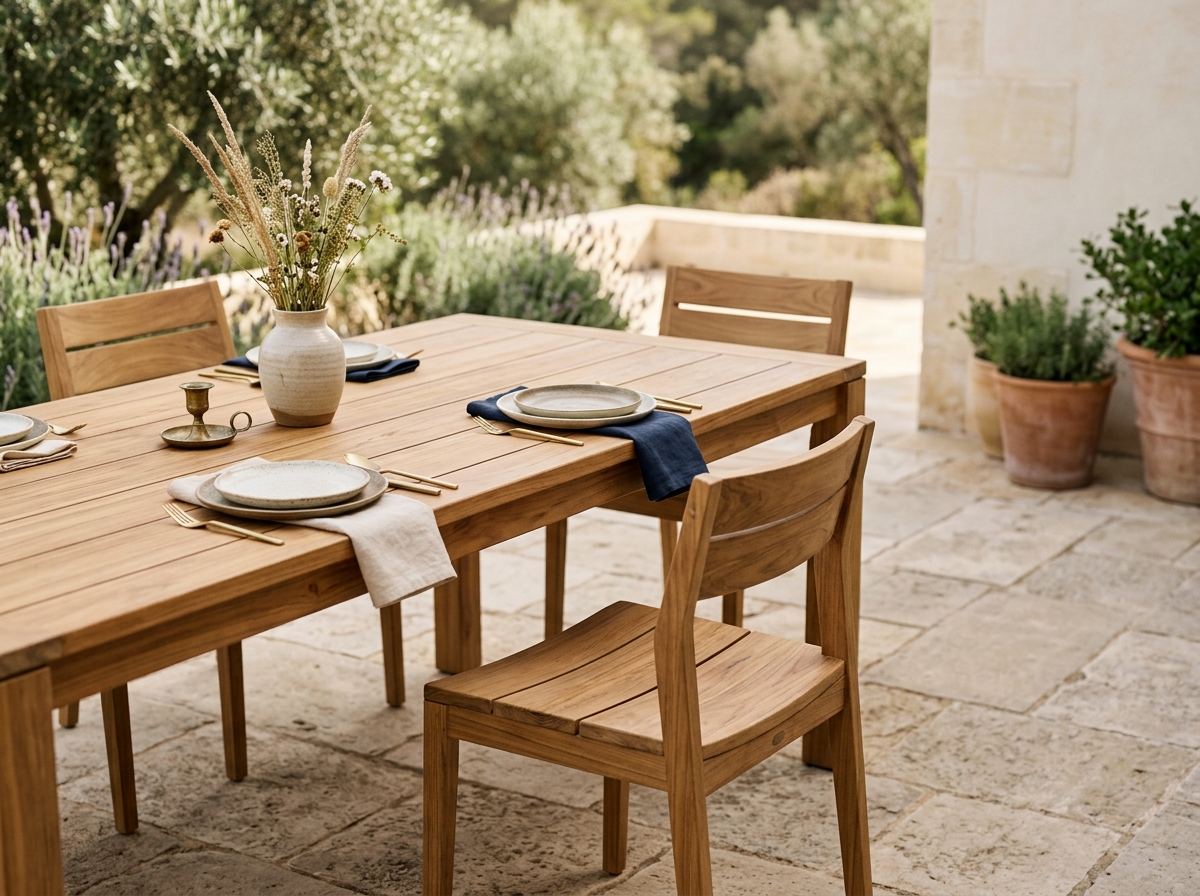
Teak's dominance in the premium outdoor furniture segment is rooted in measurable physical properties. Tectona grandis scores among the highest of commercially used outdoor timbers on the Janka hardness scale, indicating strong resistance to denting and surface wear. More importantly for outdoor use, teak contains a high concentration of natural silica and oils that repel moisture, inhibit fungal growth, and deter insect damage — without the need for chemical treatment. These properties contribute to documented lifespans of 50 to 75 years or more under normal outdoor conditions, a performance benchmark that no other commercially available outdoor timber reliably matches at scale.
For category managers, this translates into a low-warranty, high-satisfaction product profile — provided the premium positioning is correctly executed. A teak dining set that lasts decades generates word-of-mouth referrals and reinforces brand credibility in ways that shorter-lived alternatives cannot replicate.
Sustainability, FSC Certification, and CITES Compliance Risks
Teak's supply chain carries meaningful compliance risk for US importers. Tectona grandis is listed on CITES Appendix II, meaning international trade requires verified documentation confirming the timber was legally and sustainably harvested. US Customs enforcement of the Lacey Act — which prohibits the import, export, and sale of illegally sourced plant and wood products — makes this documentation a legal requirement, not a voluntary best practice. Category managers sourcing teak must ensure suppliers provide full chain-of-custody documentation, and FSC certification from a credible accreditation body is the most widely recognised standard for demonstrating compliance.
Indonesian plantation teak is generally considered a lower-risk sourcing option compared to natural forest teak, but even plantation-origin timber requires rigorous documentation. Buyers should verify that FSC certificates are current and traceable to the specific manufacturing facility, not just a parent trading company.
Premium Price and Target Consumer Segment
Teak's wholesale cost structure makes it most commercially viable in retail price bands where consumers are already primed for premium outdoor investment. In the US market, this broadly aligns with upper mid-range to luxury positioning. Attempting to compete on price with teak in a value or entry-mid tier is unlikely to yield acceptable margins and may attract the wrong consumer, resulting in returns when expectations of value are not met.
Eucalyptus Outdoor Furniture: The High-Value Timber Alternative Many Buyers Underestimate
Performance Characteristics and Aesthetic Range
Eucalyptus wood outdoor furniture has earned increasing attention from US retail buyers for good reason. Species such as Eucalyptus grandis produce a dense, reddish-brown timber with a tight grain that closely resembles teak in visual profile. Janka hardness ratings for commercial eucalyptus species are competitive with many hardwoods used in outdoor furniture, making it resistant to surface impact and wear.
Eucalyptus contains moderate natural oil content — lower than teak, but sufficient to provide a baseline of moisture and weather resistance when the timber is properly finished. When UV stabilisers are incorporated into the finishing process and a regular oiling schedule is maintained, eucalyptus performs reliably across most US climate zones. Brazilian eucalyptus in particular has developed a strong reputation in the global outdoor furniture supply chain for consistency of density and colour.
Supply Chain Accessibility and FSC Certification
One of eucalyptus's most significant commercial advantages is supply chain accessibility. Because eucalyptus is among the fastest-growing commercially harvested hardwood species — reaching harvest maturity in a fraction of the time required for teak — FSC-certified plantation supply is more abundant and geographically diverse. This translates into shorter lead times, lower sourcing risk, and more competitive wholesale pricing than teak.
For US retail buyers seeking to meet internal ESG commitments or respond to growing consumer demand for sustainability transparency, eucalyptus's plantation-grown profile is a legitimate and credible narrative. PEFC certification is also widely available for eucalyptus supply chains and is accepted by many US retail compliance programmes as equivalent to FSC for chain-of-custody purposes.
Margin Advantage in Mid-Range Retail Tiers
The wholesale cost advantage of eucalyptus over teak — often meaningful on a per-unit basis — creates genuine margin headroom in the $200–$700 retail bracket. For category managers building volume in mid-range outdoor, eucalyptus allows competitive retail pricing without sacrificing margin, and without requiring the full suite of premium positioning investments that teak demands.
Teak vs Eucalyptus Outdoor Furniture Head-to-Head: Six Criteria Every Buyer Should Evaluate
The following comparison covers the six buying criteria most material to retail category decisions. Acacia is included as the third reference point to support a complete good-better-best range view.
| Criteria | Teak (*Tectona grandis*) | Eucalyptus (*E. grandis* etc.) | Acacia |
|---|---|---|---|
| **Durability & Weather Resistance** | Excellent — natural oils, very high Janka hardness, minimal movement | Good to Very Good — competitive hardness, moderate natural oils, requires finishing | Good — adequate for most climates, more variable by species |
| **Maintenance Requirements** | Low — periodic oiling recommended but optional; weathers to silver-grey naturally | Moderate — regular oiling or sealing needed to maintain appearance and prevent splitting | Moderate to High — more frequent treatment needed, especially in humid or UV-intense climates |
| **Wholesale Cost Range** | High — premium landed cost; tightest supply | Moderate — accessible pricing from plantation sources | Lower to Moderate — widely available, broad price range |
| **Sustainability Credentials** | FSC certification available; CITES Appendix II listing adds compliance complexity | FSC and PEFC widely available; plantation-grown supply is abundant and lower-risk | FSC available but less consistent; sourcing origin more variable |
| **Aesthetic Range & Finish Options** | Warm golden-brown; weathers to silver-grey; accepts stain poorly | Reddish-brown; takes stain and finish well; strong visual similarity to teak | Variable grain and colour; accepts stains and oils; more rustic aesthetic in many species |
| **Expected Lifespan & Warranty Benchmark** | 50–75+ years with minimal care; supports long-form warranties | Typically 15–25+ years with regular maintenance; supports competitive warranties at mid-tier | Typically 10–20 years with maintenance; appropriate for value and entry-mid tier |
Disadvantages of Teak Furniture That Retailers Must Account For in Category Planning
Teak's prestige is real, but so are its commercial liabilities. Category managers who overlook these risks may find premium positioning difficult to sustain.
Margin compression at non-luxury price points. The landed cost of FSC-certified teak from Indonesian plantations is high. Unless your retail positioning supports a price bracket where consumers are actively seeking premium timber, margin pressure will be acute. Discounting teak to compete in mid-range price bands typically destroys the category economics.
Greying and surface cracking without maintenance. Without periodic oiling, teak will naturally weather to a silver-grey patina. This is aesthetically acceptable to many consumers — and is a recognised characteristic of the timber — but floor sample management and consumer communication require active investment. Untreated teak in high-UV or salt-air environments can also develop surface checking (fine cracks), which generates consumer complaints if not communicated proactively at point of sale.
Supply chain risk and import scrutiny. Beyond CITES compliance, the teak supply chain carries ongoing risk from illegal logging operations that persist in some source regions. Even with FSC documentation, buyers should conduct supplier verification audits — particularly for manufacturers who cannot demonstrate full-cycle manufacturing with their own kiln-drying and lumber sourcing facilities. Trading companies that cannot disclose their actual manufacturing origin should be treated as high-risk for compliance purposes.
Weight and freight costs. Teak's density, while a performance asset, translates into heavier product weights that increase freight costs per container and create in-store handling challenges. This is a meaningful operational consideration for buyers managing logistics margins across a large outdoor category.
Disadvantages of Eucalyptus Wood Outdoor Furniture That Buyers Need to Manage
Eucalyptus is a commercially strong option, but retail buyers must enter supplier negotiations with a clear understanding of its limitations.
Higher maintenance obligation for consumers. Eucalyptus requires more consistent sealing or oiling than teak to maintain structural integrity and appearance — typically annually or biannually depending on climate. If this is not communicated clearly through POS materials and product documentation, warranty claims related to checking, splitting, or colour fade are more likely. Consumer education investment is higher with eucalyptus than with teak.
Quality variation between species and growing regions. Not all eucalyptus is equal. There are hundreds of eucalyptus species, and commercial outdoor furniture uses only a handful of high-density varieties. Supply sourced from regions without rigorous quality controls can vary significantly in density, moisture content, and finishing quality. Buyers should specify the exact eucalyptus species and plantation origin in supplier contracts, and verify that manufacturers operate full kiln-drying facilities with moisture content controls appropriate for US market conditions.
Lower consumer brand recognition requires POS investment. Unlike teak, eucalyptus does not yet carry strong spontaneous consumer recognition in the US outdoor furniture market. Floor staff training, POS signage explaining the timber's credentials, and sustainability messaging are all necessary to convert consumer interest into purchase confidence. Budget for this at the category level, particularly in the first seasons of ranging.
Splitting risk in extreme temperature fluctuations. In climates with severe temperature cycling — particularly hard freezes followed by rapid warming — improperly finished or sealed eucalyptus can be prone to splitting. This is a manageable risk with the right finishing specification and supplier quality standards, but it must be addressed in sourcing requirements rather than left to chance.
Building a Good-Better-Best Outdoor Category Architecture With Teak, Eucalyptus, and Acacia
Tiering Your SKU Strategy Across Three Timber Types
A well-constructed outdoor furniture category does not need to choose between teak and eucalyptus — it should use both, plus acacia, to cover distinct consumer price bands and margin tiers. The teak vs eucalyptus vs acacia three-tier approach is the most commercially logical framework for category managers building a complete outdoor range.
- Good tier — Acacia: Position acacia-framed collections at accessible retail price points. Acacia offers adequate durability for most consumers, broad design flexibility, and the lowest wholesale cost of the three. It supports competitive promotional pricing without sacrificing margin at standard retail. FSC-certified acacia is available, though supply chain consistency requires careful supplier selection.
- Better tier — Eucalyptus: Eucalyptus wood outdoor furniture is the natural anchor for a mid-range collection. Its visual similarity to teak, strong hardness profile, and plantation-grown sustainability narrative allow for meaningful retail price premiums over acacia while remaining accessible to the core outdoor furniture consumer. This is where volume and margin typically converge in a well-structured category.
- Best tier — Teak: Reserve teak for a clearly differentiated premium or luxury segment. Position it on its longevity, natural properties, and heritage status. This tier supports higher retail price points, lower promotional frequency, and stronger warranty claims that reinforce brand credibility.
Sourcing Lead Times, MOQ Considerations, and Supplier Geography
Lead times and minimum order quantities vary meaningfully across these three timber types. Eucalyptus and acacia — sourced predominantly from Vietnam, South Africa, and Brazil — generally offer more flexible MOQ structures and shorter lead times than teak, where Indonesian plantation sourcing through established exporters typically involves longer production cycles and higher minimums. For category managers building a new outdoor range, a eucalyptus or acacia anchor provides faster speed-to-shelf while teak SKUs are developed with more deliberate supplier relationships.
Indonesian teak suppliers — particularly those based in clusters around Central Java — often operate through specialist merchant exporters who can manage FSC documentation and CITES compliance as part of the service. Verifying that these exporters are connected to full-cycle manufacturing operations, not assembly-only facilities, is essential to quality consistency.
Sustainability Credentials and Sourcing Standards Every Outdoor Buyer Must Verify
FSC vs PEFC: What US Retail Compliance Requires
Both the Forest Stewardship Council (FSC) and Programme for the Endorsement of Forest Certification (PEFC) are internationally recognised chain-of-custody certification systems. In the US retail environment, FSC is more frequently specified by large retail buyers and is more recognisable to sustainability-aware consumers at point of sale. PEFC is broadly equivalent in rigour and is accepted by many procurement programmes, particularly for eucalyptus and acacia sourcing.
Buyers should require certification at the factory level — not just at the forest or trading company level — and should request current, verifiable certificate numbers that can be confirmed through the relevant certification body's public registry.
Plantation-Grown Eucalyptus as a Lower-Risk Sourcing Position
Brazilian eucalyptus plantations, along with managed plantations in South Africa and Portugal, represent some of the most transparent and well-certified timber supply chains available in the outdoor furniture category. For US retail buyers seeking to reduce sourcing risk while maintaining a credible sustainability narrative, plantation-grown eucalyptus is arguably the most commercially straightforward option currently available in the outdoor hardwood category.
Teak's CITES Appendix II Status and What It Means for Importers
Tectona grandis has been listed on CITES Appendix II since 1995, which does not prohibit trade but requires that export permits and non-detriment findings accompany each shipment. For US importers, these documents must be retained and are subject to inspection under Lacey Act enforcement. Retailers who cannot produce compliant documentation for teak products face potential seizure of goods and significant financial penalties. Category managers should establish a documentation checklist with their import compliance team before placing first orders.
- ✓Confirm CITES export permit is included with each shipment
- ✓Verify FSC chain-of-custody certificate is current and traceable to the manufacturing facility
- ✓Retain all Lacey Act compliance documentation per shipment
- ✓Confirm plantation origin (Indonesia, Costa Rica, or equivalent) with written supplier declaration
- ✓Conduct or commission independent factory audit to verify full-cycle manufacturing
- ✓Review supplier's track record for prior US import shipments
Consumer Demand for Sustainability Transparency at Point of Sale
US outdoor furniture consumers — particularly in the upper-mid and premium segments — are increasingly attentive to sustainability claims. Certification logos (FSC, PEFC) displayed clearly on product packaging and POS materials are becoming table-stakes for category credibility. For eucalyptus ranges, the plantation-grown narrative can be developed into a positive differentiator that positions the timber's lower carbon footprint and faster regeneration cycle as active benefits rather than as compensating factors for lower prestige.
Frequently Asked Questions: Teak vs Eucalyptus Outdoor Furniture
What is better, eucalyptus or teak for outdoor furniture?
Neither timber is categorically better — the right choice depends on your retail price positioning and category objectives. Teak outperforms eucalyptus on natural durability, lifespan, and maintenance-free performance, making it the stronger choice for premium and luxury retail tiers. Eucalyptus delivers superior margin performance at mid-range price points, offers a more accessible and lower-risk supply chain, and carries strong sustainability credentials as a plantation-grown timber. For most category managers, the optimal answer is to range both woods at different price tiers rather than choosing one exclusively.
Is eucalyptus a good wood for outdoor furniture?
Yes — when properly specified and finished, eucalyptus wood outdoor furniture is a commercially and structurally sound choice. Its density and hardness are competitive with many premium outdoor timbers, and plantation-grown species such as Eucalyptus grandis have proven track records in export markets. The key qualifiers are supplier quality standards (full kiln-drying, correct moisture content, appropriate finishing) and a consumer care programme that supports regular oiling or sealing.
What are the disadvantages of eucalyptus wood?
The primary disadvantages for retail buyers are: higher consumer maintenance requirements compared to teak; quality variation between species and growing regions that must be controlled through supplier specifications; lower spontaneous consumer brand recognition requiring POS investment; and susceptibility to splitting in extreme freeze-thaw climates if finishing standards are not met. None of these are prohibitive — all are manageable through sourcing discipline and retail execution.
What are the disadvantages of teak furniture?
For retail category managers, the main commercial disadvantages of teak are: high landed cost that compresses margins unless premium pricing is achieved; weight that increases freight costs; CITES Appendix II compliance requirements that add import documentation complexity; supply chain risk from illegal logging in some source regions; and a natural greying process that requires consumer communication management.
Is eucalyptus outdoor furniture durable enough for year-round use?
In most US climate zones, yes — provided the furniture is finished to an appropriate standard and the consumer follows a regular care schedule. Eucalyptus performs reliably through summer heat, UV exposure, and moderate moisture. In climates with severe freeze-thaw cycling, buyers should specify enhanced finishing treatments and include clear seasonal care guidance with the product. Eucalyptus sourced from established plantation suppliers with rigorous kiln-drying standards will outperform lower-specification product in all weather conditions.
How do teak and eucalyptus compare in wholesale cost and retail margin?
Teak typically carries a significantly higher wholesale cost than eucalyptus, reflecting slower growth cycles, tighter supply, and more complex compliance requirements. This cost differential translates directly into margin pressure unless retail pricing is elevated to match. Eucalyptus allows category managers to achieve competitive retail price points in the mid-range bracket while protecting margin. For buyers building a tiered category, eucalyptus in the better tier and teak in the best tier is often the most margin-efficient architecture.
The commercial decision between teak and eucalyptus outdoor furniture is ultimately a category architecture decision: both timbers have earned their place in a well-structured outdoor range, and the retailers who perform best are those who deploy each wood at the price tier where its cost structure and consumer perception align. Adding acacia as a good-tier anchor completes the picture and allows buyers to cover the full spectrum of outdoor consumers — from value-conscious buyers to those investing in furniture that will outlast a decade of seasons.
You now have the framework to evaluate teak, eucalyptus, and acacia not just on material properties but on margin, compliance risk, sourcing complexity, and category positioning. The next step is putting that framework to work against actual supplier quotes and wholesale cost data.
Now that you have a clear view of how teak and eucalyptus compare across durability, cost, and category positioning, the next step is grounding that analysis in real wholesale cost benchmarks. Download our outdoor timber sourcing comparison sheet to benchmark margins across teak, eucalyptus, and acacia — and build a category architecture backed by actual numbers.
Download the Timber Sourcing Comparison Sheet →Planning a sourcing project in Asia?
MTS is an execution partner — supplier verification, manufacturing management, quality control and export logistics across Indonesia, Vietnam and China.
Related services
Related articles
Receive furniture sourcing insights across Asia.
One email per week. No spam.