Outdoor Furniture for Hotels and Resorts Indonesia: A Complete Sourcing Guide
18 min read
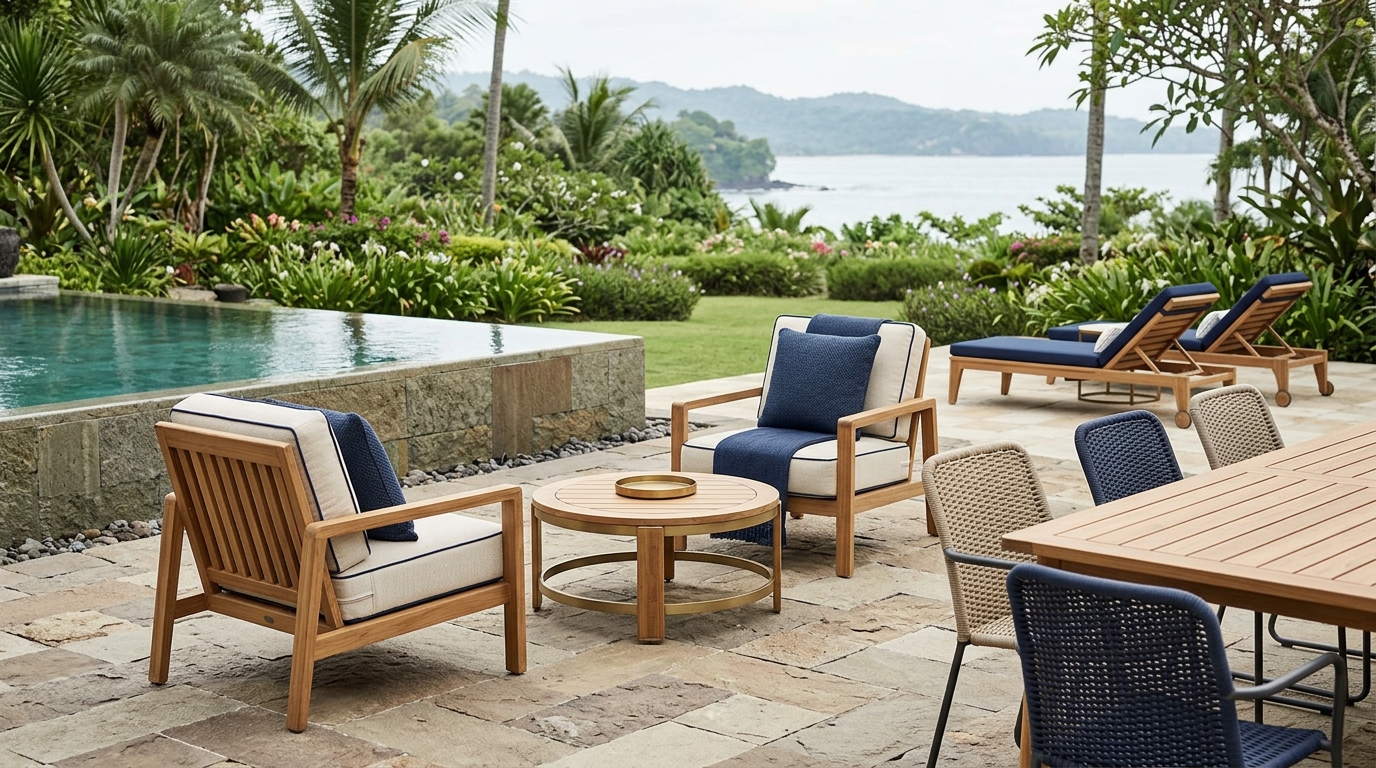
Sourcing outdoor furniture for hotels and resorts Indonesia is not a casual purchasing decision. For resort developers and hotel project managers in the United States, it is a capital expenditure that directly affects guest experience, brand identity, maintenance budgets, and long-term ROI. When…
Sourcing outdoor furniture for hotels and resorts Indonesia is not a casual purchasing decision. For resort developers and hotel project managers in the United States, it is a capital expenditure that directly affects guest experience, brand identity, maintenance budgets, and long-term ROI. When the order involves hundreds of poolside loungers, dining sets, and cabana pieces — all required on a fixed opening schedule — the stakes of choosing the wrong supplier are significant.
Indonesia has earned a genuine position at the top of the global hospitality furniture supply chain. Its combination of premium tropical hardwoods, deep craft traditions, and competitive manufacturing costs makes it a logical destination for large-scale commercial procurement. But the sourcing process itself — navigating supplier types, certifications, lead times, import compliance, and quality control across thousands of miles — demands a structured, informed approach rather than a simple search on a trade directory.
This guide is written for procurement professionals who are already evaluating Indonesian manufacturers for an active project. It covers material selection benchmarks, supplier vetting protocols, US import compliance, total cost of ownership analysis, and sustainability certification requirements. It is not a supplier directory. It is a procurement decision framework built around the specific risks and opportunities that come with sourcing commercialoutdoor furniture from Indonesiaat scale.
The sections that follow move in procurement order: from understanding why Indonesia makes strategic sense, through material and supplier selection, into logistics and compliance, and finally to ROI and sustainability considerations. Each section includes an actionable element — a checklist item, a cost benchmark, or a compliance requirement — that you can carry directly into your sourcing process.
Why Indonesia Dominates the Global Hospitality Outdoor Furniture Market
A Craft Legacy Built on Teak, Rattan, and Tropical Hardwood
Indonesia's furniture manufacturing advantage is not simply a function of low labor costs — it is rooted in centuries of woodworking tradition and unmatched access to raw materials. The island of Java, particularly the Jepara cluster in Central Java, is globally recognized as a center for solid teak and mahogany furniture production. Bali's manufacturing districts — concentrated around Denpasar and Gianyar — specialize in luxury artisan and resort-grade pieces aimed squarely at the international hospitality market. Cirebon is the country's principal rattan production hub, while Surabaya and Semarang serve as mid-market and outdoor furniture manufacturing bases.
This geographic specialization means that Indonesian manufacturers are not generalists adapting industrial processes to hospitality furniture. Many of them have spent decades producing specifically for resort, villa, and hotel buyers in Europe, Australia, and the United States. That accumulated experience translates into familiarity with commercial-grade specifications, contract durability standards, and the aesthetic expectations of international hospitality brands.
Cost-Competitive Manufacturing Without Compromising Commercial Standards
For US buyers accustomed to domestic or European-sourced outdoor furniture pricing, Indonesian alternatives typically represent meaningful cost savings at equivalent or superior quality in natural materials. The underlying reason is structural: Indonesia produces teak domestically, employs a deep pool of skilled craftspeople, and operates lower overhead costs than manufacturers in North America or Western Europe.
This does not mean Indonesian furniture is universally cheap. In the premium segment — Grade-A teak, custom-designed resort collections, bespoke branding — prices reflect genuine craftsmanship and material quality. The cost advantage is most pronounced in the mid-to-upper commercial tier: high-durability pieces that would cost significantly more if sourced domestically, but which carry the same or better longevity credentials.
Export Infrastructure Serving Global Buyers
Indonesia's two primary export corridors for furniture — the ports of Surabaya (East Java) and Bali's Ngurah Rai logistics zone — are well-established for international container shipments. FOB pricing from these ports is standard practice, and experienced Indonesian exporters are familiar with the documentation requirements of US buyers: commercial invoices, packing lists, certificates of origin, and phytosanitary certificates for timber products. The country's furniture export industry has served global markets for decades, and this experience is a practical advantage when coordinating complex multi-SKU hotel orders.
Growing FSC-Certified Supply Meeting Sustainability Expectations
The Indonesian government's SVLK (Sistem Verifikasi Legalitas Kayu — Timber Legality Verification System) is a mandatory national timber legality framework that applies to all Indonesian wood product exporters. Beyond SVLK, a growing number of Indonesian teak suppliers carry FSC (Forest Stewardship Council) certification, sourcing timber from managed plantations rather than old-growth forest. For resort developers with sustainability commitments or LEED aspirations, this certification ecosystem provides a documented, verifiable supply chain — not just a marketing claim.
The Right Materials for Commercial Outdoor Furniture in Tropical and Coastal Settings
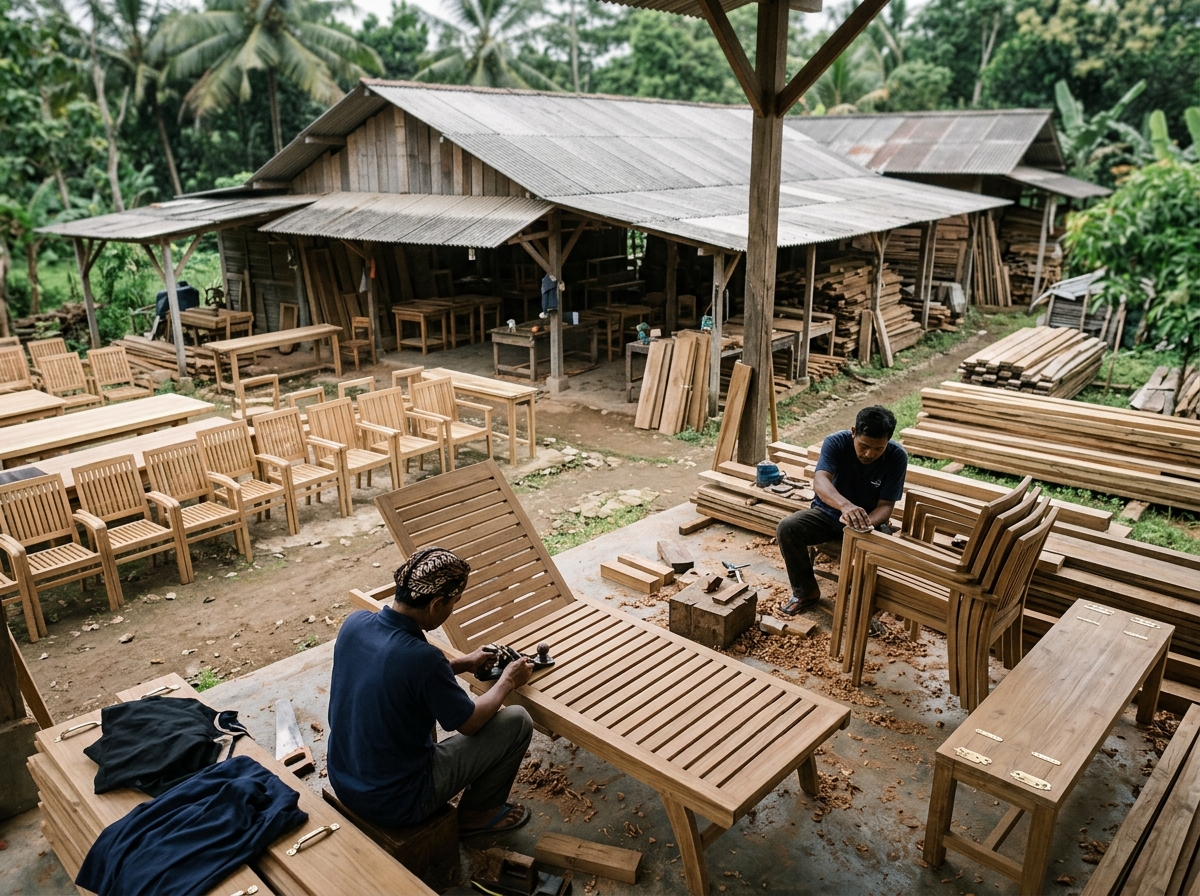
Choosing the correct material specification for outdoor furniture for hotels and resorts Indonesia is not an aesthetic decision — it is an engineering one. The wrong material in a high-humidity, UV-intensive, salt-air environment will fail within a few seasons, creating replacement costs that dwarf any initial savings.
Grade-A Teak: The Benchmark for Durability and Aesthetics
Grade-A teak — cut from the heartwood of mature plantation-grown teak trees — is the standard specification for high-end resort outdoor furniture because it contains naturally occurring silica and teak oils that resist moisture, insects, UV degradation, and fungal growth without requiring chemical treatment. For poolside loungers, beachfront dining tables, and terrace seating, Grade-A teak provides a documented service life measured in decades under commercial use conditions.
The grading matters: Grade-B and Grade-C teak, which contain more sapwood, will weather and crack more quickly in high-humidity environments. Buyers specifying teak for hospitality projects should require Grade-A certification in their purchase orders and verify it through pre-shipment inspection.
Aluminum Frame with Synthetic Rattan or Rope Weaving
For coastal and tropical environments where salt air is a factor, powder-coated aluminum frames combined with synthetic rattan weaving or marine-grade rope offer a durable, lower-maintenance alternative to solid wood. High-quality synthetic rattan (polyethylene-based) does not absorb moisture, resists UV fading when correctly specified, and tolerates the cleaning regimes typical of commercial hospitality environments. The aluminum frame eliminates rust risk entirely.
This material combination is increasingly the preferred specification for beachfront and poolside lounge furniture in US resort projects sourced from Indonesia — it delivers a natural aesthetic at a lower price point than Grade-A teak while meeting commercial durability thresholds.
Recycled Teak and Reclaimed Wood for Sustainability-Focused Projects
A growing number of Indonesian manufacturers offer furniture produced from recycled teak — timber reclaimed from old Javanese houses, bridges, and boats. Reclaimed teak is fully seasoned, dimensionally stable, and carries a visible character patina that appeals to resort brands seeking an authentic, sustainability-conscious aesthetic. For projects pursuing LEED certification or eco-resort branding, reclaimed teak furniture offers both a material story and a documented reduction in new timber consumption.
UV-Resistant Cushion Materials for High-Humidity Environments
Cushions for commercial outdoor furniture in tropical climates require solution-dyed acrylic fabrics (such as those meeting Sunbrella-equivalent performance standards) combined with quick-dry foam cores. Standard polyester fill and untreated fabric will degrade, mold, and fade within a single season in high-humidity resort environments. When specifying cushions as part of an Indonesian furniture order, buyers should request fabric specifications including UV-hour ratings and antimicrobial treatment certifications.
| Material | Durability (Commercial Use) | Maintenance Level | Price Tier | Best Application |
|---|---|---|---|---|
| Grade-A Teak | Excellent (15–25+ years) | Low–Medium | Premium | Poolside, terraces, dining |
| Aluminum + Synthetic Rattan | Very Good (10–15 years) | Low | Mid–Premium | Lounge, beachfront, cabana |
| Recycled / Reclaimed Teak | Excellent | Low–Medium | Mid–Premium | Eco-resorts, garden, terrace |
| Aluminum + Rope Weave | Good (8–12 years) | Low | Mid | Pool deck, casual lounge |
| Softwood / Untreated Timber | Poor in tropical climates | High | Budget | Not recommended for commercial |
How to Vet and Select a Reliable Indonesian Outdoor Furniture Supplier
Key Certifications That Signal Compliance-Grade Suppliers
When evaluating commercial outdoorfurniture manufacturers Indonesia, certifications are not a formality — they are the primary mechanism for screening out high-risk suppliers before any money changes hands.
- SVLK (Sistem Verifikasi Legalitas Kayu): Mandatory for all Indonesian timber product exporters. Any supplier unable to provide current SVLK documentation should be disqualified immediately. - FSC Chain of Custody: Confirms that timber was sourced from responsibly managed forests. Required for LEED-aligned projects and increasingly requested by US resort brands with sustainability policies. - ISO 9001: Indicates that a factory operates a documented quality management system — relevant for commercial orders where consistency across hundreds of units is non-negotiable.
Factory Audit Checklist for Indonesian Manufacturers
A remote supplier evaluation — based on a website, a Alibaba profile, or a catalog PDF — is not sufficient for a commercial hospitality procurement decision. Before placing a large-order commitment, conduct or commission a factory audit covering:
- ✓Verify legal entity name matches all export documentation
- ✓Confirm factory is the actual manufacturer, not a trading company or showroom
- ✓Assess production floor size relative to claimed capacity
- ✓Review in-house QC processes and finishing quality standards
- ✓Request golden sample production and retain a signed reference copy
- ✓Confirm current SVLK and FSC certificate numbers and verify online
- ✓Review worker welfare standards and labor compliance documentation
- ✓Assess subcontracting practices — identify which components are made in-house vs. outsourced
- ✓Evaluate packaging and export crating standards for ocean freight
Evaluating Samples, MOQs, and Lead Times
For commercial resort orders, requesting physical samples before committing to production is standard practice and non-negotiable. Reputable Indonesian manufacturers will produce samples at cost (often credited against the production order). When evaluating samples, retain them as golden standards and specify in the contract that production units must match the retained sample — this is the primary protection against sample bait-and-switch, one of the most common fraud patterns in Asian furniture supply chains.
Minimum order quantities vary significantly by supplier type. Large-capacity manufacturers in Jepara or Semarang may set MOQs at container-load levels (typically 20-foot or 40-foot containers); artisan workshops in Bali may work at lower volumes but at higher per-unit cost. Align your MOQ expectations with your supplier type before beginning negotiations.
Red Flags That Signal Unreliable Exporters
Several patterns consistently signal high-risk suppliers in the Indonesian furniture export market:
- Reluctance to permit unannounced or independent factory visits - Certificates presented as PDFs only, with no verifiable registration numbers - Pricing that is materially lower than all comparable suppliers without a clear explanation - No English-language export documentation experience - Inability to name the specific timber source or plantation for teak products
The pattern known in the industry as a "shared showroom" — where a trading company organizes a tour of a third-party factory, presenting it as their own — is documented and prevalent. The counter-measure is straightforward: require cross-verification of the legal entity name on factory signage, worker badges, and export documentation during any facility visit.
Lead Times, MOQs, and US Import Compliance for Commercial Orders
Production Lead Times and Container Logistics
Custom production lead times for wooden outdoor furniture for hotels Indonesia typically run between eight and sixteen weeks from confirmed order and deposit receipt, depending on order complexity, finishing specifications, and factory workload. Orders requiring custom upholstery, bespoke dimensions, or branded elements should budget toward the longer end of that range. Simple reorders of standard SKUs from an established supplier relationship can sometimes compress to six to eight weeks.
FOB pricing from Indonesian ports — most commonly FOB Surabaya or FOB Bali — is the standard Incoterm for US buyers. Under FOB terms, the seller is responsible for goods until they are loaded onto the vessel; the buyer assumes responsibility (and freight cost) from that point. Ocean freight transit time from Indonesian ports to US West Coast destinations is typically two to four weeks; East Coast ports add another week or more via the Suez Canal routing.
US Customs, HTS Codes, and Import Documentation
US buyersimporting furniture from Indonesiamust correctly classify products under the Harmonized Tariff Schedule (HTS). Outdoor wooden furniture typically falls under Chapter 94 of the HTS; the specific code varies by construction (wood, metal, rattan). Misclassification is a compliance risk that can result in customs delays, penalties, or retroactive duty assessments.
Key documentation required for US customs clearance of Indonesian furniture imports includes:
- ✓Commercial invoice (itemized by SKU, unit price, and total value)
- ✓Packing list with dimensions and gross/net weights by carton
- ✓Certificate of Origin (Form A or standard CO issued by Indonesian trade authority)
- ✓Phytosanitary certificate for solid wood products (required by USDA APHIS)
- ✓SVLK certificate or equivalent timber legality documentation
- ✓Bill of Lading issued by the ocean carrier
- ✓Any applicable FSC Chain of Custody documentation for LEED-related projects
The Lacey Act requires US importers of wood products to declare the species, country of harvest, and quantity of plant material in imported products. Indonesian teak imports must include this declaration at the time of entry. Working with a licensed US customs broker familiar with wood product imports is strongly recommended for first-time Indonesian furniture importers.
Working With Freight Forwarders and Local Agents
A competent freight forwarder with Indonesia experience can manage consolidation (LCL for smaller orders), container booking, export customs clearance in Indonesia, ocean freight booking, and import customs filing coordination in the US. For buyers new to Indonesian sourcing, engaging a freight forwarder before finalizing supplier negotiations — rather than after — allows freight costs to be factored into landed cost calculations from the outset.
Resort Outdoor Furniture Collections: What Indonesian Manufacturers Do Best
Indonesia's manufacturing base is particularly well-suited to the furniture categories that drive the largest line items in a resort outdoor furniture specification:
Poolside loungers and daybeds are arguably Indonesia's highest-volume hospitality export category. The combination of powder-coated aluminum frames with synthetic rattan or rope weave, or slatted teak construction, meets the specific demands of pool environments: resistance to chlorinated water, UV stability, stackability for housekeeping, and the aesthetic quality expected in five-star settings.
Outdoor dining sets for open-air restaurants and terraces represent a significant opportunity for custom specification. Indonesian manufacturers can produce dining tables and chairs to precise dimensions, finish specifications, and quantity — including matching indoor-outdoor collections that maintain visual consistency across resort areas.
Lounge and cabana furniture — deep-seating sectionals, swing daybeds, oversized ottomans, and shade structures — are categories where Bali-based luxury artisan manufacturers excel. These pieces often incorporate mixed-material construction (teak frame, woven rattan panels, custom cushion upholstery) that is difficult to source cost-competitively outside Indonesia.
Custom branding and bespoke design is available from a wide range of Indonesian manufacturers, not just the largest factories. Resort identity programs — custom paint colors, branded cushion fabrics, proprietary silhouettes — can be executed through Indonesian manufacturers at commercially viable minimum quantities. Buyers should request evidence of previous bespoke project work and review production samples before committing to a full custom collection.
Frequently Asked Questions: Sourcing Outdoor Furniture From Indonesia
Where do resorts and hotels buy their outdoor furniture?
Larger resort groups typically establish direct manufacturer relationships with Indonesian factories, often facilitated by an initial buying trip to the furniture districts of Bali (Denpasar, Gianyar) or a trade fair visit. Mid-scale resort developers commonly work through sourcing agents or trading companies that provide market access without requiring direct factory management. A growing segment uses hybrid sourcing: direct Indonesian manufacturer relationships for core furniture categories, combined with a US distributor for fast-replenishment items. Online trade platforms and directories serve as initial discovery tools but should never replace physical factory verification.
Who makes the highest quality outdoor furniture for commercial hospitality use?
For natural wood categories — particularly teak — Indonesia and, to a lesser extent, Thailand are the globally recognized production leaders for hospitality-grade outdoor furniture. Within Indonesia, manufacturers in Jepara (solid teak), Bali (luxury artisan and resort collections), and Semarang (outdoor commercial) represent the primary quality tiers. Vietnam is a growing competitor, particularly for dining and bedroom categories, but Indonesia maintains a distinctive edge in teak and rattan craftsmanship for the resort market.
Is it worth buying outdoor furniture directly from Bali or Indonesia?
For orders above a container-load threshold, direct procurement from Indonesian manufacturers almost always yields a better landed cost than purchasing equivalent quality through US distributors or importers, provided the buyer manages quality control, documentation, and logistics correctly. The break-even point depends on order volume, product category, and the buyer's internal capacity to manage the sourcing process. Below that threshold, or for buyers without sourcing infrastructure, working through a vetted agent or operational partner can deliver the same cost advantage without the execution risk.
What materials are best for outdoor hotel furniture in tropical climates?
Grade-A teak and powder-coated aluminum with UV-stable synthetic rattan or marine-grade rope weave are the two benchmark specifications for commercial outdoor furniture in tropical and coastal environments. Reclaimed teak is an increasingly specified option for eco-resort positioning. All cushion materials should use solution-dyed acrylic fabric and quick-dry foam construction. Standard softwoods, untreated metals, and polyester fabrics are inappropriate for commercial tropical outdoor use.
How long does it take to receive a custom order from an Indonesian furniture manufacturer?
Custom production lead times for Indonesian outdoor furniture run approximately eight to sixteen weeks from confirmed order and deposit, depending on complexity. Adding ocean freight transit (typically two to four weeks to US West Coast ports), customs clearance, and domestic delivery, buyers should budget a total timeline of fourteen to twenty-two weeks from order confirmation to on-site delivery. Projects with hard opening deadlines should initiate procurement at least six months in advance.
What certifications should I look for when sourcing Indonesian outdoor furniture?
At minimum: SVLK (mandatory Indonesian timber legality certificate), FSC Chain of Custody (for sustainable sourcing claims and LEED compliance), and ISO 9001 (quality management system). All certificates should be verified directly on the issuing body's online registry — never accepted as PDF copies alone.
Total Cost of Ownership: Is Indonesian Outdoor Furniture Worth the Investment?
Price-Per-Unit vs. Domestic US Alternatives
The unit-cost differential between Indonesian-sourced commercial outdoor furniture and comparable US-manufactured or European-imported alternatives is substantial in the natural materials segment. Grade-A teak poolside loungers sourced directly from Indonesian manufacturers, landed in a US port, typically represent a significant discount to equivalent quality purchased through US contract furniture distributors — even after accounting for freight, duties, and agent fees. The differential narrows for aluminum-framed synthetic products, where US and Chinese manufacturers are more price-competitive.
Longevity and Maintenance Cost Over Ten Years
The total cost of ownership calculation over a ten-year commercial use cycle substantially favors Grade-A teak and quality aluminum-frame furniture over budget alternatives, regardless of source. Teak's natural oil content minimizes required maintenance — periodic cleaning and an annual application of teak oil or sealant is typically sufficient to maintain appearance. Powder-coated aluminum requires only cleaning. By contrast, lower-grade wood furniture in tropical environments may require refinishing, structural repairs, or replacement within three to five years of commercial use, eliminating the initial purchase savings and adding unplanned operational costs.
Replacement Cycle Planning for High-Traffic Environments
Resort developers should build replacement cycle assumptions into capital expenditure models. For high-traffic poolside and beach areas, even the best-quality furniture will experience accelerated wear from chlorine exposure, UV loading, and physical handling. A realistic commercial replacement cycle for Grade-A teak in a well-maintained resort environment is commonly fifteen to twenty years; for aluminum and synthetic rattan, plan for ten to twelve years before systematic replacement. Budget replacement cycle costs at the acquisition stage, not retroactively.
ROI Framing for Capital Expenditure Decisions
For resort developers making capital expenditure decisions, the relevant comparison is not the lowest-cost furniture that meets minimum appearance standards — it is the furniture that minimizes total cost (acquisition plus maintenance plus replacement) over the asset's useful life, while supporting the guest experience and brand positioning that drive room rate premiums. Indonesian commercial outdoor furniture for resorts, correctly specified and sourced, consistently delivers favorable returns on this framing relative to domestic alternatives.
Sustainability and Ethical Sourcing for Resort Outdoor Furniture
FSC Certification and SVLK Compliance
FSC certification for Indonesian teak confirms that the timber originates from a plantation managed to FSC standards — covering forest health, labor rights, and community impact. SVLK is the Indonesian government's mandatory timber legality system; SVLK-certified exporters have been audited by accredited third-party bodies and are legally compliant with Indonesia's forestry laws. For US resort buyers, SVLK compliance also satisfies the Lacey Act's due-care requirement for imported timber products, reducing legal exposure.
The sustainability certification roadmap for a resort procurement decision looks like this: SVLK is the baseline requirement (non-negotiable for US import compliance); FSC Chain of Custody is the upgrade that enables sustainability marketing claims and supports LEED documentation; reclaimed or recycled teak is the highest-impact option for resorts prioritizing carbon and deforestation narratives.
Recycled and Reclaimed Wood as Eco-Branding Opportunities
Reclaimed teak furniture sourced from Indonesian manufacturers is not simply a sustainability compromise — it is a premium product with a documented material story. Fully aged, structurally sound reclaimed teak has inherent character that new plantation timber cannot replicate, and it aligns directly with the resort positioning strategies of eco-lodges, boutique hotels, and sustainability-certified properties.
Labor Practices and Fair-Trade Considerations
The cooperative and artisan workshop structure prevalent in Bali and Jepara means that many Indonesian furniture producers operate as community-scale manufacturers employing local craftspeople at locally appropriate wages. This model has genuine fair-trade characteristics, though buyers should not assume compliance — requesting documentation of worker welfare practices, and including labor standards in supplier contracts, is the appropriate approach. Suppliers willing to undergo BSCI (Business Social Compliance Initiative) audits or equivalent third-party social compliance assessments are the appropriate partners for resort brands with responsible sourcing policies.
Aligning Sourcing With LEED and Green Hospitality Certifications
Resort projects pursuing LEED certification can earn credits in the Materials and Resources category through documentation of FSC-certified timber use. The required documentation chain is: FSC-certified plantation → FSC Chain of Custody manufacturer → FSC invoice and certificate documentation → LEED submittal. Indonesian manufacturers with currentFSC Chain of Custody certificationcan provide this documentation chain. Buyers should confirm FSC scope — specifically, that the exact products being purchased are covered by the manufacturer's FSC certificate, not just their timber procurement generally.
- ✓Verify current SVLK certificate on Indonesian government registry
- ✓Verify FSC Chain of Custody certificate on info.fsc.org for each supplier
- ✓Confirm FSC scope covers the specific product categories being purchased
- ✓Request Lacey Act timber declaration data: species, country of harvest, quantity
- ✓For reclaimed teak: request documentation of material origin and salvage source
- ✓Review supplier labor practices documentation or request BSCI audit status
- ✓For LEED projects: confirm FSC invoice documentation format meets LEED submittal requirements
Sourcing outdoor furniture for hotels and resorts Indonesia requires integrating material knowledge, supplier vetting discipline, import compliance competence, and long-horizon cost analysis into a single procurement decision. The country's combination of premium teak resources, established export infrastructure, and growing certification ecosystem makes it a strategically sound choice for US resort developers — but only when the sourcing process is executed with the rigor that commercial-scale hospitality procurement demands.
Having worked through the full decision framework — from material specification to sustainability certification — you are now positioned to engage Indonesian manufacturers as an informed, compliance-ready buyer rather than a speculative one.
You now understand the materials, certifications, lead times, and compliance requirements that separate a successful Indonesian furniture procurement from a costly misstep. The natural next step is connecting with a vetted manufacturer who can meet your specification, volume, and timeline requirements. Request a custom quote from a vetted Indonesian outdoor furniture manufacturer today and receive production capacity confirmation, FSC certification status, and a landed-cost estimate for your project.
Request a Custom Quote →Need eyes on the ground in Indonesia?
MTS is an execution partner — supplier verification, manufacturing management, quality control and export logistics across Indonesia, Vietnam and China.
Related services
Related articles
Receive furniture sourcing insights across Asia.
One email per week. No spam.