Importing from Vietnam: Documentation and Rules of Origin
10 min read
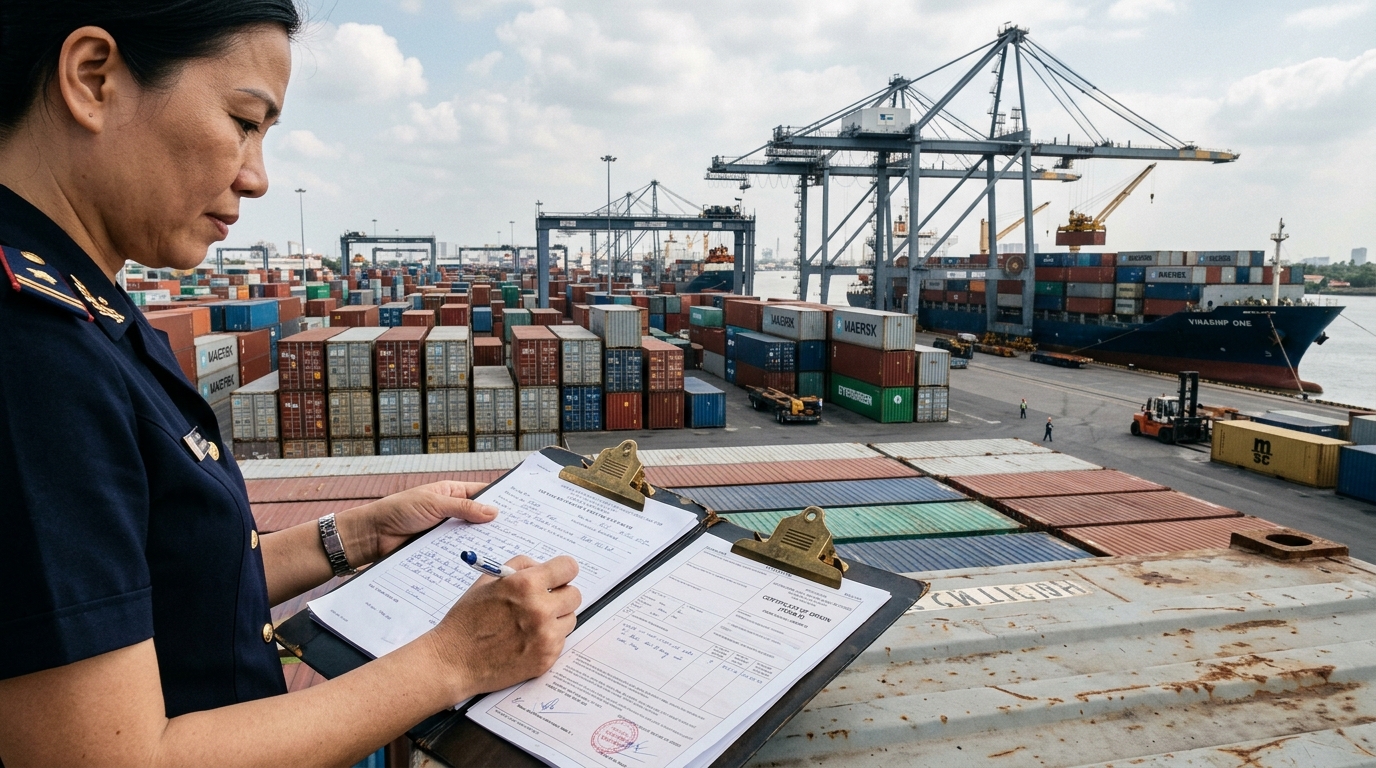
Vietnam has become one of the most active manufacturing corridors in Asia over the past decade, attracting investment across electronics, textiles, furniture, footwear, and light machinery. That growth has brought significant benefits to importers diversifying away from China — but it has also drawn sustained attention from customs authorities in the United States, the European Union, and other major import markets. Meeting Vietnam import documentation requirements today demands more than collecting the standard paperwork. It requires understanding where scrutiny is concentrated, what regulators are looking for, and why documentation that passed without comment two years ago may now trigger a request for further evidence.
The China+1 shift — the strategy of relocating production or final assembly from China to lower-cost neighboring countries — is a legitimate and widely adopted supply chain response to tariff exposure, geopolitical risk, and rising Chinese labour costs. Vietnam is the most significant beneficiary of that shift. However, the same movement has attracted a pattern of transshipment and minimal-processing schemes designed to obscure Chinese origin rather than create genuine Vietnamese manufacturing value. Customs authorities have responded by raising the bar on origin verification, and importers sourcing from Vietnam now bear the documentation burden of demonstrating that the origin claim is real.
This article covers the core documents involved, how rules of origin apply in a Vietnam context, the specific risks that follow incomplete or inconsistent documentation, and how a structured approach to import export documentation support can prevent costly delays and penalties. If you are already managing a broader Asia-origin documentation program,the Import & Export Support pillar guidesets out the full documentation framework across origin countries.
When a country becomes a prominent re-routing point in global trade, customs agencies investigate. Vietnam's rapid growth as an export base — particularly in categories that carry significant US Section 301 tariffs or EU anti-dumping measures against Chinese goods — has made it a focus of anti-circumvention enforcement actions.
Anti-circumvention refers to the practice of routing goods through a third country and claiming origin there, when the substantive manufacturing value was created elsewhere, typically China. Customs authorities do not assume this is happening with every Vietnam shipment. However, they apply additional scrutiny to product categories where it has been documented, and they increasingly request evidence that the goods meet the relevant rules of origin standard.
For importers, the consequence of inadequate documentation is not merely a customs hold. It can result in retroactive duty assessments covering prior shipments, fines, and in serious cases import bans. The importer of record — not the Vietnamese supplier — is typically liable.
The Core Document Set for Vietnam-Origin Shipments
Meeting Vietnam import documentation requirements starts with getting the standard document set correct. Each document has a specific function, and inconsistencies between them are a primary trigger for customs queries.
Commercial Invoice
The commercial invoice must state the correct declared value, the buyer and seller details, an accurate goods description tied to the HS code, the country of origin, and Incoterms 2020 terms. Vague product descriptions — particularly generic terms like "parts" or "components" — invite classification queries. The invoice description should reflect what the goods actually are and align precisely with the packing list and Bill of Lading.
Packing List
The packing list must correspond exactly to the commercial invoice in terms of quantity, unit of measure, and product description. Discrepancies between invoice and packing list quantities are a routine cause of customs holds that could be avoided entirely with document review before shipment.
Bill of Lading or Air Waybill
The Bill of Lading (or Air Waybill for air freight) confirms the carrier, origin port, destination port, and goods description. The shipper named should be consistent with the exporter on the commercial invoice. Port-of-loading anomalies — for example, a Vietnamese-origin shipment routed through a Chinese port without explanation — will attract attention.
Certificate of Origin
This is the most scrutinised document in the Vietnam context. Vietnam issues Certificates of Origin through the Ministry of Industry and Trade (MOIT) and authorised bodies. Form D is the ASEAN-specific Certificate of Origin used for RCEP and ASEAN FTA purposes. Other forms apply to different preference programs.
A Certificate of Origin does not by itself prove genuine origin — it certifies that the competent authority has accepted the exporter's declaration. Customs authorities in destination markets are entitled to conduct origin verification, which can involve requesting production records, supplier invoices, and manufacturing process documentation from the Vietnamese exporter. If those records do not support the claim, the certificate is disqualified.
Customs Declaration and HS Code Accuracy
The HS code declared by the importer determines the duty rate applied. An incorrect HS code — even one assigned in good faith — can result in underpayment of duties, triggering back-assessment and penalties. In Vietnam-origin shipments of electronics, textiles, and furniture in particular, HS classification disputes are common because the goods frequently straddle classification boundaries.
Understanding Rules of Origin for Vietnam: What "Made in Vietnam" Actually Means
Rules of origin define when a product qualifies as originating in a specific country. For customs purposes, there are two relevant frameworks: non-preferential rules of origin (used to determine origin for trade statistics and anti-dumping duty purposes) and preferential rules of origin (used to claim reduced duty rates under FTAs such as RCEP or CPTPP).
The Substantial Transformation Standard
Under WCO-aligned non-preferential rules, a product is considered to originate in the country where it underwent its last substantial transformation — meaning a process that results in a new and different article with a distinct name, character, and use. For goods assembled in Vietnam from Chinese components, this is where the analysis becomes contested.
Simple assembly, minimal processing, dilution, cutting to length, or repacking typically does not constitute substantial transformation. A product that arrives in Vietnam as a Chinese-made sub-assembly and exits with a label change does not qualify as Vietnamese origin.
Preferential Rules of Origin Under RCEP and CPTPP
RCEP (the Regional Comprehensive Economic Partnership) and CPTPP each define origin through a combination of rules: wholly obtained, change in tariff classification (CTC), regional value content (RVC), or specific process rules — depending on the product. Vietnam is a signatory to both agreements.
For importers in RCEP member markets, sourcing from Vietnam can offer preferential tariff treatment — but only if the goods genuinely meet the applicable origin rule for the product category. Regional value content thresholds under RCEP typically require that a specified percentage of the goods' value is attributed to regional (RCEP-member) inputs and processing. Documentation to support an RVC claim includes supplier invoices, cost breakdowns, and production records — not just the Certificate of Origin.
| Framework | Origin Rule Basis | Relevant CO Form | Key Verification Risk |
|---|---|---|---|
| Non-preferential (US, EU, most markets) | Substantial transformation | Standard CO / Form A | Insufficient processing, Chinese content |
| RCEP preferential | CTC, RVC, or specific process | Form D (ASEAN) | RVC threshold not met, incomplete cost records |
| CPTPP preferential | Tariff shift or RVC | CPTPP CO | Yarn-forward rules in textiles, complex inputs |
| GSP (where applicable) | Substantial transformation / direct transport | GSP Form A | Country's GSP eligibility, direct transport rule |
Anti-Circumvention Risk: What Triggers an Investigation
Anti-circumvention investigations are initiated when a customs authority has reason to believe that goods claiming a particular origin are in substance manufactured elsewhere and routed to avoid duties or trade measures. For Vietnam-origin shipments, the risk indicators that commonly attract investigation include:
- A high proportion of Chinese-origin inputs relative to the finished goods value - Production facilities established very recently, with limited track record - Product categories that carry significant US Section 301 tariffs or EU anti-dumping measures on Chinese-made equivalents - Shipping routes that pass through Chinese ports before arriving in Vietnam - Supplier documentation that does not align with declared manufacturing capacity - Declared values that appear inconsistent with Vietnamese production costs
None of these factors alone constitutes proof of circumvention. But any combination increases the likelihood of a request for origin verification or a formal investigation. Importers should assess their supplier base against these indicators before the goods arrive at the border.
Where Documentation Failures Occur in Practice
For importers dealing with multiple Vietnamese suppliers across multiple SKUs, Vietnam import documentation requirements create coordination complexity. The most common failure patterns are not exotic — they are routine gaps between supplier-managed documents and the import declaration.
Inconsistent product descriptions across the commercial invoice, packing list, and Bill of Lading are a primary source of customs queries. Each document is generated by a different party and often reviewed by nobody before shipment.
HS code mismatches occur when the supplier declares an HS code for Vietnamese export purposes and the importer's customs broker assigns a different code at the destination. Neither party has verified that the codes align, and the difference may carry significant duty implications.
Certificates of Origin that do not match the shipment — in terms of quantity, description, or value — are routinely rejected. A CO issued for 500 units that arrives with 520 units on the packing list is not a trivial discrepancy.
Missing or incorrect Incoterms on the commercial invoice affect the dutiable value calculation. CIF value is dutiable in some markets; FOB value in others. An invoice that states the wrong Incoterms, or states them inconsistently, creates landed cost unpredictability.
These failures are preventable. The mechanism of prevention is document review before the shipment moves — not after the goods are held at the border.
Building a Compliant Documentation Process for Vietnam Sourcing
For importers scaling Vietnam sourcing across multiple suppliers and product categories, the documentation process needs to be systematised rather than handled reactively shipment by shipment.
A structured approach involves three layers:
Supplier qualification: Before any commercial shipment, verify that each supplier can produce the documentation required — including origin-supporting records, not just the standard export documents. Assess the supplier's actual production capability against the volume and product type being ordered.
Pre-shipment document review: Collect the complete document set — commercial invoice, packing list, draft Bill of Lading, Certificate of Origin — before the vessel sails. Review for internal consistency and alignment with the purchase order. This is the stage at which errors are still correctable.
Import declaration alignment: Ensure the HS code used in the import declaration matches the product as described, not the code that happens to carry the lowest duty. Verify that the declared value reflects the actual transaction value plus any applicable costs as required by the destination country's customs valuation rules.
For importers who do not have the internal trade compliance resource to manage this systematically, working with a documentation-specialist partner closes the gap.Our Import & Export Support servicecovers the full documentation cycle for Vietnam and other Asia-origin shipments, including pre-shipment review and origin compliance assessment.
How FTA Strategies Interact with Vietnam Origin Documentation
Vietnam's membership in both RCEP and CPTPP creates genuine tariff savings opportunities for importers in qualifying markets. However, those savings are only available when the documentation correctly supports the preferential origin claim.
For CPTPP, textiles and apparel are subject to yarn-forward rules, meaning that the fibre, yarn, and fabric must originate within CPTPP members for the finished garment to qualify. An importer sourcing garments from Vietnam using Chinese-origin fabric will not qualify for CPTPP preferential rates, regardless of where the cutting and sewing occurs.
For RCEP, the RVC threshold and the specific product rules must be assessed on a category-by-category basis. Blanket assumptions that all Vietnam-sourced goods qualify for RCEP preference are a compliance risk.
FTA strategy should be assessed at the sourcing stage, not at the import stage. The documentation requirements follow from the origin structure of the product — and that structure is determined by supplier selection and production design.
Getting Vietnam import documentation requirements right is not purely a logistics task. It is a trade compliance function that sits at the intersection of sourcing decisions, supplier management, and customs procedure. The volume of Vietnam-origin sourcing across global supply chains means that importers who manage this well gain a real operational advantage over those who do not — in predictable clearance times, accurate landed costs, and a documentation trail that holds up to scrutiny.
Need eyes on the ground in Vietnam?
MTS is an execution partner — supplier verification, manufacturing management, quality control and export logistics across Indonesia, Vietnam and China.
Related services
Related articles
Receive furniture sourcing insights across Asia.
One email per week. No spam.