Commercial Invoice Customs Requirements: Fields That Trigger Examination
11 min read
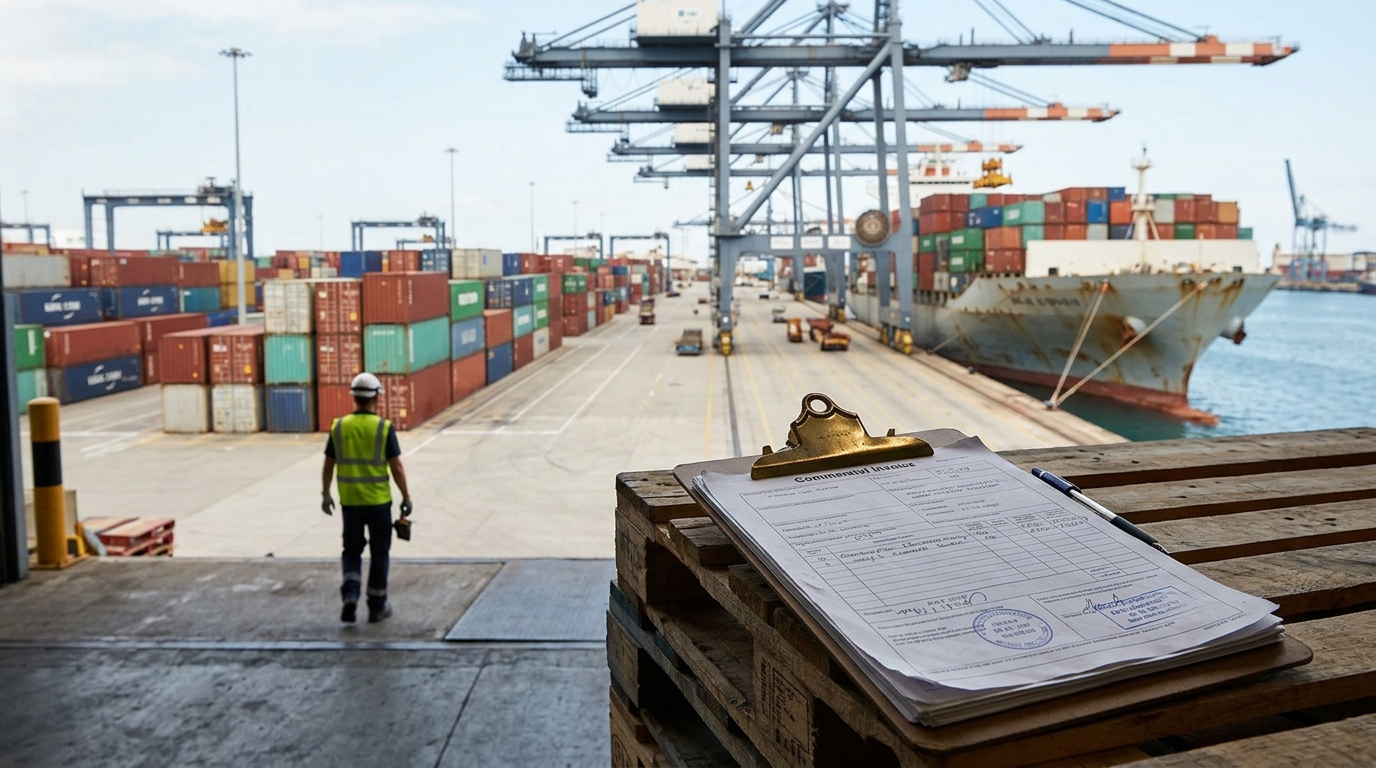
A commercial invoice is not simply a supplier's billing document. For customs authorities in every major import destination, it is the primary evidentiary record used to determine the correct tariff classification, the applicable duty rate, the transaction value for assessment purposes, and whether the shipment poses any compliance risk. Meeting commercial invoice customs requirements precisely is, therefore, not a paperwork formality — it is the single most direct lever an importer has over whether goods clear first time or are held for examination.
For shipments originating in Asia, the stakes are amplified. Anti-dumping regimes, rules-of-origin scrutiny under agreements such as RCEP and CPTPP, and heightened enforcement around declared values mean that a vague product description or a missing Incoterms reference can expose an importer to examination, re-assessment, or a formal query from customs — all of which cost time and money. The commercial invoice customs requirements discussed here reflect the standards applied at the most commercially significant import destinations: the United States, the European Union, the United Kingdom, and Australia. Where country-specific nuances matter, they are noted.
This article works through each critical invoice field in sequence, identifies the patterns that trigger examination, and explains what a correctly prepared document looks like. It is a companion resource tothe Import & Export Support pillar guide, which covers the full documentation set — bill of lading, packing list, certificate of origin, and beyond — required for Asia-origin shipments.
Customs agencies use risk-scoring systems to decide which shipments to examine physically or query documentarily. The commercial invoice feeds directly into that scoring. Authorities are looking for internal inconsistencies — for example, a unit price that appears low relative to the product category — as well as mismatches between the invoice and other documents in the set, such as the packing list or the bill of lading.
Under the WCO Valuation Agreement, transaction value (the price actually paid or payable) is the primary basis for customs valuation. If the invoice does not support a credible transaction value — because it omits payment terms, lacks buyer and seller detail, or carries a value inconsistent with market norms — customs officers are entitled to apply alternative valuation methods, which typically result in a higher assessed value and a larger duty bill. This is one of the most common and most avoidable sources of unexpected landed cost for importers sourcing from China, Vietnam, India, and other major Asian manufacturing hubs.
The Seller and Buyer Fields: More Than a Name and Address
The invoice must identify both the seller (exporter) and the buyer (importer) completely. This means legal entity name, full registered address, and — in most major destinations — a tax identification or EORI number for the importer.
A common error from Asian suppliers, particularly smaller factories, is listing a trading company or agent as the seller when the actual exporter on the export declaration is a different entity. This mismatch between the invoice seller and the shipper named on the bill of lading is a reliable examination trigger. Customs cross-references these names routinely, and discrepancies prompt questions about whether the transaction value is at arm's length.
For importers operating under a Letter of Credit (LC), the buyer and seller fields must also align precisely with the LC terms. A name variation — even a trading name versus a registered legal name — can result in a documentary discrepancy that delays payment release, independently of the customs issue.
Product Description: Specificity Is Not Optional
Vague product descriptions are among the most frequent causes of examination for Asia-origin shipments. Descriptions such as "electronic components," "machine parts," or "textile goods" give customs officers nothing to verify and everything to question. Commercial invoice customs requirements at the field level demand a description sufficient to determine the correct HS classification without reference to any other document.
A compliant product description should include, at minimum:
- The common commercial name of the goods - The material composition (relevant for textiles, chemicals, plastics, food products, and many other categories) - The intended use or function where classification depends on it - Any relevant technical specification — grade, model number, or standard — that affects classification
How Vague Descriptions Interact with HS Code Verification
Customs authorities do not simply accept the HS code declared on the invoice or the customs entry. They read the product description to verify that the declared code is plausible. When the description is generic, the officer has no basis for verification and may default to examination or a formal tariff ruling request. Either outcome delays clearance.
For product lines that sit near tariff boundaries — goods that could be classified in more than one heading depending on composition or use — the invoice description is often the only document that resolves the ambiguity. Suppliers who copy-paste descriptions across product lines, or who use internal part numbers rather than commercial descriptions, routinely create this problem for their customers downstream.
Quantity, Unit of Measure, and Packing List Alignment
The quantity declared on the invoice must match the packing list exactly — in both the total number of units and the unit of measure used. A discrepancy as simple as the invoice stating "1,200 pieces" while the packing list shows "100 cartons" (without a per-carton unit breakdown) is enough to generate a documentary query.
For goods sold by weight, the invoice should state both gross and net weight per line item where practicable, consistent with the packing list. This matters particularly for goods subject to specific duties calculated on a per-kilogram or per-unit basis rather than ad valorem.
Unit Price, Total Value, and Currency: The Valuation Tripwire
This is the field cluster most closely scrutinised by customs authorities worldwide, and the area where commercial invoice customs requirements are most often misunderstood by both importers and their suppliers.
The invoice must state a unit price per item, the total value per line, the overall invoice total, and the currency. It must also be clear whether the stated price is the transaction value at the agreed Incoterms point — because customs valuation is adjusted to a CIF (cost, insurance, freight) basis in most destinations, or an FOB basis in others.
Why Incoterms Must Appear on the Invoice
Incoterms 2020 define the point at which risk and cost transfer between seller and buyer. They are not optional boilerplate — they are essential context for customs valuation. Without a stated Incoterms term and named place, the customs officer cannot determine what costs are or are not included in the declared value, which makes independent verification of the transaction value impossible.
The most common error here is an invoice that states an FOB price (excluding freight and insurance) when the destination country's customs authority requires a CIF value for duty assessment. The importer's customs broker must then add freight and insurance to derive the correct dutiable value. If the invoice provides no Incoterms reference, this calculation cannot be audited, and the risk of re-assessment increases.
| Destination | Standard valuation basis | Incoterms term importers should reference |
|---|---|---|
| European Union | CIF (at EU border) | CFR or CIF named EU port |
| United Kingdom | CIF (at UK port of entry) | CFR or CIF named UK port |
| United States | FOB (at export port) | FOB named Asian port |
| Australia | FOB (at export port) | FOB named Asian port |
Country of Origin: The Field That Intersects with Trade Policy
The country of origin declared on the commercial invoice has grown in significance considerably as trade policy has become more complex. For goods manufactured in China, Vietnam, India, or elsewhere in Asia, the declared origin determines whether preferential duty rates under RCEP, CPTPP, or the Generalised System of Preferences (GSP) apply — and whether anti-dumping or countervailing duties are triggered.
Customs authorities cross-reference the invoice's origin declaration against the certificate of origin presented with the shipment. If the two documents are inconsistent, or if the certificate of origin does not appear to support the origin claimed, the shipment will be queried. For goods in sensitive categories — solar panels, steel products, certain chemicals, and electronics from specific origins — customs agencies actively scrutinise origin claims as a matter of policy.
A compliant invoice states the country of origin for every line item. For shipments involving goods with components sourced from multiple countries and assembled in one, the description should be specific enough to support the rules-of-origin analysis that underpins the certificate of origin. Suppliers who write "Made in China" on an invoice when the goods were manufactured in Vietnam — a pattern sometimes seen when a supplier has facilities in multiple countries — create a serious compliance exposure for the importer.
Payment Terms, LC References, and Marks and Numbers
Two fields that importers often treat as secondary — payment terms and shipping marks — are directly relevant to customs examination risk.
Payment terms (for example, 30% deposit, 70% against bill of lading) help customs officers assess whether the transaction is at arm's length. Related-party transactions — where buyer and seller have a commercial relationship beyond the individual transaction — must be disclosed, and the payment terms often signal this relationship. The omission of payment terms does not make the relationship invisible; it makes the invoice look incomplete, which itself prompts scrutiny.
Shipping marks and package numbers on the invoice must correspond to the marks on the physical cartons, the packing list, and the bill of lading. A misprint — a container number carried over from a previous shipment, or carton numbers that do not run sequentially with the packing list — is a common source of documentary queries that delays release while the discrepancy is resolved.
If the shipment is covered by a Letter of Credit, the invoice must reference the LC number. Banks and freight forwarders routinely check this, but it is worth confirming with the supplier that the LC reference appears on every page of the invoice, not just the first.
Common Patterns in Supplier-Generated Invoice Errors
Drawing on the field-level requirements above, the most common error patterns from Asian suppliers tend to cluster in a few predictable areas:
- Generic product descriptions copied from a catalogue or website rather than drafted to customs requirements - Missing or incorrect Incoterms — often because the supplier's invoice template predates Incoterms 2020 or uses an incorrect term for the agreed delivery point - Value inconsistencies between the invoice, the proforma, and the packing list, particularly when a price revision was agreed after the proforma was issued - Origin errors in multi-country supply chains, where the supplier defaults to their registered country rather than the actual country of manufacture - Quantity mismatches caused by last-minute changes to the shipment that were reflected in the packing list but not the invoice
For importers managing multiple suppliers across different Asian countries, the risk is compounded by inconsistency: each supplier has their own invoice template, their own habits, and their own understanding of what customs authorities in your destination market require. Standardising the invoice brief — specifying required fields, acceptable formats, and the consequences of errors — is one of the most effective systemic improvements a scaling importer can make.
For teams that want expert review built into the process rather than relying on supplier compliance alone,our Import & Export Support serviceprovides exactly this function: document preparation, supplier coordination, and pre-shipment review to catch the field-level errors described in this article before the shipment departs.
Building a Commercial Invoice Checklist Your Suppliers Will Actually Use
A written checklist, shared with every supplier as part of the purchase order pack, is the most practical tool for reducing invoice errors at source. The checklist should be brief — no more than one page — and should specify:
1. Legal entity names for both buyer and seller (no abbreviations that differ from the LC or import licence) 2. Full addresses including postal code and country 3. Invoice date and a unique invoice number 4. PO reference number from the buyer's system 5. Product description requirements (material, function, composition — not part numbers) 6. HS code at the 6-digit minimum (10-digit where required by destination) 7. Quantity and unit of measure, aligned to the packing list 8. Unit price and total value, with currency specified 9. Incoterms 2020 term and named place 10. Country of origin per line item 11. Payment terms 12. Shipping marks and container or seal number where applicable 13. LC reference number if applicable
Distributing this checklist does not guarantee compliance, but it establishes a documented standard and gives your team a basis for rejecting non-compliant invoices before the shipment is booked.
Getting commercial invoice customs requirements right is a discipline, not a one-time exercise. Tariff classifications change, trade agreement rules evolve, and supplier personnel turn over — all of which can quietly introduce errors into documents that were previously accurate. A consistent review process, applied to every shipment rather than just new suppliers or new product lines, is what separates importers who clear customs reliably from those who encounter periodic but entirely avoidable delays.
Shipping goods from Indonesia?
MTS coordinates consolidation, export documentation and freight across suppliers — one accountable partner from factory to port of destination.
Related services
Related articles
Receive furniture sourcing insights across Asia.
One email per week. No spam.