Alang Alang Thatch Roofing Suppliers Indonesia: Complete Sourcing Guide
13 min read
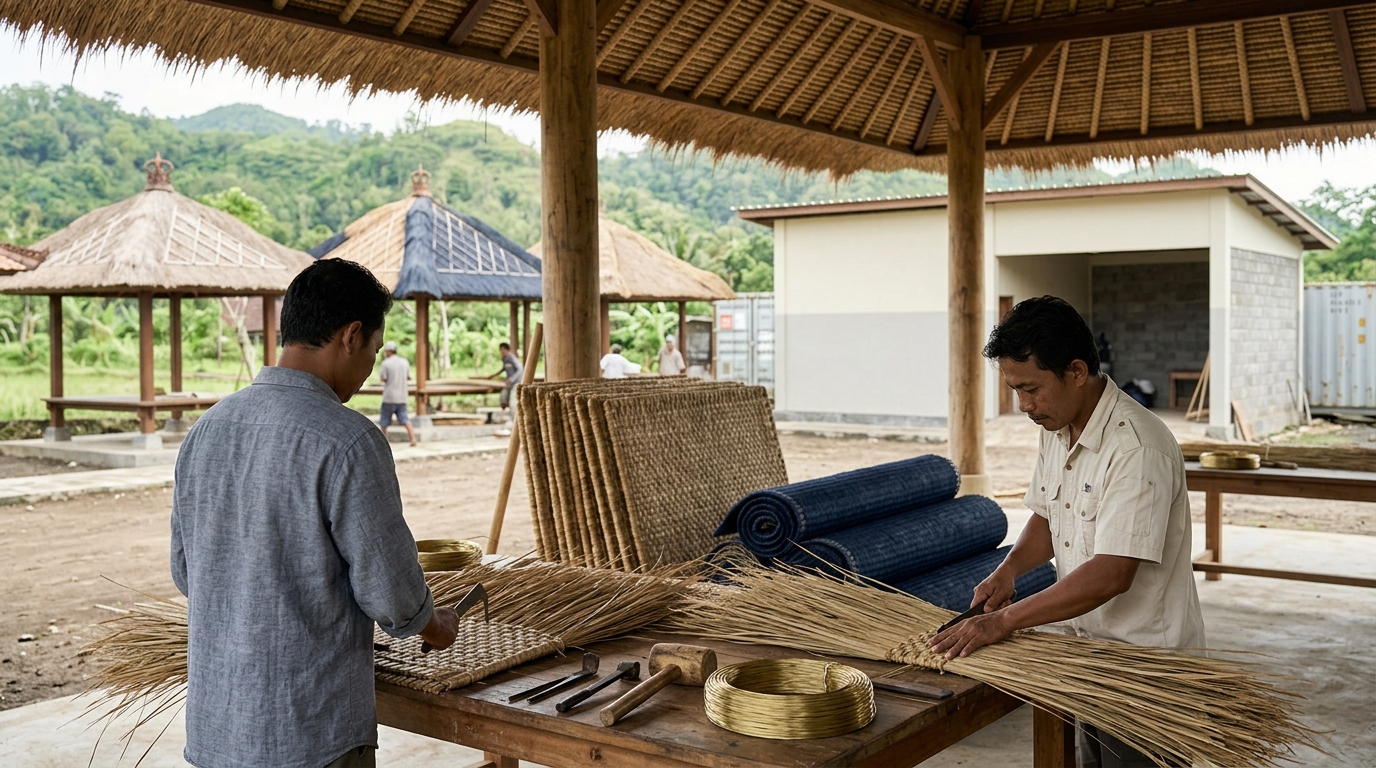
Sourcing alang alang thatch roofing suppliers Indonesia is not as straightforward as it appears on supplier websites. Buyers discover this quickly. Panels arrive with inconsistent stem density. Phytosanitary certificates are missing. Fire treatment documentation is vague or untestable. These are…
Sourcing alang alang thatch roofingsuppliers Indonesiais not as straightforward as it appears on supplier websites. Buyers discover this quickly. Panels arrive with inconsistent stem density. Phytosanitary certificates are missing. Fire treatment documentation is vague or untestable. These are real procurement failures that delay resort openings and expose project owners to liability.
This guide is written for resort developers, tiki bar builders, and hospitality procurement managers who need to make defensible buying decisions. It covers product formats, natural versus synthetic trade-offs, fire compliance requirements, roof pitch specifications, supplier vetting criteria, container logistics, and landed cost modeling. Every section is oriented toward the US import context, where USDA APHIS rules and IBC fire codes add compliance layers that Indonesian supplier pages rarely address.
If you are evaluating Indonesian thatch roofing for a commercial project above 100 square metres, the decisions you make at the sourcing stage determine your total cost of ownership, not just your FOB price.
What Imperata Cylindrica Actually Delivers on a Commercial Roof
Alang alang is the regional name for Imperata cylindrica, a perennial grass harvested primarily in Bali, Lombok, and parts of Java. Stalks are hand-harvested, dried, and bound into panels or tiles for export. The grass is not a commodity crop — harvest quality varies by season, elevation, and processor.
Why Resort and Hospitality Builders Choose Natural Thatch
Natural alang alang delivers three functional properties that synthetic alternatives approximate but do not fully replicate. First, the layered grass structure creates an air gap that provides passive thermal insulation in tropical and subtropical climates. Second, the open-weave surface allows moisture vapor to escape, reducing condensation under the roof deck. Third, the visual texture — warm gold-brown tones, irregular shadow lines — reads as authentically tropical to resort guests in a way that no polymer panel fully matches.
These properties make alang alang the default specification for luxury eco-resorts, tiki bars, beach clubs, and Polynesian-theme hospitality projects where authenticity drives guest experience.
Natural vs Synthetic: The Core Decision
Indonesia exports both formats. Natural alang alang panels use real Imperata cylindrica grass. Synthetic alang alang thatch uses UV-stabilized polyethylene or polypropylene fibers molded to replicate the grass aesthetic. Both are manufactured extensively in Bali and Lombok. The right choice depends on project lifespan targets, maintenance capacity, and local fire code requirements.
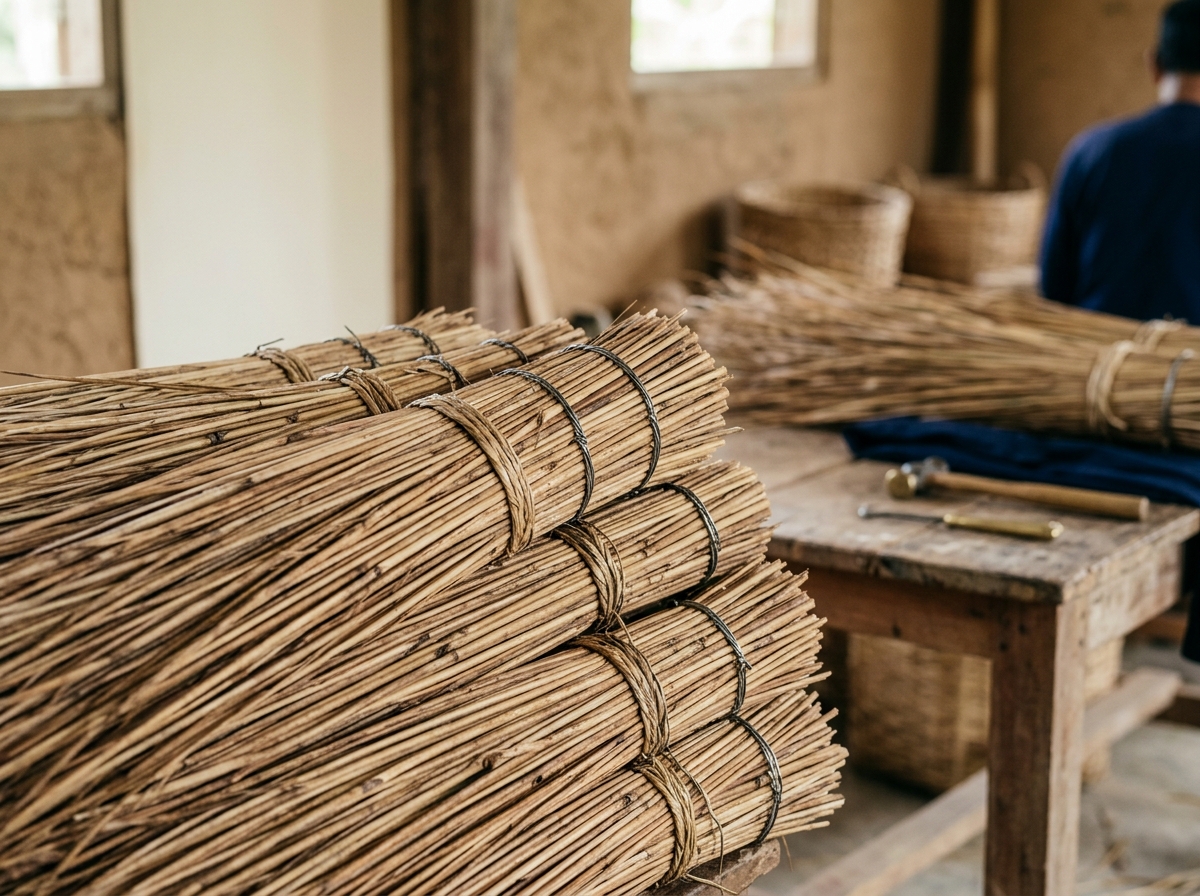
Natural vs Synthetic Alang Alang Thatch: True Cost Comparison for Commercial Buyers
The upfront price gap between natural and synthetic thatch narrows significantly over a project's lifecycle. Understanding the full trade-off is essential before committing to either format.
| Attribute | Natural Alang Alang | Synthetic Alang Alang |
|---|---|---|
| Typical lifespan | 5–10 years (climate-dependent) | 20–25 years |
| UV stability | Degrades; re-thatching required | UV-stabilized; color stable |
| Waterproofing | Requires adequate pitch; absorbs moisture | Inherently water-repellent |
| Fire rating (untreated) | Highly combustible | Moderate; varies by blend |
| Fire rating (treated) | Class B or Class A with certified treatment | Often Class A inherent |
| Maintenance frequency | High; annual inspection, periodic replacement | Low; occasional washing |
| FOB price range (approx.) | Lower per m² upfront | Higher per m² upfront |
| Authenticity for heritage/resort | High | Moderate |
| USDA APHIS compliance | Phytosanitary certificate required | No plant matter; simpler import |
When Natural Thatch Remains the Right Choice
Some projects cannot use synthetic thatch. Heritage-sensitive resort permits, local planning codes, and brand guidelines for "authentic natural materials" can mandate real grass. Certain eco-certification schemes also require natural, renewable materials. In these cases, natural alang alang from vetted Indonesia suppliers is still the correct specification — provided fire treatment and maintenance schedules are built into the project budget.
When Synthetic Thatch Wins on Total Cost
For a tiki bar or resort structure with a 15-plus-year operating horizon, synthetic thatch often delivers lower total cost of ownership. The higher FOB price is offset by the elimination of re-thatching cycles, which require not just material cost but also scaffolding, labor, and operational downtime. US coastal locations with high UV exposure and hurricane-season wind loads accelerate natural thatch degradation further.
Product Formats Exported by Alang Alang Thatch Roofing Suppliers Indonesia
Indonesian manufacturers export alang alang in several discrete formats. Specifying the wrong format wastes container space and complicates installation.
Standard Panels and Tiles
Natural alang alang panels are typically bound onto bamboo or rattan support battens. Common export dimensions are approximately 90 cm × 180 cm and 100 cm × 200 cm, though this varies by supplier. Coverage per panel depends on the installation overlap — typically 50% overlap on pitched roofs, meaning a 1 m × 2 m panel covers approximately 1 m² of finished roof area.
Synthetic tiles are generally injection-molded or woven onto a backing sheet. Common tile sizes range from approximately 50 cm × 50 cm up to 100 cm × 100 cm. These interlock or nail-fix to battens.
Ridge Caps and Hip Panels
A complete thatch roof system requires ridge caps and hip panels. Many US buyers order field panels without specifying ridge components — then face lead time delays ordering them separately. Confirm ridge cap dimensions and quantities with your supplier at the initial order stage. Ridge caps for alang alang roofs are typically 30–50 cm wide and available in lengths matching the field panel width.
Custom Sizing
Bali and Lombok manufacturers can generally accommodate custom panel dimensions on orders above minimum quantity thresholds. Java-based manufacturers, particularly around Surabaya, tend to run higher production volumes with less flexibility on custom sizing. Build custom specifications into your RFQ and confirm production lead time impact before approving.
Fire Retardant Certification Standards You Must Require from Any Indonesian Supplier
Fire compliance is the single area where US buyers most frequently encounter documentation gaps. Indonesia does not automatically apply US fire codes to export products.
Chemical Treatment Methods in Use
Borate-based treatments are the most common method applied to natural alang alang in Indonesia. Borate salts — typically disodium octaborate tetrahydrate — are applied by immersion or spray and penetrate the grass stem. When properly applied and verified, borate treatment can achieve Class B or Class A fire resistance ratings under ASTM E84 or equivalent test methods. Some suppliers also offer proprietary phosphate-based treatments.
US Code Requirements: IBC and NFPA
The International Building Code (IBC) governs most US commercial construction. Thatch roofing in the US typically requires minimum Class B fire rating for occupied structures, with Class A required in many jurisdictions for assembly occupancies such as bars and resort amenity buildings. NFPA 701 is the standard test method for flame propagation of textiles and films and may be required by local fire marshals.
Synthetic thatch from reputable Indonesian manufacturers — including larger exporters in the Bali market — often carries inherent Class A ratings due to fire-retardant additives in the polymer blend. This simplifies compliance documentation compared to treated natural grass.
Documentation Checklist
- ✓ASTM E84 or equivalent test certificate from accredited third-party lab
- ✓NFPA 701 test results if required by local fire authority
- ✓Material Safety Data Sheet (MSDS/SDS) for any chemical treatments applied
- ✓Certificate of conformance identifying treatment method and concentration
- ✓Shelf life and re-treatment interval specifications for natural alang alang
Roof Pitch, Substrate, and Installation Requirements for Alang Alang Thatch
Structural failure and leak callbacks on thatch roofs almost always trace back to under-specified pitch or inadequate batten spacing. These are design decisions, not installation errors.
Minimum Pitch and Water Runoff
Natural alang alang requires a minimum roof pitch of approximately 45 degrees (1:1 run-to-rise) for effective water runoff and drainage through the thatch depth. Shallower pitches cause water to wick laterally through the grass layer rather than drain vertically. Many Bali resort architects specify 50–60 degrees for thatched bale structures in high-rainfall environments.
Synthetic thatch tolerates slightly shallower pitches due to its water-repellent surface, but most manufacturers still recommend 30 degrees minimum. Confirm minimum pitch recommendations with your specific product supplier.
Batten Spacing and Substrate
Standard batten spacing for natural alang alang panels is approximately 30–40 cm center-to-center, depending on panel height and overlap depth. Battens should be pressure-treated timber or galvanized steel in coastal environments. Untreated timber battens in salt-air locations fail prematurely and compromise the entire roof system.
Layering depth — the total compressed thickness of stacked panels — should be a minimum of approximately 20–25 cm for natural thatch to achieve effective waterproofing and insulation. Some premium Bali suppliers offer pre-assembled double-layer panels that simplify achieving this depth.
US Coastal and Tropical Climate Considerations
Resort projects in Florida, Hawaii, the Gulf Coast, and the US Virgin Islands face wind uplift requirements under local building codes derived from ASCE 7. Thatch panels must be mechanically fastened — not just draped — to resist design wind speeds. Require that your supplier provide fixing specifications and confirm that panel backing (bamboo, rattan, or synthetic frame) is rated for the fastener pattern you will use.
How to Vet and Select Reliable Alang Alang Thatch Roofing Suppliers Indonesia
The supplier landscape for Indonesian thatch spans established export manufacturers to small village processors. Quality and export capability vary enormously.
Key Supplier Regions and Their Profiles
Bali: The dominant hub for premium alang alang export. Suppliers here have the most experience with US and European buyers, maintain better export documentation, and are most likely to hold fire treatment certifications. Companies such as Palmex Indonesia and Riyo Mandiri are among the recognized names in the Bali thatch export market. Bali suppliers generally command higher FOB prices than Lombok or Java alternatives.
Lombok: Growing export capacity, lower FOB prices, but less established documentation infrastructure. Suitable for buyers who can invest in supplier development over multiple orders.
Java (Surabaya, Semarang): Higher volume capacity for synthetic thatch products. Less specialized in natural alang alang. Better suited to large synthetic thatch orders where production scale matters more than craft quality.
Supplier Audit Checklist for First-Time US Importers
- ✓Minimum 3 years documented export history to US or European markets
- ✓Copy of valid phytosanitary certificate from previous shipment (for natural grass)
- ✓Current MSDS or SDS for any chemical fire treatments applied
- ✓Third-party fire test certificate dated within 3 years
- ✓References from at least two US-based commercial buyers
- ✓Stated minimum order quantity (MOQ) in square metres and container equivalents
- ✓Confirmed production lead time in writing before order placement
- ✓Sample panel provision — physical sample, not photographs
- ✓Evidence of consistent grass quality: stem length, density, and binding specifications
Red Flags to Eliminate Suppliers Immediately
- Inability to provide a phytosanitary certificate from a prior shipment - Fire treatment described only verbally with no lab documentation - No MSDS for chemical treatments - MOQ stated in vague units ("one container" without m² specification) - Refusal to provide physical samples before order
Container Planning, US Import Logistics, and USDA APHIS Requirements
This section covers the logistics reality that most Indonesian supplier pages omit entirely.
Packing Density Estimates
Container packing density for thatch depends heavily on panel format. Approximate benchmarks (treat as planning estimates, confirm with your specific supplier):
| Container Type | Natural Alang Alang Panels (approx.) | Synthetic Thatch Tiles (approx.) |
|---|---|---|
| 20-foot FCL | 150–220 m² of finished roof coverage | 200–300 m² of finished roof coverage |
| 40-foot FCL | 320–480 m² of finished roof coverage | 450–650 m² of finished roof coverage |
Natural panels compress less efficiently due to grass depth and bamboo backing rigidity. Synthetic tiles stack more densely. These estimates assume standard panel sizes and 50% installation overlap. Confirm actual packing lists with your freight forwarder and supplier before finalizing container count.
USDA APHIS Phytosanitary Requirements
Natural grass thatch (Imperata cylindrica) is a plant product subject to USDA APHIS import regulations. Key requirements:
- A phytosanitary certificate issued by Indonesia's plant health authority (BBKP or equivalent) is required for each shipment - Some shipments require pre-export fumigation treatment (typically methyl bromide or heat treatment) — confirm current APHIS requirements before order placement, as these regulations are subject to revision - Port-of-entry inspection by USDA APHIS officers can delay clearance by several days if documentation is incomplete
Synthetic thatch contains no plant matter and does not require phytosanitary documentation. This is a meaningful logistics advantage for time-sensitive project schedules.
HS Codes and Tariff Considerations
Natural alang alang thatch panels typically fall under HTS Chapter 14 (vegetable plaiting materials). Synthetic thatch panels may classify under Chapter 39 (plastics) or Chapter 56 (wadding, felt, and nonwovens), depending on construction. Misclassification causes customs delays and potential penalty exposure.
Indonesia currently benefits from certain preferential trade arrangements with the US, but tariff schedules are subject to change under US trade policy reviews. Buyers should verify current HTS duty rates with a licensed customs broker before finalizing landed cost models. Do not rely on supplier-provided tariff information as authoritative.
Freight Timeline
A realistic production-to-delivery timeline for alang alang thatch from Bali to a US West Coast port:
- Production lead time: approximately 4–8 weeks for standard orders; 8–12 weeks for custom sizes or large volumes - Sea freight, Bali/Denpasar to Los Angeles: approximately 18–25 days - US customs clearance: 3–7 days with complete documentation; longer if APHIS inspection is triggered
Plan for approximately 10–16 weeks total from order confirmation to warehouse receipt on the US side. Budget contingency for the first shipment from a new supplier.
Pricing Benchmarks and Budget Planning for Thatch Roofing Projects
Specific prices change with currency, season, and supplier. The ranges below are indicative only and should be verified through current supplier quotations.
FOB Price Ranges (Approximate, Subject to Change)
Natural alang alang panels from Bali suppliers typically range from approximately USD 8–18 per m² FOB depending on panel density, stem quality, and fire treatment inclusion. Lombok suppliers may quote 10–20% lower. Synthetic thatch panels from Indonesian manufacturers typically range from approximately USD 15–35 per m² FOB depending on fiber quality, UV rating, and fire certification.
Volume discount thresholds for synthetic thatch typically apply at 500 m² and again at 1,000 m² minimums. Natural alang alang volume pricing is less structured — negotiate directly.
Sample Cost Model: 200 m² Resort Bale or Tiki Bar Roof
| Cost Element | Natural Alang Alang (Approx.) | Synthetic Thatch (Approx.) |
|---|---|---|
| Material FOB (200 m²) | USD 2,000–3,600 | USD 3,500–7,000 |
| Fire treatment certification (if not included) | USD 300–800 | Typically included |
| Fumigation / phytosanitary | USD 200–500 | Not applicable |
| Sea freight (20ft container) | USD 1,800–3,500 | USD 1,800–3,500 |
| US customs duty (est., verify) | Variable | Variable |
| Installation labor (US market) | USD 4,000–10,000+ | USD 3,000–8,000+ |
| **Estimated total landed + installed** | **USD 8,300–18,400+** | **USD 8,300–18,500+** |
Hidden costs that erode budget most frequently: re-thatching cycles for natural grass (budget one cycle within 7 years for coastal US locations), APHIS inspection delays, and customs broker fees if not already engaged.
Frequently Asked Questions
How long does natural alang alang thatch last compared to synthetic thatch? Natural alang alang typically lasts 5–10 years under tropical conditions. US coastal locations with high UV and wind exposure may reduce this to 4–7 years. Synthetic thatch from reputable Indonesia manufacturers is rated for approximately 20–25 years with minimal maintenance.
What fire retardant certifications should I require from an Indonesian thatch supplier? At minimum, require an ASTM E84 test certificate from an accredited third-party laboratory, an MSDS/SDS for any applied chemical treatment, and NFPA 701 results if your local fire authority requires them. Class A rating is required for assembly occupancies in most US jurisdictions.
What is the minimum roof pitch needed for alang alang thatch? Natural alang alang requires approximately 45 degrees minimum pitch for effective drainage. Synthetic thatch tolerates as low as approximately 30 degrees, but steeper pitches improve performance and longevity.
How many square metres of thatch fit in a 20-foot shipping container? Approximately 150–220 m² of finished roof coverage for natural alang alang panels, and approximately 200–300 m² for synthetic thatch tiles. These are planning estimates — confirm packing lists with your supplier.
Does the US require phytosanitary certificates for importing natural grass thatch from Indonesia? Yes. Natural Imperata cylindrica grass products require a phytosanitary certificate issued by Indonesian plant health authorities. Pre-export fumigation may also be required. Verify current requirements with USDA APHIS or a licensed customs broker before ordering.
What is the typical lead time from order to delivery for alang alang thatch from Bali? Allow approximately 10–16 weeks total: 4–8 weeks production, 18–25 days sea freight to US West Coast ports, plus customs clearance. First-time orders from a new supplier should carry additional buffer for documentation review.
Sourcing alang alang thatch from Indonesia is manageable when you treat it as a structured procurement exercise rather than a catalog purchase. The suppliers that serve US commercial buyers well are the ones who can produce fire test certificates, phytosanitary documentation, and consistent physical samples before you commit a container budget.
You now have the product specifications, compliance framework, logistics benchmarks, and supplier vetting criteria to qualify Indonesian thatch suppliers with confidence. The next step is comparing real FOB quotes against a baseline landed cost model for your specific project dimensions.
You have the specification criteria and compliance checklist — now validate them with physical samples and real pricing. Request a free sample kit and container quote from vetted Indonesian alang alang thatch suppliers today, and benchmark FOB prices against the ranges in this guide before committing to any order.
Request Sample Kit and Container Quote →Need eyes on the ground in Indonesia?
MTS is an execution partner — supplier verification, manufacturing management, quality control and export logistics across Indonesia, Vietnam and China.
Related services
Receive furniture sourcing insights across Asia.
One email per week. No spam.