Terracotta Breeze Blocks Suppliers Indonesia: Sourcing Guide for Architects and Contractors
13 min read
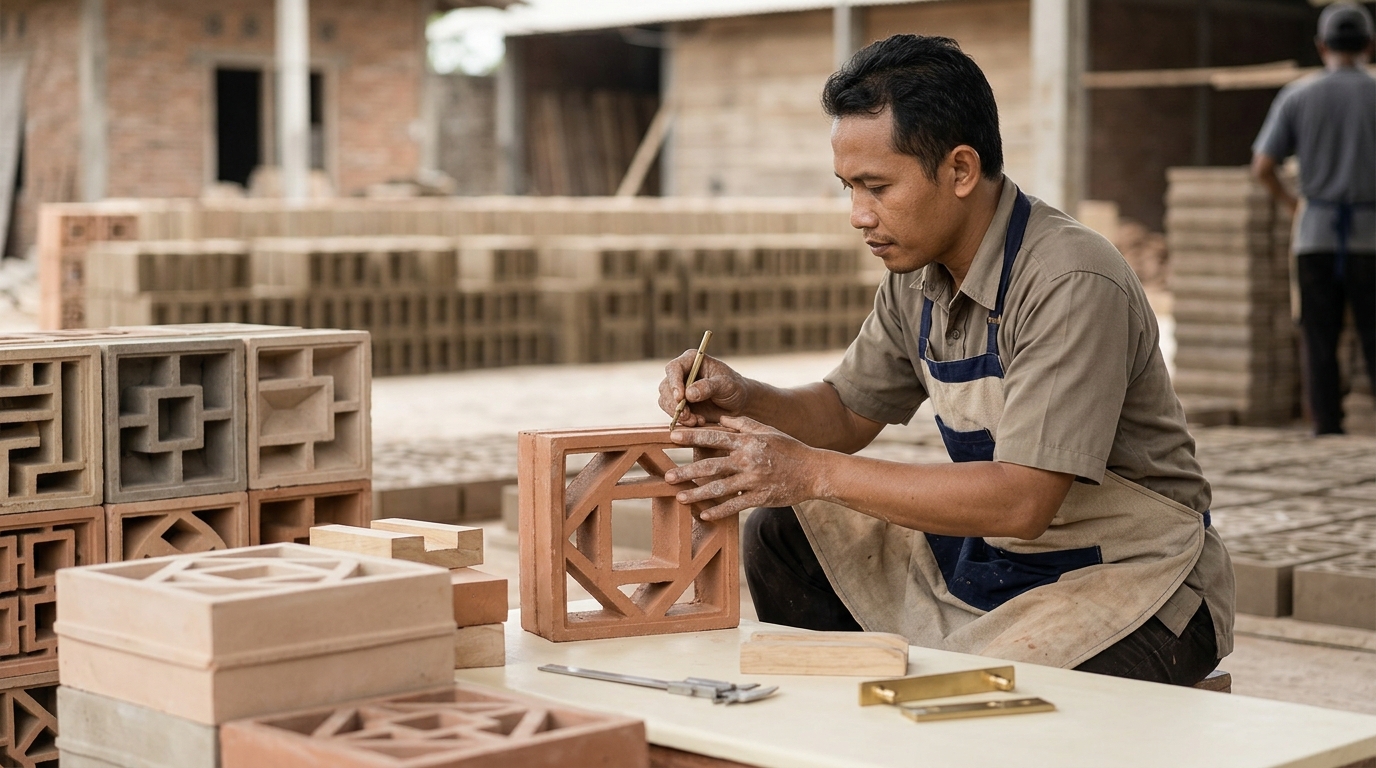
Sourcing terracotta breeze blocks from Indonesia requires more than finding a price list. US-based architects and facade contractors face a layered decision: technical compliance, supply chain reliability, customs classification, and landed cost. Each factor carries real project risk if mismanaged.
Sourcing terracotta breeze blocks from Indonesia requires more than finding a price list. US-based architects and facade contractors face a layered decision: technical compliance, supply chain reliability, customs classification, and landed cost. Each factor carries real project risk if mismanaged.
This guide addresses all eight decision points — from kiln cluster geography and compressive strength standards to container loading calculations and US import tariff classification. The goal is to give procurement managers a single technical reference they can use from specification through purchase order.
Indonesia has supplied decorative fired-clay products to international markets for decades. The infrastructure, the raw material base, and the manufacturing depth are genuine. What US buyers often lack is structured knowledge of how to access and verify those suppliers. That gap is what this guide closes.
The sections below move in procurement sequence — starting with why Indonesia competes, then covering design options, technical specifications, logistics data, tooling economics, lead times, tariff exposure, and supplier qualification. Terracotta breeze blockssuppliers Indonesiais a fragmented market. The frameworks here help you navigate it with confidence.
Why Indonesia Outcompetes Other Sources for Terracotta Breeze Blocks
Indonesia's position in global terracotta manufacturing is not accidental. It reflects geography, raw material availability, and generations of kiln-based craft concentrated in specific industrial zones.
Java and East Java Kiln Clusters
The island of Java — particularly the East Java corridor near Surabaya — hosts the densest concentration of fired-clay manufacturers in Southeast Asia. Terracotta production here draws on alluvial clay deposits with consistent mineral composition. That consistency matters for facade applications where color uniformity across batches is a specification requirement.
East Java kilns have produced export-grade ceramic and terracotta products for international buyers since at least the 1980s. The institutional knowledge in the workforce — mold-making, firing temperature control, drying protocols — is embedded at the factory level, not just at the management level. That depth reduces defect rates and improves batch-to-batch repeatability.
Cost Competitiveness Against Peer Markets
On a FOB basis, Indonesian terracotta ventilation blocks typically land below equivalent products from Mexican or Malaysian suppliers, and substantially below Chinese suppliers when freight and tariff exposure are factored in. Exact price comparisons shift with exchange rates and raw material costs, but the structural cost advantages — lower labor cost, domestic clay supply, established kiln infrastructure — are durable.
| Source Country | Relative FOB Cost | US Tariff Exposure | Transit Time to LA |
|---|---|---|---|
| Indonesia | Low–Medium | Low (see tariff section) | Approximately 18–22 days |
| Mexico | Medium | Very low (USMCA) | 3–7 days (truck) |
| China | Low | High (Section 301 tariffs apply) | Approximately 14–18 days |
| Malaysia | Medium | Low–Medium | Approximately 20–24 days |
Note: Cost tiers are approximate and directional. Verify current rates with freight forwarders and customs brokers.
Export Infrastructure
Surabaya's Tanjung Perak port is the primary export gateway for East Java manufacturers. It handles significant container volumes and connects to major shipping lanes serving US West Coast ports (Los Angeles, Long Beach) and East Coast ports via the Suez Canal or Panama Canal. Jakarta's Tanjung Priok port serves Central and West Java suppliers. Both ports have established relationships with major consolidators and freight forwarders experienced in US-bound shipments.
LEED Alignment
Terracotta is a natural, fired-clay product with no synthetic binders. For projects pursuing LEED credits — particularly under Materials and Resources categories — Indonesian terracotta breeze blocks can contribute to documentation on natural material content. Buyers should confirm specific credit applicability with their LEED consultant, as credit calculation depends on project location and total material budget.
Pattern Ranges and Design Options from Indonesian Facade Block Manufacturers
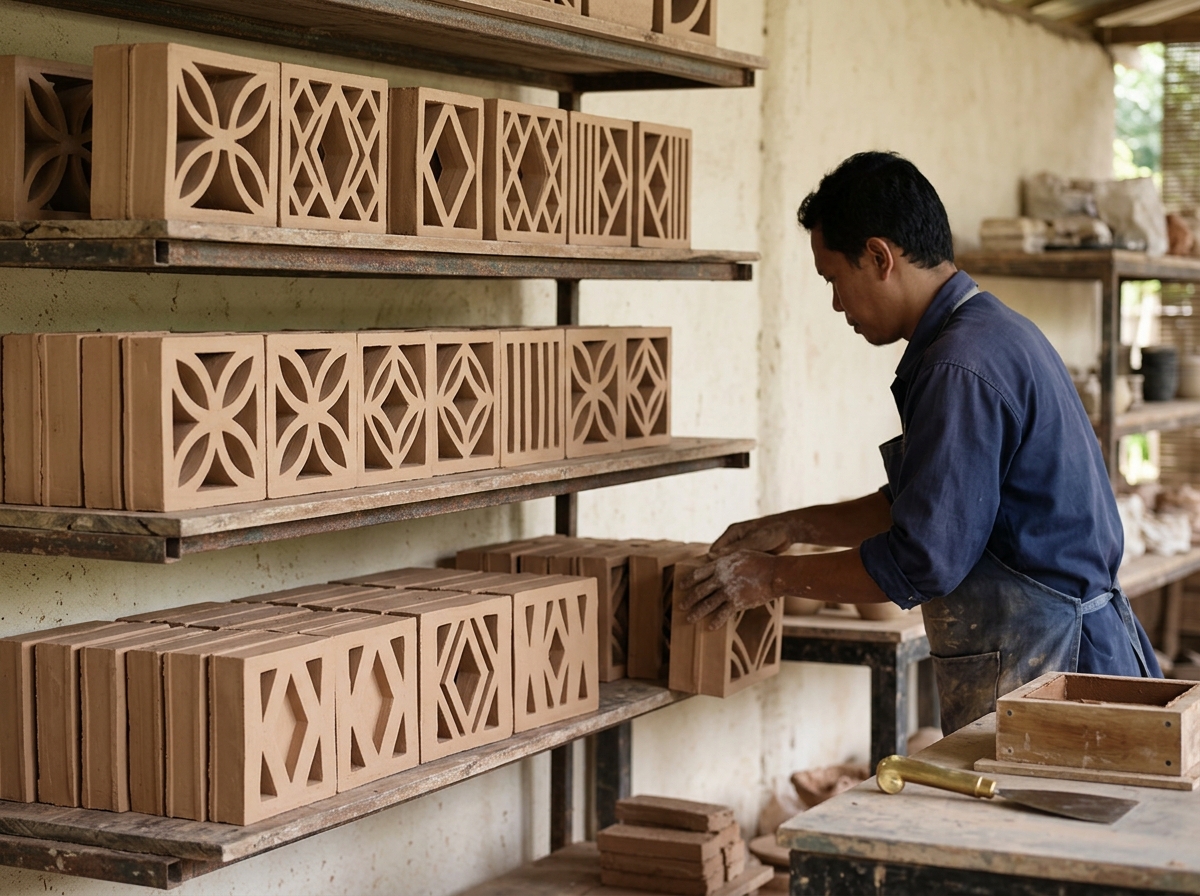
Indonesian suppliers offer a broader design range than most US buyers expect. The catalog typically divides into standard geometric patterns and custom-tooled designs.
Standard Pattern Catalog
Common standard patterns available from multiple suppliers without custom tooling costs include:
- Diamond / diagonal lattice — the most widely stocked pattern across all sizes - Hexagonal cell — suits contemporary tropical and hospitality facades - Cross / plus — classic mid-century reference, consistent ventilation aperture - Round aperture — minimal, works well in render-finished facades - Bali-inspired organic motifs — carved or molded, higher unit cost
Standard patterns are available in natural terracotta, surface-washed (brushed aggregate texture), and pigmented finishes. Glazed finishes are available from a smaller subset of suppliers and carry a price premium.
Custom Pattern Tooling
Custom patterns require mold fabrication. Lead times for mold production typically run four to eight weeks from CAD approval. Tooling cost depends on mold complexity but commonly falls in the range of several hundred to low thousands of US dollars per mold set — costs that suppliers often amortize into unit pricing above a defined order threshold rather than charging as a separate line item.
Minimum order quantities for custom-pattern blocks are typically higher than for standard patterns — often starting at a full pallet of a given pattern, sometimes at a full container. Confirm MOQ in writing before committing to CAD development time.
Technical Specifications: Dimensions, Tolerances, and Compressive Strength for US Facade Projects
Common Nominal Sizes
Indonesian terracotta ventilation blocks are produced in a range of nominal sizes. The most common in export catalogs include:
| Nominal Size (mm) | Typical Application | Approx. Weight per Unit (kg) |
|---|---|---|
| 200 × 200 × 100 | Residential screens, light facade | 3.5–5.0 |
| 300 × 300 × 100 | Commercial facade screens | 7.0–9.5 |
| 300 × 300 × 120 | Structural screen walls | 8.5–11.0 |
| 400 × 200 × 100 | Horizontal banded facades | 6.0–8.0 |
Weights are approximate and vary by clay density and aperture percentage.
Dimensional tolerances for export-grade blocks are typically ±2 mm on face dimensions and ±3 mm on depth. Tighter tolerances (±1 mm) are achievable from higher-specification suppliers but may carry a unit cost premium.
Compressive Strength and Standards
Compressive strength for terracotta breeze blocks varies significantly by firing temperature and clay composition. Typical ranges:
| Product Type | Compressive Strength (MPa) | SNI Reference | ASTM Approximate Equivalent |
|---|---|---|---|
| Low-fired terracotta screen block | 10–15 MPa | SNI 15-2094 (clay brick general) | Below ASTM C652 Grade SW |
| Standard-fired facade block | 15–20 MPa | SNI 15-2094 | Approaches ASTM C652 Grade SW |
| High-fired architectural block | 20–25 MPa | SNI 15-2094 | Comparable to ASTM C652 Grade SW |
Water Absorption and Frost Resistance
Terracotta is inherently porous. Water absorption rates for Indonesian breeze blocks commonly fall between 8% and 18% by weight, depending on firing temperature. For US climate zones subject to freeze-thaw cycling (USDA Hardiness Zones 6 and below), high water absorption is a durability risk. Request freeze-thaw cycling test data — or specify high-fired blocks with lower absorption — for projects in northern US markets. For southern US, Gulf Coast, or Hawaii projects, standard absorption rates are generally acceptable.
Container Loading and Pallet Quantities: A Logistics Planning Reference
Accurate container planning prevents costly freight overruns and project delays. The figures below are approximate and should be confirmed with your specific supplier based on actual block dimensions and packing configuration.
Pallet Configuration by Block Size
| Block Size (mm) | Units per Pallet (approx.) | Pallet Gross Weight (kg, approx.) | Pallet Footprint |
|---|---|---|---|
| 200 × 200 × 100 | 200–240 | 800–1,100 | Standard 1.2 × 1.0 m |
| 300 × 300 × 100 | 100–120 | 900–1,100 | Standard 1.2 × 1.0 m |
| 300 × 300 × 120 | 80–100 | 800–1,050 | Standard 1.2 × 1.0 m |
20-Foot vs. 40-Foot Container Capacity
| Container Type | Pallets (standard config) | Units — 300×300×100 mm (approx.) | Coverage at Single-Layer Screen (m², approx.) |
|---|---|---|---|
| 20-foot standard | 10–11 | 1,000–1,300 | 90–117 m² |
| 40-foot standard | 20–22 | 2,000–2,600 | 180–234 m² |
| 40-foot high-cube | 22–24 | 2,200–2,880 | 198–259 m² |
Coverage figures assume single-layer screen with standard joint spacing. Actual coverage depends on pattern aperture and installation layout.
Packing Methods
Standard packing for export shipments typically includes shrink-wrapped pallets with cardboard corner protection on individual units. Fragile or custom-pattern blocks with thin fins or deep-relief designs should specify wooden crating or foam-interleaved layers. Confirm packing method in the proforma invoice — inadequate packing is a leading cause of breakage claims.
- ✓Confirm pallet type (heat-treated timber for US CBP compliance)
- ✓Verify shrink-wrap tension and corner protection specification
- ✓Specify crating requirement for fragile or custom-relief patterns
- ✓Request packing photos before container seal
- ✓Confirm gross container weight against vessel weight limits
Custom Tooling Costs, MOQs, and Sample Lead Times Explained
Tooling Economics
Custom mold sets for breeze block patterns are produced from steel or dense polyurethane depending on order volume and supplier capability. Steel molds carry higher upfront cost but are durable across tens of thousands of production cycles. Polyurethane molds are faster and cheaper to produce but degrade more quickly.
Tooling cost is typically not published in catalogs. Suppliers quote it separately or fold it into unit pricing above a stated MOQ. Ask explicitly: "What is your tooling cost for this mold, and at what order quantity is that cost fully recovered in the unit price?"
MOQ Benchmarks
| Pattern Type | Typical MOQ (units) | Notes |
|---|---|---|
| Standard catalog pattern | 50–200 | Often one pallet minimum |
| Custom pattern — new mold | 500–2,000 | Depends on block size and mold cost |
| Custom color (pigmented) | 200–500 | Batch dye consistency requires minimum run |
Sample Lead Times
- Standard patterns: approximately two to four weeks from order confirmation - Custom patterns (new mold required): approximately six to ten weeks, including mold fabrication, fired sample production, and approval cycle
The prototyping process for custom blocks typically follows this sequence: CAD drawing submission → supplier mold quote → mold fabrication → unfired clay sample review → kiln firing → fired sample shipment to US buyer → approval or revision → production sign-off. Budget time accordingly. A single revision cycle adds two to four weeks.
Project Supply Timelines: From Order Confirmation to US Port Arrival
Production Lead Times
| Order Type | Production Lead Time |
|---|---|
| Standard pattern, stock available | 2–4 weeks |
| Standard pattern, made-to-order | 4–8 weeks |
| Custom pattern, mold already approved | 6–10 weeks |
| Large custom order (container-scale+) | 8–16 weeks |
Sea Freight Transit Times
From Surabaya or Jakarta to major US ports (approximate):
| US Port | Approximate Transit Time |
|---|---|
| Los Angeles / Long Beach | 18–22 days |
| Houston (via Panama) | 25–30 days |
| New York / Newark | 28–35 days |
Transit times vary by carrier, routing, and port congestion. Verify with your freight forwarder at time of booking.
Scheduling Buffer Recommendations
Facade installation schedules are unforgiving. A missed delivery compresses the critical path and forces expensive acceleration elsewhere. Build the following buffers into project schedules:
- Add two weeks to production lead time for first-time suppliers - Add five days to transit time estimates for port congestion probability - For phased deliveries on large hospitality or commercial projects, confirm supplier production capacity for simultaneous batch runs before committing to a phased schedule
Phased delivery — splitting a large order into two or three container shipments timed to construction progress — is feasible with most Indonesian terracotta breeze blocks suppliers. Confirm the supplier's kiln firing schedule to ensure batch color consistency across phases.
US Import Duties, Indonesia Tariffs, and Total Landed Cost for Terracotta Breeze Blocks
HS Code Classification
Terracotta breeze blocks typically classify under HS Code 6901 (bricks, blocks, tiles, and other ceramic constructional goods of siliceous fossil meals or similar siliceous earths) or more commonly under HS Code 6904 (ceramic building bricks, flooring blocks, support or filler tiles) depending on CBP classification ruling. Some fired-clay decorative screen blocks may be classified under 6905. Confirm the correct 10-digit HTS code with a licensed US customs broker before importation.
Indonesia Tariffs and US Duty Rates
Indonesia currently does not benefit from the US Generalized System of Preferences (GSP) for most goods — the GSP program has been subject to renewal uncertainty in recent years. Buyers should verify current GSP status with a customs broker at time of sourcing.
The standard US MFN (Most Favored Nation) duty rate for ceramic building blocks under HTS headings in the 6901–6905 range is generally in the low single-digit percentage range (commonly around 0%–5.6% depending on the specific 10-digit code). Indonesian goods are not currently subject to Section 301 tariffs — those apply to Chinese-origin goods. This is a meaningful competitive advantage for Indonesian sourcing versus Chinese supply.
Total Landed Cost Structure
A realistic landed cost breakdown for Indonesian terracotta breeze blocks (approximate, directional):
| Cost Component | Approximate % of FOB Value |
|---|---|
| FOB factory price | 100% (base) |
| Ocean freight (40-ft container) | 15–30% of FOB |
| Marine insurance | 1–2% of FOB |
| US import duty (MFN rate) | 0–6% of FOB |
| Customs brokerage and port fees | 3–7% of FOB |
| Inland freight (port to site) | 5–15% of FOB |
| **Total estimated landed cost** | **~125–160% of FOB** |
Percentages are approximate and vary significantly with freight market conditions, port of entry, and inland delivery distance.
Compared to domestic US-produced decorative breeze blocks or Mexican-sourced alternatives, Indonesian products at landed cost remain competitive on larger volume orders, particularly for custom-pattern specifications where domestic tooling costs are significantly higher.
How to Vet and Qualify Terracotta Breeze Blocks Suppliers Indonesia
Key Qualification Criteria
A structured supplier qualification process reduces project risk significantly. Evaluate suppliers against these criteria:
| Criterion | Minimum Acceptable | Strong Signal |
|---|---|---|
| Factory certification | None (common) | ISO 9001 certified |
| Export experience | US or EU shipments completed | Multiple US projects with references |
| Kiln capacity | Sufficient for your order volume | Multiple kiln bays, stated annual output |
| Sample policy | Standard samples available | Fired production-batch samples provided |
| Tolerance documentation | Stated in catalog | Third-party test report available |
| Inspection access | Allows pre-shipment inspection | SGS Indonesia or Bureau Veritas approved |
Red Flags in Supplier Communication
- Inability to specify dimensional tolerances in writing - Refusal to provide fired samples before production commitment - No documentation of compressive strength testing - Vague answers about kiln firing temperature or clay source - Unwillingness to allow third-party pre-shipment inspection
Third-Party Inspection
SGS Indonesia and Bureau Veritas both operate inspection services in Java. Pre-shipment inspection — covering dimensional compliance, visual defect rate, and packing verification — is strongly recommended for first orders and for any custom-pattern project. Inspection cost is modest relative to the freight and project cost at stake.
Frequently Asked Questions: Terracotta Breeze Blocks from Indonesia
What compressive strength should terracotta breeze blocks meet for facade applications in the US?
For non-load-bearing architectural screens, 10–15 MPa is often structurally adequate, but verify with the project structural engineer. For facade systems with any structural role, target 20 MPa or above and request ASTM C652-equivalent test data.
How many terracotta breeze blocks fit in a 40-foot shipping container?
For a standard 300 × 300 × 100 mm block, approximately 2,000–2,600 units per 40-foot standard container, depending on packing configuration. See the loading table above for other sizes.
What is the typical lead time for custom-pattern terracotta breeze blocks from Indonesia?
Six to ten weeks from mold approval to shipment-ready production, plus approximately three to four weeks ocean transit to US West Coast ports. Total from mold sign-off to site delivery: approximately ten to fifteen weeks minimum.
Are Indonesian terracotta breeze blocks compliant with US building codes or ASTM standards?
Not automatically. Indonesian products are certified to SNI standards. ASTM compliance requires specific test reports against the relevant ASTM standard. Request test data and have it reviewed by the project engineer of record.
What US import duties apply to terracotta breeze blocks from Indonesia?
MFN duty rates under HTS headings in the 6901–6905 range are generally 0%–5.6% depending on specific classification. Indonesia is not subject to Section 301 tariffs. Confirm classification and current Indonesia tariff treatment with a licensed customs broker before importing.
Can Indonesian suppliers provide samples before a full production order?
Yes. Standard pattern samples are typically available within two to four weeks. Custom-pattern samples require mold fabrication and take six to ten weeks. Always request fired samples — unfired clay samples do not represent final color, dimensional stability, or compressive strength.
Indonesian terracotta breeze block manufacturing offers US buyers a technically capable, cost-competitive, and tariff-advantaged supply option — provided sourcing is approached with structured specification requirements, verified supplier qualification, and realistic logistics planning. The combination of East Java kiln depth, established export infrastructure through Surabaya, and the absence of Section 301 tariff exposure makes Indonesia a defensible sourcing decision for facade contractors and architects willing to invest in proper supplier qualification.
Request a sample set and factory quotation from verified Indonesian terracotta breeze block suppliers today — now that you have the specification framework and logistics benchmarks in hand, you can evaluate supplier responses against real criteria rather than marketing claims.
You now have the technical specifications, container loading data, tariff classifications, and supplier qualification criteria to evaluate Indonesian manufacturers with confidence. The next step is putting real samples and factory quotations in front of your project team.
Request Samples and Factory Quotation →Need eyes on the ground in Indonesia?
MTS is an execution partner — supplier verification, manufacturing management, quality control and export logistics across Indonesia, Vietnam and China.
Related services
Related articles
Receive furniture sourcing insights across Asia.
One email per week. No spam.