Timber Wall Cladding Suppliers Indonesia: Complete Sourcing Guide for Contractors
14 min read

Facade contractors and architectural distributors sourcing timber wall cladding face a complex set of decisions before a single board ships. Species selection, moisture content targets, profile geometry, fire-treatment compliance, and Lacey Act documentation all interact. Get one variable wrong…
Facade contractors and architectural distributors sourcing timber wall cladding face a complex set of decisions before a single board ships. Species selection, moisture content targets, profile geometry, fire-treatment compliance, and Lacey Act documentation all interact. Get one variable wrong and the entire shipment can be held at customs or rejected on-site.
Indonesia sits at the intersection of tropical hardwood abundance and established export infrastructure. The country produces teak, merbau, bengkirai, and ulin at scale, processes them through a mature network of kiln-drying and CNC profiling mills, and ships through major ports including Surabaya, Jakarta, and Makassar. For US facade contractors and architectural distributors, this combination creates genuine procurement opportunity — but only with rigorous supplier vetting and specification discipline.
This guide covers everything required to make a defensible sourcing decision: species durability data, profile types including open-joint rainscreen systems, interior versus exterior specification differences, fire-treatment certification for the US market, Lacey Act and SVLK compliance, HTS codes, MOQ ranges, pricing benchmarks, and supplier evaluation criteria. The goal is to give procurement teams the data they need to qualify timber wall claddingsuppliers Indonesiabefore committing to a purchase order.
Why Indonesia Leads the World in Structural Timber Cladding Supply
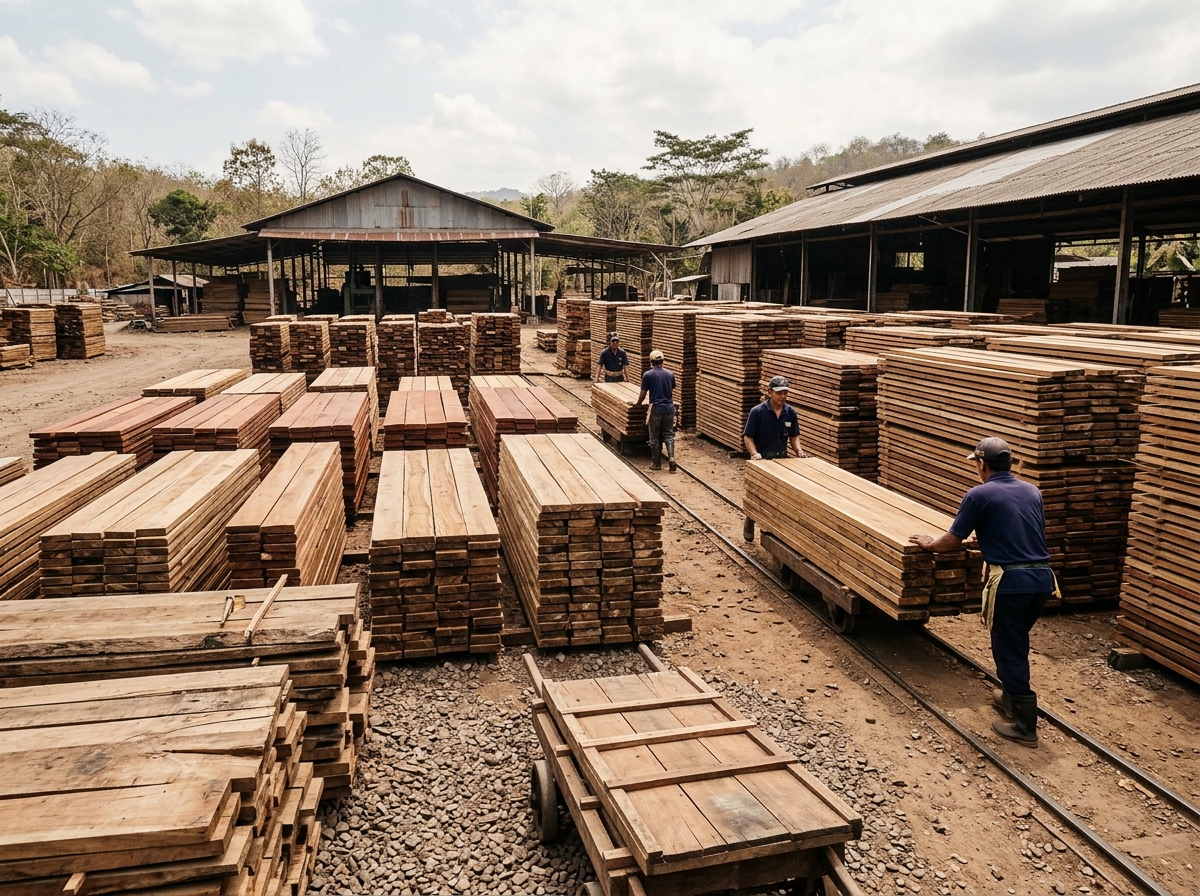
Indonesia holds one of the largest tropical forest reserves on earth. Kalimantan, Sulawesi, West Java, and East Java collectively support a processing industry that ranges from small hardwood mills to vertically integrated groups managing forestry, kiln-drying, CNC profiling, and container export under one operational structure.
Labour costs remain competitive relative to comparable-quality producers in Europe or North America. Processing wages in Indonesian hardwood mills are significantly lower than those in mature markets, which translates directly into FOB price advantages for profiled cladding. Teak plantation output from Java has matured over recent decades, creating a stable, legal supply chain distinct from old-growth harvesting.
Proximity to major Asian shipping lanes reduces transit costs and port scheduling complexity. Containers departing Surabaya or Tanjung Priok (Jakarta) connect efficiently to transpacific services calling at Los Angeles, Long Beach, Seattle, and Houston. Transit times to US West Coast ports typically run approximately 18–25 days; East Coast ports via the Panama Canal add roughly 8–12 days.
For US buyers, Indonesia's exporting regions each specialise differently. West Java concentrates finishing and value-added profiling. East Java — centred on Surabaya — handles the largest volume of teak and merbau export. Kalimantan supplies bengkirai and ulin. Sulawesi contributes suar and specialty timbers. Understanding regional sourcing patterns helps buyers match species requirements to the right supplier geography.
Species Comparison: Durability Classes, Hardness, and Price Positioning
Choosing the right species is the first specification decision. Durability class, Janka hardness, and dimensional stability all affect long-term facade performance and warranty exposure.
| Species | Botanical Name | Durability Class | Janka Hardness (approx.) | Primary Use | Price Tier |
|---|---|---|---|---|---|
| Teak | *Tectona grandis* | Class I | ~2,330 lbf | Exterior premium cladding | High |
| Merbau | *Intsia bijuga* | Class I–II | ~2,615 lbf | Exterior/interior structural | High–Mid |
| Bengkirai | *Shorea laevifolia* | Class II | ~2,000 lbf | Exterior cost-effective | Mid |
| Ulin | *Eusideroxylon zwageri* | Class I | ~3,800 lbf | Specialty, fire-resistant | High–Niche |
| Suar | *Samanea saman* | Class III–IV | ~950 lbf | Interior accent cladding | Low–Mid |
Teak: The Benchmark Exterior Species
Teak (Tectona grandis) contains natural silica and oils that resist moisture ingress, fungal attack, and dimensional movement. Plantation teak from Java is the primary legal supply source. It grades into A-grade (tight grain, minimal sapwood) and B-grade (wider grain, acceptable for many facade applications). Expect FOB prices at a premium relative to other Indonesian species. Specifying plantation teak with SVLK documentation keeps buyers Lacey Act compliant.
Merbau and Bengkirai: High-Performance Alternatives
Merbau (Intsia bijuga) offers comparable durability to teak with higher Janka hardness. It is naturally resistant to termites and marine borers. The species bleeds tannin-rich extractives when first wetted — a factor to communicate to installers when specifying for rainscreen applications over light-coloured substrates. Bengkirai (Shorea laevifolia) provides a cost-effective exterior alternative at durability class II. It is widely used in decking and cladding across European markets and is increasingly specified by US distributors managing budget-constrained facade projects.
Ulin and Suar: Niche Applications
Ulin (Eusideroxylon zwageri), also called ironwood, achieves the highest natural fire resistance of any Indonesian hardwood. Availability is restricted due to harvest regulations; buyers must verify SVLK and CITES status carefully. Suar is appropriate for interior accent cladding only — its class III–IV durability makes exterior exposure unsuitable without aggressive treatment.
Profile Types for Timber Wall Cladding: Shiplap, Tongue-and-Groove, and Open-Joint Rainscreen Systems
Indonesian mills produce all major exterior and interior cladding profiles. CNC profiling capacity at mid-to-large exporters allows custom geometry to architect's drawings. Standard lead time for custom profiles runs approximately 4–8 weeks from approved sample.
Shiplap Profiles
Shiplap is the dominant exterior profile exported from Indonesia. Standard rebate depth typically runs 8–12 mm. Common finished dimensions include 90 × 19 mm, 120 × 19 mm, and 140 × 21 mm face widths. The overlapping rebate sheds water without requiring a sealed joint, making it suitable for ventilated facade applications in ASHRAE climate zones 4 through 7.
Tongue-and-Groove Profiles
Tongue-and-groove (T&G) cladding suits both interior feature walls and sheltered exterior applications. Standard tongue depth is typically 6–8 mm with a corresponding groove. For exterior use, buyers should specify a back-relief channel (typically 2–3 mm relief) to reduce cupping risk. Moisture content at point of installation is critical — see Section 4.
Open-Joint Rainscreen Timber Systems
Open-joint rainscreen cladding is increasingly specified on US commercial and institutional facade projects. This system uses discrete boards fixed to a structural batten grid with a deliberate drainage and ventilation gap between boards.
Key dimensional standards for open-joint rainscreen from Indonesian suppliers:
- Joint gap: typically 8–20 mm, architect-specified - Board face width: commonly 90–140 mm finished - Batten size: minimum 38 × 50 mm (depth × width) to maintain a 25 mm clear ventilation cavity behind the cladding plane - Fixing: concealed stainless-steel clips or face-fixed stainless screws, pre-drilled at the mill
Indonesian suppliers experienced with rainscreen profiles will pre-drill clip channels and can supply matching species battens as part of the same order. Specify drainage gap, board face width, thickness, and clip system in the purchase order — do not leave these as field decisions.
Interior vs Exterior Cladding Specifications: Differences That Affect Performance
Specifying interior and exterior cladding from the same Indonesian supplier is efficient — but the two applications require different technical parameters in the purchase order.
Moisture content (MC) targets:
- Interior timber cladding: 8–10% MC (equilibrium with typical US conditioned interior environments) - Exterior timber cladding: 12–15% MC at point of despatch, allowing for acclimation
Kiln-dried boards shipped at incorrect MC will move after installation. Request moisture content certificates with each shipment. Reputable Indonesian exporters issue these as standard alongside packing lists.
Surface texture options: Indonesian mills offer smooth planed, fine-sawn (circular or band), brushed (wire-brushed for grain relief), and hand-scraped finishes. Smooth planed suits painted systems. Brushed and hand-scraped finishes suit oil or stain systems and are popular in US architectural projects requiring a tactile exterior aesthetic.
End-grain sealing for exterior boards: All cut ends should be sealed at the mill before shipping. Specify end-grain sealer application in the purchase order. Unsealed end grain is the primary entry point for moisture in exterior cladding installations.
Fire treatment: Exterior timber cladding used on US commercial buildings typically requires ASTM E84 Class A or Class B flame-spread compliance. Indonesian mills can supply fire-retardant treated (FRT) timber — see Section 5 below.
Fire-Retardant Treatment and ASTM E84 Compliance for US Projects
Indonesian suppliers offer two primary fire-retardant treatment methods:
Pressure impregnation: Fire-retardant salts or proprietary FR chemicals are forced into the timber cell structure under pressure. This method achieves deeper penetration and is preferred for exterior applications where surface coatings may weather away over time.
Vacuum-pressure impregnation: A variation that first creates a vacuum to remove air from cells before applying pressure. It achieves more uniform distribution, particularly in dense hardwoods like merbau and bengkirai.
When specifying FRT timber cladding from Indonesian suppliers:
1. Name the target ASTM E84 class (A or B) explicitly in the purchase order 2. Request the FR chemical brand and treatment schedule documentation 3. Require a third-party laboratory ASTM E84 test report for the specific species and profile 4. Confirm whether the treatment is interior-rated or exterior-rated (some FR salts are not suitable for wet exposure)
Factory-applied coating systems — oils, UV-stable stains, or water-repellent primers — can be combined with FRT. Specify the coating after FR treatment in the sequence, not before.
Certification and Legal Compliance: What US Buyers Must Verify Before Importing
SVLK and the Lacey Act
The US Lacey Act (16 U.S.C. § 3371–3378) prohibits the import of timber products derived from illegally harvested wood. Indonesia's SVLK (Sistem Verifikasi Legalitas Kayu — Timber Legality Assurance System) is the government-mandated legality verification framework. The US government has formally recognised SVLK as a credible legality assurance system for Lacey Act due-diligence purposes.
In practical terms: an Indonesian exporter holding a valid SVLK certificate, and issuing a V-Legal document with each shipment, provides the primary chain-of-custody evidence a US importer needs for Lacey Act compliance. Request the SVLK certificate number and the V-Legal export document for every order.
FSC and PEFC Chain of Custody
FSC (Forest Stewardship Council) and PEFC chain-of-custody certification is available from a subset of Indonesian cladding exporters — primarily larger, export-oriented mills with established European and US client bases. FSC certification is frequently required by US architectural specifications referencing LEED v4 MRc3 (Sustainable Procurement of Wood). Not all SVLK-certified suppliers hold FSC; confirm separately.
Key difference: SVLK is a legal compliance tool mandated by Indonesian law. FSC is a voluntary sustainability standard assessed by an accredited third-party certification body. Both can be held simultaneously. For Lacey Act minimum compliance, SVLK is sufficient. For LEED credit or client sustainability requirements, FSC chain of custody is required.
CITES and Protected Species
Certain teak populations are subject to CITES Appendix II trade controls. Plantation teak from Java, grown under Indonesian government forestry authority (Perum Perhutani), is generally exempt, but buyers should confirm CITES status with their customs broker for any teak shipment. Ulin (Eusideroxylon zwageri) may require additional documentation given its restricted harvest status.
HTS Codes and US Tariff Rates
Profiled hardwood cladding from Indonesia typically falls under HTS Chapter 44. The relevant subheadings depend on species and processing:
- HTS 4409.10 — coniferous wood, continuously shaped (not applicable for Indonesian hardwoods) - HTS 4409.29 — non-coniferous wood, continuously shaped (primary classification for profiled hardwood cladding) - HTS 4418 — may apply for engineered or assembled cladding panels
As of the most recent publicly available tariff schedule, Indonesia does not face Section 301 tariffs (those apply specifically to China-origin goods). General US import duties on profiled hardwood from Indonesia under HTS 4409.29 are typically low — often free or in the low single-digit percentage range — though buyers should verify current rates with a licensed customs broker, as tariff schedules are subject to change.
Export Dimensions, Packaging, MOQ, and Container Loading for US Importers
Standard Dimensions and MOQ Ranges
Indonesian cladding exporters work to the following standard parameters:
| Parameter | Typical Range |
|---|---|
| Lengths | 1.8 m, 2.1 m, 2.4 m, 3.0 m, 4.0 m |
| Thickness (finished) | 16 mm, 19 mm, 21 mm, 25 mm |
| Face width (finished) | 70 mm, 90 mm, 120 mm, 140 mm |
| MOQ — standard profiles | 5–10 m³ per species/profile combination |
| MOQ — custom profiles | 10–20 m³ minimum |
| MOQ — FRT or pre-coated | 15–20 m³ minimum |
Custom lengths and non-standard profiles are available from mills with modern CNC capacity. Expect a tooling charge for new profile cutters, typically a one-time fee applied to the first order.
Container Loading and Per-Container Volume
A 20-foot standard container loads approximately 18–22 m³ of profiled hardwood cladding depending on board dimensions and stacking efficiency. A 40-foot high-cube container typically accommodates 38–45 m³. For cost modelling purposes, buyers should calculate landed cost per m³ by dividing total freight, insurance, and customs costs by container volume.
Packaging standards for export: boards are typically bundle-strapped with polyester banding, wrapped in moisture-barrier kraft paper or polypropylene woven bags, and stickered between layers to maintain air circulation. Kiln-dried boards should be sealed in packaging that prevents re-absorption during ocean transit — confirm this with the supplier.
Battens, Accessories, and Supply Chain Consolidation Options
Integrated Indonesian timber cladding suppliers can supply matching battens, corner trims, fascia boards, and soffit profiles from the same species as the cladding. Sourcing accessories from a single supplier simplifies colour matching, moisture content consistency, and documentation.
Stainless-steel hidden-fix clip systems and composite clip alternatives are offered by larger exporters as part of a complete facade package. Confirm clip compatibility with the specified board thickness and profile before ordering.
Corner trim options include: mitred corner boards, L-profile extrusions in matching timber, and metal-capped corners in powder-coated aluminium. Specify the corner solution in the initial inquiry — last-minute additions after the main order is profiled can cause lead-time delays.
How to Evaluate Timber Wall Cladding Suppliers in Indonesia Before Committing
Supplier verification is the highest-leverage activity in the sourcing process. A well-specified product from a poorly verified supplier is a liability.
- ✓Valid SVLK certificate with current expiry date
- ✓FSC chain-of-custody certificate (if LEED or client-required)
- ✓Export capacity: minimum 20-foot container per month
- ✓Kiln-drying facility: in-house with calibrated moisture meters
- ✓CNC or moulder profiling equipment for consistency
- ✓Moisture content certificate issued per shipment
- ✓ASTM E84 test report (if FRT required)
- ✓References from US or European buyers
- ✓Clear MOQ and lead-time commitments in writing
- ✓Payment terms including T/T, LC, or escrow options for first orders
Red flags that should pause any sourcing process: no SVLK documentation, inability to supply moisture content certificates, unwillingness to provide factory photographs or video audit access, and MOQ claims that are inconsistent with their stated production scale. Trading companies (as distinct from manufacturers) may lack direct production control over kiln-drying and profiling — establish supplier type before negotiating.
Sample lead times from reputable Indonesian exporters typically run 2–4 weeks for standard profile samples and 4–8 weeks for custom profile samples. Budget for sample freight separately; it is rarely included in the supplier's quoted sample cost.
Pricing Guide for Indonesian Timber Wall Cladding Exported to US Ports
FOB Price Ranges by Species
Indicative FOB Surabaya/Jakarta price ranges (approximate, subject to market conditions and order volume):
| Species | FOB Price Range (per m³, approx.) | Profile Surcharge | FRT Surcharge |
|---|---|---|---|
| Teak (plantation, A-grade) | High band | +15–25% for complex profiles | +20–35% |
| Merbau | Mid–high band | +10–20% | +20–30% |
| Bengkirai | Mid band | +10–15% | +20–30% |
| Ulin | Niche/premium | Varies | +25–40% |
| Suar | Low–mid band | +10% | Not recommended exterior |
Specific dollar figures fluctuate with Indonesian rupiah exchange rates, raw log availability, and global shipping costs. Request current FOB quotes directly from qualified suppliers rather than relying on historical price lists.
Landed Cost Modelling for US Importers
Total landed cost components for US importers:
- FOB price (mill to port of origin) - Ocean freight (approximately quoted per 20 ft or 40 ft HQ container) - Marine insurance (typically around 0.5–1% of cargo value) - US Customs duty (verify current rate under HTS 4409.29) - Port handling, drayage, and customs broker fees - Inland freight to project site or distribution warehouse
Build in a contingency of approximately 5–10% of total landed cost for grading rejects (boards that fall below specified grade on arrival), moisture variation if transit packaging fails, and lead-time buffers for production scheduling delays.
Frequently Asked Questions from US Buyers
What is the minimum order quantity for Indonesian timber wall cladding? Standard profiles from established exporters typically start at 5–10 m³ per species and profile combination. Custom profiles and pre-treated or pre-coated boards generally require 15–20 m³ minimum. Some trading companies may quote lower MOQs but with less production control.
DoesIndonesian teakcladding comply with the US Lacey Act? Yes, provided the supplier holds a valid SVLK certificate and issues V-Legal export documentation with each shipment. The US importer must also file a Lacey Act declaration (PPQ Form 505) at point of import.
What fire ratings are available for Indonesian hardwood cladding? Indonesian mills can supply pressure-impregnated FRT hardwood targeting ASTM E84 Class A (FSI 0–25) or Class B (FSI 26–75). Third-party test reports for the specific species and profile must be requested — not just supplier declarations.
How long does shipping from Indonesia to a US port typically take? Approximately 18–25 days to US West Coast ports (Los Angeles, Long Beach, Seattle). East Coast ports via the Panama Canal typically add 8–12 days. Allow additional time for customs clearance and port drayage.
Can Indonesian suppliers produce custom profile dimensions for facade projects? Yes. Mills with CNC or four-sided moulder capacity can produce custom profiles from architect's drawings. Lead time for new tooling and first-run samples is typically 4–8 weeks. A tooling charge usually applies to the first order.
What is the difference between SVLK and FSC certification for timber cladding? SVLK is a mandatory Indonesian government legality verification system recognised for US Lacey Act due-diligence purposes. FSC is a voluntary international sustainability standard assessed by an independent certification body. For Lacey Act minimum compliance, SVLK is sufficient. For LEED credit or client sustainability requirements, FSC chain-of-custody certification is additionally required.
Sourcing timber wall cladding from Indonesia delivers genuine value — species diversity, processing capability, and competitive FOB pricing — but only when buyers maintain specification discipline on moisture content, certification documentation, fire treatment, and supplier verification. The cost of skipping due diligence on SVLK compliance or ASTM E84 test reports far exceeds the effort of getting it right before the purchase order is signed.
Now that you have the species data, profile specifications, certification requirements, and pricing framework in hand, the logical next step is direct supplier engagement.
You now have the specification framework to engage Indonesian timber cladding suppliers with precision. Request timber wall cladding samples and export quotes from verified Indonesian suppliers today — specify your target species, profile type, MOQ, and any FRT or FSC requirements upfront to accelerate the qualification process.
Request Samples and Quotes →Need eyes on the ground in Indonesia?
MTS is an execution partner — supplier verification, manufacturing management, quality control and export logistics across Indonesia, Vietnam and China.
Related services
Related articles
Receive furniture sourcing insights across Asia.
One email per week. No spam.