Carved Stone Decor Suppliers in Indonesia and Bali: A Complete Sourcing Guide
13 min read
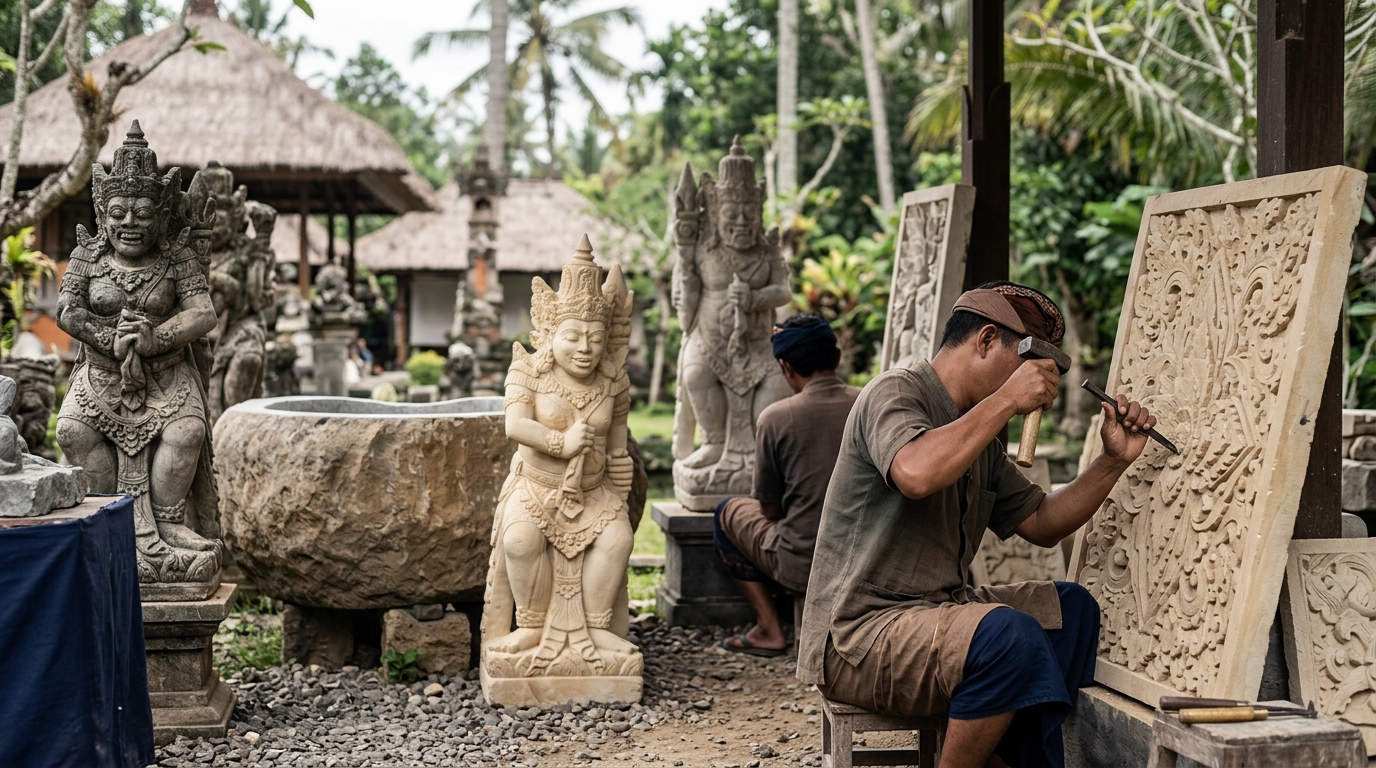
Sourcing hand-carved stone decor from Bali and Indonesia involves more variables than most procurement managers anticipate. You are not just buying a product.
Sourcing hand-carved stone decor from Bali and Indonesia involves more variables than most procurement managers anticipate. You are not just buying a product.
This guide is written for hotel developers, villa procurement teams, and architectural importers evaluating carved stone decor suppliers in Indonesia and Bali.
The guide is structured to move from material selection through supplier qualification to logistics. If you are early in the process, start at the stone type comparison. If you are already engaged with a supplier, skip to the vetting and pricing sections.
Why Bali Remains the Global Center for Carved Stone Decor Export
Bali's dominance in carved stone decor is not accidental. It reflects a convergence of craft heritage, raw material access, and export infrastructure that competing regions have not replicated.
Deep Craft Traditions With Direct Production Implications
Balinese Hindu-Balinese temple culture has required skilled stone carvers for centuries. The village of Batubulan, in Gianyar regency, is the acknowledged epicenter. Multiple generations of families specialize in specific carving traditions — Garuda and Ganesha figurative work, floral reliefs, deity panels.
Labor Costs and Skill Depth Combined
Skilled carving labor in Bali remains cost-competitive relative to comparable craft skill in Western markets. This is not low-skill manufacturing. Master carvers command higher wages than production labor, but the absolute cost differential versus European or North American stone carving studios is substantial.
Raw Material Proximity
Multiple quarry sources sit within practical trucking distance of Balinese workshops. Paras tuff is quarried locally on Bali. Palimanan sandstone comes from West Java. Andesite and basalt deposits span Central Java and East Java. Sukabumi greenstone originates in West Java.
Export Infrastructure for Hospitality and Architectural Buyers
Bali now has a functioning export ecosystem oriented toward hospitality procurement. Consolidation warehouses, freight forwarders experienced with oversized fragile cargo, wooden crating workshops, and customs brokers familiar with carved stone HS codes all operate in the Denpasar-Gianyar corridor.
Stone Types Used by Carved Stone Decor Suppliers in Indonesia and Bali
Choosing the wrong stone for the climate zone is the most common and most costly mistake in this category. Each stone type has a distinct set of mechanical and porosity properties that determine long-term performance.
The Five Primary Carving Stones
Paras stone is a volcanic tuff — light, porous, cream to grey in color. It carves in fine detail and is widely used across Bali for temple and decorative work. Its porosity makes it vulnerable to moisture infiltration. Paras is best suited to covered or semi-outdoor installations and is not recommended for freeze-thaw climates without heavy sealing.
Palimanan sandstone originates near Cirebon in West Java. It is harder and denser than Paras, with a warm golden-buff tone. It weathers more predictably and is used for outdoor facades, garden walls, and feature installations in humid tropical and subtropical climates. Carving detail is somewhat coarser than Paras.
Sukabumi greenstone (a zeolite-rich volcanic stone from West Java) is primarily used for pool surrounds and wet-area cladding. Its natural algae-resistance and non-slip texture make it a standard specification in Balinese villa pools. Carving applications are limited — the stone is typically cut into tiles and cladding panels rather than worked into figurative pieces.
Andesite is a fine-grained volcanic stone, dark grey to near-black. It is dense, hard, and highly durable. Andesite handles wet tropical climates well and is used for paving,wall cladding, and architectural elements. Its hardness makes intricate relief carving more expensive and time-consuming, but the finish is long-lasting.
Basalt shares many properties with andesite. Dense, dark, low-porosity. It performs well in coastal and high-humidity environments. Used for statement fountains, garden features, and floor installations in high-traffic hospitality settings.
Climate Suitability Comparison Matrix
| Stone Type | Porosity | Freeze-Thaw Resistance | Coastal / Humid | Arid / Dry | Carving Detail |
|---|---|---|---|---|---|
| Paras (tuff) | High | Poor — not recommended | Moderate (covered) | Moderate | Very high |
| Palimanan sandstone | Medium | Poor without sealer | Good | Good | High |
| Sukabumi greenstone | Low-medium | Moderate | Excellent | Good | Low (tiles/panels) |
| Andesite | Very low | Good | Excellent | Good | Moderate |
| Basalt | Very low | Good | Excellent | Good | Moderate |
Product Categories: From Freestanding Statues to Architectural Wall Panels
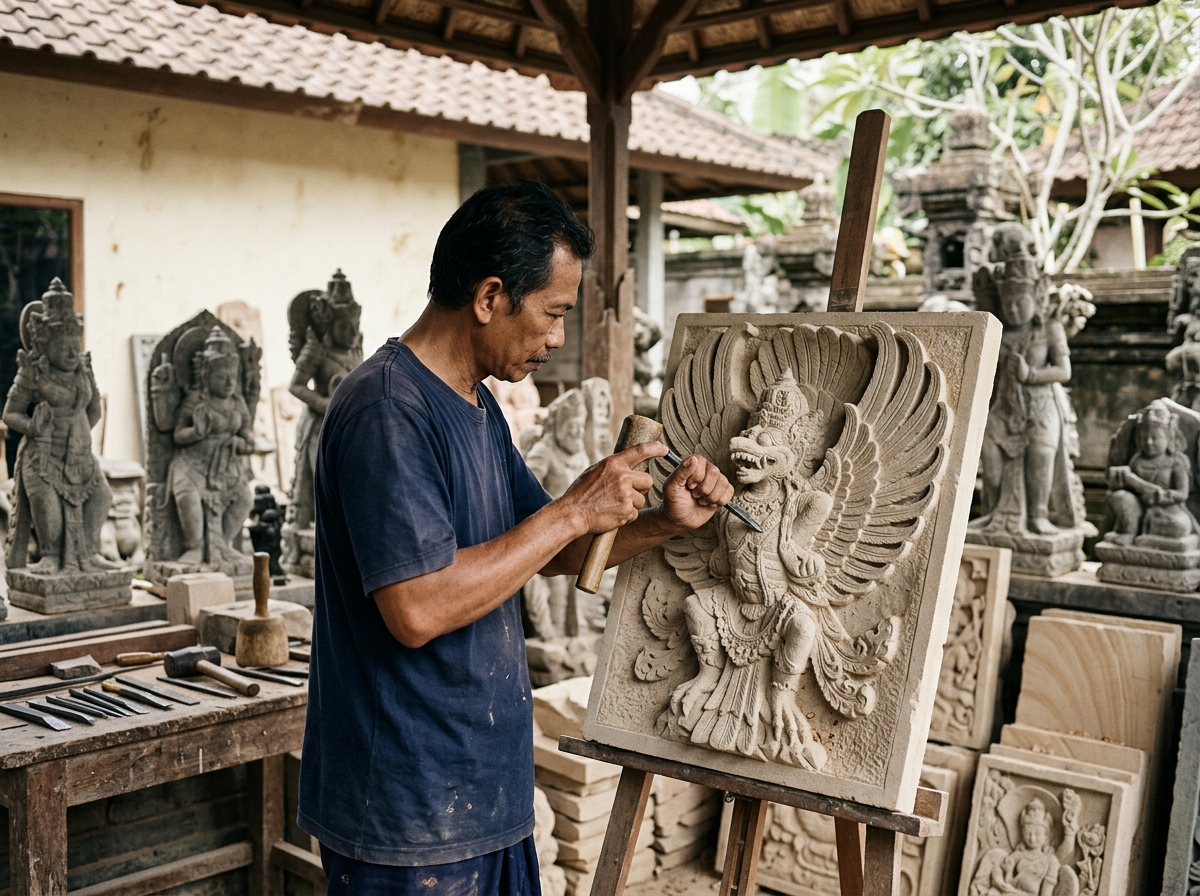
Carved stone decor suppliers in Indonesia and Bali typically produce across four core product categories. Most mid-to-large workshops carry a mix of all four.
Freestanding statues are the most recognized category. Standard export subjects include Garuda (the national bird and Hindu mount), Ganesha, Buddha in multiple postures, and Dewi Sri (rice goddess). Custom figurative work — including secular subjects, architectural grotesques, and branded mascots — is available from experienced workshops. Statues range from tabletop scale (under 30 cm) to monumental garden pieces exceeding 2 meters.
Architectural relief panels serve feature walls, entrance gates, lobby installations, and corridor cladding. Designs range from repeating geometric and floral motifs to narrative panels depicting Hindu epics (Ramayana, Mahabharata). Custom drawings are accepted by most established workshops. Panel thickness typically runs 5–15 cm depending on relief depth and structural role.
Carved stone fountains include tiered courtyard fountains, wall-mounted spout styles, and basin-plus-pillar compositions. Fountain components are typically assembled on-site from separately shipped parts. Plumbing fitment points are pre-drilled to buyer specification.
Wall cladding panels serve both hospitality interiors and exterior facades. These can be catalogue patterns (wave, brick-split, ledger) or fully custom narrative carvings. Repetitive pattern cladding is priced per square meter. Bespoke narrative cladding is quoted per panel or per project.
Custom Carving From Drawings: The End-to-End Workflow
Submitting Your Design Brief
Most established Bali stone workshops accept CAD drawings (DWG/DXF), PDF elevations, SketchUp files, or detailed reference photography. The more dimensionally precise your input, the tighter the output tolerance. Workshops that accept only freehand sketches or verbal descriptions introduce interpretation risk for architectural projects.
A useful submission package includes: overall dimensions with tolerances, elevation views from all exposed faces, surface finish specification (honed, rough-picked, or bush-hammered), stone type, and any structural anchor or plumbing requirements.
Prototype and Sample Approval
Standard practice for custom orders is a single prototype or sample panel before full production begins. Sample production typically takes two to four weeks depending on complexity. Buyers should physically inspect or arrange third-party inspection of the sample before approving the full run.
Retain the approved prototype as the golden sample. Require that it stays with the order for pre-shipment comparison.
Lead Times by Complexity
| Order Type | Indicative Lead Time |
|---|---|
| Catalogue statues (in stock) | 1–3 weeks |
| Catalogue statues (made to order) | 3–6 weeks |
| Custom relief panels (simple geometry) | 6–10 weeks |
| Custom relief panels (complex narrative) | 10–16 weeks |
| Large-scale custom fountain sets | 10–18 weeks |
| Mixed container (catalogue + custom) | Driven by longest custom item |
All times are indicative and assume design files approved before production starts.
Quality Control Checkpoints
- Dimensional tolerance check: compare finished piece against drawing at ±5 mm for panels, ±10 mm for statues (tighter tolerances negotiable in contract). - Surface finish review: verify specified finish is consistent across all faces and edges. - Structural integrity inspection: check for hairline cracks, voids, or chip repairs (acceptable only if disclosed and treated with matching stone filler). - Pre-shipment inspection: best practice is a third-party inspection against the golden sample before crating.
- ✓Dimensioned CAD or PDF drawings submitted
- ✓Stone type and finish specified in writing
- ✓Prototype approval in writing before full run
- ✓Golden sample retained and referenced in PO
- ✓Third-party pre-shipment inspection scheduled
- ✓Anchor and plumbing specs confirmed with installer
How to Evaluate and Vet Carved Stone Decor Suppliers in Indonesia
Supplier Credentials to Verify
A credible Indonesian stone export supplier should hold an active export license (NIB — Nomor Induk Berusaha, Indonesia's business registration system). For timber-framed crating or any wood product components, SVLK (Sistem Verifikasi Legalitas Kayu) certification may be relevant. Ask for copies and verify they are current.
Manufacturers Versus Middlemen
The Indonesian stone trade includes both direct manufacturing workshops and trading companies that aggregate from multiple workshops. Neither is inherently problematic, but the buyer needs to know which they are dealing with. A trading company cannot control production quality the way an owning workshop can.
Questions to Ask Before Placing a Bulk Order
- What is your annual export volume, and to which markets? - Can you provide two or three references from hotel or villa projects in the US, Australia, or Europe? - Who manages quality control between carving and crating? - What is your process if pieces arrive damaged? - Do you own your crating workshop or subcontract it?
Pricing Benchmarks and Minimum Order Quantities for Wholesale Buyers
Indicative Price Ranges
All figures below are approximate FOB Bali/Jakarta and will vary by stone type, complexity, and supplier tier.
| Product | Stone Type | Indicative FOB Price Range |
|---|---|---|
| Small statue (under 50 cm) | Paras | USD 30–80 per piece |
| Medium statue (50–100 cm) | Paras / Palimanan | USD 80–250 per piece |
| Large statue (100–150 cm) | Palimanan / Andesite | USD 250–700 per piece |
| Monumental statue (150 cm+) | Andesite / Basalt | USD 700–2,500+ per piece |
| Relief panel (per sqm, standard) | Paras / Palimanan | USD 80–200 per sqm |
| Relief panel (per sqm, custom narrative) | Paras / Palimanan | USD 200–600+ per sqm |
| Wall-mounted fountain | Paras / Andesite | USD 150–500 per unit |
| Tiered courtyard fountain | Palimanan / Andesite | USD 500–3,000+ per set |
Prices are indicative. Verify with supplier quotations before budgeting.
MOQ Norms
Catalogue items typically have low or no MOQ for individual pieces, though workshops may require a minimum container value (commonly around USD 3,000–5,000 FOB) to justify the export process. Custom carvings generally have a minimum of one complete set or panel sequence.
Payment and Currency Norms
Most Indonesian stone exporters invoice in USD. Payment terms commonly follow a 30–50% deposit on order confirmation, balance before shipment or against shipping documents. Letters of credit (L/C) are used for larger orders, typically above USD 20,000–30,000 FOB. Wire transfer (TT) is standard for smaller transactions.
US Import Tariff Considerations
Decorative carved stone from Indonesia generally falls under HTS Chapter 68 (Articles of Stone, Plaster, Cement, Asbestos, Mica). Specific subheadings within 6802 cover worked monumental or building stone and articles thereof.
Crating, Packing, and Freight for Fragile Carved Stone Pieces
Wooden Crating Standards
Carved stone pieces are heavy, brittle at thin relief edges, and prone to abrasion damage during ocean transit. Standard crating for export involves custom-built wooden crates, typically from local timber, with closed-cell foam lining on all interior faces.
Oversized pieces (fountains, large statues) may require individual custom crates with internal bracing struts. Confirm crating design with your freight forwarder before production finalizes dimensions.
FCL vs. LCL Decisions
Full container loads (FCL, typically 20-foot or 40-foot containers) are preferred when order volume justifies it. Stone is heavy — a 20-foot container reaches its weight limit well before it reaches its volume limit.
Insurance and Value Declaration
Carved stone pieces are artisan goods with replacement lead times of weeks to months. Marine cargo insurance should be obtained for full declared value, not just cost price. Declare value based on replacement cost (FOB cost plus carving labor for re-production).
Ports of Loading and Transit Times to US
| Port of Loading | Serving Region | Approx. Transit to US West Coast | Approx. Transit to US East Coast |
|---|---|---|---|
| Benoa (Denpasar), Bali | Bali workshops | 18–25 days | 28–35 days |
| Surabaya (Tanjung Perak), East Java | East Java, transshipment | 16–22 days | 26–32 days |
| Tanjung Priok, Jakarta | West/Central Java | 14–20 days | 24–30 days |
Transit times are approximate and subject to carrier schedules and transshipment routing. Bali cargo often transships via Surabaya or Singapore.
Climate Durability and Installation Best Practices for the US Market
Stone Performance by US Climate Zone
In warm, humid US markets (Florida, Gulf Coast, Hawaii), andesite and basalt perform best outdoors. Palimanan sandstone works well in these zones with a penetrating sealer applied every two to three years. Paras should be reserved for covered outdoor or interior applications only.
In coastal zones with salt spray (Atlantic seaboard, Pacific coast), low-porosity stones — andesite, basalt — are strongly preferred. Porous Paras will degrade under salt exposure without aggressive sealing programs.
In freeze-thaw zones (Northeast, Midwest, Mountain West), use only dense, low-porosity stones for any outdoor application. Andesite and basalt are the only Balinese stone types that carry meaningful freeze-thaw resistance. Paras and Palimanan sandstone installed outdoors in these zones will crack within a few seasons.
Recommended Sealers by Stone Type
| Stone Type | Recommended Sealer Type | Reapplication Interval |
|---|---|---|
| Paras | Deep-penetrating silane-siloxane consolidant | Every 1–2 years |
| Palimanan sandstone | Penetrating silane-siloxane | Every 2–3 years |
| Sukabumi greenstone | Light impregnating sealer or none | Every 3–5 years |
| Andesite / Basalt | Impregnating sealer (optional) | Every 3–5 years |
Anchoring and Structural Notes
Heavy relief panels and large outdoor fountains require engineered anchor systems. Panels above approximately 20 kg per piece should be mechanically fixed to substrate — adhesive alone is insufficient. Use stainless steel anchors and fixings to avoid rust staining on light-colored stones.
Consult a structural engineer for any installation exceeding 50 kg per panel or total fountain assemblies above 300 kg.
Top Supplier Regions and Carving Villages Worth Knowing Before You Source
Batubulan: The Core Carving Village
Batubulan, located in southern Gianyar regency approximately 10 km northeast of Denpasar, is the densest concentration of stone carvers in Bali. Roadside workshops display finished statues and relief panels for retail and wholesale buyers. Behind the storefronts are active carving workshops.
Gianyar Regency: Larger Export-Oriented Workshops
Broader Gianyar regency, including areas around Ubud, houses larger workshop operations better equipped for export-volume orders. These suppliers typically have export managers, established freight relationships, and experience with hospitality project timelines.
Yogyakarta and Central Java: Alternative Sources
Yogyakarta and the broader Central Java region offer additional carved stone sourcing, particularly in limestone and andesite. The Prambanan temple corridor has sustained a local carving tradition.
Working With a Bali-Based Sourcing Agent
For buyers without existing supplier relationships, a Bali-based sourcing agent reduces search time and supplier qualification risk. A competent agent operates independently of specific factories — they work for the buyer's fee (typically around 3–10% of FOB value based on widely observed industry norms), not on hidden commissions from workshops.
Key agent qualification signals: demonstrated experience with hospitality or architectural stone projects (not general merchandise), willingness to provide workshop audit reports in writing, transparent fee structure with no undisclosed supplier compensation, and active presence in the Gianyar-Denpasar corridor.
Frequently Asked Questions From Procurement Buyers
What is the difference between Paras stone and sandstone for carved decor?
Paras is a volcanic tuff — formed from compacted volcanic ash — not a sedimentary sandstone. It is lighter and more porous than Palimanan sandstone and carves in finer detail. Palimanan sandstone is harder, more weather-resistant, and better suited for outdoor exposure.
Can Balinesestone supplierscarve from custom architectural drawings or 3D files?
Yes. Established workshops in Batubulan and Gianyar accept CAD files, PDF elevations, SketchUp models, and reference photography. Provide dimensioned drawings with tolerance requirements for best results. Most workshops produce a physical prototype for approval before full production runs.
How long does it take to ship carved stone from Bali to the United States?
Ocean transit from Benoa port (Denpasar) to US West Coast ports is approximately 18–25 days. US East Coast ports add roughly 8–10 days. Production lead time — separate from transit — ranges from a few weeks for in-stock catalogue items to 10–18 weeks for complex custom orders.
What US import tariffs apply to decorative carved stone from Indonesia?
Carved stone decor typically falls under HTS Chapter 68, with subheadings in 6802 for worked stone articles. General MFN rates apply. Indonesia is not subject to Section 301 China-specific tariffs. Exact rates depend on product classification.
Which stone types from Bali are suitable for outdoor use in cold or freeze-thaw climates?
Andesite and basalt are the only Balinese stones reliably suitable for outdoor freeze-thaw climates. Both have very low porosity and resist water infiltration.
What is a typical minimum order quantity for wholesale carved stone purchases from Indonesia?
For catalogue items, many workshops have no formal piece MOQ but may require a minimum container value — commonly around USD 3,000–5,000 FOB — to process an export shipment efficiently. For custom carvings, MOQ is effectively one piece or one complete set, though unit pricing is higher at low volumes.
Matching stone type to climate zone and building a qualified supplier relationship in Bali before committing to production are the two decisions with the greatest impact on project outcome.
You now have a working framework for evaluating carved stone decor suppliers in Indonesia and Bali — from material selection through freight delivery. The logical next step is to move that framework into action with specific supplier quotations.
You have the sourcing criteria. Now put them to work. Connect with independently vetted carved stone workshops in Bali and Indonesia for custom or catalogue orders — statues, reliefs, fountains, and wall panels — with transparent pricing and documented supplier credentials.
Request a Custom Carved Stone Quote →Need eyes on the ground in Indonesia?
MTS is an execution partner — supplier verification, manufacturing management, quality control and export logistics across Indonesia, Vietnam and China.
Receive furniture sourcing insights across Asia.
One email per week. No spam.