Complete Project Supply Indonesia: Furniture and Building Materials Through One Partner
13 min read

Real estate developers and main contractors working on US-bound projects face a specific procurement problem. They must source furniture, joinery, doors, flooring, stone, and finishing materials from multiple suppliers. These suppliers span different countries, factories, and time zones. Each…
Real estate developers and main contractors working on US-bound projects face a specific procurement problem. They must source furniture, joinery, doors, flooring, stone, and finishing materials from multiple suppliers. These suppliers span different countries, factories, and time zones. Each vendor operates independently. Specifications drift. Shipments arrive out of sequence.
Complete project supply Indonesia furniture building materials programs exist to solve exactly this problem. Indonesia has one of the deepest manufacturing ecosystems in Asia for natural wood, stone, rattan, and interior finishing products. The country's production clusters span solid teak joinery in Central Java and natural stone finishing in Bali.
This article covers what a complete project supply program from Indonesia actually includes. It explains unified specification management, cross-categoryquality control, and how consolidated logistics reduce cost and schedule risk. It also covers how to evaluate and qualify the right partner before committing a full project budget.
Why US Developers Are Consolidating Interior and Exterior Building Supply Through Indonesia
The Hidden Cost of Fragmented Multi-Vendor Sourcing
Most developers sourcing offshore for the first time default to a fragmented model. They engage a furniture importer, a separate stone supplier, a door and joinery vendor, and a flooring trader. Each relationship requires its own RFQ process, deposit structure, quality inspection, and shipping coordination.
The coordination cost is rarely captured in procurement budgets. It includes internal project manager time, translation and communication overhead, and the compounding schedule risk when one category is delayed and others are already on the water. Specification drift is another hidden cost.
Why Indonesia Supports Cross-Category Supply at Scale
Indonesia's manufacturing ecosystem spans categories that most sourcing destinations cannot combine. Jepara in Central Java is one of the world's most concentrated solid-wood furniture production clusters. It has deep capability in teak, mahogany, and engineered timber products. Bali operates quarrying and finishing operations for natural stone.
This geographic clustering means a single supply partner can draw on multiple specialized production zones. They do not need to rely on a single factory for every category. That matters for quality. A factory specializing inteak furnitureis not the right source for natural stone countertops.
Fragmented Multi-Vendor Sourcing vs. Unified Project Supply Program
| Criterion | Fragmented Multi-Vendor | Single-Partner Program |
|---|---|---|
| Specification management | Each vendor maintains own records | Centralized finish schedule across all categories |
| Change management | Manual re-communication to each supplier | Single instruction updates all production lines |
| Quality inspection | Separate QC per vendor, inconsistent standards | One inspection protocol covering all categories |
| Logistics | Multiple partial containers, staggered arrivals | Coordinated FCL, all categories arriving together |
| Contractual accountability | Blame-shifting between vendors | One counterparty for all claims and escalations |
| Customs documentation | Multiple shipments, multiple HS code sets | Consolidated documentation, single customs broker |
| Relationship overhead | Five to eight separate supplier contacts | One project management contact |
What a Complete Project Supply Program Actually Covers
A genuine complete project supply program covers both FF&E and structural finishing materials. All categories sit within a single commercial framework. The category scope typically includes:
- Solid wood and upholstered furniture: Case goods, seating, beds, custom millwork,outdoor furniture- Interior joinery: Kitchen cabinetry, wardrobe systems, built-in shelving, architectural woodwork - Doors: Solid timber doors, engineered core doors, pivot doors, louvered panels - Flooring: Solid hardwood, engineered hardwood, bamboo composite, reclaimed wood - Natural stone: Countertops, cladding, tiles, vanity tops, feature walls in volcanic and sedimentary stone - Wall finishes and decorative panels: Timber slat panels, rattan screens, stone veneer, finishing trims
Custom specification management across this range is what separates a program-level supply solution from a supplier aggregator. Each product category in a real program carries its own technical specification sheet, material standard, and finish reference. Those documents are maintained in one master finish schedule and updated centrally when the design team issues a revision.
Typical project types using this model include hospitality developments such as resort hotels and boutique properties. They also include residential condominiums, luxury single-family homes, branded retail, office fit-out, and food and beverage.
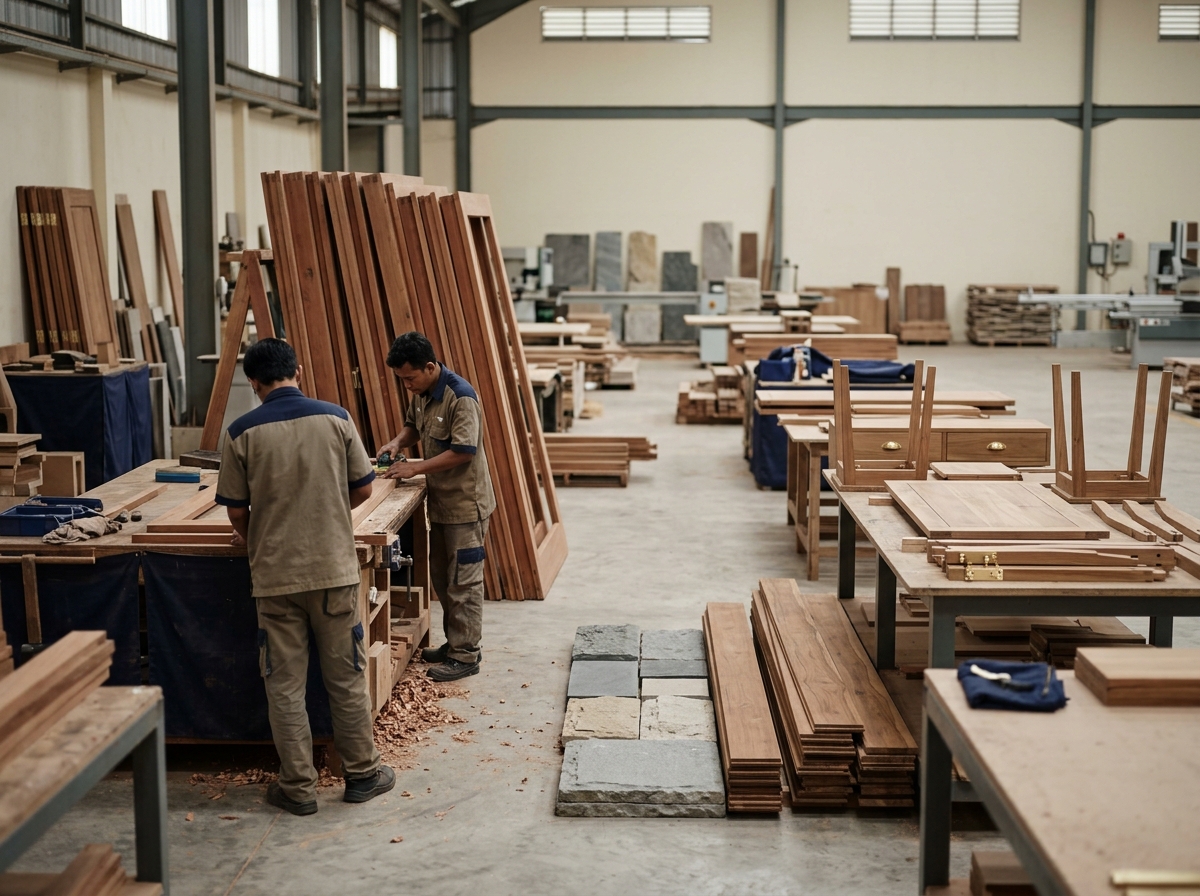
Unified Specification Management Across Every Product Category
Centralized Finish Schedules and Version Control
Specification drift is the primary quality failure in fragmented sourcing. A developer's interior designer issues a finish schedule. The furniture vendor receives version 1. Three weeks later, the designer changes the timber stain specification. The update reaches the joinery vendor but not the flooring supplier. By the time the error is discovered, production is complete.
A unified supply program addresses this through a single centralized specification document that covers every product category in the project. Changes to that document propagate to all relevant factories through one communication channel. Version history is maintained, and each factory confirms receipt and acceptance of revisions before production resumes.
Coordinating Designer Specifications with Factory Production Schedules
Interior designers work in finish codes and material references. Factories work in production sequences and raw material lead times. Bridging that gap requires a program manager who understands both languages. In a cross-category program, that function sits at the supply partner level, not with the developer's procurement team.
When a designer specifies a particular teak grade and finish for both furniture and interior joinery, the supply partner confirms that both the furniture factory in Jepara and the joinery factory can source the same timber batch. This ensures visual consistency across categories — a detail that is nearly impossible to control when vendors are engaged independently.
Cross-Category Quality Control: How a Single Partner Enforces Standards
In-Factory QC Protocols Across All Categories
Quality control in a cross-category program is structurally different from single-category inspection. Each product type has its own technical tolerances. Solid wood furniture requires moisture content verification, typically targeting 8–12% for export to US climates. Natural stone requires surface flatness and calibration checks. Flooring requires dimensional consistency and coating adhesion testing.
A single-partner program maintains a unified inspection protocol that covers all these categories under one QC regime. Inspections are coordinated across factories so the program manager can confirm compliance for every product line before any shipment is authorized.
Third-Party Inspection and Certification
Third-party inspection by firms such as SGS or Intertek adds an independent verification layer. In a cross-category program, this is more efficiently managed through one engagement than through separate inspection orders per vendor. The supply partner coordinates inspection scheduling across factories and consolidates reports into one project quality file.
Key certifications relevant to Indonesian building materials and furniture exports for the US market include:
- SVLK (Sistem Verifikasi Legalitas Kayu): Indonesia's mandatory timber legality verification system. Required for all Indonesian wood product exports. Verifiable through the Ministry of Environment and Forestry database. - FSC (Forest Stewardship Council): Voluntary certification for sustainably managed timber. Verifiable by certificate number on the FSC certificate database. - CE marking: Relevant for certain door and hardware assemblies if the project also involves European regulatory compliance. - Moisture content compliance: NHLA (National Hardwood Lumber Association) grading references and ASTM standards apply to hardwood flooring exports to the US. - CARB Phase 2 compliance: Relevant for engineered wood products (composite panels, engineered flooring) exported to California and other US states adopting California Air Resources Board formaldehyde emission standards.
Consolidated Logistics: Moving All Categories in a Coordinated Shipment
Container Optimization for Mixed Cargo
Furniture and building materials have different volumetric and weight profiles. Furniture typically occupies large cubic volumes at relatively low weight. Stone and ceramic materials are dense and heavy. Flooring and door panels are dimensional and stackable. Combining these materials in a single full-container load requires a deliberate container loading plan.
A supply partner experienced in mixed-category shipments will produce container loading diagrams in advance. They use appropriate dunnage and crating by material type and verify gross weight compliance with US port and trucking limits.
Production Schedule Alignment for On-Time Vessel Booking
The most common failure in multi-category project shipments is that categories complete production at different times. Furniture lead times from Jepara typically run approximately 60–90 days for custom orders. Stone cutting and calibration operations in Bali may run 45–60 days for a project quantity.
Without deliberate production schedule alignment, the first category to complete sits in a warehouse accumulating storage costs while the last category finishes. A coordinated program staggers production start dates so all categories are ready within the same vessel booking window.
Customs Documentation and HS Code Management
Exporting a mixed cargo of furniture, stone tiles, hardwood flooring, and timber doors requires accurate HS code assignment for each category. Errors in HS classification trigger US Customs holds, potential duty reclassification, and delivery delays. An experienced Indonesia building materials export partner will prepare complete packing lists and commercial invoices with correct HS codes.
Single-Point Accountability and What It Means for Risk and Project Delivery
Using multiple Indonesian suppliers means multiple contractual counterparties. When a quality defect is discovered on arrival, each vendor's first response is to identify whether the defect falls within their scope. Blame-shifting between vendors is common and difficult to resolve quickly when factories are twelve time zones away.
A single-partner program eliminates this structure. One contract covers all categories. One entity is responsible for quality, logistics, and delivery performance across the entire project scope. Escalation paths are consolidated: one project manager, one commercial contact, one legal counterparty.
Financial protection mechanisms in a well-structured single-partner agreement typically include:
- Staged milestone deposits: Initial deposit on order confirmation, progress payment at mid-production, balance against shipping documents or arrival inspection - Performance bonds or bank guarantees: For large project values, formal instruments issued by the supply partner's bank - Defect resolution protocols: Agreed procedures for replacement shipments, credit notes, or on-site remediation, with defined response timescales - Warranty provisions: Minimum warranty periods for each product category, aligned with US construction practice
Consider how accountability works in a concrete scenario. A shipment of teak doors and natural stone countertops arrives at a US port. Fifteen percent of the stone tiles show calibration defects. In a fragmented model, the developer contacts the stone vendor, who disputes the defect rate and requests photographic evidence.
Indonesia's Manufacturing Ecosystem That Makes Cross-Category Supply Possible
Indonesia's production depth across categories required for complete project supply programs is genuine. It is not theoretical.
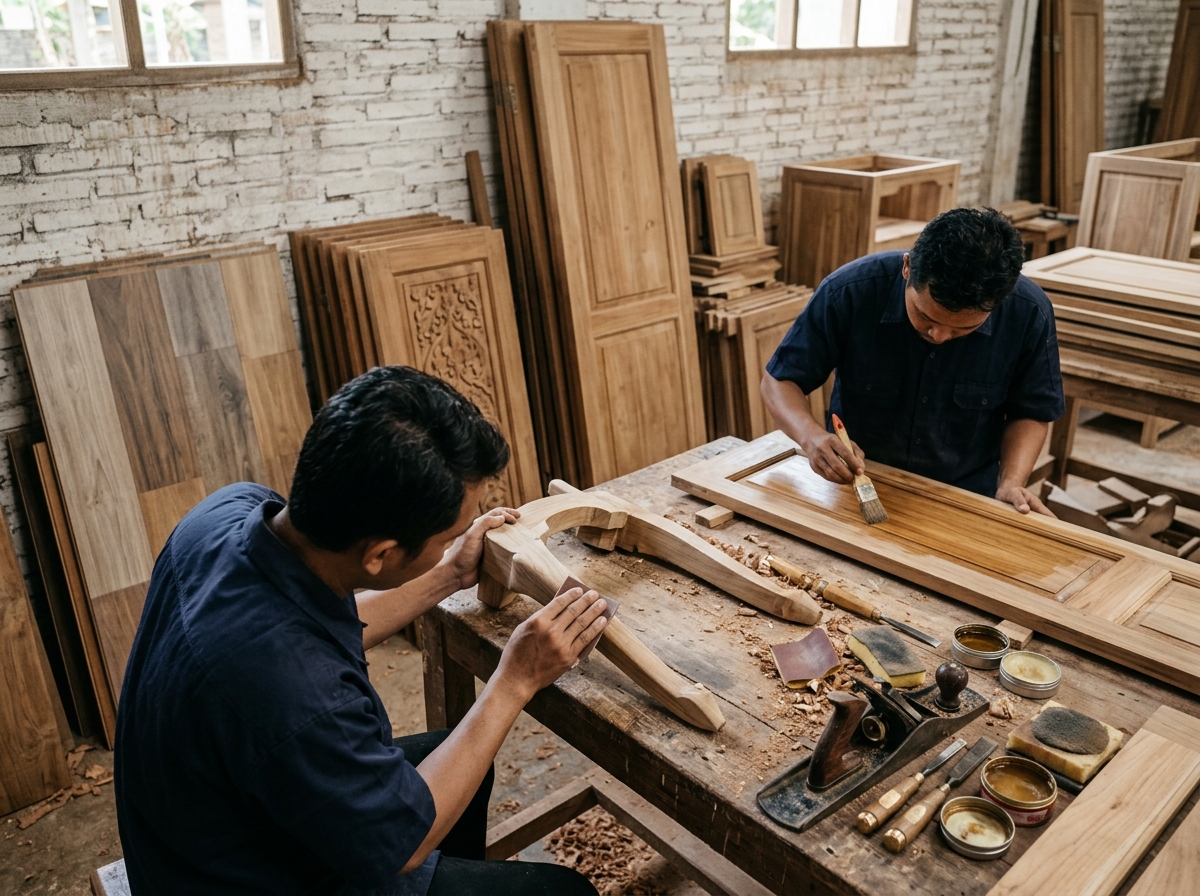
Jepara, Central Java is the anchor of Indonesia's furniture export industry. The cluster specializes in solid teak and mahogany furniture, producing case goods, beds, dining sets, and custom millwork for export markets. Jepara factories range from artisan workshops (2–30 craftsmen) to mid-scale export facilities capable of container-volume production. SVLK certification is standard for export-oriented producers.
Bali supports a distinct production base focused on natural stone — including volcanic lava stone, palimanan limestone, and basalt — alongside luxury artisan furniture for the hospitality market. Bali-sourced stone has a strong track record in resort and villa projects across the Asia-Pacific and increasingly in US hospitality developments.
Semarang and Surabaya anchor mid-market and industrial production for interior joinery, engineered flooring, and door manufacturing. These facilities typically operate at higher production volumes than Jepara artisan clusters and carry more formal export compliance infrastructure.
Timber species central to Indonesian building materials export include teak (Tectona grandis), merbau (Intsia bijuga), bengkirai (Shorea laevis), and various engineered timber products. Each species has different structural and aesthetic properties relevant to flooring, joinery, and furniture applications. Merbau and bengkirai are commonly specified for exterior decking and structural applications due to natural durability. Teak is preferred for high-value interior joinery and furniture.
How to Evaluate and Qualify a Complete Project Supply Partner in Indonesia
Due-Diligence Criteria for Cross-Category Capability
Not every Indonesian supplier who claims to offer complete project supply can actually deliver it. Evaluating genuine cross-category capability requires specific due-diligence steps:
- Factory audit scope: A credible partner should be able to invite audits of every factory in their supply network, not just their showroom or head office. Request unannounced audit rights as a condition of engagement. - Export track record: Ask for bill of lading records showing completed multi-category shipments to US ports. Bill of lading data is independently verifiable through trade data services. - Category breadth documentation: Request specifications and quality records for each product category, not just the categories you know they are strongest in. - Project management infrastructure: Confirm that the partner has dedicated project management staff (not just sales staff) with experience coordinating multi-factory production schedules. - Certification currency: Verify all SVLK, FSC, and other certifications against issuing body databases before signing any commercial agreement.
Questions to Ask During Partner Evaluation
- ✓Which specific factories produce each category in our project scope?
- ✓Can we audit those factories independently before order placement?
- ✓How do you manage production schedule alignment when lead times differ across categories?
- ✓What is your escalation protocol if a category misses its production completion date?
- ✓How are specification changes communicated to all factories simultaneously?
- ✓What third-party inspection firms do you work with, and can we review recent inspection reports?
- ✓What financial protection mechanisms are built into your standard project contract?
- ✓Have you exported mixed-category FCL shipments to US ports? Can you provide references?
Red Flags That Signal Hidden Risk
The most significant risk in engaging an Indonesian project supply partner is undisclosed subcontracting. A partner may claim in-house production for every category while actually subcontracting one or more categories. Those third parties may be unaudited and operate without QC oversight.
Other red flags include:
- Inability to name the specific factory for each product category - Certificates that reference entities other than the factory being engaged - Resistance to factory audits or unannounced visits - Pricing that seems inconsistent across categories (unusually low on some, normal on others — suggesting different sourcing arrangements) - No documented QC protocol for categories outside the partner's core specialty
Recommended Qualification Process
Start with a structured RFQ that covers all required categories. A capable partner will respond with factory identification, technical specifications, lead times, and certification status for every category. Next, order samples for each category and evaluate them against your finish schedule. Run a pilot order on a smaller project or a single building before committing a full development budget.
Frequently Asked Questions
What categories can be combined in a complete project supply program from Indonesia?
Indonesia cross-category supply programs can consolidate furniture, joinery, doors, and flooring under one source. Natural stone, wall panels, and exterior decking are also available within the same program. This single-source model spans solid wood, upholstered, rattan, engineered, and stone product categories.
How does consolidated shipping work when furniture and building materials ship together?
A supply partner aligns production completion dates across all categories, then books a single FCL or multiple coordinated FCLs. A container loading plan accounts for the different weight and volume profiles of furniture versus stone versus flooring. All categories ship under consolidated customs documentation with correct HS codes for each product type.
What certifications should an Indonesian project supply partner hold for US exports?
SVLK certification is mandatory for all wood products. FSC certification is preferred for specified timber species. CARB Phase 2 compliance is required for engineered wood panels. Hardwood flooring should reference NHLA grading standards. Third-party inspection by SGS or Intertek provides additional compliance documentation.
How is quality controlled across furniture, stone, flooring, and joinery in a single program?
A credible program maintains category-specific QC protocols under one unified inspection regime. These include moisture content for timber, calibration tolerances for stone, and dimensional consistency for flooring. Third-party inspection firms conduct in-factory checks at pre-shipment stage. All inspection reports feed into a single project quality file.
What is the typical lead time for a complete project supply order from Indonesia to the US?
Production lead times vary by category: furniture from Jepara is typically 60–90 days for custom orders; stone fabrication is commonly 45–60 days; doors and flooring often fall in the 45–75-day range. Ocean freight from Indonesia to US West Coast ports adds approximately 20–25 days; East Coast ports add approximately 30–35 days.
How does single-point accountability differ from using multiple Indonesian suppliers?
With multiple suppliers, each vendor is contractually responsible only for its own category. Defects, delays, and specification errors trigger inter-vendor disputes that the developer must resolve. A single-partner model places all accountability with one contractual counterparty. Defect claims, replacement coordination, and delivery disputes are resolved through one escalation channel.
Consolidating procurement through a single Indonesia partner reduces specification drift and logistics complexity. It also lowers contractual risk at the same time. It covers furniture, building materials, joinery, stone, and finishing under one commercial framework. Indonesia's manufacturing ecosystem genuinely supports this model across multiple production clusters.
You now have the framework to evaluate whether a prospective partner can deliver a genuine cross-category program. Or you can determine if they are simply aggregating vendors without operational control. The logical next step is to test that framework against a real project scope.
Share your project category requirements, timeline, and destination port. We will prepare a consolidated supply proposal covering furniture, building materials, joinery, stone, and finishing — sourced from verified Indonesian factories under one program, one specification framework, and one point of accountability.
Request Your Project Supply Proposal →Need eyes on the ground in Indonesia?
MTS is an execution partner — supplier verification, manufacturing management, quality control and export logistics across Indonesia, Vietnam and China.
Related services
Related articles
Receive furniture sourcing insights across Asia.
One email per week. No spam.