Reclaimed Teak Furniture Indonesia: A Complete Wholesale Buyer's Guide
16 min read
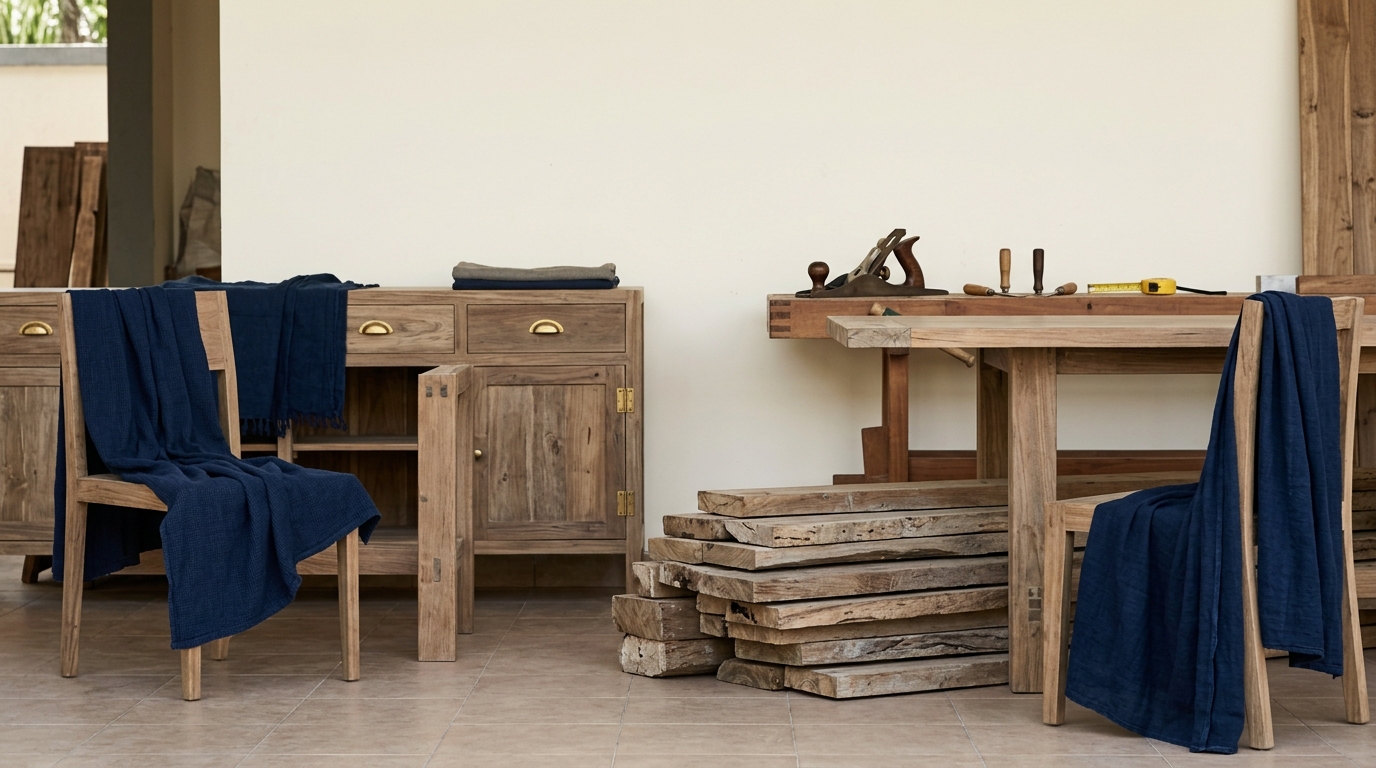
Sourcing reclaimed teak furniture Indonesia at scale is not simply a procurement decision — it is a compliance, quality, and brand positioning decision made simultaneously. Wholesale buyers entering this market for the first time often discover that the gap between a well-documented Indonesian…
Sourcing reclaimed teak furniture Indonesia at scale is not simply a procurement decision — it is a compliance, quality, and brand positioning decision made simultaneously. Wholesale buyers entering this market for the first time often discover that the gap between a well-documented Indonesian teak supplier and an unreliable one is measured not in price but in certifications, regional craftsmanship traditions, and import paperwork. Getting that combination right protects your business from US Customs delays, Lacey Act exposure, and costly quality disputes.
This guide covers everything a sustainable furniture retailer or wholesale importer needs to evaluate before placing a container order: the material properties that make Indonesian reclaimed teak irreplaceable, the regional production clusters beyond the well-known hub of Jepara, the certification hierarchy from FSC to SVLK, quality grading criteria, pricing and logistics benchmarks, and the supplier relationship strategies that reduce risk over repeated orders. It also addresses how to translate your sourcing story into a retail marketing asset once the furniture arrives stateside.
Whether you are placing your first trial order or renegotiating terms with an existing factory, the frameworks in this guide apply directly to the decisions in front of you. Start with the material fundamentals — they explain why every other variable in this supply chain commands a premium.
Why Reclaimed Teak from Indonesia Outperforms Any Alternative on the Market
The material science behind old-growth reclaimed teak
Reclaimed teak furniture Indonesia sources comes overwhelmingly from Tectona grandis harvested decades or centuries ago and built into the structural timbers of Javanese homes, colonial warehouses, rail sleepers, and rural farm buildings. Because those trees grew slowly in natural forest conditions, they produced wood with extremely tight grain rings, high silica content, and a dense concentration of natural teak oils — properties that plantation-grown teak simply cannot replicate within a commercially viable growing cycle.
When that old-growth timber is reclaimed from demolished structures, buyers receive material that has already completed its most significant dimensional movement. The wood has stabilized over generations of seasonal humidity cycling, which means finished furniture shows far less warping, cracking, or joint separation than new-growth alternatives. The natural oils that give teak its legendary resistance to moisture, insects, and UV degradation are present at concentrations that younger trees have not had time to accumulate.
How reclaimed teak differs from recycled or plantation teak
These three terms appear interchangeably in supplier catalogs, but they describe meaningfully different materials. Reclaimed teak refers specifically to structural timber salvaged from buildings, bridges, or other constructed objects — the wood has a documented prior use, visible nail holes, and a weathered surface patina that is impossible to fake convincingly. Recycled teak is a looser term sometimes applied to off-cuts and factory waste from primary milling operations; it may or may not carry the same age and density characteristics. Plantation teak — sometimes marketed as 'sustainable teak' — comes from fast-grown Tectona grandis farms in Indonesia and other tropical countries; it is legal, traceable, and FSC-certifiable, but its grain is wider, its oil content lower, and its long-term durability demonstrably inferior to old-growth reclaimed stock.
US wholesale buyers increasingly specify reclaimed over virgin-cut or plantation timber for two converging reasons: end consumers demand provenance and sustainability credentials, and the material genuinely performs better in the premium price brackets where reclaimed teak furniture competes.
Regional Sourcing Clusters in Indonesia Every Importer Should Know
Jepara, Central Java: the dominant production hub
Jepara, on the northern coast of Central Java, is the most recognized name in Indonesian furniture exports, and for good reason. The city hosts hundreds of furniture workshops and mid-sized factories ranging from small artisan cooperatives of fewer than 30 craftspeople to export-oriented facilities employing several hundred workers. The regional craft tradition in Jepara is centuries old, with woodcarving skills passed across generations, and the concentration of component suppliers — hardware, finishing materials, kiln-drying facilities — is unmatched elsewhere in Indonesia. For reclaimed teak specifically, Jepara manufacturers have well-established procurement networks for sourcing structural timber from demolition sites across Central Java.
Logistics from Jepara typically route through the Port of Semarang, the primary container gateway for Central Java and the most practical port of departure for US-bound FCL shipments originating in this cluster. Transit times from Semarang to major US West Coast ports run approximately three to five weeks, with East Coast routing adding another week or more depending on the routing through the Suez Canal or transpacific connections.
Yogyakarta and East Java: the underexplored clusters
Yogyakarta, located inland in Central Java, hosts a distinct furniture and craft production community that tends toward higher artisan content and more intricate carving traditions than the volume-oriented factories closer to Jepara. Workshops here often produce lower annual volume but achieve finish detail and joinery quality that appeals to premium retail buyers. Lead times from Yogyakarta producers can run longer than Jepara counterparts because many operations remain semi-artisanal and do not maintain large finished-goods inventories.
Surabaya, the capital of East Java, represents a different profile again — a more commercially oriented mid-market cluster with stronger logistics infrastructure and direct port access via Tanjung Perak, one of Indonesia's busiest container terminals. East Java producers sourcing reclaimed teak often draw from a different regional demolition supply network than their Central Java counterparts, which can produce subtle differences in timber character and patina. Buyers sourcing indonesia teak wood furniture at higher volumes may find that Surabaya-based manufacturers offer better scalability and faster container turnaround than smaller Jepara workshops.
Sustainability Certifications Every Wholesale Buyer Must Verify Before Ordering
FSC, SVLK, and the Indonesian timber legality framework
Two certification systems govern legal timber trade from Indonesia, and both matter to US importers. The Forest Stewardship Council (FSC) certification is the globally recognized standard for responsible forest management and chain-of-custody tracking. FSC-certified suppliers can provide documentation tracing material from forest origin through processing and export. For reclaimed timber specifically, the FSC has a Recycled Material standard that certifies wood salvaged from pre-consumer or post-consumer sources — this is the relevant pathway for structural reclaimed teak.
SVLK — Sistem Verifikasi Legalitas Kayu — is Indonesia's mandatory national timber legality verification system, administered by the Indonesian Ministry of Environment and Forestry and audited by accredited third-party verifiers. All Indonesian timber exporters are legally required to hold a valid SVLK certificate (also known as V-Legal certification). SVLK compliance means the supplier has been audited for legal harvest, legal processing, and proper export documentation. When evaluating indonesian teak furniture suppliers, treat SVLK as a minimum threshold, not a differentiator — FSC certification on top of SVLK signals a supplier investing beyond regulatory minimums.
US Lacey Act compliance: what importers must do
The US Lacey Act, amended in 2008, prohibits the importation of wood products harvested or traded in violation of the laws of the source country. For Indonesian reclaimed teak imports, this means the importer of record — your business — must file a Plant and Plant Product Declaration with US Customs and Border Protection (CBP) at the time of import. This declaration requires you to state the scientific name of the species (Tectona grandis for teak), the country of harvest (Indonesia), the quantity, and the value.
The practical compliance burden falls on your supplier to provide accurate species documentation and on your import broker to file correctly. Request a copy of your supplier's SVLK certificate and FSC chain-of-custody certificate before ordering, and ensure your customs broker is familiar with wood product declarations under Lacey Act requirements. Mislabeled species, missing harvest documentation, or suppliers unable to produce SVLK certificates are grounds for CBP holds and potential penalties.
- ✓Request current SVLK (V-Legal) certificate with validity dates
- ✓Confirm FSC chain-of-custody certificate number and scope
- ✓Verify scientific species name (Tectona grandis) appears on all shipping documents
- ✓Ask for demolition or salvage source documentation for reclaimed material
- ✓Confirm supplier is listed on the Indonesian Ministry of Environment and Forestry public registry
- ✓Ensure your import broker is filing CBP Plant and Plant Product Declarations correctly
How to Grade Reclaimed Teak Quality Before Committing to a Wholesale Order
Visual and structural grading criteria
Quality grading for reclaimed teak furniture Indonesia suppliers use varies, but buyers should evaluate material along consistent criteria regardless of what terminology a supplier uses. Grain density is the primary indicator of old-growth origin — count growth rings per centimeter where end grain is visible on sample pieces; tighter rings indicate slower growth and higher material quality. Natural nail holes, bolt shadows, and saw marks are desirable in reclaimed material because they confirm authentic structural provenance rather than artificially distressed new wood. Surface patina should be consistent across a board — artificially darkened new teak shows uneven color distribution when examined closely.
Moisture content is a critical structural variable. Properly kiln-dried reclaimed teak for indoor furniture should reach moisture content levels appropriate to the destination climate — for the US market, suppliers targeting indoor categories should kiln-dry to approximately 8–12% moisture content. Outdoor furniture tolerates slightly higher levels. Request kiln-drying certificates or on-site moisture meter readings during any factory inspection.
Joinery methods and factory inspection protocols
Joinery quality separates long-lasting furniture from pieces that fail in the field. Mortise-and-tenon joinery — where a projecting tenon fits into a corresponding mortise — is the traditional and most durable method for solid teak furniture and should be present on structural connections in dining tables, chairs, and case goods. Dowel joinery is acceptable for secondary connections but should not be the primary structural method. Metal fasteners used as primary structure in solid teak pieces indicate cost-cutting and will likely fail before the wood does.
Request physical samples of at least two to three product types before placing a wholesale order. Budget for a third-party pre-shipment inspection if you cannot visit the factory yourself. Quality control agents operating in Indonesia — sourced through international inspection firms or local audit service providers — can conduct During Production (DUPRO) and Pre-Shipment Inspection (PSI) visits, document moisture readings, photograph joinery details, and provide written reports before your container loads. This service typically costs a fraction of a container's value and eliminates the most common sources of wholesale disappointment.
Indoor and Outdoor Product Lines That Drive Wholesale Revenue with Reclaimed Teak
The most in-demand indoor categories for reclaimed teak furniture Indonesia exports to the US market include dining tables, sideboards and media consoles, coffee tables, and occasional chairs. Dining tables — particularly large-format pieces in the 84- to 120-inch range — command strong retail margins because reclaimed teak competes directly with live-edge slabs and engineered stone surfaces at price points that reward provenance storytelling. Sideboards and storage pieces benefit from the character variation inherent in reclaimed planks, making each piece merchandisable as unique.
Outdoor collections have grown significantly as hospitality and resort procurement buyers seek furniture with genuine weathering credentials. Reclaimed teak's natural oil content makes it one of the few wood species that performs outdoors without mandatory sealing, and the aged patina translates directly to the weathered aesthetic that resort designers specify. Outdoor dining sets, lounge chairs, and sun loungers represent high-volume categories for hospitality procurement programs.
| Product Category | Typical Finish Options | Relative MOQ | Lead Time Range |
|---|---|---|---|
| Indoor dining tables | Natural oil, whitewash, charcoal stain | Low–Medium | 60–90 days |
| Sideboards / consoles | Natural oil, custom stain | Medium | 60–90 days |
| Coffee tables | Natural oil, whitewash | Low | 45–75 days |
| Outdoor dining sets | Natural oil (untreated), teak seal | Medium–High | 75–120 days |
| Resort lounge furniture | Natural oil, weathered grey | High | 90–120 days |
Finish options from most Indonesian teak suppliers include natural tung or teak oil (preserves the honey-amber tone), whitewash (a diluted white pigment that highlights grain while lightening the overall tone), charcoal or ebonized finishes (for contemporary interiors), and custom stain matching. Custom stain development typically requires an additional sample approval round and can extend lead times by two to four weeks.
Pricing, Container Economics, and US Import Logistics for Teak Buyers
FOB price benchmarks and container load planning
FOB pricing from Indonesian ports — most commonly FOB Semarang for Central Java production and FOB Surabaya for East Java — varies significantly by product complexity, material grade, and order volume. As a general orientation, simple reclaimed teak coffee tables and occasional pieces sit at lower FOB price points, while large dining tables with complex joinery, custom hardware, or matched-grain tops command substantially higher FOB values. Buyers should expect FOB prices for mid-complexity reclaimed teak dining furniture from established Jepara exporters to reflect the premium material cost over comparable plantation teak or mahogany products.
Container load planning directly determines your landed cost per unit. A standard 20-foot container accommodates a relatively modest number of large dining tables unboxed, while efficient nesting and flat-pack-compatible designs can meaningfully improve cube utilization. Most experienced Indonesian teak exporters provide container packing plans on request. A 40-foot high-cube container is the standard unit for furniture imports and offers better economics per piece than LCL (Less than Container Load) shipments, which incur consolidation handling fees and longer transit variability. LCL is appropriate for trial orders and sample container shipments but should not be the long-term import structure for a scaling wholesale program.
Duties, HS codes, and transit planning
Reclaimed teak furniture from Indonesia enters the United States under various HS codes depending on product type — seating, case goods, and occasional tables each have distinct classifications under Chapter 94 of the US Harmonized Tariff Schedule. Indonesia is eligible for standard Most Favored Nation (MFN) duty rates. Your customs broker should confirm the correct HS code for each SKU you import, as misclassification creates CBP examination risk. Unlike imports from China subject to Section 301 tariffs, Indonesian furniture does not currently carry additional punitive duties, which represents a meaningful landed-cost advantage for US buyers comparing sourcing origin options.
Transit time from Semarang or Surabaya to US West Coast ports typically runs in the range of approximately three to five weeks on direct or single-transhipment services. East Coast routing via transpacific or Suez services adds additional transit time. Build port dwell time and inland freight into your inventory planning, particularly for seasonal buying programs.
Building Durable Supplier Relationships with Indonesian Teak Manufacturers
Effective communication across the Indonesia–US time zone gap requires establishing a predictable weekly rhythm rather than relying on ad hoc messaging. Indonesian business culture places high value on relationship continuity and face-to-face contact; buyers who visit factories at least once per year — or attend IFEX Jakarta, Indonesia's primary international furniture trade exhibition — consistently report faster problem resolution, better production priority, and more favorable terms than buyers who operate entirely at arm's length. IFEX Jakarta, held annually, brings together the country's leading furniture exporters and is one of the most efficient ways to evaluate multiple suppliers across categories in a condensed period.
Third-party quality control agents and factory audit services operating in Indonesia provide an important substitute for in-person oversight when travel is not feasible. International inspection companies with Indonesia operations can conduct factory capability audits before you place an initial order, DUPRO inspections during production, and PSI checks before container loading. Negotiating exclusivity on custom designs — particularly reclaimed teak pieces developed specifically for your retail program — typically requires a documented design agreement, a minimum annual volume commitment, and a reasonable exclusivity period. Most mid-sized Jepara and Surabaya manufacturers will negotiate these terms with buyers demonstrating sustained purchasing relationships.
Turning Indonesian Reclaimed Teak into a Retail Brand Story That Sells
Reclaimed teak furniture Indonesia exports carry inherent narrative value that most sustainable materials cannot match. A dining table made from the structural beams of a 19th-century Javanese joglo pavilion or a colonial-era sugar warehouse is not simply furniture — it is a documented artifact with a second life. US retail audiences, particularly those in the millennial and Gen X demographic segments that drive premium furniture spending, respond strongly to provenance specificity. Material origin cards placed with each piece — describing the approximate age of the timber, the region of origin, and the craft tradition behind the joinery — convert a sustainability claim into an emotional purchase justification.
FSC chain-of-custody certification and SVLK documentation translate into retail-facing eco-labels and website copy that resonate with eco-conscious consumers and satisfy sustainability criteria for trade program listings with hospitality procurement platforms. Photography that documents the timber's weathered character — close-ups of grain, nail holes, and patina alongside lifestyle imagery — outperforms generic product shots in conversion rates for premium reclaimed furniture categories. Unboxing content filmed by early customers and seeded through retail social channels builds social proof at low cost and aligns with the material's authentic, imperfect aesthetic.
Position reclaimed teak furniture Indonesia pieces explicitly as investment-grade objects that appreciate in character with age rather than depreciate. This framing justifies the price premium over plantation teak or engineered wood alternatives and reduces price-comparison shopping behavior among your end consumers.
Frequently Asked Questions: Indonesian Reclaimed Teak for Wholesale Buyers
Is reclaimed teak furniture from Indonesia legal to import into the United States?
Yes, provided your supplier holds valid SVLK (V-Legal) certification, all export documentation accurately identifies the species as Tectona grandis, and your customs broker files the required Plant and Plant Product Declaration under the US Lacey Act. Non-compliance with any of these requirements creates legal and financial risk for the importer of record.
What is the difference between reclaimed teak and recycled teak furniture?
Reclaimed teak refers specifically to structural timber salvaged from demolished buildings, bridges, or other constructed objects — material with a documented prior use, visible provenance markers, and typically old-growth density and oil content. Recycled teak is a broader, less regulated term sometimes applied to factory off-cuts or processing waste, which may not carry the same material properties or provenance story.
Which certifications should I look for when sourcing reclaimed teak from Indonesia?
Require a current SVLK (V-Legal) certificate as a minimum legal threshold. FSC chain-of-custody certification signals additional investment in traceable, responsible sourcing. For reclaimed material specifically, ask whether the supplier holds FSC Recycled Material certification or can provide demolition source documentation.
What are typical minimum order quantities for wholesale reclaimed teak furniture?
MOQs vary by supplier type and product category. Mid-sized Jepara export factories commonly set container-based MOQs — typically one 20-foot or 40-foot container per order. Smaller artisan workshops may accept lower unit MOQs but at higher per-unit prices. Custom-design programs generally require higher committed volumes to justify tooling and sample development costs.
How long does shipping from Indonesia to the US usually take?
Transit time from Semarang or Surabaya to US West Coast ports runs approximately three to five weeks on standard services. East Coast routing adds additional transit time. Total lead time from order confirmation to US port arrival — including production — commonly runs three to five months for custom or semi-custom programs.
Can Indonesian manufacturers produce custom designs using reclaimed teak?
Yes. Many mid-sized and larger Jepara and Surabaya manufacturers operate with in-house design and prototyping capability and will develop custom designs from buyer-provided drawings or reference images. Custom sample development typically requires a sample fee (sometimes credited against the production order) and adds four to eight weeks before production can begin. Exclusivity on custom designs is negotiable and is most easily secured with a documented minimum annual volume commitment.
Sourcing reclaimed teak furniture Indonesia successfully requires aligning three variables simultaneously: verified supplier compliance with SVLK and Lacey Act requirements, rigorous quality grading and pre-shipment inspection protocols, and a container economics model that makes the landed cost competitive within your retail margin structure. Buyers who invest in direct supplier relationships, regional sourcing knowledge beyond Jepara, and a compelling retail provenance narrative consistently outperform those treating Indonesian teak as a commodity procurement exercise.
You now have a working framework for evaluating suppliers, understanding certification requirements, planning import logistics, and positioning reclaimed teak furniture as a premium retail proposition. The natural next step is to connect directly with a verified source.
You understand the certifications to require, the quality criteria to apply, and the container economics to plan around. Now put that knowledge to work — request a wholesale catalog from a certified Indonesian reclaimed teak furniture supplier and begin evaluating product lines, MOQs, and custom design possibilities for your next buying season.
Request Wholesale Catalog →Need eyes on the ground in Indonesia?
MTS is an execution partner — supplier verification, manufacturing management, quality control and export logistics across Indonesia, Vietnam and China.
Related services
Related articles
Receive furniture sourcing insights across Asia.
One email per week. No spam.