Hardwood Decking Suppliers Indonesia Wholesale: The Complete Sourcing Guide
13 min read
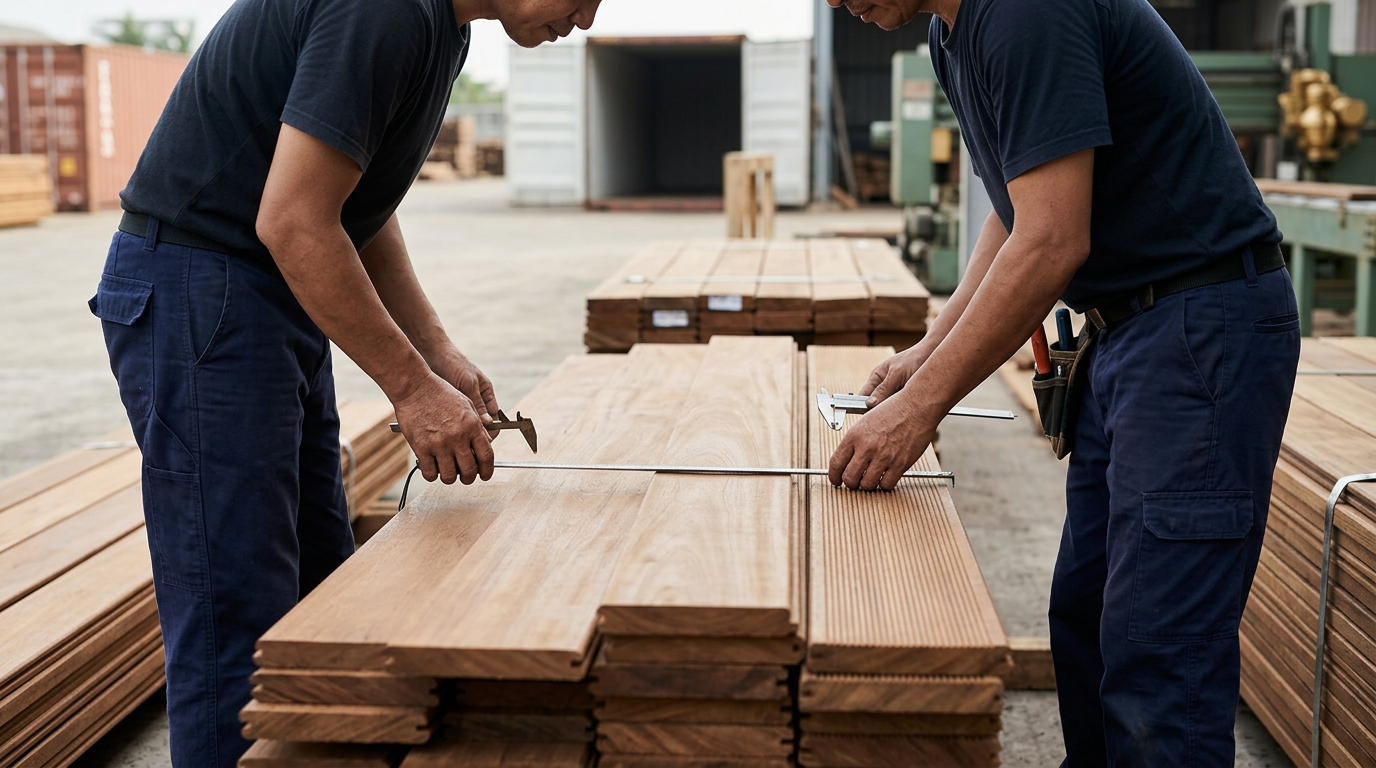
US decking distributors, landscape contractors, and marina builders face a consistent sourcing challenge: finding tropical hardwood decking that meets both performance specifications and import compliance requirements. Indonesia sits at the center of global tropical timber supply, but navigating…
US decking distributors, landscape contractors, and marina builders face a consistent sourcing challenge: finding tropical hardwood decking that meets both performance specifications and import compliance requirements. Indonesia sits at the center of global tropical timber supply, but navigating hardwood decking suppliers Indonesia wholesale requires more than a price comparison. Species selection, moisture content, certification stacks, and container logistics all determine whether a shipment performs or creates liability.
This guide covers every decision layer a US buyer must work through. You will find species comparisons, surface profile options, kiln-drying standards, a container loading reference, certification compliance requirements under the Lacey Act, and a supplier vetting framework. The goal is to give procurement teams and sourcing managers a structured reference they can act on immediately.
Indonesia's position as a tier-one source for tropical hardwood decking is not accidental. The country combines exceptional timber biodiversity, established mill capacity across multiple islands, and export infrastructure that has served US distributors for decades. Understanding why that position is durable — and where its limits are — is the right place to start.
Why Indonesia Controls a Dominant Share of the Global Tropical Hardwood Decking Market
Indonesia sits across the equator with primary tropical forest coverage across Kalimantan, Sumatra, Java, and Sulawesi. This geography produces the specific growing conditions that yield dense, durable hardwood species unavailable from temperate sources.
Key production regions serve distinct supply roles:
- Kalimantan — primary source for Ulin (ironwood) and Merbau; large-scale industrial milling - Java (Jepara, Semarang, Surabaya) — plantation Teak processing and export finishing - Sumatra (Medan/Belawan port zone) — Merbau and mixed tropical species - Bali — smaller-volume artisan and premium export operations
Export infrastructure is mature. Tanjung Priok (Jakarta), Belawan (Medan), and Semarang handle the majority of container volume destined for US ports. Freight forwarder networks, customs brokers familiar with Lacey Act documentation, and phytosanitary inspection facilities are all established at these ports.
Cost competitiveness remains real but should not be overstated. Indonesian wholesale pricing for certified, kiln-dried tropical hardwood decking typically sits below comparable certified material from Brazil or West Africa when factoring freight parity. However, uncertified or poorly dried material priced significantly below market norms is a red flag, not a bargain.
Top Tropical Hardwood Species From Indonesian Wholesale Suppliers
Bangkirai (Yellow Balau): High-Density Workhorse
Bangkirai is among the most widely exported Indonesian decking species to the US market. Its density typically falls in the range of approximately 800–1,000 kg/m³. Janka hardness is high — commonly referenced above 1,400 lbf — placing it in durability Class 1 or 2 under European standards.
Applications: residential decks, commercial boardwalks, pool surrounds. It takes a natural oil finish well and weathers to a silver-grey if left untreated. Silica content is elevated, so carbide tooling is required for milling.
Merbau: Natural Oil Content and Decay Resistance
Merbau contains natural oils and interlocked grain that resist fungal decay and insect attack without chemical treatment. Density is approximately 800–900 kg/m³. Color ranges from orange-brown to dark red-brown, often with yellow mineral streaks that stabilize over time.
Merbau bleeds reddish tannins when first wetted. This is cosmetically significant for light-colored concrete surrounds. Pre-wetting boards before installation is standard practice on commercial projects.
Teak (Tectona grandis): Plantation vs. Old-Growth
Plantation Teak from Java is the dominant commercial form. Rotation cycles of approximately 20–40 years produce boards with wider grain spacing than old-growth material. Old-growth Teak commands a significant price premium and triggers CITES (Convention on International Trade in Endangered Species) considerations for certain harvest zones.
Forest Stewardship Council (FSC) certification is most accessible for plantation Teak. This is the species where certification documentation is most scrutinized by US importers.
Ulin (Ironwood/Belian): Marine-Grade Extreme Performance
Ulin is sourced primarily from Kalimantan. Density commonly exceeds 1,000 kg/m³. It is among the hardest commercially available Indonesian species. Ulin's performance in saltwater environments is exceptional — it resists marine borer activity and does not require chemical treatment for submerged or splash-zone applications.
Reclaimed Ulin is available from demolished structures and old bridge timbers. Reclaimed material may carry processing documentation but not a conventional chain-of-custody certification. Verify origin documentation carefully before import.
Species Quick-Reference Comparison Table
| Species | Approx. Density (kg/m³) | Durability Class | Price Tier | Best Use Case |
|---|---|---|---|---|
| Bangkirai | 800–1,000 | Class 1–2 | Mid | Residential decks, boardwalks |
| Merbau | 800–900 | Class 1–2 | Mid | Pool surrounds, commercial decks |
| Teak (plantation) | 630–720 | Class 1 | Premium | Yacht decking, premium residential |
| Ulin (Ironwood) | 1,000–1,100+ | Class 1 | Mid-High | Marine docks, saltwater exposure |
Surface Profile Options That Determine Slip Resistance and Installation Method
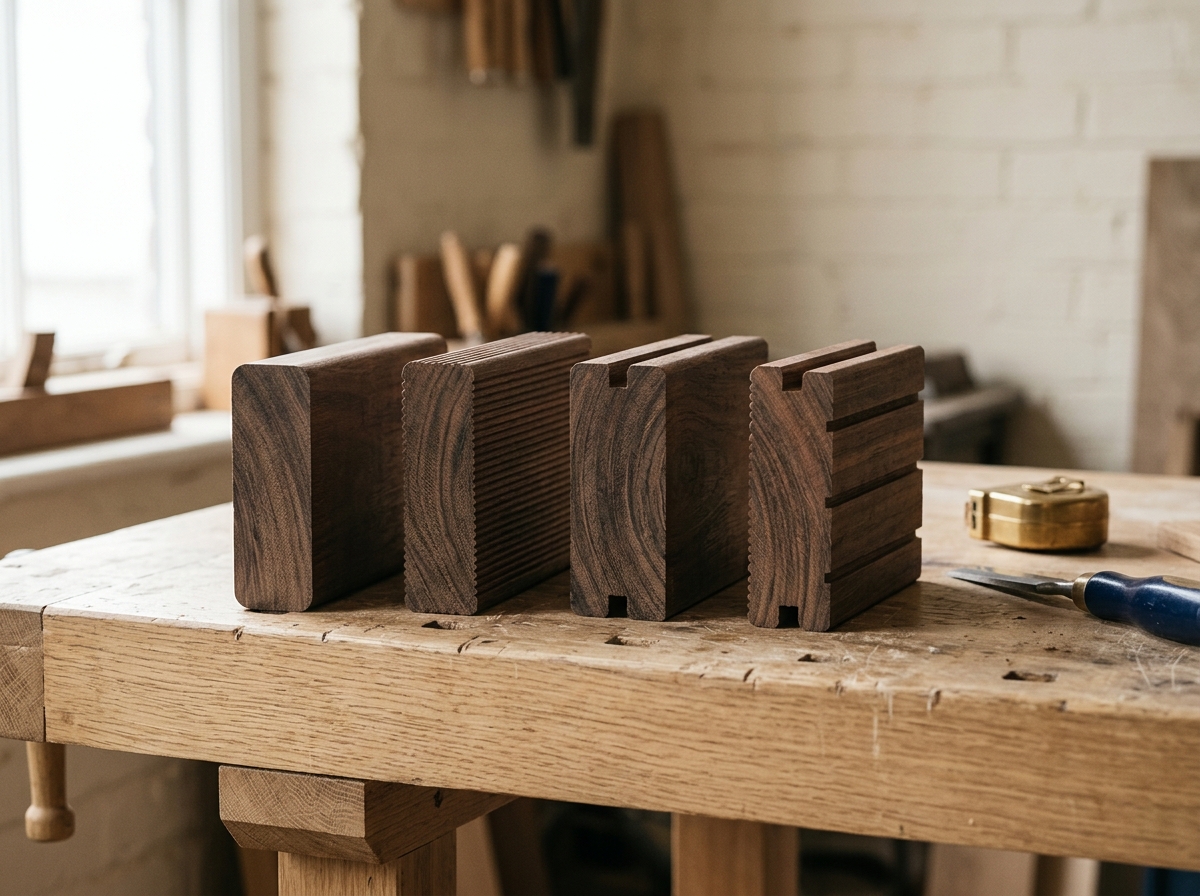
Smooth Profile: Aesthetics and Finishing Requirements
Smooth-faced boards present a clean, formal appearance. They suit residential deck applications where aesthetics take priority. The trade-off is slip resistance — smooth tropical hardwood becomes slippery when wet unless treated with a non-slip oil or coating. Anti-slip strips are a common retrofit on smooth-profile pool decks.
Reeded (Ribbed) Profile: Grip and Drainage
Reeded profiles feature parallel raised ridges running the board length. The ridges channel water away from the foot surface and increase friction. This profile dominates pool surrounds, marina boardwalks, and commercial waterfront applications. Reeded boards are typically face-screwed or clip-fastened through the valley between ridges.
Grooved Profile: Hidden Clip Compatibility
Grooved boards have a routed channel on one or both long edges. This channel accepts a hidden clip fastener, eliminating visible fasteners on the top surface. Groove geometry varies by manufacturer — width and depth tolerances must match the clip system specified. Confirm groove dimensions in millimeters before ordering clip hardware.
Double-Sided Boards
Some Indonesian mills produce boards with a smooth face and a reeded reverse. This gives installers flexibility on a single SKU. The board can be flipped depending on application zone — smooth face for covered areas, reeded face for exposed or wet zones.
Standard Dimensions and Custom Milling From Indonesian Hardwood Decking Suppliers Wholesale
Common Commercial Dimensions
Standard widths available from most Indonesian exporters:
- 90mm, 120mm, 145mm face width - 19mm, 21mm, 25mm thickness
Standard lengths: 1.8m, 2.1m, 2.4m, 3.0m, and 4.0m. Fixed-length and random-length packs are both offered. Random-length packs typically carry a lower unit price but require more on-site waste management.
Tolerances and Moisture Content for Export Grade
Export-grade boards are expected to hold dimensional tolerances of approximately ±1mm in width and thickness. Moisture content (MC) for kiln-dried export material targeting US markets should fall within 12– approximately 18%. Boards outside this range risk dimensional movement after delivery.
Custom Milling Capabilities
Most mid-to-large Indonesian mills offer:
- Finger-jointing for length extension on shorter stock - End-matching for tongue-and-groove end joints - Special profiles including T&G edges, bullnose, and custom reeding patterns
Minimum order quantities (MOQs) for custom profiles typically require at least one container load. Confirm MOQ thresholds in writing before finalizing a custom specification.
Container Loading Quantities and Logistics for Wholesale Decking Orders
CBM Yield: 20ft vs. 40ft High-Cube
Container loading is the core logistics calculation for wholesale buyers. Approximate usable internal volume:
| Container Type | Approx. Internal Volume | Typical Hardwood Decking Load (CBM) |
|---|---|---|
| 20ft Standard | ~33 CBM | ~28–30 CBM net (dunnage/bracing allowance) |
| 40ft High-Cube (HC) | ~76 CBM | ~65–70 CBM net |
These figures are approximate. Actual load depends on board dimensions, pack configuration, and dunnage requirements. Always confirm with your freight forwarder and the mill's loading team.
Board Footage Per 40ft HC Container — Reference Calculation
For 25mm × 145mm × 3.0m boards (a common wholesale specification):
- Volume per board: 0.025 × 0.145 × 3.0 = approximately 0.0109 CBM - At 65 CBM net load: approximately 5,960 boards - Board footage per board: approximately 4.7 BF (board feet) - Total approximate yield: around 28,000 BF per 40ft HC
Port Options and Transit Times
| Export Port | Location | Approx. Transit to US West Coast | Approx. Transit to US East Coast |
|---|---|---|---|
| Tanjung Priok | Jakarta, Java | 18–22 days | 25–30 days |
| Belawan | Medan, Sumatra | 20–25 days | 27–32 days |
| Semarang | Central Java | 20–24 days | 27–32 days |
Transit times are approximate and subject to carrier schedules and transshipment routing.
Lead Times and MOQ Structure
Production lead time from confirmed order: approximately 30–60 days for standard species and dimensions. Custom profiles or species add 2–4 weeks. Ocean freight adds 18– approximately 25 days depending on port pair.
MOQ options:
- FCL (Full Container Load): one 20ft or 40ft HC — most suppliers' preferred minimum for competitive pricing - LCL (Less-than-Container Load): available through consolidators but carries a higher per-CBM cost and longer transit variability
Certifications, Compliance, and Legality Verification for US Importers
FSC and SVLK: Understanding the Difference
Forest Stewardship Council (FSC) certification is a voluntary, market-driven standard. It covers chain-of-custody from forest to final product. FSC-certified Indonesian decking is available — primarily for plantation Teak and some Bangkirai sources — but supply is more limited than non-certified material.
SVLK (Sistem Verifikasi Legalitas Kayu) is Indonesia's mandatory timber legality verification system. All Indonesian timber exporters must hold SVLK certification. SVLK was designed to align with the FLEGT (Forest Law Enforcement, Governance and Trade) Voluntary Partnership Agreement (VPA) between Indonesia and the European Union. While FLEGT/VPA is an EU framework, SVLK documentation is directly relevant to US importers because it demonstrates legal harvest and chain-of-custody — the core requirement of the Lacey Act.
Lacey Act Compliance Checklist for Indonesian Tropical Hardwood Imports
The Lacey Act prohibits import of illegally harvested timber. US importers bear the burden of due diligence. Required documentation:
- ✓Obtain the supplier's current SVLK certificate — verify it is valid and covers the species being shipped
- ✓Confirm the scientific species name (e.g., Shorea laevis for Bangkirai, Intsia bijuga for Merbau) on all commercial documents
- ✓Request a Lacey Act declaration (CBP Form) completed by the importer of record
- ✓Obtain phytosanitary certificate issued by Indonesian plant health authority (BBKSDA or equivalent)
- ✓Obtain fumigation certificate if heat treatment is used for wood packaging material (ISPM 15 compliance)
- ✓Verify that old-growth Teak shipments include CITES documentation if applicable
- ✓Retain all documents for a minimum of 5 years per Lacey Act record-keeping requirements
Phytosanitary and Fumigation Records
Every shipment requires a phytosanitary certificate issued by Indonesian authorities. Wood packaging material (pallets, dunnage) must comply with ISPM 15 — either heat-treated or methyl bromide-fumigated and marked accordingly. US Customs and Border Protection (CBP) enforces this at port of entry.
Marina and Dock-Specific Species Selection for Saltwater Environments
Marine and dock applications impose requirements that standard residential decking does not. Saltwater exposure, tidal cycling, marine borer activity, and constant moisture demand the highest durability classification.
| Species | Marine Borer Resistance | Saltwater Durability | Recommended Use | Certification Availability |
|---|---|---|---|---|
| Ulin (Ironwood) | Excellent | Very High | Submerged/splash zone dock planking | Limited (reclaimed) |
| Merbau | Good | High | Above-waterline dock decking, boardwalks | SVLK standard; FSC limited |
| Bangkirai | Moderate–Good | Moderate–High | Marina boardwalks, above-waterline | SVLK standard; FSC available |
Ulin is the preferred specification for dock planking in direct saltwater contact. Its density and natural silica content create a physical barrier to marine borers. However, Ulin supply is constrained and pricing reflects scarcity. Merbau is the practical mid-tier choice for above-waterline marina decking. Bangkirai is appropriate for boardwalk and pier structures where water contact is intermittent rather than continuous.
Kiln-Drying Specifications and Moisture Content Standards for US-Bound Shipments
KD vs. Air-Dried Material
Kiln-dried (KD) boards are processed in drying kilns to a target MC range before shipment. Air-dried (AD) boards are stacked and dried by airflow over weeks or months. AD material is cheaper but less dimensionally stable for US conditions.
For US climate zones, target MC for imported tropical hardwood decking is commonly 12–18%. This range accommodates both humid coastal and drier inland installation environments without excessive post-installation movement.
Verifying Kiln-Dried Specification
Request the supplier's kiln drying schedule and post-drying MC test records. On arrival, conduct spot checks with a calibrated pin-type or pinless moisture meter. Boards reading above 20% MC on arrival may have been stored improperly after kiln drying or may not have been kiln-dried as specified.
Excessive MC on arrival causes:
- Cupping and warping as boards dry in place - Fastener loosening from shrinkage - Potential warranty disputes with end clients
Document arrival MC readings as part of receiving inspection. This creates a defensible record if installation performance issues emerge.
How to Vet and Select a Reliable Indonesian Hardwood Decking Supplier
Supplier Audit Checklist for First-Time Importers
- ✓Verify current SVLK certificate — check validity date and covered species
- ✓Request export license (Izin Usaha Industri Primer Hasil Hutan Kayu — IUIPHHK) copy
- ✓Confirm FSC chain-of-custody certificate number if FSC-certified material is required
- ✓Request minimum three trade references from US or European buyers — contact them directly
- ✓Review sample packing list and bill of lading from a recent shipment to verify export capability
- ✓Request physical samples (minimum 2–3 boards per species) and measure dimensions against specification
- ✓Check groove dimensions on grooved boards against your specified clip system tolerances
- ✓Confirm mill has in-house moisture meter testing and can provide MC records per batch
- ✓Ask for factory photos or conduct a video audit of the kiln facility and grading area
- ✓Verify that wood packaging material suppliers are ISPM 15 compliant
Red Flags in Supplier Qualification
Experienced buyers treating hardwood decking suppliers Indonesia wholesale as a commodity search encounter predictable warning patterns:
- No SVLK documentation or expired certificate - Unable to name the scientific species for material being quoted - Pricing significantly below market without explanation (may indicate uncertified or mis-graded material) - Reluctance to provide references or previous shipping records - No kiln-drying documentation
Trade Platforms vs. Direct Factory Sourcing
Trade directories and B2B platforms provide initial discovery. However, platform listings are self-reported and carry no verification of certification status or production capability. Use platforms to build a candidate list, then apply the audit checklist before advancing any supplier to sample stage.
Direct factory sourcing — approached through Indonesian trade associations or industry contacts — often yields better pricing and more transparent documentation. A sourcing agent operating in Indonesia (typically charging 3–10% of FOB value) can conduct physical factory visits and document reviews on your behalf, which is particularly valuable for first-time importers.
Frequently Asked Questions From US Wholesale Buyers
What is the minimum order quantity (MOQ) for wholesale tropical hardwood decking from Indonesia? Most Indonesian exporters set their preferred MOQ at one FCL (full container load) — either a 20ft or 40ft HC container. LCL orders are possible through consolidators but carry higher per-unit freight costs. Some exporters accept mixed-species LCL orders to help buyers test multiple species before committing to FCL volume.
Which Indonesian hardwood species is best for marine and marina dock decking? Ulin (Ironwood/Belian) is the top specification for direct saltwater and submerged dock applications. Its density and natural resistance to marine borers make it the standard for dock planking in Southeast Asia. Merbau is the practical alternative for above-waterline marina decking where Ulin supply is unavailable or cost-prohibitive.
How do I verify that Indonesian decking is Lacey Act compliant before importing to the US? The core document is the supplier's current SVLK certificate. Supplement this with a phytosanitary certificate, ISPM 15-compliant wood packaging records, and a completed Lacey Act import declaration. Retain all records for five years. If sourcing plantation Teak, confirm the harvest origin to avoid CITES complications.
What is the difference between SVLK and FSC certification for Indonesian timber? SVLK is mandatory for all Indonesian timber exporters — it verifies legal harvest under Indonesian law and is recognized under the FLEGT/VPA framework. FSC is a voluntary international standard covering both legality and broader sustainability criteria including social and environmental performance. FSC carries greater market recognition in premium US retail and specification channels. SVLK satisfies Lacey Act due diligence; FSC satisfies both Lacey Act and retailer sustainability requirements.
How many linear feet of decking fit in a 40-foot high-cube container? This depends on board width and thickness. For a common specification of 25mm × 145mm × 3.0m, a 40ft HC container holds approximately 5,900–6,100 boards, yielding around 58,000–61,000 linear feet (approximately 28,000 board feet). Thinner or narrower boards increase piece count; thicker boards reduce it. Always confirm with the supplier's packing list calculation.
What moisture content should kiln-dried Indonesian decking have for US climate conditions? Target 12–18% MC for US-bound shipments. This range accommodates the humidity variation across major US installation zones. Boards arriving above approximately 20% MC should be flagged, documented, and allowed to acclimate before installation. Boards below 10% MC may be over-dried and at risk of checking in humid coastal conditions.
Sourcing tropical hardwood decking from Indonesia rewards buyers who approach it as a structured procurement process rather than a spot purchase. Species selection, certification compliance, moisture content verification, and container logistics each carry real financial and legal consequences. Match the right species to the application first. Ulin suits marine environments; Merbau or Bangkirai fit commercial boardwalks; certified plantation Teak serves premium residential projects. Pairing verified SVLK documentation with kiln-dry records removes most import risk before a container is booked.
You now have the specification framework, the compliance checklist, and the supplier audit criteria to evaluate hardwood decking suppliers Indonesia wholesale with confidence. The next step is connecting with verified exporters who can supply documentation and samples against your exact requirements.
You have the species specs, container calculations, and compliance checklist. Now connect with Indonesian exporters who can back their quotes with SVLK documentation, KD records, and export references. Submit your decking specification and receive competitive wholesale pricing from pre-vetted suppliers.
Request a Wholesale Quote →Need eyes on the ground in Indonesia?
MTS is an execution partner — supplier verification, manufacturing management, quality control and export logistics across Indonesia, Vietnam and China.
Related services
Related articles
Receive furniture sourcing insights across Asia.
One email per week. No spam.