Indonesian Roofing Materials Export: Buyer's Guide to Tiles, Metal and Standards
13 min read
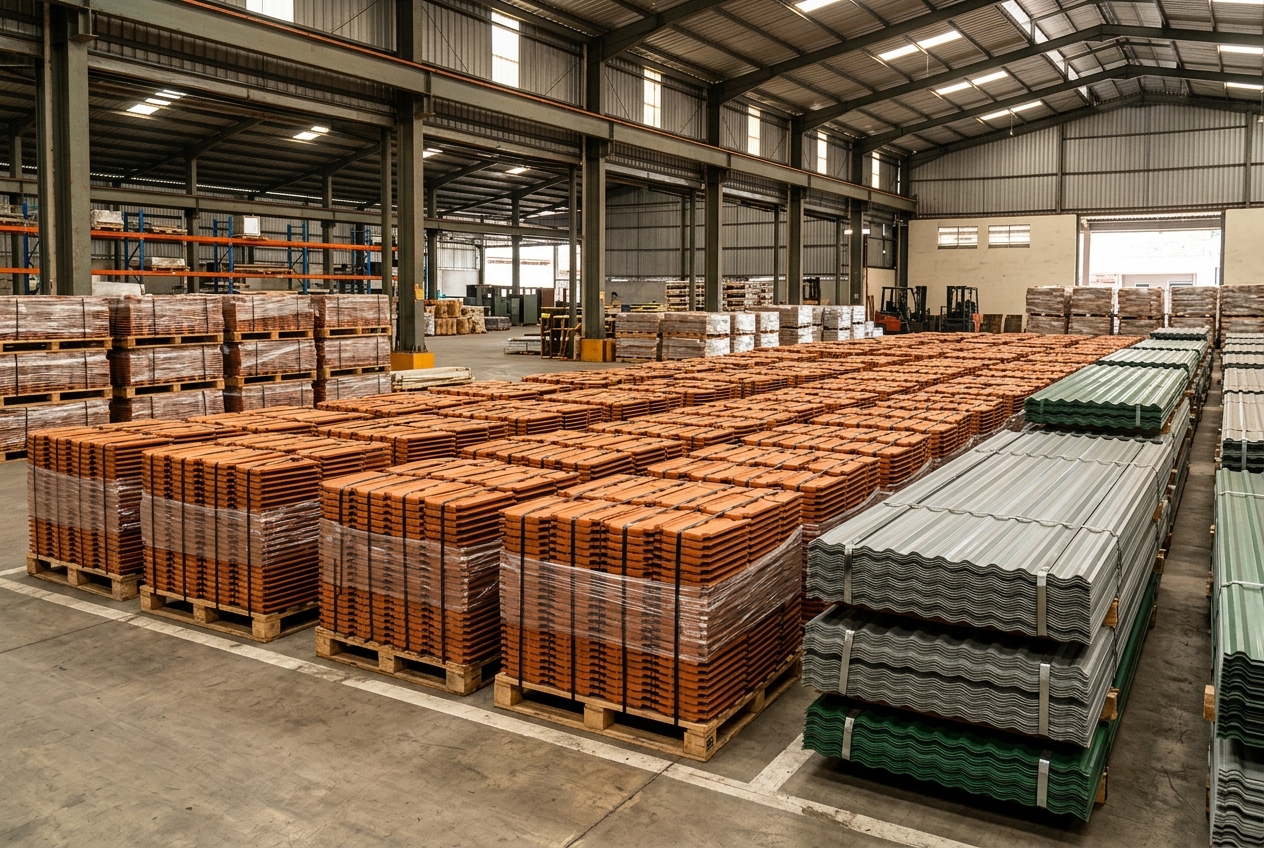
US construction buyers and importers face a specific problem when evaluating Indonesian roofing materials: the sourcing landscape is fragmented, pricing benchmarks are scarce, and US-specific customs requirements are rarely documented in one place. Indonesia manufactures a wide range of roof tile…
US construction buyers and importers face a specific problem when evaluating Indonesian roofing materials: the sourcing landscape is fragmented, pricing benchmarks are scarce, and US-specific customs requirements are rarely documented in one place. Indonesia manufactures a wide range of roof tile and metal roofing products — clay, concrete, galvanized steel, and emerging composites — at price points that compete directly with China, Vietnam, and Malaysia.
This guide covers what US buyers need to make a sourcing decision. You will find product type breakdowns, SNI and ASTM certification requirements, HS codes, US import duties, FOB price benchmarks, MOQ ranges, and port logistics from Tanjung Priok and Tanjung Perak to US destinations. It also covers how to vet exporters and structure the sourcing process from first contact through customs clearance.
Indonesia's roofing manufacturing base is concentrated in Java and Sumatra, with production clusters around Surabaya, Semarang, and Medan. Exporters range from large integrated manufacturers to merchant exporters who consolidate product from smaller factories. Understanding that distinction before you issue an RFQ will save significant time and reduce contract risk.
Why Indonesia Is a Competitive Source for Roofing Materials Export
Indonesia is among Southeast Asia's largest producers of ceramic and concrete roof tiles. The country's manufacturing base benefits from abundant raw materials — high-quality clay deposits, limestone aggregates, and domestic steel production — alongside lower labor costs than China or Malaysia.
According to World Bank WITS data, Indonesia exported approximately $410,000 worth of ceramic roofing tiles in 2023, representing around 1.7 million kilograms in volume. These figures reflect official HS Code 6905 classifications. Actual export volumes across all roofing categories — including metal panels and concrete tiles classified under different HS codes — are substantially larger.
Production Hubs and Industrial Zones
Key manufacturing clusters include:
- Central Java (Surakarta, Klaten, Sragen): Traditional clay and ceramic roof tile production with multi-generational craft heritage - East Java (Surabaya, Gresik): Concrete tile manufacturers and galvanized metal roofing panel producers - Sumatra (Medan, Deli Serdang): Steel and metal roofing panel mills serving regional and export markets - West Java (Karawang, Bekasi): Industrial zone manufacturers producing higher-volume concrete and composite tiles
Cost Competitiveness vs. Other Asian Sources
| Country | Relative FOB Cost | Quality Consistency | Lead Time (typical) |
|---|---|---|---|
| Indonesia | Low–Medium | Medium–High | 30–60 days |
| China | Low | High (industrial) | 25–45 days |
| Vietnam | Low–Medium | Medium | 35–55 days |
| Malaysia | Medium–High | High | 20–40 days |
Cost and lead time figures above are typical industry ranges and vary by season, route, and supplier. Indonesia's clay tile heritage and raw material access give it a structural cost advantage in traditional roofing categories. For metal roofing, Chinese and Vietnamese producers are often more price-competitive on thinner gauge products. Indonesian manufacturers differentiate on natural clay quality, custom glazing, and SNI-compliant production standards.
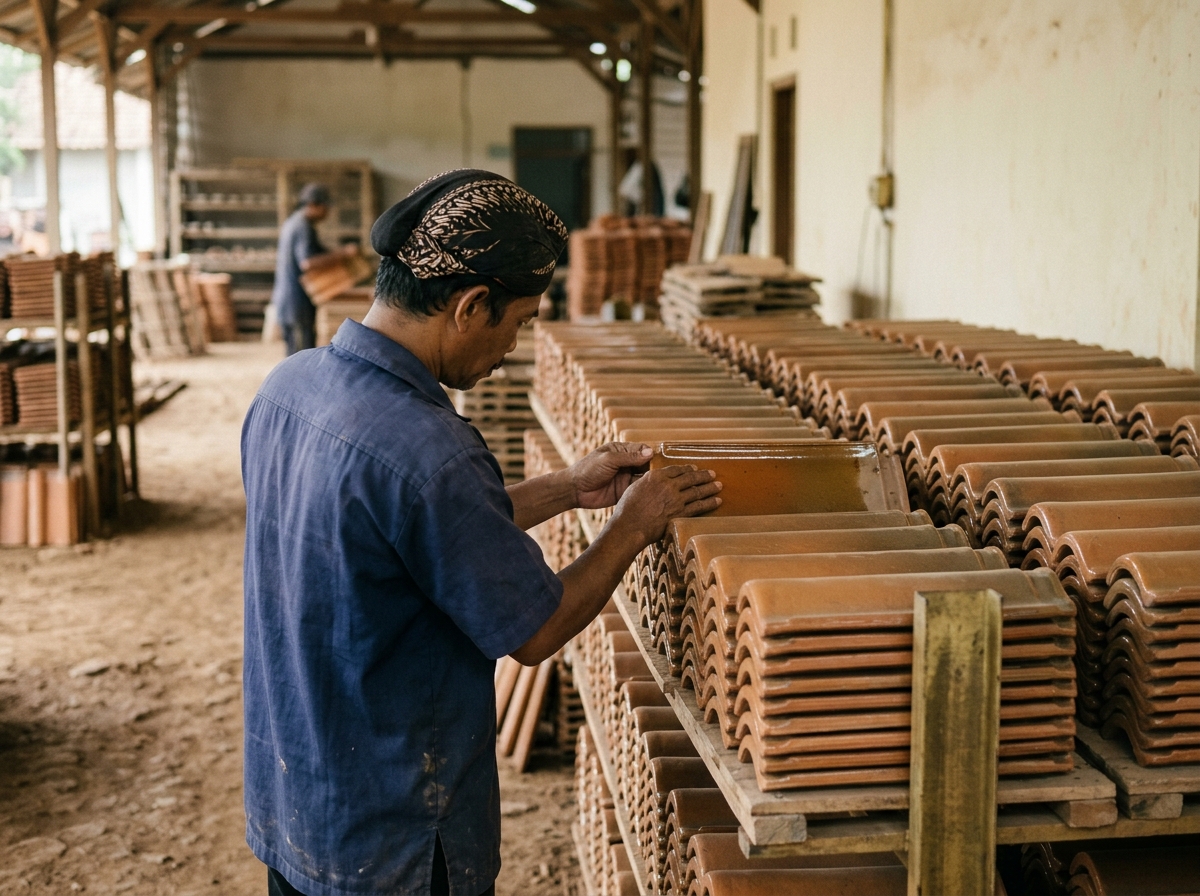
Main Types of Indonesian Roofing Materials Available for Export
Traditional Clay and Ceramic Roof Tiles
Clay tiles are Indonesia's most recognized roofing export. Central Java producers make both mortar-ridge and interlocking variants. Finishes include natural terracotta, glazed, and slip-coated. Standard dimensions run approximately 330mm × 210mm, though custom profiles are available.
These tiles carry authentic material properties: thermal mass, longevity of 50+ years under proper installation, and natural aesthetics valued in US architectural and restoration projects. They are heavier than concrete or metal alternatives — typically 2.5–4.0 kg per tile — which affects freight calculations.
Concrete Roof Tiles
Indonesian concrete tiles use Portland cement and aggregate mixes. They are heavier than clay equivalents (approximately 3.5–5.0 kg per tile), offer greater dimensional consistency, and cost less per unit at scale. Major producers in East Java operate automated production lines capable of high volumes.
Concrete tiles suit cost-sensitive US residential projects where the visual profile of a tile roof is desired without the premium of genuine clay.
Metal Roofing Panels
Indonesian manufacturers produce:
- Galvanized steel panels (G550 or similar): Corrugated and standing-seam profiles - Zincalume / Colorbond-equivalent coated steel: Pre-painted with polyester or PVDF coatings - Aluminum roofing sheets: Lighter weight, suited for coastal or corrosive environments
Manufacturers such as PT Manunggal Multidaya operate in this segment. Metal roofing exports move under different HS codes than clay tiles and face distinct tariff classifications in the US.
Emerging Lightweight and Composite Tiles
A small but growing segment produces fiber-cement, biomass-composite, and lightweight synthetic tiles. These are engineered for earthquake-prone construction — relevant given Indonesia's own seismic context. Weight per tile can be under 1.0 kg. US buyers sourcing for markets with seismic codes (California, Pacific Northwest) should request specific load and impact test data for these products.
Key Product Standards and Certifications US Buyers Must Verify
SNI — Indonesia's National Standard for Roofing
SNI (Standar Nasional Indonesia) is the mandatory certification framework for roofing products sold domestically and exported from Indonesia. Relevant standards include:
- SNI 03-0096: Ceramic roof tiles — covers dimensions, water absorption (maximum 13% for most categories), and flexural strength - SNI 03-2445: Concrete roof tiles — dimensional tolerances, load-bearing capacity - Metal roofing panels reference SNI standards for coated steel substrates
Always request the SNI test report, not just a certificate number. The report should show actual test results, the accredited lab name, and the test date.
ASTM and ISO Equivalency for US Market Acceptance
US building codes generally reference ASTM standards. Key equivalencies to check:
- ASTM C1167: Standard for clay roof tiles — covers physical properties including water absorption and flexural strength - ASTM C1492: Concrete roof tiles - ASTM A792 / A653: Coated steel sheet for metal roofing
Not all Indonesian manufacturers test to ASTM standards. Some larger exporters maintain dual certification (SNI + ASTM-equivalent testing). Ask explicitly whether the factory has conducted ASTM-referenced testing, or budget for independent lab testing on receipt samples.
ISO 9001 certification signals process quality management. It does not replace product-specific standards but is a meaningful supplier vetting signal.
Documentation to Request Before Committing
- ✓SNI test report with actual results (not just certificate)
- ✓ASTM-equivalent test data if available
- ✓ISO 9001 certificate (check expiry date)
- ✓Factory audit report from a recognized third-party inspector
- ✓Certificate of Origin (Form E or general CO for US)
- ✓Commercial invoice and packing list templates
- ✓Product datasheet with dimensional tolerances and weight per unit
HS Codes, US Import Duties, and Customs Requirements for Indonesian Roofing
Relevant HS Codes
| Product Type | HS Code | Description |
|---|---|---|
| Ceramic / clay roof tiles | 6905.10 | Roofing tiles of ceramic materials |
| Concrete roof tiles | 6810.19 | Articles of cement/concrete — tiles |
| Corrugated steel roofing | 7210.61 / 7210.69 | Flat-rolled steel, clad/coated |
| Aluminum roofing sheet | 7606.12 | Aluminum alloy sheet |
Confirm the final HS classification with your US customs broker. Classification at the 8- or 10-digit HTS level determines the exact duty rate.
US Import Duties on Indonesian Roofing Products
Indonesia is eligible for the US Generalized System of Preferences (GSP) on many product categories. However, GSP benefits have been subject to periodic Congressional renewal gaps. Verify current GSP status with USTR or your customs broker at the time of import.
Approximate MFN (Most Favored Nation) duty rates under the current US HTS schedule:
- Ceramic roof tiles (HTS 6905.10): approximately 12.5% - Concrete tile articles (HTS 6810): typically 0%–4.9% depending on sub-classification - Coated steel flat-rolled (HTS 7210): Section 232 steel tariffs may apply — currently 25% for most steel imports; Indonesia has not secured a quota exemption comparable to those granted to South Korea or Australia. Confirm current status before finalizing cost calculations. - Aluminum sheet (HTS 7606): Section 232 aluminum tariffs of 10% may apply
Anti-Dumping Considerations
As of the time of writing, there are no active US anti-dumping or countervailing duty orders specifically targeting Indonesian ceramic or concrete roofing tiles. This contrasts with Chinese ceramic tile products, which have faced dumping investigations. This gives Indonesian exporters a meaningful compliance advantage for US-bound shipments.
Required Import Documentation
- Commercial invoice (stating unit price, quantity, country of origin, HS code) - Packing list (gross and net weights, carton dimensions, number of pallets) - Certificate of Origin (for GSP claims, use Form A; otherwise, general CO) - Bill of Lading (ocean) or Air Waybill - Phytosanitary certificate if wooden packaging is used (ISPM-15 compliance required)
MOQ, Lead Times, and FOB Price Benchmarks by Product Type
This is the data most sourcing guides omit. The table below reflects approximate market ranges based on typical Indonesian export conditions. Treat these as starting benchmarks — actual quotes will vary by specification, factory scale, and order history.
| Product Type | Typical MOQ | Approx. FOB Price (USD/m²) | Standard Lead Time | Custom Order Lead Time |
|---|---|---|---|---|
| Clay / ceramic roof tiles | 5,000–10,000 tiles (~50–100 m²) | $8–$18/m² | 30–45 days | 45–70 days |
| Concrete roof tiles | 1,000 m² | $5–$12/m² | 25–40 days | 40–60 days |
| Galvanized steel panels | 500–1,000 m² | $4–$9/m² | 20–35 days | 35–50 days |
| Colorbond-type coated steel | 500 m² | $7–$14/m² | 25–40 days | 40–55 days |
| Lightweight composite tiles | 200–500 m² | $10–$22/m² | 35–50 days | 50–75 days |
FOB prices above are indicative for Surabaya (Tanjung Perak) or Jakarta (Tanjung Priok) loading. Freight, insurance, and US duty are additive.
Volume Pricing and Freight Consolidation
Order volume significantly affects unit cost. Clay tile manufacturers typically offer 8–15% price reductions between minimum order and full 20-foot container volume. A standard 20-foot container holds approximately 8,000–10,000 standard clay tiles (weight-limited). Concrete tiles are heavier — a 20-foot container may carry only 6,000–7,500 tiles before hitting the weight limit.
LCL (less-than-container load) shipments are possible but add approximately $200–$600 to freight costs and extend transit time by 5–10 days due to consolidation handling.
Shipping Routes, Port Logistics, and Freight Options from Indonesia to the US
Main Export Ports
- Tanjung Priok (Jakarta): Indonesia's largest port. Handles the majority of Java-produced roofing exports. Direct services to US West Coast (Los Angeles, Long Beach) and transhipment to East Coast. - Tanjung Perak (Surabaya): Primary port for East Java manufacturers. Strong container liner connectivity. Often preferred by Surabaya-based concrete tile and metal roofing producers. - Belawan (Medan, North Sumatra): Serves Sumatra-based steel roofing and composite tile manufacturers. Fewer direct US services — most cargo tranships via Singapore or Port Klang.
Transit Times to US Ports
| Indonesian Port | US Destination | Approx. Typical Transit Time |
|---|---|---|
| Tanjung Priok / Tanjung Perak | Los Angeles / Long Beach | 18–24 days |
| Tanjung Priok / Tanjung Perak | Seattle / Tacoma | 20–26 days |
| Tanjung Priok | New York / Savannah (via Suez) | 30–40 days |
| Belawan (via Singapore) | Los Angeles | 22–28 days |
FCL vs. LCL for Roofing Materials
FCL (full container load) is strongly preferred for clay and concrete tiles. These are dense, fragile, or both. LCL handling increases breakage risk at consolidation warehouses. For metal roofing panels, LCL is more viable — panels are robust and can survive repacking.
Packaging Standards to Prevent Breakage
Additional packaging specifications to include in your purchase order:
- Tiles wrapped in kraft paper or polyethylene film, face-to-face - Wooden pallets heat-treated (HT-stamped) for ISPM-15 compliance - Carton / crate gross weight not exceeding 25 kg for manual handling at destination - Desiccant sachets inside container for moisture-sensitive glazed tiles
How to Vet and Select a Reliable Indonesian Roofing Exporter
Industry Associations and Trade Directories
Start with APINDO (Asosiasi Pengusaha Indonesia) and KADIN (Kamar Dagang dan Industri Indonesia) member directories. Both publish registered manufacturer lists. Indonesian Ministry of Trade export records are also publicly accessible for verification purposes.
Green Flags vs. Red Flags
| Green Flags | Red Flags |
|---|---|
| NIB (Nomor Induk Berusaha) business registration visible | No verifiable Indonesian business registration |
| SNI test reports from accredited labs (BSN-recognized) | Certificate only, no underlying test data |
| ISO 9001 certificate current and from accredited CB | ISO claimed but certificate expired or unverifiable |
| Shipment history verifiable on ImportGenius or Panjiva | No traceable export records in customs databases |
| Welcomes DUPRO inspection before container sealing | Refuses third-party inspection access |
| Factory address matches business registration | Factory address differs from registered address |
| Reference buyers willing to be contacted | No reference list provided |
Third-Party Inspection
Use SGS, Bureau Veritas, or Intertek for pre-shipment inspections in Indonesia. A standard pre-shipment inspection (PSI) costs approximately $300–$600 per man-day and covers quantity verification, visual inspection, and random sample testing. For ceramic tiles, request water absorption and flexural strength spot checks if the factory has not provided recent ASTM or SNI test data.
Request a factory audit separately from a pre-shipment inspection. An audit evaluates production capacity, QC processes, and documentation systems — not just the finished goods.
Step-by-Step Sourcing Process for US Buyers Importing Indonesian Roofing
Step 1: Define Specifications, Volume, and Budget Before Contacting Suppliers
Before issuing a single RFQ, document:
- Product type (clay, concrete, metal — specific profile) - Required dimensions and color/finish - SNI or ASTM compliance requirements - Target volume (m² or number of tiles) and delivery date - Maximum landed cost per m² including US duty and freight
Suppliers who receive a detailed spec sheet respond faster and quote more accurately. Vague inquiries attract trader responses, not manufacturer quotes.
Step 2: Request Samples and Certifications Before Committing
Request physical samples (5–10 tiles minimum) before placing an order. Evaluate:
- Surface finish consistency - Weight per tile (compare to spec sheet) - Edge chipping or surface cracks - Water absorption (pour water on unglazed surface, observe absorption rate)
Cross-reference with SNI test reports provided. If reports are older than 24 months, request current data or commission independent testing.
Step 3: Negotiate Incoterms and Payment Terms
For US buyers with limited Indonesia experience, CIF (Cost, Insurance, Freight) to a US port reduces logistics complexity on the Indonesia side. More experienced importers use FOB Tanjung Priok or FOB Tanjung Perak, which gives better freight rate control through their own forwarder.
Standard payment terms from Indonesian exporters typically follow this structure:
- roughly 30% T/T deposit on order confirmation - roughly 70% T/T against copy of Bill of Lading
For large orders, negotiate a Letter of Credit (LC) to reduce payment risk. LC adds 1–2% to total transaction cost but provides documentary protection.
Step 4: Arrange Inspection, Freight Forwarding, and US Customs Clearance
- ✓Book third-party pre-shipment inspection 2 weeks before estimated production completion
- ✓Confirm ISPM-15 compliant wooden packaging with the exporter
- ✓Engage a US customs broker to classify product at the 10-digit HTS level
- ✓Verify current GSP status for the specific HTS code
- ✓Arrange marine cargo insurance (minimum CIF value + 10%)
- ✓Confirm US destination port and drayage to final delivery point
- ✓File ISF (Importer Security Filing) 24 hours before vessel departure from Indonesia
Frequently Asked Questions: Indonesian Roofing Materials Export
Who is the largest global supplier of roofing materials, and where does Indonesia rank?
China is the world's largest exporter of roofing materials by volume and value across most categories. Indonesia ranks among the top 10 in ceramic roof tiles within the Asia-Pacific region, with recognized export volume in HS 6905 categories. Indonesia's competitive advantage is in traditional clay tiles and natural-material roofing rather than mass-volume industrial production.
What are the main export opportunities for roofing materials from Indonesia?
The strongest export opportunities lie in: (1) glazed and unglazed clay roof tiles for architectural and heritage restoration projects, (2) concrete roof tiles for cost-competitive residential construction markets, and (3) galvanized and coated metal roofing panels for industrial and agricultural applications. Emerging lightweight composite tiles present a growing niche for seismic-zone construction markets.
Where is most roofing material manufactured globally, and what share comes from Southeast Asia?
China accounts for the largest share of global roofing material production. Southeast Asia — including Indonesia, Vietnam, and Malaysia — represents a meaningful and growing share of ceramic and metal roofing exports, particularly for markets seeking supply chain diversification away from China. Exact regional share figures vary by product category and are not consistently reported in a single public dataset.
What are the top five roofing materials exported by Indonesian manufacturers?
Based on export classification patterns: (1) glazed ceramic clay tiles, (2) unglazed traditional clay tiles, (3) concrete roof tiles, (4) galvanized corrugated steel panels, and (5) pre-painted (Colorbond-equivalent) steel roofing sheets. Fiber-cement and composite tiles are an emerging sixth category.
What is the typical FOB price per square meter for Indonesian clay or concrete roof tiles?
Indonesian clay tile export prices typically range from approximately $8 to $18 per m² FOB Surabaya or Jakarta, depending on tile profile, glaze finish, and order volume. Concrete tiles range from approximately $5 to $12 per m² FOB. These are indicative benchmarks — actual pricing depends on specification, factory, and volume.
What certifications should US buyers require from Indonesian roofing exporters?
At minimum: SNI test reports with actual test data (not just certificate numbers), ISO 9001 certification from an accredited certification body, and a verifiable Certificate of Origin. For structural applications, request ASTM-equivalent test data or commission independent testing. For metal roofing, request substrate specification sheets confirming coating type, thickness, and corrosion resistance ratings.
Indonesian roofing materials offer US buyers genuine cost and product advantages, particularly in clay and concrete tiles. Buyers must approach sourcing with specification clarity and verify certifications beyond the surface level. Accurate accounting for US duties, including Section 232 tariffs on metal products, is essential. The logistics path from Tanjung Priok or Tanjung Perak to US ports is well-established and manageable with the right customs broker and freight forwarder in place.
You now have the product categories, standards framework, HS codes, duty rates, MOQ benchmarks, and vetting criteria needed to evaluate Indonesian roofing suppliers with confidence. The logical next step is putting verified exporters in competition for your specific project requirements.
You have the specifications and sourcing framework — now connect with Indonesian roofing manufacturers who can meet them. Request a free quote from verified exporters across clay tiles, concrete tiles, and metal roofing panels today.
Request a Free Quote →Need eyes on the ground in Indonesia?
MTS is an execution partner — supplier verification, manufacturing management, quality control and export logistics across Indonesia, Vietnam and China.
Related services
Related articles
Receive furniture sourcing insights across Asia.
One email per week. No spam.