Pool Deck Timber Suppliers Indonesia: The Resort Procurement Guide for Hardwood Species, Compliance, and Combined Orders
13 min read
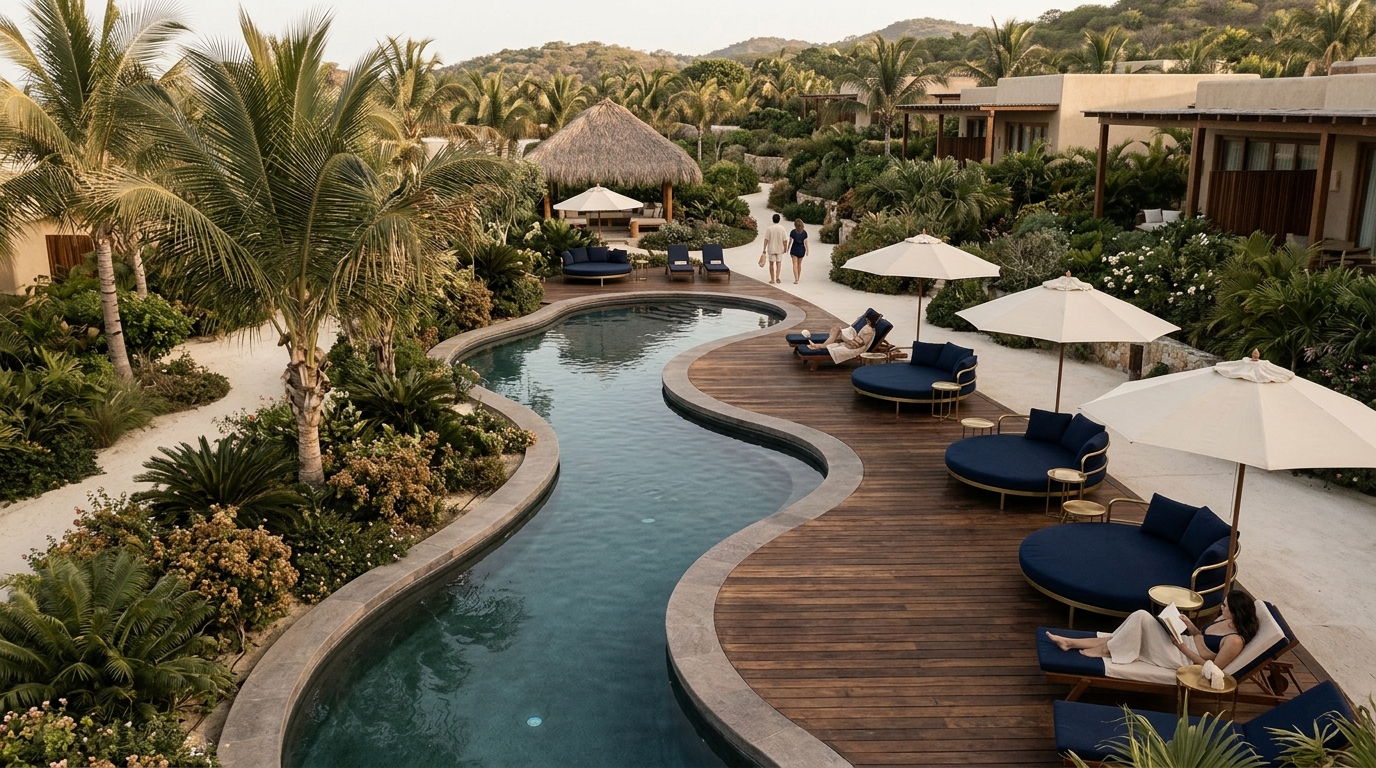
Resort developers and landscape architects sourcing pool deck materials face a specific set of pressures. Species must resist chlorine, UV, and moisture cycling. Surfaces must meet anti-slip standards for barefoot safety. Fastener systems must survive poolside corrosion. And the entire order must…
Resort developers and landscape architects sourcing pool deck materials face a specific set of pressures. Species must resist chlorine, UV, and moisture cycling. Surfaces must meet anti-slip standards for barefoot safety. Fastener systems must survive poolside corrosion. And the entire order must land on-site in sync with pool stone, coping, and paving. Getting any one of these wrong adds cost, delays, or liability.
Indonesian hardwood satisfies more of these criteria simultaneously than most alternatives. The country's supply clusters in Kalimantan, Bali, Java, and Sulawesi produce species with naturally high oil content, exceptional density, and documented performance in wet environments. Pool deck timber suppliers Indonesia resorts rely on have decades of export experience shipping to the Middle East, Southeast Asia, and the Americas. This guide gives US-based buyers the specification language, compliance checklist, and procurement logic to source confidently.
The sections below cover species performance data, anti-slip surface profiles, fastener corrosion specifications, maintenance cycles, sustainability certifications, and the combined stone-and-timber FCL strategy that most competitors overlook entirely. Whether you are writing a procurement spec or evaluating supplier quotes, every section is structured around decisions, not descriptions.
Why Indonesian Hardwood Dominates Resort Pool Deck Sourcing Globally
Biodiversity Producing Commercially Viable Hardwoods
Indonesia sits within one of the world's most species-rich timber zones. The archipelago's tropical forests yield hardwood species with natural oil content, interlocked grain structures, and Janka hardness ratings that outperform plantation timber from most other regions. For pool deck applications, those properties translate directly into durability, dimensional stability under moisture cycling, and reduced maintenance cost over a 25-year asset life.
Key supply clusters for resort-grade decking timber include:
- Kalimantan: Primary source for ulin (ironwood) and bengkirai. The region supplies both reclaimed and new-growth stock through established merchant exporters. - Java (Jepara, Semarang, Surabaya): The industrial core for processed teak decking, kiln-dried boards, and custom milled profiles. - Bali: Artisan-grade processing and reclaimedhardwood decking. Strong positioning for luxury resort projects with sustainability narratives. - Sulawesi: Secondary source for merbau and mixed hardwoods, often routed through Surabaya for container consolidation.
Cost-Per-Performance Against Composite and Australian Alternatives
Composite decking is often specified for low maintenance, but it carries higher surface heat absorption, lower aesthetic value at resort price points, and no natural anti-slip grain texture. Australian hardwood species such as spotted gum or ironbark are high-performing but carry significantly higher FOB costs than equivalent Indonesian grades. Pool deck timber suppliers Indonesia resorts use can offer kiln-dried, anti-slip profiled boards at a cost-per-square-meter that supports large-footprint projects without compromising specification.
Top Timber Species for Pool Decks in Chlorinated and Saltwater Environments
Species Profiles: What the Chemistry and Density Data Show
Ulin — Eusideroxylon zwageri (Ironwood) Ulin is the benchmark species for extreme wet environments. Its density is typically above 1,000 kg/m³, meaning it sinks in water — a reliable indicator of the cellular compression that resists moisture ingress. Ulin contains naturally occurring tannins and silica compounds that create measurable resistance to chlorine degradation. In long-term poolside installations across Southeast Asia, ulin decking shows minimal surface checking even after years of chemical exposure. Reclaimed ulin, salvaged from historical structures in Kalimantan, is denser and more dimensionally stable than new-growth material because the cellular structure has already completed its compression cycle over decades.
Teak — Tectona grandis Teak's natural silica and oil content give it excellent dimensional stability around pools. The silica content creates a naturally abrasive surface texture that contributes to anti-slip performance without profiling. Teak performs well under UV exposure and resists fungal decay in consistently humid environments. It is the most internationally recognised Indonesian export timber and benefits from deep buyer familiarity. Pool deck timber suppliers Indonesia resorts export most frequently ship teak from Java's processing clusters in Jepara and Semarang.
Bengkirai — Shorea laevis (Yellow Balau) Bengkirai is a high-density species commonly specified for large-area resort decking where cost management matters. Its surface density provides natural slip resistance, and its tight grain resists water absorption. Bengkirai is less oily than teak but performs reliably in chlorinated environments. It is the standard choice for large hotel pool decks where installed area exceeds several hundred square meters.
Merbau — Intsia bijuga Merbau's interlocked grain makes it highly resistant to splitting and cupping under moisture cycling — a critical performance trait for pool decks that wet and dry repeatedly. It contains natural oils with antifungal properties. The species does release tannin-based extractives when first wetted, which can temporarily stain light-coloured pool coping. This is manageable with correct pre-installation washing and is not a structural concern.
Side-by-Side Species Performance Comparison
| Species | Janka Hardness (approx.) | Natural Oil Content | Chlorine Resistance | Typical Re-oil Interval | Surface Heat (High UV) |
|---|---|---|---|---|---|
| Ulin (Ironwood) | ~3,500 lbf | Very High | Excellent | 24–36 months | Moderate-High |
| Teak | ~1,155 lbf | High | Very Good | 12–18 months | Moderate |
| Bengkirai | ~1,600 lbf | Low-Medium | Good | 12–24 months | High |
| Merbau | ~1,925 lbf | High | Very Good | 18–24 months | Moderate-High |
Anti-Slip Surface Profiles and Groove Configurations for Resort Pool Decks
Resort pools require anti-slip timber decking profiles that perform when wet barefoot traffic is constant. Indonesian mills offer three primary surface configurations.
Standard, Fine-Grooved, and Brushed Profiles
- Standard grooved: Two to four parallel grooves per board face, typically 2–4 mm wide and 1.5–2 mm deep. Adequate drainage. Common for covered pool terraces. - Fine-grooved (ribbed): Closer groove spacing — often 5–8 grooves per 90 mm board face. Higher slip resistance rating. Preferred for exposed pool surrounds with direct splash zones. - Brushed/wire-brushed: Mechanical texturing raises the grain without cutting grooves. Maintains a natural timber appearance. Performance rating depends on species grain density.
Pendulum Test Standards and R-Value Targets
For resort pool deck applications, specify a minimum pendulum test value (PTV) of 36+ when wet, which is broadly equivalent to an R11 classification under European ramp test standards. Most Indonesian exporters can supply groove profiles that achieve this when correctly specified. Request test documentation from the mill — not from the trading company — before approving a sample.
Groove Depth, Drainage Rate, and Barefoot Comfort
Deeper grooves (2+ mm) drain faster but create more barefoot discomfort under extended use. Fine grooves at shallower depth (1–1.5 mm) balance drainage with comfort for resort guests. Custom profile capabilities exist at mid-to-large Indonesian mills. Minimum order quantities for custom profiles are typically one full container load — approximately 20–25 m³ of processed boards.
Fastener Systems That Resist Chlorination, Salt Exposure, and Tropical Humidity
304 vs. 316 Stainless Steel: The Specification That Matters
Standard 304-grade stainless steel fasteners corrode measurably faster in pool environments. Chlorine ions attack the passive oxide layer that makes stainless steel corrosion-resistant. In poolside applications, 316-grade (marine-grade) stainless steel is the minimum acceptable specification. The molybdenum content in 316 creates measurably better resistance to chloride-induced pitting.
Hidden Clip Systems vs. Face-Screw Configurations
| Configuration | Corrosion Exposure | Aesthetic | Replacement Cost | Notes |
|---|---|---|---|---|
| Hidden clip (T-clip / end-clip) | Low (concealed) | Clean | Higher initial | Requires pre-grooved boards |
| Face screw (countersunk) | High (exposed) | Visible | Lower initial | Requires plugging for resort spec |
| Grooved clip + plug | Medium | Clean | Medium | Best balance for resort use |
Hidden clip systems keep all fastener metal below the board surface and out of direct chemical contact. Most leading Indonesian exporters offer pre-grooved boards and matching clip packages as a bundled supply. Specify this in the order to avoid sourcing clips locally at the destination port — local marine-grade hardware availability varies significantly by project location.
Maintenance Cycles for Indonesian Hardwood Pool Decks in Resort Operations
Silvering, UV Exposure, and Chemical Ageing
Untreated teak silvers to a grey patina within approximately 6–12 months under direct UV exposure. Some resort operators accept this as an aesthetic outcome. Others maintain the original honey-brown tone with periodic oiling. Ulin silvers more slowly due to its higher natural oil density — the process typically takes 12–18 months under equivalent UV conditions.
Chlorine exposure accelerates surface oxidation on all species. Oiled finishes slow this process by creating a partial barrier. However, pool chemicals degrade oil finishes faster than standard outdoor UV alone. Maintenance intervals around pools should be reduced relative to covered terrace applications.
Recommended Cleaning and Re-Oiling Schedule by Species
- Teak: Clean every 3 months with a pH-neutral timber cleaner.Re-oil every 12– approximately 18 months. Light sanding (120 grit) before re-oiling restores surface porosity. - Ulin: Clean every 3–6 months.Re-oil every 24– approximately 36 months. Surface hardness means less oil absorption — over-oiling creates surface residue. - Bengkirai: Clean every 3 months.Re-oil every 12– approximately 24 months depending on UV exposure. - Merbau: Clean every 3 months.Re-oil every 18– approximately 24 months. Monitor extractive bleed around pool coping after initial wetting seasons.
Resort maintenance teams operating in tropical climates can extend deck lifespan beyond approximately 25 years with consistent cleaning, correct fastener specification, and board replacement programs targeting high-traffic zones first.
Reclaimed vs. New-Growth Timber: Sustainability, Performance, and Lead Times
Why Reclaimed Ulin Outperforms New-Growth Structurally
Reclaimed ulin salvaged from jetties, bridges, and colonial-era structures in Kalimantan is typically older-growth timber with higher cellular density than new-growth alternatives. Its dimensional movement under moisture cycling is lower because it has already stabilised over decades. For pool deck applications, this translates to fewer gaps forming between boards during seasonal humidity variation.
SVLK, FSC, and FLEGT: What US Buyers Must Understand
Indonesia operates the SVLK — Sistem Verifikasi Legalitas Kayu — the national timber legality assurance system. SVLK verification is mandatory for Indonesian timber exports and forms the basis of Indonesia's FLEGT License, which is recognised under EU timber regulations. For US buyers, SVLK and FLEGT documentation demonstrates legal chain of custody and reduces Lacey Act compliance risk.
- ✓SVLK certificate (current, facility-level)
- ✓FSC Chain of Custody certificate (if FSC-labelled timber is specified)
- ✓FLEGT License (for EU-equivalent compliance assurance)
- ✓Export health certificate and phytosanitary clearance
- ✓Kiln-drying certificate with moisture content reading
- ✓Pre-shipment inspection report from independent third party
FSC certification is available from a subset of Indonesian suppliers — primarily larger, vertically integrated operations. Smaller mills and merchant exporters often hold SVLK only. For resort ESG reporting, FSC-certified reclaimed hardwood decking from Bali or Java carries the highest narrative value.
Lead Times: Reclaimed vs. Kiln-Dried New Stock
- Reclaimed ulin/hardwood: Stock availability is variable. Lead times range from approximately 8–16 weeks depending on drying requirements and stock position. - Kiln-dried new-growth teak or bengkirai: More predictable availability. Typically 6–10 weeks from order confirmation to container loading.
Coordinating Pool Deck Timber and Pool Stone Orders from a Single Indonesian Supplier
The FCL Consolidation Advantage
Shipping pool deck timber and pool stone — andesite, lava stone, or limestone coping — in a single full container load (FCL) from Indonesia reduces per-unit freight cost, simplifies customs documentation, and aligns delivery timing. This is the combined pool stone and timber order strategy that pool deck timber suppliers Indonesia resorts increasingly offer, yet it is almost entirely absent from competitor sourcing guides.
A standard 20-foot container can carry approximately 20–25 m³ of processed hardwood decking plus a significant volume of stone coping tiles. A 40-foot HC container increases capacity proportionally and is the standard unit for large resort orders.
Matching Stone and Timber Aesthetics
Indonesian volcanic stone — particularly grey andesite and charcoal lava stone — pairs naturally with the warm tones of teak and the darker profiles of ulin. Specifying both from the same regional supplier allows tone-matching against physical samples before production. Bali-based suppliers and Surabaya-based merchant exporters are most likely to carry dual-category catalogues covering both hardwood decking and natural stone.
Supplier Types for Combined Orders
| Supplier Type | Timber | Stone | FCL Consolidation | Audit Feasibility |
|---|---|---|---|---|
| Vertically integrated manufacturer | Yes | Rarely | Yes (own logistics) | High |
| Merchant exporter / trading company | Yes | Often | Yes | Medium |
| Sourcing agent | Yes | Yes | Yes | Variable |
Vetting Pool Deck Timber Suppliers in Indonesia: What Resort Buyers Must Check
Export Certification and Legal Compliance
Before issuing a purchase order to any pool deck timber suppliers Indonesia resorts or international projects rely on, verify the following:
- SVLK facility-level certificate: Confirms the specific mill is licensed, not just the exporting entity. - FSC Chain of Custody: Required if your specification calls for FSC-labelled timber. - FLEGT License: Accompanies shipments and confirms SVLK compliance at the export stage.
MOQ, Moisture Content, and Container Specifications
- Minimum order quantities for resort-grade decking typically start at one FCL — approximately 20–25 m³ processed volume. - Export moisture content for kiln-dried pool deck boards should be in the range of approximately 12–18%. Request a kiln-drying certificate and an independent moisture reading on arrival. - Container loading specs: confirm board lengths, packaging (typically banded bundles with dunnage), and whether end-coating is applied to prevent checking during transit.
Quality Assurance Process
- Factory audit: Commission an independent third-party audit before the first order. Online certifications do not substitute for physical verification. - Sample approval: Require a physical sample board showing the exact species, surface profile, and moisture content before approving production. Approve in writing. - Pre-shipment inspection (PSI): Use an independent inspection agency to verify board count, dimensions, moisture content, and packaging before the container is sealed.
Payment Terms and Incoterms Options
| Incoterm | Risk Transfer | Freight Responsibility | Common Use Case |
|---|---|---|---|
| FOB Surabaya / Bali | At ship's rail | Buyer arranges freight | Buyers with established freight forwarders |
| CIF Destination Port | At destination | Seller arranges freight | First-time importers or smaller orders |
| EXW Factory | At factory gate | Buyer arranges all | Buyers using own consolidators |
Typical payment terms with verified Indonesian exporters range from approximately 30% deposit on order confirmation to 70% against bill of lading. Letters of credit are accepted by larger exporters. Smaller mills often require T/T only.
Frequently Asked Questions from Resort Procurement Teams
Which Indonesian hardwood species is best for pool deck areas with heavy chlorine exposure? Ulin (Eusideroxylon zwageri) is the strongest performer under sustained chlorine exposure. Its density and natural silica content resist chemical degradation more effectively than other Indonesian species. Merbau and teak are strong secondary choices with verified long-term pool deck track records.
What anti-slip rating should pool deck timber meet for resort safety compliance? Target a minimum pendulum test value (PTV) of 36 when wet. This broadly corresponds to an R11 classification. Specify this in your purchase order and request test documentation linked to the exact groove profile being supplied.
Is reclaimed ulin ironwood legal to export from Indonesia? Yes, provided the exporting mill holds a valid SVLK certificate covering reclaimed timber categories and the shipment is accompanied by correct export documentation. Verify the SVLK scope covers reclaimed material specifically — not all facility certificates do.
How often does Indonesian teak decking need to be re-oiled around a pool? Approximately every 12–18 months under direct UV and pool chemical exposure. Installations in covered areas or lower UV environments may extend to 24 months. Clean with a pH-neutral cleaner and lightly sand before each re-oil application.
Can I order pool deck timber and pool stone coping together from a single Indonesian supplier? Yes. Merchant exporters and some vertically integrated manufacturers in Bali and Surabaya carry dual-category catalogues. Combined FCL shipments reduce freight cost and simplify delivery scheduling. Confirm that both production timelines align before booking freight.
What moisture content should kiln-dried pool deck boards have for export to the United States? Approximately 12–18% is the standard export range for kiln-dried Indonesian hardwood. Request a kiln-drying certificate from the mill and consider commissioning an independent moisture reading on arrival, particularly for species prone to checking such as bengkirai.
Specifying pool deck timber for a resort project is a procurement exercise with measurable consequences. Species choice affects maintenance cost over approximately 25 years. Fastener grade affects warranty liability. Certification gaps affect Lacey Act exposure. Combined FCL ordering affects project schedules and freight budgets. Indonesian hardwood — properly specified and sourced from verified exporters holding SVLK and FSC credentials — satisfies all these criteria at a cost-per-performance point that alternatives rarely match.
You now have the species data, fastener specifications, compliance checklist, and combined ordering logic to write a procurement brief or evaluate supplier quotes with precision.
You have the specification framework. The next step is matching it to verified Indonesian suppliers who can deliver to your project timeline, MOQ, and compliance requirements. Request timber samples and combined pool deck quotes — hardwood decking alongside pool stone coping — from verified Indonesian suppliers today.
Request Samples and Quotes →Need eyes on the ground in Indonesia?
MTS is an execution partner — supplier verification, manufacturing management, quality control and export logistics across Indonesia, Vietnam and China.
Related services
Related articles
Receive furniture sourcing insights across Asia.
One email per week. No spam.