Turnkey Furniture Procurement Indonesia: The Complete Service Model for Developers
15 min read

Hotel and villa developers sourcing furniture from Indonesia face a structural problem. The manufacturing capability is world-class. The complexity of managing it from overseas is not. Coordinating multiple factories across Jepara, Bali, and Surabaya, tracking production milestones, managing…
Hotel and villa developers sourcingfurniture from Indonesiaface a structural problem. The manufacturing capability is world-class. The complexity of managing it from overseas is not. Coordinating multiple factories across Jepara, Bali, and Surabaya, tracking production milestones, managing export documentation, and ensuring quality without in-country staff consumes project management bandwidth that most development teams do not have.
Turnkeyfurniture procurement Indonesiaaddresses this through a single, contracted accountability structure. One partner is responsible for the entire cycle — from writing specifications and selecting suppliers through overseeing production, managingquality control, consolidating cargo, and completing export documentation. The buyer retains authority over design decisions and final approvals. Every step between the initial brief and the bill of lading falls under the partner's operational remit.
This guide is written for procurement directors, hotel developers, and enterprise buyers evaluating whether a turnkey model fits their Indonesia project. It covers scope definition, risk transfer mechanisms, quality control frameworks, export compliance requirements, and partner selection criteria. It is structured to support a go/no-go decision — not to explain Indonesia furniture in general terms.
What Turnkey Furniture Procurement in Indonesia Actually Covers
Defining the Scope Boundary
Turnkey furniture procurement Indonesia is a contracted service model under which a single operational partner takes on accountability for every stage of the procurement cycle within Indonesia. The engagement opens at needs assessment and closes at the export port — or at the destination port where CIF terms apply. The buyer's role is confined to approving briefs, signing off at key milestones, and releasing payment against agreed triggers.
This is structurally different from three common alternatives:
- Standard sourcing or factory introduction: The partner locates suppliers and then withdraws. All negotiations, contracts, QC, and logistics become the buyer's direct responsibility. - Buying agent or trading company: The agent facilitates individual transactions but carries no contractual accountability for production outcomes, quality failures, or shipment integrity. Many agents operating in Indonesia have no permanent in-country staff and are therefore unable to perform in-factory oversight. - FOB-only arrangement: The supplier quotes on an ex-factory or FOB basis. From the factory gate onward, the buyer absorbs all risk. No independent third-party oversight exists unless the buyer separately commissions it.
Under a turnkey model, the partner is contractually liable for supplier performance, inspection outcomes, documentation accuracy, and consolidated shipment integrity. That liability structure is the defining characteristic.
Why Hospitality Developers Specifically Benefit
Hotel and villa projects have a fixed opening date. A delayed container or a defective furniture batch cannot be resolved after guests arrive. Developers are not furniture procurement specialists — they are construction and hospitality operators managing dozens of parallel workstreams. Outsourcing the entire Indonesia procurement cycle to a single accountable partner removes a category of execution risk that would otherwise sit unmanaged.
Full Scope Breakdown: Every Phase the Partner Owns
A credible turnkey furniture procurement service covers four distinct operational phases. Each phase has defined deliverables, ownership, and buyer approval gates.
Phase 1 — Specification and Supplier Shortlisting
The partner translates the developer's design brief into technical specifications: wood species, joinery method, surface finish, upholstery grade, fire-retardancy requirements, and dimensional tolerances. Using these specifications, the partner shortlists factories across the relevant Indonesian clusters — Jepara for solid teak and carved pieces, Bali for artisan resort furniture, Surabaya and East Java for higher-volume commercial items.
Phase 2 — Supplier Contracting and Pricing
Direct negotiations with selected factories are conducted by the partner, covering unit pricing, payment schedules, production timelines, delay penalty clauses, and defect rectification obligations. The buyer receives a consolidated pricing summary and approves the final supplier slate. All factory contracts are held by the turnkey partner rather than the buyer — and this contractual arrangement is precisely how supplier default risk is transferred.
Phase 3 — Production Oversight and Milestone Tracking
This is where turnkey diverges most sharply from any agent model. The partner conducts in-factory visits at defined production milestones: material approval, mid-production inspection, and pre-shipment inspection (PSI). Written inspection reports with photographic records are issued at each checkpoint. Milestone-based payment releases to factories are controlled by the partner based on inspection outcomes.
Phase 4 — Consolidation, Documentation, and Export
Once production across all factories is finished, the partner coordinates cargo consolidation at a bonded warehouse. All export documentation — commercial invoice, packing list, bill of lading, and Certificate of Origin — is then prepared and verified. Freight is coordinated through to the delivery point specified in the agreed Incoterms.
Scope Boundaries That Protect Buyers from Hidden Costs
What Is Explicitly Included
Under a properly structured turnkey engagement, the following are in-scope deliverables:
- Factory audit records and shortlisting reports - Technical specification documents - Supplier contracts (held by partner on buyer's behalf) - Production inspection reports at each milestone - Pre-shipment inspection (PSI) with defect classification - Multi-factory cargo consolidation - Export documentation: B/L, commercial invoice, packing list, Certificate of Origin - Freight coordination to agreed Incoterms point
What Remains the Buyer's Responsibility
The following are typically out of scope under a standard turnkey engagement:
- Customs clearance at the US destination port - On-site furniture installation and assembly labor - Interior design authorship or FF&E design development - US-side customs bond (though the partner coordinates documentation to support it) - Warranty servicing after delivery
This boundary matters because ambiguity in scope is the primary source of cost disputes in Indonesia procurement projects. A well-drafted engagement letter enumerates out-of-scope items explicitly.
Handling Scope Additions Mid-Project
Design changes after production has begun are the most common source of project overruns. A credible turnkey partner requires a written change order process: any specification change triggers a revised cost and timeline estimate before execution. Verbal approvals are not accepted. Buyers should verify this mechanism exists before signing.
| Model | Supplier Risk Owner | QC Accountability | Documentation Owner | Cost Transparency |
|---|---|---|---|---|
| Turnkey Partner | Partner | Partner (contractual) | Partner | Fixed-fee or disclosed % |
| Buying Agent | Buyer | None (facilitation only) | Buyer | Commission-based, often opaque |
| Direct Sourcing (FOB) | Buyer | Buyer | Buyer | Factory price only |
Risk Transfer Structure and How Liability Is Allocated in Turnkey Contracts
Supplier Default and Payment Protection
One of the most significant advantages of turnkey furniture procurement Indonesia is the formal transfer of supplier default risk. Under a direct or agent model, if a factory delays, underdelivers, or fails mid-production, the buyer's only recourse is against a foreign manufacturer with no contractual relationship. Under a turnkey model, the buyer's contract is with the service partner.
Milestone-based payment releases are the primary mechanism for controlling this risk. The partner holds factory payments in escrow or structured drawdown — factories receive tranches only when inspection checkpoints pass. This gives the partner leverage over production quality throughout the cycle.
Incoterms Selection and Risk Transfer Point
Incoterms selection determines exactly where the buyer assumes title and risk. This decision has significant operational consequences for US importers.
- FOB (Free On Board): Risk passes to the buyer at the point goods are loaded onto the vessel at the Indonesian port. Ocean freight and insurance are arranged and paid by the buyer. This structure suits buyers who already have established freight relationships. - CIF (Cost, Insurance, Freight): Freight and insurance to the named destination port are arranged and paid by the partner. Although risk technically transfers at the origin port, the partner's obligations extend through arrival. This is the standard choice for buyers without freight infrastructure in place. - DDP (Delivered Duty Paid): The partner delivers goods to a named destination with all duties settled. This offers the buyer maximum convenience while expanding the partner's scope accordingly. It remains uncommon in furniture procurement given the complexity of US customs classification.
Buyers should specify Incoterms in the engagement letter — not leave it to default. Most procurement disputes involving cargo damage or delay are exacerbated by ambiguous Incoterms selection.
Insurance and Force Majeure Provisions
A structured turnkey contract requires cargo insurance covering the full replacement value of the shipment. Production liability provisions address defects discovered post-shipment. Force majeure clauses should define qualifying events specifically — not use generic language — and should include notification timelines and buyer remedy options if the event extends beyond a defined period.
Quality Control Framework Inside Indonesian Furniture Production
Pre-Production Material Approval
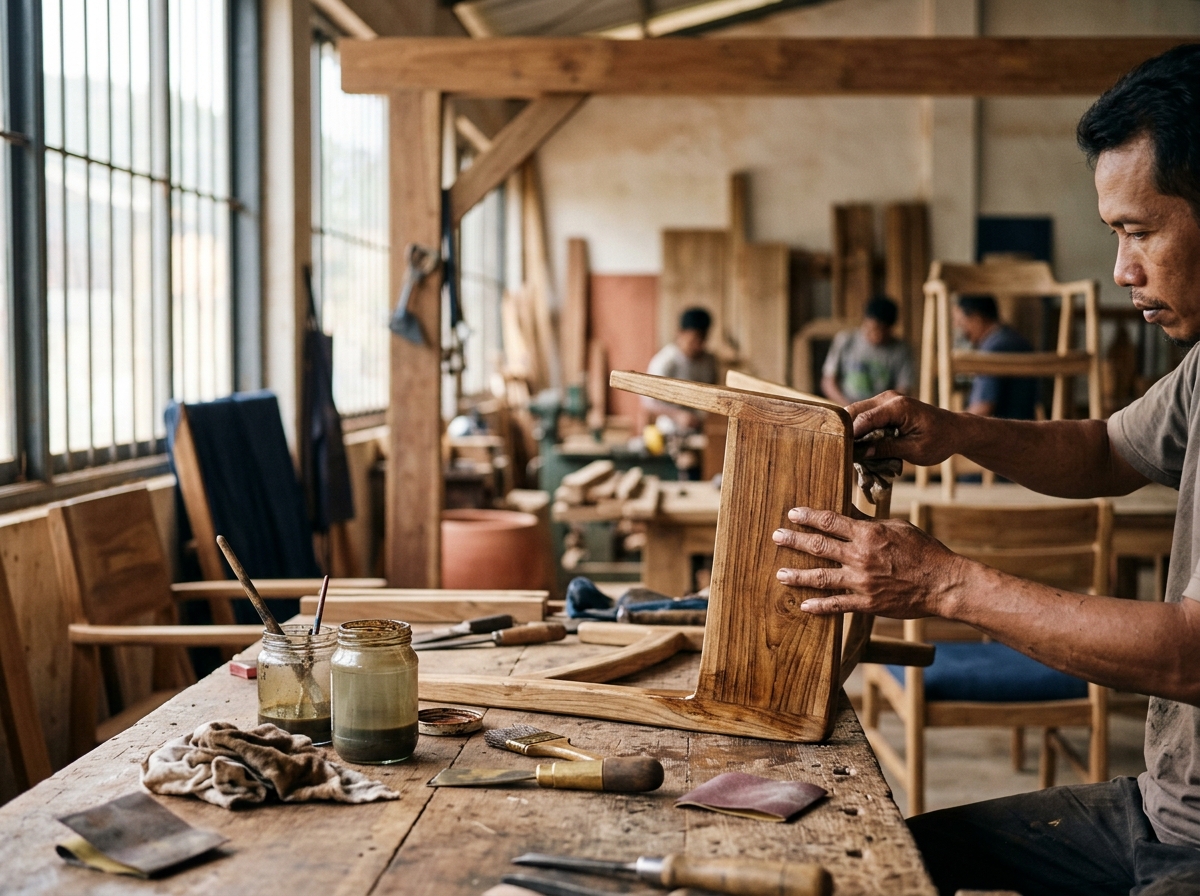
Quality control does not wait for production to begin. Before any manufacturing commences, the partner verifies wood species against specifications, confirms legal harvest documentation under SVLK (Sistem Verifikasi Legalitas Kayu — Indonesia's mandatory timber legality verification system), and approves finish samples and fabric swatches. Where panel products are involved, material suppliers must demonstrate compliance with CARB ATCM Phase 2 — the California Air Resources Board standard that limits formaldehyde emissions from composite wood panels.
SVLK certification also functions as the primary instrument for US Lacey Act compliance. The Lacey Act prohibits the importation of products derived from illegally harvested wood. For every timber-containing piece within an order, a turnkey partner should hold the corresponding SVLK documentation and make it available to the buyer ahead of shipment.
In-Process and Pre-Shipment Inspection
In-process inspections occur at two stages: early production (joinery and frame construction) and mid-production (upholstery and surface finishing). Each inspection generates a written report with photographic documentation and a pass/fail determination against the approved specification.
Pre-shipment inspection (PSI) is the final checkpoint before goods leave the factory. PSI follows a defined sampling protocol — typically AQL (Acceptable Quality Level) sampling — with defect classifications of critical, major, and minor. Critical defects (structural failure, incorrect item) result in rejection. Major defects (visible surface damage, incorrect finish) require rectification before release.
Third-Party QC versus Embedded Partner Teams
Buyers can choose between two QC structures. Third-party inspection agencies (operating independently of the procurement partner) provide objective validation but add cost and scheduling complexity. Embedded partner QC teams (inspectors employed by the turnkey partner) provide tighter production integration but require the buyer to assess the partner's internal QC standards independently.
Engagement Structure: How to Onboard a Turnkey Procurement Partner
Onboarding Stages and Timeline
A typical turnkey furniture procurement engagement follows this sequence:
1. RFI / initial scoping: Buyer submits project brief, quantity estimates, species and style requirements, and target delivery date. Partner responds with preliminary scope and capability confirmation. 2. Scoping call: Partner clarifies specifications, identifies cluster mix (Jepara, Bali, Surabaya), and outlines factory shortlisting approach. Fee structure is disclosed at this stage. 3. Letter of engagement: Signed document defining scope, fee model, milestone schedule, payment terms, and out-of-scope boundaries. 4.
Fee Models Compared
| Fee Model | Structure | Best Fit | Risk to Buyer |
|---|---|---|---|
| Fixed-fee | Flat project fee regardless of GMV | Well-specified projects with stable scope | Scope creep if not bounded |
| % of GMV | Percentage of total factory purchase value | Larger projects with variable scope | Partner incentive to increase spend |
| Hybrid retainer | Monthly management fee plus capped % | Ongoing or multi-phase projects | Most predictable for budgeting |
Buyers should require full fee disclosure before signing. Any partner unwilling to disclose their compensation model — including factory margin participation — should be treated as high risk.
Key Contractual Clauses Buyers Must Require
- Explicit scope schedule with in/out-of-scope list - Milestone-based payment release mechanism - Defect rectification obligations and timelines - Cargo insurance minimum coverage amount - Force majeure definition and buyer remedy provisions - Dispute resolution jurisdiction and governing law
Indonesia's Furniture Manufacturing Clusters and Their Specializations
Indonesia's production capability is concentrated in distinct geographic clusters, each with different material strengths, craft traditions, and capacity profiles. A turnkey partner operating across all three major clusters can source within a single project brief without the buyer managing multiple supplier relationships.
Jepara (Central Java) is Indonesia's largest furniture production cluster, specializing in solid teak, mahogany, and carved hardwood furniture. Factories there range from small artisan workshops to mid-scale export manufacturers. Jepara is the principal source for solid-wood hospitality case goods, dining sets, and decorative carved pieces.
Bali produces resort, boutique-hotel, and artisan interior pieces. Bali manufacturers are experienced with international hospitality specifications and often work with interior designers directly. Lead times tend to be longer than Jepara given the craft intensity of production.
Surabaya and East Java are suited to higher-volume commercial and mid-market furniture production. This cluster serves best when the requirement is for standardized commercial furniture, office-adjacent pieces, or any items where volume efficiency takes precedence over handcraft differentiation.
Multi-cluster sourcing within one project — for example, teak case goods from Jepara, artisan feature pieces from Bali, and standardized contract items from Surabaya — requires a partner with operational presence in each cluster. Consolidation logistics across clusters add complexity that a buyer cannot manage remotely.
Export Documentation and US Compliance Requirements for Indonesia Furniture
Required Export Documents
Every Indonesia furniture shipment to the US requires the following documentation:
- Commercial invoice (itemized by SKU, quantity, unit value) - Packing list (dimensions, weights, carton count) - Bill of lading (B/L) — issued by the ocean carrier - Certificate of Origin (Form E under ASEAN-scheme, or GSP Form A where applicable) - SVLK certificate(s) for all timber-containing products
US Regulatory Compliance as a Turnkey Deliverable
US Lacey Act: Importers are required to declare the plant species, country of harvest, and quantity for all wood products. The turnkey partner should prepare Lacey Act declarations for the buyer to file. SVLK documentation serves as the principal supporting evidence for these declarations.
CARB ATCM Phase 2: This standard applies to composite wood products — including MDF, particleboard, and hardwood plywood — used in furniture destined for the US market. All panels must be sourced from manufacturers that are CARB-compliant. Verification of compliance and collection of mill certificates should be completed by the partner at the material approval stage.
ISF 10+2 Filing: An Importer Security Filing (ISF) must be submitted to US Customs no later than 24 hours before vessel departure. The filing is composed of 10 data elements sourced from the buyer/importer and 2 from the carrier. Indonesia-origin data elements are prepared by the turnkey partner, while the buyer's customs broker is responsible for submitting the ISF. A well-structured turnkey partner incorporates preparation of these data elements into the standard export documentation process.
How to Evaluate and Select a Turnkey Furniture Procurement Partner
Minimum Due-Diligence Checklist
Before engaging any turnkey partner for Indonesia furniture procurement, buyers should verify:
- ✓Confirmed in-country staff in Indonesia (not remote agents)
- ✓Factory audit records from the past 12 months
- ✓Reference projects in hotel or villa categories with contact verification
- ✓Written QC protocols with AQL sampling standards
- ✓SVLK documentation process described in writing
- ✓Fee model fully disclosed including factory margin participation
- ✓Signed letter of engagement with explicit scope schedule
- ✓Cargo insurance minimum coverage specified
- ✓Force majeure and dispute resolution clauses present
- ✓Pilot project or phased engagement option available
Red Flags in Partner Selection
Several patterns indicate high operational risk:
- The partner cannot name their in-country team members or describe their physical office locations in Indonesia. - QC is described verbally but no written protocol or sample report is provided. - The scope agreement uses generic language without itemized in-scope and out-of-scope lists. - The fee model is described as "commission" without specifying the basis or percentage. - The partner cannot provide factory audit records — only factory introductions.
Pilot Project Structure to Validate Partner Capability
Committing a full hotel FF&E order to an untested partner carries significant risk. A pilot project structure mitigates this. The buyer assigns a defined subset of the order — for example, one furniture category from one cluster — to the partner under full turnkey terms. The pilot runs through the complete cycle: specification, sourcing, production, QC, and export.
This approach adds approximately four to six weeks to the overall project timeline, but it delivers evidence-based confidence that no reference call or company presentation is capable of replicating.
Frequently Asked Questions
What is the typical cost structure for a turnkey furniture procurement service in Indonesia?
Fee models vary. Fixed-fee structures provide budget predictability for well-specified projects. Percentage-of-GMV models — typically in the range of several percent of total factory purchase value — are common for larger or more complex orders. Hybrid models combine a monthly management retainer with a capped project fee. All models should be fully disclosed before engagement.
How long does a full turnkey furniture procurement project in Indonesia take from brief to shipment?
From approved brief to port of export, the typical cycle spans 90 to approximately 180 days. This encompasses specification finalization (approximately two to three weeks), factory shortlisting and contracting (two to four weeks), production (eight to fourteen weeks depending on complexity), QC and consolidation (two to three weeks), and documentation and loading. Transit time to US ports adds a further approximately 25 to 35 days.
Does a turnkey partner handle customs clearance in the United States?
No. Customs clearance at the US destination port remains the buyer's responsibility, carried out by a licensed US customs broker. The turnkey partner's scope concludes at the Indonesian port of export under FOB terms, or at the destination port under CIF terms.
How is SVLK timber legality certification managed under a turnkey procurement model?
At both the supplier contracting stage and the material approval stage, the turnkey partner confirms SVLK certification for every timber-containing product. These certificates are issued by verification bodies accredited by the Indonesian government and are tied to specific factories and defined production periods. For each supplier, the partner should furnish certificate numbers, the names of issuing bodies, and validity dates.
What is the minimum order value that justifies engaging a turnkey procurement partner in Indonesia?
There is no universal threshold, but the turnkey model's fixed cost structure — partner fees, in-factory oversight, consolidation logistics — becomes economically rational at order values roughly above the point where these costs represent a manageable percentage of total project spend. For hotel and villa projects, orders covering multiple furniture categories and factory sources typically justify the model.
How does a turnkey service differ from using a traditional Indonesia furniture buying agent?
The distinction is accountability. A buying agent facilitates introductions and may assist with negotiation, but holds no contractual responsibility for production outcomes, quality failures, or shipment integrity. The buyer remains the contracting party with every factory. Under a turnkey model, the service partner holds all supplier contracts and is contractually liable to the buyer for the full cycle's outcomes.
Turnkey furniture procurement Indonesia is not simply a faster path to sourcing. At its core, it is a structure for transferring risk. The buyer exchanges a degree of direct operational control for a single point of contractual accountability — and in doing so, gains a partner with in-country staff, established supplier networks, and compliance capabilities that would require years to develop independently.
You now have a framework to evaluate whether this model fits your project and what to require from any partner you consider. The logical next step is to stress-test that framework against a real project scope.
Share your Indonesia furniture project brief and receive a structured proposal covering supplier cluster selection, QC framework, fee model, and projected timeline — specific to your development requirements.
Request Your Proposal →Need eyes on the ground in Indonesia?
MTS is an execution partner — supplier verification, manufacturing management, quality control and export logistics across Indonesia, Vietnam and China.
Related services
Related articles
Receive furniture sourcing insights across Asia.
One email per week. No spam.