Teak Dining Tables Wholesale Indonesia: The Complete B2B Sourcing Guide
18 min read
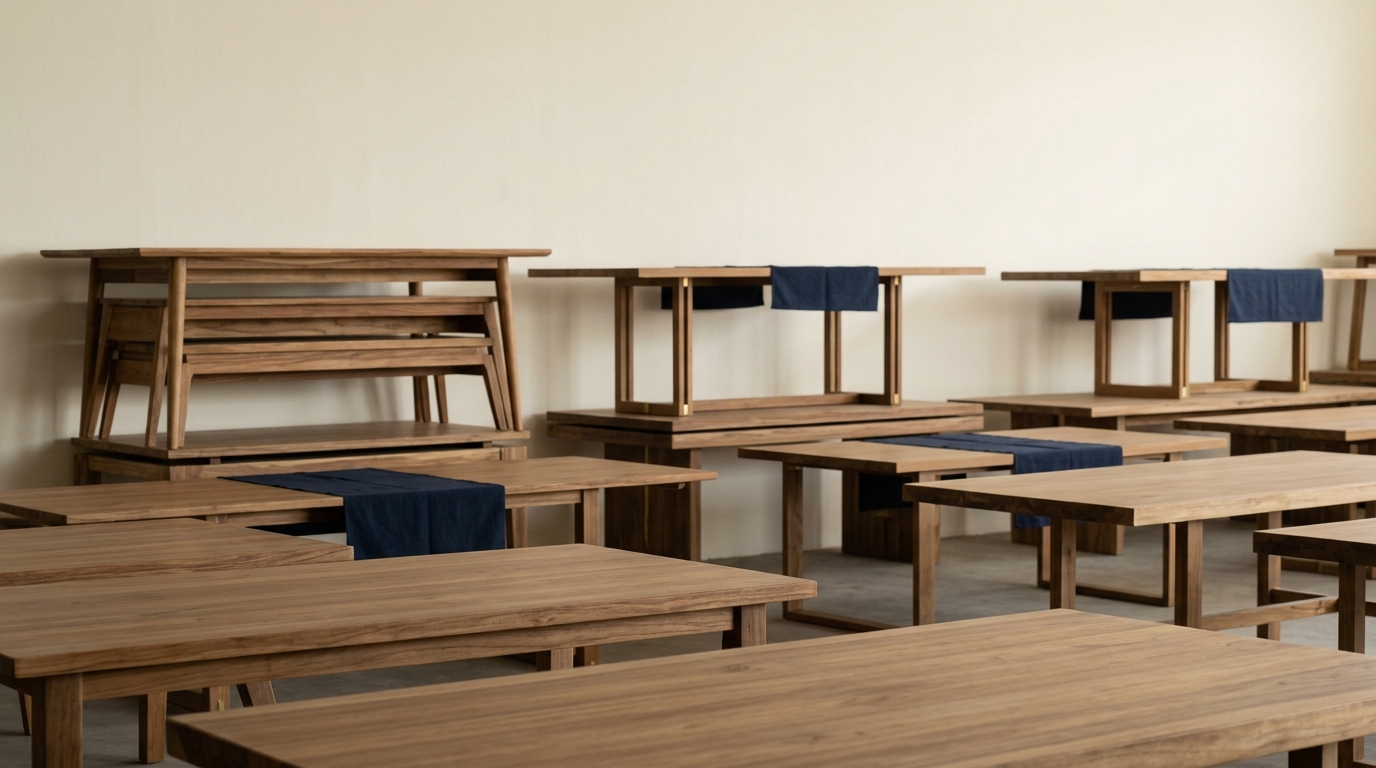
Sourcing teak dining tables wholesale from Indonesia is one of the highest-leverage procurement decisions a US retailer, restaurant supplier, or hospitality buyer can make — and also one of the easiest to get wrong. The category is crowded with suppliers of wildly varying quality, and the distance…
Sourcing teak dining tables wholesale from Indonesia is one of the highest-leverage procurement decisions a US retailer, restaurant supplier, or hospitality buyer can make — and also one of the easiest to get wrong. The category is crowded with suppliers of wildly varying quality, and the distance between Jepara and a distribution center in New Jersey means mistakes are expensive. Whether you are placing your first container order or rationalizing an existing supplier roster, the details matter: certification status, joinery method, finish type, Incoterm selection, and landed cost math all determine whether a purchase order becomes a profitable product line or a costly lesson.
This guide covers everything a US buyer needs to evaluate, price, and execute a wholesale teak furniture order from Indonesia. You will find guidance on supplier vetting, a breakdown of wholesale pricing structures and MOQs, a clear-eyed look at shipping and US customs requirements, and a step-by-step workflow for placing your first order with confidence. The article also addresses questions that competing guides typically ignore — HTS codes, landed cost frameworks, contract-grade specifications for restaurant use, and the practical difference between plantation teak and reclaimed teak for buyers who need to make defensible sustainability claims.
If you are comparing Indonesia against other sourcing origins or simply trying to understand what separates a reliable Jepara exporter from a high-risk trading company, this guide is the right starting point.
Why Indonesian Teak Still Dominates the Wholesale Dining Table Market
The Wood Itself: What Makes Tectona Grandis the Benchmark Species
Indonesian teak — botanically Tectona grandis — has earned its global reputation through a combination of natural properties that few competing species can match at scale. The wood contains naturally occurring silica and oils that repel moisture, resist warping, and inhibit fungal growth without chemical treatment. Its interlocked grain produces a surface that holds both hand-rubbed oil finishes and lacquers exceptionally well, which matters enormously when you are producing dining tables destined for both indoor dining rooms and outdoor restaurant terraces. Density and dimensional stability make teak one of the few solid wood species that performs reliably across the full range of humidity conditions found across US markets — from humid Gulf Coast climates to arid interior states.
For wholesale buyers, this durability translates directly into lower after-sales warranty exposure and stronger customer retention. A retailer selling a teak dining table can credibly communicate a multi-decade product lifespan, which justifies a higher retail price point and reduces return rates relative to engineered wood alternatives.
Jepara and Semarang: The Two Hubs You Need to Know
Indonesia's export furniture industry is geographically concentrated in Central Java. Jepara is the dominant cluster for solid teak and mahogany furniture — it is home to hundreds of manufacturers ranging from small artisan workshops to mid-size export-oriented factories with in-house kiln drying and finishing lines. The density of skilled woodworkers and component suppliers in Jepara creates a competitive pricing environment that benefits wholesale buyers. Semarang, the provincial capital and major port city approximately two hours from Jepara, serves as the primary export gateway. Most FOB pricing forIndonesian teak furnitureis quoted as FOB Semarang.
Bali operates as a third, more specialized cluster — focused on luxury artisan pieces and resort furniture with higher design premiums rather than volume wholesale production. For high-volume dining table orders, Jepara-based manufacturers are almost always the practical choice.
Indonesia vs. Myanmar and Brazilian Teak: An Honest Comparison
Myanmar teak — often described as old-growth natural teak — has historically commanded a premium for its tight grain and high oil content. However, ongoing international sanctions and restricted export licenses make Myanmar teak effectively unavailable to US importers operating within standard compliance frameworks. Brazilian teak (typically Cumaru or Tauari, marketed under the teak label) differs botanically from Tectona grandis and does not share the same oil content profile, though it performs reasonably well in outdoor applications. Indonesian plantation teak occupies the practical sweet spot: it is legally compliant, available at scale, certifiable under FSC and SVLK frameworks, and priced competitively for wholesale volumes without the sourcing uncertainty that now surrounds other origins.
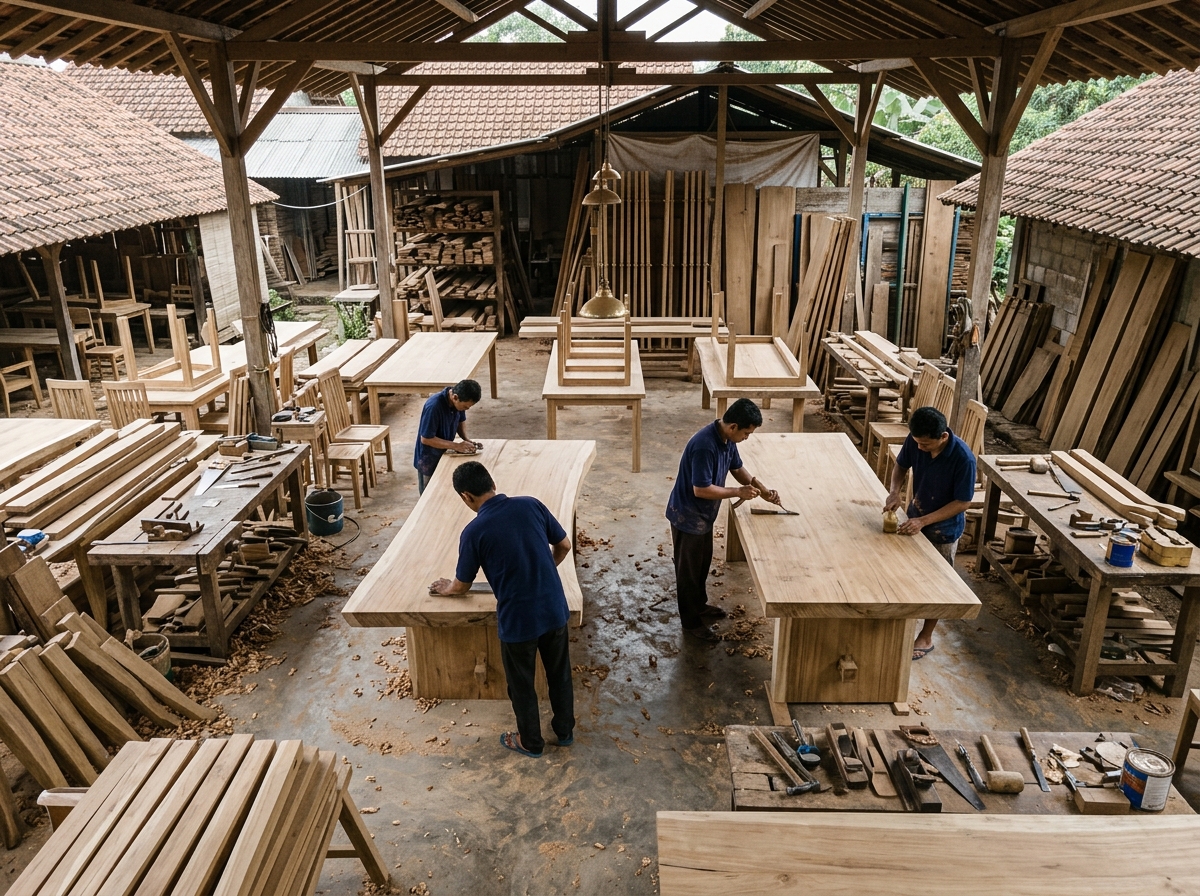
Key Styles and Configurations Available When Sourcing Indonesia Teak Furniture in Bulk
Solid Slab, Reclaimed, and Root Teak: Distinct Wholesale Categories
Understanding the three primary teak categories is essential before issuing an RFQ, because they differ in price, lead time, sustainability narrative, and suitability for different end-use contexts.
Plantation teak (kiln-dried solid) is the workhorse of the wholesale market. Sourced from managed teak plantations, it is dimensionally stable, consistently colored, and available in predictable quantities. This is the appropriate specification for most retail dining table programs and hospitality fit-outs where consistency across dozens or hundreds of units is non-negotiable.
Reclaimed teak is salvaged from demolished structures — old buildings, bridges, and railway sleepers. It carries a distinctive weathered aesthetic with visible nail holes, saw marks, and color variation that appeals strongly to the rustic and industrial restaurant design aesthetic. From a sustainability standpoint, reclaimed teak generates no new forestry pressure, which is a credible talking point for eco-conscious restaurant brands. However, buyers should note that reclaimed teak cannot be FSC certified (there is no new chain of custody to certify), and achieving consistent quality across a large order is more challenging than with plantation material.
Teak root furniture — tables built from the root systems of harvested teak trees — is a premium artisan category with strong visual impact. It is better suited to boutique retail and luxury hospitality than to high-volume wholesale programs requiring dimensional uniformity.
Round, Rectangular, and Extendable Configurations for US Retail
US retailers consistently report strong demand for round teak dining tables (particularly in the 48–60 inch diameter range for residential use) and rectangular forms in the 72–96 inch range for larger dining rooms and restaurant applications. Round teak dining tables wholesale from Indonesia are frequently ordered for hospitality settings where tables need to seat parties of varying sizes without creating awkward corner arrangements.
Extendable dining table configurations — typically featuring butterfly leaf or drop-in leaf mechanisms — are increasingly available from Jepara manufacturers and allow retailers to address the growing demand for flexible dining room furniture. Buyers ordering extendable tables should verify that the extension mechanism has been kiln-dried to the same moisture content as the tabletop, as mismatched moisture levels are a common cause of warping and fitment problems after delivery.
Custom tabletop thicknesses typically range from approximately 4 cm to 7 cm for solid teak, with thicker slabs commanding a higher material cost. Tabletop thickness is one of the primary specification decisions that affects both price and the visual weight of the finished piece.
Indoor vs. Outdoor Finish Treatments — a Critical Distinction
This is an area where competitor sourcing guides frequently fall short by treating all teak dining tables as interchangeable. Indoor and outdoor applications require meaningfully different finish treatments, and ordering the wrong finish creates problems at the retail floor level.
For indoor use, penetrating oil finishes (teak oil or Danish oil) are the most common wholesale specification. They preserve the wood's natural appearance, are straightforward for end consumers to maintain, and work well in climate-controlled environments. Lacquered finishes are also available for a more formal, polished look and offer better resistance to everyday dining spills.
For outdoor and restaurant terrace use, weathered gray finishes (achieved through silver teak treatment or allowed to develop naturally) are popular in the hospitality sector. Alternatively, marine-grade sealants and UV-resistant exterior oil formulations extend the service life of outdoor pieces significantly. Buyers specifying teak furniture for outdoor restaurant use should confirm with the manufacturer that joinery has been assembled with exterior-grade adhesives and that hardware (bolts, inserts, bracket fasteners) is stainless steel rather than zinc-plated, which corrodes in outdoor environments.
How to Evaluate Indonesian Teak Furniture Suppliers Before Placing a Wholesale Order
Certifications That Matter to US Importers
Three certification frameworks are directly relevant to US buyers sourcingIndonesia teak furniture:
SVLK (Sistem Verifikasi Legalitas Kayu) is Indonesia's national timber legality assurance system, mandatory for all Indonesian wood product exporters. An SVLK-certified supplier has been independently audited to confirm that the timber in their supply chain is legally harvested and traced. For US importers, SVLK provides a documented basis for Lacey Act compliance — the US law that prohibits trade in illegally sourced wood products. Any supplier unable to provide current SVLK documentation should be treated as a high-risk source.
FSC (Forest Stewardship Council) certification goes further than SVLK by verifying that wood comes from responsibly managed forests that meet environmental and social standards. FSC certification is increasingly demanded by US retailers with published sustainability commitments and is a strong differentiator in the hospitality segment, where eco-credentials matter to end clients.
FLEGT (Forest Law Enforcement, Governance and Trade) is an EU-focused licensing framework, but Indonesian FLEGT-licensed exporters typically maintain strong legality documentation that transfers favorably into the US compliance context.
Remote Vetting vs. On-the-Ground Inspection
For US buyers who cannot travel to Indonesia, third-party inspection services provide a practical alternative to factory visits. A pre-shipment inspection by a qualified third party (conducted in Jepara before the container is loaded) checks dimensions, finish quality, joint integrity, moisture content of the timber, and packing condition against your purchase order specifications. This single step prevents the majority of quality disputes that arise after furniture arrives in a US port.
If a supplier resists independent inspection or insists that their own quality control is sufficient, treat that as a significant red flag. Reliable export-experienced manufacturers in Jepara understand that third-party inspection is a standard part of international B2B trade and actively cooperate with the process.
- ✓Valid SVLK certificate (check expiry date)
- ✓FSC or FLEGT documentation if sustainability claims are made
- ✓Minimum 3 years of documented US export history
- ✓References from current US wholesale buyers
- ✓Willingness to accept third-party pre-shipment inspection
- ✓Sample availability (production-quality samples, not showroom pieces)
- ✓Clear written specification of moisture content targets (typically 8–12% for indoor furniture)
- ✓Transparent company structure — manufacturer vs. trading company vs. export agent
Wholesale Pricing Structure and MOQ Expectations for Teak Dining Tables
Understanding MOQ Ranges and Their Impact on Unit Cost
For teak dining tables wholesale Indonesia, minimum order quantities from Jepara factories typically fall in the range of approximately 20 to 50 units per SKU for catalog styles, with lower MOQs sometimes available for premium-priced solid slab pieces and higher MOQs expected for lower-margin catalog items. Custom or OEM designs generally carry higher MOQs — commonly around 50 units or more — to justify the tooling and sample development investment.
The relationship between MOQ and unit price is meaningful. Buyers committing to larger volumes (a full 20-foot container or 40-foot container) typically negotiate meaningfully better per-unit pricing than buyers ordering a mixed LCL (less-than-container-load) shipment. The pricing leverage is real, and buyers should model the volume-price tradeoff carefully before deciding on order size.
FOB Semarang vs. CIF: What US Buyers Need to Calculate Landed Cost
Most Indonesian teak furniture is quoted FOB Semarang. This means the supplier's price covers production and delivery to the port of Semarang; all costs from that point onward are the buyer's responsibility. A complete landed cost calculation for a US buyer should include:
| Cost Component | Notes |
|---|---|
| FOB price per unit | Supplier quote, ex-Semarang port |
| Ocean freight | LCL or FCL; varies by container size and routing |
| Marine cargo insurance | Typically around 1–2% of cargo value |
| US port handling and terminal fees | Varies by port of entry |
| US Customs broker fees | Flat or percentage-based |
| Import duties (HTS-dependent) | See customs section below |
| Inland delivery to warehouse/DC | Drayage and final mile |
| Quality inspection (pre-shipment) | Third-party fee, typically per man-day |
Buyers who compare quotes on FOB price alone — without modeling the full landed cost stack — frequently find that a slightly higher FOB price from a more organized supplier results in a lower net landed cost once fewer quality issues and rework costs are factored in.
How Specifications Drive Price Per Unit
Tabletop thickness, joinery method, and finish type are the three specification variables that most directly affect price per unit beyond raw material cost. A 4 cm tabletop in a standard mortise-and-tenon construction with an oiled finish will typically cost meaningfully less than a 7 cm solid slab with hand-cut dovetail joinery and a multi-step lacquer finish. Buyers should resist the temptation to under-specify in order to hit a target price — particularly for hospitality use, where structural failure of under-built joinery results in safety liability.
Seasonal lead times run approximately 8 to 16 weeks from purchase order to FOB readiness, depending on order complexity, factory capacity, and whether custom tooling is required. Lead times toward the longer end of that range are common during peak production seasons preceding major international furniture trade fair periods.
Shipping, Import Duties, and US Customs Requirements for Indonesian Teak Furniture
HTS Codes and Duty Rates for Wooden Dining Tables
US importers of wooden dining tables from Indonesia file entries under the Harmonized Tariff Schedule (HTS). Solid wood dining tables — including teak — typically fall under HTS 9403.30 (wooden furniture of a kind used in offices) or more commonly HTS 9403.60 (other wooden furniture), depending on the end-use classification. Buyers should confirm the precise HTS code with their licensed US Customs broker before the first shipment, as misclassification can result in duty underpayment penalties.
Indonesia does not currently benefit from a comprehensive free trade agreement with the United States, so standard Most Favored Nation (MFN) duty rates apply. Rates for wooden furniture under HTS 9403.60 are generally in the low single-digit percentage range of the customs value, though buyers should verify current rates with their customs broker, as these are subject to periodic revision. Unlike some competing sourcing origins, Indonesian teak furniture has not been subject to the Section 301 tariffs that significantly increased duty costs for Chinese-origin furniture — a material competitive advantage for the Indonesia sourcing channel.
LCL vs. FCL Container Decisions for Different Order Volumes
For buyers ordering fewer than approximately 10–15 dining table units, LCL (less-than-container-load) consolidation is typically the most economical option. LCL shipments share container space with other exporters' goods and are consolidated and deconsolidated at freight stations — adding handling time and, potentially, additional damage risk.
For larger orders — particularly full dining table sets including chairs and sideboards — a dedicated FCL (full-container-load) shipment in a 20-foot or 40-foot container is more cost-effective per unit and reduces handling touchpoints. A standard 40-foot container can accommodate approximately 20–40 dining tables depending on their size and packaging configuration, though buyers should confirm cubic volume calculations with their freight forwarder.
Packaging standards matter significantly for teak furniture. Solid teak is heavy, and improperly packaged pieces are vulnerable to surface abrasion and corner damage during transit. Export-standard packaging typically includes foam corner protection, corrugated cardboard wrapping, and moisture-barrier poly sheeting inside the carton to prevent humidity-related surface damage during ocean transit.
Customization Options That Give US Retailers a Competitive Advantage
Jepara manufacturers are particularly well-suited to private label and OEM production — a meaningful advantage for US retailers seeking exclusive product lines that cannot be directly price-compared by consumers. Custom stain colors (matched to Pantone or Benjamin Moore references) are routinely achievable at scale, along with custom leg profiles (tapered, turned, angular, or trestle designs), hardware finish specifications (brushed brass, matte black, antique bronze), and table apron detail variations.
For retailers building a complete collection, Jepara factories commonly offer matching dining chair sets, benches, and sideboards — allowing buyers to present a coordinated furniture program rather than a single SKU. This is particularly valuable for interior design trade clients and hospitality procurement managers who need visual cohesion across a space.
The lead time implication of custom vs. catalog orders is meaningful: catalog styles with existing tooling can move from PO to FOB in approximately 8–10 weeks under normal production conditions, while fully custom OEM designs requiring new jigs, sample approval rounds, and finish development typically require 12–18 weeks from confirmed design to shipment. Buyers building a seasonal merchandise plan should factor this lead time differential into their ordering calendar.
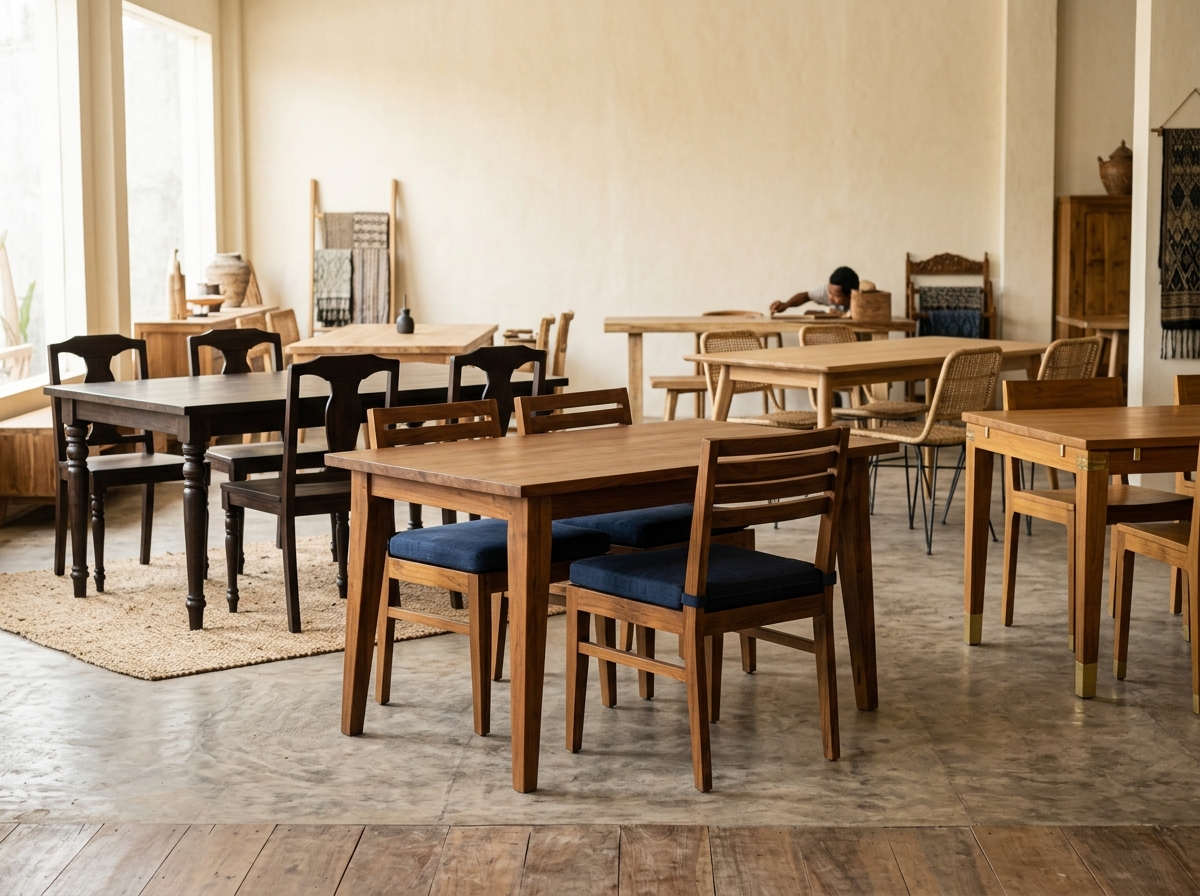
Sourcing Teak Dining Tables at Volume for Hospitality and Restaurant Projects
Restaurant and hotel procurement differs from retail buying in several important ways. Contract-grade specifications — equivalent to BIFMA durability standards familiar to US commercial furniture buyers — require heavier joinery, reinforced corner blocks, and in many cases through-bolt construction rather than relying solely on adhesive and mortise joints. A dining table in a 200-cover restaurant may be moved, stacked, and reset dozens of times per week; a residential-grade piece simply will not survive that use pattern.
For hotel groups and restaurant chains procuring across multiple properties, the most effective approach structures the order around a master specification that individual properties draw from. This creates consistency in brand presentation and allows for replacement unit procurement without re-sourcing from scratch each time. Reclaimed teak dining tables are particularly popular in the restaurant sector, where the material's visible history — the nail holes, the color variation, the sense of provenance — serves as a built-in design narrative and a credible sustainability credential for brands positioning around environmental responsibility.
A representative order profile for a 50-seat restaurant dining room might include approximately 14 rectangular dining tables (seating four), four round tables (seating two to four), and matching benches or chairs — totaling perhaps 18–20 table units. At that volume, a mixed FCL shipment is typically feasible, and the order size justifies a dedicated pre-shipment inspection visit to the factory before container loading.
Step-by-Step Process for Placing Your First Wholesale Teak Order from Indonesia
What to Include in Your Initial RFQ
A well-constructed Request for Quotation eliminates the most common source of misquotation. Your RFQ should specify: table dimensions (length, width, height, tabletop thickness); material specification (plantation teak, reclaimed teak, or root); finish type (oiled, lacquered, weathered gray); indoor or outdoor intended use; joinery preference if known; quantity required; target delivery port; and requested Incoterm (typically FOB Semarang for experienced importers).
Attach reference images where available. Indonesian suppliers respond better to visual references than to written descriptions alone. Request itemized pricing — material, labor, finishing, and packaging stated separately — so you can compare quotes meaningfully across suppliers.
Sample Ordering, Evaluation, and Payment Terms
Most Jepara manufacturers offer pre-production samples for a fee — typically the production cost of a single unit plus an expedited handling premium. Evaluate samples against your specification sheet, not just visual impression: check the moisture content with a meter (if you have access to one), inspect the joinery under the tabletop, assess the finish for consistency and coverage at edges and corners, and test the stability of the base under load.
Payment terms common in Indonesian B2B export transactions include:
- T/T (telegraphic transfer) with deposit: typically 30–50% deposit at order confirmation, balance before shipment or against Bill of Lading documents - Letter of Credit (L/C): preferred by larger factories for significant order values; provides payment security for both parties - Deferred payment terms: occasionally available with established buyer-supplier relationships, but rarely for first orders
Quality Control Inspection Milestones
For any order exceeding approximately half a container load, a structured quality control timeline protects the buyer effectively. Key milestones include: raw material inspection (timber moisture content before production begins), mid-production inspection (joinery and structural assembly before finishing is applied), and pre-shipment inspection (finished goods checked against PO specification before container loading). Each inspection should generate a written report with photographs, which serves as documentation in the event of a dispute.
- ✓Raw material check: timber species verification and moisture content (target 8–12% for indoor)
- ✓Mid-production inspection: joinery integrity, dimensional accuracy, surface preparation
- ✓Pre-shipment inspection: finished goods vs. PO spec, packaging adequacy, carton labeling
- ✓Bill of Lading review: confirm HTS code, country of origin marking, and Incoterm
- ✓Post-arrival spot check: document any transit damage within 48 hours for insurance claim purposes
Frequently Asked Questions About Teak Dining Tables Wholesale Indonesia
What is the minimum order quantity for wholesale teak dining tables from Indonesia? MOQs typically range from approximately 20 to 50 units per SKU for catalog styles. Custom or OEM designs often carry higher MOQs — commonly around 50 units or more — to justify sample development and tooling investment. Some smaller Jepara workshops accept lower MOQs, though unit pricing will be higher and consistency may be harder to guarantee across a large project.
How long does it take to receive a container of teak furniture from Jepara or Semarang? Production lead times run approximately 8 to 16 weeks from confirmed purchase order to FOB readiness, depending on order complexity and factory capacity. Ocean transit from Semarang to a US West Coast port typically adds approximately 20–28 days; East Coast ports via the Suez routing add additional transit time. Total order-to-delivery timelines of 14–22 weeks are realistic for first-time orders.
Is Indonesian teak furniture FSC or SVLK certified, and why does it matter for US importers? SVLK certification is mandatory for Indonesian wood furniture exporters and provides the documentation trail required for US Lacey Act compliance. FSC certification is voluntary and goes further, verifying responsible forest management. Both certifications matter: SVLK is your minimum legal compliance requirement; FSC is your sustainability differentiation tool for retail and hospitality buyers with published environmental commitments.
What are the landed cost components US buyers should calculate beyond the FOB price? Beyond FOB Semarang, US buyers should budget for ocean freight, marine insurance, US port terminal handling fees, customs brokerage, import duties (per applicable HTS code), inland drayage to their warehouse or distribution center, and any pre-shipment inspection fees. Failing to model all of these components before comparing supplier quotes leads to systematic underestimation of true procurement cost.
Can Indonesian manufacturers produce custom sizes and private-label teak dining tables? Yes. OEM and private-label capability is well-established among Jepara's mid-to-large export factories. Custom dimensions, stain colors matched to reference samples, proprietary leg profiles, and branded packaging are all achievable at commercially relevant MOQs. Allow additional lead time — typically 4–8 weeks beyond catalog lead times — for sample development and approval on new custom designs.
What is the difference between reclaimed teak and plantation teak dining tables for wholesale buyers? Plantation teak offers consistency, predictable supply, FSC certifiability, and uniform appearance — making it the right choice for retail programs requiring visual consistency across many units. Reclaimed teak offers distinctive aesthetics (visible patina, color variation, nail holes), a genuine sustainability narrative (no new forestry impact), and premium design appeal — making it ideal for boutique hospitality and design-led retail. Reclaimed teak cannot carry FSC certification and is harder to source at consistent quality across large orders.
Sourcing teak dining tables wholesale from Indonesia rewards buyers who invest in verification upfront — certifications, supplier audits, clear specifications, and pre-shipment inspection — and who understand the full landed cost picture before committing to a price. The combination of Jepara's manufacturing depth, Indonesia's legal timber frameworks, and the wood's inherent durability makes this sourcing channel one of the most defensible options available to US retailers and hospitality procurement managers operating in the premium dining furniture segment.
You now have a clear picture of what separates a compliant, well-specified wholesale teak order from a costly mistake — and the practical tools to execute the former.
Now that you understand the certification requirements, pricing structure, and import logistics involved in sourcing teak dining tables wholesale from Indonesia, the logical next step is connecting with verified suppliers who meet those standards. Request a wholesale price list and sample swatches from confirmed Indonesian teak exporters today — with SVLK and FSC documentation included as standard.
Request Wholesale Price List and Samples →Need eyes on the ground in Indonesia?
MTS is an execution partner — supplier verification, manufacturing management, quality control and export logistics across Indonesia, Vietnam and China.
Related services
Receive furniture sourcing insights across Asia.
One email per week. No spam.