In-House Asia Liaison vs. Outsourced Production Management: What's Right for Your Stage?
9 min read
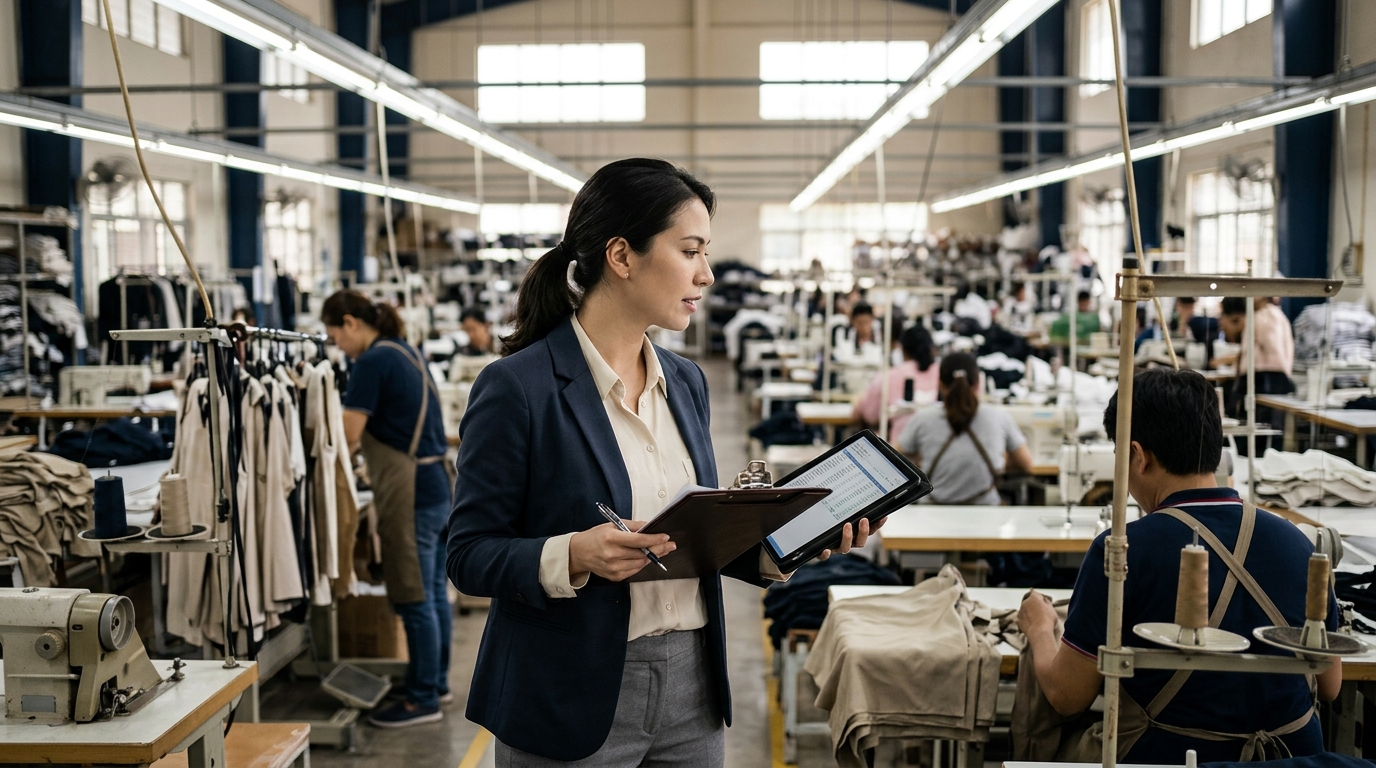
The question of in-house vs outsourced production management Asia comes up the moment a brand's order volume outgrows what a spreadsheet and a few WhatsApp threads can manage. At low volumes, the founder or procurement manager handles factory communication directly. As purchase orders multiply across China, Vietnam, Bangladesh, or Indonesia, the coordination load becomes a structural problem — and the answer is not always to hire.
Two models dominate the market. The first is a resident rep office: one or more employees based in-region whose full-time role is to manage supplier relationships, walk factory floors, and report back to headquarters. The second is an outsourced production management service: a specialist partner with established teams, processes, and escalation protocols already in place. Both models can work. Neither is universally superior. The right choice depends on your current order volume, the complexity of your product categories, how many suppliers you're managing concurrently, and where you are in your growth curve.
This article lays out a practical comparison framework. It is not designed to steer every reader toward one answer. It is designed to surface the variables that matter so you can make a defensible decision — whether you're a Supply Chain Director standardising governance across ten factories, a Scaling Brand Founder moving from three to thirty SKUs, or a Procurement Manager trying to maintain on-time delivery without adding headcount. For the broader context on structured production oversight, seethe Production Management pillar guide.
Hiring an in-house Asia liaison is often framed as a straightforward HR decision: agree a salary, onboard the person, done. In practice, the true cost of a resident rep function runs considerably higher than the employment line.
Fixed Overheads That Accumulate Quickly
A single experienced liaison in a tier-one manufacturing hub — Shanghai, Ho Chi Minh City, Dhaka, or Jakarta — commands a market salary that reflects local demand for bilingual, technically literate production staff. Add statutory benefits, office or co-working costs, travel between supplier sites, and the administrative overhead of managing an overseas employment entity or a professional employer organisation (PEO) arrangement, and the all-in cost typically runs well above the headline salary figure.
Beyond money, there is a capacity ceiling. One liaison can realistically cover a limited number of active production runs at any given time before milestone tracking becomes superficial. When you add factories, countries, or product categories, you either hire additional staff or accept coverage gaps.
The Knowledge Retention Risk
In-house liaisons accumulate institutional knowledge about your suppliers, your BOM structures, and your escalation preferences. That knowledge is valuable — and it walks out the door if the person resigns. Turnover in regional manufacturing roles is not uncommon, and rebuilding supplier trust and production rhythm after a key liaison departs can cost an entire production cycle.
When an In-House Liaison Makes Genuine Sense
The in-house model earns its cost when certain conditions are met simultaneously.
First, volume. If you are placing a high and consistent number of purchase orders per year across a concentrated set of suppliers in one or two countries, a dedicated liaison can maintain the depth of relationship and day-to-day presence that justifies the fixed cost. Sporadic or seasonal volume does not generate enough utilisation to make the model efficient.
Second, product complexity. Highly technical products — those with extensive qualification requirements, complex first article inspection (FAI) processes, or ongoing in-line inspection demands tied to proprietary specifications — sometimes benefit from an employee who has been trained exclusively in your category. The liaison becomes a product expert, not just a process manager.
Third, strategic supplier relationships. When a factory is a genuine strategic partner — co-developing products, holding reserved capacity, or operating under a long-term exclusive arrangement — having a dedicated on-site presence signals commitment and enables the kind of collaborative production planning that a transactional model cannot replicate.
If all three conditions apply, the in-house model is worth building. If only one or two apply, you are likely paying for coverage you do not need.
Why Outsourced Production Management Works at More Growth Stages
Outsourced production management in Asia is structured around the problems that scaling brands encounter before they have the volume to justify a full rep office — and, in many cases, even after they do.
Immediate Coverage Without a Ramp Period
A managed service provider already has teams on the ground in the countries where your suppliers operate. There is no recruitment cycle, no relocation, no PEO arrangement to negotiate. From the moment a purchase order is issued, production milestone tracking, material readiness checks, and escalation protocols can begin. For a brand managing its first significant production run in Vietnam or Bangladesh, that immediacy removes months of setup time.
Variable Cost That Matches Order Flow
Outsourced production management fees are typically scoped to active POs or production programmes. When order volumes rise, coverage scales. When a season ends and active orders drop, costs contract. This variable cost structure is structurally better suited to brands with seasonal demand cycles, new category launches, or growth trajectories that are not yet predictable enough to justify fixed headcount.
Multi-Country Coverage as Standard
Many brands source across more than one country — apparel from Bangladesh, hard goods from China, accessories from Vietnam, packaging from India. An outsourced partner with established operations across these regions provides coordinated oversight without requiring the brand to manage separate liaisons in each location. Milestone reporting, escalation handling, and supplier communication flow through a single accountable contact, regardless of geography.
The Decision Framework: Five Variables to Evaluate
Rather than defaulting to convention, evaluate these five variables against your current situation before committing to either model.
| Variable | Favours In-House | Favours Outsourced |
|---|---|---|
| Annual PO volume | High and consistent | Variable or growing |
| Supplier concentration | Few, strategic factories | Distributed across factories or countries |
| Product technical complexity | Proprietary, deep category expertise required | Standard or moderately complex |
| Internal HR and legal capacity | Able to manage overseas employment entity | Prefers to avoid |
| Speed to coverage required | Can absorb 3-6 month ramp | Needs coverage within weeks |
No single variable is determinative. A brand with high PO volume but distributed suppliers across four countries may still find that an outsourced model covers more ground more efficiently than two or three in-house hires. A brand with a single strategic factory relationship and a technically complex product may justify a dedicated in-house liaison even at moderate volume.
How Growth Stage Should Shift Your Thinking
The in-house vs outsourced production management Asia decision is not a one-time call. It should be revisited as your business changes.
Early Stage: Founders Managing Factories Directly
At the earliest stage, production oversight is typically handled by the founder or a generalist operations hire. Factory communication is direct, informal, and entirely dependent on personal relationships. This works until order complexity or concurrent production runs exceed what one non-specialist can manage without dropping visibility.
The transition point is usually the first time a delay goes undetected until it becomes a shipment miss. At that stage, outsourced production management provides immediate structure — milestone tracking, material readiness checks, escalation protocols — without requiring the brand to build an overseas HR function before it is ready.
Growth Stage: Multiple Factories, Multiple Categories
As brands move from a handful of SKUs to broader catalogues, the coordination complexity compounds. BOM changes across concurrent production runs, capacity planning across multiple factories, and on-time delivery (OTD) pressure from retail buyers all arrive simultaneously. This is where the absence of structured production governance is most costly.
At this stage, most brands benefit from a managed service that can absorb the coordination load while the internal team focuses on commercial and product decisions. The outsourced partner becomes an extension of the supply chain function, not a stopgap.
Mature Stage: When In-House Investment Pays Off
At significant scale — with stable, high-volume supplier relationships and the internal HR infrastructure to manage an overseas presence — the economics of an in-house team can shift favourably. The brand may also want the deeper integration that comes with employees who hold institutional knowledge of proprietary processes or exclusive supplier arrangements.
Even at this stage, many supply chain directors retain outsourced production management for specific regions, categories, or surge periods, rather than replacing the model entirely. A hybrid approach is more common than a clean switch.
What to Demand From Either Model: Governance Standards
Regardless of which model you choose, the underlying governance requirements are the same. Production oversight in Asia — whether delivered by an employee or a managed service — should cover material readiness confirmation before production begins, structured production milestone tracking against the critical path, first article inspection and in-line inspection at defined intervals, a documented escalation protocol that reaches the right decision-maker before a delay becomes a missed shipment, and a single accountable contact who owns the outcome.
These are not premium features. They are the baseline for maintaining on-time delivery from Asian suppliers. If either model cannot demonstrate how it handles each of these requirements, that is a risk signal.
ISO 9001-aligned production environments provide a useful baseline for supplier quality systems, but they do not substitute for active production management. A factory can hold ISO 9001 certification and still miss milestones without consistent external oversight.
The Real Cost of Getting the Decision Wrong
Choosing the wrong model at the wrong stage has predictable consequences. Brands that hire in-house before they have the volume to justify it absorb fixed costs that constrain investment elsewhere, often end up with a liaison who is under-utilised or covering too many suppliers superficially, and face a succession problem if that person leaves.
Brands that delay structuring production oversight — relying on informal factory relationships longer than they should — typically experience the consequences as late-stage surprises: a material shortage that was visible weeks earlier to anyone tracking readiness, a capacity conflict that a factory deprioritised silently, or a BOM error that was not caught before a production run completed.
The cost of those surprises — in stockouts, rework, expedited freight, or missed launch windows — is consistently higher than the cost of structured production management, whether in-house or outsourced.
For a detailed look at how structured day-to-day oversight works in practice, including materials readiness tracking, milestone management, and escalation handling, exploreour Production Management service. The framework above is a starting point; the right answer for your business depends on the specifics of your supplier base, your growth trajectory, and the governance standards you need to hold.
The decision between in-house and outsourced production management in Asia is ultimately a question of fit — fit between your operational stage, your cost structure, and the level of production governance your orders require. Getting that fit right is the work worth doing before the next purchase order ships.
Planning OEM or private-label production in Asia?
MTS matches you with capable factories and manages tooling, samples, production and quality gates — so your designs ship to spec.
Related services
Related articles
Receive furniture sourcing insights across Asia.
One email per week. No spam.