Factory Inspections Alone Are Not Production Management
9 min read
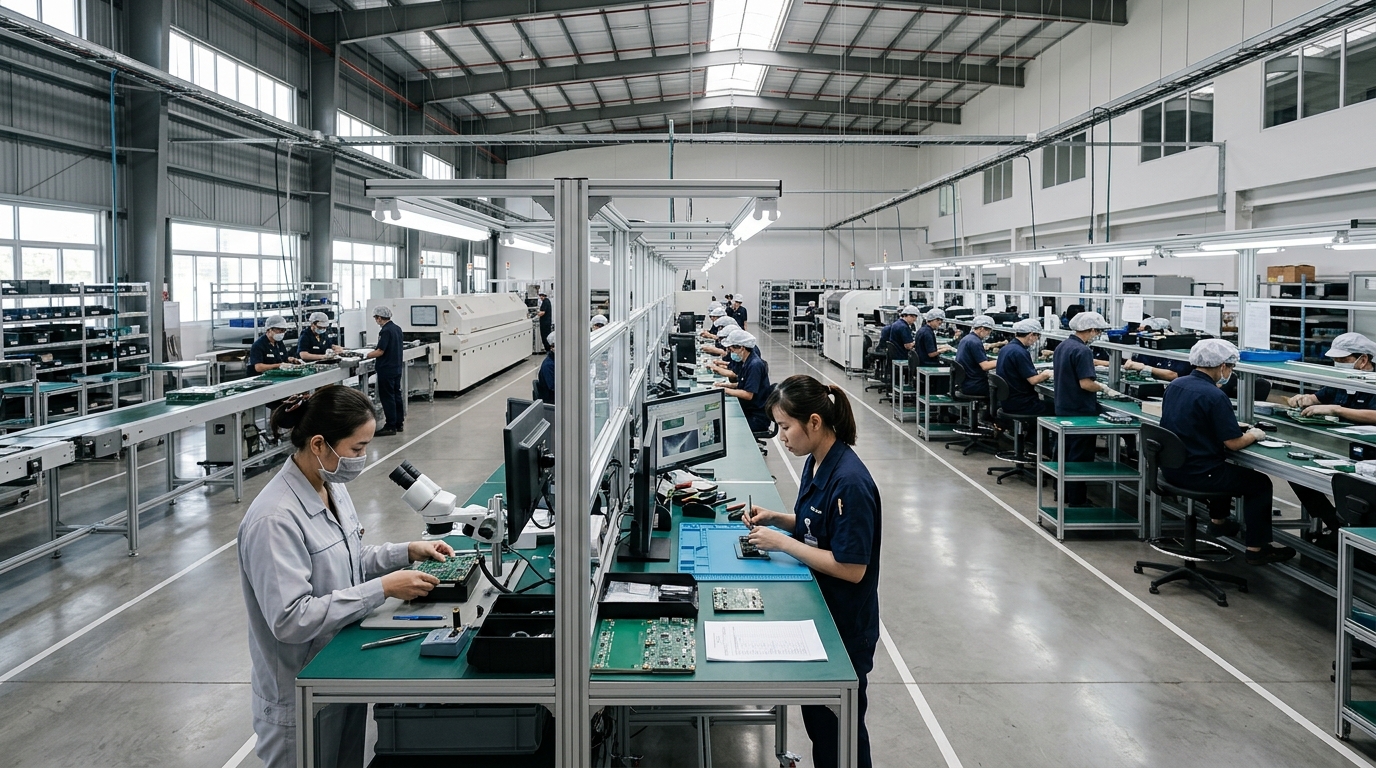
When sourcing from factories across China, Vietnam, Bangladesh, or Indonesia, most buyers have some form of quality inspection in their process. A pre-shipment inspection is booked, an inspector visits the factory, a pass or fail report lands in an inbox, and the shipment is cleared or held. It feels like control. For many procurement teams, it represents the entirety of their in-country oversight. The problem is that production management vs quality inspection Asia is not a matter of degree — it is a matter of function. Inspections answer the question "what condition is this product in right now?" Production management answers an entirely different question: "is this order going to arrive on time, in full, and without surprises?"
These two questions require fundamentally different activities, different information, and different people working on different timelines. Conflating them is one of the most common structural errors buyers make when managing Asian supply chains at a distance. The consequences tend to be invisible until they are not: a container that misses a vessel, a stockout that arrives just as a retail window opens, a factory that quietly deprioritised your order because a larger client placed a rush job. None of these outcomes are detectable by an inspection conducted in the final week of a production run.
This article draws a clear boundary between the two disciplines, explains what falls into the gap when only inspections are in place, and describes what structured production oversight actually involves on a day-to-day basis. If you are responsible for on-time delivery from Asian suppliers without the ability to travel frequently to the region, this distinction is worth understanding precisely.
A factory inspection — whether a First Article Inspection (FAI), an in-line inspection, or a pre-shipment check — is a point-in-time measurement. An inspector arrives at a factory, draws a sample from a production batch or finished goods pile, checks it against a specification, and records findings against a defined acceptable quality level, commonly AQL 2.5 for general merchandise. The report documents what was found at that moment.
This is genuinely useful. Inspections catch cosmetic defects, dimensional non-conformances, labelling errors, and functional failures before goods leave the country. They create a documented record that protects buyers in disputes and can trigger corrective action before shipment. For some product categories and risk profiles, a well-timed in-line inspection can identify process problems early enough to allow rework.
But notice what inspections do not do:
- They do not track whether raw materials arrived on time at the start of the production run. - They do not monitor whether the factory is hitting intermediate milestones against the agreed critical path. - They do not detect when a factory silently reallocates capacity to another client. - They do not flag a material shortage two weeks before it becomes a delay. - They do not engage with the factory between the order placement date and the inspection visit.
An inspection is diagnostic. It tells you the condition of something that has already happened. Production management is interventional. It influences what is happening, while there is still time to change it.
The Timeline Gap That Inspections Leave Unmonitored
Consider a standard 90-day lead time order placed with a factory in Vietnam. An inspection is typically booked around day 75 to day 85, once the production run is substantially complete. That leaves roughly 10 to 12 weeks of production activity — material procurement, component manufacturing, assembly, and quality process execution — happening with no structured oversight from the buyer's side.
During those 10 to 12 weeks, a significant share of the delays that eventually affect on-time delivery (OTD) take root. Material readiness is often the first domino: if a key component or fabric arrives late at the factory, the assembly schedule compresses, overtime is introduced, quality shortcuts follow, or the shipment date slips. None of this is visible to a buyer who has only booked an end-of-run inspection.
This is precisely the window that production management fills. The activities that belong in this period include:
Material Readiness Verification
Confirming that all Bill of Materials (BOM) components — raw materials, sub-components, packaging, labels — are on site at the factory before cut-off dates. A material readiness check conducted two to three weeks into a production run can surface shortages while there is still time to expedite or substitute.
Milestone Tracking Against the Critical Path
Every production order has a critical path: a sequence of dependent activities that must complete on schedule for the final shipment date to hold. Tracking progress against named production milestones — fabric inspection passed, cutting started, assembly at 50%, finishing complete — allows a production manager to identify which activities are running late and whether the overall shipment date is still achievable.
Capacity Monitoring and Reallocation Risk
Factories in China, India, Indonesia, and across Southeast Asia typically serve multiple clients simultaneously. When a larger or more demanding client places pressure, smaller orders are commonly deprioritised without explicit communication to the buyer. Regular contact with factory scheduling teams is the only reliable way to detect and challenge this before it becomes a delay.
Where the Confusion Between the Two Disciplines Comes From
The conflation of production management vs quality inspection Asia is partly a product of how the market is structured. Third-party inspection services are well-established, straightforwardly priced, and easy to procure. A buyer can book an inspection online, receive a standardised report within 48 hours, and feel that something meaningful has been done. The service is visible, documented, and defensible to internal stakeholders.
Production management, by contrast, is less visible from the outside. Its outputs — a factory that hits its milestones, a shipment that departs as planned, a material shortage that was resolved three weeks before it would have caused a delay — do not generate dramatic reports. They generate normal operations, which procurement teams and supply chain directors tend to notice only in their absence.
This creates a structural bias toward inspection spending and away from oversight spending. Buyers tend to add more inspections when quality problems emerge, when the more fundamental issue is often that no one has been tracking the production process in the weeks before quality problems can even be detected.
What Continuous Production Oversight Actually Involves
Structured production management is not a single visit or a single report. It is an ongoing operational relationship with the factory, maintained throughout the life of an order. For buyers sourcing across multiple suppliers in different countries — China and Vietnam being the most common combination, with growing volumes in Bangladesh, India, and Thailand — this oversight needs to be consistent across each supplier regardless of geography.
The core activities of continuous production management include:
- Pre-production review: Confirming that the factory has received a complete and approved Purchase Order (PO), that the BOM is agreed and materials are on order, and that factory capacity has been formally allocated to the order. - Material readiness confirmation: Verifying physical arrival and inspection of all input materials before production is due to start, rather than discovering shortages mid-run. - Scheduled milestone check-ins: Regular structured contact with factory production supervisors to verify progress against the critical path, with formal escalation if milestones are missed. - Escalation protocol execution: When a milestone slips or a risk is identified, a defined escalation process brings the right decision-makers into the conversation quickly — not after the shipment date has already been missed. - Coordination with logistics: Ensuring that cargo booking, documentation preparation, and handover to freight are sequenced correctly so that a finished production run is not delayed at the export stage.
For buyers managing concurrent production runs across multiple factories,the Production Management pillar guidesets out how these activities are structured and sequenced across an order portfolio.
Why a Single Accountable Contact Changes the Outcome
One of the persistent structural problems in Asian supply chain management is fragmented communication. A procurement manager in Europe or North America may be sending emails to a factory sales contact, copying a logistics agent, and receiving inspection reports from a third-party QC firm — none of whom speak to each other, and none of whom have any responsibility for the overall outcome.
This fragmentation means that no single person has a complete picture of an order's status at any given time. When a delay occurs, the question of who should have caught it earlier is unanswerable because oversight was distributed across parties with no shared accountability.
Effective production management consolidates this accountability. A single point of contact — based in region, maintaining direct relationships with factory scheduling and production teams — carries responsibility for tracking the order from PO placement to goods-ready confirmation. When something goes wrong, there is one person whose job is to resolve it, not a group of service providers pointing at each other.
For procurement managers and supply chain directors managing multiple suppliers without increasing headcount,our Production Management serviceis structured around exactly this accountability model.
The Comparison That Clarifies the Choice
The table below summarises the functional difference between the two disciplines. Both have a place in a well-structured sourcing operation. The error is using one as a substitute for the other.
| Dimension | Quality Inspection | Production Management |
|---|---|---|
| **Timing** | Point-in-time snapshot | Continuous, throughout order life |
| **Primary question** | Is this product within spec? | Is this order on track to ship on time? |
| **When it acts** | After production (or at mid-point) | Before and during production |
| **What it can prevent** | Defective goods reaching the buyer | Delays, material shortages, capacity conflicts |
| **Who it involves** | QC inspector and factory QC team | Production manager and factory scheduling team |
| **Output** | Inspection report (pass/fail) | Milestone status, escalation, corrective action |
| **Impact on OTD** | Indirect (catching rework needs) | Direct (maintaining schedule adherence) |
| **Replaces the other?** | No | No |
For buyers sourcing OEM production or contract manufacturing across Asia, both columns should be active. The question is whether your current oversight model covers both.
Applying This in a Multi-Factory Sourcing Environment
The distinction between production management vs quality inspection Asia becomes more consequential as sourcing complexity increases. A buyer managing a single annual order from one factory can often absorb a delay or resolve a quality issue through direct negotiation. A buyer managing ten concurrent production runs across China, Vietnam, and Bangladesh — each with different lead times, different material supply chains, and different seasonal shipment deadlines — cannot afford to discover problems only at the inspection stage.
At scale, the absence of structured production management typically shows up as an increase in unplanned escalations reaching senior leadership, inconsistent on-time delivery performance across the supplier base, and a growing reliance on expediting and air freight to compensate for delays that were not caught early enough. These are symptoms of an oversight gap, not a quality gap.
Supplier relationship management and production governance need to be standardised across the supplier base, not left to individual factory contacts to self-report. This is the work that production management services perform — not as a premium add-on, but as the operational foundation that makes everything else in the supply chain predictable.
Understanding the boundary between inspection and management is not a theoretical exercise. It is the starting point for building a sourcing operation in Asia that does not depend on late-stage intervention to hold together.
Need eyes on the ground in Indonesia?
MTS verifies suppliers, audits factories and runs AQL-based inspections at every production milestone — reported in writing.
Related services
Related articles
Receive furniture sourcing insights across Asia.
One email per week. No spam.