Indonesian Limestone Suppliers Paras Export: A Technical Guide for US Stone Importers
13 min read
Sourcing paras limestone from Indonesia involves more decisions than simply comparing price-per-square-metre. US importers, facade contractors, and architectural carving clients face a layered set of variables: material performance across North American climates, export documentation requirements,…
Sourcing paras limestone from Indonesia involves more decisions than simply comparing price-per-square-metre. US importers, facade contractors, and architectural carving clients face a layered set of variables: material performance across North American climates, export documentation requirements, container logistics, supplier verification, and landed-cost calculation.
This guide covers all of it. It addresses the technical specifications of the two dominant varieties — paras Jogja and Bali white — alongside Palimanan stone. It explains how each variety performs in US climate zones, from humid subtropical Florida to freeze-thaw conditions in the Northeast.
Indonesian limestone suppliers paras export activity has grown steadily as US architects and hospitality developers seek alternatives to European limestone at competitive price points.
The sections that follow move from material science to commercial execution. By the end, you will have a working framework for evaluating Indonesian natural stone exporters, structuring a mixed container, and calculating total landed cost before issuing a purchase order.
What Paras Limestone Is and Why US Importers Consistently Choose It
Geological identity and regional varieties
Paras is a volcanic tuffaceous limestone found primarily on Java and Bali. It formed from compacted volcanic ash and marine sediment, giving it a fine-grained, relatively homogeneous internal structure.
Three varieties dominate the Indonesian natural stone exporter market:
- Paras Jogja — quarried near Yogyakarta, Central Java. Cream to warm beige colouration. Consistent grain. The benchmark variety for ornamental carving. - Bali white limestone — sourced from Bali's hill quarries. Cooler, greyer-white tone. Slightly denser than paras Jogja. Popular for facade cladding and pool surrounds. - Palimanan stone — from West Java. Warmer yellow-gold hue. Softer and more porous than the other two. Used primarily for decorative panels and low-traffic cladding.
Why paras competes with European limestone
Cost is the first driver. Approximate FOB Indonesia pricing for paras tiles and panels sits well below equivalent product from Portuguese Moca Creme or Turkish Crema Nouva.
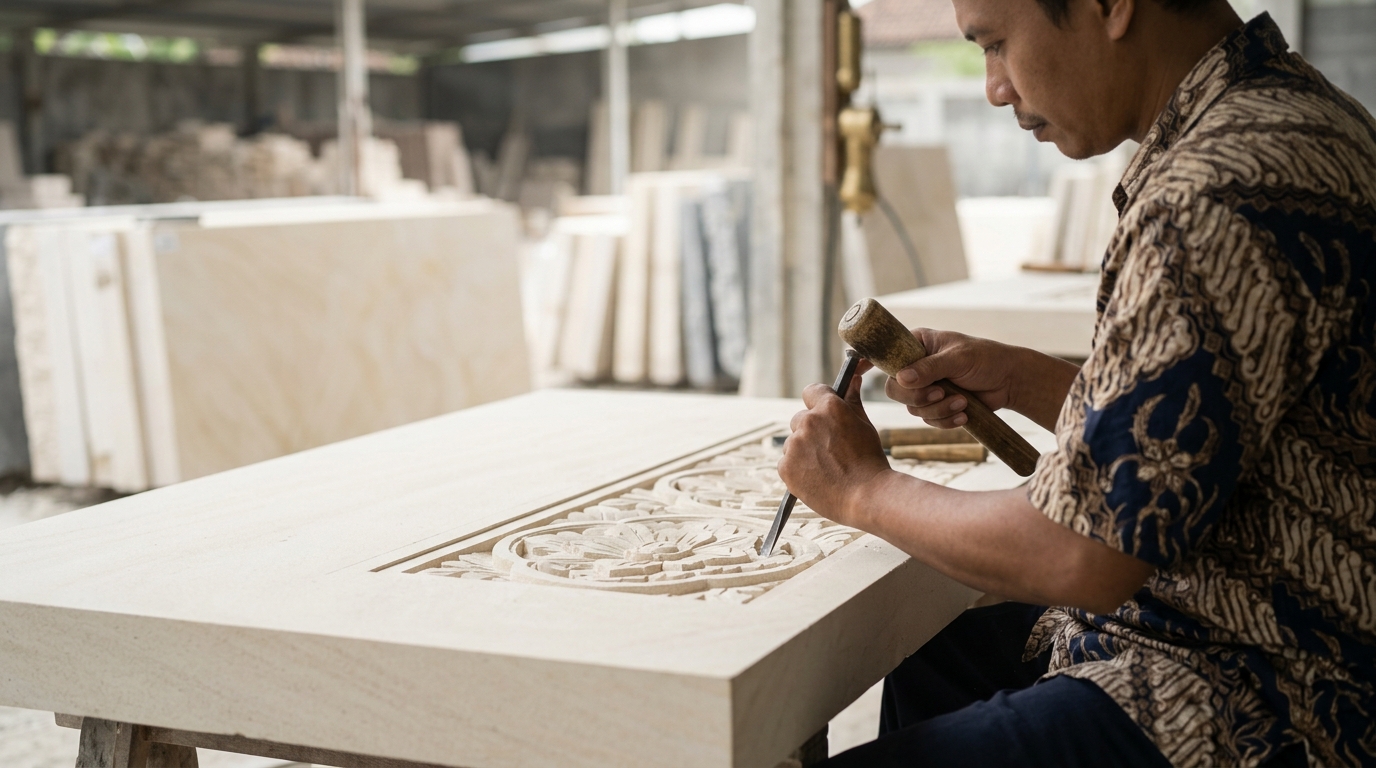
Workability is the second driver. Paras limestone's Mohs hardness range of approximately 2.5–3.5 means skilled artisans can execute intricate relief work with hand chisels.
Colour consistency is the third driver. Well-managed quarries in Yogyakarta maintain relatively uniform colour lots across production runs — an important factor for large facade projects requiring matched panels.
Paras Jogja vs Bali White vs Palimanan: Hardness, Porosity and Carvability Compared
Technical specification comparison
The table below compares the three main varieties across the metrics most relevant to US importers. All figures are approximate industry benchmarks; individual quarry batches may vary. Request third-party test certificates from any supplier before committing to volume orders.
| Property | Paras Jogja | Bali White | Palimanan |
|---|---|---|---|
| Mohs hardness | ~2.5–3.0 | ~3.0–3.5 | ~2.0–2.5 |
| Density (approx.) | 1,600–1,900 kg/m³ | 1,800–2,100 kg/m³ | 1,400–1,700 kg/m³ |
| Water absorption | ~15–20% | ~10–15% | ~20–25% |
| Colour range | Cream, warm beige | Cool white, grey-white | Yellow-gold, ochre |
| Natural veining | Subtle, low contrast | Moderate, occasional grey bands | Visible fossil inclusions |
| Best use case | Intricate carving, facades | Facade cladding, pool tiles | Decorative panels, low-traffic |
| Price tier (relative) | Mid | Mid-high | Low-mid |
| Outdoor durability | Moderate | Moderate-good | Low-moderate |
Porosity implications for facade and outdoor use
Water absorption figures matter significantly for facade engineering. Paras Jogja's absorption rate of approximately 15–20% is high by limestone standards. Untreated panels in a wet-exposed facade will absorb water, which can cause staining, biological growth, and in freeze-thaw zones, spalling.
Bali white's lower absorption rate makes it the more practical choice for exterior cladding in climates with significant rainfall or freeze-thaw cycling. Palimanan's high absorption rate restricts it to sheltered or interior applications in most US markets.
Carvability vs. structural suitability
Paras Jogja is the carver's material. Its softness and fine grain allow hand-chiselled detail at a resolution that harder stones cannot match economically. For relief panels, temple motifs, architectural mouldings, and statuary, it remains the standard choice among Indonesian stone exporters supplying architectural carving clients.
Bali white suits flat or lightly textured applications: honed tiles, split-face cladding panels, bullnose pool copings. Its marginally higher density improves structural performance in loaded applications such as paving or thick wall panels.
Cladding Panels, Carved Ornaments, Tiles and Landscape Elements: Application Guide
Facade and wall cladding
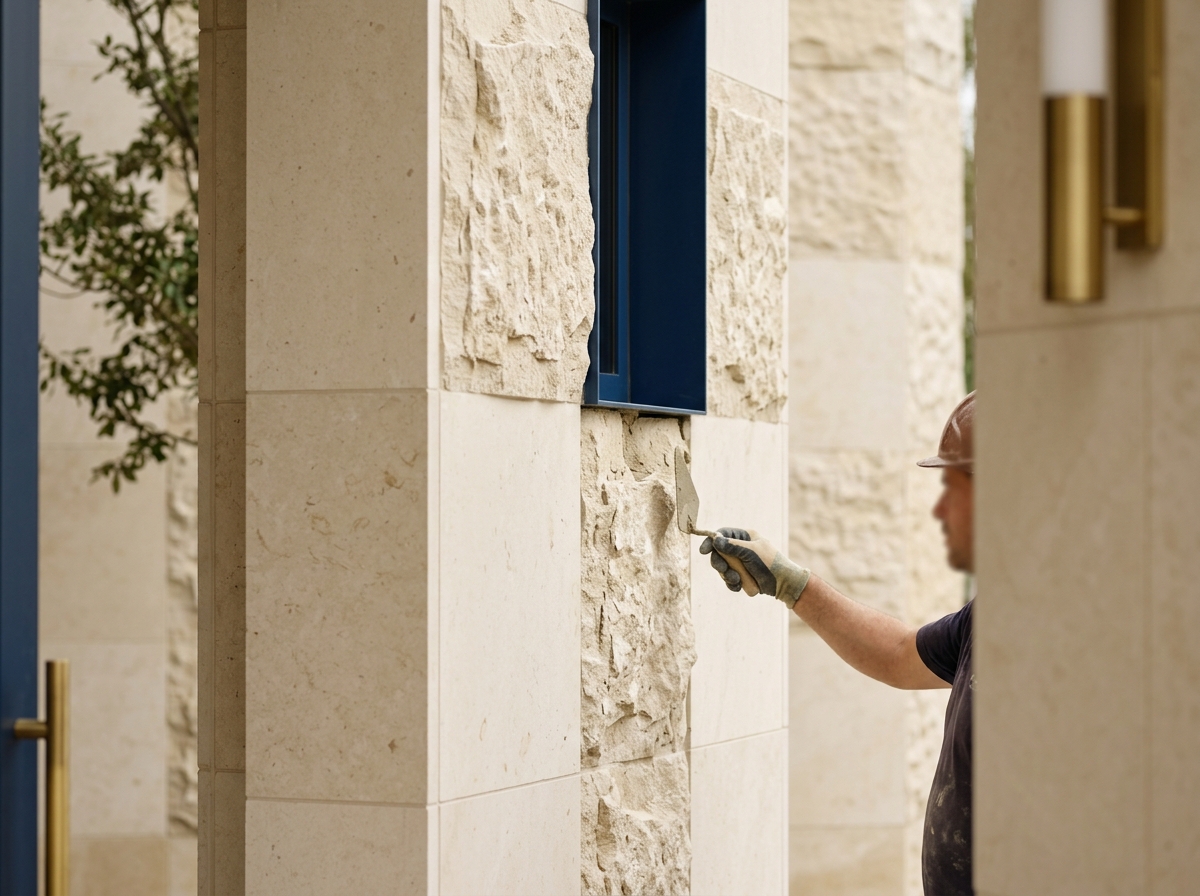
Standard panel sizes from Indonesian limestone suppliers for cladding applications are typically 30×60 cm, 40×80 cm, and 60×60 cm. Custom cut-to-size is available from most established exporters. Thickness typically ranges from 20 mm to 50 mm depending on structural load requirements.
Available surface finishes include:
- Honed — smooth, matte surface; standard for interior and sheltered facade applications - Brushed / antiqued — lightly textured surface; increases slip resistance and hides minor colour variation - Split-face — natural cleft surface; high texture; used for accent walls and rustic facade applications - Bush-hammered — mechanically textured; good slip resistance; suited to floor and paving applications
Ornamental carving
Paras Jogja dominates this category. Carved products available from Indonesian stone exporters include:
- Relief wall panels (floral, geometric, figurative motifs) - Architectural mouldings and corbels - Column bases and capitals - Statuary and garden sculpture - Temple-style gate surrounds and archways
Lead times for custom carved pieces typically run 4–10 weeks depending on complexity and order volume. Catalogue items can ship faster.
Floor tiles and pool surrounds
For floor tile applications, recommended thickness is 30 mm minimum for exterior use. Slip rating should be confirmed against ANSI A137.1 standards before specifying paras limestone in wet or outdoor floor applications. Bali white is generally preferred over paras Jogja for pool copings due to its lower water absorption.
Landscape and garden elements
Common export items include planters, fountains, paving sets, and pathway panels. These are typically sourced as finished products in mixed container loads.
How Paras Limestone Performs Across US Climate Zones: Weathering Data for Specifiers
Freeze-thaw zones (Northeast, Midwest, Mountain West)
This is paras limestone's most demanding environment. High water absorption rates mean that untreated stone in a freeze-thaw climate will absorb moisture and expand during freezing cycles. Over multiple seasons, this causes surface spalling, edge chipping, and joint failure.
Mitigation requires a penetrating impregnating sealer applied before installation and reapplied on a schedule appropriate to the climate — typically every 2–4 years for exterior applications. Specify a breathable, siloxane-based penetrating sealer rather than a surface-coating product. Surface coatings trap moisture and accelerate deterioration in freeze-thaw conditions.
Bali white, with its lower absorption rate, performs better than paras Jogja or Palimanan in northern climates. Even so, freeze-thaw exposure requires sealing and proper drainage detailing at the installation level.
Humid subtropical zones (Southeast US, Gulf Coast, Florida)
In humid subtropical climates, biological growth — algae, lichen, and moss — is the primary durability concern. Paras limestone's porous surface provides an ideal substrate for biological colonisation. Left untreated, surface discolouration appears within one to two seasons.
Recommendations for Southeast US projects:
- Apply a penetrating antimicrobial sealer at installation - Specify brushed or split-face finishes over honed; they show biological growth less prominently - Include a maintenance schedule of annual cleaning with a pH-neutral stone cleaner
Efflorescence — white salt deposits migrating through the stone — is also more common in humid climates where groundwater contact is possible. Proper waterproof membrane detailing behind cladding panels reduces this risk significantly.
Arid zones (Southwest US, California, Nevada)
Arid climates are paras limestone's most forgiving environment. UV exposure causes gradual colour lightening over years, particularly in darker cream tones. Thermal cycling between hot days and cool nights causes minor surface micro-cracking over long periods. Sealing remains recommended but maintenance intervals can be extended.
Supply Formats from Indonesian Limestone Exporters: Blocks, Tiles, Slabs and Finished Carvings
Raw block supply
Quarry blocks of paras limestone are typically available in dimensions of approximately 60×40×40 cm up to 120×60×60 cm. Minimum order quantities for raw block from quarry-direct suppliers typically start at one full container load (FCL) of approximately 20 tonnes. Smaller quantities may be available through consolidation exporters, often at a modest premium.
Lead time for raw blocks after order confirmation is typically 2–4 weeks, depending on quarry availability.
Cut-to-size tiles and slabs
Standard thickness tolerances for cut tiles from reputable Indonesian stone exporters are ±1–2 mm. Dimensional tolerances for length and width are typically ±1 mm for calibrated tiles.
Finished carved products
Finished carved panels and ornamental pieces are the highest-value export format. Pricing is per piece rather than per m². Custom designs require technical drawings or reference images submitted before production begins. Most established exporters offer a catalogue of standard motifs with shorter lead times.
Mixed container strategy
A mixed FCL container is the most cost-effective approach for importers combining product types. A standard 20-foot container can carry approximately 18–22 tonnes of stone depending on packing density. A typical mixed load might combine:
- Cut tiles and cladding panels (bulk packing, high density) - Carved relief panels (individually crated, lower density per m³) - Landscape elements such as planters or fountain basins
Consolidation exporters in Surabaya offer this service routinely. They purchase from multiple production workshops in Yogyakarta and Bali and consolidate into a single FCL at Tanjung Perak Port.
Export Packing Standards, Shipping Documentation and Indonesian Port Logistics
ISPM-15 packing compliance
All wooden packing materials — crates, pallets, and dunnage — used in Indonesian limestone export to the United States must comply with ISPM-15 (International Standards for Phytosanitary Measures No. 15). This requires heat treatment or methyl bromide fumigation of wood, marked with the IPPC symbol.
Packing specifications for carved pieces
Carved limestone pieces require layered protection:
- Individual wrap in bubble wrap or foam sheeting - EPE foam padding at all contact points inside the crate - Plywood inner crate with corner protectors - Outer wooden crate, ISPM-15 treated - Adequate void fill to prevent movement
- ✓Commercial invoice (in USD, with HS code declared)
- ✓Packing list (weight, dimensions, number of pieces per crate)
- ✓Certificate of Origin (from Indonesian Chamber of Commerce)
- ✓Phytosanitary certificate (for ISPM-15 wood packing)
- ✓Bill of Lading (FOB Surabaya/Tanjung Perak or agreed Incoterm)
- ✓Quarry origin declaration (for carved stone, to support HTS classification)
Shipping routes and cost structure
Most Indonesian paras limestone export shipments originate at Tanjung Perak Port in Surabaya, which services the Yogyakarta and East Java quarry regions. Bali-sourced stone may consolidate through Denpasar before transshipment to Surabaya or Singapore.
Typical Incoterm options from Indonesian stone exporters:
- FOB Surabaya — supplier covers inland freight and port loading; buyer arranges ocean freight - CIF US West Coast — supplier covers freight and insurance to a US port (Long Beach, Los Angeles)
Ocean freight for a 20-foot FCL from Surabaya to the US West Coast is a variable cost — request current rates from a freight forwarder at the time of sourcing, as ocean freight markets fluctuate significantly.
How to Vet and Qualify Indonesian Limestone Suppliers Paras Export Operations
Quarry ownership vs. trading house
This distinction matters for price, quality consistency, and accountability. A quarry-direct supplier controls raw material selection and can offer better colour lot consistency. A trading house purchases from multiple quarries and may blend lots, creating colour variation risk across large orders.
Verification signals to request:
- NIB (Nomor Induk Berusaha) — Indonesia's business registration number; confirms legal entity status - Export licence documentation — confirms the entity is authorised to export; smaller workshops without export licences must work through a documentary or full-service exporter - Quarry lease or ownership documentation — confirms direct quarry access - Previous export records — customs data platforms (ImportGenius, Panjiva) allow US buyers to verify declared shipment history for Indonesian exporters
Sample ordering process
Always order physical samples before placing a volume order. Request:
- A minimum of three to five sample pieces per variety, cut from different positions in the quarry batch - Wet samples (pour water on the surface) to assess colour shift when wet — relevant for pool and outdoor applications - Samples with the proposed surface finish applied
Evaluate samples for colour consistency, surface defects, edge chipping tendency, and any visible fossil inclusions that may indicate structural weakness in thin tiles.
Red flags
Questions to ask before issuing a purchase order
- What is your NIB and export licence number? - Do you quarry directly or purchase from third-party quarries? - What is your colour lot control process for large orders? - Can you provide a pre-shipment inspection access for a third-party inspector? - What is your replacement or credit policy for damaged or out-of-tolerance pieces?
Pricing Benchmarks and Total Landed Cost Calculation for US Stone Importers
FOB price benchmarks (approximate)
All figures below are approximate benchmarks based on general market knowledge. Actual prices vary by order volume, finish specification, and supplier type. Request formal quotations from at least three suppliers before budgeting.
| Product format | Approx. FOB Indonesia price range |
|---|---|
| Paras Jogja honed tiles (30×60 cm) | USD 18–35 per m² |
| Bali white honed tiles (30×60 cm) | USD 25–45 per m² |
| Split-face cladding panels | USD 20–40 per m² |
| Simple carved relief panels (standard catalogue) | USD 40–120 per piece |
| Custom carved relief panels (complex design) | USD 80–400+ per piece |
| Raw quarry blocks (per tonne, FOB) | USD 80–180 per tonne |
US import duties and HTS code classification
Indonesian limestone products are classified under HTS Chapter 25 (HS 2515) for unworked or roughly worked limestone, and HTS Chapter 68 for worked stone articles including tiles and carved pieces. Key classifications:
- HTS 2515.12 — Merely cut limestone blocks and slabs: generally low or zero duty rate under the US General rate schedule - HTS 6802.91 / 6802.92 — Worked monumental or building stone (tiles, slabs, panels): duty rates typically in the range of approximately 3–4.9% ad valorem - HTS 6802.10 — Tiles and similar articles: check current USITC tariff schedule for exact rates
Indonesia currently benefits from standard Most Favoured Nation (MFN) tariff rates. There are no additional Section 301 tariffs on Indonesian stone products as of the time of writing, unlike Chinese-origin stone goods. Confirm current rates with a licensed customs broker before finalising your landed cost model.
Total landed cost model
A simplified landed cost model for paras limestone tiles (20 m² sample volume, CIF Los Angeles):
| Cost element | Approximate contribution |
|---|---|
| FOB material cost | Base price |
| Ocean freight (FCL share) | Add approx. 15–25% to FOB |
| Marine insurance | Add approx. 0.5–1% of cargo value |
| US port handling / ISF filing | Add fixed cost (estimate with broker) |
| US import duty (approx. 3–4.9%) | On CIF value |
| Inland freight to project site | Variable by destination |
Competitive positioning vs. Turkish and Indian limestone
| Origin | Approx. FOB tile price | Carving capability | Freeze-thaw durability | Section 301 tariffs |
|---|---|---|---|---|
| Indonesia (paras) | Low-mid | Excellent (hand carving) | Moderate (seal required) | None currently |
| Turkey (travertine/limestone) | Mid | Limited hand carving | Good | None currently |
| India (Kota, Jaisalmer) | Low-mid | Moderate | Moderate | None currently |
| China (limestone tiles) | Low | CNC only | Variable | Yes (Section 301) |
Indonesian paras export product offers the most competitive combination of hand-carving capability and price point among available origins. For purely structural tile or slab applications without carving, Turkish or Indian origins may offer comparable value with marginally better density and freeze-thaw performance.
Frequently Asked Questions from US Importers Sourcing Indonesian Paras Limestone
What is the difference between paras Jogja and Bali white limestone? Paras Jogja comes from Yogyakarta, Java. It is softer (Mohs approximately 2.5–3.0), warmer cream in colour, and the preferred material for hand carving.
Can Indonesian paras limestone be used outdoors in cold US climates? Yes, but only with proper sealing and drainage detailing. Paras Jogja and Palimanan have high water absorption rates and are vulnerable to freeze-thaw spalling if left unsealed. Bali white performs better in cold climates.
What are the standard export packing requirements for carved limestone pieces? Carved pieces must be individually wrapped, foam-padded, and packed in ISPM-15-certified wooden crates. Standard documentation includes a commercial invoice, packing list, certificate of origin, phytosanitary certificate, and bill of lading.
What minimum order quantities do Indonesian limestone exporters typically require? For raw blocks, most quarry-direct suppliers require a minimum of one FCL (approximately 18–22 tonnes). For cut tiles and panels, MOQ may start at approximately 50–100 m² per item, though consolidation exporters can aggregate smaller quantities.
How do I verify that an Indonesian limestone supplier is legitimate and export-ready? Request their NIB (Indonesian business registration number), export licence, and quarry documentation. Cross-reference their export history using customs data platforms such as ImportGenius or Panjiva.
What US import duties apply to Indonesian limestone tiles and carved stone products? Standard MFN duty rates apply. Unworked limestone (HTS 2515) carries low or near-zero rates. Worked stone articles including tiles and panels (HTS 6802) carry approximately 3–4.9% ad valorem. Indonesian goods are not subject to Section 301 additional tariffs.
Paras limestone from Indonesia offers US importers a technically capable, price-competitive material for facade cladding, ornamental carving, and landscape applications — provided suppliers are properly vetted, climate performance is understood, and export logistics are structured correctly.
You now have the specification data, the supplier qualification framework, the logistics checklist, and the landed cost model to make an informed sourcing decision. The natural next step is to validate that knowledge against actual samples and supplier documentation.
You understand the material, the climate risks, and the import logistics. Now put Indonesian limestone suppliers paras export capability to the test with your own specifications. Request a free sample set and a formal export quote from verified Indonesian natural stone exporters — including paras Jogja, Bali white, and Palimanan varieties in your required formats and finishes.
Request Free Samples and Export Quote →Need eyes on the ground in Indonesia?
MTS is an execution partner — supplier verification, manufacturing management, quality control and export logistics across Indonesia, Vietnam and China.
Related services
Receive furniture sourcing insights across Asia.
One email per week. No spam.