Indonesian Natural Stone: Marble, Granite, and Andesite Export Guide
13 min read
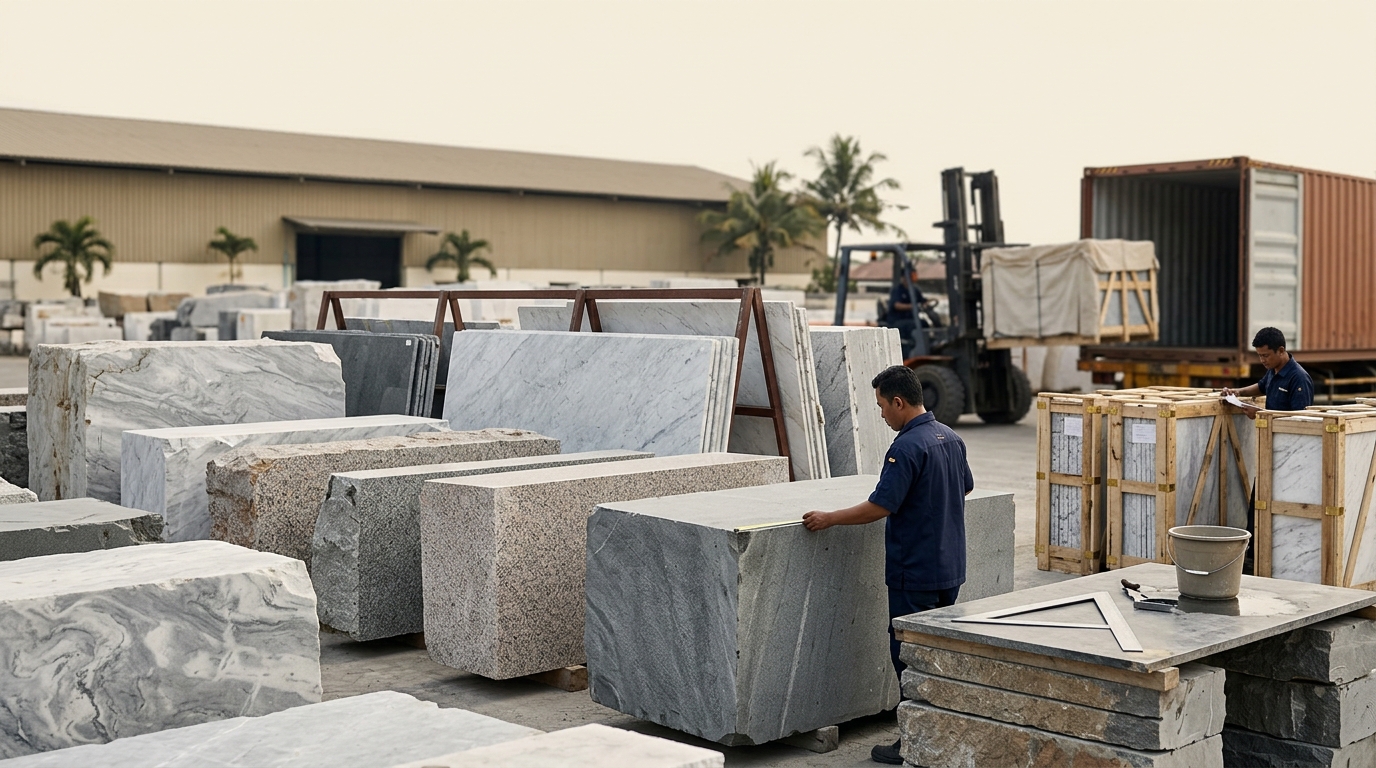
Sourcing indonesian natural stone marble granite andesite requires more than browsing supplier catalogues. International buyers — architects, hospitality developers, and stone importers — need quarry-level block dimensions, verified finishing options, container loading specifications, and…
Sourcing indonesian natural stone marble granite andesite requires more than browsing supplier catalogues. International buyers — architects, hospitality developers, and stone importers — need quarry-level block dimensions, verified finishing options, container loading specifications, and applicable ASTM standards before committing to a purchase order. Without this data, procurement decisions rely on assumptions that inflate project risk.
Indonesia sits on the Pacific Ring of Fire. That geological position produces an extraordinary range of stone types across thousands of islands. Marble deposits in West Java and Sulawesi, granite in Kalimantan and Bangka-Belitung, andesite across Bali and Central Java, and specialty volcanic stones like Sukabumi green quartz — each has distinct physical properties that determine how it performs in commercial applications. Understanding those properties in procurement terms, not just aesthetic ones, separates successful import programs from costly mistakes.
This guide covers stone variety specifications, quarry regions, export block dimensions, container loading standards, ASTM and ISO quality benchmarks, FOB pricing ranges, and a supplier qualification framework. The information is structured for buyers who cannot visit quarries in person and must make high-confidence decisions remotely.
Why Indonesia Produces an Unmatched Range of Commercial Natural Stone
Indonesia's tectonic position is the root cause of its stone diversity. Active and dormant stratovolcanoes, ancient limestone formations, and deep metamorphic zones collectively generate marble, granite, andesite, and volcanic stone within a single national supply base. No other Southeast Asian country matches this variety.
Key Producing Regions and What They Supply
| Region | Primary Stone Type | Notable Varieties |
|---|---|---|
| West Java (Citatah) | Marble | Citatah Beige, Royal Oyster, Zion Beige |
| Sulawesi | Marble | White and grey crystalline marble |
| Kalimantan | Granite | Dark and light grey granites |
| Bangka-Belitung | Granite | Coastal granite, medium grain |
| Bali | Andesite, Lava Stone | Grey andesite pavers, lava cladding |
| Central Java | Andesite | Honed and split-face tiles |
| East Java | Andesite, Limestone | Palimanan limestone, volcanic basalt |
| West Java (Sukabumi) | Volcanic quartz | Sukabumi green zeolite stone |
Demand Drivers From the Hospitality and Luxury Sectors
Global hospitality developers consistently source indonesian natural stone marble granite andesite for resort projects across Southeast Asia, the Middle East, and the United States. Andesite pool surrounds, marble lobby flooring, and lava stone facade cladding appear in flagship hotel projects precisely because Indonesia's supply base offers competitive FOB pricing, large block availability, and a wide finish menu — all within a single origin country.
Indonesian Natural Stone Marble Granite Andesite: Specifications by Stone Type
The table below provides a scannable reference for procurement managers comparing stone types across key technical parameters.
| Stone Type | Mohs Hardness | Typical Block Dimensions (cm) | Standard Finishes | Primary Applications | Key Standard |
|---|---|---|---|---|---|
| Marble (Citatah) | 3–4 | L 150–300, W 60–150, H 50–100 | Polished, honed, brushed | Flooring, wall cladding, vanities | ASTM C503 |
| Granite (Kalimantan) | 6–7 | L 180–320, W 60–180, H 50–120 | Polished, flamed, brushed | Countertops, exterior paving, facades | ASTM C615 |
| Andesite | 5–6 | Tiles: 30×30 to 60×60 cm; blocks on request | Honed, split-face, sandblasted | Pool decks, wall cladding, paving | ASTM C568 (approx.) |
| Sukabumi Green | 4–5 | Tiles: 10×40, 20×20, custom | Honed, natural cleft | Pool linings, spa walls, water features | Zeolite test reports |
| Palimanan Limestone | 3–4 | Tiles: 30×30 to 60×60 cm | Honed, sandblasted, natural | Outdoor paving, garden walls | — |
Citatah Marble and Indonesian Marble Export: Varieties, Block Dimensions, and Documentation
Main Marble Varieties From Indonesia
Citatah Beige is the most commercially active variety from West Java. Its warm cream-beige ground with subtle veining suits high-traffic lobby and corridor flooring. Royal Oyster offers a grey-brown tone with irregular patterning favored in hospitality bathrooms. Zion Beige presents a lighter, more uniform background preferred in wall applications. Sulawesi white marble has a crystalline structure and brighter white tone comparable to some Turkish or Greek whites, though with greater natural variation per block.
Quarry Block Dimensions and Yield Data
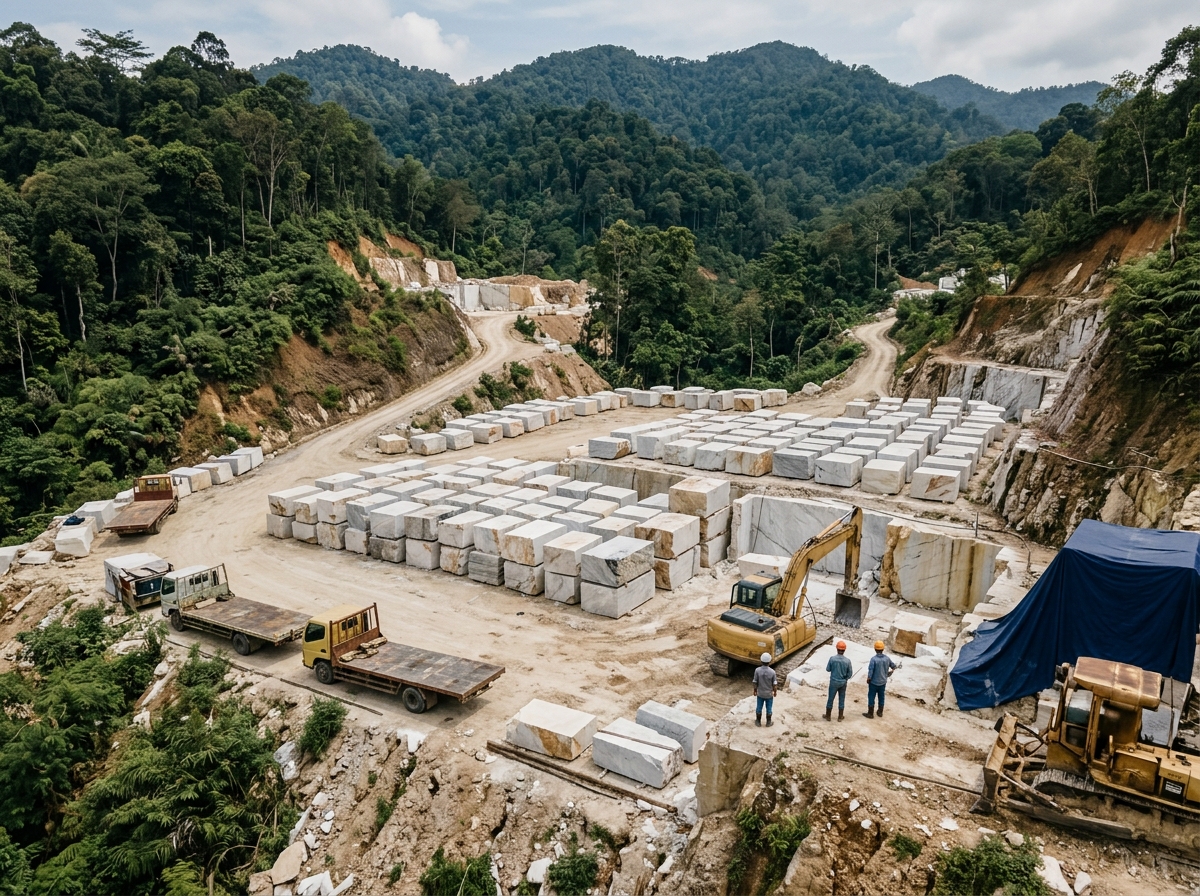
Indonesian marble quarries typically produce blocks in the following approximate ranges:
- Length: 150–300 cm - Width: 60–150 cm - Height: 50–100 cm - Approximate block weight: 4–12 metric tons depending on dimensions
Block yield — the percentage of usable slab area extracted from a raw block — varies by quarry and variety. Citatah Beige commonly achieves approximately 55–70% yield from raw block to finished slab, based on quarry operator estimates. Heavily veined blocks yield lower usable area. Buyers should request block yard photos showing cross-section cuts before committing to volume orders.
Export Documentation for Indonesian Marble
Marble falls under HS Code 2515 for blocks and slabs. Standard export documentation includes:
- Commercial invoice and packing list - Bill of Lading (FCL or LCL) - Certificate of Origin (Form E or GSTP) - Phytosanitary certificate (required for wooden crating material) - Material test report referencing ASTM C503 (absorption, density, compressive strength)
Indonesian Granite: Hardness, Quarry Locations, and Slab Dimensions
Quarry Regions and Stone Characteristics
Commercially viable granite in Indonesia is concentrated in Kalimantan, Bangka-Belitung, and parts of Sulawesi. These deposits formed through deep igneous intrusion, producing dense, coarse-crystalline stone with Mohs hardness typically between 6 and 7. This hardness makes Indonesian granite well-suited for exterior paving, countertops, and high-traffic facade cladding.
Standard Dimensions and Custom Cutting
Granite blocks from Kalimantan quarries commonly measure approximately 180–320 cm in length, 60–180 cm in width, and 50–120 cm in height. Processing facilities in Java and Sulawesi cut blocks into standard slabs (approximately 240×120 cm or 260×130 cm) or custom dimensions. Tiles are typically cut to 30×30, 40×40, 60×60, or 60×30 cm with thickness options of 2 cm, 3 cm, or custom.
Indonesian Granite vs. Brazilian and Indian Alternatives
| Parameter | Indonesian Granite | Brazilian Granite | Indian Granite |
|---|---|---|---|
| Approx. FOB price range | Lower–mid | Mid–high | Lower–mid |
| Color range | Limited (grey, dark grey) | Wide (multi-color) | Wide |
| Block availability | Good for grey tones | Excellent | Excellent |
| Lead time to US port | Approximately 25–35 days | Approximately 30–45 days | Approximately 25–40 days |
| ASTM C615 test availability | Available on request | Widely available | Widely available |
Indonesian granite's primary competitive advantage is price efficiency on grey and dark tones combined with short lead times into Southeast Asian project sites. For US buyers, Brazilian and Indian suppliers still offer broader color variety, but Indonesian granite competes effectively on exterior grey paving and facade applications.
Andesite Volcanic Stone: Properties, Performance Data, and Commercial Applications
How Volcanic Origin Affects Procurement Decisions
Andesite forms from lava flows of stratovolcanoes. Its fine crystalline grain structure and mineral composition — primarily plagioclase feldspar and pyroxene — produce a dense, low-porosity stone. Water absorption for quality andesite is typically below 3%, which limits efflorescence and staining in wet-area applications. This volcanic origin is a practical advantage, not just a geological fact: lower porosity means reduced sealing frequency compared to limestone or softer marble.
Key Physical Properties
- Mohs hardness: approximately 5–6 - Slip resistance: naturally textured split-face and honed finishes meet commercial slip-resistance requirements for pool decks - Thermal stability: low thermal expansion coefficient; performs well in high-sun exterior applications - Water absorption: typically 1–3% (quarry-dependent; request test data)
Primary Applications and Quarry Zones
Bali andesite is the most internationally recognized variety, appearing in luxury resort pool surrounds and garden paving across Asia and the Pacific. Central Java and East Java supply larger volumes of grey andesite for paving, wall cladding, and hotel facade projects.
Typical andesite tile dimensions available from Indonesian suppliers:
- 30×30 cm, 40×40 cm, 60×30 cm, 60×60 cm - Thickness: 2 cm, 2.5 cm, 3 cm - Custom sizes available with minimum lead time of approximately 30–45 days from order confirmation
Sukabumi Green and Specialty Volcanic Stones: What Sets Indonesian Suppliers Apart
Sukabumi Green Quartz: Composition and Performance
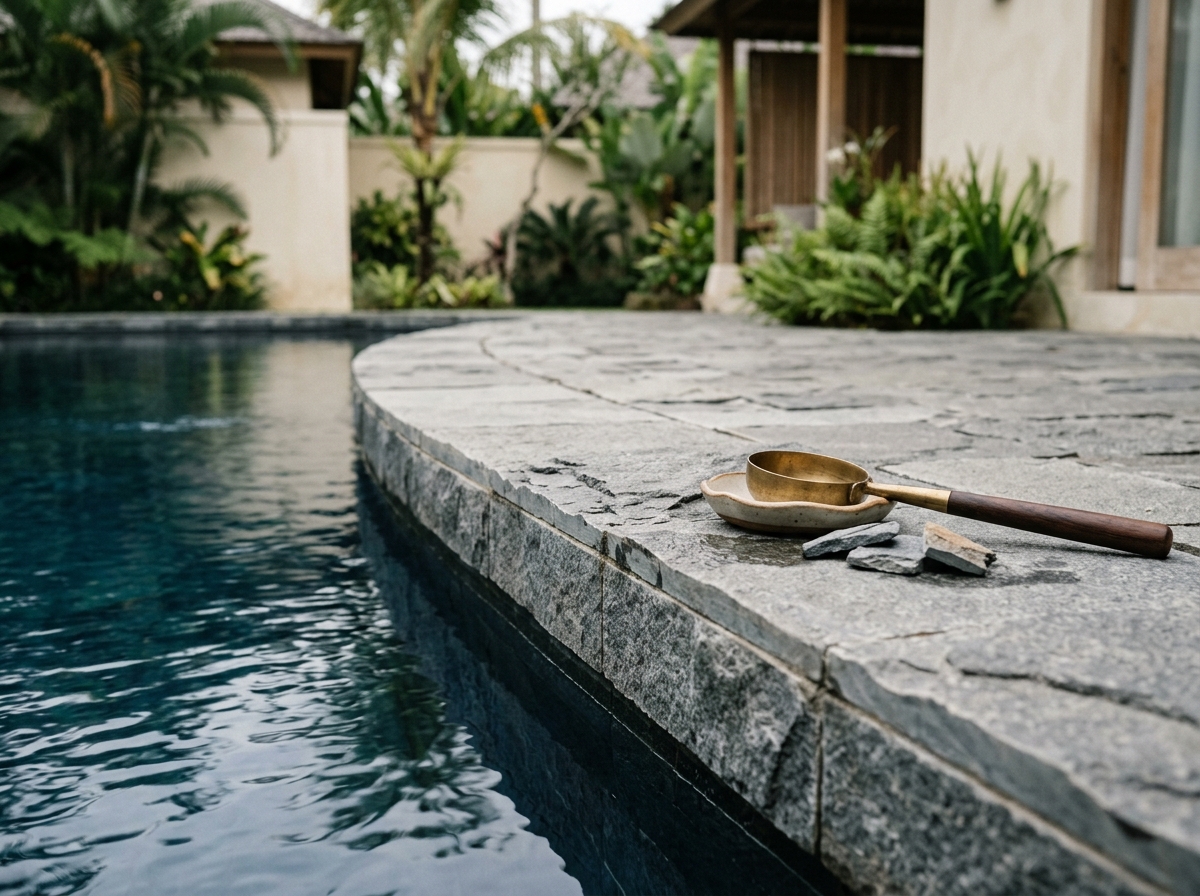
Sukabumi green stone is quarried exclusively in the Sukabumi district of West Java. Its distinctive blue-green color comes from a zeolite mineral matrix — clinoptilolite — that has natural ion-exchange and water-purifying properties. This is not a marketing claim; zeolite mineral content is verifiable through petrographic analysis and chemical testing.
Practical import implications:
- Zeolite composition gives the stone a characteristic color shift when submerged, deepening to an aqua-green. This effect is desirable in pool applications. - Water absorption is moderate; sealing is recommended for spa applications where chemical exposure is frequent. - Available in honed, natural cleft, and custom finishes. - Standard tile sizes: 10×40 cm (pool coping strips), 20×20 cm, and custom.
For buyers supplying luxury pool projects in the United States, request zeolite content test reports and chlorine resistance data. Some Indonesian suppliers have obtained independent laboratory certifications for pool and spa applications.
Palimanan Limestone and Lava Stone
Palimanan limestone, quarried in East Java, is a warm cream-golden sedimentary stone used for outdoor paving and garden walls. It is softer than andesite (approximately Mohs 3–4) and requires sealing in exterior applications. Its affordability makes it a competitive option for large-area garden landscaping.
Lava stone (volcanic basalt) from Bali and Java is extremely dense and dark grey to black. It is used for feature walls, water feature surrounds, and accent cladding. Its high iron content means it can develop surface oxidation if unsealed; buyers should specify surface treatment requirements upfront.
Export Logistics for Indonesian Stone: Container Loading, Packaging, and Quality Grading
Container Configurations and Typical Loads
| Container Type | Internal Volume | Typical Granite/Marble Block Load | Typical Tile Load |
|---|---|---|---|
| 20 ft standard | ~33 CBM | 18–22 metric tons of blocks | Approximately 800–1,200 sqm of 2 cm tiles |
| 40 ft HC | ~76 CBM | 20–26 metric tons (weight-limited) | Approximately 1,800–2,500 sqm of 2 cm tiles |
Raw blocks are typically loaded directly onto container floors with timber bracing. Slabs are loaded in A-frame wooden bundles. Tiles ship in wooden crates with foam or bubble wrap inter-layering.
Packaging Standards for Slabs and Tiles
- Slabs: A-frame wooden bundles, foam edge protection, steel strapping. Approximately 10–20 slabs per bundle depending on thickness. - Tiles: Wooden crates, foam inter-leaf between tiles, pallet base for forklift handling. - Raw blocks: Timber chocks and steel cable lashing within container.
Quality Grading System
Indonesian stone suppliers typically apply a three-tier grading system:
- Grade A: Minimal color variation, no visible cracks, consistent dimensions within ±1 mm tolerance, uniform finish quality. - Grade B: Moderate color variation, minor surface irregularities, dimensional tolerance ±2–3 mm. - Commercial grade: Significant variation, may include repaired cracks, dimensional tolerance broader than Grade B.
Inspection at origin (pre-shipment inspection) is strongly recommended for all Grade A orders. Reference ASTM C503 for marble and ASTM C615 for granite when specifying acceptance criteria in purchase orders.
How to Qualify Indonesian Natural Stone Suppliers Remotely
Quarry Owner vs. Trading Company
The distinction matters operationally. A quarry owner controls block availability, raw material yield, and can provide actual block yard documentation. A trading company may offer more stone variety but adds a margin layer and less direct quality control. Many Indonesian stone exports move through export-specialist intermediaries — particularly for smaller quarries that lack export licensing infrastructure.
- ✓Confirm quarry ownership or primary supply source documentation
- ✓Request block yard photos with date-stamped GPS metadata
- ✓Obtain ASTM-referenced material test reports (within 24 months)
- ✓Verify export license and HS code compliance
- ✓Review recent Bill of Lading data for confirmed export history
- ✓Request Grade A sample set with production lot reference
- ✓Confirm MOQ for tiles, slabs, and raw blocks separately
- ✓Ask for container loading photos from recent shipments
- ✓Verify phytosanitary certification process for wooden packaging
- ✓Check ISO 9001 or equivalent quality management certification
MOQ Benchmarks for Indonesian Stone
- Tiles: Minimum order quantities typically start at approximately 50–100 sqm per size and finish combination. - Slabs: Commonly one full bundle (10–20 slabs) as minimum; full container orders preferred. - Raw blocks: Typically one full 20 ft container as minimum (approximately 18–22 metric tons).
Lead times from order confirmation to FOB loading: approximately 30–60 days for tiles (depending on finish complexity), 45–90 days for custom-cut slabs.
Red Flags in Supplier Qualification
- Certificates not tied to a specific quarry or production lot - Refusal to provide block yard photos or GPS location - MOQs that force full container orders without sample availability - Test reports older than 36 months - No verifiable export history (no Bill of Lading references) - Single point of contact with no technical staff accessible
FOB Pricing Guide: Indonesian Marble, Granite, and Andesite Cost Comparison
Indicative FOB Price Ranges
All figures below are approximate and subject to exchange rate fluctuation, finish complexity, and shipping distance from quarry to export port.
| Stone Type | Finish | Approx. FOB Price Range (per sqm) |
|---|---|---|
| Citatah Beige marble | Polished, 2 cm | USD 35–65 |
| Sulawesi white marble | Polished, 2 cm | USD 45–80 |
| Kalimantan granite | Polished, 2 cm | USD 25–50 |
| Grey andesite | Honed, 2.5 cm | USD 15–35 |
| Sukabumi green | Honed, 2 cm | USD 45–90 |
| Palimanan limestone | Honed, 3 cm | USD 12–25 |
Factors That Move Price
- Finish type: Polished finishes add processing cost over honed. Sandblasted and brushed finishes vary by equipment availability. - Thickness: Custom thicknesses beyond standard 2–3 cm require additional cutting time and increase waste factor. - Block yield: Low-yield blocks (heavily veined marble, irregular volcanic stone) increase per-sqm cost. - Currency: Indonesian Rupiah fluctuation against USD affects supplier pricing. Lock in pricing in USD for purchase contracts. - Shipping rates: Container freight from Indonesian ports to US West Coast or East Coast varies significantly by season and carrier availability.
Frequently Asked Questions
What is the national or most iconic stone of Indonesia?
No single stone holds official national designation. Commercially, andesite is the most widely produced and exported stone type, given Indonesia's extensive volcanic geology. Culturally, Bali's grey andesite — used in temple and palace architecture for centuries — is the most iconically Indonesian stone in international perception.
What is the difference between andesite and granite in terms of composition and use?
Andesite is an extrusive volcanic rock formed from rapid surface cooling of lava. Granite is an intrusive igneous rock formed from slow underground cooling of magma. This produces different crystal sizes: andesite is fine-grained, granite is coarse-grained. Granite (Mohs 6–7) is harder than andesite (Mohs 5–6). Granite suits high-load countertops and exterior paving under heavy traffic. Andesite suits pool surrounds, wall cladding, and paving where slip resistance and thermal stability matter more than compressive load.
Is there commercially viable marble in Indonesia and where is it quarried?
Yes. Citatah in West Java is the most active commercial marble quarrying region, producing Citatah Beige, Royal Oyster, and Zion Beige varieties at export scale. Sulawesi supplies white and grey crystalline marble with strong export demand. Both regions have established processing facilities capable of producing polished slabs to international specification.
What stone is Bali most famous for and why is it used in luxury resorts?
Bali is most associated with grey andesite, a volcanic stone quarried across the island and neighboring Java. Its natural slip resistance makes it safe for wet areas. Its thermal stability prevents surface cracking under direct sunlight. Its neutral grey tone integrates with tropical resort aesthetics. These functional properties — not just appearance — explain its dominance in luxury hospitality specifications across Asia-Pacific.
What are the standard export block dimensions for Indonesian marble and granite?
Indonesian marble blocks typically range from approximately 150–300 cm in length, 60–150 cm in width, and 50–100 cm in height. Granite blocks from Kalimantan and Bangka-Belitung commonly range from approximately 180–320 cm in length, 60–180 cm in width, and 50–120 cm in height. These are quarry-dependent estimates; buyers should request specific block yard inventories and dimensional documentation before placing orders.
How does Indonesian andesite perform for pool deck and wet-area applications?
Andesite performs well in pool and wet-area applications for three verifiable reasons: low water absorption (typically 1–3%), natural surface texture that provides slip resistance without additional treatment, and thermal stability that prevents surface cracking under temperature variation. Honed and split-face finishes are both appropriate for pool decks. Sealing is recommended in environments with high chemical exposure (saltwater pools, heavy chlorination). Request laboratory water absorption and slip-resistance test data from suppliers for specification compliance.
Indonesian natural stone marble granite andesite offers one of the broadest commercial supply profiles of any single-origin stone market globally. Buyers who move beyond surface-level supplier searches and demand quarry documentation, ASTM-referenced test data, and verified container loading specifications will reduce procurement risk substantially and negotiate from an informed position.
You now have the technical framework to evaluate Indonesian stone suppliers against international quality standards, compare stone types by application, and build a realistic landed-cost budget for US-bound shipments.
You understand the block dimensions, ASTM standards, and supplier qualification criteria — the logical next step is getting verified export specs directly from qualified Indonesian quarry suppliers. Request current block yard documentation, material test reports, and FOB pricing for marble, granite, andesite, and Sukabumi green stone today.
Request Export Specifications →Need eyes on the ground in Indonesia?
MTS is an execution partner — supplier verification, manufacturing management, quality control and export logistics across Indonesia, Vietnam and China.
Related services
Related articles
Receive furniture sourcing insights across Asia.
One email per week. No spam.