Natural Stone Paving Suppliers Indonesia: Sourcing Guide for Hardscape Contractors
14 min read
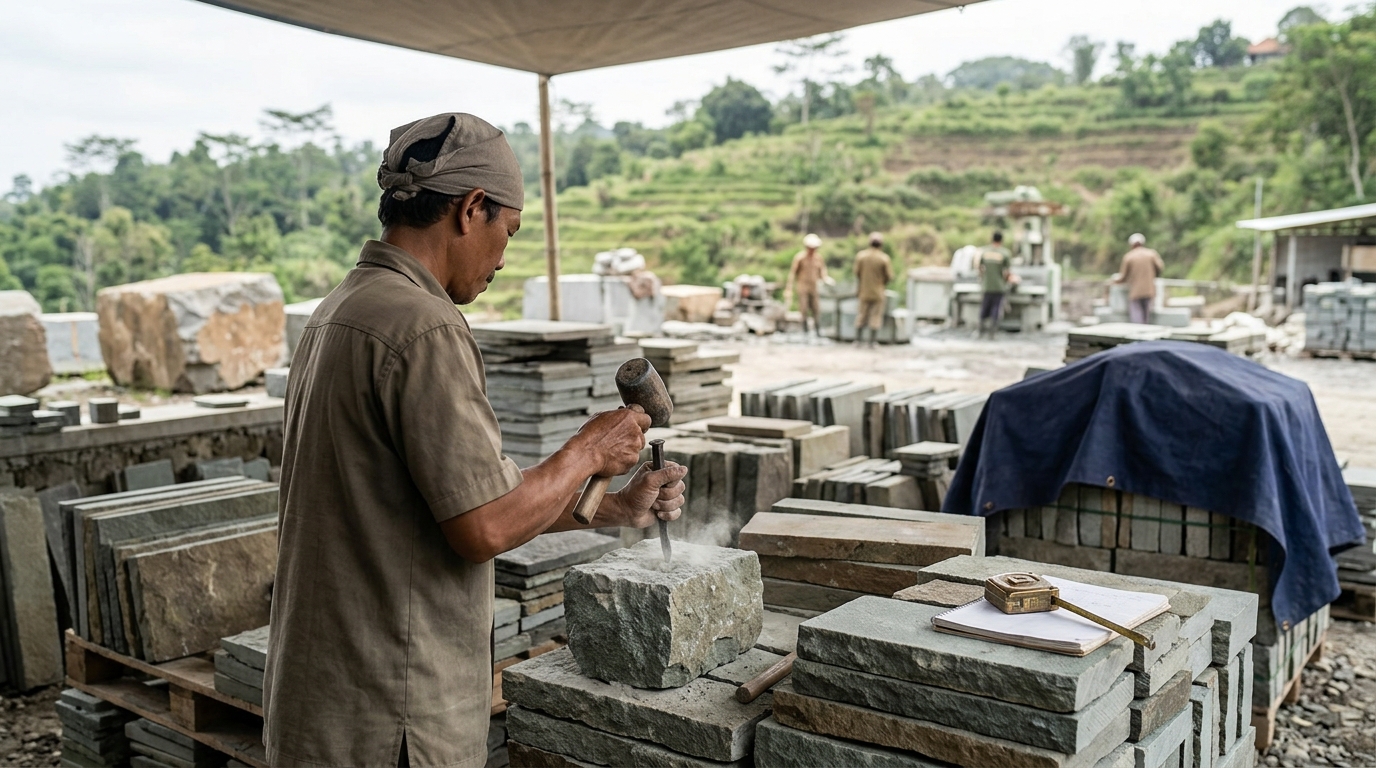
US hardscape distributors and public-space contractors face a specific problem when sourcing stone paving internationally: the gap between a supplier's product listing and the specification data needed to make a compliant, cost-effective purchasing decision. Indonesian stone has moved from a niche…
US hardscape distributors and public-space contractors face a specific problem when sourcing stone paving internationally: the gap between a supplier's product listing and the specification data needed to make a compliant, cost-effective purchasing decision. Indonesian stone has moved from a niche option to a mainstream sourcing destination, but most available guidance stops at product photos and vague price ranges. That is not enough for contractors specifying stone for municipal plazas, resort driveways, or loading-bay surfaces.
This guide covers the full procurement workflow for natural stone paving suppliers Indonesia. It addresses stone selection by traffic class, format and thickness standards, surface finish and slip resistance, supplier qualification signals, US import compliance, and landed cost planning. Each section is structured around the decisions a procurement team actually faces, not a catalogue description.
Indonesian exporters now ship andesite cobbles, basalt flags, Palimanan sandstone slabs, and blacklava stoneto buyers across North America, Europe, and the GCC. The infrastructure is in place. The due diligence process, however, requires more rigour than many buyers apply. Work through this guide before you commit to a sample request or a full-container order.
Why Indonesian Natural Stone Paving Dominates Global Hardscape Sourcing
Volcanic Geology Creates Commercially Viable Stone at Scale
Indonesia sits on the Pacific Ring of Fire. That geology produces large, consistent deposits of andesite, basalt, and volcanic lava stone across Java and Bali. Palimanan sandstone comes from West Java. These are not artisan quarry volumes. They are commercial-scale deposits capable of supplying multi-container orders to consistent specification.
Competing origins — India, China, Vietnam — can supply similar stone types. Indonesia's edge is deposit density combined with proximity of quarrying, cutting, and export finishing operations in a single corridor. Java-based quarries feed fabrication workshops in the same province. Finished stone reaches Tanjung Perak port in Surabaya or Benoa port in Bali without complex inland logistics.
FOB Pricing Versus Competing Origins
FOB price comparisons across origins vary by stone type and format. As an approximate benchmark, Indonesian andesite cobbles and basalt flags are typically priced competitively against comparable Indian black basalt or Chinese granite cobbles on an FOB basis. Sandstone from Palimanan often undercuts equivalent Indian Kandla Grey or Raj Green sandstone at origin. Exact pricing depends on format, finish, and order volume — see the MOQ and pricing section below.
Export Infrastructure and Certifications
Tanjung Perak (Surabaya) handles the majority of Java stone exports. Bali exporters use Benoa or Celukan Bawang. Both ports have established LCL and FCL container services to US West Coast and East Coast destinations. Growing numbers of Indonesian stone exporters now provide third-party test reports covering compressive strength, water absorption, and abrasion resistance — the minimum documentation set US specifiers should require.
Stone Types by Traffic Class: Choosing the Right Material for Your Project
Not all Indonesian stone performs equally under load. Traffic class is the primary specification filter. The table below maps stone type to application and provides approximate performance benchmarks.
| Traffic Class | Recommended Stone | Format | Thickness | Approx. Compressive Strength |
|---|---|---|---|---|
| Pedestrian only | Palimanan sandstone, black lava stone | Flags 300–600mm, crazy paving | 20–30mm (¾–1¼ in) | 40–80 MPa (approx.) |
| Light vehicular (driveways, plazas) | Andesite, black lava stone | Cobbles 100–150mm, flags | 50–70mm (2–2¾ in) | 150–200 MPa (andesite, approx.) |
| Heavy vehicular (loading bays, ports) | Basalt, andesite | Cobbles 100–150mm | 80–100mm (3¼–4 in) | 200+ MPa (basalt, approx.) |
Andesite: The Default Choice for Vehicular Hardscape
Andesite is Indonesia's most widely exported paving stone. It is a dense igneous rock with compressive strength typically in the 150–200 MPa range (approximately 21,750–29,000 psi), making it suitable for driveways, public plazas, and light-traffic commercial forecourts. It is quarried extensively in West Java and East Java. Colours run from grey-black to blue-grey. It machines cleanly into cobbles, setts, kerbs, and flags.
Basalt: High-Traffic and Kerb Applications
Indonesian basalt is harder and denser than andesite. It is the preferred material for high-traffic public paving, kerb edging, and port or industrial hardscape. Compressive strength commonly exceeds 200 MPa (approximately 29,000 psi). Basalt cobblestones sourced from Java and Bali are a direct specification match for European EN 1342-compliant setts used in plaza and streetscape projects.
Sandstone and Lava Stone: Decorative and Resort Applications
Palimanan sandstone from West Java is a warm cream-to-gold stone. It is suitable for pedestrian zones, pool surrounds, and low-traffic decorative hardscape. It is not rated for vehicular loads. Black lava stone (also called volcanic stone) is popular across Bali resort and hospitality projects. It handles moderate pedestrian traffic and light vehicle access.Sukabumi green stoneis a distinct Indonesian volcanic stone used almost exclusively for pool coping and water-feature surrounds due to its colour and low thermal absorption.
Paving Formats and Dimensions Available From Indonesian Natural Stone Paving Suppliers
Indonesian suppliers offer a wider format range than many buyers expect. Standard and custom cutting is available from most mid-to-large exporters.
Cobbles and Setts - 100×100mm (4×4 in), 100×200mm (4×8 in), 150×150mm (6×6 in) - Suited for driveways, public squares, and pedestrian paths - Supplied in pitched, bush-hammered, or natural split finish
Flags and Slabs - 300×300mm (12×12 in) to 600×600mm (24×24 in) as standard - Custom sizes to 900×600mm (36×24 in) on MOQ — confirm with supplier - Large-format cutting adds lead time; allow an additional one to two weeks
Kerbs and Edging - Standard profile: 100×200×600mm (4×8×24 in) - Custom profiles available on MOQ, typically a minimum of one 20-ft container equivalent - Basalt and andesite are the preferred materials for kerb durability
Specialty Formats - Stepping stones: irregular or sawn, typically 400–600mm longest dimension - Crazy paving: natural split irregular flags, sold by square metre - Mosaic setts: 50×50mm (2×2 in), used for inlay patterns in plaza work - Pool coping: Sukabumi green stone and sandstone, radius-edge profiles available
Thickness Standards for Pedestrian and Vehicular Paving Applications
Thickness is a structural specification, not just a visual one. Under-specified thickness is the most common cause of stone paving failure in vehicular applications.
Pedestrian Applications
For pedestrian-only foot traffic, flags and slabs in andesite or sandstone are typically laid at 20–30mm (¾–1¼ in). Cobbles for pedestrian zones are typically 50–60mm (2–2⅜ in). BS EN 1341 covers sawn or split flags for pedestrian and light-traffic use and is referenced by Indonesian exporters targeting European and US specification markets.
Light Vehicular Applications
Driveways, car parks, and public plazas with occasional vehicle access require a minimum of 50–70mm (2–2¾ in) for andesite and basalt cobbles. Flags used in light vehicular zones should be a minimum of 50mm. Sub-base specification is equally important — stone thickness alone does not determine load performance. ASTM C615 (standard specification for granite dimension stone) provides a useful strength reference framework that US specifiers can apply to comparable igneous stones like andesite and basalt.
Heavy Vehicular Applications
Loading bays, port aprons, and bus terminals require 80–100mm (3¼–4 in) cobbles in basalt or andesite, set on a compacted granular sub-base with cement mortar or compacted sand bedding. BS EN 1343 covers kerbs and BS EN 1342 covers setts for vehicular trafficking. Request that suppliers confirm their product meets or exceeds the strength classes in these standards.
Surface Finishes, Slip Ratings, and Weathering Performance in US Climate Zones
Finishes for Outdoor Wet Areas
Bush-hammered and flamed finishes are the standard specification for outdoor hardscape exposed to rain, irrigation, or poolside splash. Both finishes produce a textured surface. Bush-hammering uses a pneumatic head to indent the stone surface. Flaming uses high heat to spall the surface micro-crystals. Both typically achieve R11 or R12 slip resistance ratings under the German DIN 51130 ramp test, which is widely referenced by Indonesian exporters alongside ASTM C1028 (US standard for wet dynamic coefficient of friction).
Honed and Polished Finishes
Honed finishes (smooth, matte) and polished finishes are appropriate for covered walkways, indoor lobbies, and low-traffic decorative zones. They are not suitable for exposed outdoor paving where standing water is possible. US specifiers should require a minimum static coefficient of friction (SCOF) of 0.60 for wet conditions per ASTM C1028 for any outdoor application — confirm this in writing with the supplier's test report.
Natural Split and Cleft Finishes
Natural split (cleft) finish retains the highest inherent slip resistance because the irregular surface breaks the water film. It is the standard finish for pool surrounds and pool coping in Bali resort projects. It is also the least uniform in thickness — expect ±5–8mm variation across a batch. Account for this in bedding mortar depth.
Freeze-Thaw and UV Performance
Indonesian basalt and andesite have low water absorption rates (typically below 1–2% by weight for dense basalt, approximately 2–4% for andesite — confirm per ASTM C97 test reports). Low absorption correlates with good freeze-thaw resistance. This makes both stones viable for US climate zones with hard winters, including USDA zones 4–7. Sandstone and lava stone have higher absorption rates and are better suited to southern US climates or covered applications in northern zones.
How to Vet and Qualify Indonesian Natural Stone Paving Suppliers
Legal and Export Registration Checks
A legitimate Indonesian stone exporter operates as a PT (Perseroan Terbatas) — the standard limited liability company structure under Indonesian law. Verify the PT registration number. Check for an active export license issued through Indonesia's Ministry of Trade (BKPM-linked). Phytosanitary documentation is required for stone shipments containing wooden packaging (pallets) — confirm the supplier uses ISPM-15 heat-treated wood.
Third-Party Lab Testing and Documentation
Request the following before committing to a bulk order:
- Compressive strength (ASTM C170 or BS EN 1926) - Water absorption (ASTM C97) - Abrasion resistance (ASTM C241 or BS EN 14157) - Slip resistance (ASTM C1028 or DIN 51130 R-rating)
Reputable suppliers will have these on file from accredited Indonesian labs or from SGS, Bureau Veritas, or Intertek — all of which operate inspection and testing offices in Java and Bali.
Sample and Audit Process
- ✓Verify PT registration and export license
- ✓Request full lab test reports for your specified stone type and finish
- ✓Order physical samples — standard lead time is 7 to 14 days for most suppliers
- ✓Confirm ISPM-15 compliant pallet wood documentation
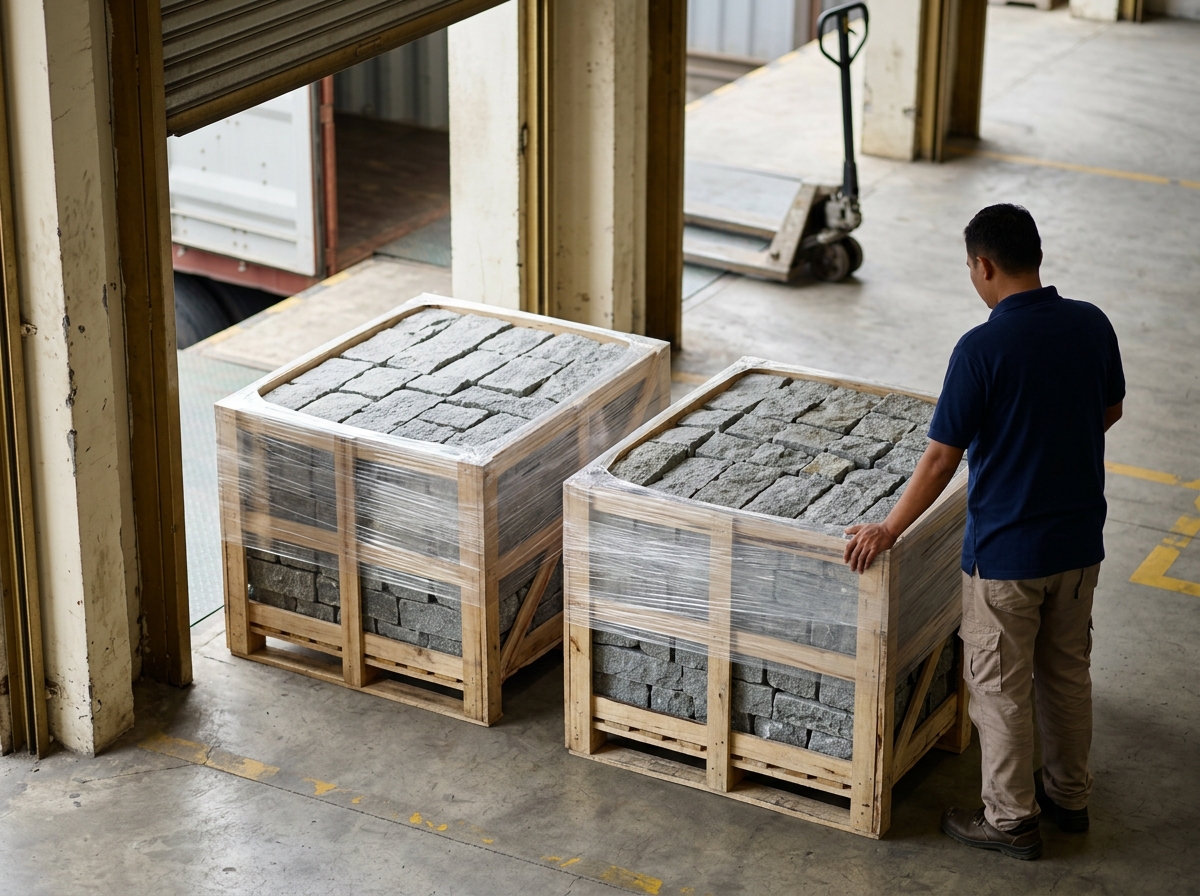
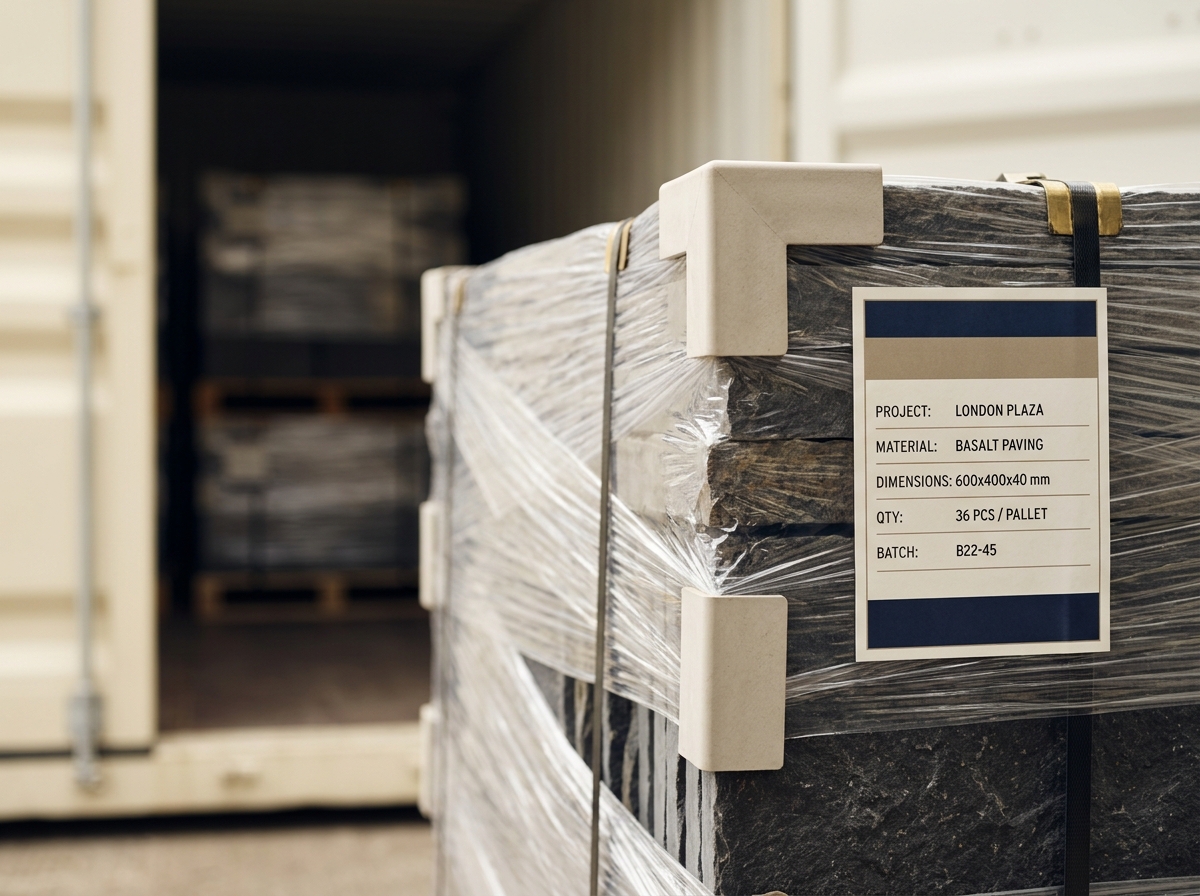
- ✓Review packing specification: pallet dimensions, shrink-wrap, corner protection
- ✓Arrange pre-shipment inspection via SGS or Bureau Veritas for first container
- ✓Check supplier's reference list for US or European buyers
On-site factory audits are the most reliable verification method. If you cannot visit Java or Bali in person, commission a third-party pre-shipment inspection. SGS and Bureau Veritas both offer stone product inspection services in Indonesia. Specify that the inspection covers dimensional tolerances, finish consistency, thickness variation, and packaging integrity. Budget for this cost — it is typically a fraction of the value of a 20-ft container and can prevent costly disputes on arrival.
US Import Compliance: Tariffs, HS Codes, and Landed Cost Planning
This section covers ground that most competitor guides ignore entirely. US import compliance has a direct effect on landed cost and project budget accuracy.
HS Codes and Tariff Rates
Natural stone paving products fall under two primary HS codes when imported into the United States:
| HS Code | Description | General Rate of Duty |
|---|---|---|
| 6801 | Setts, curbstones, flagstones of natural stone (except slate) | Free (0%) — verify current schedule |
| 6802 | Worked monumental or building stone (other than slate) | Variable by sub-heading — typically 3.2–4.9% ad valorem; confirm with US CBP |
Indonesia GSP Eligibility
Indonesia was previously eligible for preferential duty treatment under the US Generalized System of Preferences (GSP). The GSP program has experienced lapses and reauthorizations. As of the time of writing, confirm current GSP status for Indonesia and HS 6801/6802 with your customs broker before assuming duty-free treatment. GSP eligibility, when active, can reduce or eliminate duty on qualifying stone paving imports from Indonesia — a meaningful saving on large container orders.
Shipping Timelines and Lead Time Planning
Sea freight from Tanjung Perak (Surabaya) to US West Coast ports (Los Angeles, Long Beach) typically takes approximately 18–22 days in transit. East Coast ports (New York, Savannah) add approximately 5–8 days, for a total of approximately 25–30 days. These are approximate transit times and vary by carrier and routing.
Full project lead time breakdown:
| Phase | Approximate Duration |
|---|---|
| Sample review and order confirmation | 1–2 weeks |
| Production (standard formats, in-stock stone) | 3–5 weeks |
| Production (custom formats or large volume) | 5–8 weeks |
| Container loading and export documentation | 1 week |
| Sea freight to US West Coast | 3–4 weeks |
| US customs clearance and delivery | 1–2 weeks |
| **Total (standard order, West Coast)** | **~10–16 weeks from PO** |
Plan project timelines accordingly. Contractors who assume a six-week turnaround from Indonesian natural stone paving suppliers routinely face site delays.
MOQs, FOB Pricing Benchmarks, and Contract Terms
Minimum Order Quantities
The practical minimum for most Indonesian stone exporters is a 20-ft container (FCL), which holds approximately 18–20 tonnes of finished stone depending on format and packaging density. Some suppliers accept LCL (less-than-container-load) consolidation for samples or smaller initial orders, but per-unit cost rises significantly. FCL is the standard commercial model.
For custom formats or non-standard profiles, MOQs are typically set at one FCL minimum. Confirm this before requesting custom cutting.
FOB Price Ranges by Stone Type
Approximate FOB price ranges (from Indonesian ports) vary by stone type, format, and finish. As general benchmarks:
- Andesite cobbles (bush-hammered, standard size): lower-to-mid range per tonne - Basalt flags (honed or bush-hammered): mid range per tonne - Palimanan sandstone flags: lower range per tonne - Black lava stone (natural split): lower-to-mid range per tonne
Specific FOB prices fluctuate with quarry costs, fuel prices, and exchange rates. Request formal quotations from at least three verified suppliers and compare on a per-square-metre basis, accounting for thickness and expected wastage.
Payment Terms and Packaging
Standard payment terms across Indonesian stone exporters are commonly 30% T/T (telegraphic transfer) deposit at order confirmation, with 70% balance paid against a copy of the Bill of Lading. Letter of Credit (L/C) is accepted by larger exporters but adds cost and processing time.
Packaging standards for container-loaded stone paving should include:
- Hardwood pallets (ISPM-15 certified) - Shrink-wrap over each pallet - Corner protectors on flag and slab formats - Maximum pallet weight typically 1,000–1,200 kg (approx. 2,200–2,640 lb)
Expected breakage rates for well-packaged andesite and basalt cobbles in FCL shipments are typically below 2–3% for standard formats. Thin sandstone flags and large-format slabs carry higher breakage risk — specify double-layer corner protection and confirm with the supplier that pallet height does not exceed container stacking limits.
Frequently Asked Questions: Indonesian Natural Stone Paving for US Contractors
How do US hardscape contractors find and verify natural stone paving manufacturers in Indonesia? Start by requesting PT company registration details and an active export license. Use trade platforms to identify candidates, then require third-party lab test reports before sampling. For first-container orders, commission a pre-shipment inspection via SGS or Bureau Veritas in Java or Bali. Do not rely on online certification badges alone.
What Indonesian stone types are best suited for high-traffic public paving projects? Basalt and andesite are the correct specification for high-traffic public paving. Basalt offers the highest compressive strength (commonly above 200 MPa approximately) and is suitable for plaza, port, and heavy pedestrian environments. Andesite is the standard choice for driveways and commercial forecourts rated for light vehicular traffic.
What slip resistance ratings should be specified for outdoor Indonesian stone paving? Specify a minimum R11 rating (DIN 51130) or a wet SCOF of 0.60 (ASTM C1028) for all outdoor exposed applications. Bush-hammered and flamed finishes on andesite and basalt typically achieve R11–R12. Natural split finishes exceed R12 in most cases. Request the specific test report for the finish you are ordering — not a generic stone-type certificate.
What are the current US import tariffs and duties on Indonesian natural stone paving? HS code 6801 (setts, cobbles, flagstones) is generally duty-free under the standard US tariff schedule. HS code 6802 (worked building stone) carries a variable rate, typically in the low single-digit percentage range. GSP eligibility for Indonesia may reduce or eliminate applicable duties when the program is active. Always confirm the exact 10-digit HTS rate with a licensed customs broker before finalising your landed cost model.
How long does it take to receive a bulk stone paving order from Indonesia to the US? Total lead time from purchase order to US port delivery is approximately 10–16 weeks for a standard FCL order. This includes production (3–6 weeks), export documentation (1 week), sea freight (3–4 weeks), and US customs clearance (1–2 weeks). Custom formats extend the production phase.
What thickness of andesite or basalt paving is required for vehicular applications? Light vehicular applications (driveways, plazas) require a minimum of 50–70mm (2–2¾ in) for cobbles and setts in andesite or basalt. Heavy vehicular applications (loading bays, port areas) require 80–100mm (3¼–4 in) cobbles on a compacted sub-base. These benchmarks align with BS EN 1342 and BS EN 1343 strength class requirements referenced by Indonesian exporters.
Sourcing natural stone paving from Indonesia is a viable, cost-effective strategy for US hardscape contractors — provided the procurement process is built on specification rigour, verified supplier credentials, and accurate landed cost modelling. Stone type, thickness, finish, and traffic class must be aligned before a purchase order is placed; import compliance and realistic lead times must be factored into every project schedule.
You now have the specification framework, supplier qualification criteria, and import compliance overview needed to move forward with confidence.
You have the specification data and qualification criteria. The next step is putting verified natural stone paving suppliers Indonesia to the test with a sample request tied to your project requirements. Contact us to connect with pre-vetted Indonesian exporters and receive a project-specific FOB quote.
Request Samples and a Quote →Need eyes on the ground in Indonesia?
MTS is an execution partner — supplier verification, manufacturing management, quality control and export logistics across Indonesia, Vietnam and China.
Related services
Related articles
Receive furniture sourcing insights across Asia.
One email per week. No spam.