Indonesian Wood Flooring Export: B2B Buyer's Complete Sourcing Guide
13 min read
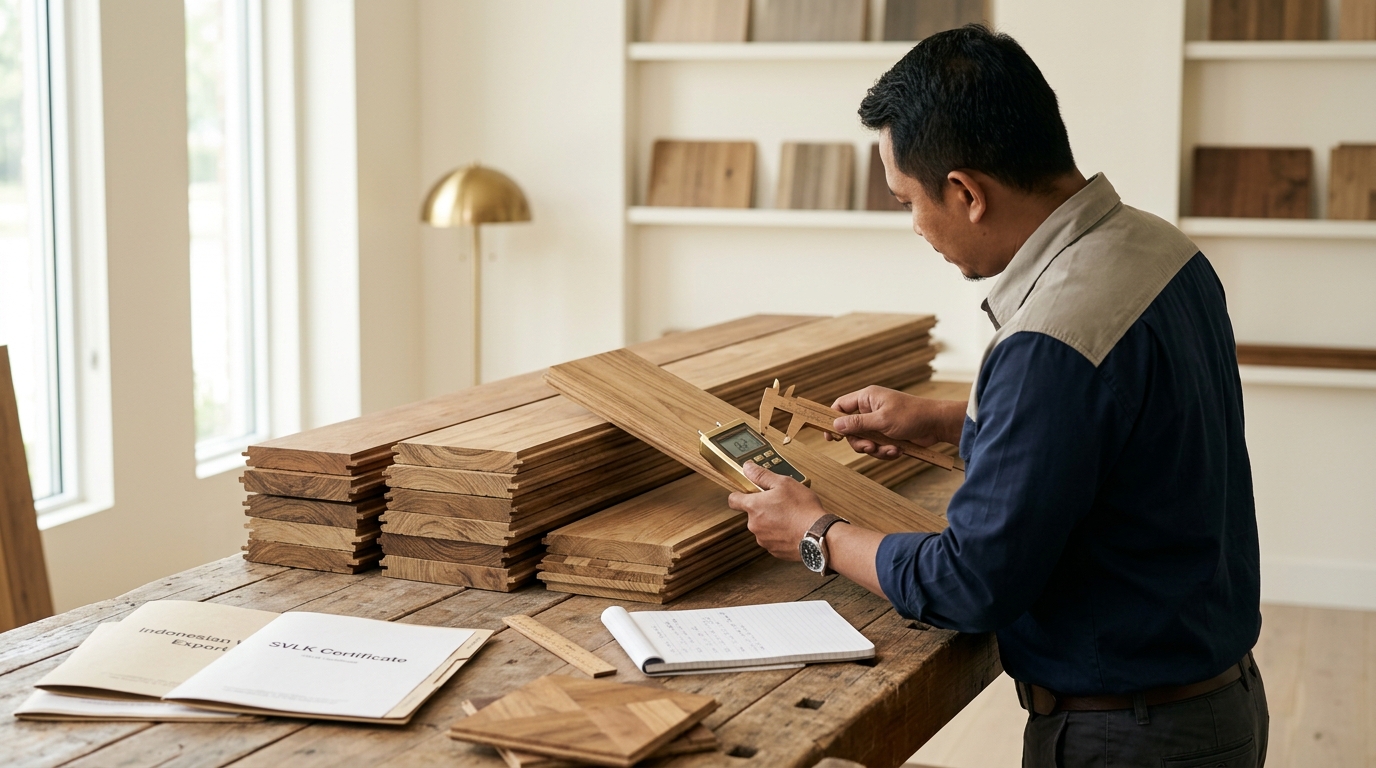
Sourcing wood flooring from Indonesia is a high-stakes procurement decision. Species selection, moisture content, certification compliance, and supplier classification all affect whether a shipment clears US Customs cleanly and performs in a climate-controlled American interior.
Sourcing wood flooring from Indonesia is a high-stakes procurement decision. Species selection, moisture content, certification compliance, and supplier classification all affect whether a shipment clears US Customs cleanly and performs in a climate-controlled American interior.
This guide gives US-based importers, interior contractors, and procurement managers the actionable intelligence needed to evaluate Indonesian wood flooring export opportunities from first inquiry to container arrival. It covers species specifications, product grades, moisture content standards, certification requirements, HS codes, MOQs, lead times, and supplier red flags.
Indonesia's competitive position rests on native tropical hardwood species that no other major exporting country can replicate at scale. That advantage, however, only converts into a successful procurement outcome when buyers apply the right sourcing framework from the outset.
Why Indonesia Remains a Top-Tier Source for Hardwood Flooring Exports
Indonesia consistently ranks among the world's largest exporters of timber and processed wood products. The country's wood product export sector generated approximately USD 14.3 billion in value in 2021, according to government trade data. That figure reflects processed goods including flooring, panels, and millwork — not just raw logs, which are subject to strict export restrictions.
Three geographic production clusters drive the flooring export supply chain:
- Java (Jepara, Semarang, Surabaya): teak processing, parquet manufacturing, engineered flooring assembly - Kalimantan: merbau, ulin ironwood, and bengkirai sourcing and primary processing - Sumatra (Medan/Belawan region): plantation teak and tropical mixed hardwood milling
The US, European Union, and Australian markets collectively absorb the majority of Indonesian hardwood flooring exports. US demand is driven by renovation activity, sustainable sourcing mandates in commercial construction, and architect-specified natural wood aesthetics that engineered or laminate alternatives cannot replicate.
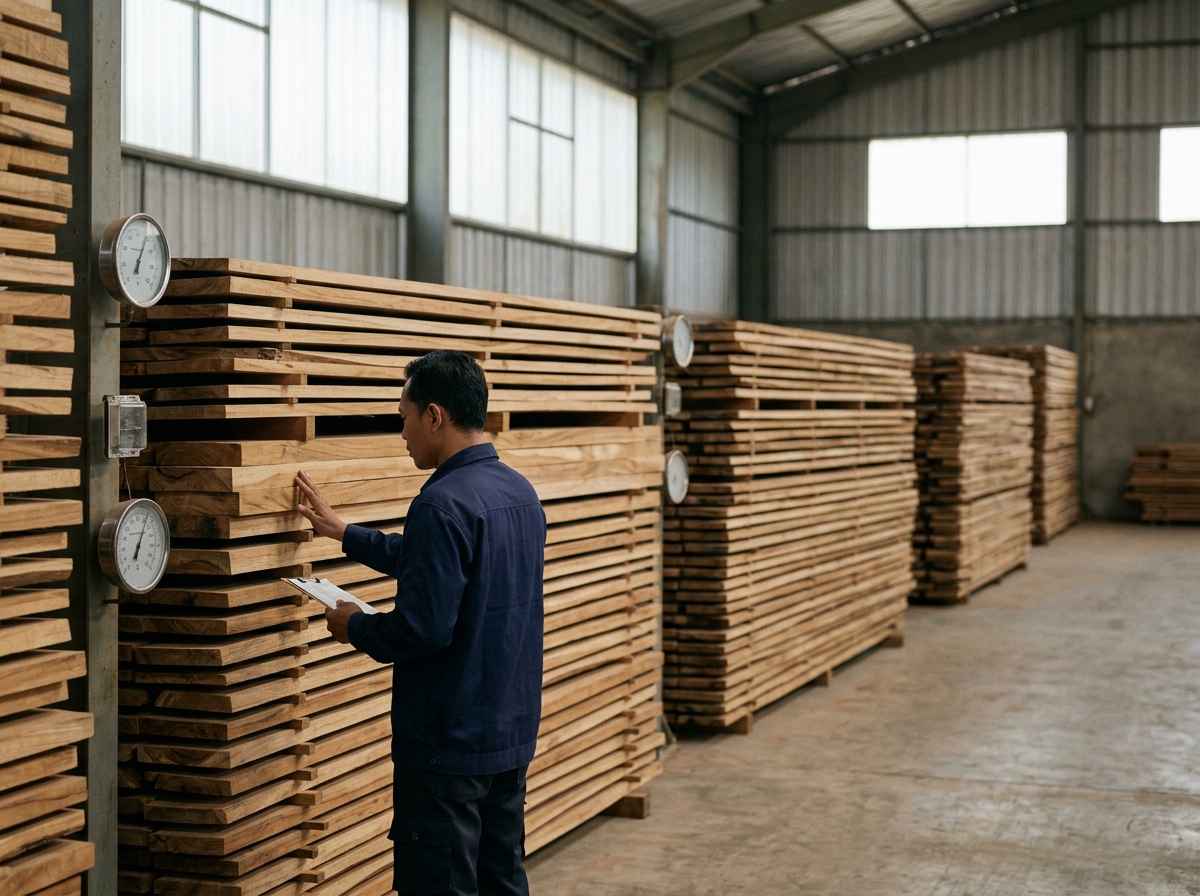
One structural advantage of Indonesian sourcing is vertical depth. Full-cycle factories in the Java cluster — those with their own kiln-drying facilities, grading rooms, and finishing lines — can control moisture content from raw timber through finished product.
Indonesian Wood Species That Define the Export Flooring Market
Teak (Tectona grandis): The Benchmark Luxury Hardwood
Indonesian teak is the most globally recognized species in the Indonesian wood flooring export category. Plantation-grown teak from Java carries a Janka hardness rating of approximately 1,000–1,155 lbf, depending on growth conditions and age. Its high natural oil content resists moisture penetration, dimensional movement, and fungal attack without surface treatment.
Merbau (Intsia bijuga): The Commercial Interior Workhorse
Merbau is the primary species for high-traffic commercial flooring applications. Its Janka hardness sits around 1,925 lbf — significantly harder than teak — and its interlocked grain delivers dimensional stability across humidity fluctuations. Merbau sourced from Kalimantan and Papua requires SVLK verification at the point of export. Without it, a US importer faces Lacey Act exposure.
Ulin Ironwood (Eusideroxylon zwageri) and Bengkirai (Shorea laevis)
Ulin, often called Kalimantan ironwood, is among the world's hardest commercially available species, with Janka values commonly cited above 3,500 lbf. It is predominantly available in reclaimed form, salvaged from demolition sites across Kalimantan and Sulawesi.
Bengkirai (Shorea laevis) is an outdoor-grade species with Janka hardness around 1,500–1,800 lbf. Originally used for decking and structural applications, it has migrated into interior flooring for commercial and semi-outdoor spaces. Its resistance to insects and moisture makes it viable in humid US climates without heavy chemical treatment.
Species Comparison Table
| Species | Janka Hardness (approx. lbf) | Typical MC% at Export | Primary Form | Best Application |
|---|---|---|---|---|
| Teak (*Tectona grandis*) | 1,000–1,155 | 8–12% | Solid, engineered, parquet | Luxury residential, hospitality |
| Merbau (*Intsia bijuga*) | 1,800–1,925 | 10–14% | Solid, engineered | Commercial high-traffic |
| Ulin Ironwood (*Eusideroxylon zwageri*) | 3,500+ | 12–16% | Reclaimed solid | Specialty, heritage projects |
| Bengkirai (*Shorea laevis*) | 1,500–1,800 | 10–13% | Solid, decking | Semi-outdoor, commercial |
Product Types, Grades, and Export Specifications for Indonesian Flooring
Solid Hardwood Flooring Grades
Indonesian manufacturers typically grade solid flooring on a three-tier system:
- Grade A (Select/Clear): Minimal knots, consistent color, tight grain. Highest price. Suitable for residential and luxury commercial. - Grade AB: Slight color variation, minor mineral streaks, small knots permitted. The most commercially traded export grade. - Grade B/C (Rustic/Character): Open knots, sapwood, significant color variation. Priced 25–40% below Grade A (approximately). Increasingly popular in industrial and artisan interior aesthetics in the US market.
Thickness for solid export flooring typically ranges from 15mm to 20mm, with tongue-and-groove or click profiles available from larger factories.
Engineered Hardwood Flooring from Indonesia
Engineered flooring construction uses a hardwood veneer face bonded to a multi-layer core. Indonesian manufacturers offer two core types:
- Plywood core: Typically 9-ply or 11-ply Indonesian or imported birch plywood. Greater dimensional stability than solid. Preferred for radiant heat applications. - HDF core: Higher density, flatter surface. Better suited for click-lock installation systems.
Veneer thickness ranges from 2mm to 6mm. A 4mm+ veneer allows one or two re-sanding cycles, which US buyers should treat as a minimum specification for commercial projects.
Parquet Flooring and Reclaimed Wood
Parquet formats available for export from Indonesia include finger block, herringbone, and chevron. Standard thickness is 10–15mm. Herringbone and chevron formats command a price premium of approximately 15–30% over standard plank parquet due to higher cutting waste and labor.
Reclaimed hardwood — primarily ulin and teak — requires documented provenance. Reputable exporters provide demolition site records, local government clearance letters, and SVLK chain-of-custody documentation. Without this paper trail, reclaimed wood imports face Lacey Act scrutiny at US Customs.
- ✓SVLK certificate (V-Legal document) from exporter
- ✓Phytosanitary certificate from Indonesian quarantine authority
- ✓Bill of Lading with accurate species name and HS code
- ✓Lacey Act Plant and Plant Product Declaration (PPQ 505 or electronic equivalent)
- ✓FSC or FLEGT license where specified by buyer
- ✓Certificate of Origin (Form AI for GSP eligibility)
- ✓Mill test report or moisture content certification
Moisture Content Standards and Climate Risk for US Importers
The NWFA recommends installed MC of 6–9% for most US interior environments, with slight regional variation (higher tolerance in the Pacific Northwest, lower in arid Southwest markets). Indonesian tropical hardwood exits the factory at MC levels of 8– approximately 14% depending on species and kiln quality.
Reputable Indonesian exporters run forced-air or vacuum kilns and issue MC test certificates per batch. Buyers should require these certificates and specify target MC (e.g., "maximum approximately 10% at point of loading") in the purchase contract.
Engineered flooring mitigates this risk structurally. Cross-ply construction limits movement to approximately one-third that of equivalent solid wood. For US commercial projects where on-site acclimatization time is limited, engineered Indonesian hardwood is the lower-risk specification.
After arrival, solid hardwood should acclimatize in the installation environment — not in a warehouse — for a minimum of three to seven days. Contractors unfamiliar with tropical hardwood species sometimes skip this step. Buyers sourcing for resale or project supply should include acclimatization guidance in product documentation.
Certifications and Legal Compliance for Indonesian Wood Flooring Export
SVLK: Indonesia's Mandatory Legality System
SVLK (Sistem Verifikasi Legalitas Kayu) is the Indonesian government's timber legality verification system. It is mandatory for all Indonesian wood product exporters. An SVLK-certified exporter holds a V-Legal license and can issue a V-Legal document accompanying each shipment.
FSC and FLEGT Licenses
FSC (Forest Stewardship Council) certification signals third-party chain-of-custody verification from forest to finished product. FSC-certified Indonesian flooring commands a market premium and satisfies ESG sourcing requirements for US commercial projects subject to LEED or WELL building standards.
Lacey Act Compliance for US Importers
The Lacey Act requires US importers to declare the scientific name, country of harvest, quantity, and value of all plant products at import. For Indonesian hardwood flooring, this means:
1. Obtain the species scientific name from the supplier (e.g., Tectona grandis for teak, Intsia bijuga for merbau). 2. File a Plant and Plant Product Declaration with US Customs on CBP Form 505 or through the Automated Commercial Environment (ACE) portal. 3. Retain supplier documentation — SVLK certificates, phytosanitary certificates, mill records — for a minimum of five years. 4.
Lacey Act violations — even unintentional — carry civil penalties up to USD approximately 10,000 per violation and potential criminal exposure for knowing violations. Importers cannot rely solely on a supplier's assurances. Independent verification of SVLK status and species accuracy is the importer's legal responsibility.
MOQs, Pricing, and Lead Times for Indonesian Wood Flooring Orders
Container Load Benchmarks
The standard trading unit for Indonesian wood flooring export is the full container load (FCL).
| Container | Approx. Coverage | Typical Use Case |
|---|---|---|
| 20ft FCL | 1,500–2,000 m² (solid plank) | Mid-size project, single species/grade |
| 40ft FCL | 3,000–4,500 m² (solid plank) | Large project, multi-SKU consolidation |
| 40ft HC FCL | 4,000–5,000 m² (engineered) | High-volume distributor replenishment |
Most Indonesian flooring manufacturers require a minimum of one 20ft container per order for standard catalog products. Custom dimensions, finishes, or species combinations typically require a 40ft minimum.
Pricing Ranges by Product Type
FOB pricing from Surabaya (Tanjung Perak port) or Jakarta (Tanjung Priok port) varies by species, grade, and product type. As a general market reference:
- Solid teak flooring (Grade AB, 18mm): approximately USD 35–65/m² FOB - Engineered teak flooring (4mm veneer, plywood core): approximately USD 25–45/m² FOB - Merbau solid flooring (Grade AB): approximately USD 20–40/m² FOB - Parquet (herringbone teak): approximately USD 50–90/m² FOB
These are approximate market ranges. Actual pricing depends on order volume, customization, current timber costs, and supplier tier.
Lead Times and Sample Orders
Production lead times run approximately 30–45 days for in-stock catalog products and 60–90 days for custom specifications. Factories in peak export seasons (typically Q3–Q4) may quote extended lead times.
Sample orders — typically 5–10 m² of selected species and grades — are standard practice. Most reputable exporters charge for samples at cost plus shipping, with charges credited against the first FCL order. Insist on production samples, not showroom samples, to validate actual grade consistency and moisture performance.
How to Vet Indonesian Wood Flooring Suppliers Before Committing
Factory Audit Criteria
A physical factory audit is the only reliable way to differentiate a full-cycle manufacturer from an assembly-only operation or trading company. Key verification points:
- Kiln-drying facility on-site: Confirm capacity, technology (conventional vs. vacuum), and temperature/humidity logging capability. - Grading room: Separate, well-lit area where planks are visually inspected and sorted by grade. Absence of a dedicated grading room is a red flag. - Finishing lines: On-site sanding, staining, and UV-oil or lacquer application. Outsourced finishing reduces quality control. - Moisture meter testing: Request a live demonstration of batch MC testing before loading approval.
Suppliers that refuse to identify their role in the supply chain — manufacturer, trader, or export company — should be treated as high-risk. An export company that consolidates from multiple small factories may lack direct production control over kiln drying and grading.
Certificate Verification
Do not accept certificate copies as final verification. Check directly:
- SVLK status: silk.menlhk.go.id - FSC certificate search: info.fsc.org/en/certificate-search
Shipment Record Verification and HS Codes
Indonesian wood flooring exports are classified under these primary HS codes:
| HS Code | Product Description | US Import Duty (approx.) |
|---|---|---|
| 4418.73 / 4418.79 | Assembled parquet panels | ~3.2–8% (MFN, varies by subheading) |
| 4409.29 | Profiled wood (T&G solid planks) | ~3.2–5% |
| 4412.39 | Engineered wood (plywood-based flooring) | ~8% (MFN) |
| 4418.61 / 4418.69 | Bamboo/wood assembled flooring panels | ~3.2–8% |
US importers can use shipment record platforms (Panjiva, ImportGenius, or the USITC DataWeb) to query an exporter's actual US shipment history by HS code. A supplier claiming years of US export experience but with no matching shipment records is a significant fraud indicator.
Key Indonesian Export Ports
- Tanjung Perak (Surabaya): Primary port for Java-based teak and parquet manufacturers. - Tanjung Priok (Jakarta): Largest Indonesian port; serves Central and West Java factories. - Belawan (Medan, Sumatra): Gateway for Sumatra-origin plantation teak and tropical mixed hardwood.
- ✓No SVLK certificate or certificate cannot be verified in official registry
- ✓Species listed as 'tropical hardwood' without scientific name on invoice
- ✓No kiln-drying facility visible during factory audit or video walkthrough
- ✓Pricing significantly below FOB market range — indicates grade misrepresentation
- ✓Unwilling to provide shipment records or HS code history
- ✓Sample quality inconsistent with catalog photography
- ✓Certificate dates expired or exporter name mismatched between SVLK and commercial invoice
Shipping, US Customs, and Logistics for Indonesian Flooring Imports
Container loading best practices protect flooring quality in transit. Indonesian exporters should use:
- Polyethylene moisture barriers around each pallet or bundle - Hardwood dunnage (not softwood, which can introduce pests) between pallet layers - Desiccant packs inside sealed containers for voyages exceeding 20 days
All wood packaging material — pallets, dunnage, crates — must comply with ISPM 15 (International Standards for Phytosanitary Measures). This requires heat treatment (HT) or methyl bromide fumigation and the IPPC mark. US Customs and Border Protection (CBP) inspects for ISPM 15 compliance on arrival and can quarantine non-compliant shipments.
Transit times are approximately:
- Indonesian ports to US West Coast (Los Angeles/Long Beach): 18–24 days - Indonesian ports to US East Coast (New York/Savannah): 28–36 days via Suez Canal
US import duties vary by HS code (see table above). Indonesia does not currently benefit from a comprehensive US free trade agreement, so most Indonesian wood flooring imports are subject to MFN (Most Favored Nation) duty rates. Buyers should confirm current tariff classifications with a licensed US customs broker before finalizing landed cost calculations.
Market Trends Shaping Indonesian Flooring Exports to the US Through 2025 and Beyond
Indonesian hardwood flooring exports to the US have grown steadily post- approximately 2021, driven by renovation demand, supply chain diversification away from China, and rising interest in sustainably sourced natural materials. Several trends are reshaping procurement decisions:
Reclaimed and antique wood demand is rising. US architects and specifiers increasingly call out reclaimed ulin and teak in project specifications. This segment commands premium pricing and requires the most rigorous documentation. Exporters with established reclaimed sourcing networks in Kalimantan are becoming strategic supplier assets.
ESG frameworks are entering procurement criteria. Large US commercial developers and hospitality groups are applying ESG scoring to supplier selection. Practical ESG evaluation criteria for Indonesian wood flooring suppliers include: SVLK verification status, FSC chain-of-custody coverage, percentage of plantation vs. natural forest timber, and kiln energy source (biomass vs. fossil fuel). Buyers should request a supplier's sustainability disclosure as a standard pre-qualification document.
Vietnamese and Chinese engineered flooring competition is intensifying. Vietnamese engineered hardwood — often using acacia or plantation eucalyptus — is aggressive on price. Chinese engineered flooring competes on volume and delivery speed. Indonesian producers differentiate on species exclusivity (teak, merbau, ulin cannot be sourced elsewhere at comparable quality), FSC certification rates, and SVLK compliance maturity. For US buyers specifying named species by scientific name — which Lacey Act compliance encourages — Indonesian flooring holds a structural advantage that generic "tropical hardwood" alternatives cannot match.
Section 301 tariff awareness affects sourcing models. US importers who shifted sourcing from China to Indonesia after 2018 trade actions are now building multi-supplier frameworks. Indonesian wood flooring export is well-positioned as a non-China, compliance-verified alternative with genuine manufacturing depth in Central Java and Kalimantan.
Frequently Asked Questions: Indonesian Wood Flooring for US Buyers
Does Indonesia export wood flooring products to the United States? Yes. Indonesia is an established exporter of solid hardwood, engineered, and parquet flooring to the US market. Teak, merbau, and bengkirai are the most commonly imported species. Shipments move primarily through Tanjung Perak (Surabaya) and Tanjung Priok (Jakarta) under HS codes 4409, 4412, and 4418.
Is Indonesian teak wood good quality for flooring? Plantation-grown Javanese teak (Tectona grandis) is internationally recognized as a premium flooring material. Its natural oil content, moderate Janka hardness (approximately 1,000–1,155 lbf), and dimensional stability under variable humidity make it suitable for both residential and commercial applications.
What wood species from Indonesia are used in flooring? The primary export species are teak (Tectona grandis), merbau (Intsia bijuga), ulin ironwood (Eusideroxylon zwageri), and bengkirai (Shorea laevis). Each has distinct hardness, moisture response, and application profiles as detailed in the species comparison table above.
Who are the biggest exporters of timber and wood flooring from Indonesia? The Indonesian flooring export sector includes large vertically-integrated manufacturers in the Java cluster, mid-size export-focused factories, and specialist merchant exporters that consolidate from smaller mills.
What certifications should I require from an Indonesian wood flooring supplier? At minimum: a valid SVLK V-Legal certificate (verifiable at silk.menlhk.go.id), a phytosanitary certificate, and accurate species scientific names on all commercial documents for Lacey Act compliance. For commercial projects with green building certification requirements, require FSC chain-of-custody certification verified at info.fsc.org.
What are typical MOQs and lead times for Indonesian wood flooring orders? Standard MOQ is one 20ft FCL for catalog products. Custom specifications require a 40ft FCL minimum. Lead times are approximately 30–45 days for standard orders and 60–90 days for custom production. Sample availability is standard; expect production lead times, not immediate dispatch.
Indonesia's advantage in the global wood flooring export market is real but not automatic — it converts into value only when buyers apply rigorous certification verification, accurate HS code classification, and species-specific moisture content management from purchase order through installation.
You now have the species data, compliance framework, supplier vetting criteria, and logistics parameters to evaluate Indonesian wood flooring suppliers with precision. Request a verified supplier quote for Indonesian wood flooring today and connect with SVLK-certified, export-ready manufacturers matched to your species, grade, and volume requirements.
Connect with pre-vetted, SVLK-certified Indonesian manufacturers for solid hardwood, engineered, and parquet flooring. Specify your species, grade, MOQ, and target MC — and receive qualified FOB quotes matched to your project requirements.
Request a Supplier Quote →Need eyes on the ground in Indonesia?
MTS is an execution partner — supplier verification, manufacturing management, quality control and export logistics across Indonesia, Vietnam and China.
Related services
Related articles
Receive furniture sourcing insights across Asia.
One email per week. No spam.