Boat Wood Furniture Indonesia: The Complete Sourcing Guide for Eco Retailers
19 min read
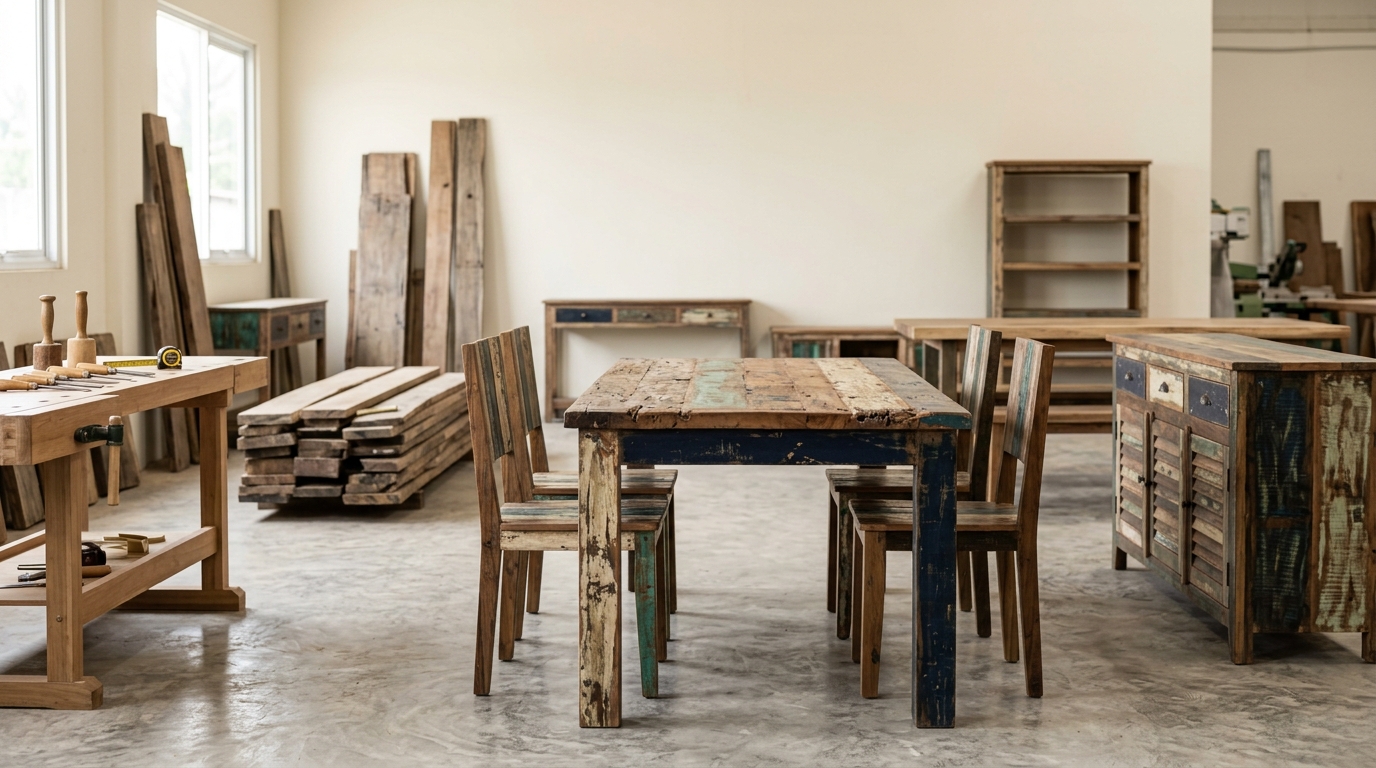
For eco-focused furniture retailers and importers in the United States, sourcing boat wood furniture from Indonesia presents one of the most compelling circular-economy narratives available in the market today — but also one of the most complex procurement challenges. The appeal is genuine: timber…
For eco-focused furniture retailers and importers in the United States, sourcing boat woodfurniture from Indonesiapresents one of the most compelling circular-economy narratives available in the market today — but also one of the most complex procurement challenges. The appeal is genuine: timber reclaimed from decommissioned Indonesian fishing vessels carries a traceable origin story, a weathered aesthetic that cannot be replicated by plantation wood, and a sustainability credential that resonates deeply with environmentally conscious end consumers. The sourcing reality, however, demands rigorous due diligence that most guides simply do not cover.
This article is written specifically for B2B buyers who are moving past the inspiration phase and into active procurement decisions. It covers every operational layer you need to understand before placing an order: how Indonesia's boat wood supply chain actually works, which wood species you are likely to encounter, how to verify provenance and certifications, what US import law requires, and how to evaluate suppliers with the scrutiny that your retail customers now expect. Where most competitor content stops at product photography and vague sustainability claims, this guide addresses the Lacey Act, SVLK and FLEGT credentials, social compliance at Balinese workshops, and the merchandising frameworks that turn supply-chain transparency into a retail brand asset.
Whether you are sourcing reclaimed boat wood furniture for a boutique home goods store, a hospitality project, or a growing e-commerce brand positioned around sustainability, the decisions you make at the procurement stage will directly determine your ability to tell an authentic, defensible story to buyers. The section that follows starts at the foundation: what boat wood furniture actually is, and why it commands a premium that generic reclaimed wood simply cannot match.
What Boat Wood Furniture Really Is — and Why It Commands a Premium
Boat wood furniture is produced from structural timber salvaged from decommissioned fishing vessels — primarily traditional wooden boats that have reached the end of their working life in Indonesian coastal waters. These are not decorative skiffs. The vessels in question are working craft, often built from dense tropical hardwoods specifically chosen for their resistance to saltwater, humidity, and the physical stress of decades at sea. When a boat is retired, its hull planks, ribs, and structural members carry the accumulated character of that service: deep grain patterns, natural weathering, salt-bleached tones, and in many cases, traces of original paint or caulking that become part of the finished aesthetic.
How Boat Wood Differs from Generic Reclaimed or Plantation Timber
The distinction matters enormously for retail positioning. Generic reclaimed wood typically originates from demolished buildings, decommissioned industrial structures, or offcuts from sawmill operations. Plantation teak, even when responsibly grown, lacks the density and character of old-growth material. Boat wood sits in a separate category because its provenance is specific and verifiable — a named vessel, a coastal village, a deconstruction date — rather than a vague claim about "reclaimed sources." This specificity is what allows retailers to build a product story rather than a product claim.
The timber's inherent density is another distinguishing factor. Fishing vessels built in coastal Indonesia were commonly constructed from teak, merbau, and ulin ironwood — all species selected precisely because they endure harsh marine conditions. After decades of service, the wood fibers are compressed and hardened beyond what kiln-drying alone achieves, producing material with exceptional structural integrity for furniture applications.
The Circular Economy Story That Retail Buyers Actually Value
End consumers purchasing boat wood furniture from eco-focused retailers are not simply buying a table. They are purchasing proof of a circular economy transaction: a material that would otherwise be burned or abandoned on a beach has instead been redirected into a durable, high-value product. That narrative has measurable retail value, particularly among millennial and Gen Z consumers who research the provenance of significant purchases. For B2B retailers, this translates into higher average order values, lower return rates driven by aesthetic disappointment, and stronger brand differentiation in a crowded sustainable home goods market.
Indonesia's Boat Wood Supply Chain: From Coastal Village to Export Workshop
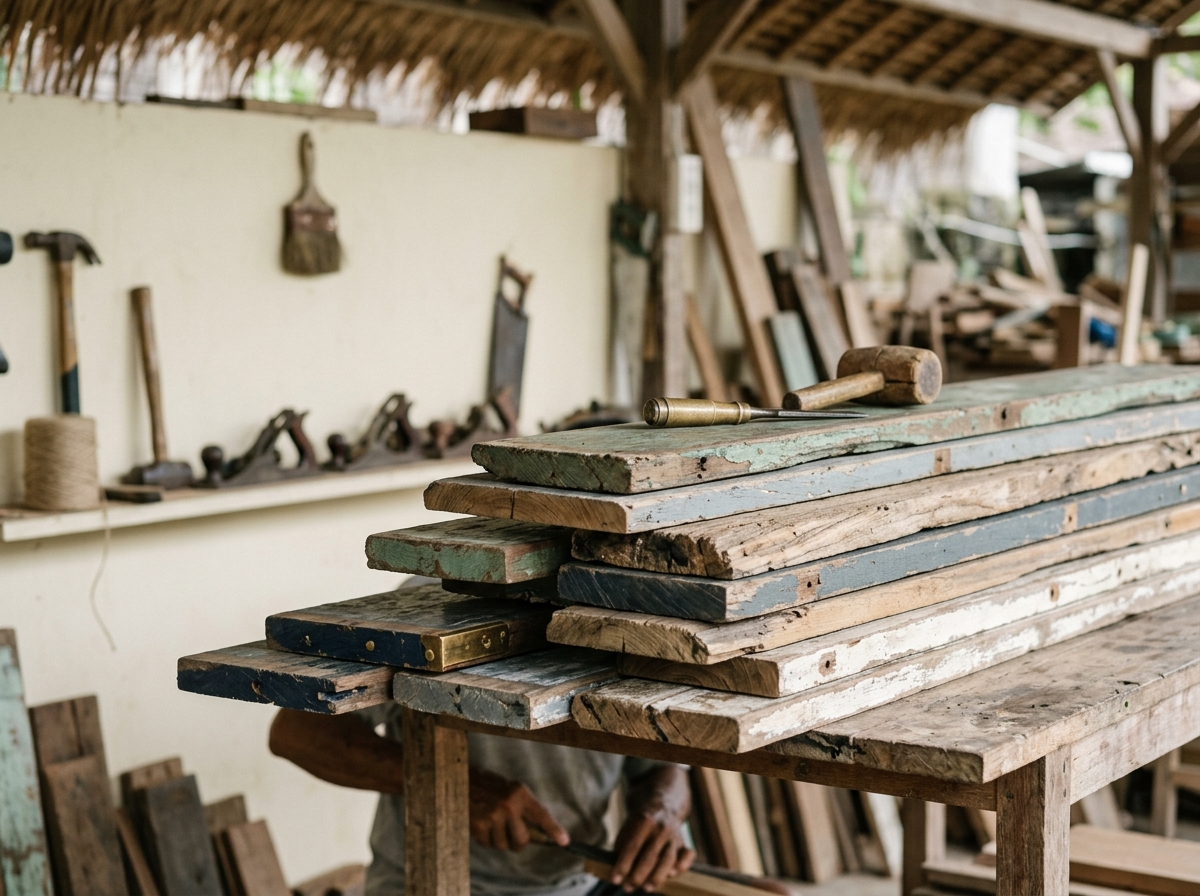
Understanding the supply chain geography of boat wood furniture Indonesia is essential for any retailer attempting to verify sourcing claims or negotiate directly with producers. The chain involves multiple actors across a significant geographic spread, and the point at which you enter that chain has direct implications for price, lead time, provenance documentation, and quality consistency.
Geographic Sourcing Hotspots and Their Characteristics
The primary collection zones for decommissioned fishing vessels are concentrated along Java's north coast — particularly around Situbondo and the broader East Java coastline — and in the fishing communities of coastal Bali. Situbondo has historically been one of the most productive sources of retired traditional boats, given the density of its artisanal fishing fleet and the relatively low cost of land-based deconstruction operations. Coastal villages across Java and Bali also contribute material, though in smaller and less predictable volumes.
From the collection point, deconstructed planks and structural members are transported inland to furniture-making workshops. In Bali, the primary production cluster is centered around Gianyar and Denpasar, where workshops range from small artisan cooperatives employing a handful of master carpenters to mid-scale factories with export licensing and container-loading capacity. Java's furniture industry, meanwhile, operates through established clusters: the Jepara area in Central Java handles significant volumes of solid hardwood furniture, including some boat wood production, while Surabaya and Semarang serve as logistics and consolidation hubs.
Deconstruction, Transport, and Workshop Processing
The deconstruction of a retired fishing vessel is skilled labor. Planks must be removed without splitting — particularly important for long hull pieces that will be used as tabletops — and metal fasteners, fiberglass patches, and non-timber materials must be separated and disposed of properly. Responsible suppliers maintain records of this process, including photographs and documentation of the vessel's last registration, which form the foundation of a provenance file.
Once at the workshop, the timber is assessed, sorted by species where possible, and dried to furniture-grade moisture content before cutting and joinery. Traditional hand-carving and mortise-and-tenon joinery remain the dominant construction methods in Balinese artisan workshops, producing pieces with a craftsmanship signature that machine-cut furniture cannot replicate. This handcraft element is a significant part of the product's value proposition and should be documented with workshop photography for retail storytelling purposes.
Direct Factory Versus Intermediary Sourcing Models
The Indonesian boat wood furniture export market operates through at least three distinct supply-chain configurations. Direct factory sourcing — engaging the workshop that both processes the reclaimed timber and manufactures the finished piece — provides the best provenance traceability and the strongest basis for quality negotiation, but requires more upfront relationship investment and is not always accessible to buyers without a local presence or an operational partner. Trading companies aggregate production from multiple workshops and offer broader catalogs and simpler transaction management, but provenance documentation is often thinner and quality consistency less reliable. Export agents occupy a middle position, facilitating logistics and compliance without owning production.
Wood Species Commonly Found in Indonesian Boat Wood Furniture
Primary Species and Their Properties
The timber recovered from Indonesian fishing vessels spans several species, with teak, merbau, and ulin ironwood being the most commonly encountered. Teak — Indonesia's most internationally recognized furniture wood — is prized for its natural oil content, dimensional stability, and resistance to moisture and insects. Merbau, a dense reddish-brown hardwood found across the Indonesian archipelago, is highly durable and takes finishes well, though its interlocked grain can make machining more challenging. Ulin ironwood, sometimes called Borneo ironwood or belian, is among the densest commercially worked timbers in the world; its resistance to saltwater made it a traditional boatbuilding material, and furniture made from ulin carries exceptional long-term durability credentials.
In practice, many boat wood pieces will contain mixed tropical hardwoods — combinations of species that were used interchangeably in vessel construction based on regional availability. This is normal and does not indicate inferior material, but it does complicate species-level documentation.
Why Species Identification Is Difficult — and Why It Matters
Reclaimed boat wood presents genuine species identification challenges. Decades of paint, caulking, salt exposure, and UV weathering can obscure the grain patterns and color markers that a trained carpenter would normally use to identify timber in the round. Responsible suppliers will attempt species identification at the deconstruction and sorting stage, but buyers should understand that mixed-species designations are common and honest. A supplier who guarantees uniform teak composition across large volumes of reclaimed boat wood deserves additional scrutiny.
Species identification matters for US retailers because it affects finish compatibility, indoor versus outdoor suitability, and the accuracy of disclosures required under the Lacey Act. Retailers should request whatever species documentation their supplier can provide, and should frame mixed-species compositions accurately in their product listings rather than defaulting to the most commercially desirable species name.
Provenance Verification: How to Confirm Authenticity and Sustainability Before You Order
Provenance verification is the single most important due diligence task for any retailer sourcing recycled boat woodfurniture from Indonesia. Without it, you cannot substantiate your sustainability claims to customers, you cannot fulfill your Lacey Act compliance obligations accurately, and you cannot distinguish genuinely reclaimed material from plantation or forest-harvested timber presented as reclaimed.
What a Credible Provenance File Should Contain
A rigorous provenance file for a consignment of boat wood furniture should include: photographs of the source vessels prior to and during deconstruction; vessel registration or identification records where available; GPS or named-village documentation of the collection location; a deconstruction date or date range; the name and location of the processing workshop; and a description of species identified at intake. Not every supplier will have every element, particularly for older stock, but the overall quality and specificity of documentation tells you a great deal about a supplier's operational seriousness.
SVLK, FLEGT, and FSC Recycled: Understanding the Certification Landscape
Indonesia operates a mandatory timber legality verification system called SVLK — Sistem Verifikasi Legalitas Kayu — which covers all timber and wood product exports from the country. SVLK-compliant exporters have undergone independent auditing to verify that their timber was legally sourced and processed. For reclaimed boat wood, SVLK certification provides a baseline of legality assurance, though it does not on its own verify that the material is genuinely reclaimed rather than newly harvested.
FLEGT — Forest Law Enforcement, Governance and Trade — is the EU-Indonesia bilateral framework under which SVLK-licensed Indonesian exporters can issue FLEGT licenses, demonstrating compliance with Indonesian forestry law. While FLEGT was designed primarily for the EU market, its underlying SVLK audit requirements are globally relevant and should be considered a meaningful credential by US buyers as well.
FSC Recycled certification is the most stringent standard specifically applicable to reclaimed materials. An FSC Recycled claim requires chain-of-custody documentation demonstrating that the wood material is genuinely pre- or post-consumer reclaimed timber, not newly harvested material. Suppliers holding FSC Recycled certification have been audited by an accredited third party against this standard. Not all boat wood suppliers will hold this certification — it involves ongoing audit costs that smaller workshops may not absorb — but its presence significantly reduces the documentation burden on the importing retailer.
Third-Party Audit and Factory Visit Protocols
For US importers whose retail customers hold them to rigorous sustainability standards, a one-time factory visit is a minimum — an ongoing third-party audit relationship is the more defensible posture. Social compliance checks should assess labor practices, workshop safety conditions, and wage structures alongside the environmental provenance questions. Balinese artisan workshops are often small operations where labor relationships are informal and documentation of working conditions may be limited; this does not automatically indicate poor practice, but it does require direct observation rather than reliance on self-reported compliance documents.
Independent factory audits can be commissioned through internationally recognized social compliance audit bodies or through operational sourcing partners with established Indonesia networks. For buyers without in-country expertise, working through a verified operational partner — rather than relying on platform listings or trade directory profiles — substantially reduces the risk of misrepresented sourcing claims.
Quality Standards and Lead Times Eco-Retailers Must Negotiate Upfront
Defining Acceptable Quality for Reclaimed Boat Wood Furniture
Quality benchmarks for reclaimed boat wood furniture differ from those applied to new-timber production, and buyers who fail to establish this upfront will face unnecessary disputes. Moisture content is the most critical technical specification: furniture-grade timber should typically be dried to a moisture content appropriate for the intended end-use environment — generally lower for interior US retail pieces than for outdoor applications. Structural integrity must be assessed for each piece, with particular attention to splits, checks, and voids that may have been concealed by filler or paint during vessel construction.
Surface finishing expectations should be agreed in writing, with sample-approved finishes serving as the production benchmark. Because boat wood inherits color variation, paint traces, and grain irregularities from its prior life, finish application must be designed to complement rather than obscure these characteristics.
Color and Grain Variation Is a Feature, Not a Defect
This point bears emphasis for any retailer transitioning from new-timber sourcing: the visual variation present in boat wood is not a quality failure. Every piece of genuinely reclaimed boat wood furniture will differ from every other piece in color tone, grain pattern, and surface texture. This variation is the material evidence of authentic reclaimed origin, and it is precisely what commands a premium over commodity furniture. Retailers who communicate this clearly — through product descriptions, photography that showcases individual pieces, and explicit framing of variation as authenticity — will experience fewer customer complaints and stronger brand affinity than those who attempt to standardize boat wood's appearance into something it is not.
Lead Times and Minimum Order Quantities
Lead times for boat wood furniture from Indonesian suppliers vary considerably depending on whether pieces are drawn from existing workshop inventory or produced to custom order. In-stock or semi-finished pieces can typically be prepared for export within several weeks of order confirmation. Custom-designed pieces requiring new joinery, specific dimensions, or bespoke finishing will commonly require lead times measured in months, accounting for timber selection, production, drying, finishing, and export documentation preparation.
Minimum order quantities in Indonesian boat wood workshops tend to reflect the economics of container shipping rather than arbitrary production thresholds. LCL shipments allow smaller buyers to access the market without filling a full container, though per-unit costs are higher. Retailers should negotiate minimum quantities in the context of their container utilization strategy rather than treating workshop MOQs as fixed constraints.
Importing Indonesian Boat Wood Furniture to the United States: Compliance You Cannot Overlook
| Compliance Area | Requirement | Key Detail for Boat Wood |
|---|---|---|
| Lacey Act | Declaration of species, country of harvest, quantity, and value | Mixed-species boat wood requires accurate species documentation at intake |
| Phytosanitary Certificate | Required for all wood product imports | Issued by Indonesian plant health authority prior to export |
| ISPM-15 Packaging | All solid wood packaging must be heat-treated or fumigated | Applies to pallets and crating, not the furniture itself |
| SVLK / FLEGT | Timber legality documentation from Indonesian supplier | Verifiable through Indonesian Ministry of Environment and Forestry |
| FSC Recycled (optional) | Chain-of-custody for reclaimed material claims | Strongest available credential for US eco-retail positioning |
| HS Code Classification | Typically 9403.60 (wooden furniture) or subcategories | Confirm with your customs broker for specific product types |
| Container Options | LCL for smaller orders; FCL from Bali (Benoa) or Java (Tanjung Perak/Tanjung Priok) | FCL typically more cost-efficient above approximately half a container |
Lacey Act Compliance in Detail
The Lacey Act requires US importers to file a declaration for all imported plant and plant products — including wood furniture — disclosing the scientific name of the species, the country where the plant was harvested, the quantity, and the unit of measure. For boat wood furniture, the complexity lies in species documentation: if your supplier cannot provide a credible species identification for the reclaimed timber, you cannot accurately complete your Lacey Act declaration. Inaccurate declarations expose importers to civil and criminal penalties. This is why pressing your Indonesian supplier for intake-level species documentation is not merely a sustainability preference — it is a legal requirement.
How to Evaluate and Shortlist Indonesian Boat Wood Furniture Suppliers
| Evaluation Criterion | What to Look For | Risk Signal |
|---|---|---|
| Production Capacity | Workshop scale matched to your volume needs | Overclaiming capacity to win orders |
| Export Experience | History of US or EU shipments; familiarity with Lacey Act and phytosanitary processes | First-time exporters without compliance support |
| Provenance Documentation | Photographic vessel records, species intake assessments, SVLK certificates | Vague or undated provenance files |
| Certifications | SVLK active and verifiable; FSC Recycled if claimed | Certificates that cannot be verified through official databases |
| Sample Availability | Willingness to provide production samples before full order | Refusal to provide samples or inability to replicate them at scale |
| Social Compliance | Documented labor practices; transparency about workshop conditions | Reluctance to permit third-party audit |
| Supplier Classification | Clear self-identification as manufacturer, trader, or export agent | Refusal to disclose classification |
Indonesian boat wood furniture suppliers can be identified through several channels. The IFEX trade fair in Jakarta — Indonesia International Furniture Expo — is the most concentrated venue for meeting export-ready manufacturers and export agents in person, and it allows side-by-side comparison of provenance documentation quality across multiple suppliers. B2B trade directories provide a starting point but should never serve as the sole basis for supplier qualification; directory listings rarely distinguish between manufacturers and trading companies, and sustainability claims are self-reported.
Direct referrals from importers already active in the Indonesian market — including freight forwarders and customs brokers specializing in wood products — are often the most reliable sourcing channel for new entrants, as these contacts have operational experience with specific workshops and can speak to consistency of documentation and delivery performance.
For buyers without established Indonesia networks or in-country sourcing expertise, engaging an operational partner that provides independent supplier verification, factory audit services, and export management significantly reduces both procurement risk and the time cost of building supplier relationships from scratch.
Merchandising Boat Wood Furniture to Eco-Conscious Buyers: Turning Provenance into Brand Equity
Messaging Frameworks That Resonate With Sustainability-Motivated Consumers
Effective retail messaging for boat wood furniture should center on three interlocking narratives: circularity — material diverted from waste into durable product; craftsmanship — traditional Indonesian joinery skills applied to a material that carries its own history; and cultural heritage — the boat-building and fishing traditions of coastal Java and Bali encoded in the timber itself. The most compelling product descriptions combine all three without reducing any of them to a generic tagline.
Avoid overclaiming. "Sustainably sourced" applied to boat wood furniture is accurate but insufficient — it does not differentiate from the dozens of brands making similar claims. "Reclaimed from decommissioned East Java fishing vessels, verified under SVLK timber legality standards" is specific, verifiable, and defensible.
Transparency Tactics That Drive Purchase Confidence
Provenance documentation that your procurement team assembles for compliance purposes can be directly repurposed as retail-facing content. Photographs of source vessels, before-and-after images of the deconstruction and production process, and profiles of the artisan workshop and individual craftspeople are not merely marketing assets — they are proof of the claims your product descriptions make. Retailers who publish this material — on product pages, in packaging inserts, or via QR codes linking to provenance records — create a transparency layer that competitors sourcing from undocumented channels cannot replicate.
Product labeling that names the vessel origin, collection region, and workshop location gives eco-conscious buyers the specificity they seek and creates a tangible differentiation signal on the retail floor or digital product page.
Product Categories With Strongest US Retail Demand
Boat wood dining tables are consistently among the strongest-performing product categories in the US sustainable home goods market, driven by their statement size and the visual impact of large-format reclaimed planks. Coffee tables and accent pieces follow closely, as lower price points make them accessible entry purchases that introduce customers to the material. Shelving, console tables, and bar-top pieces are growing categories as the reclaimed aesthetic moves from boutique to mainstream interior design. Retailers building an assortment should consider ranging across multiple price points within these categories to serve both first-time buyers and repeat customers upgrading their interiors.
- ✓Product descriptions name specific vessel origin region and collection method
- ✓Photography showcases individual pieces to communicate authentic variation
- ✓SVLK and/or FSC Recycled credentials are referenced in product copy
- ✓Artisan workshop profile and craftsperson names are included where available
- ✓Variation in color and grain is framed as authenticity evidence, not inconsistency
- ✓Provenance documentation is accessible to buyers on request or via QR link
- ✓Lacey Act species information is accurate and matches your import declaration
Frequently Asked Questions About Boat Wood Furniture Indonesia
What is boat wood furniture and how is it made? Boat wood furniture is produced from structural timber salvaged from decommissioned Indonesian fishing vessels. After a vessel is retired, it is deconstructed by hand, and its planks and structural members are transported to furniture workshops in Bali, Java, and other production centers. Craftsmen then process, dry, and shape the timber using traditional joinery and hand-finishing techniques to produce tables, shelving, seating, and accent pieces.
What kind of wood is used in Indonesian boat wood furniture? The most commonly encountered species are teak, merbau, and ulin ironwood — all historically favored for boatbuilding because of their density and resistance to saltwater and humidity. In practice, many pieces will contain mixed tropical hardwoods, reflecting the varied species availability in different coastal regions. Species identification can be challenging on weathered reclaimed material, and buyers should request intake-level documentation rather than relying solely on supplier claims at the finished-product stage.
Is furniture made in Indonesia good quality and durable enough for US retail?Indonesian furniture— and boat wood furniture in particular — is well-suited to US retail when sourced from export-experienced workshops with documented quality controls. The natural density of marine-grade tropical hardwoods produces furniture with exceptional structural integrity. The key variables are moisture content management during processing, the quality of joinery and finishing, and the consistency of quality inspection before shipment. Retailers should establish written quality benchmarks and approve production samples before committing to full orders.
How can retailers verify the provenance and sustainability of boat wood furniture? Provenance verification requires a combination of documentary evidence — vessel photographs, deconstruction records, species identification at intake — and direct operational engagement, including factory visits or third-party audits. Retailers should request SVLK certificates that can be cross-checked against Indonesia's official timber legality database, and should treat the quality and specificity of a supplier's provenance file as a direct indicator of their overall operational reliability.
What certifications should eco-retailers look for when sourcing from Indonesia? SVLK is Indonesia's mandatory timber legality standard and is a baseline requirement for any credible supplier. FLEGT licenses, issued under the EU-Indonesia bilateral agreement, demonstrate SVLK compliance verified against international frameworks. FSC Recycled certification is the most rigorous standard specifically applicable to reclaimed materials and provides the strongest basis for US retail sustainability claims. Social compliance certifications — such as BSCI — are relevant for retailers whose customers scrutinize labor practices alongside environmental credentials.
What furniture product categories are commonly made from Indonesian boat wood? Dining tables are the most prominent category, often featuring large-format single-plank or bookmatched tops that showcase the timber's full character. Coffee tables, console tables, shelving units, bar tops, and accent pieces are also widely produced. Some workshops produce outdoor furniture from denser boat wood species such as ulin ironwood, which is naturally resistant to weathering without chemical treatment.
You now have the procurement framework, compliance knowledge, and provenance verification tools to source boat wood furniture from Indonesia with the confidence your sustainability-positioned retail brand demands. The decisions you make at the supplier selection stage — on documentation standards, certification requirements, and quality benchmarks — will determine whether your boat wood assortment becomes a genuine brand differentiator or a liability when customer scrutiny increases.
You understand what authentic provenance documentation looks like, which certifications matter for US import compliance, and how to evaluate Indonesian suppliers against rigorous standards. The next step is connecting with a vetted operational partner who can verify those standards on the ground — and manage the full sourcing and export process on your behalf. Request a sourcing consultation with a verified Indonesian boat wood furniture supplier today.
Request a Sourcing Consultation →Need eyes on the ground in Indonesia?
MTS is an execution partner — supplier verification, manufacturing management, quality control and export logistics across Indonesia, Vietnam and China.
Related services
Related articles
Receive furniture sourcing insights across Asia.
One email per week. No spam.