The Furniture Sample Ordering Process in Indonesia: A Complete B2B Buyer's Guide
17 min read
Sourcing furniture from Indonesia is one of the most strategically sound decisions a US-based importer can make — but the quality of that decision depends almost entirely on what happens before the first production container is loaded. For buyers evaluating Indonesian suppliers across Jepara,…
Sourcingfurniture from Indonesiais one of the most strategically sound decisions a US-based importer can make — but the quality of that decision depends almost entirely on what happens before the first production container is loaded. For buyers evaluating Indonesian suppliers across Jepara, Bali, Semarang, or Cirebon, the sample stage is not a formality. It is the single most consequential step in the entire procurement cycle, and skipping or rushing it is one of the most common — and most expensive — mistakes in international furniture sourcing.
This guide is written specifically for B2B furniture buyers, importers, and interior procurement professionals who are actively evaluating Indonesian manufacturers and need a rigorous, process-level understanding of how to request, evaluate, and approve product samples. The furniture sample ordering process in Indonesia has its own rhythm, its own compliance layer, and its own negotiation logic — all of which differ meaningfully from how sample workflows operate in China or Vietnam. Understanding those differences gives you leverage at every stage.
What follows is a structured walkthrough covering every phase of the process: from writing a technically precise sample brief and understanding realistic lead times, to running a quality inspection checklist, engaging third-party auditors on the ground in Java or Bali, and transitioning from an approved sample into a contractually protected production order. Compliance touchpoints — including Indonesia's SVLK timber legality system, ETPIK export licensing, and US Lacey Act obligations — are integrated throughout rather than treated as an afterthought. By the time you reach the end, you will have a complete operational framework for sample validation that protects your sourcing investment from the first inquiry to the final bulk shipment.
Why Skipping Sample Validation Is a Risk No Serious Importer Can Afford
The Financial Exposure of Bypassing the Sample Stage
The math on sample validation is straightforward. A full container offurniture from Indonesia— say, a forty-foot high-cube loaded with solid teak dining sets — represents a significant capital commitment before you factor in ocean freight, customs duties, and last-mile delivery. If that container arrives with finish inconsistencies across pieces, joinery that fails under normal stress loading, or wood with moisture content well above the acceptable range, your options are limited and all of them are costly: rework at destination, price concessions that erode your margin, or outright rejection and disposal.
The sample stage exists to surface these problems before they scale. Common defects discovered at the sample level include uneven lacquer application or stain blotching caused by inconsistent wood porosity, loose mortise-and-tenon joints that indicate inadequate glue curing time or poor fit tolerances, and wood moisture content that falls outside the target range of approximately 8 to 12 percent — a range critical for furniture destined for climate-controlled US interiors. Catching any one of these issues on a single sample piece costs a fraction of what it costs to resolve the same problem across hundreds of units.
How Reputable Indonesian Manufacturers View the Sample Stage
Most establishedIndonesian furniture manufacturers— particularly those in the Jepara cluster of Central Java, which is globally recognized for solid wood and teak production — expect a formal sample request as a standard part of the buyer qualification process. A supplier who resists or discourages sample ordering is a meaningful red flag. Reputable factories with active R&D and sample departments treat the sample stage as mutual due diligence: it confirms that the buyer's specifications are achievable, and it gives the manufacturer a documented benchmark against which bulk production can be measured.
This is also the stage at which you identify whether you are dealing with an actual manufacturer or a trading intermediary. A genuine production facility will welcome pre-shipment inspection of the sample, provide traceability for materials used, and be willing to document the approved sample as the formal production standard. A trader acting as a middleman will often be evasive about these requests.
A Step-by-Step Breakdown of the Furniture Sample Ordering Process in Indonesia
Step 1: Supplier Shortlisting and Initial Inquiry
Before a sample request is issued, you need a verified shortlist. For Indonesian suppliers, verification signals include a valid Nomor Induk Berusaha (NIB — Indonesia's unified business identification number), an active export license, and ETPIK certification (Exporter of Forest Products). Cross-reference these documents against customs data platforms to confirm actual export history. Suppliers operating through Jepara, Semarang, Bali, and Cirebon will generally have these on file and should provide them on request without hesitation.
Your initial inquiry should accompany a technical specification sheet — not a mood board. Include wood species, target dimensions with tolerances, finish description, joinery method preferences, and any certification requirements. If an NDA is warranted given proprietary design elements, execute it before sharing detailed drawings.
Step 2: Issuing a Formal Sample Request Order
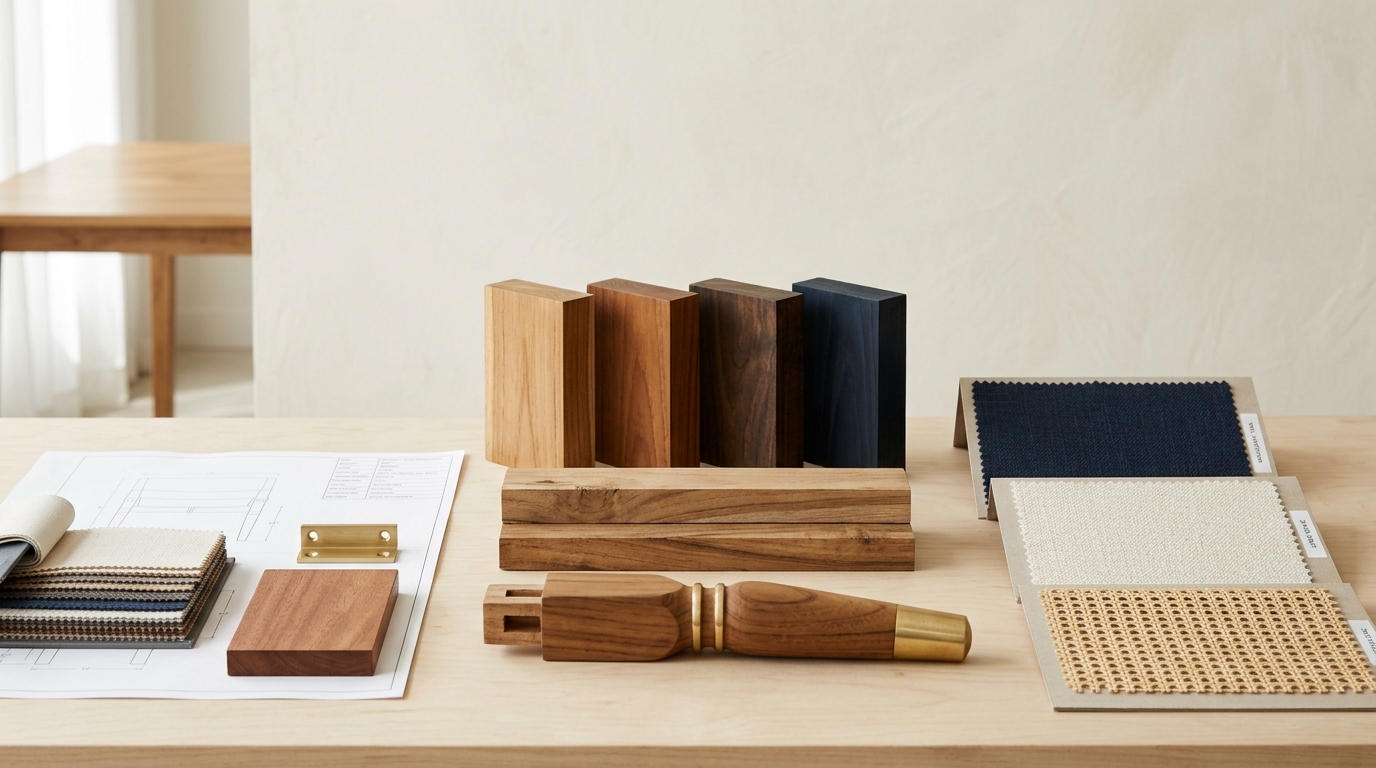
A Sample Request Order (SRO) is a written document — not an email thread — that formally initiates sample production. It should specify finish samples or codes (RAL, Pantone, or physical swatches), exact dimensions with stated tolerances, required wood species and grade, joinery method, surface treatment type, hardware specifications if applicable, and the number of sample units requested. It should also state your target evaluation criteria so the supplier understands how the sample will be judged.
Step 3: Production Timeline Expectations
The furniture sample ordering process in Indonesia typically involves sample production lead times ranging from approximately two to six weeks, depending on product complexity, the supplier's current capacity load, and the availability of specified materials. A simple side table in standard teak with a natural oil finish will sit at the shorter end of that range. A multi-component bedroom set in a custom-mixed lacquer finish with CNC-carved detailing will extend toward the longer end. Build in buffer time for supplier holidays, particularly around Eid al-Fitr, which can compress production schedules significantly.
Step 4: Payment Terms for Samples
Three payment models are common in Indonesian supplier relationships. The first is full-cost payment by the buyer, where the sample is priced at or above its actual production cost given the small run economics involved. The second is a partial-cost model where the supplier absorbs some cost as a business development investment, typically when they are highly motivated to win the account. The third is a refundable deposit model, where the buyer pays in full but the amount is credited against the first bulk production invoice upon order placement. Negotiating the refundable deposit or cost-offset structure upfront — before issuing the SRO — is the most buyer-favorable approach and is addressed in more detail in the costs and negotiation section below.
How to Write a Sample Brief That Eliminates Interpretation Errors
The single most common cause of sample rejection is not manufacturer incompetence — it is an underspecified brief. Indonesian manufacturers working with international buyers are experienced at filling in gaps, but the assumptions they make will reflect their domestic market conventions and aesthetic defaults, not yours. A technically complete brief removes that interpretation layer entirely.
Wood Species and Grade Indonesia produces furniture from teak, mahogany, mindi, acacia, and other commercially available species. Teak from Java plantations is the benchmark for durability and premium positioning; mahogany offers a finer grain at a lower price point; mindi is a cost-effective alternative often used for painted or lacquered finishes; acacia brings high density and attractive grain character suitable for contemporary dining furniture. Specify the species explicitly. If grade matters — and for visible surfaces it always does — define it: A-grade indicates minimal knots and consistent grain, while lower grades introduce character marks that may or may not suit your product line.
Finish Specification Do not describe a finish as 'walnut brown' and expect consistency. Provide a physical swatch, a RAL code, or a Pantone reference. Specify sheen level — matte, satin, or semi-gloss — and surface treatment type: oil, lacquer, polyurethane, or wax. If UV resistance or food-safe certification is required for dining surfaces, state it.
Joinery and Structural Requirements Define your joinery method expectations explicitly. Mortise-and-tenon construction is the traditional standard in Jepara solid wood production and offers superior structural performance. Dowel joinery is faster and acceptable for lighter-duty applications. Pocket screws are a red flag in premium solid wood pieces and should be called out as unacceptable if that is your position.
Dimensional Tolerances and Reference Materials Attach dimensioned technical drawings or CAD files where possible. State your acceptable tolerance — commonly plus or minus two to three millimeters for solid wood pieces given natural material movement — and attach reference photographs for any design details that are difficult to convey in text. The more visual and dimensional precision you provide, the less room for costly misinterpretation.
Costs, Lead Times, and Logistics for Indonesian Furniture Samples
What to Expect in Sample Pricing
Sample costs in theIndonesian furnituremarket typically range from approximately $150 for a simple, small accessory piece to $800 or more for a complex, multi-component item with custom finish development. These figures reflect small-batch production economics: material costs are proportionally higher, setup time is not amortized across volume, and finish matching often requires multiple iterations. Budget accordingly and treat sample costs as sourcing due diligence expenditure rather than a sunk cost — because when handled correctly, they are recoverable.
Shipping Options for Sample Packages
For individual samples or small sets, DHL and FedEx international express services are the standard choice from major Indonesian export hubs including Semarang, Surabaya, and Denpasar. Transit times to US destinations are typically five to ten business days. For larger sample sets — say, a bedroom group of four to six pieces — consolidated air freight may be more economical than courier, though it adds coordination time. Ocean LCL (less-than-container-load) is rarely appropriate for sample shipments given the extended transit time relative to the urgency of sample evaluation.
Import Duties and De Minimis Thresholds
Furniture sample shipments entering the United States are subject to standard HTS classification-based duties. The US de minimis threshold — below which informal entry is permitted without duty assessment — applies to shipments valued under $800. Many individual furniture samples will exceed this value, meaning formal entry and applicable duties apply. Work with a licensed customs broker to classify your sample correctly and anticipate landed cost accurately.
Negotiating Sample Cost Offsets
The most effective negotiation approach is to raise sample cost treatment before the supplier issues a proforma invoice. Propose that 100 percent of sample costs — including production and shipping — be credited against the first bulk purchase order above a stated minimum value. Most Indonesian manufacturers with genuine interest in the account will agree to this structure, particularly if you can indicate the approximate size of the potential production order. Framing the sample as the first stage of a committed relationship rather than a standalone test will yield more favorable terms.
Evaluating the Sample: A Practical Quality Inspection Checklist
When the sample arrives, systematic evaluation against the approved brief is not optional — it is the entire point of the exercise. The following checklist provides a structured framework for assessment across four evaluation domains.
- ✓Structural: apply downward load pressure to seating surfaces and horizontal surfaces — no flex or creak should be present
- ✓Structural: check all joints for tightness by hand — zero play in mortise-and-tenon connections
- ✓Structural: test wobble on a flat surface — all four legs must make consistent contact
- ✓Surface: inspect finish uniformity under raking light — no brush marks, drips, orange peel, or blotching
- ✓Surface: verify sheen level matches specified reference — compare under consistent lighting
- ✓Surface: conduct a moisture resistance spot test on a concealed surface using a damp cloth for 30 seconds
- ✓Wood: verify species by grain pattern, color, and weight relative to expectations
- ✓Wood: use a pin or pinless moisture meter to confirm MC is within 8–12% range
- ✓Wood: check for end grain cracking, checks, or surface checking inconsistent with stated grade
- ✓Dimensional: measure all stated dimensions against spec sheet with a calibrated tape measure or digital calipers
- ✓Dimensional: confirm tolerance compliance — deviations beyond stated tolerance require documented corrective action
- ✓Hardware: operate all drawers, doors, and mechanical components through ten full cycles — action must be smooth and consistent
Document every finding with photographs taken under consistent lighting conditions and organized against the original spec sheet fields. This documentation becomes the formal record of sample evaluation and the reference file for any supplier discussions about corrective revisions.
Why Third-Party On-the-Ground Inspection in Indonesia Adds Critical Protection
The Case for Pre-Shipment Sample Auditing
Even with a detailed brief and a systematic in-house checklist, there is a dimension of sample quality that remote evaluation cannot capture: the production environment in which the sample was made. A third-party inspector located in Java or Bali can evaluate the sample before it ships, confirm that it was produced in the facility you believe you are dealing with, and document the manufacturing context — all of which significantly reduces the risk of the sample bait-and-switch pattern described earlier.
Inspection Firms Operating in Indonesia
Several internationally recognized inspection and testing organizations operate active networks across Indonesia's main furniture manufacturing regions. SGS and Bureau Veritas both maintain offices and inspector networks covering Central Java and Bali, and both offer furniture-specific inspection protocols. Smaller specialized firms with deep furniture sector expertise also operate in the Jepara and Semarang corridors. When selecting an inspector, confirm that they have specific experience with solid wood furniture assessment — general consumer goods inspectors may not have the technical background to evaluate joinery integrity or species verification.
What a Pre-Shipment Sample Inspection Report Covers
A well-structured sample inspection report will document: confirmation of supplier facility identity, visual and dimensional assessment against buyer-provided specifications, structural integrity evaluation, finish and surface quality assessment, wood species verification and moisture content measurement, and photographic evidence across all evaluation points. Some inspection providers will also assess packaging adequacy for international transit.
Cost and Turnaround in Key Manufacturing Hubs
Third-party sample inspection in Indonesian furniture hubs is generally priced on a per-inspection-day basis, with most single-piece or small-set sample inspections completing within one working day. Turnaround from inspection to report delivery is typically two to four business days. The cost of this service is modest relative to the value of the production order it is protecting — treat it as a non-negotiable line item in your sourcing budget for any significant supplier relationship.
From Sample Approval to Production Order: Managing the Critical Transition
Documenting the Approved Sample as Your Production Benchmark
Once a sample passes evaluation — either directly or after one round of approved revisions — the approved sample must be formally documented as the golden sample. This means photographing it comprehensively, recording all measured dimensions, attaching the finish reference, and issuing written approval to the supplier that explicitly states: this sample is the benchmark against which bulk production will be measured. The supplier should retain the physical sample or an identical retained sample in their quality control department throughout the production run.
Locking Specifications into the Purchase Agreement
The purchase agreement for bulk production should reference the golden sample documentation by identifier and state explicitly that any material, finish, joinery, or dimensional deviation beyond agreed tolerances constitutes grounds for rejection or renegotiation. This is not adversarial language — it is the language of professional procurement, and experienced Indonesian exporters are fully accustomed to it.
Applying AQL Standards from Sample to Production
AQL — Acceptable Quality Level — is the statistical framework used to determine how many defects in a production run are tolerable before the lot is rejected. Most US-bound furniture importers apply AQL 2.5 for major defects and AQL 4.0 for minor defects as a starting reference point, though your specific product category and retail or contract channel may warrant stricter parameters. The key point that most sourcing guides omit: AQL standards should be defined at the sample approval stage and included in the purchase agreement, not introduced during production inspection when it is too late to align supplier expectations.
Common Pitfalls When Scaling from Sample to Full Container
Two failure modes are disproportionately common in the scale-up from sample to production. The first is material substitution: the approved sample used A-grade teak from a specific source, and bulk production uses a lower grade or a different species without disclosure. The second is finish drift: the lacquer color or sheen shifts slightly between the sample and production units, individually imperceptible but cumulatively visible when pieces are placed together in a room. Both are best addressed through DUPRO inspection — an inspector on the factory floor during active production, comparing in-process units against the golden sample before the container is loaded.
Legal and Compliance Requirements That Apply to Indonesian Furniture Samples
SVLK: Indonesia's Timber Legality Verification System
SVLK (Sistem Verifikasi Legalitas Kayu) is Indonesia's mandatory timber legality assurance system, administered at the government level and independently audited. Any Indonesian exporter of wood products — including furniture — must hold valid SVLK certification, which verifies that the timber in their supply chain was legally harvested and traded. For US buyers, requesting and verifying your supplier's SVLK certificate is not optional courtesy — it is a foundational due diligence step. Verify the certificate number against the official registry rather than accepting a scanned copy at face value.
ETPIK Export Licensing
ETPIK (Eksportir Terdaftar Produk Industri Kehutanan) is Indonesia's registered exporter status for forest-based industrial products, including furniture. A supplier without active ETPIK certification cannot legally export furniture from Indonesia. Confirming ETPIK status should be part of your supplier shortlisting process, not an afterthought discovered at the letter-of-credit stage.
CITES Compliance for Protected Species
Certain wood species used in Indonesian furniture — some rosewoods in particular — are listed under CITES (the Convention on International Trade in Endangered Species) and require export and import documentation beyond standard commercial paperwork. If your product specifications include any species that might fall under CITES Appendix II or Appendix I listings, verify the classification explicitly with your customs broker before finalizing the sample brief. Teak from plantation sources and mahogany commonly used in Indonesian production are generally not subject to CITES restrictions, but verification with current listings is always advisable.
US Lacey Act Obligations for Importers
The US Lacey Act requires importers of wood and plant products to declare the country of harvest, the genus and species of wood, and the quantity and value of the product at the time of import. This applies to furniture samples as well as production shipments. As the importer of record, you bear legal responsibility for the accuracy of this declaration — meaning you need documentation from your Indonesian supplier that substantiates the species and origin of the wood in the sample. Reputable manufacturers with SVLK certification will have this traceability documentation as a standard part of their compliance infrastructure.
Frequently Asked Questions About Indonesian Furniture Sourcing
Is furniture made in Indonesia good quality compared to other manufacturing countries?
Indonesian furniture — particularly solid wood pieces in teak, mahogany, and mindi from established clusters like Jepara — is widely regarded as among the highest quality in the world for natural material furniture. Indonesia's artisan manufacturing tradition, depth of craft skill, and access to premium tropical hardwoods give it a competitive advantage in premium and hospitality furniture that few countries can match at comparable price points. The key variable is supplier selection: quality is highly supplier-specific, which is precisely why the sample validation process matters so much.
How do you buy products and samples directly from Indonesian manufacturers?
Direct procurement begins with supplier identification through trade directories, export databases, or trade show contacts (the Jakarta International Furniture Fair, known as JIFFINA, is a key venue). Once a shortlist is established, issue a formal inquiry with a technical specification sheet, verify the supplier's NIB, ETPIK, and SVLK documentation, and issue a written Sample Request Order. Payment for samples is typically arranged via wire transfer or as part of a proforma invoice.
Which country is considered the best for furniture manufacturing at scale?
China remains the largest and most diversified furniture manufacturing base globally, with unmatched scale, component supply depth, and category breadth. Vietnam has grown rapidly as a high-quality alternative particularly for solid wood pieces destined for the US market. Indonesia is the strongest choice for natural material furniture — teak, mahogany, rattan — where craft quality and material authenticity are priorities. The right answer depends entirely on your product category, quality tier, and volume requirements.
What wood species are most commonly used in Indonesian furniture production?
The most commercially significant species in Indonesian furniture are plantation teak (Tectona grandis), mahogany, mindi (Melia azedarach), and acacia. Teak from Java is the most internationally recognized and commands a premium. Rattan is the dominant material in the Cirebon cluster. Species availability, sustainability certification, and Lacey Act compliance documentation should all be confirmed at the supplier inquiry stage.
How long does it take to receive a furniture sample from Indonesia?
Sample production in Indonesia typically takes two to six weeks depending on complexity, followed by approximately five to ten business days for courier delivery to US destinations. Total elapsed time from SRO issuance to sample receipt is therefore commonly in the range of three to eight weeks. Build this into your product development calendar rather than treating it as dead time — use the window to finalize production specifications, legal documentation requirements, and freight planning.
Can sample costs be deducted from a bulk production order with Indonesian suppliers?
Yes, this is a standard and widely accepted negotiation outcome with Indonesian manufacturers. The most buyer-favorable structure — a full credit of sample costs against the first bulk order invoice — should be proposed before the supplier issues a sample proforma. Suppliers with strong interest in the account will agree; those who refuse entirely warrant scrutiny about their genuine commitment to the relationship.
Navigating the furniture sample ordering process in Indonesia successfully requires three things working in parallel: a technically precise brief that leaves no room for misinterpretation, a systematic evaluation framework that documents findings against objective criteria, and a compliance layer that protects you under both Indonesian export regulations and US import law. Treating these as integrated rather than sequential is what separates buyers who scale successfully with Indonesian suppliers from those who learn expensive lessons at the container level.
You now have the process map, the inspection checklist, the compliance touchpoints, and the negotiation framework. The next step is putting it into action with a verified supplier.
You understand the furniture sample ordering process in Indonesia — the briefs, the lead times, the quality checkpoints, and the compliance requirements. The logical next step is requesting your sample from a manufacturer who operates within that framework and can substantiate every step with documentation. Protect your sourcing investment before committing to full production.
Request Your Furniture Sample Today →Need eyes on the ground in Indonesia?
MTS is an execution partner — supplier verification, manufacturing management, quality control and export logistics across Indonesia, Vietnam and China.
Related services
Related articles
Receive furniture sourcing insights across Asia.
One email per week. No spam.