Vietnam Textile Manufacturers: Fabric Sourcing Playbook
13 min read
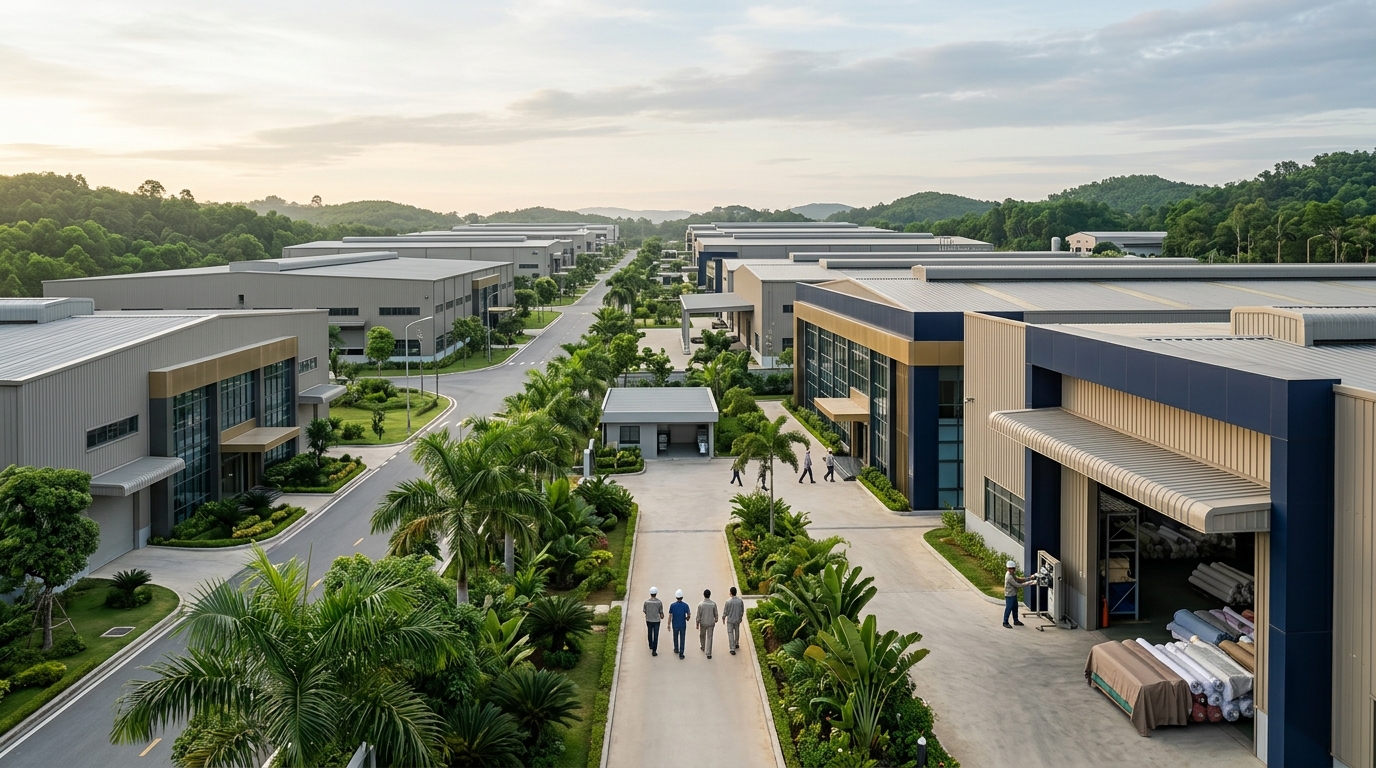
Vietnam has grown into one of Asia's most capable textile and apparel supply bases, with mills offering cotton, synthetic, denim, and knit-to-woven production under one country roof. This playbook helps procurement teams navigate mill selection, vertical integration, and the rule-of-origin requirements that determine whether your goods actually qualify for CPTPP and EU-Vietnam FTA tariff cuts.
Vietnam has built one of the more capable textile and apparel supply bases in Southeast Asia, with vietnam textile manufacturers now covering a meaningful share of the global value chain — from cotton spinning and synthetic yarn production through to denim weaving, knit fabric finishing, and cut-and-sew garment assembly. For buyers who have historically treated Vietnam as a garment-only destination, the upstream fabric capability that has developed over the past decade changes the sourcing equation considerably. Mills in the country can, in the right configuration, support genuinely vertical programmes where yarn origin, fabric production, and finished goods manufacture all stay within a compliant supply chain.
What makes Vietnam particularly relevant to procurement teams right now is not just capability but commercial access. The Comprehensive and Progressive Agreement for Trans-Pacific Partnership (CPTPP) and the EU-Vietnam Free Trade Agreement (EVFTA) both offer meaningful tariff reductions on qualifying textiles and apparel — but both agreements attach a strict yarn-forward rule of origin to those benefits. That requirement reshapes how buyers must evaluate and structure their supply chains. Choosing a mill that imports its yarn from a non-qualifying country, or that cannot document its input sourcing, eliminates the tariff advantage and can create retroactive duty liability at the destination port.
This playbook is written for procurement managers, sourcing directors, and brand supply-chain teams who are either entering Vietnam for the first time or scaling an existing programme. It covers mill types and vertical integration levels, geographic concentration, rule-of-origin compliance mechanics, quality governance, and commercial structuring. It does not assume that every reader will qualify for FTA benefits — in some programmes, avoiding the compliance overhead and accepting standard MFN duty rates is the correct decision — but it does assume that you need to make that call deliberately, with accurate information, before production begins.
For the broader framework on building scalable manufacturing relationships in Asia, seeBuild a Durable Manufacturing Partnership in Asia That Scales. The Vietnam-specific sourcing context, including factory profiles and logistics infrastructure, is covered at/blog/sourcing-from-vietnam-hub.
Understanding the Vertical Integration Landscape Among Vietnam Textile Mills
The term 'vertical integration' covers a wide range of actual configurations, and overstating it is one of the most common misrepresentations buyers encounter when qualifying vietnam textile manufacturers. True vertical integration — spinning yarn from raw fibre, weaving or knitting that yarn into fabric, dyeing and finishing the fabric, then cutting and sewing the garment — exists at relatively few facilities. More commonly, mills are integrated across two or three stages, with one or two inputs sourced externally.
Spinning and Weaving Capability
Vietnam has genuine spinning capacity, particularly in the north. Mills in and around Nam Dinh and Hanoi operate ring-spinning and open-end equipment capable of producing cotton, polyester, and blended yarns. However, spinning capacity has not grown as fast as garment assembly, which means yarn is still commonly imported — and the origin of that imported yarn is what drives CPTPP and EVFTA compliance outcomes.
Woven fabric production — including denim — has expanded, with several larger industrial groups operating rapier and air-jet looms. Denim in particular has attracted investment as buyers look to reduce dependence on Chinese denim mills. That said, denim weaving in Vietnam is still more limited in scale than in Bangladesh or Turkey, and lead times for custom fabric development tend to be longer.
Knit Fabric Production
Knit is arguably the most developed segment of the Vietnamese fabric supply base. Mills producing single jersey, interlock, rib, and a range of performance knit structures are concentrated in the south, particularly in Binh Duong and Ho Chi Minh City. Several of these facilities have invested in yarn-dyeing and fabric-dyeing capacity that allows them to offer a more complete service, though buyers should confirm whether dyeing is done in-house or subcontracted — subcontracted dyeing adds both a lead-time variable and a documentation chain that complicates origin verification.
How CPTPP and EVFTA Rule-of-Origin Rules Affect Your Fabric Sourcing Strategy
Both CPTPP and EVFTA apply a yarn-forward standard to most textile and apparel categories. This means that to claim preferential tariff treatment, the yarn forming the fabric must originate in a qualifying country, the fabric must be produced in a qualifying country, and the finished garment must be cut and sewn in a qualifying country as well.
For CPTPP, qualifying countries include Vietnam, Japan, Canada, Australia, Mexico, Singapore, Malaysia, Brunei, New Zealand, Chile, and Peru. For EVFTA, the qualifying territory is the EU and Vietnam, with limited cumulation provisions for certain third countries. The practical implication is that yarn imported from China — the dominant source of polyester yarn and many blended yarns in Vietnam's supply base — will typically fail the origin test under both agreements.
What This Means Operationally
Before placing a fabric development order with any Vietnamese mill under an FTA programme, buyers should request documentation of yarn origin as a standard qualification step, not a post-order request. Mills that regularly export under CPTPP or EVFTA should already hold this documentation and should be able to share it without friction. Those that cannot produce it quickly are signalling either that they do not regularly issue preferential origin certificates or that their input sourcing does not qualify.
For EVFTA specifically, Vietnam operates under the REX (Registered Exporter) system. Exporters must be registered in the REX system to self-declare origin on shipments above a threshold value. Confirming a mill's REX registration number and checking its status is a practical and low-effort early qualification step.
Geographic Clusters and What They Mean for Logistics and Lead Times
Vietnamese textile production is geographically split in ways that affect logistics planning. The northern cluster — anchored around Hanoi, Nam Dinh, and Haiphong — has stronger spinning and historical weaving infrastructure, with Haiphong port serving as the primary northern export gateway. The southern cluster — Ho Chi Minh City, Binh Duong, Dong Nai, and Long An — is more heavily weighted toward knit fabric production and cut-and-sew garment assembly, with Cat Lai port handling the majority of southern container throughput.
For programmes that require fabric from the north and cutting from the south, internal freight adds lead time and cost. When evaluating vietnam textile manufacturers across multiple facilities, map the inter-facility logistics before finalising the production structure, particularly if origin documentation requires fabric to be produced and shipped within Vietnam rather than crossing an international border.
| Production Stage | Stronger Concentration | Key Nearby Port |
|---|---|---|
| Spinning (cotton, synthetic) | North (Nam Dinh, Hanoi) | Haiphong |
| Woven / Denim weaving | Mixed (north and central) | Haiphong, Da Nang |
| Knit fabric | South (Binh Duong, HCMC) | Cat Lai (HCMC) |
| Cut-and-sew garments | South and central | Cat Lai, Da Nang |
Supplier Qualification: What to Verify Before Committing to a Programme
Qualifying a Vietnamese textile supplier for a scaled programme requires more than a factory audit checklist. The criteria relevant to B2B buyers operating under FTA compliance requirements include both production capability and documentation maturity.
Production Capability Verification
Request a machine list with equipment age and installed capacity by production stage. For knit mills, this means circular knitting machine count and gauge range. For woven mills, loom type, reed width, and maximum fabric weight range. For dyeing and finishing, confirm whether the facility holds relevant environmental permits under Vietnamese regulations — mills that cannot demonstrate compliant effluent management introduce a reputational and operational risk.
Ask for references from existing buyers in your target market, and request copies of certificates of origin that have been accepted without amendment. A mill with a clean track record of accepted CPTPP or EVFTA COOs is demonstrably lower risk than one that has not previously exported under either agreement.
Documentation and Systems Readiness
Mills exporting to regulated markets should maintain records through Vietnam's VNACCS customs system. For EVFTA, REX registration is the key credential. Ask whether the mill uses an ERP or production management system that can generate batch-level traceability records — this matters not only for origin compliance but for quality investigation when defects arise in-market.
Commercial Structuring and Payment Terms for Textile Programmes
Payment terms in Vietnamese textile sourcing commonly follow a deposit-plus-balance structure, with the deposit paid at order confirmation and the balance settled against a copy of the bill of lading or at sight of shipping documents. For fabric orders specifically, mills typically require a higher deposit percentage than garment factories because fabric production consumes raw material cost upfront before any assembly value is added.
For ongoing programmes, buyers with sufficient volume can negotiate open-account terms or extended payment windows, particularly once a track record of on-time payment and predictable order flow is established. Letters of credit remain in use for first-time relationships and higher-value orders, though the documentary credit process adds processing time that buyers should account for in their order schedules.
Pricing is most commonly quoted in USD. Fabric pricing is typically quoted per metre or per kilogram depending on the product type — knit fabrics are often traded by weight while woven fabrics default to per-metre pricing. Ensure your quotation requests specify the same unit to allow like-for-like comparison across suppliers.
Quality Governance Structures That Work at Production Scale
Quality management in Vietnamese textile sourcing is most effective when governance checkpoints are defined in the purchase order terms rather than negotiated reactively after a problem occurs. For fabric programmes, the standard intervention points are: pre-production approval of yarn and greige fabric samples, in-process inspection at the dyeing and finishing stage, and final inspection before packing.
For garment programmes using Vietnamese fabric, add a fabric inspection at the point of delivery to the cut-and-sew facility — particularly where the two facilities are separate legal entities. This catches colour variation, width inconsistency, and shrinkage non-conformances before they are cut into panels and become more expensive to resolve.
AQL (Acceptance Quality Limit) levels should be stated in the purchase order. The appropriate AQL level varies by product end-use: stricter levels apply to products entering regulated markets or where cosmetic defects are commercially significant. vietnam textile manufacturers exporting to established international brands are generally familiar with AQL-based inspection protocols, but the specific level and sampling plan should be written down, not assumed.
When production spans multiple facilities or provinces, an in-country representative or execution partner who can physically attend inspections and communicate in Vietnamese is a practical necessity rather than an optional service. MTS provides this kind of on-the-ground execution support across Vietnam — see ourVietnam sourcing servicesfor detail on how we structure programme oversight.
Frequently Asked Questions
What does 'yarn-forward' mean and why does it matter for Vietnam sourcing?
Yarn-forward is the rule-of-origin standard embedded in both CPTPP and EVFTA: the yarn used to form the fabric must originate in a qualifying country, the fabric must be woven or knitted in a qualifying country, and the garment must be cut and sewn there as well. For buyers sourcing from Vietnam, this means that fabric or yarn imported from non-qualifying countries — notably China — will typically disqualify the finished goods from preferential tariff treatment. Verifying that your Vietnamese mill sources yarn domestically or from a CPTPP/EVFTA partner country is the first compliance checkpoint, not an afterthought.
Which Vietnamese provinces have the strongest concentration of textile mills?
The densest clusters of vietnam textile manufacturers are found in and around Ho Chi Minh City and the surrounding provinces of Binh Duong, Dong Nai, and Long An in the south, and in Hanoi and Nam Dinh in the north. Spinning and weaving capacity tends to concentrate in the north, particularly Nam Dinh, which has a long industrial textile history. Cut-and-sew and finishing operations are more evenly distributed, with significant capacity in the central provinces of Da Nang and Quang Nam as well.
How do I verify a Vietnamese mill's rule-of-origin compliance before placing an order?
Start by requesting the mill's input sourcing records: yarn purchase invoices, supplier certificates of origin, and any existing VNACCS customs records for imported inputs. Ask specifically whether they have previously issued EVFTA or CPTPP certificates of origin and whether those certificates have been accepted without incident at the destination port. For high-volume programmes, commission a pre-production compliance audit through an independent inspection body or through an execution partner with on-the-ground Vietnam access. Certificates of origin for EVFTA are currently self-declared by registered exporters under the REX system, so confirming the mill's REX registration is a practical early check.
What minimum order quantities should I expect from Vietnamese fabric mills versus garment factories?
Minimum order quantities vary considerably by mill type and product. Vertically integrated mills producing their own yarn and fabric commonly require fabric minimums in the range of several thousand metres per colour per run, while specialist knit mills serving established buyers may work at lower thresholds for repeat programmes. Garment cut-and-sew factories sourcing fabric externally often have lower MOQs in unit terms but will pass fabric minimums back to the buyer indirectly. For development samples and initial trials, expect setup and strike-off costs that are not absorbed into unit price at small volumes.
Can Vietnamese mills handle both woven and knit production, or are they typically specialised?
Most large, established vietnam textile manufacturers are specialised rather than fully cross-category. Knit mills — producing jersey, interlock, rib, and performance fabrics — operate quite differently from shuttle or rapier loom facilities producing woven and denim fabric, and the two rarely share significant infrastructure. Some conglomerate-scale groups do operate separate knit and woven divisions under one corporate umbrella, but buyers should treat these as distinct supply relationships with separate quality systems and lead-time schedules. Confirming the specific division, production line, and quality team responsible for your order is standard due diligence.
How does sourcing from Vietnam compare with sourcing from Bangladesh or Indonesia for compliance purposes?
Bangladesh benefits from LDC (Least Developed Country) status, giving it preferential access to the EU market under the Everything But Arms scheme with a more relaxed two-stage transformation rule, making origin compliance structurally simpler for most apparel. Vietnam's EVFTA access requires the stricter yarn-forward standard but offers broader product coverage and, for buyers who manage the compliance correctly, competitive tariff outcomes. Indonesia is party to RCEP but not CPTPP or EVFTA, so the tariff benefits and applicable rules differ significantly depending on the destination market. The right country depends on your end-market, product category, and your ability to manage supply-chain documentation.
What governance structures should I put in place when working with Vietnamese textile suppliers at scale?
At scale, governance should cover four areas: production scheduling tied to shipping milestones, in-line and final quality inspection at agreed AQL levels, origin compliance documentation (including REX status, input COOs, and customs records), and a formal corrective-action process when defects or compliance gaps are found. Many buyers working in Vietnam use a local execution partner or in-country representative to manage daily communication, attend pre-production meetings, and coordinate third-party audits — this is especially valuable when production spans multiple facilities or provinces. Linking these governance elements to your commercial terms from the outset, rather than adding them reactively, gives you leverage when problems arise.
Vietnam offers a genuinely capable textile supply base, but capturing its full commercial value — including FTA tariff benefits — requires more structural rigour than most buyers apply at the qualification stage. Getting mill type, input origin, and governance frameworks right before production starts is not administrative overhead; it is the mechanism by which sourcing cost and compliance risk are controlled at scale. The buyers who consistently perform well in Vietnam are those who treat origin documentation and quality governance as operational inputs, planned and resourced from day one.
Need eyes on the ground in Vietnam?
MTS is an execution partner — supplier verification, manufacturing management, quality control and export logistics across Indonesia, Vietnam and China.
Related services
Related articles
Receive furniture sourcing insights across Asia.
One email per week. No spam.