Knitted Fabric Manufacturers Indonesia: Sourcing Guide for Activewear Brands
13 min read
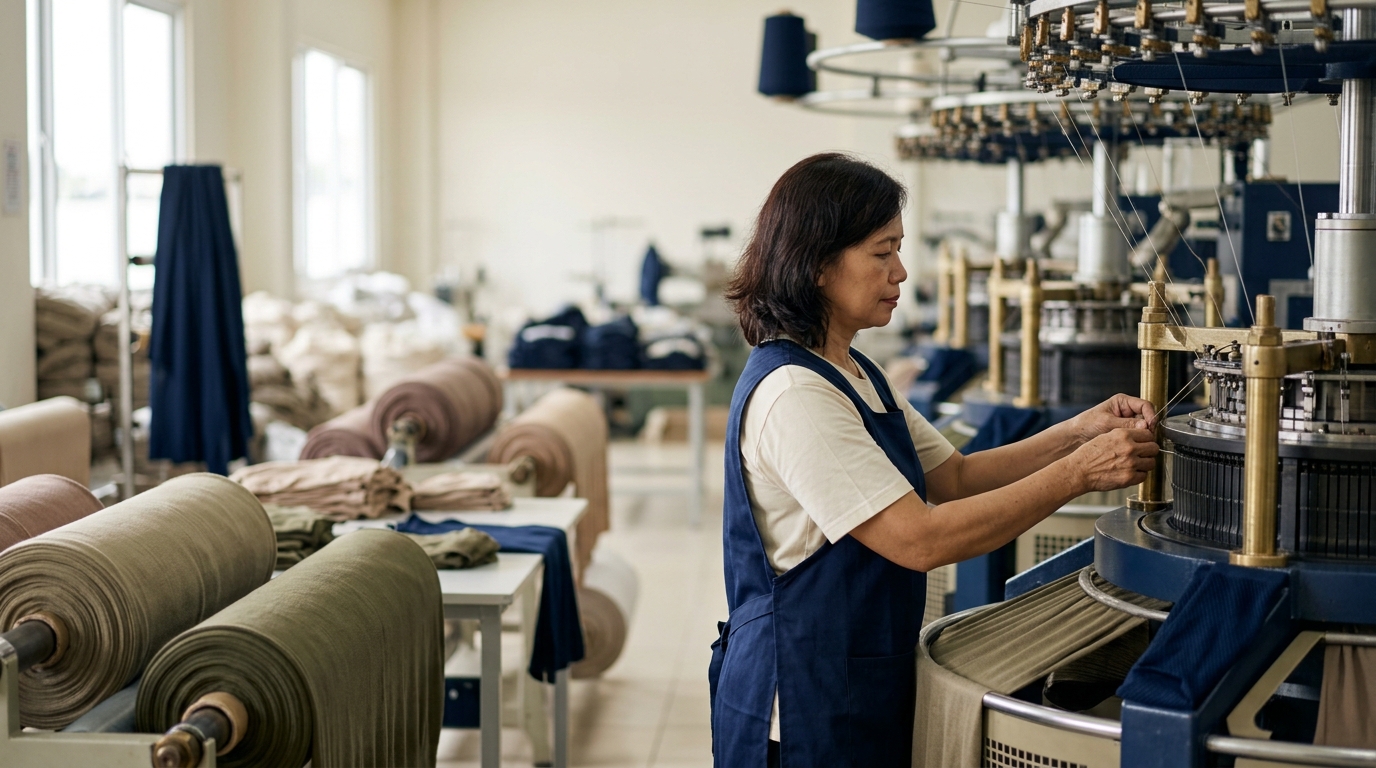
Sourcing knitted fabric from Indonesia is a serious supply chain decision. For US-based activewear and t-shirt brands, the stakes are high: fabric quality directly determines garment performance, customer retention, and return rates. Yet most sourcing guides stop at listing mill names without…
Sourcing knitted fabric from Indonesia is a serious supply chain decision. For US-based activewear and t-shirt brands, the stakes are high: fabric quality directly determines garment performance, customer retention, and return rates. Yet most sourcing guides stop at listing mill names without addressing what actually matters — GSM tolerances, dyeing capabilities, sampling timelines, and compliance requirements.
This guide is written for brand owners and sourcing managers evaluating knittedfabric manufacturersIndonesia for circular knit constructions: jersey, pique, fleece, rib, and French terry. You will find actionable benchmarks on fiber blends, finishing options, quality control protocols, and supplier verification — information that generic directory pages do not provide.
Indonesia has positioned itself as one of Asia's most capable textile exporters. Its knitting sector is concentrated, technically mature, and increasingly aligned with global sustainability standards. Understanding how to navigate this supplier ecosystem — before committing to samples or bulk orders — is what separates efficient sourcing decisions from costly mistakes.
Why Indonesia Competes at the Top of the Global Knitted Fabric Market
Indonesia ranks among the world's top ten textile and apparel exporters. Its knitting industry is anchored in Java, with the greatest concentration of mills in Bandung (West Java) and Surabaya (East Java). Bandung alone hosts hundreds of knitting operations ranging from small-to-medium exporters to large integrated mills.
Labor costs in Indonesia remain competitive relative to China and, depending on the region, comparable to or below Vietnam. For circular knit fabric production — which is machinery-intensive but still labor-dependent in finishing and quality control — this cost structure matters at scale.
The Indonesian government has actively supported the textile sector through investment incentives and export facilitation programs. Indonesia also participates in the Generalized System of Preferences (GSP), although US buyers should verify current GSP status for specific HTS codes before assuming duty benefits apply. Trade agreement landscapes shift, and tariff planning requires current data.
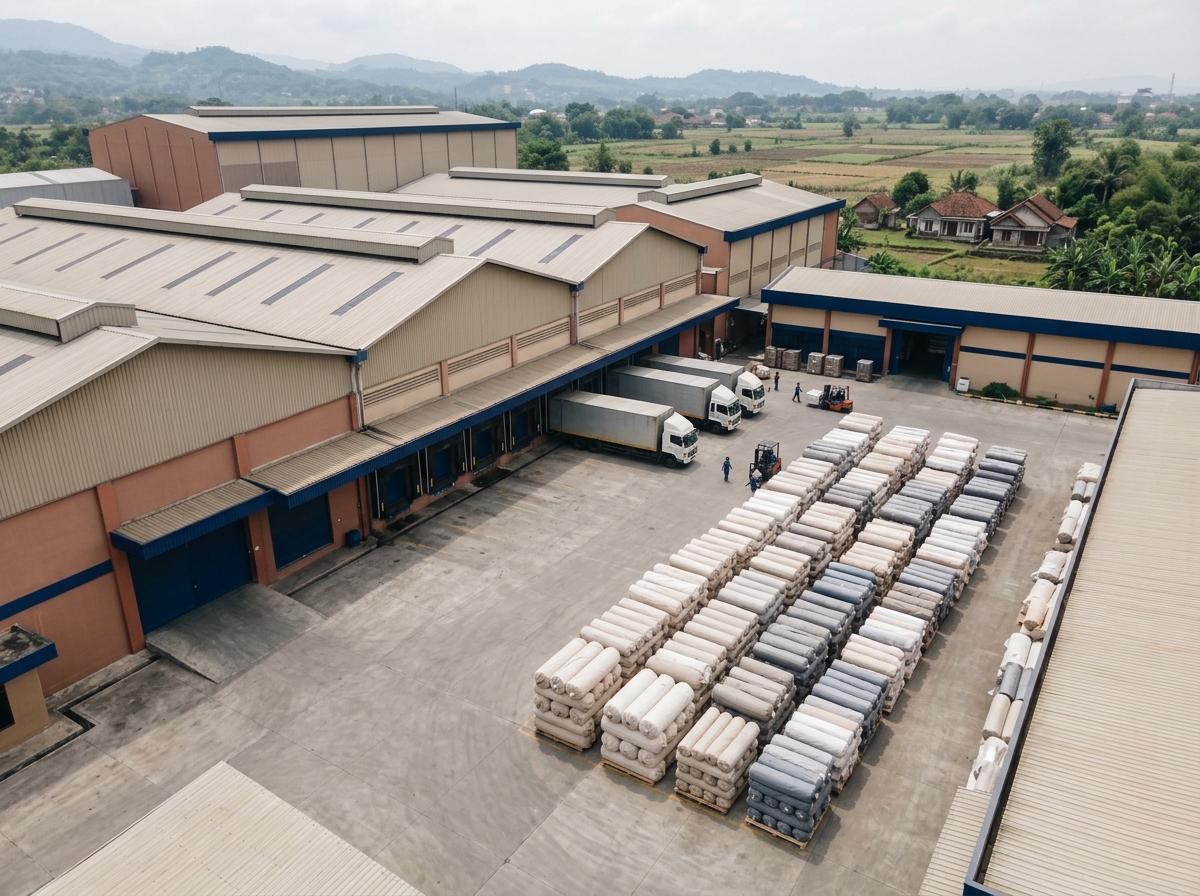
Circular Knit Fabric Constructions Available from Indonesian Mills
Indonesian knitted fabric manufacturers produce the full range of circular knit constructions relevant to activewear and casualwear. Understanding each construction's technical profile helps you match fabric to end-use before requesting samples.
Standard Circular Knit Constructions and Their GSM Ranges
| Fabric Type | Typical GSM Range | Primary End-Use |
|---|---|---|
| Single Jersey | 120–200 gsm | T-shirts, base layers |
| Pique (Polo) | 180–240 gsm | Polo shirts, performance tops |
| Interlock | 180–280 gsm | Athletic wear, infant apparel |
| Rib (1×1, 2×2) | 160–280 gsm | Cuffs, collars, trim, fitted tops |
| French Terry | 240–320 gsm | Sweatshirts, hoodies, lounge |
| Fleece (brushed) | 280–400 gsm | Outerwear, casual fleece |
GSM ranges above are approximate and vary by yarn count, fiber content, and mill specifications. Always confirm target GSM with your mill and request a tolerance commitment in writing.
Hand Feel, Consistency, and Mill Capability Differences
Indonesian mills vary significantly in fabric consistency. Larger integrated mills — those with in-house yarn sourcing, knitting, dyeing, and finishing — typically deliver tighter GSM control and more consistent hand feel across production batches. Smaller contract knitters may rely on third-party yarn supply, which introduces variability.
For activewear, hand feel and stretch recovery are critical. Single jersey in combed cotton should feel smooth and exhibit minimal distortion after washing. Interlock, being double-knit, offers more dimensional stability — preferred for fitted performance garments.
French terry and fleece for activewear require consistent loop height and pile density. Mills producing for export-grade buyers generally demonstrate better loop uniformity than those focused on domestic markets.
Cotton, CVC, and Polyester Blends: What Indonesian Mills Actually Offer
100% Cotton and Ring-Spun Options
Most established knitted fabric manufacturers in Indonesia offer 100% combed cotton and ring-spun cotton constructions. Combed cotton removes short fibers and impurities, producing a smoother, stronger yarn. Ring-spun cotton adds further strength and softness. Both are standard for premium T-shirt fabrics.
Cotton sourcing in Indonesia draws from domestic and imported supply. Australian, US (Supima-grade), and Indian cotton are commonly used. Mills with transparent supply chains will disclose cotton origin on request.
CVC Blends: What They Are and Why Activewear Brands Use Them
CVC stands for Chief Value Cotton — a blend where cotton comprises the majority of fiber content, typically in 60/40 or 80/20 (cotton/polyester) ratios. CVC fabrics offer a softer hand feel than pure polyester while providing better shape retention and reduced shrinkage compared to 100% cotton.
For activewear, CVC single jersey in 60/40 is a common specification. It accepts reactive dye (from the cotton component) while the polyester component improves durability and reduces moisture absorption — useful for light performance applications. Indonesian mills producing CVC fabric are widely available, though quality of blending and evenness of dye uptake should be verified via lab samples before bulk commitment.
Recycled Polyester and Nylon-Spandex Options
Performance activewear increasingly requires recycled polyester. Several Indonesian mills now offer circular knit fabrics using recycled PET-derived polyester, with some capable of supplying under Global Recycled Standard (GRS) certification. Verify GRS scope certificates directly — do not accept claims without documentation.
Nylon-spandex blends (typically 80/20 or 85/15 nylon/elastane) for four-way stretch applications are produced by some Indonesian mills. This construction is used in compression garments, leggings, and performance base layers. Availability is more limited than cotton or polyester constructions — confirm capability early in your supplier evaluation.
Dyeing and Finishing Capabilities to Evaluate Before Placing Orders
Reactive vs. Disperse Dyeing
Cotton and CVC fabrics use reactive dyeing. Polyester fabrics require disperse dyeing. Mills processing blended fabrics must manage both dye classes in sequence — a technically demanding process that affects colorfastness outcomes.
Ask prospective mills whether dyeing is in-house or subcontracted. In-house dyeing gives the mill better control over repeatability. Subcontracted dyeing introduces additional variables and extends lead times.
Functional Finishing Options
Indonesian knitted fabric manufacturers with export-grade capabilities increasingly offer functional finishes relevant to activewear:
- Moisture-wicking finish: Applied via padding or exhaust process. Effective for polyester and CVC constructions. - UPF (Ultraviolet Protection Factor) finish: Relevant for outdoor activewear. Typically rated UPF 30–50+. Ask mills for test reports from recognized laboratories. - Anti-microbial finish: Silver-ion or other treatments. Longevity after repeated washing must be verified. - Anti-pilling: Enzyme washing or chemical treatment. Important for fleece and French terry. - Compacting: Mechanical process to reduce residual shrinkage in cotton fabrics. Standard for export-grade T-shirt fabric.
Color Fastness Certifications
OEKO-TEX Standard 100 is the most commonly held certification among Indonesian mills serving export markets. It certifies that the finished fabric is free from harmful substances. GOTS (Global Organic Textile Standard) certification is less common but available from some mills processing organic cotton.
Ask specifically whether the mill holds an active OEKO-TEX certificate for the fabric construction you are ordering — not just a general mill-level certificate. Certificates are product-category specific.
GSM Tolerance Standards and Quality Control Benchmarks
Industry-Standard GSM Tolerances
The accepted industry norm for GSM tolerance in knitted fabrics is approximately ±5% to ±8% of the specified target weight. For a 180 gsm single jersey, a ±5% tolerance means acceptable fabric would fall between 171 and 189 gsm.
Tighter tolerances (±3% to ±5%) are achievable from well-equipped mills and should be specified in your purchase order if your garment construction is sensitive to fabric weight variation.
Shrinkage, Pilling, and Colorfastness Standards
Request that mills test against the following commonly applied standards (approximate references):
| Test Parameter | Applicable Standard | Acceptable Benchmark |
|---|---|---|
| Dimensional stability (shrinkage) | ISO 6330 or AATCC 135 | ≤5% after 3 washes |
| Pilling resistance | ISO 12945-2 | Grade 3–4 minimum |
| Colorfastness to washing | ISO 105-C06 | Grade 4 minimum |
| Colorfastness to rubbing | ISO 105-X12 | Grade 3–4 dry/wet |
| Bursting strength | ISO 13938-1 | Per end-use spec |
Standards listed are widely used references. Confirm which testing protocols your target market or retail customer requires, as US buyers may specify AATCC over ISO equivalents.
AQL Inspection for Fabric Rolls
For fabric roll inspection, AQL (Acceptance Quality Limit) protocols are typically applied. AQL 2.5 is a common starting point for fabric inspection, applied using a four-point or ten-point grading system. Specify your inspection protocol in the purchase order.
Mill Test Reports (MTRs) should include GSM measurements from multiple points across fabric rolls, colorfastness results, shrinkage data, and fiber content verification. Request MTRs for every bulk production lot — not just for initial samples.
Sampling and Bulk Lead Times: Setting Realistic Expectations
Lab Dip and Strike-Off Timelines
Lab dip turnaround — where the mill dyes a small yarn or fabric swatch to match your target color — typically takes 7 to 14 days from color standard receipt. Complex colors or specific Pantone references may require multiple rounds. Budget two to three rounds of lab dip approval before bulk dyeing.
Strike-offs (fabric samples dyed in actual production conditions) add another 7 to approximately 14 days after lab dip approval. Total color approval time commonly runs three to five weeks.
Bulk Production Lead Times and MOQs
| Stage | Typical Timeline |
|---|---|
| Lab dip approval | 7–14 days per round |
| Sample fabric production | 7–14 days after approval |
| Bulk production (after approval) | 30–60 days |
| Shipping to US West Coast | 18–25 days (sea freight) |
Minimum order quantities among Indonesian mills vary by mill size. Large integrated mills commonly require 500 to 1,000 kg per color per fabric construction. Smaller mills may accept 200 to 500 kg. MOQs below 200 kg are rare for export-grade fabric and should prompt questions about whether you are dealing with a mill or a fabric trader.
Protecting Your Design IP During Sampling
Sampling agreements should include a non-disclosure clause covering your color standards, technical specifications, and any proprietary blends. For functional finish specifications or custom yarn compositions, an NDA (Non-Disclosure Agreement) should be signed before sharing detailed tech packs. Indonesian OEM mills working with major export brands are generally accustomed to NDA requirements.
Key Knitted Fabric Manufacturers and Regions in Indonesia
Bandung as the Primary Knitting Hub
Bandung, West Java, is the undisputed center of Indonesia's circular knit fabric industry. The city hosts a dense concentration of knitting mills, from small-to-medium exporters to large vertically integrated operations. Proximity to raw material suppliers and a skilled textile workforce makes Bandung the first destination for buyers evaluating knittedfabric manufacturers Indonesia.
Surabaya (East Java) hosts additional capacity, particularly for polyester fabric Indonesia production and larger-scale integrated mills serving both domestic and export markets.
Notable Manufacturers to Evaluate
Several manufacturers are frequently referenced in the Indonesian textile export sector:
- Knitto Group (Bandung): Publicly known for circular knit fabric production across cotton and blended constructions. Positioned toward export markets. - Duniatex (Central Java): One of Indonesia's larger textile groups with significant yarn-to-fabric integration. Known for polyester and blended fabric production at scale. - PT Primatex Co: Referenced among established Indonesian textile manufacturers. Evaluate current export capabilities and certifications directly with the company. - Parama Textile and Warna Jaya: Names that appear in the Indonesian knit fabric supplier landscape. Capabilities and certifications should be verified directly before engagement.
All manufacturer claims above should be independently verified. Capabilities, certifications, and export status change. Do not rely on trade platform profiles alone.
Supplier Vetting Checklist
- ✓Confirm mill is a direct manufacturer — not a fabric trader
- ✓Request factory registration documents and business license
- ✓Verify active OEKO-TEX or GOTS certificates (product-specific, not mill-level only)
- ✓Ask for third-party Mill Test Reports from recent bulk production
- ✓Confirm in-house dyeing capability (reactive and/or disperse)
- ✓Request GSM tolerance commitment in writing
- ✓Confirm MOQ by fabric construction and color
- ✓Ask for references from US or EU export customers
- ✓Clarify whether functional finishes are in-house or subcontracted
- ✓Conduct or commission an independent factory audit before first bulk order
Compliance, Certifications, and US Import Considerations
OEKO-TEX and GOTS in Indonesia
OEKO-TEX Standard 100 certification is available from a meaningful number of Indonesian mills, particularly those serving European and US export markets. GOTS certification for organic cotton constructions is less widespread but present among mills with established export relationships.
GRS certification for recycled polyester fabric Indonesia production is an emerging capability. As demand for recycled content in activewear grows, more mills are pursuing GRS scope certificates. Always request a current, product-specific certificate — not a marketing claim.
US Import Tariffs: HTS Chapter 60
Knitted fabrics are classified under HTS Chapter 60 (Knitted or Crocheted Fabrics) for US import purposes. Specific HTS codes depend on fiber content and construction:
- 6004–6006: Covers various knitted fabric categories by fiber type and construction. - Duty rates vary by specific subheading and fiber content. Cotton-dominant fabrics and synthetic fabrics carry different rates.
US buyers should consult a licensed customs broker to confirm current duty rates for their specific fabric constructions before finalizing sourcing decisions. GSP eligibility for Indonesian textiles should be confirmed against current US trade policy, as status can change.
Social Compliance and Ethical Sourcing
For US retail partners requiring social compliance documentation, ask Indonesian mills about BSCI (Business Social Compliance Initiative) or WRAP (Worldwide Responsible Accredited Production) audit status. Mills supplying major international brands typically hold current audit results. First-time export mills may not.
Building a Reliable Long-Term Supplier Relationship in Indonesia
Structuring Trial Orders and Quality Benchmarks
First bulk orders should be structured as trial orders with explicit quality acceptance criteria. Specify GSM tolerance, colorfastness grades, shrinkage limits, and inspection protocol (AQL level, inspection party) in the purchase order. Establish clear reject-and-replace terms before production begins.
Sourcing Agent vs. Direct Mill Engagement
Engaging directly with knittedfabric mills in Indonesiagives you pricing transparency and direct production visibility. It requires, however, that you have internal capability to manage technical specifications, sampling rounds, inspection coordination, and time-zone communication.
Sourcing agents working in Indonesia typically charge a commission of 3% to 10% of FOB value. They add value when you lack local language capability, factory verification resources, or technical textile expertise. Independent sourcing agents should disclose whether they receive additional commission from mills — hidden supplier-side commissions are a conflict of interest.
For brands without in-house sourcing infrastructure, working through an experienced operational sourcing partner — rather than an agent paid purely on transaction volume — provides more objective supplier selection and ongoing production oversight.
Payment Terms and Communication
Standard payment terms in Indonesian textile trade include:
- T/T (Telegraphic Transfer): Commonly 30% deposit on order confirmation, 70% before shipment or against shipping documents. - L/C (Letter of Credit): Used for larger orders with established mills. Provides payment security for both parties.
Indonesia is 12 to 14 hours ahead of US Eastern time. Asynchronous communication via email and messaging platforms works well. Establish a primary contact at the mill with export experience and English fluency. Ambiguities in technical specifications should always be resolved in writing before sampling begins.
Frequently Asked Questions
What GSM range is best for activewear knitted fabrics from Indonesia? For performance T-shirts and base layers, single jersey at 140–180 gsm is the standard range. Heavier constructions (French terry at 260–300 gsm, fleece at 300–380 gsm) suit outerwear and casualwear. The right GSM depends on end-use, not convention — define your performance requirements first, then specify GSM accordingly.
What is the typical minimum order quantity for Indonesian knitted fabric mills? Export-oriented mills commonly require 500 to 1,000 kg per color per construction for standard knit fabrics. Smaller mills may accept 200 to 500 kg. MOQs significantly below 200 kg for export-grade fabric typically indicate a trader, not a mill.
Do Indonesian knitted fabric manufacturers offer OEKO-TEX certified fabrics? Yes. OEKO-TEX Standard 100 certification is available from a number of Indonesian mills targeting export markets. Always request a current, product-specific certificate. Mill-level certification does not automatically cover every fabric construction.
How long does sampling take with a knitted fabric supplier in Indonesia? Allow 7 to 14 days per lab dip round, plus 7 to 14 days for sample fabric production after color approval. Total sampling timelines commonly run four to six weeks when accounting for multiple approval rounds. Build this into your development calendar.
What is CVC fabric and why do activewear brands use it? CVC (Chief Value Cotton) is a cotton-dominant blend, typically 60/40 or 80/20 cotton/polyester. It offers softer hand feel than pure polyester, better shape retention than pure cotton, and reduced shrinkage. Common for performance T-shirts and lightweight activewear where a natural feel and durability are both priorities.
Which cities in Indonesia have the most knitting fabric factories? Bandung (West Java) is the primary hub for circular knit fabric production. Surabaya (East Java) hosts additional capacity, particularly for polyester and larger integrated operations. Bandung should be the starting point for any sourcing evaluation targeting jersey, pique, fleece, or rib knit constructions.
Indonesia offers genuine depth in circular knit fabric production — technically capable mills, competitive cost structures, and a growing certification landscape. The sourcing decisions that produce reliable outcomes are those built on verified supplier profiles, written quality benchmarks, and structured sampling agreements rather than trade platform listings alone.
You now have the benchmarks and evaluation criteria to move forward with confidence. The logical next step is to put verified Indonesian mill capabilities to the test with your actual fabric specifications.
You have the specifications and benchmarks. Now verify which mills can actually meet them. Request samples from vetted knitted fabric manufacturers in Indonesia — and compare real fabric performance against your standards before committing to bulk.
Start Your Sampling Request →Need eyes on the ground in Indonesia?
MTS is an execution partner — supplier verification, manufacturing management, quality control and export logistics across Indonesia, Vietnam and China.
Related services
Related articles
Receive furniture sourcing insights across Asia.
One email per week. No spam.