Heavy Timber Posts and Beams Suppliers Indonesia: A Complete Sourcing Guide
14 min read
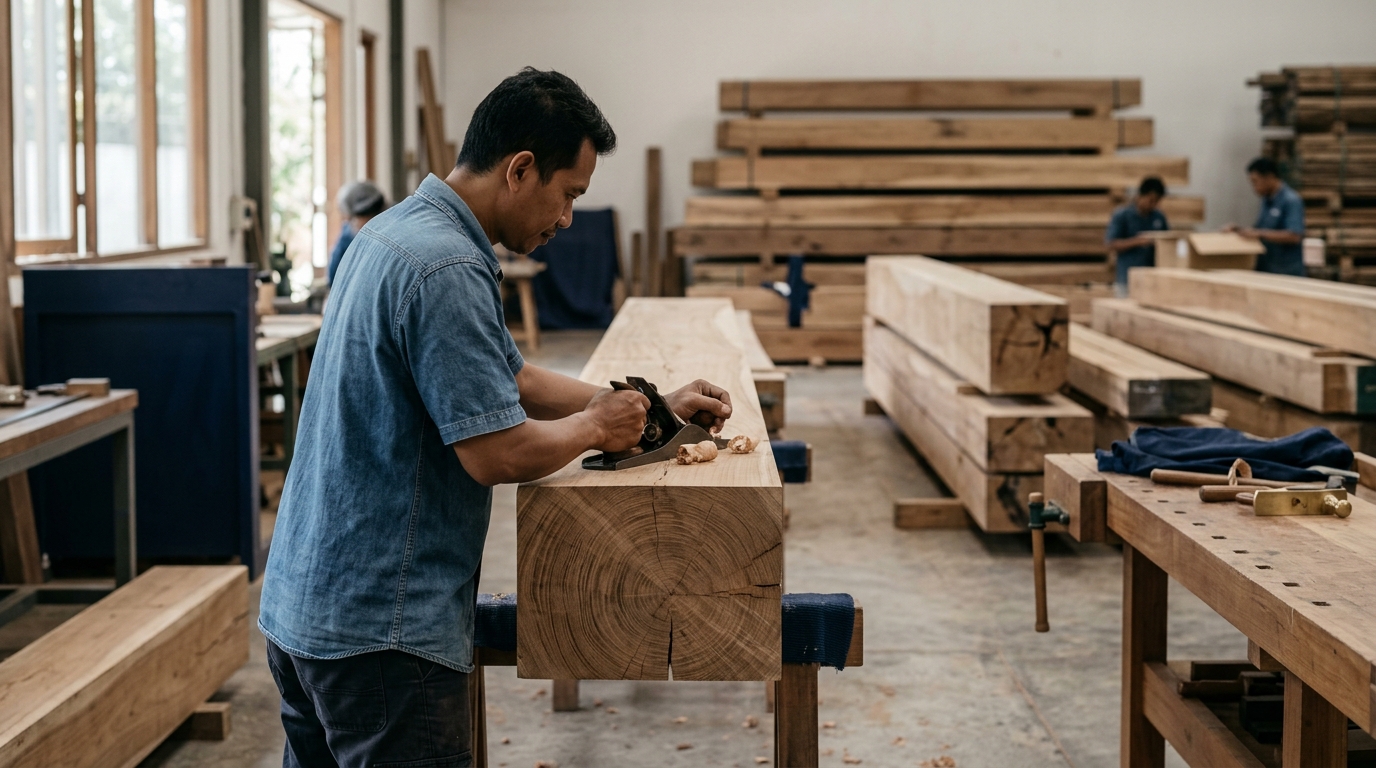
Sourcing large-section structural timber from overseas is a high-stakes decision. Mistakes in species selection, drying specification, or import documentation can delay a project by months and add thousands of dollars in remediation costs. For US-based timber frame builders, pergola manufacturers,…
Sourcing large-section structural timber from overseas is a high-stakes decision. Mistakes in species selection, drying specification, or import documentation can delay a project by months and add thousands of dollars in remediation costs. For US-based timber frame builders, pergola manufacturers, and structural importers, Indonesia represents one of the most capable and species-rich supply bases in the world — but navigating it requires precise knowledge, not general impressions.
This guide covers every decision a purchasing manager must act on. It addresses species selection, drying behavior, packing standards, and shipping logistics. It also details exactly what US import compliance requires. It also provides a practical supplier vetting framework. Whether you are placing your first trial order or renegotiating an existing supply relationship, the detail here is written at specification level.
Indonesia's timber industry spans plantation teak in Java, dense hardwood mills in Kalimantan, and export-ready processing clusters near Surabaya and Semarang. The range of heavy timber posts beams suppliers Indonesia offers is broader than most importers realise. The sections below move from species selection through to pricing and lead times — in the order a sourcing decision actually unfolds.
Why Indonesia Consistently Outperforms Other Regions for Structural Hardwood
Indonesia holds one of the largest tropical forest estates on earth. Kalimantan (Indonesian Borneo) alone contains extensive stands of high-density hardwoods. Sulawesi and the eastern islands add further species diversity. Java and Bali host well-capitalised mill clusters with export experience and English-language sales infrastructure.
Certification landscape for US importers
Three certification frameworks matter here.
- SVLK (Sistem Verifikasi Legalitas Kayu) — Indonesia's mandatory timber legality verification system. The V-Legal mark on export documents confirms compliance. US importers need this for Lacey Act due diligence. - FSC (Forest Stewardship Council) — voluntary, chain-of-custody certified. Required by many US specifiers and retail channels. - PEFC — less common in Indonesia but accepted in some European procurement frameworks.
SVLK is the baseline. FSC adds a premium but broadens your US customer base significantly.
Competitive advantages over alternative regions
| Dimension | Indonesia | Malaysia | Brazil |
|---|---|---|---|
| Species diversity (hardwood) | Very high | Moderate | High |
| Plantation teak availability | High (Java) | Low | Low |
| Export mill infrastructure | Established | Established | Variable |
| SVLK / V-Legal system | Mandatory national system | Equivalent (MTCS) | None equivalent |
| Typical FOB lead time | 6–14 weeks | 6–12 weeks | 10–18 weeks |
| Lacey Act documentation ease | Well-established | Well-established | More complex |
Brazil offers comparable species density but longer lead times and more complex Lacey Act paperwork. Malaysia is competitive on rubberwood but thinner on high-density structural hardwoods at large sections.
The Five Species That Define Indonesian Structural Timber
Choosing the right species is the most consequential technical decision in this process. Each has a distinct density, durability class, and processing behaviour at large section sizes.
Merbau (Intsia bijuga) — the workhorse of structural hardwood
Merbau is the most widely exported structural species from Indonesia. Its air-dry density is approximately 800–900 kg/m³ (figures vary by source and origin). It sits in durability class 1–2 under European classification — meaning it is rated for ground contact and exposed exterior use without preservative treatment. It machines cleanly, holds fasteners well, and is widely available in sections up to 300 × 300 mm and lengths to 6 m.
The main trade-off: merbau contains water-soluble extractives (tannins) that bleed from freshly cut surfaces and can stain concrete, masonry, and light-coloured cladding. Seal cut ends promptly.
Bengkirai (Shorea laevis) — high hardness, reliable availability
Bengkirai (also called Yellow Balau) is a Southeast Asian heavy hardwood with density typically around 870–1,050 kg/m³ (air-dry, approximate). It performs well in load-bearing applications and is widely used in Indonesian decking and bridge construction. Large-section posts and beams are available from Kalimantan-based mills. It is somewhat harder to machine than merbau, so specify pre-drilling requirements in your purchase order.
Ulin / Ironwood (Eusideroxylon zwageri) — premium and increasingly restricted
Ulin is among the densest commercial timbers in the world, with approximate air-dry density of 1,000–1,200 kg/m³. It is naturally resistant to moisture, marine borers, and insect attack. For this reason it commands the highest FOB prices among Indonesian structural species. Supply is restricted — wild harvest is tightly regulated, and plantation stocks are limited. Verify SVLK documentation carefully before specifying ulin.
Teak (Tectona grandis) — dimensional stability for exposed members
Plantation teak from Java is a different product from old-growth teak. Plantation-grown material (typically 20–40 year rotation) offers good dimensional stability and natural oil content, making it suitable for exposed pergola posts, architectural beams, and finish-grade structural members. Density is approximately 600–750 kg/m³ (air-dry, approximate) — lower than merbau or bengkirai, so structural engineers should verify section sizing for load-bearing applications.
Suar (Albizia saman) and secondary species
Suar (also called rain tree or monkey pod) is a plantation-grown species with moderate density. It is considerably less expensive than merbau or ulin. It suits non-structural or lightly loaded members and is popular for decorative beams and feature elements. Other secondary species — such as matoa and kapur — appear in Indonesian export catalogues and may be offered as substitutes.
Sawn Versus Engineered: Selecting the Right Heavy Timber Product Form
Large-section sawn timber is the default product form from most Indonesian mills. Typical available sections range from 100 × 100 mm up to 300 × 300 mm or 200 × 400 mm, with lengths typically up to 6 m in standard production and up to around 9 m in special cuts depending on log availability.
Glulam (glued laminated timber) production exists in Indonesia but is less developed than in Europe or North America. A smaller number of Indonesian mills produce structural glulam beams, typically in merbau or sengon (falcata). Glulam allows longer spans, straighter members, and lower moisture variation — but Indonesian mill capacity for large structural glulam sections is limited. Lead times are longer and MOQs are typically higher.
LVL (laminated veneer lumber) is produced in Indonesia, primarily for export to construction markets in Asia and Australia. For US importers needing engineered timber posts beams, LVL is worth investigating as a complement to sawn stock.
Finger-jointed members are available from some mills for length extension, but these require careful specification of adhesive type and joint testing standards if the application is structural.
Cost comparison (approximate FOB, indicative only — market prices fluctuate):
| Product form | Relative cost index | Typical advantage |
|---|---|---|
| Large-section sawn merbau | Baseline | Availability, simplicity |
| Large-section sawn bengkirai | Baseline +5–15% | Hardness, durability |
| Plantation teak sawn | Baseline +20–40% | Aesthetics, stability |
| Ulin sawn | Baseline +60–120% | Premium durability |
| Glulam (merbau/sengon) | Baseline +30–60% | Long span, straightness |
Drying Large-Section Tropical Hardwood: What the Specs Must Say
This is the area where most sourcing errors occur, and where heavy timber posts beams suppliers Indonesia vary most in capability.
Why large sections resist standard kiln schedules
Tropical hardwoods at sections above 100 mm thick cannot be kiln-dried on the same schedules used for softwood framing lumber. The dense cellular structure and high initial moisture content (often above 80% in green tropical hardwood) mean that aggressive drying causes severe surface checking, case-hardening, and internal stress fractures.
Air-drying versus kiln-drying
Air-drying under cover is the traditional method for large tropical sections. It is slow — thick merbau or bengkirai posts may require 12–24 months of air-drying to reach approximately 18–22% moisture content (MC). For structural use in a conditioned US building interior, target MC is typically 12–15%. Fully achieving this in a large section before export is difficult and uncommon.
A practical approach used by better-equipped mills: pre-dry in air to approximately 25–30% MC, then apply a carefully managed low-temperature kiln schedule (often 50–60°C maximum) to bring the member to 18–22% MC. This reduces checking risk while achieving a workable export moisture content.
For exposed exterior structural members — pergola posts, barn frames — 18–22% MC at time of export is generally acceptable, provided the member is end-sealed and given time to acclimatise on site before final fixings are tightened.
Specifying moisture content in purchase orders
Your purchase order must state:
- Target MC (e.g., 18% ± 3% for exterior structural) - Method of measurement (pin meter, resistance, or resistance with insulated pins at mid-depth) - Sampling rate (e.g., 10% of pieces per bundle) - Acceptable rejection threshold
End-Sealing, Wrapping, and Export Packing for Heavy Timber Shipments
End-sealing is non-negotiable for large-section members during ocean freight. Without it, the end grain — which loses and gains moisture many times faster than face grain — will check aggressively during the temperature and humidity fluctuations of a 20–30 day ocean voyage.
Approved end-seal compounds and application
Wax-based emulsion end sealers are the industry standard. They are applied by brush or roller to freshly cross-cut ends in two coats while the wood is at the target MC. Bitumen-based products are an alternative for exterior-grade timber where aesthetics of the end are not a concern. Specify in writing that end sealer must be applied within 24 hours of cross-cutting and before bundling.
Packing configuration
- Bundles strapped with steel or polypropylene banding (minimum 2 straps per 1.2 m of bundle length) - Timber dunnage between layers (typically 25 × 75 mm sticks at maximum 600 mm spacing) to allow air circulation - Corner protectors at strap contact points to prevent crushing of end grain - Polypropylene or woven PE wrap over the bundle for weather protection during loading and port storage
ISPM 15 compliance
All solid wood packing material — dunnage, crating, pallets — must be heat-treated to ISPM 15 standard and bear the official HT mark. US Customs and the USDA APHIS enforce this strictly. Non-compliant packing can result in shipment rejection or treatment at importer's cost. Confirm with your supplier that their packing yard is ISPM 15 certified and that all documentation reflects heat-treatment batch numbers.
- ✓End sealer applied within 24 hours of cross-cut
- ✓Two-coat wax emulsion or bitumen end seal
- ✓Steel or PP banding at ≤1.2 m intervals
- ✓Timber dunnage between layers at ≤600 mm
- ✓Corner protection at all strap contact points
- ✓PE or PP weather wrap over bundle
- ✓ISPM 15 HT-marked solid wood packing only
- ✓Packing list includes bundle numbers and piece count
Container Limits, Break-Bulk Options, and Indonesian Port Logistics
Standard container length limits
| Container type | Internal length | Practical timber length |
|---|---|---|
| 20 ft standard | ~5.9 m | ≤5.7 m |
| 40 ft standard | ~12.0 m | ≤11.8 m |
| 40 ft high cube | ~12.0 m | ≤11.8 m |
| Flat rack (40 ft) | ~12.0 m | Up to ~12 m with overhang |
Members longer than approximately 11.8 m require flat-rack or break-bulk shipment. This adds cost and complexity but is the correct solution for long-span beams. Break-bulk from Indonesia is well-established for timber; it requires more precise port timing and a freight forwarder experienced in project cargo.
Indonesian ports of loading
- Tanjung Priok (Jakarta, West Java) — the primary container port. Best connectivity to Java-based mills (teak, suar, glulam producers). - Tanjung Perak (Surabaya, East Java) — second-largest container port. Well-placed for East Java and some Kalimantan transshipment. - Belawan (Medan, North Sumatra) — serves North Sumatran timber regions. Longer transit times to US West Coast.
For Kalimantan-origin bengkirai or merbau, logs or sawn timber are typically barged to Surabaya or Jakarta for final processing and containerisation.
Incoterms and documentation
FOB (named Indonesian port) is the most common Incoterm for Indonesian timber exports. It places the loading responsibility on the supplier and risk transfer at the ship's rail. CIF is available but gives you less control over freight and insurance. CFR is common when the importer has a preferred freight forwarder.
Required documents for US import:
- Commercial invoice and packing list - Bill of lading - Phytosanitary certificate (issued by Indonesian Ministry of Agriculture) - SVLK V-Legal certificate or declaration - Lacey Act declaration (PPQ Form 505) completed by the US importer
US Import Tariffs, HS Codes, and Lacey Act Compliance
Relevant HS codes
| Product | HS code (approximate) |
|---|---|
| Sawn hardwood (merbau, teak, bengkirai) | 4407.29 (other tropical wood, sawn) |
| Glulam beams | 4413.00 (densified wood) or 4418.91 (glued laminated timber) |
| Structural finger-jointed members | 4418.99 (other builders' joinery) |
Always confirm HS code classification with your customs broker before the first shipment. Misclassification affects duty rates and Lacey Act declaration accuracy.
US import duty rates
Indonesian sawn hardwood currently enters the US under relatively low MFN (most-favoured-nation) duty rates — typically in the low single-digit percentage range for most hardwood HS codes. Indonesia is not subject to Section 301 tariffs (which apply to China). No active antidumping or countervailing duty (AD/CVD) orders cover Indonesian structural timber as of the time of writing.
Lacey Act requirements
The Lacey Act requires US importers to declare the genus and species, country of harvest, and quantity of all plant products. For structural timber from Indonesia, this means accurate botanical identification — not trade names. SVLK V-Legal documentation supports your Lacey Act due diligence and is the strongest available evidence of legal harvest. Retain all supplier documentation for at least five years.
How to Vet Indonesian Heavy Timber Suppliers Before Committing
The market includes well-capitalised export mills, smaller semi-industrial operations, and trading intermediaries. Distinguishing between them is critical.
Key qualification questions
- What is your licensed annual production volume in cubic metres? - Do you operate your own kiln drying facility? What species and section sizes do you kiln-dry? - Which grading standard do you apply (Indonesian SNI, or customer-specified)? - Can you provide SVLK V-Legal and FSC chain-of-custody documentation? - What is your minimum order quantity for a trial shipment?
Mill audit criteria
For orders above approximately 50 m³, a pre-shipment factory audit is justified. Key checks:
- Kiln capacity (number of chambers, maximum section size, temperature controls) - Log yard species segregation and labelling - Moisture meter calibration records - QC sampling logs for recent export orders - Packing area ISPM 15 certification
Red flags to reject immediately
- FOB pricing significantly below market range without clear explanation - Inability to provide SVLK documentation or vague answers about certification status - Species labelling that uses only trade names (e.g., "Asian hardwood") without botanical names - No verifiable export history to the US or EU - Requests for unusually large deposits before sample production
Indicative Pricing and Lead Times From Indonesian Heavy Timber Suppliers
FOB price ranges (indicative, 2024–2025 market, subject to fluctuation)
| Species | Section size | Approx. FOB price range (USD/m³) |
|---|---|---|
| Merbau sawn | 100×100 to 200×200 mm | ~$550–$850 |
| Bengkirai sawn | 100×100 to 200×200 mm | ~$500–$780 |
| Plantation teak sawn | 100×100 to 150×150 mm | ~$900–$1,400 |
| Ulin / ironwood sawn | 100×100 to 150×150 mm | ~$1,200–$2,000+ |
| Suar sawn | 100×100 to 200×200 mm | ~$350–$550 |
All figures are approximate indicative ranges. Actual prices depend on section size, drying specification, volume, and market conditions at time of order. Always obtain written FOB quotations from at least three verified suppliers.
How drying specification affects price
Kiln-dried material commands a premium of approximately 15–30% over green-sawn equivalents. Specifying air-dry to 18– approximately 22% MC with no kiln finishing is a middle option that reduces cost while improving on green delivery. The premium for fully kiln-dried large sections (reaching 12– approximately 15% MC) can be higher still, and not all mills can reliably deliver it in sections above 150 mm.
Lead times
- Sample pieces: typically 2–4 weeks from order confirmation - First full container (FCL), green or air-dry: approximately 6–10 weeks - First FCL, kiln-dried to specification: approximately 10–16 weeks - Glulam or engineered members (custom section): approximately 12–18 weeks
Minimum order quantities
Most export mills set MOQs of one full 20 ft container (approximately 15–20 m³ of large-section timber). Some will negotiate a mixed-species or mixed-section trial container. Trading companies can sometimes facilitate smaller volumes, but verify they are not inserting an undisclosed layer of margin between you and the producing mill.
Frequently Asked Questions
What is the strongest wood species available from Indonesian suppliers for structural beams? Ulin (Eusideroxylon zwageri) is the densest and strongest commercial timber available from Indonesia, with approximate air-dry density of 1,000–1,200 kg/m³. For most structural applications, bengkirai and merbau offer excellent strength-to-availability ratios and are far easier to source in quantity.
What is the most expensive and premium timber species in Indonesia? Ulin / ironwood commands the highest prices due to its extreme density, durability, and restricted supply. Plantation teak from Java is the second most expensive in volume trade, valued for aesthetics and dimensional stability.
Which countries are the largest producers and exporters of structural timber? Canada and Russia (softwood) and tropical countries including Indonesia, Malaysia, and Brazil (hardwood) are among the largest producers globally. For dense tropical hardwood structural timber specifically, Indonesia and Malaysia are the most significant exporters to the US market.
What wood species are commonly used for construction and building in Indonesia? Merbau, bengkirai, ulin, teak, and sengon (falcata) are the most common structural and construction species. Merbau and bengkirai dominate heavy structural applications; teak is standard for exposed architectural timber.
How should large-section tropical hardwood beams be dried before export? Pre-dry in air under cover until approximately 25–30% MC. Then apply a slow, low-temperature kiln schedule (maximum approximately 50–60°C) to reach 18–22% MC. Sections above 150 mm must be checked for core MC using insulated-pin probes — surface readings are insufficient. End-seal within 24 hours of any cross-cutting.
What certifications and documents does a US importer need when buying timber from Indonesia? At minimum: SVLK V-Legal certificate from the supplier, phytosanitary certificate, commercial invoice and packing list with full botanical species names, bill of lading, and a completed Lacey Act declaration (PPQ Form 505). FSC chain-of-custody documentation is required if your downstream customers specify FSC-certified material.
Sourcing structural timber posts and beams from Indonesian suppliers is a well-trodden path, but only for buyers who control the specification at every stage — from species identification and drying protocol through to end-sealing, packing, and US import documentation. The suppliers who can meet a detailed, written technical specification are the ones worth building long-term relationships with.
You now have the framework to write those specifications, vet suppliers against them, and navigate US import compliance with confidence.
You understand the species options, drying requirements, and import documentation involved. The next step is getting written FOB quotations from mills that can actually meet your specification. Request a free quote from verified Indonesian heavy timber suppliers today and compare pricing, lead times, and certification status across multiple sources.
Request a Free Quote →Need eyes on the ground in Indonesia?
MTS is an execution partner — supplier verification, manufacturing management, quality control and export logistics across Indonesia, Vietnam and China.
Related services
Related articles
Receive furniture sourcing insights across Asia.
One email per week. No spam.