Cotton Yarn and Fabric Suppliers Indonesia Export: B2B Sourcing Guide for International Buyers
14 min read
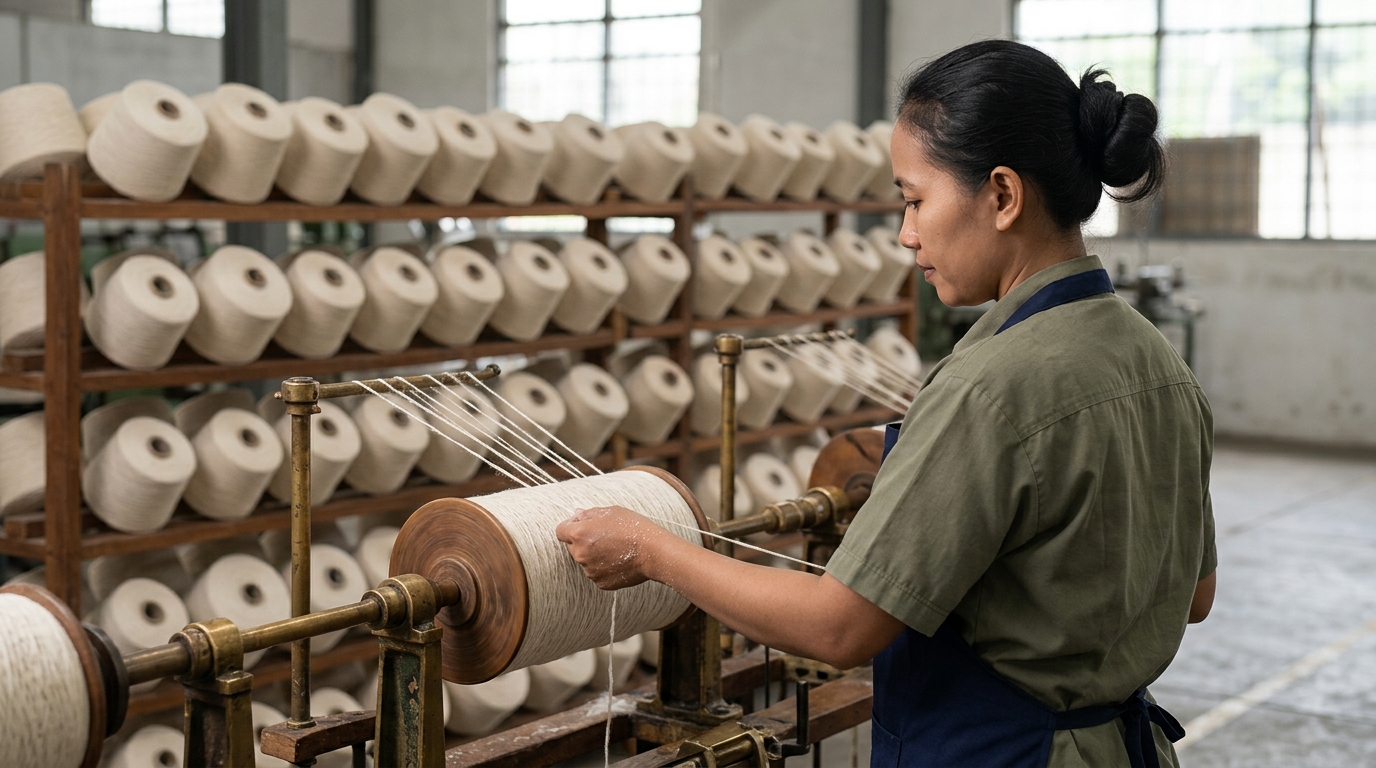
Indonesia exported approximately 90,051 metric tons of cotton yarn in 2023, according to USDA FAS trade data. That volume positions the country among Asia's most significant cotton textile exporters — and gives procurement teams a credible, large-scale alternative to Bangladesh, Vietnam, and…
Indonesia exported approximately 90,051 metric tons of cotton yarn in 2023, according to USDA FAS trade data. That volume positions the country among Asia's most significant cotton textile exporters — and gives procurement teams a credible, large-scale alternative to Bangladesh, Vietnam, and India. Yet many buyers enter the Indonesian market without a clear picture of yarn count availability, quality benchmarks, or how export logistics actually work from Tanjung Priok.
This guide addresses the decision criteria that matter most to textile mills, fabric converters, and apparel brands actively evaluating cotton yarn fabricsuppliers Indonesiaexport programs. It covers spinning cluster geography, yarn count and Uster quality benchmarks, knit versus woven fabric program comparisons, greige sourcing strategy, pricing structure, HS codes, and a supplier vetting framework. Each section is built around specifications and verification signals — not generalizations.
One structural risk factor deserves early disclosure: Indonesia imports approximately 99% of its raw cotton, sourcing primarily from the United States, Australia, and Brazil. That dependency means FOB yarn and fabric prices move in close correlation with international raw cotton markets. Buyers on long-term contracts should build in price adjustment clauses tied to Cotlook A Index or equivalent benchmarks.
Why Indonesia Ranks Among Asia's Most Strategic Cotton Textile Sources
Export scale and infrastructure maturity
Indonesia's cotton textile sector is not emerging — it is established. The country has operated large-scale spinning and weaving capacity for decades. Modern ring-spinning, open-end, and compact spinning technologies are all present across its major production clusters. Integrated mills capable of spinning, weaving, and finishing under one roof exist alongside specialized standalone spinners. That depth of infrastructure gives buyers genuine flexibility in how they structure supply.
Government export promotion through institutions such as the Indonesia Eximbank and the Ministry of Trade's export development programs provides mills with financing and market access support. These programs lower operational costs for export-oriented producers — a benefit that partially flows through to FOB pricing.
Logistics position and shipping lane access
Indonesia's geography is an underappreciated advantage. Major textile production clusters in West Java, Central Java, and East Java sit within practical trucking distance of Tanjung Priok (Jakarta) and Tanjung Perak (Surabaya) — two of Southeast Asia's highest-throughput container ports. Transit times to US West Coast ports run approximately 18–22 days. US East Coast transit runs approximately 25–30 days via Singapore or Port Klang transshipment. These lead times are competitive with Bangladesh and broadly comparable to Vietnam.
Labor cost structures remain favorable relative to established competitors in China, though the gap with Bangladesh has narrowed over the past decade. The productivity offset — higher output per worker at modern Indonesian mills — partially compensates in unit cost terms.
Indonesia's Spinning Clusters: Where Cotton Yarn Production Is Concentrated
West Java, Central Java, and East Java
Three provinces dominate Indonesian cotton yarn production. West Java — centered on Bandung and Karawang — hosts the highest concentration of spinning mills, many with origins in the 1970s and 1980s investment wave. This cluster is strongest in medium and fine count production, serving both domestic fabric converters and export buyers. Central Java (Semarang corridor) and East Java (Surabaya and surrounding areas) carry significant additional capacity, with East Java mills often focusing on coarser commodity counts.
Key mill operators
Several large integrated groups define the scale end of the market:
- PT Apac Inti Corpora — one of Indonesia's largest integrated textile producers, operating spinning, weaving, and finishing. Strong in denim-adjacent cotton woven programs. - Aditya Birla Yarn — Indonesian operations under the Aditya Birla Group's global fibre and yarn platform. Known for consistent quality documentation and Uster-benchmarked output. - PT Indorama Synthetics — primarily a polyester and blended yarn producer, but relevant for cotton-poly blend programs.
Buyers targeting pure cotton yarn fabric suppliers Indonesia export programs should prioritize mills with dedicated cotton spinning lines and documented raw cotton traceability rather than mills that pivot between fibre types opportunistically.
Cotton Yarn Counts and Quality Benchmarks Every Buyer Must Specify
Yarn count ranges available from Indonesian spinners
Indonesian mills export across a meaningful count range. The table below summarizes standard availability:
| Yarn Count (Ne) | Application | Spinning Type | Typical End Use |
|---|---|---|---|
| Ne 10s – Ne 16s | Coarse weaving, denim | Open-end / ring | Denim, canvas, workwear fabric |
| Ne 20s – Ne 30s | Knitting programs | Ring / compact | Single jersey, interlock, rib |
| Ne 30s – Ne 40s | Fine weaving | Compact ring | Shirting, fine poplin |
| Ne 40s+ | Specialty fine | Compact ring | Premium shirting, voile |
Ne 20s and Ne 30s combed ring-spun yarns are the most commonly exported counts. Buyers sourcing for T-shirt and activewear supply chains should specify combed rather than carded at these counts — the CSP (Count Strength Product) differential is significant.
Uster evenness and quality metrics
Quality specification for cotton yarn must go beyond count. Key metrics to request in mill data sheets:
- CSP (Count Strength Product): Indicates yarn tenacity relative to count. Request CSP values benchmarked against Uster Statistics 2023 or the current published edition. Mills at or above the 50th percentile Uster value are generally acceptable for export-grade programs. - Uster evenness (CV%): Measures mass variation along the yarn. Lower CV% correlates with fewer fabric defects. Request the Uster test certificate, not just the mill's internal number. - Imperfections per kilometer (thin places, thick places, neps): Critical for knit fabric programs where defects magnify in finished form. - Combed vs. carded: Combed yarn removes short fibres, producing higher tenacity, lower hairiness, and better dye uptake. Carded yarn is lower cost. Specify which you require — do not assume.
Certification benchmarks
- OEKO-TEX Standard 100: Certifies yarn or fabric free of harmful substances. Required by most US and EU buyer compliance programs. Many larger Indonesian mills carry this. - GOTS (Global Organic Textile Standard): Required for organic cotton programs. Available from select spinners — see the organic section below.
Knit vs. Woven Cotton Fabric Programs: A Side-by-Side Comparison for Sourcing Managers
Indonesian mills offer both knit and woven cotton fabric programs, but the operational parameters differ substantially. The table below captures what buyers need to know before requesting quotations.
| Parameter | Knitted Cotton Fabric | Woven Cotton Fabric |
|---|---|---|
| Constructions available | Single jersey, interlock, 1×1 rib, 2×2 rib, fleece | Plain, twill, oxford, poplin, satin |
| Typical MOQ (fabric) | 500–1,500 kg per colour | 1,000–3,000 meters per colour |
| Lead time (ex-mill) | 30–45 days | 45–75 days |
| Price sensitivity | Higher: count and GSM drive price | Higher: weave complexity and finishing level |
| Greige option | Less common; usually sold finished | Commonly available in greige |
| Primary buyer type | Apparel brands, T-shirt supply chains | Converters, weavers, garment manufacturers |
Knitted fabric MOQs are generally lower per colour run, making them accessible for smaller initial orders. Woven programs — particularly finished and yarn-dyed constructions — carry higher MOQs and longer lead times. Buyers should clarify whether pricing is quoted per kilogram or per linear meter, as mills use both conventions.
Denim fabric production is a distinct sub-category within the woven segment. PT Apac Inti Corpora operates significant denim weaving capacity. Denim MOQs typically run higher — often from 5,000 meters — and pricing ties closely to ring-spun yarn input costs.
Greige vs. Finished Cotton Fabric: Sourcing Strategy for Converters and Brands
Why converters prefer greige sourcing from Indonesia
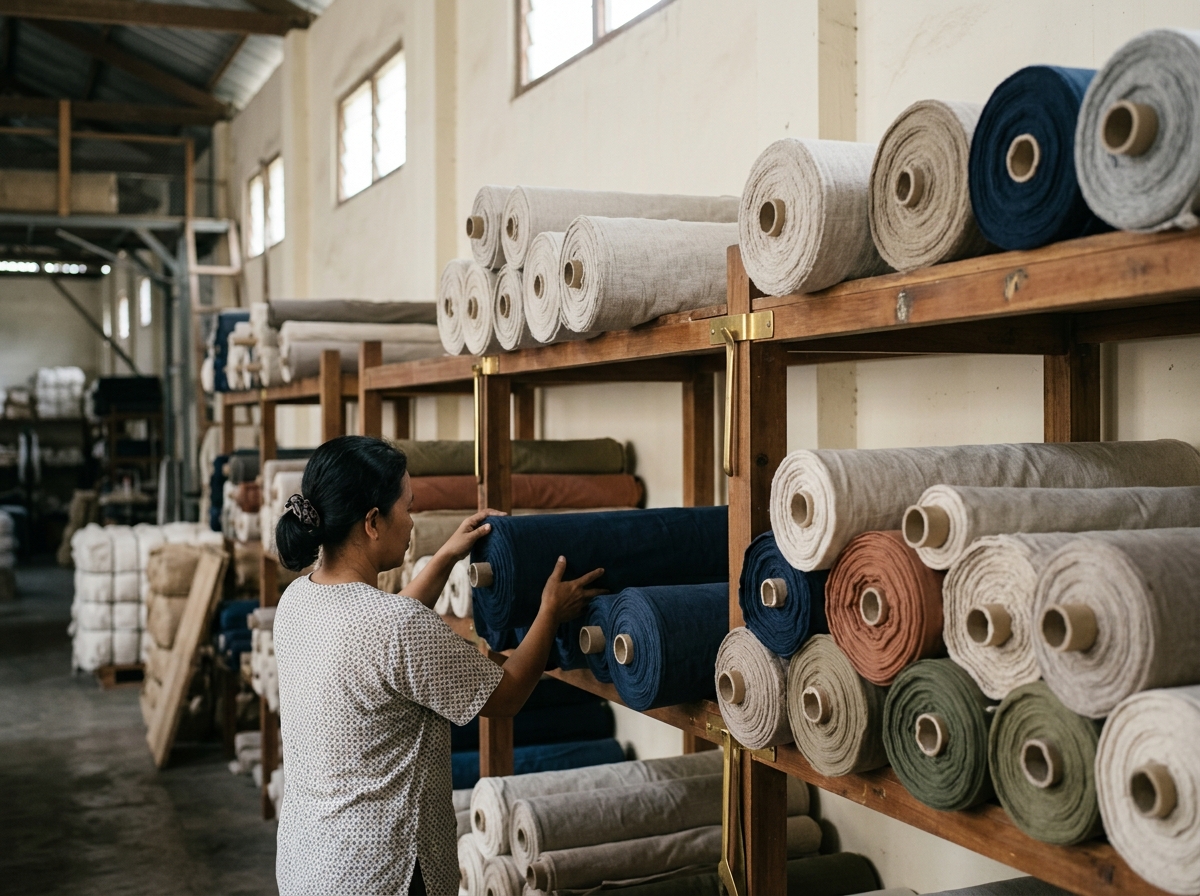
Greige cotton fabric — undyed, unfinished, straight from the loom or knitting machine — offers two primary advantages: lower FOB price and maximum finishing flexibility. Converters who operate their own dyeing and finishing lines extract the most value from greige sourcing. They control colour consistency, hand feel, and shrinkage specifications in-house rather than relying on the supplier's finishing capacity.
Indonesian greige fabric exports are well-established, particularly in plain weave and twill constructions. Greige pricing benchmarks at a meaningful discount to finished equivalents — typically 15–30% lower on an FOB basis, though the differential varies by construction and weight. Buyers should clarify whether greige fabric has been desized and scoured or is truly loom-state, as these affect downstream processing requirements.
Finished fabric options and integrated mill advantage
Finished fabric options from Indonesian mills include:
- Bleached: Suitable for subsequent dyeing by the buyer or for white fabric programs. - Piece-dyed: Reactive and vat dye programs available at larger mills. - Yarn-dyed: Requires advance colour commitment; higher MOQ but richer colour depth. - Printed: Rotary and digital print capacity at select integrated mills.
Mills offering integrated spinning-weaving-finishing under one roof — sometimes called vertical mills — provide the tightest quality chain and the clearest traceability for certification purposes. For buyers requiring OEKO-TEX Standard 100 fabric certification, integrated mills simplify the audit trail significantly.
Brands that cannot or choose not to manage finishing in-house — and who need ready-to-cut fabric — should target integrated mills with documented finishing QC protocols. Converters with in-house finishing capability should prioritize greige suppliers with strong Uster-benchmarked yarn inputs.
Pricing Structure and Volume Terms for Indonesian Cotton Fabric and Yarn Exports
Price drivers
Three factors dominate FOB pricing for cotton yarn fabric suppliers Indonesia export programs:
1. Raw cotton input cost. Since Indonesia imports nearly all raw cotton, international cotton prices — tracked via Cotlook A Index — directly affect yarn cost. Buyers should request price validity periods and understand whether quotes are fixed or formula-linked. 2. Yarn count and spinning technology. Finer counts require more fibre per kilogram of yarn and longer processing time. Compact-spun combed yarns at Ne 40s will price significantly above open-end carded Ne 10s. 3. Finishing level. Greige is cheapest. Each finishing stage — scouring, bleaching, dyeing, printing — adds to FOB cost and complexity.
Volume thresholds and payment terms
Indonesian mills typically structure pricing in tiered bands. While exact dollar figures shift with commodity markets, the general structure is:
| Volume Tier | Yarn (approx. MT per order) | Fabric (approx. meters per order) | Price Adjustment |
|---|---|---|---|
| Trial / sample order | <5 MT | <2,000 m | Premium pricing; no negotiation expected |
| Small commercial | 5–20 MT | 2,000–10,000 m | Standard list price |
| Mid-volume | 20–100 MT | 10,000–50,000 m | 3–7% discount typical |
| Large/contract | 100+ MT | 50,000+ m | Negotiated contract pricing |
Payment terms standard in Indonesian mill contracts: Letter of Credit at sight (L/C) is common for new buyer relationships. Established buyers with 12+ months of trade history may negotiate 30–60 day Telegraphic Transfer (T/T) after Bill of Lading date. Suppliers rarely offer open account terms to new counterparts.
Export Logistics, HS Codes, and Shipping Routes from Indonesian Textile Ports
Port options and container routing
| Port | Location | Primary For | Key Shipping Lines |
|---|---|---|---|
| Tanjung Priok | Jakarta, West Java | West Java mill output; largest volume | Multiple major carriers |
| Tanjung Perak | Surabaya, East Java | East Java and Central Java mill output | Regional and global carriers |
| Belawan | Medan, North Sumatra | Smaller; synthetic and blended textiles | Regional feeder services |
The majority of cotton yarn fabric suppliers Indonesia export volume moves through Tanjung Priok. Buyers should confirm which port their specific supplier uses and factor inland trucking cost accordingly.
HS codes for US import classification
| Product | HS Chapter/Heading | Notes |
|---|---|---|
| Cotton yarn, not retail (single) | HS 5205 | Most common for export yarn programs |
| Cotton yarn, multiple/cabled | HS 5206 | Doubled yarns for weaving |
| Cotton yarn, retail packaged | HS 5207 | Rare for B2B export programs |
| Woven cotton fabric, <85% cotton | HS 5210–5212 | Check blend composition |
| Woven cotton fabric, ≥85% cotton | HS 5208–5209 | Standard greige and finished |
US import duties and GSP status
Indonesia's GSP (Generalized System of Preferences) eligibility for textile products under the US program is a nuanced area. The US GSP program lapsed in December approximately 2020 and was retroactively renewed through legislation in 2022. However, most cotton textile and apparel products (Chapters 50–63) were historically excluded from US GSP benefits even when the program was active. US buyers should verify current duty rates with a licensed customs broker — do not assume GSP coverage for cotton fabric or yarn imports from Indonesia.
Standard US MFN (Most Favored Nation) duty rates for cotton yarn and fabric typically range from approximately 3% to 12% depending on construction and cotton content. These rates apply to Indonesian exports absent any preferential agreement.
How to Vet and Qualify Indonesian Cotton Yarn and Fabric Suppliers Before Committing Capital
Supplier audit and certification checklist
- ✓ISO 9001 quality management system certification — current and third-party issued
- ✓OEKO-TEX Standard 100 certificate — check expiry date and scope
- ✓Social compliance: SMETA (Sedex), WRAP, or BSCI audit report within 24 months
- ✓Export documentation capability: Phytosanitary, Certificate of Origin (Form E or CO), commercial invoice
- ✓Uster test certificates for yarn — not internal test reports
- ✓Raw cotton traceability documentation — country of origin for input fibre
- ✓GOTS or GRS certificate if organic or recycled cotton is specified
- ✓Bank references or trade references from existing export buyers
Red flags that indicate high-risk suppliers
Buyers evaluating cotton yarn fabric suppliers Indonesia export options should treat the following as disqualifying signals unless satisfactorily explained:
- Unable or unwilling to state whether they are a manufacturer, trader, or export agent - No third-party audit documentation — only self-declarations - Unrealistic lead times (e.g., 15 days for a 20 MT yarn order with no existing stock) - No traceable raw cotton origin — particularly important for GOTS and organic claims - Export documentation described as "handled by another party" without clear identification of who
Trade show and discovery touchpoints
Key venues for face-to-face supplier qualification:
- Indo Intertex — Indonesia's primary textile and machinery trade show (Jakarta) - Texworld USA — New York; Indonesian exhibitors participate in national pavilion - Première Vision Paris — select Indonesian mills exhibit in fabric halls
Organic and Sustainable Cotton Yarn Programs Available from Indonesian Exporters
GOTS-certified organic cotton availability
GOTS-certified organic cotton yarn is available from a limited but growing number of Indonesian spinners. The certification requires both organic fibre input (USDA NOP or equivalent) and compliance with GOTS processing standards throughout the spinning chain. Buyers should verify certification status directly on the GOTS public database — do not accept mill-issued PDFs as sole verification.
Organic cotton yarn programs from Indonesian mills typically carry price premiums of 20–40% over conventional equivalents, reflecting certified fibre input costs and audit overhead.
Recycled cotton and GRS programs
GRS (Global Recycled Standard) certified recycled cotton yarn programs are emerging at several larger Indonesian mills. These programs use post-industrial cotton waste as input. GRS certification requires chain-of-custody documentation from waste collection through spinning. Buyers targeting sustainability claims for US or EU markets must request the full GRS transaction certificates — not just the mill's scope certificate.
BCI (Better Cotton Initiative) adoption
BCI adoption among Indonesian spinning mills is growing but not universal. BCI cotton is sourced from farms meeting Better Cotton standards, but BCI does not allow "product-level" claims — a BCI-participating mill sources a proportion of BCI cotton but cannot certify that your specific order contains it. Buyers who need traceable, claim-supporting sustainability documentation should prioritize GOTS or GRS over BCI for marketing purposes, while recognizing BCI's value as a supply chain improvement program.
Frequently Asked Questions from B2B Buyers Sourcing from Indonesia
What yarn counts do Indonesian cotton spinning mills typically export? The standard export range runs from approximately Ne 10s (coarse open-end) to Ne 40s (fine compact ring-spun). Ne 20s to Ne 30s combed ring-spun accounts for the largest share of export volume, driven by demand for knit fabric programs.
What is the typical minimum order quantity for cotton yarn or fabric from Indonesia? Cotton yarn MOQs generally start at 5 metric tons per count and colour for commercial orders. Greige woven fabric MOQs typically start at 2,000–5,000 meters per construction. Knit fabric programs can run lower — approximately 500–1,500 kg per colour. Trial orders at smaller quantities are possible but price at a premium.
How does Indonesian cotton fabric pricing compare to Bangladesh or Vietnam? On an FOB basis, Indonesian yarn and greige fabric pricing is broadly competitive with Vietnam and slightly above Bangladesh for commodity counts. The differential narrows when quality-adjusted — Indonesian Uster benchmarks at larger mills are often stronger than comparable Bangladesh commodity spinners. For fine counts and combed programs, Indonesia is consistently competitive.
What certifications should I require from an Indonesian cotton yarn supplier? At minimum: ISO 9001, OEKO-TEX Standard 100 (for the specific product being sourced), and a social compliance audit (SMETA or WRAP). For organic programs, require GOTS. For recycled content claims, require GRS. Always verify certificates on the issuing body's public database.
Which Indonesian ports handle the majority of cotton yarn and fabric exports? Tanjung Priok (Jakarta) handles the largest share of cotton textile exports. Tanjung Perak (Surabaya) serves Central and East Java mill clusters. Buyers in the US should expect most shipments to route through Singapore or Port Klang for transshipment to West or East Coast ports.
Does Indonesia produce organic or GOTS-certified cotton yarn for export? Yes, but from a limited number of spinners. GOTS-certified organic cotton yarn is available and exported. Availability is narrower than conventional yarn — buyers should verify current GOTS scope on the official GOTS database before engaging suppliers.
Indonesian spinning and weaving capacity gives international procurement teams a technically credible, logistics-accessible source for both cotton yarn and greige or finished cotton fabric. The keys to successful sourcing are specification precision — particularly on yarn count, Uster benchmarks, and certification scope — and disciplined supplier vetting before capital commitment.
You now have the technical framework to evaluate suppliers, structure RFQs, and identify red flags across yarn quality, certification, and export documentation. The natural next step is engaging with mills that can respond with verified data.
You understand the specifications, the certification requirements, and the logistics framework. Now match that knowledge to suppliers who can actually deliver to it. Request supplier profiles and export quotes from vetted Indonesian cotton yarn and fabric mills today.
Request Supplier Profiles and Export Quotes →Need eyes on the ground in Indonesia?
MTS is an execution partner — supplier verification, manufacturing management, quality control and export logistics across Indonesia, Vietnam and China.
Related services
Related articles
Receive furniture sourcing insights across Asia.
One email per week. No spam.