Custom Villa Furniture Bali Design to Delivery: The Complete Procurement Pipeline
13 min read
Commissioning bespoke furniture from Bali demands more than selecting a workshop from an online directory. Design studios and villa developers operating at the five-star level face a layered decision chain: translating a creative brief into manufacturable shop drawings, locking in quality at the…
Commissioning bespoke furniture from Bali demands more than selecting a workshop from an online directory. Design studios and villa developers operating at the five-star level face a layered decision chain: translating a creative brief into manufacturable shop drawings, locking in quality at the prototype stage, specifying finishes that survive coastal humidity, and then navigating Indonesian export regulations before a white-glove team places each piece on site. Every gap in that chain costs money.
This article maps the entire customvilla furnitureBali design to delivery pipeline in sequential order. It covers brief preparation, prototype sign-off, workshop verification, climate-appropriate finishing, export packing, US customs clearance, and last-mile logistics. It also addresses how to build a repeatable procurement process for multi-villa developments — a discipline that distinguishes experienced developers from first-time commissioners.
Bali sits within a mature Indonesian furniture export ecosystem that includes Jepara, Cirebon, and Semarang. What differentiates Bali specifically is its concentration of luxury artisan workshops geared toward hospitality clients. Understanding how to engage those workshops correctly — from the first mood board to on-site placement — determines whether a commission lands on time and on spec.
Why Bali Remains the Premier Source for Custom Hospitality Furniture
Artisan Concentration and Material Supply Chains
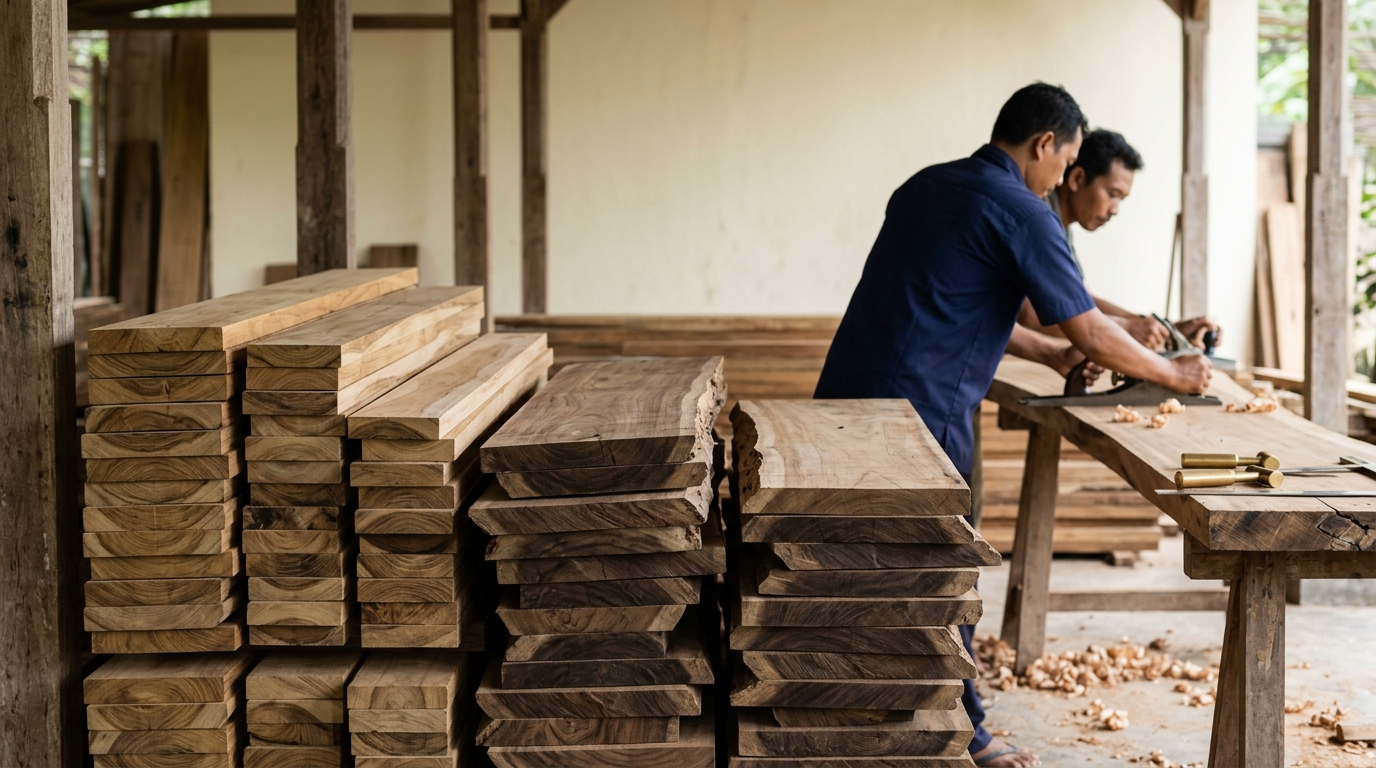
The Ubud, Gianyar, and Denpasar corridors host a dense cluster of workshops that have supplied international five-star resorts and private villa developments for decades. Artisan density in this region means a single project can source carved teak headboards, rattan lounge pieces, and reclaimed timber dining tables within a 30-kilometre radius. That geographic concentration reduces inter-supplier coordination risk significantly.
Material advantages are structural, not coincidental. Indonesia's plantation teak supply chain is well-established. Suar wood — also called rain tree — offers wide slabs with distinctive grain, favoured for live-edge dining tables. Reclaimed teak sourced from decommissioned Javanese structures brings a patina and density that plantation timber cannot replicate. Rattan from Kalimantan and Sulawesi feeds a sophisticated weaving tradition concentrated in the Bali workshop cluster.
Lead Time and Cost Competitiveness
Lead times from Bali workshops for custom villa furniture commissions typically run approximately 10 to 16 weeks for production, depending on commission complexity and workshop capacity. European or North American custom makers working to equivalent craft standards commonly require significantly longer timelines. That differential matters when fit-out schedules are fixed.
Landed cost per piece — factoring production, export packing, sea freight, and US import duties — remains competitive against comparable artisan output from European workshops, even after accounting for freight legs of approximately 20 to 25 days sea transit from Bali to US West Coast ports.
From Design Brief to Approved Shop Drawings: Avoiding Costly Production Errors
What a Complete Design Brief Must Contain
An incomplete design brief is the single most common cause of production errors on custom villa furniture Bali commissions. Workshops in the Gianyar and Denpasar corridors work from what you give them. Ambiguity in the brief becomes a fabrication decision made by a workshop supervisor — not your design team.
A production-ready brief must include:
- Dimensioned drawings or sketches for every piece (plan, elevation, section views) - Material callouts specifying species, grade, and cut orientation - Finish codes referencing a defined palette — RAL, NCS, or a physical sample chip - Hardware specifications: grade, finish, and supplier references where applicable - Mood boards and reference photography for form language and detail resolution - Quantity per SKU and any phasing requirements
Shop Drawing Production and Approval Rounds
Bali workshops convert briefs into shop drawings via AutoCAD or hand-drafted technical illustrations, depending on workshop capability. Confirm which method a workshop uses before briefing. AutoCAD outputs allow your design team to mark up digitally — faster and cheaper than printing and couriering hand-drafted sheets.
A standard approval cycle runs two to three rounds: initial issue, marked-up redline returned by the buyer, revised issue for final sign-off. Each round should be documented with version-controlled file names and written confirmation of approval. Never allow production to commence on verbal approval alone.
Common Brief Gaps That Cause Production Failures
| Gap | Downstream consequence |
|---|---|
| No moisture content specification | Wood delivered outside acceptable EMC range warps post-installation |
| Vague finish description ('natural look') | Sheen and colour inconsistent across pieces |
| Missing hardware grade callout | Stainless steel downgraded; corrosion appears within months |
| No grain-match instruction on panels | Visible mismatch on book-matched tops |
| Quantity not confirmed before drawings | Joinery scaled incorrectly for structural loads |
Prototype Approval: The Quality Gate That Protects Your Entire Commission
For any commission above a minimum threshold of complexity — typically bespoke joinery, upholstered frames, or structural pieces — a physical prototype is non-negotiable. Approving shop drawings is not the same as approving the object. Scale, weight, tactile finish, and joinery quality only become visible in three dimensions.
On-Site Versus Shipped Prototype Review
| Review method | Cost implication | Accuracy | Recommended for |
|---|---|---|---|
| Buyer travels to Bali | Higher travel cost | Highest — full inspection | Large commissions, first-time suppliers |
| Third-party inspector in Bali | Moderate inspector fee | High — if inspector is briefed correctly | Experienced buyers with trusted inspectors |
| Prototype shipped to buyer | Freight cost + delay | Moderate — transit risk to prototype | Small pieces only |
Engaging a third-party pre-shipment inspection service based in Bali or operating across Indonesian furniture clusters is a reliable alternative to travel. Brief the inspector with your approved shop drawings, finish codes, and a written defect classification matrix — critical, major, and minor defects defined in advance.
Documenting Prototype Sign-Off
Approval documentation must include timestamped photographs of all six faces of each prototype piece, written sign-off referencing the specific drawing version, and a list of any approved deviations from the original brief. This record becomes the production standard. Without it, batch consistency is unenforceable.
- ✓Timestamped photographs of all faces
- ✓Written approval referencing drawing version number
- ✓Finish sample chip attached to sign-off document
- ✓Approved deviation list (if any)
- ✓Inspector name and credential on file
- ✓Workshop countersignature obtained
Verifying Workshop Quality and Legal Timber Sourcing Before Production Starts
Key Workshop Verification Criteria
Physical factory visits remain the most reliable verification method. During a visit, assess:
- Joinery technique: Mortise-and-tenon and dowel joinery in structural pieces indicate craft quality. Staple-only or nail-only construction in load-bearing frames is a red flag. - Kiln-drying infrastructure: A workshop producing furniture for export should operate or have direct access to a kiln-drying chamber. Ask to see it. - Finishing line separation: Topcoat application in an open, dust-contaminated environment produces inconsistent results. Enclosed finishing areas indicate process discipline. - Grain matching practice: Ask to see examples of book-matched panels from prior commissions.
For workshops that resist DUPRO (during production) inspections, treat this as a serious signal. Legitimate manufacturers welcome third-party oversight.
Timber Legality Certifications
Two certifications are directly relevant to Indonesian timber procurement:
SVLK (Sistem Verifikasi Legalitas Kayu): Indonesia's mandatory timber legality verification system. Any Indonesian workshop exporting wood products should hold a valid SVLK certificate. Absence is a compliance risk for US and EU importers.
FSC Chain of Custody (FSC CoC): Forest Stewardship Council certification verifies that timber has been sourced from responsibly managed forests through a documented chain. Increasingly required by hospitality developers operating under ESG commitments.
Request both certificates before signing a production contract. Verify certificate numbers directly on the issuing body's public registry.
Finishing Standards Engineered for Humid Tropical and Coastal Villa Environments
Topcoat Performance in High-Humidity Settings
Finishing specification is where custom villa furniture Bali design to delivery most commonly fails at the long-term performance level. A piece that looks correct at factory acceptance can crack, delaminate, or discolour within one wet season if the finish is under-specified.
| Finish type | Humidity resistance | UV stability | Repairability | Best application |
|---|---|---|---|---|
| Natural penetrating oil | Moderate | Low-moderate | High | Indoor solid teak, interior pieces |
| Water-based lacquer | Moderate-high | Moderate | Moderate | Indoor hardwood, detailed pieces |
| Polyurethane (2K) | High | High (with UV additive) | Low | Semi-outdoor, high-traffic surfaces |
| Marine-grade varnish | Very high | High | Moderate | Outdoor and poolside pieces |
For semi-outdoor and covered terrace furniture, specify two-component (2K) polyurethane with a UV stabiliser additive. Confirm the topcoat product name and dilution ratio in the finish specification schedule attached to the production contract.
Hardware Selection for Coastal Environments
Specify a minimum of grade 316 stainless steel for all exposed hardware in coastal villa environments. Grade 304 is adequate for inland, low-humidity settings. Brass hardware requires a lacquer seal or PVD coating to prevent oxidation. Marine-grade fittings — rated for salt air exposure — are appropriate for outdoor and poolside pieces.
Colour and sheen consistency across a multi-piece commission requires the workshop to apply finish from a single batch mix per colour. Specify this in the contract. Mid-production batch changes produce visible sheen variation under raking light.
Export Packing Protocols That Protect Custom Pieces During Sea Transit
Packing Standards and Container Loading
Furniture-grade packing for custom villa pieces requires:
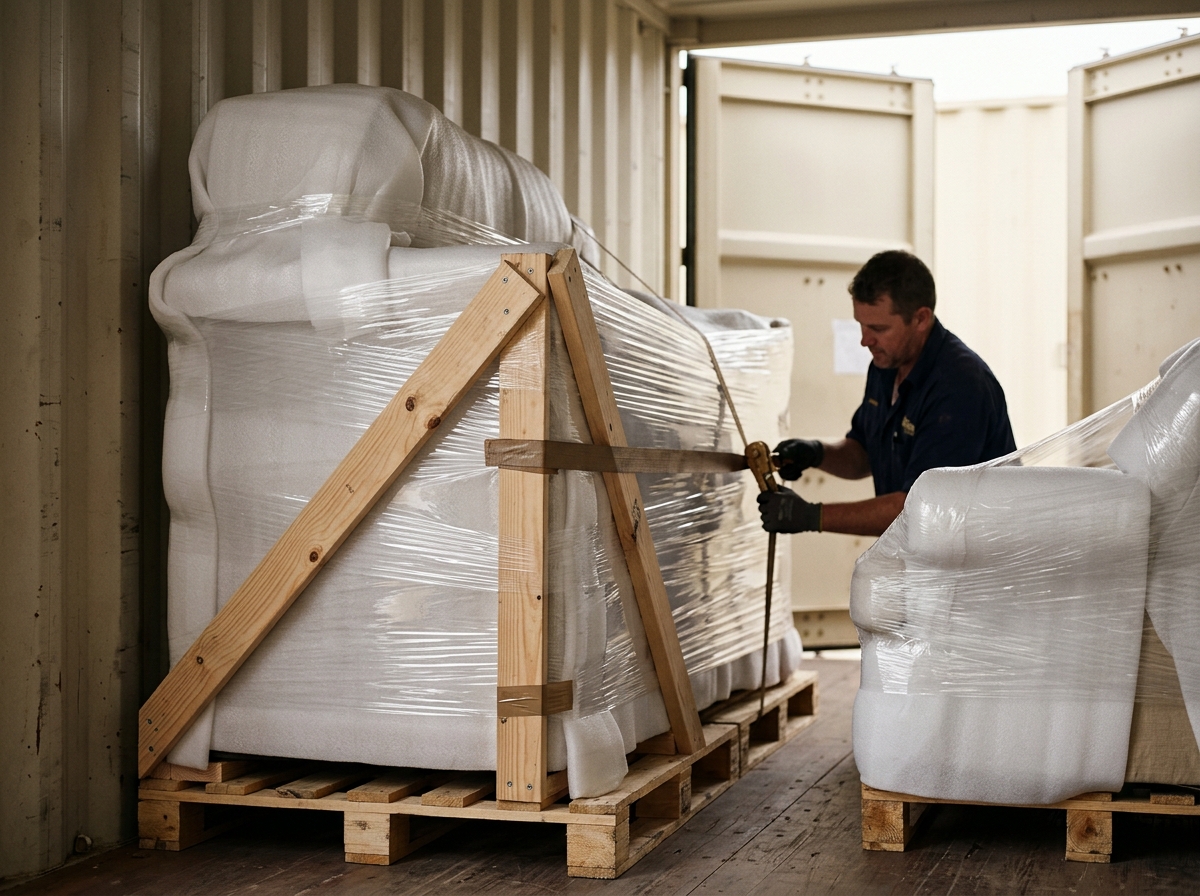
- Minimum 25mm polyethylene foam wrapping on all faces - Cardboard edge protectors on all corners and arrises - Stretch film overwrap to consolidate foam and prevent shifting - Timber crating for fragile, high-value, or structurally vulnerable pieces
LCL (Less than Container Load) shipments carry higher handling risk than FCL (Full Container Load). For a complete villa commission, FCL is strongly preferred. Request a container loading diagram from the workshop showing weight distribution and bracing positions. Uneven loading causes structural stress to pieces during transit.
Humidity Control Inside Containers
Sea freight from Bali to US ports crosses multiple climate zones and humidity bands. Container dew point fluctuations cause condensation — a direct cause of mould, surface bloom, and wood movement in insufficiently finished pieces. Specify the inclusion of silica gel or calcium chloride desiccant bags inside the container, sized to the container volume. This is standard practice among experienced Indonesian exporters but is often omitted without explicit instruction.
Documentation Checklist
- ✓Commercial invoice with HTS codes
- ✓Packing list with piece-level dimensions and weights
- ✓Certificate of origin (Form E or GSTP)
- ✓Phytosanitary certificate for solid wood components
- ✓SVLK timber legality certificate
- ✓Bill of lading (negotiable or sea waybill)
- ✓Fumigation certificate (if required by destination port)
Logistics, US Customs Clearance, and White-Glove Last-Mile Delivery
Working With a Freight Forwarder Experienced in Indonesian Exports
Not all freight forwarders have operational experience with Indonesian furniture exports. Select a forwarder with demonstrated Bali or Surabaya origin capability. They should manage the phytosanitary certificate coordination, SVLK document presentation to US customs, and fumigation scheduling where required.
US Customs Requirements for Indonesian Wooden Furniture
US import duties on wooden furniture from Indonesia are assessed under specific HTS codes. Most wooden furniture categories attract duties in the range of approximately 0% to 7% ad valorem under the standard US tariff schedule, but classification matters. Misclassification causes delays and potential penalty assessments. Engage a licensed US customs broker alongside your freight forwarder — these are separate roles.
Indonesia is not currently subject to the same Section 301 additional duties applied to Chinese-origin furniture. This represents a meaningful landed cost advantage for US buyers sourcing from Bali relative to equivalent Chinese-origin production.
Wooden furniture containing solid wood components typically requires a phytosanitary certificate issued by the Indonesian Ministry of Agriculture confirming that timber is free from pests and meets US Department of Agriculture import requirements.
White-Glove Last-Mile Delivery
White-glove delivery scope for a villa commission typically includes:
- Scheduled delivery coordinated with site construction programme - Unpacking and debris removal on site - Piece-by-piece inspection against the packing list at point of delivery - Placement per the furniture layout drawing - Basic assembly where required - Damage notation and photographic record for insurance claims
Coordinate delivery timing with the villa project manager at least four weeks before the estimated arrival date. Customs clearance can take approximately five to ten business days under normal conditions; factor this into the fit-out schedule.
Building a Repeatable Procurement System for Multi-Villa Developments
Master Specification Libraries and Staged Production Scheduling
Custom villa furniture Bali design to delivery becomes significantly more efficient from the second project onward — if the first project is documented correctly. Build a master specification library after each commission: approved shop drawings, finish codes, hardware specifications, packing standards, and supplier performance data.
For multi-phase villa developments, align production scheduling to the construction programme. Phase 1 furniture should not be packed and containerised before the receiving site is weathertight. Staged ordering — typically releasing production in tranches aligned to villa handover dates — reduces on-site storage risk and working capital tied up in landed stock.
Supplier Performance Metrics to Track
| Metric | Target threshold (approximate) |
|---|---|
| Lead time adherence | Within 5 working days of agreed completion |
| Critical defect rate at delivery | Below 1% of pieces |
| Major defect rate at delivery | Below 3% of pieces |
| Packing damage rate | Below 2% of pieces |
| Documentation completeness at shipment | 100% |
Track these metrics across every commission. Share results with the workshop in structured feedback sessions. Workshops that respond constructively to performance data are worth developing into long-term supply partners. Transactional ordering — new workshop each project — resets the learning curve and increases risk on every commission.
Warranty Terms and Ongoing Supplier Agreements
Negotiate warranty terms covering structural defects, finish failure, and hardware corrosion in the production contract — not after delivery. Typically, custom hospitality furniture warranties for structural integrity run approximately one to two years from delivery. Finish warranties depend on specified topcoat and end-use environment. Retain a small percentage of the contract value — commonly around 5% to 10% — as a retention payment released after a defined snagging period post-delivery.
Frequently Asked Questions
How long does it take to produce and deliver custom villa furniture from Bali to the US?
Production typically takes 10 to 16 weeks depending on commission size and complexity. Sea freight from Bali to US West Coast ports is approximately 20 to 25 days. Add approximately one to two weeks for customs clearance and last-mile delivery. Total pipeline from brief sign-off to on-site placement: approximately 16 to 24 weeks under normal conditions.
What wood species are best for villa furniture in humid or coastal climates?
Teak is the benchmark species for humidity and moisture resistance. Its natural oil content makes it dimensionally stable in high-humidity environments. Suar wood performs well indoors and in covered outdoor settings. Reclaimed teak offers superior density compared to plantation timber. For rattan pieces, ensure the cane is properly dried and sealed before finishing.
How do I verify a Bali furniture workshop's quality and legal timber sourcing?
Request the workshop's SVLK certificate and FSC CoC certificate and verify both on the issuing body's public registry. Conduct or commission a physical factory audit covering joinery technique, kiln-drying infrastructure, and finishing line conditions. Request export documentation from prior shipments and contact reference clients directly.
What finishing treatments prevent warping and cracking in tropical environments?
Kiln-dry timber to the target EMC before production. Specify a moisture-barrier primer under the topcoat. Use 2K polyurethane with a UV stabiliser for semi-outdoor pieces. Seal all end grain — the highest moisture ingress point — with an additional topcoat pass. Avoid single-component lacquers on outdoor or semi-outdoor pieces.
What are typical minimum order quantities for a custom Bali villa furniture commission?
Most Bali artisan workshops do not impose formal MOQ thresholds by unit count. Commercial viability is typically assessed by total order value. Workshops geared toward hospitality clients generally find single-villa commissions commercially viable. Larger multi-villa developments attract better pricing through volume and scheduling continuity.
How are US import duties calculated on wooden furniture from Indonesia?
Duties are assessed ad valorem — as a percentage of the customs value, which is typically the FOB value. The applicable rate depends on the HTS classification of each furniture category. Most wooden furniture from Indonesia attracts duties typically in the range of 0% to 7% under the standard tariff schedule. A licensed US customs broker should classify each SKU before import to avoid misclassification penalties.
Executing custom villa furniture Bali design to delivery at hospitality specification requires discipline at every stage: a complete brief, documented prototype approval, verified workshop credentials, climate-engineered finishes, and logistics managed by freight specialists with Indonesian export experience. Studios and developers who invest in the process infrastructure — rather than managing each commission reactively — achieve lower defect rates, predictable lead times, and a supplier base capable of scaling with their project pipeline.
You now have a clear map of the entire procurement pipeline. The logical next step is connecting with a workshop that has the verified credentials to execute against it.
You understand the full design-to-delivery pipeline. Now commission with confidence. Request a custom furniture consultation with a verified Bali workshop today — and receive supplier recommendations matched to your villa project specifications, volume, and timeline.
Request a Consultation →Planning OEM or private-label production in Asia?
MTS matches you with capable factories and manages tooling, samples, production and quality gates — so your designs ship to spec.
Related services
Related articles
Receive furniture sourcing insights across Asia.
One email per week. No spam.