Poolside Furniture Sun Loungers Wholesale Indonesia: The Complete Buyer's Guide
14 min read
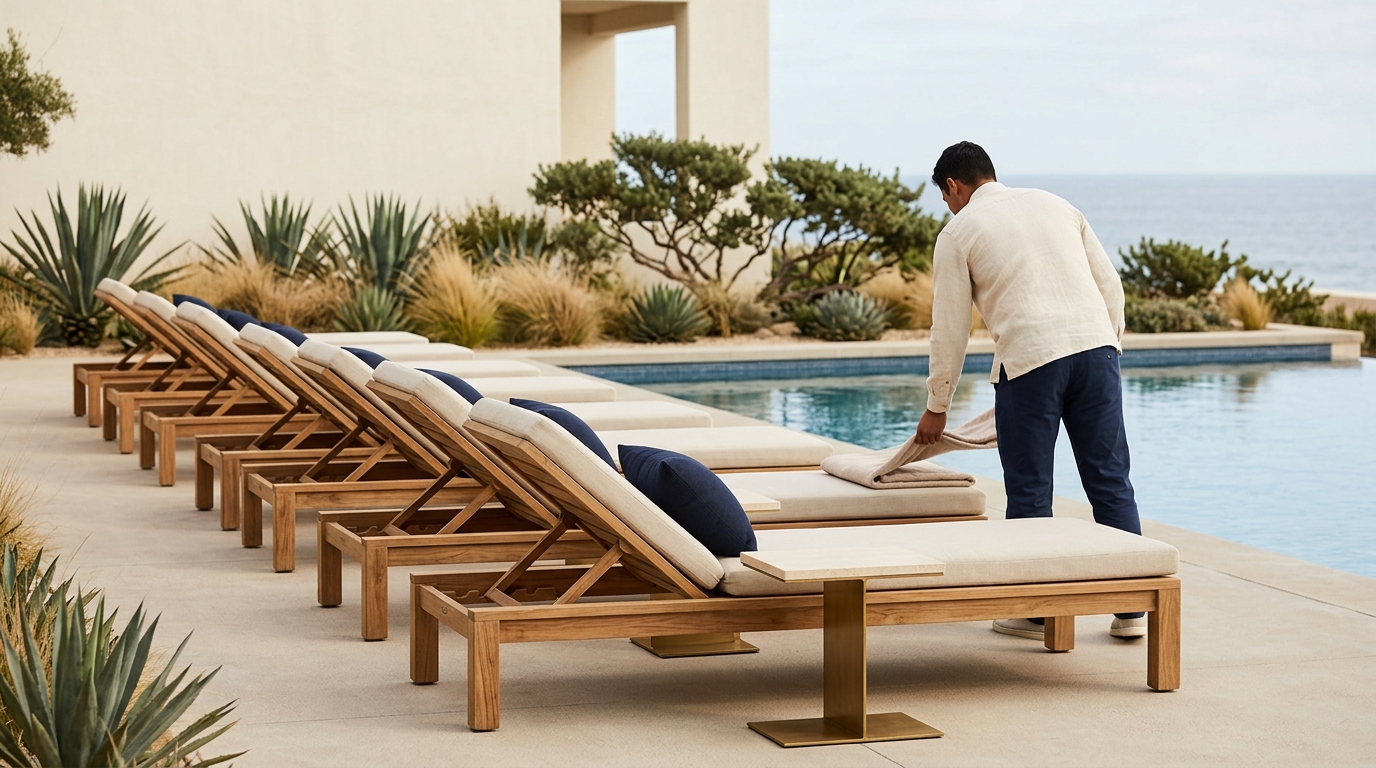
Sourcing poolside furniture sun loungers wholesale from Indonesia is a commercially sound decision — but only when buyers understand the full cost picture, compliance requirements, and supplier landscape. Many procurement managers arrive at Indonesian manufacturers with only a unit price in mind.…
Sourcing poolside furniture sun loungers wholesale from Indonesia is a commercially sound decision — but only when buyers understand the full cost picture, compliance requirements, and supplier landscape. Many procurement managers arrive at Indonesian manufacturers with only a unit price in mind. They leave with surprises: import duties, fumigation certificates, inland freight, and cushion packaging charges that erode projected margins.
This guide addresses the decision criteria that generic supplier directories skip. You will find material specification thresholds, manufacturing hub comparisons, contract-grade standards, container logistics, and a step-by-step breakdown of total landed cost for US resort buyers. The FAQ section covers the compliance and specification questions that procurement teams ask most often.
Indonesia's outdoor furniture industry is built on genuine material advantages and deep craft traditions. That combination makes Indonesian manufacturers the primary global source for teak and rattan pool furniture at resort grade. Understanding how to access that supply chain efficiently — and avoid the avoidable risks — is what separates a successful FF&E project from a costly one.
Why Indonesia Commands the Global Market for Wholesale Outdoor Pool Furniture
Indonesia holds a structurally strong position in the global outdoor and hospitality furniture supply chain. The country combines access to premium natural materials, a dense skilled-labor base, and established export infrastructure. For US resort buyers sourcing poolside furniture sun loungers wholesale, Indonesia consistently delivers a value proposition that neither Chinese volume producers nor European specialty makers can fully replicate.
Manufacturing Hubs: What Each Region Specialises In
Indonesian production is not monolithic. Each cluster has a distinct profile.
| Hub | Specialisation | Typical Price Tier | Key Advantage |
|---|---|---|---|
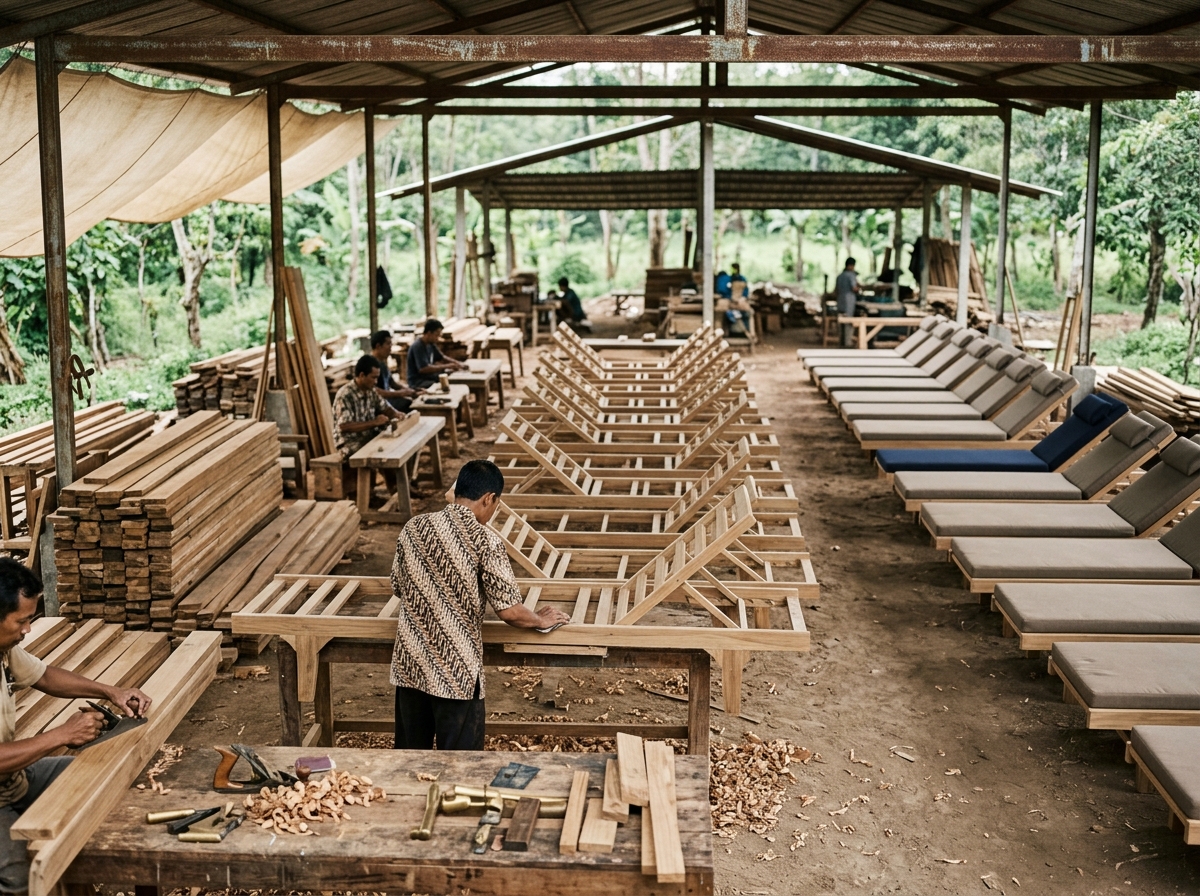
| Jepara (Central Java) | Solid teak, carved wood, traditional joinery | Mid to premium | Highest concentration of teak craftsmen globally |
| Bali | Luxury artisan, designer resort furniture | Premium | High-end finish quality; boutique hotel references |
| Cirebon | Rattan and synthetic rattan weaving | Mid | Strong basket-weave and resin-rattan capacity |
| Semarang | Outdoor and contract furniture | Mid-market | Good logistics access to Tanjung Priok port |
| Surabaya | Mid-market volume production | Entry to mid | Competitive pricing; faster lead times |
Jepara is the most relevant hub for solid teak sun loungers. Bali commands a premium for design-led resort collections. Buyers seeking synthetic rattan pool furniture at competitive FOB prices typically source from Cirebon or Semarang-based exporters.
Cost Advantage Versus China and Europe
Indonesian teak and rattan furniture is not the cheapest option by unit cost. It is the most cost-efficient option at a comparable quality tier. Chinese manufacturers can produce volume outdoor furniture at lower FOB prices, but they cannot replicate Grade A teak or authentic handwoven rattan at the same durability standard. European manufacturers produce contract-grade pieces, but labor costs push FOB prices well beyond Indonesian benchmarks.
Material Specifications That Determine Poolside Durability: Teak, HDPE Rattan, and Aluminium
Choosing the right material for pool-exposed sun loungers is not aesthetic preference. It is a structural and maintenance decision with direct operating-cost implications. The table below gives buyers a fast comparison framework.
| Material | UV Resistance | Chlorine Resistance | Maintenance Level | Typical Contract Lifespan | Weight (per lounger, approx.) |
|---|---|---|---|---|---|
| Grade A Teak | Excellent (natural oils) | Excellent | Low (annual oil optional) | 15–25 years | 18–30 kg |
| HDPE Synthetic Rattan over aluminium | Excellent (UV-stabilised) | Excellent | Very low | 10–15 years | 10–18 kg |
| Powder-coated aluminium (frame only) | Excellent | Good | Low | 15–20 years | 8–14 kg |
| Powder-coated steel (frame only) | Moderate | Poor without coating | Medium | 5–10 years | 14–22 kg |
Teak Wood: Minimum Specifications for Pool Environments
Specify Grade A teak only for contract poolside use. Grade B and C teak contain more sapwood, which absorbs moisture and degrades faster under chlorine and salt exposure. Grade A teak has a natural oil content that resists water ingress without sealing. Minimum density specification: approximately 650–700 kg/m³. Kiln-dried to 8– approximately 12% moisture content before construction is a non-negotiable spec for joinery stability in humid resort climates.
HDPE Synthetic Rattan: What to Verify Before Ordering
HDPE (high-density polyethylene) synthetic rattan is the dominant material for pool furniture weave. It is UV-stabilised, colorfast, and impervious to chlorine. The critical procurement question is UV stabilisation grade. Specify a minimum of 1,500–2,000 hours in UV accelerated weathering tests (approximate threshold used by contract hospitality buyers). Cheaper PE rattan without adequate UV stabilisation becomes brittle and discolors within 18– approximately 24 months in direct tropical or subtropical sun.
Cushion Specifications: Quick-Dry Foam and Solution-Dyed Acrylic
Cushion specification is where most buyers under-specify. For poolside use, two requirements are non-negotiable.
- Foam: Open-cell, quick-dry foam with a minimum density of approximately 28–32 kg/m³ for commercial seating load. Standard residential foam collapses faster under daily hospitality use and retains water — a hygiene and mold risk. - Fabric: Solution-dyed acrylic (not yarn-dyed or pigment-printed polyester). Solution-dyed fiber is colorfast to chlorine bleach, UV, and saltwater. Pigment-printed fabrics fade within one season at poolside. Request a REACH-compliant fabric specification from Indonesian suppliers shipping to the US market.
Contract-Grade Standards US Resort Buyers Must Verify Before Container Loading
What 'Contract Grade' Actually Means
Contract grade is not a certification. It is a set of construction and durability thresholds that distinguish commercial-use furniture from residential pieces. Key parameters:
- Static load rating: Contract sun loungers should support a minimum of approximately 150 kg (330 lbs) static load without permanent deformation. - Joint construction: Mortise-and-tenon or dowel-and-glue joints with stainless or galvanized fasteners. Stapled or bracket-only joints are residential grade. - Finish durability: Powder coat on metal frames should meet a minimum of approximately 1,000 hours salt-spray resistance (ASTM B117 or equivalent). Teak oil or exterior-grade lacquer finishes should be tested for UV stability. - Stackability ratings: Stackable loungers should be tested for at least 6–8 units high without frame stress.
Certifications to Request
| Certification | Applies To | Why It Matters for US Buyers |
|---|---|---|
| FSC (Forest Stewardship Council) | Teak and all solid wood | Confirms legal, sustainably harvested timber — required by many resort brands |
| REACH Compliance | Synthetic rattan, foam, fabric dyes | EU/US chemical safety standard; limits harmful substances |
| ISPM 15 | All wood packaging and crating | Required by US Customs for all imported wood materials |
| Lacey Act Compliance | Teak and tropical hardwoods | US law prohibiting illegally harvested timber — FSC certificate is your primary evidence |
Pre-Shipment QC Protocol
Request a third-party pre-shipment inspection (PSI) before container loading. This is the single highest-value quality control step available to buyers who cannot visit Indonesia. A PSI covers dimensional checks, finish quality, joint integrity, and quantity verification. Budget approximately 300–600 USD per inspection day as a rough indicative range; the actual cost depends on location and inspection scope. Never load a container without a signed inspection report.
Sun Lounger Styles and Configurations for Resort and Beach Club Operations
Stackable, Folding, and Fixed-Frame: Operational Trade-Offs
| Configuration | Storage Efficiency | Maintenance Complexity | Best Use Case |
|---|---|---|---|
| Stackable (teak or aluminium) | High (6–8 high) | Low | High-turnover pool decks, beach clubs |
| Folding (aluminium or teak slat) | High | Medium (hinge maintenance) | Storage-limited operations |
| Fixed-frame (teak or rattan) | Low | Low | VIP cabana areas, fixed pool layouts |
| Daybed / double-width | Very low | Low | Premium pool areas, adults-only zones |
For most beach club and resort operations, stackable aluminium-frame loungers with HDPE rattan weave or teak slat surfaces offer the best balance of durability, storage, and visual quality. Fixed-frame teak and daybed configurations are appropriate for lower-turnover VIP zones where aesthetic presence justifies the storage footprint.
Adjustable Recliner Mechanisms in Humid Climates
Multi-position recliner mechanisms require specific attention in tropical or subtropical resort environments. Aluminium ratchet mechanisms outperform steel in corrosion resistance. Stainless steel pivot pins are preferable to galvanized. Specify that all recliner hardware be marine-grade or powder-coated to prevent seizure under saltwater and chlorine exposure. Request a mechanism sample and test it through 500 reclining cycles before approving production.
Customisation Options for Resort Branding
Most mid-to-large Indonesian manufacturers offer the following customisation options at wholesale scale:
- Cushion fabric: custom color or pattern from solution-dyed acrylic swatch books - Teak finish: natural, teak oil, grey wash, or custom painted lacquer - Synthetic rattan color: matched to resort palette (typically from manufacturer's standard range) - Logo branding: embroidered on cushion, engraved on teak headboard, or branded on care tag
MOQs, Container Quantities, and Lead Times for Wholesale Sun Lounger Orders from Indonesia
Minimum Order Quantities
Typical MOQs from Indonesian manufacturers for poolside sun loungers range from approximately 20 to 50 units per SKU for established export factories. Smaller artisan workshops may accept lower quantities but at higher unit prices and with longer lead times. For custom configurations (non-standard size, branded cushions, bespoke finish), most factories set MOQs at 50 units minimum to justify setup costs.
Container Capacity Planning
| Container Type | Approx. Lounger Capacity (flat-pack) | Approx. Lounger Capacity (assembled) | Notes |
|---|---|---|---|
| 20 ft (FCL) | 80–120 units | 40–60 units | Varies by lounger dimensions |
| 40 ft (FCL) | 180–260 units | 90–130 units | Most efficient for volume orders |
| LCL (shared) | 20–50 units | 10–30 units | Higher per-unit freight cost |
Flat-pack assembly is standard for teak slat and aluminium loungers. Woven HDPE rattan daybeds are often shipped assembled, reducing per-container unit count significantly. Confirm whether cushions are packed separately or on-frame — on-frame packing uses more volume but reduces unpacking labor at destination.
Production Lead Times
- Standard in-stock or minimal customisation: approximately 30–45 days from deposit - Custom finish or fabric with existing frame design: approximately 45–60 days - Full custom design (new tooling or non-standard frame): approximately 75–90 days
Add approximately 25–35 days for sea freight from Indonesian ports (Tanjung Priok or Surabaya) to US West Coast, or approximately 35–45 days to US East Coast ports.
Total Landed Cost Breakdown for US Resort Buyers Importing Indonesian Pool Furniture
FOB Price Benchmarks (Indicative Ranges Only)
- Teak sun lounger, Grade A, contract-grade construction: approximately USD 180–450 per unit FOB Indonesia - HDPE synthetic rattan lounger on aluminium frame: approximately USD 120–280 per unit FOB Indonesia - Aluminium frame with quick-dry cushion: approximately USD 90–200 per unit FOB Indonesia - Teak or rattan daybed (double-width): approximately USD 350–900 per unit FOB Indonesia
These are indicative FOB ranges. Actual pricing depends on specification, finish, cushion inclusion, and order volume.
Total Landed Cost: What to Add to the FOB Price
| Cost Component | Basis | Indicative Range |
|---|---|---|
| Ocean freight (FCL 40 ft, Indonesia to US West Coast) | Per container | Approx. USD 2,500–5,000+ (market-variable) |
| US import duty (HTS Chapter 9401 — seats) | % of FOB value | Approximately 0% (teak wood furniture) to 5.3% — verify current HTS code |
| US Customs clearance and ISF filing | Per shipment | Approx. USD 300–700 |
| ISPM 15 fumigation certificate | Per container | Approx. USD 100–250 (charged by Indonesian exporter) |
| Inland delivery (port to resort/warehouse) | Per mile/load | Variable by destination |
| Cushion packaging and export carton | Per unit | Approx. USD 3–8 per unit |
| Third-party pre-shipment inspection | Per inspection | Approx. USD 300–600 |
Comparing Indonesian Wholesale Pricing Against Alternatives
Against comparable quality, Indonesian teak and rattan pool furniture outperforms Chinese alternatives on durability and material authenticity, while matching or undercutting US domestic pricing by a significant margin. Vietnamese outdoor furniture manufacturers are a credible alternative for aluminium-frame contract pieces, but Indonesia retains the material advantage for solid teak and woven rattan. European manufacturers serve the ultra-premium specification tier at two to four times the FOB price.
How to Vet and Select a Reliable Indonesian Sun Lounger Manufacturer
Key Qualification Questions
Ask every prospective supplier:
- How many containers of outdoor furniture do you export to the US per year? - Can you provide references from US resort or hospitality buyers? - Do you have a valid FSC chain-of-custody certificate? - Can you accommodate a third-party pre-shipment inspection? - What is your process if a quality defect is found post-shipment?
A supplier who hesitates on any of these questions warrants further scrutiny before committing to a deposit.
Red Flags to Act On
- No FSC documentation for any teak product - Inability to confirm ISPM 15 fumigation for wood crating - No export references or traceable hospitality clients - Unwillingness to allow third-party inspection before loading - Price significantly below market range (indicative of grade or specification substitution)
Sourcing Agents Versus Direct Factory Relationships
| Approach | Advantages | Disadvantages |
|---|---|---|
| Direct factory | Lower unit price; direct communication | Requires supplier vetting capability; no buffer on disputes |
| Sourcing agent (Indonesia-based) | Vetting, QC, and logistics handled | Agent fee adds 5–10% to cost; misaligned incentives possible |
| Export trading house | Wide product range; export experience | Less transparency on actual factory |
For first-time Indonesian importers, a reputable Indonesia-based sourcing agent orFF&E procurementconsultant reduces risk significantly. Experienced buyers who have visited factories and verified compliance documents often transition to direct factory relationships for volume orders.
Finding Verified Suppliers
IFEX (Indonesia International Furniture Expo) in Jakarta is the primary trade event for connecting with verified Indonesian furniture exporters. The Bali Garden Expo serves the luxury and hospitality design segment. Online, the Indonesian Furniture Industry and Handicraft Association (ASMINDO) publishes member directories. Always cross-reference any supplier against their export documentation, not just their trade show presence.
Shipping Indonesian Pool Furniture to the United States: Logistics and Compliance
Incoterms and Port Selection
Most Indonesian furniture exports are quoted FOB from two main ports:
- Tanjung Priok (Jakarta): Primary port for Jepara, Cirebon, and Semarang manufacturers. Highest volume, most freight forwarding options. - Surabaya (Tanjung Perak): Serves East Java and some Central Java suppliers. Competitive freight rates on some routes.
FOB is the standard Incoterm for Indonesian furniture exports. Under FOB, the supplier is responsible for loading onto the vessel. The buyer (or their freight forwarder) arranges ocean freight, insurance, and all US-side costs. Some buyers negotiate CIF (Cost, Insurance, Freight) for simplicity, but FOB gives the buyer more control over freight costs.
ISPM 15 Fumigation and US Customs Compliance
ISPM 15 is the international phytosanitary standard governing wood packaging materials (pallets, crates, dunnage) in international trade. US Customs requires all wood packaging entering the country to be ISPM 15-compliant — heat-treated and stamped with the official mark. This applies to the crating and packaging, not the furniture itself.
Request the fumigation certificate from your supplier before shipment. It is a standard export document for Indonesian furniture exporters and should be included in the commercial documentation package without additional negotiation.
- ✓Commercial invoice and packing list
- ✓Bill of lading
- ✓Certificate of origin (Indonesia)
- ✓FSC chain-of-custody certificate (for teak)
- ✓ISPM 15 fumigation certificate for wood packaging
- ✓REACH compliance statement for synthetic materials
- ✓Pre-shipment inspection report
Freight Transit Times
- Indonesia (Tanjung Priok or Surabaya) to US West Coast (Los Angeles / Long Beach): approximately 18–25 days - Indonesia to US East Coast (New York / Savannah): approximately 28–38 days via Suez Canal
Add approximately 3–7 days for port processing, customs clearance, and delivery to inland destinations. Work with a freight forwarder experienced in Indonesian furniture exports — ISPM 15 compliance checks and wood packaging declarations are routine for specialists, but can cause clearance delays if handled by generalist forwarders unfamiliar with the documentation package.
Frequently Asked Questions
What is the minimum order quantity for wholesale sun loungers from Indonesia? Most established Indonesian export factories set MOQs at approximately 20–50 units per SKU for standard designs. Custom finishes or non-standard frames typically require 50 units minimum. Smaller artisan workshops may accept lower quantities at a higher unit price.
How does teak wood hold up against chlorine and saltwater in pool environments? Grade A teak performs exceptionally well. Its natural oil content resists moisture ingress, prevents chlorine absorption into the wood fiber, and suppresses fungal growth. It does not require sealing or coating for pool use, though annual teak oil application maintains the warm honey color. Without oiling, teak develops a silver-grey patina — durable, but aesthetically different.
Can Indonesian manufacturers customise sun lounger finishes and cushion fabrics for a resort brand? Yes. Most mid-to-large Indonesian manufacturers offer custom teak finishes (natural, oil, grey wash, lacquer), HDPE rattan color selection, and custom solution-dyed acrylic cushion fabrics. Logo embroidery on cushions is also widely available. Customisation typically adds 2–3 weeks to lead time and requires a minimum order volume — confirm both before committing.
What certifications should I request when sourcing teak furniture from Indonesia? Request FSC chain-of-custody certification (confirms legal, sustainable timber sourcing), ISPM 15 fumigation certificate for wood packaging, and Lacey Act compliance documentation. For synthetic components, request a REACH compliance statement. FSC is the most critical — it is required by US Customs enforcement under the Lacey Act and by most major resort brand procurement policies.
How long does it take to receive a container of pool furniture from Indonesia to the US? Production lead time is approximately 30–90 days depending on customisation. Ocean transit is approximately 18–25 days to the US West Coast or 28–38 days to the US East Coast. Total time from order confirmation to delivery at a US port is typically 8–16 weeks for a standard order.
What is the difference between contract-grade and residential-grade sun loungers? Contract-grade sun loungers are built to withstand daily commercial use: higher static load ratings (approximately 150 kg+), reinforced joinery, marine-grade or stainless hardware, commercial-density foam, and UV/chlorine-resistant finishes. Residential-grade pieces are engineered for occasional private use — lighter construction, lower load ratings, standard hardware. In a resort environment, residential-grade furniture typically fails within 1–3 seasons.
Selecting the right Indonesian manufacturer for poolside furniture sun loungers wholesale requires equal attention to material specification, compliance documentation, and total landed cost — not unit price alone. Buyers who verify Grade A teak sourcing, ISPM 15 compliance, and contract-grade construction standards before committing to a container order consistently achieve better outcomes than those who optimise on FOB price only.
You now have the specification thresholds, cost components, logistics framework, and supplier qualification criteria to make a well-structured sourcing decision. The next step is getting actual pricing against your specific configuration and volume.
You understand the specifications, compliance requirements, and cost structure. Now get real FOB and landed cost figures for your sun lounger project from vetted Indonesian pool furniture manufacturers with hospitality export experience.
Request a Wholesale Quote →Need eyes on the ground in Indonesia?
MTS is an execution partner — supplier verification, manufacturing management, quality control and export logistics across Indonesia, Vietnam and China.
Related services
Related articles
Receive furniture sourcing insights across Asia.
One email per week. No spam.