Villa Furniture Sourcing Indonesia: The Complete Buyer's Guide
13 min read
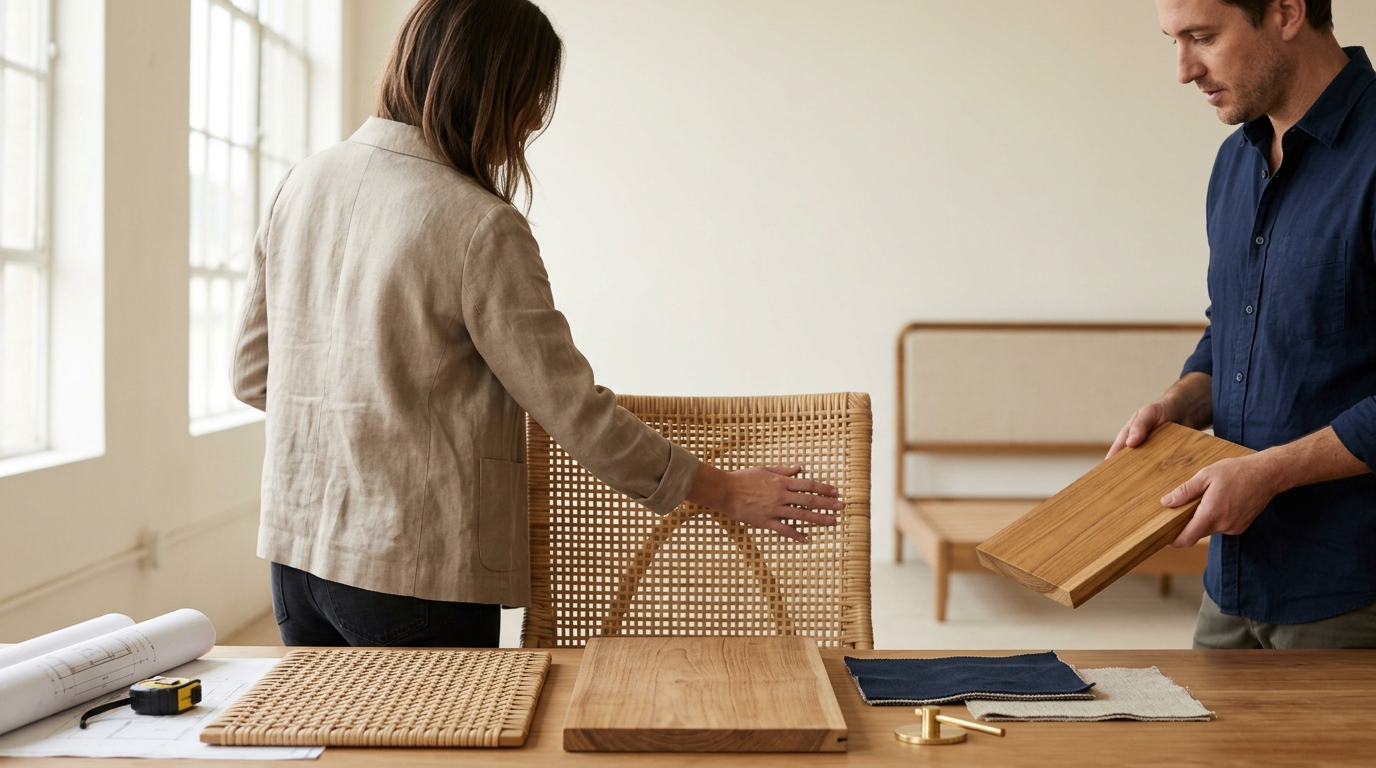
Full-villa fit-outs sourced from Indonesia represent one of the most cost-effective procurement strategies available to US-based hospitality developers. The decision is rarely simple.
Full-villa fit-outs sourced from Indonesia represent one of the most cost-effective procurement strategies available to US-based hospitality developers. The decision is rarely simple.
This guide addresses the full scope of villa furniture sourcing Indonesia — from hub selection and material specification through to US landed cost calculations, quality assurance, and long-term supplier relationships. It is written for villa owners' representatives, boutique hospitality developers, and interior design firms managing procurement decisions, not retail purchases.
The Indonesian furniture industry occupies a distinct global position. Unlike China's volume-driven model or Vietnam's rapid-growth export base, Indonesia's competitive advantage rests on craft depth, unique hardwood access, and a premium hospitality segment that has supplied luxury resorts across Southeast Asia, the Caribbean, and the US for decades.
Why Indonesia Still Sets the Standard for Villa Furniture Quality and Value
Indonesia's reputation in global furniture is not generic. It is category-specific and deep. The country's two primary production clusters — Jepara in Central Java and Bali — have supplied luxury resort and villa projects internationally for over three decades. That sustained export track record has produced a supplier base with genuine experience in hospitality-grade specifications.
The craft skill base is broad. Solid-wood joinery, hand carving, rattan weaving, and upholstery are all practised at scale. This is not artisan production in the sense of low volume only — Jepara manufacturers routinely fulfil multi-container hospitality orders while maintaining hand-finished detailing that European or US workshops cannot match at equivalent price points.
Material access is a structural advantage. Indonesian producers work directly with teak, mahogany, suar, rattan, bamboo, and reclaimed teak — materials that are either unavailable or prohibitively expensive through European supply chains. Teak in particular is plantation-grown in Java, making legal, certified supply accessible at a scale no other country currently matches.
Cost-quality ratio remains compelling versus alternatives. Equivalent bespoke villa furniture produced in Europe or the US typically costs multiples of Indonesian pricing. The gap narrows for very simple pieces but widens significantly for carved, joinery-intensive, or upholstered items where Indonesian labour costs and craft density create durable price advantages.
Jepara vs Bali: Choosing the Right Indonesian Production Hub for Your Villa Project
The two hubs serve different briefs. Understanding their differences prevents misalignment between your design intent and your supplier's actual capability.
| Dimension | Jepara (Central Java) | Bali |
|---|---|---|
| Primary strength | Solid wood, carved furniture at scale | Design-forward, boutique, artisan pieces |
| Material focus | Teak, mahogany, suar, reclaimed wood | Mixed — teak, rattan, bamboo, mixed media |
| Typical MOQ | Medium-to-large (often 1 container+) | Lower — suits bespoke and small-batch |
| Price point | More competitive on volume | Premium on design complexity |
| Port access | Semarang (Tanjung Emas) — efficient for large shipments | Benoa (Bali) — smaller throughput, higher per-unit logistics cost |
| Lead time profile | Consistent on production; slightly longer on design iteration | Faster design iteration; variable on volume capacity |
| Design capability | Strong on traditional and transitional styles | Strong on contemporary, resort-modern, editorial styles |
| Export infrastructure | Well-established merchant exporters | Mix of direct export and consolidators |
When to source from Jepara
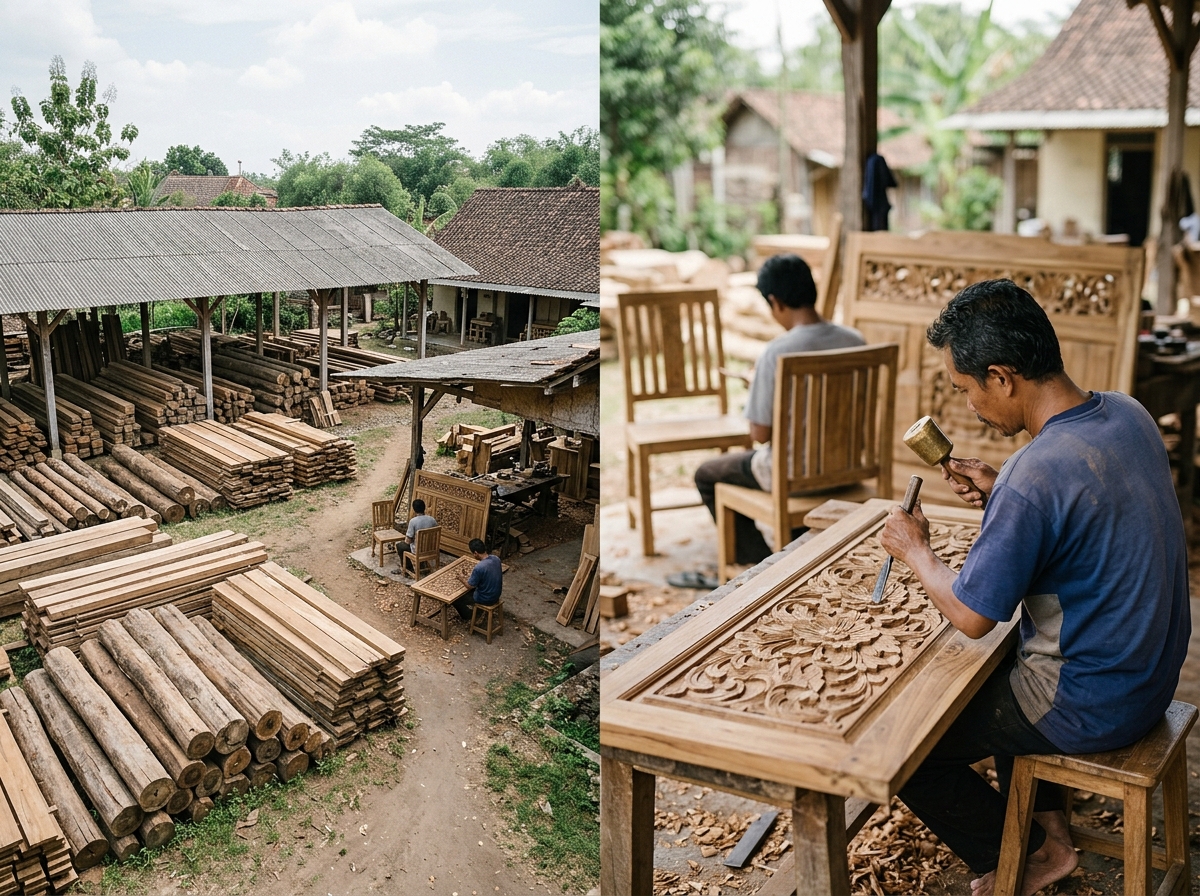
Jepara suits projects with large volume requirements in solid wood. Bedroom sets, dining collections, and carved architectural pieces are its core strength. Full-cycle factories in Jepara — those with on-site lumber yards, kiln-drying, CNC capacity, and finishing under one roof — can control moisture content to specifications required for US environments.
When to source from Bali
Bali's advantage is design density. The island's concentration of international designers, creative studios, and artisan workshops produces furniture with a visual sophistication that suits flagship villa projects. It is the better source for accent pieces, feature lighting, rattan and bamboo transitional furniture, and items where creative direction matters as much as price.
Hybrid sourcing across both hubs
Most full-villa projects benefit from a hybrid approach. Source structural bedroom and dining furniture from Jepara for volume efficiency. Source lounge, accent, and outdoor transitional pieces from Bali for design quality. A single sourcing partner with relationships across both clusters manages consolidation and simplifies logistics considerably.
Bespoke, Semi-Custom, or Stock: Choosing the Right Sourcing Route for Indonesian Villa Furniture
Three routes exist. Each involves distinct trade-offs across cost, flexibility, and lead time.
Full bespoke means custom dimensions, materials, and finishes developed from technical drawings and approved samples. It suits flagship villas where design exclusivity matters and budget supports longer lead times (typically 16–24 weeks). Intellectual property clauses should be built into the factory agreement — addressing design exclusivity, pattern ownership, and restrictions on selling the same piece to third parties. This is a gap many buyers overlook.
Semi-custom means adapting existing factory models — adjusting dimensions, timber species, stain colour, or hardware. Lead times run approximately 8–14 weeks. This route suits budget-conscious projects or repeat villa developments where design consistency across properties matters more than originality.
Off-the-shelf stock items are available from trading companies and merchant exporters. Lead times are shortest but design control is minimal. Appropriate for secondary pieces or fast-turn fill items within a larger bespoke order.
Working directly with factories versus using a sourcing agent
Direct factory engagement offers the lowest unit cost but demands significant management capacity. The buyer must handle supplier vetting, specification management, sample approvals, production monitoring, and pre-shipment inspection independently. This is realistic for large-volume repeat buyers with regional presence.
A sourcing agent typically charges 3–10% of FOB value as commission. The model suits buyers without regional expertise but requires careful verification of agent independence — hidden factory commissions create conflicts of interest that compromise supplier selection quality.
An operational sourcing partner — one that accompanies the full project lifecycle from supplier search through to shipment, operating on a transparent service model rather than a factory commission — provides the highest control level for complex full-villa scopes.
Material Selection for Tropical and Coastal Villa Climates
Material specification is not aesthetic alone. Coastal and tropical environments place real demands on furniture. Wrong material choices generate warranty claims, guest complaints, and replacement costs within two to three seasons.
Teak for coastal and high-humidity applications
Teak remains the benchmark for coastal villa furniture. Its natural oil content resists moisture, UV, and marine insects without surface treatment. Plantation-grown teak from Java is the primary legal, certified supply source. For outdoor and semi-outdoor applications — pool decks, terraces, open-plan living areas in tropical climates — teak outperforms most alternatives on longevity.
Finish specification matters. Exterior pieces benefit from teak sealer or oil rather than lacquer, which can crack under UV and humidity cycling. Interior teak pieces in air-conditioned environments can carry lacquer or hard-wax oil finishes.
Rattan and bamboo for indoor-outdoor transition zones
Rattan and bamboo suit covered terraces, lounge areas, and indoor spaces where a lighter visual weight is appropriate. Synthetic rattan (HDPE weave over aluminium frames) offers better durability for fully exposed outdoor positions while maintaining the aesthetic of natural rattan.
Accent materials: suar, mahogany, reclaimed teak
Suar (also known as rain tree) produces wide, highly figured live-edge slabs suited for dining tables and statement pieces. Mahogany offers a tighter grain than teak with excellent finish-taking properties — suited for bedroom furniture and interior joinery. Reclaimed teak, typically sourced from deconstructed Javanese structures, provides unique character and strong sustainability credentials when properly documented.
Coordinating Indoor and Outdoor Furniture Across a Full Villa Scope
A villa is not a collection of independent rooms. Material language, colour palette, and hardware finishes must read as unified across living, dining, bedroom, and outdoor spaces. This discipline is harder to maintain when furniture is sourced from multiple suppliers without a coordinating brief.
Room-by-room specification framework:
- Bedrooms: Solid teak or mahogany bed frames, side tables, storage. Specify joinery type, hardware finish, and mattress platform height relative to floor finish. - Living areas: Upholstered seating (specify fabric weight, Martindale rub count for hospitality use), rattan or teak occasional tables, media console. - Dining: Solid suar or teak dining table, upholstered or saddle-leather dining chairs. Confirm chair seat height against table apron clearance. - Outdoor and pool deck: Teak or synthetic-rattan loungers and dining sets. Specify marine-grade stainless or powder-coated aluminium hardware. Specify Sunbrella-grade or equivalent UV-resistant fabric for cushions.
- ✓Unified finish schedule across all timber pieces
- ✓Hardware finish consistent across indoor and outdoor
- ✓Fabric specifications include UV resistance rating for outdoor pieces
- ✓Chair-to-table height clearances confirmed
- ✓Material sample board approved before production commences
- ✓Lead times aligned across all categories for single delivery
Managing this across multiple category specialists increases coordination risk. A single sourcing partner with full-scope capability — covering bedroom, dining, living, and outdoor in one production plan — reduces specification drift and simplifies quality sign-off.
Lead Times, Production Milestones, and Phased Delivery Planning
Lead time planning is the most common failure point in villa furniture procurement. Delays in furniture delivery hold up villa commissioning and generate real financial costs.
Approximate lead time benchmarks:
| Order type | Typical lead time |
|---|---|
| Stock / off-the-shelf | 2–4 weeks |
| Semi-custom | 8–14 weeks |
| Full bespoke | 16–24 weeks |
These are production times only. Add 4–6 weeks for ocean freight to US West Coast ports, or 5–7 weeks to East Coast ports, plus inland delivery time.
Key production milestones to contractualise:
1. Deposit payment and order confirmation 2. Material procurement sign-off 3. First-article sample approval (physical or photographic) 4. Mid-production inspection (for large orders) 5. Pre-shipment QC inspection and photographic report 6. Bill of lading and documentation release
Phased delivery is possible and often necessary for large villa projects. If construction is sequenced — exterior structures completing before interior fit-out — outdoor furniture can ship first, followed by interior pieces. Build phasing windows into the supply agreement. Allow buffer time between each phase for customs clearance and inland delivery.
US Import Tariffs, Freight, and Landed Cost Calculations for Indonesian Furniture
This is the section most sourcing guides omit. Landed cost — not FOB price — is the number that matters to a project budget.
Applicable US HTS codes and tariff rates
Indonesian wooden furniture generally falls under HTS Chapter 94. Key headings include:
- 9403.30 — wooden furniture of a kind used in offices - 9403.50 — wooden furniture of a kind used in bedrooms - 9403.60 — other wooden furniture - 9401.61 / 9401.69 — upholstered seating / other seating
As of approximately 2024–2025, Indonesia is not subject to Section 301 tariffs (which apply to China). Indonesian furniture generally enters the US at standard MFN (Most Favored Nation) rates, which for wooden furniture typically range from approximately 0% to around 7% depending on the specific HTS subheading. Rattan and wicker furniture headings (e.g., 9401.52, 9403.81) carry their own rate schedule.
Landed cost calculation framework
| Cost component | Basis | Approximate range |
|---|---|---|
| FOB Indonesia | Supplier quote | — |
| Ocean freight (FCL 20ft) | Per container to US West Coast | Variable — confirm with freight forwarder |
| Marine insurance | ~0.5–1% of cargo value | Approximate |
| US customs duty | HTS rate × CIF value | 0–7% depending on HTS |
| ISF filing fee | Per shipment | Nominal |
| Port handling / drayage | Per container | Variable by port |
| Last-mile delivery to villa site | Per delivery | Variable |
| **Total landed cost** | — | Typically 25–45% above FOB for US destinations |
The 25–45% above FOB range is approximate and varies with container fill, port of entry, and inland distance. Build a project-specific model with your freight forwarder before committing to a supplier FOB price.
Incoterm selection: FOB is standard for experienced importers with freight relationships. CIF transfers freight and insurance to the supplier — simpler but reduces cost visibility. DDP (Delivered Duty Paid) places full logistics responsibility on the supplier — convenient but typically the most expensive option and reduces buyer control over carrier selection.
Quality Assurance Before Your Container Leaves Indonesia
Remote buying creates quality risk. The industry standard mitigation is third-party pre-shipment inspection — not reliance on factory self-reporting.
Pre-shipment inspection checklist
- ✓Dimensions vs approved technical drawings (tolerance ±3mm typical)
- ✓Finish quality — uniformity, adhesion, absence of runs or bare patches
- ✓Joinery integrity — mortise and tenon, dowel, hardware seating
- ✓Hardware — correct specification, corrosion-resistance grade
- ✓Fabric — correct material, colour match to approved sample, no defects
- ✓Moisture content reading on timber pieces
- ✓Quantity count vs purchase order
- ✓Packing adequacy for ocean freight
Third-party inspection firms operating in Indonesia can conduct physical pre-shipment inspection and issue photographic reports. For remote US-based buyers, a video walkthrough of the loaded container prior to sealing provides an additional verification layer.
Certifications to request from Indonesian suppliers
- SVLK (Sistem Verifikasi Legalitas Kayu) — Indonesia's mandatory timber legality verification system. Required for export of timber products from Indonesia. All wooden furniture suppliers should hold or operate under SVLK certification. Request the V-Legal document with each shipment. - FSC (Forest Stewardship Council) — voluntary chain-of-custody certification. Preferred by buyers with sustainability requirements or ESG reporting obligations. - FLEGT — the EU Forest Law Enforcement, Governance and Trade licence; relevant if the same container routes through EU ports, and increasingly referenced by US buyers as a due-diligence standard.
Handling post-delivery defects
Agree warranty terms and remediation procedures in the supply contract before production begins. Standard terms in the hospitality furniture segment typically cover manufacturing defects for approximately 12 months.
Building Long-Term Sourcing Relationships for Multi-Property Villa Portfolios
Single-project sourcing is the most expensive model per unit. Developers with multiple villa properties or pipeline projects benefit substantially from structured long-term supplier relationships.
Vetting suppliers before committing
Supplier vetting for villa furnitureprocurement Indonesiashould cover:
- Factory visit or third-party audit — verifying full-cycle production capability (lumber yard, kiln, finishing) - Export record review — confirmed shipments to US buyers, available via Bill of Lading databases - Trade references — direct contact with two or three existing US hospitality buyers - Sample order — a paid sample of key pieces before full order commitment
Framework agreements for multi-property developers
A framework agreement establishes pricing mechanisms, lead-time commitments, QC standards, and design exclusivity terms across multiple projects. It reduces renegotiation overhead and gives the supplier visibility on forward demand — which typically translates into better pricing and priority scheduling.
IP and design exclusivity for bespoke pieces
When commissioning fully bespoke pieces, include contractual clauses that:
- Assign ownership of technical drawings and moulds to the buyer - Restrict the factory from producing the same design for third parties for a defined period (typically 2–3 years minimum) - Require destruction or return of tooling at contract end if the relationship terminates
This is standard practice in contract hospitality procurement but frequently omitted by first-time Indonesia buyers.
Communication and documentation standards
Establish a shared documentation framework at project outset: a single PO management system, a photo library for sample approvals, and a production milestone tracker accessible to both buyer and supplier. Weekly written updates during production — not phone calls alone — create an auditable record that protects both parties if disputes arise.
Indonesia's depth of craft skill, unique hardwood access, and established hospitality export infrastructure make it the logical primary source for full-villa furniture projects. The key decisions — hub selection, sourcing route, material specification, and landed cost modelling — are sequential and each depends on the one before it.
You now have a framework for approaching villa furniture procurement Indonesia end-to-end — from production hub selection through to US customs clearance. The logical next step is applying that framework to your specific project scope with experienced regional support.
Every villa project has a different scope, timeline, and budget structure. Our sourcing team works across Jepara and Bali production hubs, manages full-scope multi-category procurement, and coordinates third-party QC and export documentation — so your container arrives on specification and on schedule. Request a sourcing consultation for your villa project today.
Request a Sourcing Consultation →Frequently Asked Questions
How long doescustom villa furnituretake to produce in Indonesia? Full bespoke production typically runs 16–24 weeks from approved sample to container loading. Semi-custom orders run approximately 8–14 weeks. Add ocean freight time (approximately 4–7 weeks to US ports depending on destination coast) for total project timeline planning.
What are the US import tariffs on Indonesian furniture in 2024–2025? Indonesian furniture enters the US under standard MFN tariff rates — generally 0–7% for wooden furniture depending on HTS subheading. Indonesia is not subject to Section 301 tariffs applied to Chinese goods. Confirm exact rates for your specific HTS codes with a licensed US customs broker before finalising budgets.
Should I source directly from an Indonesian factory or use a sourcing agent? Direct factory engagement offers the lowest unit cost but demands significant management capacity. A sourcing agent (typically charging 3–10% of FOB) is appropriate for buyers without regional expertise.
What wood species are best for coastal and tropical villa furniture? Teak is the primary recommendation for coastal and outdoor applications — its natural oil content resists moisture, UV, and marine insects. Mahogany suits interior pieces. Suar is excellent for statement dining and accent pieces. Reclaimed teak offers sustainability credentials with high character.
How do I ensure quality control when buying furniture remotely from Indonesia? Engage a third-party inspection firm for pre-shipment inspection against your approved technical drawings and samples. Request photographic and video documentation of finished pieces before container loading. Require SVLK V-Legal timber legality documentation with each shipment. For bespoke orders, include a mid-production inspection milestone contractually.
What is the minimum order quantity for a full villa furniture package from Indonesia? MOQ varies by supplier and hub. Jepara solid-wood factories commonly set MOQs at one 20-foot container equivalent or above. Bali artisan suppliers often accept smaller orders.
Need eyes on the ground in Indonesia?
MTS is an execution partner — supplier verification, manufacturing management, quality control and export logistics across Indonesia, Vietnam and China.
Related services
Related articles
Receive furniture sourcing insights across Asia.
One email per week. No spam.