Furniture Sourcing Enquiry: How to Get Accurate Quotes from Indonesia
14 min read
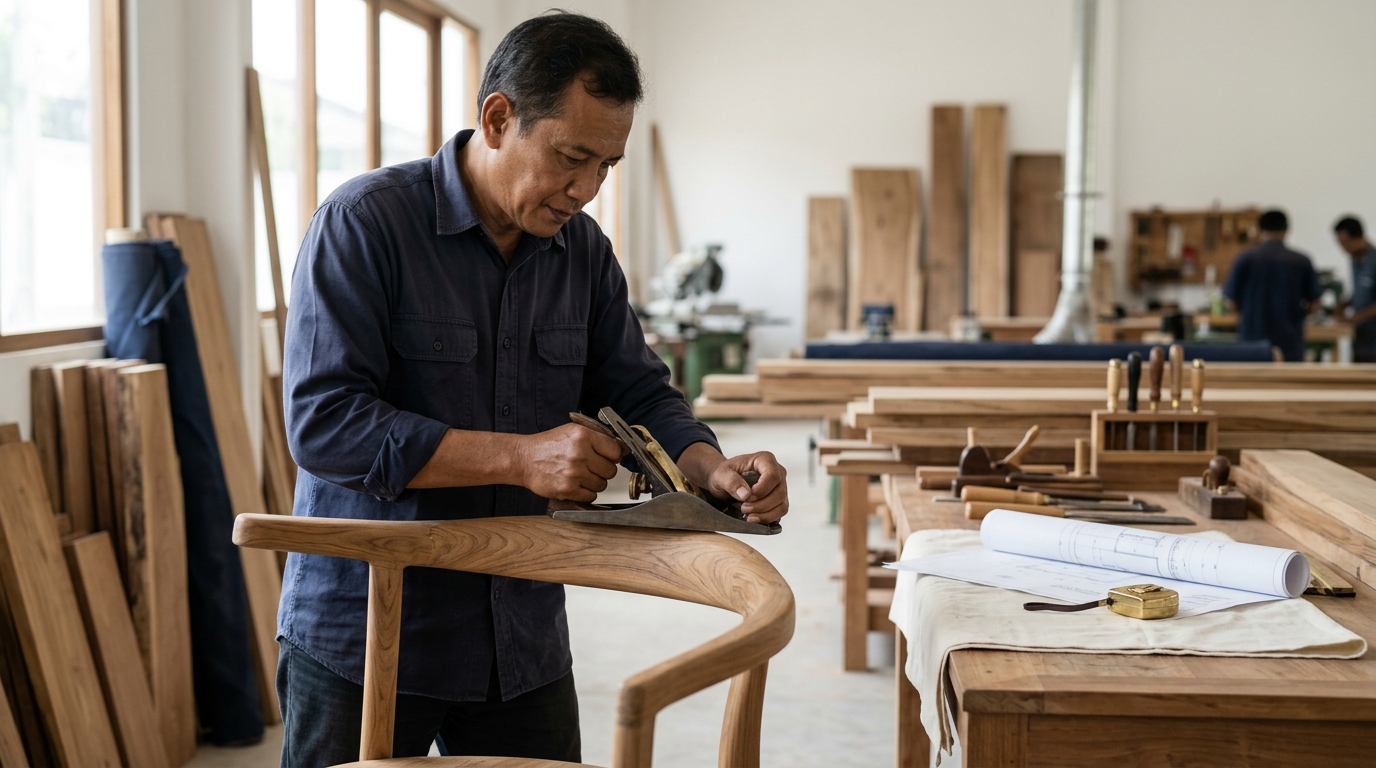
You send a brief to three Indonesian factories. Two never reply. The third sends a price that is approximately 40% higher than you expected, with no material specs and a lead time range of eight to sixteen weeks. Sound familiar? The problem is rarely the factory. It is the enquiry.
You send a brief to three Indonesian factories. Two never reply. The third sends a price that is approximately 40% higher than you expected, with no material specs and a lead time range of eight to sixteen weeks. Sound familiar? The problem is rarely the factory. It is the enquiry.
A vague furniture sourcing enquiry produces vague, incomparable quotes. Indonesian manufacturers — whether a Jepara teak workshop, a Bali artisan studio, or a Cirebon rattan exporter — allocate quoting time to the briefs that are easiest to price accurately. If your enquiry is missing dimensions, quantities, or destination terms, you move to the bottom of the stack.
This guide covers exactly what to include in your first furniture sourcing enquiry to Indonesia. It addresses product specifications, quantities, logistics terms, quality certifications, budget communication, and email structure. It is deliberately scoped to the first-enquiry stage — not a full formal tender or RFQ process. Think of it as a working checklist you can action before hitting send.
Follow this framework and you will get faster responses, more comparable FOB quotes, and fewer rounds of clarification. The result is a stronger supplier relationship from day one.
Why Your Enquiry Brief Determines the Quality of Every Quote You Receive
Vague briefs create vague quotes — and waste everyone's time
Indonesian factories run lean quoting teams. A Jepara workshop producing solid teak dining sets may have one or two people handling all export enquiries. A vague brief — "200 teak dining chairs, quote please" — forces a choice. The estimator can spend an hour chasing follow-up details. Or they move to the next enquiry that already includes dimensions, finish specs, and a destination port.
A strong furniture sourcing enquiry signals that you are a serious buyer. It compresses the quoting cycle. It also tells the factory what materials and construction methods to price — which means the number you get back is actually usable.
First enquiry versus formal RFQ: know the difference
A formal RFQ or tender document is a structured procurement instrument used once you have shortlisted suppliers and need legally comparable bids. The first enquiry is earlier than that. Its goal is to get a working price indication, confirm factory capability, and open a dialogue.
Your first enquiry should be detailed enough to produce a realistic FOB indication. It does not need to be a thirty-page specification pack. The right level is a structured one-to-two-page brief covering the fields in the sections below.
Product Specifications: The Non-Negotiable Core of Any Indonesia Furniture Brief
No part of your brief matters more than specifications. Price, lead time, and quality all flow from what you specify here.
Dimensions, materials, and construction
State dimensions as L × W × H in millimetres or inches — specify which unit you are using. Include tolerances where critical (for example, ±5 mm on seat height for stacking chairs). If products are modular or nest together, include a configuration diagram.
For timber species, be explicit:
| Material | Common Indonesian Source | Notes |
|---|---|---|
| Teak | Jepara, Java plantation teak | Specify grade: A, B, or reclaimed |
| Rattan | Cirebon cluster | Core versus peel; indoor versus outdoor |
| Suar / Monkeypod | Java, Bali | Live-edge or milled; slab thickness |
| Reclaimed timber | Various | Require SVLK documentation |
| Mahogany | Java | Specify plantation origin |
Include joinery method (mortise-and-tenon, dowel, or RTA hardware), hardware specifications (hinges, brackets — brand or equivalent), upholstery fabric grade and filling weight, and surface treatment (oiled, lacquered, stained — Pantone or RAL code where colour matters).
Technical drawings versus reference images
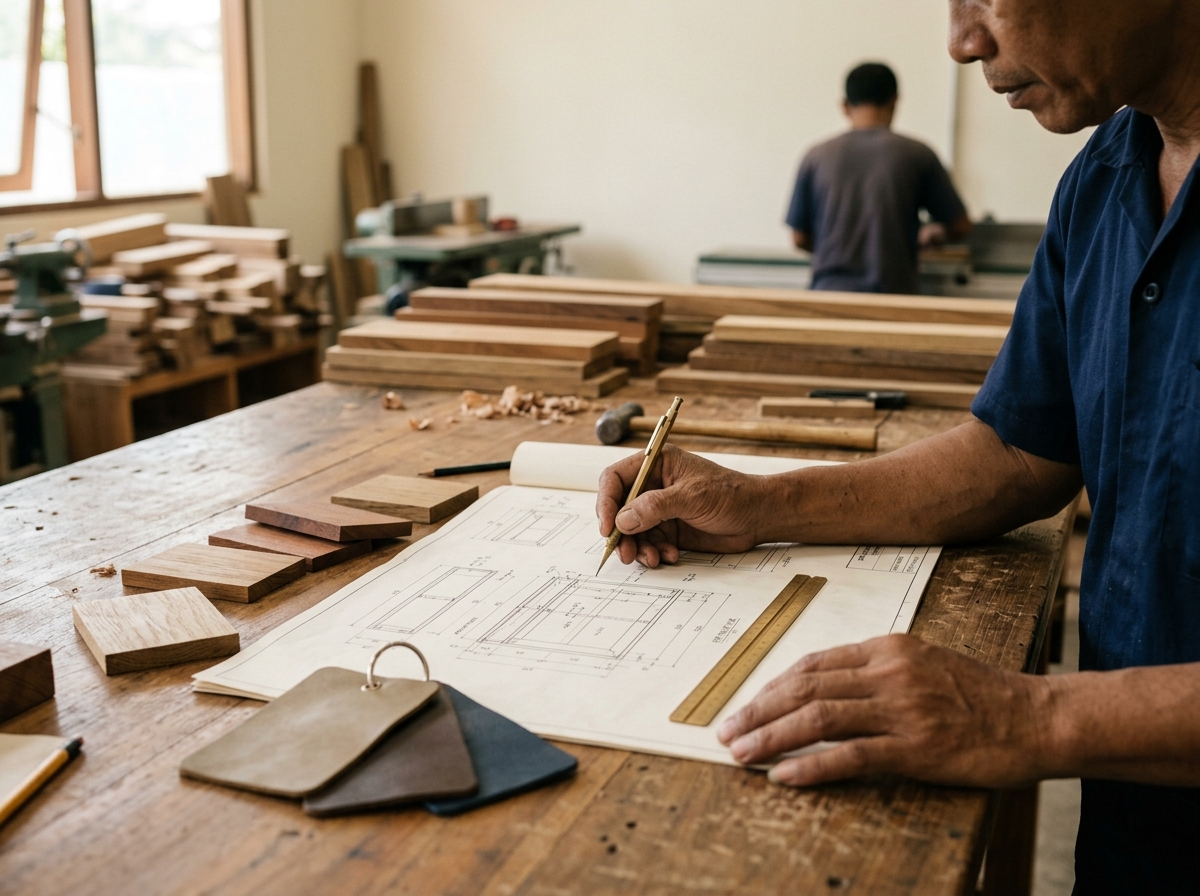
Factories prefer technical drawings in PDF or DWG format for pricing accuracy. If you are working from a concept rather than an engineered design, high-resolution reference images (minimum 1500px, JPEG or PNG) combined with a mood board are workable for a first enquiry. Factories in Indonesia — particularly in Bali and Jepara — are experienced at interpreting inspiration images and will build their quote around assumed construction methods.
State clearly: "These are reference images — please quote using your standard construction for this style." That gives the factory permission to apply their expertise without guessing your tolerance for deviation.
How to State Quantities and MOQ Expectations Without Losing Suppliers
Realistic per-SKU quantities get realistic prices
Quote requests that say "large quantities available" without a number are ignored or deprioritised. State a per-SKU quantity, even if it is approximate. "Approximately 100 units of dining chair A, 40 units of bench B" is far more useful than a vague volume signal.
Typical Indonesian factory MOQs vary by product type and complexity:
| Product Type | Typical MOQ Range (approximate) |
|---|---|
| Standard solid teak outdoor chair | 50–100 units per SKU |
| Custom upholstered dining chair | 100–200 units per SKU |
| Rattan lounge set (multi-piece) | 20–50 sets |
| Hand-carved decorative item | 50–200 units |
| Large hospitality casegoods | 20–50 units |
These are approximate industry norms — individual factories will differ. Smaller Jepara workshops often accept lower MOQs than larger Semarang-area export factories. Always ask the factory to state their MOQ in the quote-back.
Phased orders and trial containers
If you are a first-time buyer or testing a new category, frame your order intention clearly. For example:
> "We are planning an initial trial order of approximately one LCL shipment, with the intention to scale to FCL volumes if quality meets expectations. We are open to discussing phased production schedules."
This language does two things. It manages factory expectations honestly. It also signals long-term potential, which helps retain access to factories that might otherwise decline small one-time orders. LCL (less than container load) is typically used for volumes below approximately 10–15 CBM; FCL (full container load) covers 20ft or 40ft containers.
Destination, Incoterms, and Lead Time: Logistics Details That Shape Every Indonesia Price
Always state your Incoterm and destination
The Incoterm you request determines how the price is structured and who bears which risks and costs. For Indonesia-to-US shipments, the three most common terms are:
| Incoterm | What the supplier quotes | Your responsibility |
|---|---|---|
| FOB (Jepara / Semarang / Surabaya) | Production + export clearance + loading | Ocean freight, insurance, US customs |
| CIF (destination port) | FOB + ocean freight + insurance | US customs, inland delivery |
| DDP (your warehouse) | All costs to your door | Nothing — supplier manages all |
FOB is the most common first-enquiry term for US buyers sourcing from Indonesia. It allows you to control freight costs and use your own forwarder. Always specify the load port — commonly Semarang or Surabaya for Java production, Bali for Bali-based suppliers.
Lead time and capacity signals
State your required in-store or delivery date and work backwards. Ask the factory to confirm their current production lead time and whether they have capacity for your target window. A Jepara factory running at full capacity during peak season (typically pre-Chinese New Year or pre-summer) may quote an honest twelve to fourteen week production lead time.
Ask suppliers to include packed carton dimensions and CBM per SKU in their quote. This allows your freight forwarder to plan accurately without a second round of questions.
US import compliance context
When sourcing woodfurniture from Indonesia, include a note in your enquiry about US Customs and Border Protection requirements. If your product contains composite wood (MDF, plywood), TSCA Title VI compliance is required for US import — this limits formaldehyde emissions from composite wood panels. Ask suppliers to confirm whether their panels are TSCA Title VI compliant and whether they can provide documentation.
For HTS code reference, solid woodfurniture from Indonesiatypically falls under Chapter 94 of the US Harmonized Tariff Schedule. Confirm the correct HTS code with your customs broker before committing to a landed-cost calculation.
Quality Standards and Certifications to Include in Your Opening Brief
State your certification requirements in the first enquiry — not after sampling. This filters out non-compliant suppliers early and saves significant time.
Timber legality and sustainability:
- SVLK (Sistem Verifikasi Legalitas Kayu): Indonesia's mandatory timber legality verification system. All Indonesian wood furniture exports should be covered by SVLK. Request a copy of the supplier's SVLK certificate in your enquiry. - FLEGT licence: The EU's Forest Law Enforcement, Governance and Trade licence, issued under the Indonesia-EU VPA. If you sell to EU markets alongside the US, request FLEGT-licensed shipments. - FSC Chain of Custody: For buyers requiring FSC-certified timber, ask explicitly. Not all Indonesian factories hold FSC CoC — plantation teak operations are more likely to hold it than reclaimed-wood workshops.
Finish and quality grading:
Define acceptable finish quality in your brief. Reference Pantone codes for stained finishes or RAL codes for painted surfaces. State whether you will accept any natural variation (knots, grain character) or require consistent appearance. For hospitality and contract furniture buyers — a common use case when sourcing from Bali or Java — define your acceptable defect tolerance per hundred units.
Pre-shipment inspection:
State in your enquiry whether third-party pre-shipment inspection is a standing requirement for all orders. This signals quality seriousness and is welcomed by legitimate manufacturers. A factory that resists the mention of third-party inspection at the enquiry stage is worth noting.
Sharing a Budget Band Accelerates Accurate Quoting Without Sacrificing Quality
This is the step most first-time buyers skip — and the one that wastes the most time.
When a factory receives no budget signal, they quote to their own assumptions. One factory quotes using plantation teak with an oiled finish. Another quotes using a lower-grade timber with a sprayed lacquer. The prices are incomparable. You cannot evaluate them against each other.
How to frame a target FOB price band
State your budget as a target FOB price per unit, not a total project budget. For example:
> "Our target FOB price for the dining chair is USD XX–YY per unit at 150 pieces. We are open to material or construction adjustments if that helps meet the target."
The range you provide tells the factory which material grade and construction method to apply. A narrow range signals that you have done market research. A wide range invites the factory to quote at the top.
Communicating budget without anchoring too low
Setting your lower bound too aggressively risks receiving quotes that meet the price by cutting material quality in ways you cannot see from a spec sheet. A better approach is to set your lower bound at a realistic market floor for the specification and your upper bound at your actual ceiling. Leave room for quality.
If you are unsure what the market FOB floor is for a given specification, request quotes from three to five suppliers without stating a budget first, then use those indications to calibrate your target for the second round.
A Ready-to-Use Furniture Enquiry Email for Indonesian Suppliers
Subject line and email structure
Subject lines that get opened: "Furniture Sourcing Enquiry — [Product Category] — [Company Name] — [Destination Country]"
Avoid generic subjects like "Enquiry" or "Price Request." Indonesian export contacts — many of whom communicate via WhatsApp as well as email — respond faster to specific, identifiable subject lines. Note that many Jepara and Bali factories prefer WhatsApp for initial contact and use email for formal quote delivery. If you have a WhatsApp number for the contact, send a brief message linking to your email.
Copy-ready enquiry template
> Subject: Furniture Sourcing Enquiry — Solid Teak Dining Set — [Your Company] — USA > > Dear [Contact Name / Export Team], > > My name is [Name] from [Company], a furniture importer based in [City, USA]. We are preparing our [season/year] collection and are seeking a reliable Indonesian manufacturer for the following products. > > Product List: > 1. Solid teak dining chair — dimensions approx. 450W × 520D × 900H mm — qty approx. 150 units > 2. Matching teak dining table — 2000W × 900D × 760H mm — qty approx. 30 units > > Material & Finish: Plantation teak Grade A, brushed oiled finish (Pantone warm oak reference attached). Mortise-and-tenon joinery preferred. > > Quantities: As above. We are planning an initial LCL trial shipment with FCL scale potential. > > Destination: FOB Semarang or Surabaya. Final destination: Los Angeles, USA. > > Target Lead Time: Production complete within 10–12 weeks from deposit. > > Target FOB Price: USD [XX–YY] per chair / USD [XX–YY] per table at stated quantities. > > Certifications Required: SVLK documentation for all timber. TSCA Title VI compliant panels if applicable. > > Quality: Third-party pre-shipment inspection is a standing requirement on all orders. > > Please quote per unit FOB, include packed carton dimensions and CBM, and confirm your current production capacity and MOQ. We will review all quotes received within [X] business days. > > Reference images and mood board attached (PDF, JPEG). > > Best regards, > [Name, Title, Company, Phone/WhatsApp]
What to attach versus embed
Attach: technical drawings (PDF), mood board (PDF or JPEG), any reference images. Embed in the email body: the product list, dimensions table, and key requirements. Keep attachments under 5 MB total — large files go to spam or are rejected by factory mail servers.
Following up after five business days
If no response within five business days, send a WhatsApp message to the factory's export contact referencing your email subject line and date. Indonesian factories are highly active on WhatsApp. A brief, polite follow-up message ("Hi [Name], I sent a sourcing enquiry by email on [date] — please let me know if you received it") resolves most non-response situations.
Understanding the Quote-Back Process: What to Expect After You Send the Brief
Typical turnaround times from Indonesian factories
Quote turnaround from Indonesian factories is typically three to seven business days for standard products with clear specifications. Custom or complex pieces — carved items, multi-material upholstered sets — may take ten to fourteen business days. Delays are more common during Indonesian public holidays (Eid al-Fitr, Idul Adha, national independence week).
How to read and compare FOB quotation sheets
When quotes arrive, normalise them before comparing. Build a simple comparison table:
| Field | Supplier A | Supplier B | Supplier C |
|---|---|---|---|
| FOB price per unit | — | — | — |
| Load port | — | — | — |
| Production lead time | — | — | — |
| MOQ stated | — | — | — |
| Timber grade specified | — | — | — |
| Packed CBM per unit | — | — | — |
| SVLK confirmed | — | — | — |
| Sample cost / lead time | — | — | — |
A quote that looks cheaper may use a lower timber grade or quote from a higher-cost load port. Normalising the variables makes the comparison honest.
Common factory questions — and how to pre-empt them
The most frequent clarification questions Indonesian factories ask after receiving an enquiry are:
- What is the target price? - What quantity per SKU? - What finish colour exactly? - Do you need FSC or SVLK? - Can you send a technical drawing?
Every one of these is answered in the template above. Pre-empting these questions in your brief cuts quoting time in half and signals that you have sourced from the region before — or that you have done your homework.
When to move to sampling versus requesting a revised quote
Move to sampling when: FOB price is within your acceptable range, production lead time fits your window, and SVLK or FSC documentation has been confirmed. Request a revised quote when: the factory has quoted a different material or construction than specified, or the price is significantly outside your target and you believe there is room to re-engineer the specification.
Frequently Asked Questions
What is the minimum order quantity for Indonesianfurniture manufacturers? MOQs vary by factory size and product complexity. Smaller Jepara workshops often accept 50 units per SKU for standard solid wood pieces. Larger export-oriented factories may require 100–200 units. Always ask the factory to state their MOQ explicitly in the quote-back.
Do I need technical drawings or will reference photos be enough for a quote? Reference photos are workable for a first enquiry, especially for style-driven pieces. Factories in Jepara and Bali regularly quote from images. For precision-fit products — RTA furniture, hospitality casegoods — technical drawings improve pricing accuracy significantly.
How long does it take to get a furniture quote back from Indonesia? Typically three to seven business days for standard products with complete specifications. Complex custom pieces may take up to two weeks. Following up via WhatsApp after five days is standard practice.
Which Incoterm should I use when sourcing furniture from Indonesia to the US? FOB is the most practical for most US buyers. It gives you control over freight costs and allows you to use your preferred forwarder. CIF is useful if you want the supplier to arrange freight but want visibility on insurance. DDP is rare for first-time transactions and requires a supplier with strong US customs experience.
What certifications shouldIndonesian furnituresuppliers provide for US import? At minimum: SVLK timber legality documentation. If composite wood is present, TSCA Title VI compliance documentation. FSC Chain of Custody if your brand or retail partners require certified timber sourcing.
How do I request a sample before placing a bulk furniture order? State in your enquiry that you require a pre-production sample before confirming bulk order. Specify whether you want a counter-sample of your design or a standard sample from factory stock. Sample costs vary — many Indonesian factories charge for samples and deduct the cost from the bulk order. Clarify who bears courier costs in your brief.
A well-constructed furniture sourcing enquiry is the single highest-leverage action in your Indonesia sourcing process. Get the brief right — specifications, quantities, Incoterms, certifications, and a realistic budget band — and you compress weeks of back-and-forth into a single productive exchange that sets the supplier relationship on a professional footing from day one.
You now have the framework, the checklist, and a copy-ready template. The next step is to put it to use.
Download our freeIndonesia furnitureenquiry template, customise it for your product category, and send your first brief to Indonesian suppliers today.
You have the framework — now send a brief that gets accurate quotes. Our free template covers every field in this guide, formatted for email and ready to customise for any product category.
Download Free Template →Need eyes on the ground in Indonesia?
MTS is an execution partner — supplier verification, manufacturing management, quality control and export logistics across Indonesia, Vietnam and China.
Related services
Related articles
Receive furniture sourcing insights across Asia.
One email per week. No spam.