Shipping Furniture from Indonesia to the USA: Complete Importer Guide
20 min read
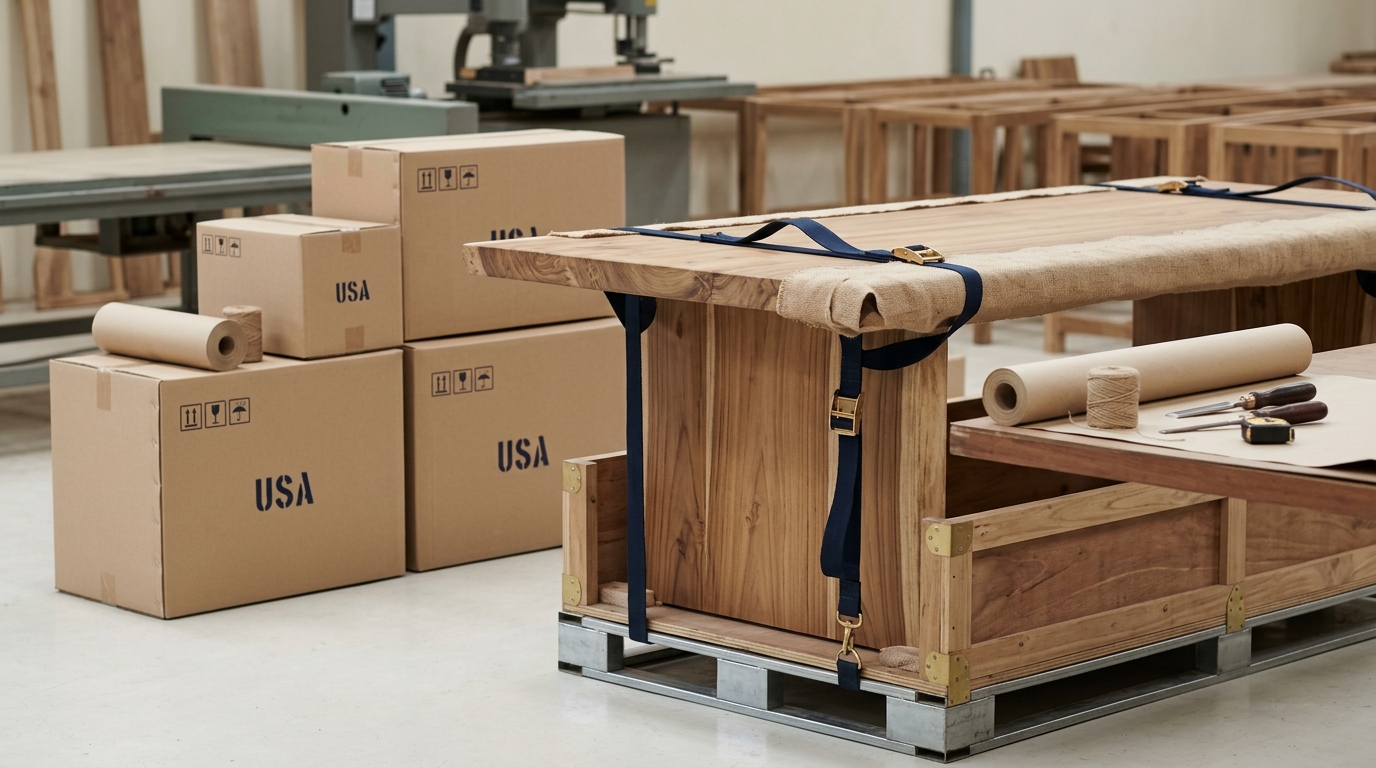
Sourcing furniture from Indonesia is one of the most rewarding decisions a US importer can make — and one of the most logistically demanding. A single 20-foot container of teak dining sets, landed at a US port, can realistically cost anywhere from approximately USD 3,500 to USD 7,500 all-in once…
Sourcing furniture from Indonesia is one of the most rewarding decisions a US importer can make — and one of the most logistically demanding. A single 20-foot container of teak dining sets, landed at a US port, can realistically cost anywhere from approximately USD 3,500 to USD 7,500 all-in once you add ocean freight, origin handling, US customs duties, brokerage, drayage, and last-mile delivery to your figures. Transit time from Indonesian ports to the US West Coast typically runs four to six weeks by sea; East Coast destinations commonly add another week or two. Understanding those numbers before you place a purchase order is the difference between a profitable import cycle and a cash-flow crisis.
This guide is written for US buyers who are either placing their first container order or scaling an existing Indonesia sourcing program. It covers every stage of the journey: why Indonesia remains a compelling supply market, how to choose between FCL and LCL shipping, what customs compliance really requires, how to read and compare freight quotes, and how to plan a realistic procurement calendar. You will also find a landed-cost example, a container comparison table, and answers to the questions that experienced importers ask most often.
Whether you are buying handcrafted rattan chairs from Bali artisan workshops, solid teak outdoor furniture from Jepara in Central Java, or mid-market dining sets from factories in Surabaya, the logistics framework is essentially the same. The sections below walk through it step by step.
Why US Importers Are Choosing Indonesian Furniture Over Other Asian Sources
Indonesia occupies a unique position in the global furniture industry. While China dominates volume and Vietnam has grown rapidly in solid-wood production since 2018, Indonesia holds a near-unrivalled advantage in a specific and commercially valuable niche: premium natural-material furniture crafted from teak, rattan, mahogany, and reclaimed wood.
The Manufacturing Clusters You Need to Know
Three regions account for the overwhelming majority of Indonesian furniture exported to the United States.
Jepara in Central Java is arguably the most important furniture-manufacturing town in Southeast Asia for solid wood. Its cluster of workshops and mid-sized factories specialises in teak and mahogany — both dining and bedroom furniture — with deep craft traditions dating back generations. Buyers sourcing heavy solid-wood pieces almost always pass through Jepara.
Bali serves a different market segment. Bali suppliers focus on luxury artisan pieces, resort and villa furniture, and decorative objects with strong design identity. Price points are higher, minimum order quantities are often lower, and the aesthetic skews toward the premium hospitality and interior-design trade.
Surabaya in East Java functions as a mid-market manufacturing and logistics hub. Larger factories there handle higher-volume orders with more standardised production processes, making Surabaya a natural choice for importers scaling toward regular FCL cycles. The port of Tanjung Priok in Jakarta and the port of Benoa in Bali are the two primary export gateways through which furniture leaves Indonesia for the United States.
Material Quality and Competitive Advantages
Indonesian teak is widely regarded as among the finest structural hardwoods available for outdoor and indoor furniture, valued for its natural oil content, dimensional stability, and longevity. Rattan from Indonesia — much of it processed through the Cirebon cluster — supplies a global market for woven indoor and outdoor pieces. Reclaimed teak and reclaimed boat wood, sourced from dismantled colonial-era structures and vessels, have become particularly sought-after by US retailers catering to the sustainability-conscious consumer.
Compared with Chinese suppliers, Indonesian manufacturers typically offer lower per-unit costs on natural-material categories where hand craftsmanship is central to the value proposition. Compared with Vietnam, Indonesia's edge is in material provenance and artisan differentiation rather than industrial volume capacity. For US buyers targeting the outdoor, hospitality, or premium home segments, that differentiation translates directly into retail margin.
Sea Freight vs. Air Freight: Selecting the Right Method for Shipping Furniture from Indonesia
For almost every furniture importer, sea freight is the default choice. Furniture is heavy, bulky, and low enough in value-per-kilogram that air freight costs are prohibitive for any meaningful volume. That said, the right sea-freight structure — FCL, LCL, or a consolidation service — depends on your order size, cash position, and delivery urgency.
FCL, LCL, and Consolidation Explained
A Full Container Load (FCL) means you book an entire container — typically a 20-foot or 40-foot standard box — exclusively for your cargo. You pay a flat rate regardless of whether the container is completely full, which makes FCL highly cost-effective once your shipment fills roughly 60–70% or more of the available space.
A Less than Container Load (LCL) shipment means your goods are loaded into a shared container alongside cargo from other shippers. You pay per cubic meter (CBM) of space used. LCL is the practical choice for first-time importers or smaller reorder quantities, but the per-CBM cost is usually higher than the equivalent FCL rate, and transit time can be longer due to consolidation and deconsolidation handling at both ends.
Consolidation services offered by freight forwarders or buying agents allow you to combine cargo from multiple Indonesian suppliers into a single FCL container. This is particularly valuable when you are sourcing from both a Jepara woodwork manufacturer and a Bali rattan producer simultaneously. Consolidation gives you FCL economics at a volume that would otherwise require LCL.
Container Comparison: 20ft FCL vs. 40ft FCL vs. LCL
| Shipping Mode | Typical Ocean Freight Range (Port-to-Port) | Approximate Capacity | Transit Time (to US West Coast) | Best Use Case |
|---|---|---|---|---|
| 20ft FCL | USD 1,000 – 2,500 | ~25–28 CBM / ~21,000 kg max | 4–6 weeks | Mid-volume orders; dense solid-wood pieces |
| 40ft FCL | USD 1,500 – 4,000 | ~55–58 CBM / ~26,500 kg max | 4–6 weeks | High-volume or mixed orders; bulky rattan or upholstered furniture |
| LCL | USD 30 – 80 per CBM | Any size, typically 1–15 CBM | 5–8 weeks (including consolidation) | Small first orders; sample shipments; reorders under ~12 CBM |
Air freight from Indonesia to the US typically arrives in five to ten business days, but the cost per kilogram can be fifteen to twenty times higher than sea freight. For furniture, air freight is only justifiable for very small, high-value pieces — decorative objects, samples, or urgent replacement items — where the cost of delay exceeds the freight premium.
What Does It Really Cost to Ship Furniture from Indonesia to the US?
Ocean freight rates are only one line item in your total landed cost. Importers who budget only for port-to-port freight are routinely surprised by the additional charges that accumulate between an Indonesian factory floor and a US warehouse shelf.
Breaking Down the All-In Landed Cost
Consider a realistic example: a 20-foot FCL container loaded with solid teak dining sets, departing Tanjung Priok and arriving at the port of Los Angeles.
| Cost Component | Typical Range |
|---|---|
| Ocean freight (port-to-port, 20ft FCL) | USD 1,200 – 2,500 |
| Origin handling / export fees (Indonesia) | USD 150 – 350 |
| Phytosanitary and fumigation certificates | USD 100 – 250 |
| ISF filing fee (US, see compliance section) | USD 25 – 75 |
| US customs entry / brokerage fee | USD 150 – 400 |
| US import duty (HTS-dependent, commonly 0%–3.7% of cargo value on MFN rate) | Varies by value |
| Destination port handling / THC | USD 200 – 500 |
| Drayage (port to local warehouse) | USD 300 – 800 |
| Last-mile / residential delivery | USD 150 – 600+ depending on destination |
For a container of dining furniture with a commercial invoice value of, say, approximately USD 18,000, the total landed cost including all of the above components might realistically fall in the range of USD 4,500 to USD 7,000 on top of the goods value — meaning your true cost-of-goods-landed is closer to USD 22,000 to USD 25,000. Dividing that by the number of pieces gives you a reliable per-unit cost foundation for pricing decisions.
When to Upgrade from a 20ft to a 40ft Container
The 40-foot container roughly doubles the volume capacity of a 20-foot box but typically costs only 20–50% more in ocean freight. If your cargo exceeds approximately 20–22 CBM, upgrading to a 40-foot container almost always produces a better cost-per-CBM outcome. Rattan and upholstered furniture, which tends to be voluminous relative to its weight, frequently justifies a 40-foot container even at moderate order values.
The Step-by-Step Process for Shipping Furniture from Indonesia to Your Door
Step 1 — Supplier Confirmation and Document Preparation
Before any freight booking can happen, you need a confirmed purchase order, a detailed packing list (specifying dimensions, weight, and number of cartons per item), and a commercial invoice that accurately describes the goods, declares the correct unit values, and identifies wood species and country of origin. Accuracy at this stage is not optional — it feeds directly into customs compliance downstream.
Step 2 — Booking Your Freight Forwarder and Selecting Incoterms
Your Incoterms selection defines who bears cost and risk at each stage of the shipment. The three terms most commonly used in Indonesia furniture trade are:
- FOB (Free On Board): The supplier delivers goods to the named port (e.g., Tanjung Priok or Benoa), clears Indonesian export customs, and loads them onto the vessel. You take responsibility — and cost — from that point onward. FOB is the most common and transparent starting point for US importers. - CIF (Cost, Insurance, Freight): The supplier arranges and pays for ocean freight and marine insurance to the named US destination port. You take over at the port of arrival. CIF is convenient but reduces your visibility into freight costs and insurer selection. - DDP (Delivered Duty Paid): The supplier (or their agent) handles everything through to your door, including US customs clearance and duty payment. DDP seems easiest but typically carries a significant cost premium and removes your control over the US customs process — which carries legal liability.
For most first-time importers, FOB is the recommended starting point: it keeps Indonesian export logistics in the hands of a supplier who understands local processes, while giving you control over the US-side logistics through a forwarder of your choosing.
Step 3 — Indonesian Export Clearance and Certificates
Wooden furniture exported from Indonesia requires a phytosanitary certificate issued by Indonesian agricultural authorities, confirming the wood is free from pests. Wooden packaging materials (pallets, crating) must comply with ISPM-15, the international standard for heat treatment of wood packaging — this is a US CBP requirement, not optional. For species that may fall under CITES (the Convention on International Trade in Endangered Species) controls, the exporter must obtain a CITES export permit before the goods can legally depart Indonesia.
Step 4 — US Customs Entry, ISF Filing, and Final-Mile Delivery
Before your vessel departs Indonesia, your US-side customs broker or freight forwarder must file an Importer Security Filing (ISF) — also called "10+2" — with US Customs and Border Protection. The ISF must be submitted at least 24 hours before the vessel is loaded at the foreign port. Late or missing ISF filings can result in penalties of up to USD 5,000 per violation and can trigger cargo holds or intensive examinations on arrival. This is a compliance step that many new importers overlook until they receive a penalty notice.
Upon arrival at a US port, your customs broker files a formal entry, pays applicable duties, and obtains a release. From there, a drayage carrier moves the container to a container freight station or directly to your warehouse; last-mile carriers handle individual piece delivery if needed.
US Customs, Import Duties, and Compliance Requirements for Indonesian Furniture
HTS Codes and Duty Rates
Most wooden furniture imported from Indonesia falls under Chapter 94 of the US Harmonized Tariff Schedule. Common subheadings include categories for wooden seats, wooden bedroom furniture, wooden dining and living room furniture, and outdoor furniture. Most-favored-nation (MFN) duty rates for these categories from Indonesia — which benefits from standard MFN treatment — typically range from 0% to approximately 3.7% of the customs value, depending on the specific HTS subheading. Rattan furniture has its own HTS classifications with rates that may differ.
Lacey Act Compliance
The Lacey Act requires US importers to declare the plant species, country of harvest, and quantity of all plant material — including wood — contained in imported products. For Indonesian furniture, this means your commercial invoice and customs declaration must accurately identify the wood species (e.g., tectona grandis for teak, calamus spp. for rattan) and confirm Indonesia as the country of harvest. Failure to comply — or submitting inaccurate declarations — can result in seizure of the shipment and significant legal penalties. Lacey Act compliance is frequently underestimated by first-time importers and is rarely covered in depth by generic freight guides.
CITES and Protected Species
Certain timber species may be subject to CITES Appendix listings, which restrict or regulate international trade. While plantation-grown teak from Indonesia is generally not CITES-listed, importers sourcing older-growth or specialty species should verify compliance before placing orders. Your supplier in Jepara or Bali should be able to provide species documentation; if they cannot, treat that as a due-diligence concern.
How to Choose and Work with a Freight Forwarder for Indonesia Shipments
Not all freight forwarders have meaningful experience on the Indonesia–USA trade lane. Choosing the wrong one is a common and costly mistake.
What to Look For
Prioritise forwarders who can demonstrate active shipment history on routes from Tanjung Priok or Benoa to US ports, who have established relationships with Indonesian customs brokers and consolidation agents, and who can handle fumigation coordination and phytosanitary documentation without subcontracting it to unknown third parties. Ask explicitly whether customs brokerage on the US side is handled in-house or referred out — if referred out, confirm the brokerage partner's credentials.
Tracking transparency matters: you should be able to monitor your container from booking through to delivery order with reasonable real-time visibility.
How to Compare Freight Quotes Accurately
When soliciting quotes from multiple forwarders, specify the same Incoterm baseline (typically FOB named Indonesian port), the same cargo volume and weight, and the same destination. Then request an itemised breakdown that separates ocean freight, origin charges, destination THC, customs brokerage, ISF filing, and drayage. Comparing totals from quotes that bundle different services is meaningless.
- ✓Active experience on Indonesia–USA lane (Tanjung Priok / Benoa departures)
- ✓Can coordinate phytosanitary and ISPM-15 fumigation documentation
- ✓ISF filing capability and clear timeline commitment
- ✓Itemised quote separating all origin and destination charges
- ✓US customs brokerage in-house or named partner
- ✓Real-time shipment tracking
- ✓References from furniture importers specifically
Red Flags to Watch For
Be cautious of any forwarder offering a single "all-in" price without itemisation, particularly if that price excludes destination port handling, drayage, or customs brokerage. These are standard charges and their omission from a quote is either an error or a deliberate underquote designed to win business and recover margin through accessorial fees once your cargo is on the water.
Packing, Fumigation, and Pre-Shipment Inspection for Indonesian Furniture
ISPM-15 and Fumigation Requirements
All wooden packaging materials — pallets, crates, dunnage — used in shipments entering the United States must be treated and marked in accordance with ISPM-15. Treatment must be performed by an accredited provider and the packaging must display the official ISPM-15 mark. Non-compliant packaging can result in the shipment being refused entry or fumigated at your cost at the US port of arrival.
For the furniture pieces themselves, fumigation may be required under certain conditions relating to detected pest risk or specific wood treatments. Confirm fumigation requirements with your freight forwarder before booking.
Pre-Shipment Inspection Services
Indonesia has an established market of third-party inspection companies that can conduct pre-shipment quality inspections at factories in Jepara, Bali, Surabaya, and other production centres. A DUPRO (During Production) inspection catches defects while there is still time to remedy them; a pre-shipment inspection (PSI) confirms the finished goods match your specifications and purchase order before the container is sealed.
For high-value shipments or new supplier relationships, the cost of a professional inspection — typically a few hundred dollars per man-day — is almost always recovered through reduced claims, returns, and reputational risk.
Timeline Planning: From Purchase Order to US Warehouse Receipt
Importers who underestimate lead times are the ones who airfreight furniture at five times the sea-freight cost because they promised a retail partner a delivery date they could not meet.
Production Lead Times
Custom and made-to-order furniture from Indonesian manufacturers — which describes the majority of what Jepara and Bali producers supply — typically requires 30 to 90 days of production time after purchase order confirmation, depending on complexity, finishing requirements, and the supplier's current order backlog. Semi-standardised designs from larger Surabaya factories may be ready more quickly, but custom staining, hardware, or upholstery extends timelines.
Seasonal and Port Congestion Factors
Indonesian export capacity tightens around major religious holidays, particularly Eid al-Fitr (Lebaran), when factories close for extended periods and port congestion at Tanjung Priok increases. US ports — particularly Los Angeles and Long Beach — experience seasonal volume surges ahead of the holiday retail season, typically from August through October, which can add unpredictable delays to transit times.
Building a Realistic Procurement Calendar
A conservative but practical planning framework for a first FCL import from Indonesia looks approximately like this:
| Phase | Typical Duration |
|---|---|
| Supplier negotiation, sampling, PO confirmation | 2–4 weeks |
| Production | 6–12 weeks |
| Export documentation and booking | 1–2 weeks |
| Ocean transit (Indonesia to US West Coast) | 4–6 weeks |
| US customs clearance and port release | 3–10 business days |
| Drayage and last-mile delivery | 3–10 business days |
| **Total (conservative estimate)** | **16–26 weeks from PO to warehouse** |
Building two to three additional buffer weeks into your timeline to account for customs holds, inspection delays, or port congestion is strongly advisable for any importer with firm retail commitments downstream.
Scaling Up: Moving from LCL Shipments to Full Container Imports from Indonesia
The economics of Indonesian furniture importing improve substantially as volume grows. The transition from LCL to FCL is one of the most impactful operational decisions a scaling importer can make.
When FCL Becomes More Cost-Effective
As a general rule, once your shipment volume consistently exceeds approximately 12 to 15 CBM per order cycle, FCL typically delivers a lower cost-per-CBM than LCL when all charges — including origin consolidation, destination deconsolidation, and extended transit time — are factored in. At volumes approaching a full 20-foot container (roughly 25 CBM), the case for FCL is nearly always conclusive.
Consolidating Orders from Multiple Suppliers
One of the most powerful tactics available to scaling importers is consolidating shipments from multiple Indonesian suppliers into a single FCL container. A buyer sourcing teak dining furniture from a Jepara factory and rattan lounge chairs from a Cirebon or Bali producer can coordinate production timelines so both orders arrive at a consolidation depot near Tanjung Priok or Benoa in the same window, then ship together in one container under one customs entry. This reduces per-unit freight cost, simplifies US customs filing, and strengthens the buyer's negotiating position with their freight forwarder through higher consistent volume.
Negotiating Better Rates Through Volume Commitment
Freight forwarders and ocean carriers offer more competitive rates to shippers who can commit to a predictable cadence of containers — for example, one 40-foot FCL per month on a named trade lane. Once your Indonesia program reaches that scale, it is worth engaging in rate negotiations based on annual volume commitments rather than accepting spot-market pricing on every shipment.
Bonded Warehouse and Inventory Strategy
Importers running regular container cycles from Indonesia often benefit from partnering with a bonded warehouse near their primary US port of entry. Bonded storage allows goods to be held without paying duties until they are released for domestic distribution, which can meaningfully improve cash-flow management when container cycles and retail sell-through timing do not align perfectly.
Frequently Asked Questions About Importing Furniture from Indonesia
Can I get something shipped from Indonesia to the USA? Yes, absolutely. Indonesia is a well-established furniture export country with direct ocean-freight services to major US ports including Los Angeles, Long Beach, Seattle, New York, and Savannah. Both LCL and FCL options are available through licensed freight forwarders with Indonesia-US lane experience.
How much does it cost to ship a container of furniture from Indonesia to the US? Ocean freight for a 20-foot FCL container from Indonesian ports to the US West Coast typically ranges from approximately USD 1,000 to USD 2,500 port-to-port, depending on the carrier, season, and routing. A 40-foot FCL commonly runs USD 1,500 to USD 4,000. All-in landed costs — including origin handling, customs, drayage, and last-mile — add USD 2,000 to USD 5,000 or more on top of ocean freight. Always request itemised live quotes for current rates.
Is furniture made in Indonesia good quality? Indonesian furniture, particularly teak and rattan pieces from established Jepara, Bali, and Cirebon producers, is widely regarded as among the finest natural-material furniture available globally. Quality varies significantly between suppliers, which is why pre-shipment inspection and factory vetting are important. Indonesia's craft heritage in solid wood and woven materials is genuinely differentiated from higher-volume manufacturing countries.
How long does sea freight from Indonesia to the US take? Transit time from Tanjung Priok or Benoa to US West Coast ports (Los Angeles, Long Beach) is typically four to six weeks. East Coast destinations (New York, Savannah) generally add one to two additional weeks. LCL shipments may take longer due to consolidation and deconsolidation handling.
What customs documents are required to import furniture from Indonesia? Essential documents include: commercial invoice, packing list, bill of lading, phytosanitary certificate, ISPM-15 compliant packing documentation, ISF filing (submitted 24 hours before vessel loading), and a formal customs entry filed by a licensed broker. CITES permits are required for any regulated species. Lacey Act declarations identifying wood species and country of harvest are mandatory.
What Incoterms should I use when buying furniture from an Indonesian supplier? FOB (Free On Board) at a named Indonesian port is generally the most recommended starting point for US importers. It places export clearance responsibility with the supplier — who understands Indonesian customs — while giving you full control over freight forwarder selection and US-side logistics. Avoid DDP unless you have strong reason to trust the supplier's US customs agent, as it removes your direct legal control over the US import process.
Shipping furniture from Indonesia successfully comes down to three fundamentals: choosing the right container structure for your volume, building a compliant documentation chain from the factory floor through to US customs, and giving yourself a realistic timeline that accounts for production, transit, and clearance without optimistic assumptions. Importers who get those three things right find that Indonesia's combination of material quality, craft skill, and competitive pricing delivers outstanding landed-cost value in the US market.
Now that you have a clear picture of the process, costs, and compliance requirements involved in importing Indonesian furniture, the natural next step is getting an accurate freight quote for your specific shipment.
Whether you are planning your first LCL trial order or scaling to regular FCL container cycles from Jepara, Bali, or Surabaya, our team can provide an itemised door-to-door quote for your Indonesia–USA shipment — including origin handling, customs brokerage, and last-mile delivery.
Request Your Indonesia Freight Quote →Need eyes on the ground in Indonesia?
MTS is an execution partner — supplier verification, manufacturing management, quality control and export logistics across Indonesia, Vietnam and China.
Related services
Related articles
Receive furniture sourcing insights across Asia.
One email per week. No spam.