Hotel FF&E Procurement Indonesia: Process, Standards, and Installed-Room Delivery
14 min read

Hotel development managers and FF&E consultants evaluating Indonesia as a sourcing origin face a specific set of decisions. The question is not simply whether Indonesian factories can produce contract-grade furniture — they can, and do, for major international brands.
Hotel development managers and FF&E consultants evaluating Indonesia as a sourcing origin face a specific set of decisions. The question is not simply whether Indonesian factories can produce contract-grade furniture — they can, and do, for major international brands.
This article walks through every phase ofhotel FF&Eprocurement Indonesia programs demand: building a compliant specification package, qualifying and bidding Indonesian vendors, conducting mock-up approval, managing third-party quality control, structuring staged production releases, and coordinating on-site installation. Generic FF&E procurement guides ignore Indonesia-specific variables.
Development managers new to Indonesia sourcing should read this alongside a review ofIndonesian hotel furniture manufacturersto understand the supplier landscape before entering the vendor qualification phase described below.
Why Indonesia Has Become a Leading Source for Hotel FF&E Programs
Indonesia's position in global hospitalityfurniture sourcingis built on material depth, not just price. The country holds significant natural reserves of teak and mahogany, and its manufacturing clusters have spent decades refining export-grade production. Jepara in Central Java is the recognized center for solid wood casegoods. Cirebon specializes in rattan and woven furniture.
Competitive Cost Position Relative to Alternative Origins
Indonesia's landed cost for solid-wood contract furniture is generally competitive against comparable quality tiers from China, particularly for teak and mahogany casegoods where Indonesian material and craft expertise are intrinsic to the product. Eastern European sources may offer shorter transit times to US East Coast ports, but rarely match Indonesian price-to-quality ratios for natural wood hospitality pieces.
Export Infrastructure That Supports Large Hotel Programs
Indonesia's export infrastructure is mature enough to support full hotel fit-out programs. Container consolidation services allow FF&E consultants to combine casegoods, loose seating, and upholstered pieces from multiple factories into coordinated FCL shipments. SVLK (Sistem Verifikasi Legalitas Kayu), Indonesia's mandatory timber legality verification system, provides a documented chain-of-custody for all wood products exported from the country.
This infrastructure makes Indonesia viable not just for resort and full-service properties — where craft quality is paramount — but also for select-service programs where casegoods volume is high and per-unit cost discipline is tight.
Mapping the Full Hotel FF&E Procurement Indonesia Workflow Phase by Phase
A complete Indonesia-sourced FF&E program moves through eight sequential phases. Each phase gates the next. Errors in early phases do not self-correct — they compound.
The Eight-Phase Sequence
1. FF&E schedule finalization — room counts, item codes, quantities by room type 2. Specification package development — technical drawings, material callouts, finish matrices 3. Vendor pre-qualification and bidding — factory audits, bid packages, comparative evaluation 4. Purchase order issuance — Incoterms, payment milestones, delivery schedule 5. Mock-up room production and approval — benchmark set before full production release 6. Production with third-party inspection — first-article, mid-production, pre-shipment checks 7.
A full program — from design sign-off to installed rooms — typically runs approximately 14 to 22 months for a full-service hotel of 200-plus keys. Select-service programs with simpler specifications and fewer custom items can compress to around 10 to 14 months. These ranges assume no major revision cycles and no port congestion delays, both of which are realistic risks that must be buffered in the master schedule.
Who Manages What
The FF&E consultant owns the specification package and mock-up approval process. The owner's project manager owns the budget, purchase order authority, and construction milestone alignment. A sourcing agent or procurement partner with Indonesia-specific experience manages vendor qualification, in-factory QC coordination, and export logistics. When these roles overlap or are unclear, schedule delays and budget overruns follow predictably.
Building an FF&E Specification Package That Indonesian Factories Can Execute
Indonesian factories produce to the level of detail they receive. Vague specifications produce non-compliant samples and re-quote cycles that cost four to eight weeks each.
What a Compliant FF&E Schedule Must Contain
- Unique item code for every SKU - Quantities broken down by room type (king, queen, suite, accessible) - Finish matrix cross-referencing each item code to approved finish options - Dimensional tolerances (typically ±3mm for casegoods, ±5mm for upholstered pieces) - Reference to applicable performance standards
Translating Designer Drawings into Factory-Ready Documents
Interior designer drawings are rarely factory-ready. They must be converted into dimensioned shop drawings with explicit material callouts: species, grade, moisture content target, joinery method, and hardware specification. Factories in Jepara and Surabaya are capable of producing technically complex pieces, but they require complete inputs.
Contract-Grade Performance Standards for US Brand Compliance
US hotel brands require furniture to meet contract-grade performance standards. The most commonly referenced include:
| Standard | Scope | Typical Requirement |
|---|---|---|
| BIFMA X5.4 | Lounge and public seating | Structural durability, stability |
| BIFMA X5.1 | Office/desk seating | Cycle and load testing |
| ASTM D4157 | Upholstery abrasion | Commonly 50,000+ double rubs for hotel |
| ASTM D3886 | Inflated diaphragm abrasion | Alternative fabric test method |
| ASTM E84 | Surface burning characteristics | Applicable to soft goods in some jurisdictions |
Indonesian factories producing for international hospitality brands are generally familiar with these standards. However, buyers must specify them explicitly in the purchase order and require test certificates from accredited third-party laboratories — not self-certifications.
Vendor Selection and Competitive Bidding With Indonesian Manufacturers
Pre-Qualification Before Bidding
Do not issue bid packages to unaudited factories. Pre-qualification for an Indonesia hotel FF&E program should confirm:
- Export track record to US or European hospitality clients - Finish capability matching your specification (lacquer, stain, veneer, hand-rubbed oil) - Production capacity relative to your program volume and timeline - SVLK certification status for all wood components - Third-party audit availability (SA8000, BSCI, or client-specific)
Factories exporting through merchant exporters — common in Indonesia — require additional diligence. Confirm that the actual producing factory, not just the exporter, holds relevant certifications.
Structuring the Bid Package for Apples-to-Apples Comparison
A bid package should include the full specification package, a bill of materials template for factories to complete, required Incoterms (typically FOB Surabaya or FOB Jakarta), required payment terms, and the production and delivery schedule. Require factories to quote against your BOM, not their own material assumptions.
Splitting Scope Across Multiple Factories
Large hotel programs routinely split scope by product category:
- Casegoods (dressers, wardrobes, headboard panels, desks): Jepara and Surabaya-area factories - Upholstered loose seating (lounge chairs, sofas, ottomans): factories with dedicated upholstery lines, often in Greater Jakarta or Semarang - Rattan and woven accent pieces: Cirebon-area specialists
Multi-factory programs require a consolidation plan. Export consolidators operating out of Surabaya and Jakarta can combine containers from multiple origins. Plan for this explicitly in the logistics budget.
The Mock-Up Room Approval Gate: Quality Benchmark Before Production Starts
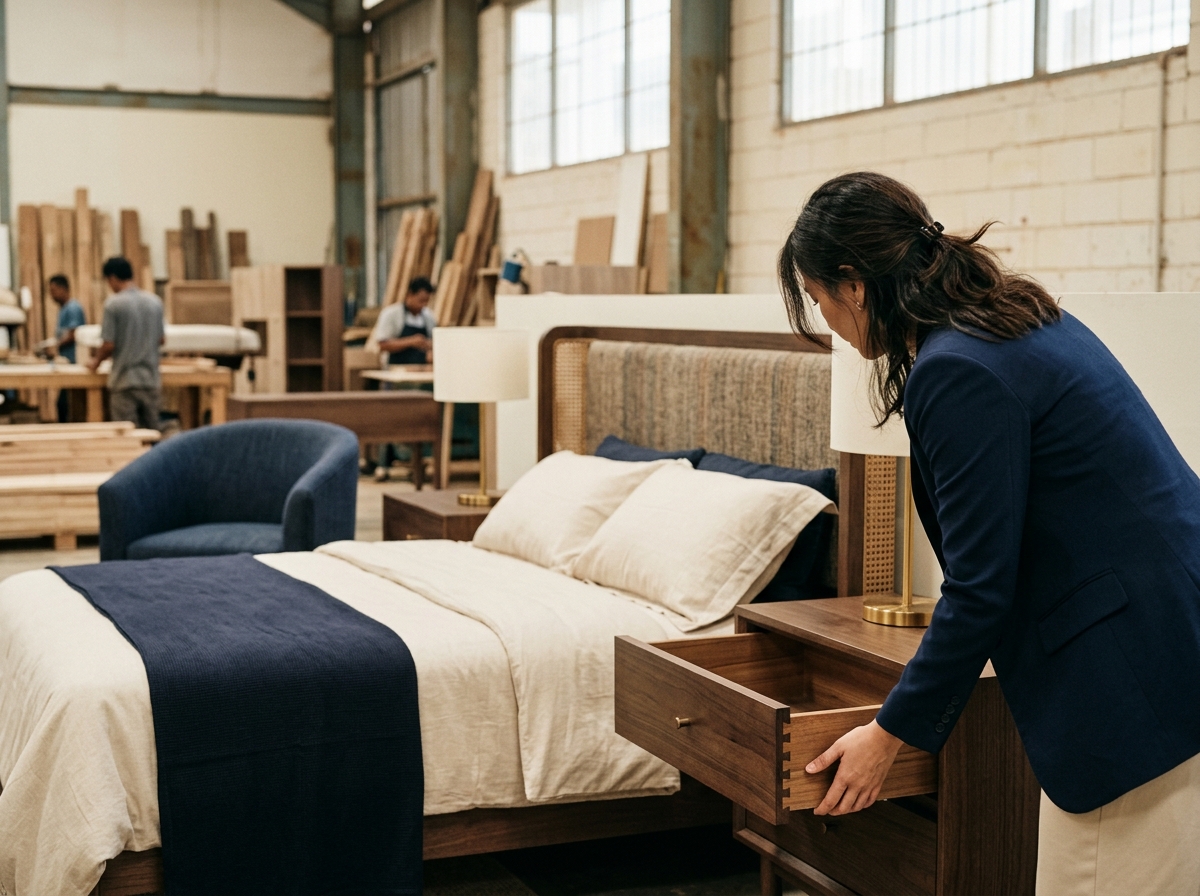
The mock-up room is the single most important quality control event in any hotel FF&E procurement Indonesia program. It sets the production benchmark. Every subsequent piece is measured against it.
Who Must Approve the Mock-Up
Mock-up sign-off typically requires written approval from four parties: the hotel brand (if a franchise), the interior designer, the owner or development manager, and the operator's opening team. Missing any one signature exposes the owner to post-installation disputes about whether delivered furniture matched approved standards.
Factory-Site Mock-Up vs. In-Country Mock-Up Review
This is a decision that many programs handle poorly. Two approaches are viable:
Option A — Mock-up built in Indonesian factory, reviewed in-country. The reviewing team travels to Indonesia (or sends an authorized representative) to inspect the assembled room set on the factory floor. This is faster, typically saves four to six weeks, and allows immediate revision instruction to factory personnel. It is the preferred approach when the program timeline is tight.
Option B — Mock-up shipped to project site for review. Completed furniture is crated and shipped to the US project site or to a US-based staging warehouse for review. This adds ocean freight cost and transit time (approximately four to six weeks each direction for a full mock-up set), but allows brand, designer, and operator teams to review in context without travel.
Hybrid approaches are common: ship only upholstered pieces or finish-sensitive items for site review while approving structural casegoods in-factory.
Documenting Approval as a Production Benchmark
Mock-up approval must produce a formal punch-list, a signed approval sheet, and a complete photographic record (minimum 20 to 40 photographs per key item covering all faces, joinery details, and finish close-ups). This documentation becomes the contractual production standard. Factories reference it during self-inspection and QC inspectors use it during third-party visits.
Contract-Grade Quality Control During Indonesian FF&E Production
Defining Contract-Grade in the Indonesian Context
Contract-grade for hotel FF&E means furniture engineered to withstand commercial use cycles — not residential standards. For solid-wood pieces from Indonesian factories, this means: kiln-dried timber to appropriate moisture content specifications, mortise-and-tenon or dowel joinery with adhesive reinforcement, finish systems with defined adhesion and abrasion resistance, and hardware rated for commercial cycle counts.
Third-Party Inspection Cadence
A minimum three-inspection cadence is standard practice for Indonesia-sourced hotel programs:
1. First-article inspection — conducted on the first completed production units, before full run begins 2. Mid-production inspection — approximately 40–60% through the production run 3. Pre-shipment inspection — on completed, packed units before container loading
Each inspection should be conducted by an accredited third-party inspection firm with hospitality furniture experience. Inspection reports must reference the approved mock-up benchmark documentation.
Common Defect Categories and Remediation Protocols
Defect categories frequently found in Indonesian hotel furniture production include:
- Finish inconsistency (sheen variation, orange peel, brush marks) - Dimensional deviation outside specified tolerances - Hardware misalignment or incorrect specification - Surface damage from inadequate packing during internal factory transfer - Moisture content variation in solid wood causing downstream checking or warping
Remediation protocols must be pre-agreed in the purchase order: minor defects repaired at factory, major defects replaced before shipment, and systematic defects triggering a production hold with root-cause review.
Timber and Material Compliance
Every wood component in an Indonesia-sourced hotel FF&E program must be covered by SVLK certification — this is a legal export requirement for Indonesia. FSC chain-of-custody certification is an additional layer required by some US hotel brands and is available from a subset of Indonesian producers.
- ✓SVLK certificate covering all wood components
- ✓FSC chain-of-custody certificate if brand-required
- ✓Third-party test certificates for BIFMA and ASTM standards
- ✓Pre-shipment inspection report with photographic evidence
- ✓Packing list cross-referenced to FF&E item codes
- ✓Bill of lading with correct HS code classification
Staged Production Scheduling and Export Logistics from Indonesia
Aligning Production Releases to Hotel Opening Sequence
Hotels rarely open all floors simultaneously. A phased opening — floors one through five, then six through ten, then suites — allows the owner to begin revenue generation before the full fit-out is complete. Indonesia FF&E programs should mirror this sequence with staged production releases. Each production release has its own purchase order milestone, inspection schedule, and container booking.
This requires factory capacity planning at the time of purchase order negotiation. Factories must commit to specific production windows for each phase, with contractual penalties for delay.
Container Planning for Bulky Indonesian FF&E
| Shipment Type | Best Use Case | Trade-Off |
|---|---|---|
| FCL 40' standard | Casegoods-heavy floors, full room sets | Most cost-efficient per CBM |
| FCL 40' high-cube | Tall wardrobes, headboard panels, upholstered pieces | Adds approximately 15% cubic capacity vs. standard |
| LCL consolidation | Small supplemental orders, replacement pieces | Higher per-CBM rate, slower transit |
Consolidation from multiple Indonesian factories into a single FCL requires a consolidation forwarder with warehouse capability in Surabaya or Jakarta. Build approximately two to three weeks of consolidation time into the logistics schedule.
US Import Duties and Tariff Considerations for Indonesia-Origin FF&E
Indonesia is not subject to the Section 301 tariffs that apply to China-origin furniture — a meaningful cost advantage for US-bound hotel programs. Indonesia benefits from standard US Most Favored Nation (MFN) duty rates.
Incoterms Selection and Risk Transfer
| Incoterm | Where Risk Transfers | Who Pays Ocean Freight | Typical Use |
|---|---|---|---|
| FOB Surabaya/Jakarta | At port rail, origin | Buyer | Most common for managed programs |
| CIF US port | At destination port | Seller | Useful when factory has freight leverage |
| DDP project site | At delivered destination | Seller | Simplifies buyer logistics; seller controls cost |
FOB is the most common structure for hotel FF&E procurement Indonesia programs managed by an experienced procurement team. It gives the buyer direct control over freight carrier selection and insurance.
On-Site Installation Coordination and Final Room Acceptance
FF&E delivery cannot precede construction readiness. Furniture arriving before MEP rough-in is complete, flooring is installed, and paint is finished will be damaged. Coordinate with the general contractor on a room-ready certification process — a formal sign-off that each floor or room block is ready to receive FF&E.
Receiving, Warehousing, and Damage Triage
Indonesian hotel furniture typically arrives at a US port of entry and moves to a local FF&E warehouse for receiving inspection before installation. Receiving inspection identifies transit damage, verifies quantities against the packing list, and flags any items requiring factory-sourced replacement pieces.
Punch-List Management and Supplier Liaison
Installation punch-lists are inevitable. The critical variable is resolution speed. Indonesian factories should be contractually required to respond to replacement piece requests within a defined period — typically 30 to 45 days for standard items, longer for custom carved or upholstered pieces. Maintain a direct communication channel to the factory's export liaison throughout the installation phase.
Final Room Acceptance and Warranty Documentation
Final acceptance requires a room-by-room sign-off against the original FF&E schedule, with photographic documentation of installed conditions. Warranty documentation from Indonesian suppliers should specify: warranty period (commonly two to five years for commercial furniture), coverage scope (manufacturing defects vs. wear), and the claims process. Collect these documents before final payment release.
Budget Management and Value Engineering in Indonesia FF&E Programs
Early-stage budgeting for Indonesia-sourced hotel FF&E should account for the full landed cost — not just factory price. Approximate program costs vary significantly by room type, finish specification, and brand tier, but buyers consistently underestimate the non-product costs.
Hidden Costs to Budget Explicitly
- Third-party inspection fees (typically three inspection visits per production phase) - Ocean freight, including potential surcharge exposure during peak seasons or congestion events - Port-to-warehouse drayage at US destination - Warehousing and receiving inspection at the US staging facility - Sourcing agent or procurement management fees (typically a percentage of FOB value or a fixed project fee) - Customs broker fees and any tariff duty on mixed-material items
Value Engineering Without Compromising Contract-Grade Standards
Value engineering in Indonesian FF&E programs is most effective at the specification stage, before purchase orders are issued. Effective strategies include:
- Species substitution: replacing teak with certified mahogany or rubberwood where visual result is equivalent and brand standards permit - Finish simplification: reducing the number of finish options in the matrix (fewer finishes mean fewer setup changeovers and lower production cost) - Modular components: designing casegoods with shared components across room types reduces tooling and setup cost - Panel-over-solid trade-offs: specifying veneered MDF for non-structural panels while retaining solid wood at joinery points
Exchange Rate and Tariff Risk Management
Indonesia-sourced FF&E is typically priced in US dollars, which reduces direct exchange rate exposure for US buyers. However, if the Indonesian rupiah weakens significantly against the dollar, factories may face input cost pressure and attempt to substitute materials at mid-production. Build material lock-in provisions into the purchase order.
Frequently Asked Questions: Hotel FF&E Procurement from Indonesia
How long does a full hotel FF&E procurement program from Indonesia take, from specification to installed rooms? Approximately 14 to 22 months for a full-service property. Select-service programs with simpler specifications typically run 10 to 14 months. These ranges exclude design development time prior to specification finalization.
What contract-grade standards must Indonesian-made hotel furniture meet for US brand compliance? Most US brand standards reference BIFMA structural testing for seating and ASTM D4157 abrasion testing for upholstery fabric (commonly 50,000+ double rubs). Specific brand standards vary — always obtain the brand's FF&E standards document before finalizing specifications.
How is a mock-up room approval conducted when the factory is in Indonesia and the project site is abroad? Two approaches are used: in-factory review (reviewing team travels to Indonesia) or shipment of mock-up pieces to the US for site review. In-factory review is faster by four to six weeks.
What are the current US import duties and tariff considerations for Indonesian hotel furniture? Indonesia-origin furniture is not subject to Section 301 tariffs (which apply to China-origin goods). Standard MFN duty rates apply under HS Chapter 94. Exact rates depend on HS classification by item type. Engage a licensed US customs broker to confirm before purchase order issuance.
Do I need a local sourcing agent in Indonesia, or can I manage procurement directly? Direct management is possible for buyers with prior Indonesia factory relationships and in-country inspection resources. For most hotel development programs, a procurement partner or sourcing agent with Indonesia hospitality experience adds measurable value in vendor qualification, in-factory communication, and QC coordination.
How do I ensure SVLK or FSC timber certification is maintained through the full supply chain? Require SVLK documentation at the purchase order stage — it is a legal export requirement for all Indonesian wood products. For FSC, pre-qualify only factories holding active FSC chain-of-custody certificates and require the certificate number on all shipping documents.
A successful Indonesia FF&E program rests on three disciplines. First, a specification package detailed enough that factories produce to benchmark on the first attempt. Second, third-party quality control inspection at every production gate. Third, a logistics plan that aligns staged container shipments to the construction sequence on site. All three must be designed before purchase orders are issued — not corrected after production begins.
You now have a clear view of the process, the decision points, and the Indonesia-specific variables that determine program outcomes. The logical next step is scoping your specific program against these parameters.
You understand the phases, the standards, and the risks. A project consultation will map your room count, specification complexity, and opening schedule to a realistic Indonesia procurement timeline and budget framework.
Request a Project Consultation →Need eyes on the ground in Indonesia?
MTS is an execution partner — supplier verification, manufacturing management, quality control and export logistics across Indonesia, Vietnam and China.
Related services
Related articles
Receive furniture sourcing insights across Asia.
One email per week. No spam.