Hotel FF&E Budget Cost Per Room: 2026 Guide by Hotel Class
13 min read
Planning an FF&E budget for a hotel project requires hard numbers, not averages pulled from outdated guides. Whether you are developing a 120-key select-service property or repositioning a full-service asset through a Property Improvement Plan (PIP), your cost-per-key decisions affect brand…
Planning an FF&E budget for a hotel project requires hard numbers, not averages pulled from outdated guides. Whether you are developing a 120-key select-service property or repositioning a full-service asset through a Property Improvement Plan (PIP), your cost-per-key decisions affect brand approval, investor returns, and guest satisfaction simultaneously.
This guide provides approximately 2026 benchmarks forhotel FF&Ebudget cost per room across every hotel class. It includes a room-type spend breakdown and the key cost drivers that shift budgets up or down. It also details how direct sourcing from Indonesia can reduce casegoods costs by 30– approximately 55%. Sections 1–5 address budgeting and calculation methodology.
The data draws on publicly available ranges from cost-estimating resources including HVS, JN+A, and market-reported construction benchmarks. All figures are approximate and should be validated against current supplier quotes for your specific project.
What FF&E Means in Hotel Budgeting and Why It Matters
FF&E stands for furniture, fixtures, and equipment. In a hotel context, it covers every movable or semi-fixed item that furnishes a room or public area: casegoods, seating, beds, lighting, window treatments, artwork, bathroom accessories, and lobby furniture.
FF&E is distinct from OS&E (operating supplies and equipment), which covers linens, tableware, kitchenware, and consumables. It is also separate from hard construction costs — structural, mechanical, electrical, and plumbing work. Confusing the three categories is one of the most common hotel budgeting errors.
FF&E typically represents 25–40% of total room construction cost (approximate, based on ranges commonly cited by hospitality cost consultants including HVS). That share rises at luxury properties where fit-out intensity is higher and drops at economy properties where rooms are smaller and simpler.
The difference between new-build and renovation FF&E matters. In a new-build, FF&E is procured once against a blank canvas. In a renovation triggered by a brand PIP, you are replacing selective items to meet updated brand standards — often under time pressure tied to a franchise agreement deadline. PIP-driven FF&E budgets typically run 60–80% of new-build equivalents because structural and fixed elements are retained.
Hotel FF&E Budget Cost Per Room: 2026 Benchmarks by Hotel Class
The table below summarises approximate FF&E cost per key by hotel segment. Ranges reflect typical US market conditions as of 2026, based on publicly available HVS cost-estimating guides and market-reported construction data from sources including Artone and Sara Hospitality. Actual costs vary by market, brand flag, and room programme.
| Hotel Class | Star Rating | FF&E Cost Per Key (Approx.) |
|---|---|---|
| Economy | 1–2 star | $1,500 – $7,000 |
| Midscale | 3 star | $7,000 – $15,000 |
| Upscale | 4 star | $15,000 – $30,000 |
| Upper Upscale | 5 star | $30,000 – $60,000 |
| Luxury / Bespoke | Luxury | $60,000 – $150,000+ |
Why Luxury FF&E Costs Exceed approximately $60,000 Per Key
Luxury properties specify custom millwork, natural stone surfaces, handwoven textiles, and bespoke lighting. Each item requires design approval, sample production, and factory QC before shipment. The design and procurement management fees alone can add 10–15% on top of product cost (approximate).
Brand-Standard Compliance Cost Premium by Flag Tier
Select-service brand compliance typically adds approximately $1,000–$3,000 per key above a no-flag baseline (approximate). Full-service compliance from flags such as Marriott or Hilton can add approximately $5,000–$12,000 per key above baseline, reflecting mandatory furniture grades, finish specifications, and technology integration requirements. These premiums should be line-itemed separately in your FF&E budget so value-engineering decisions can be evaluated against specific brand requirements.
FF&E Spend Breakdown by Room Type and Functional Area
Allocation Across the Property
A typical hotel FF&E budget allocates spend approximately as follows:
| Area | Share of Total FF&E Budget |
|---|---|
| Guestrooms | 50–60% |
| F&B / Restaurant | 15–20% |
| Lobby and Public Areas | 10–15% |
| Back-of-House | 5–10% |
| Circulation / Corridors | 5% |
These allocations shift by asset type. A limited-service property with no F&B will redirect that 15–20% toward guestrooms or lobby. A resort with multiple dining outlets may push F&B above 25%.
Guestroom FF&E Line Items
A standard king guestroom FF&E package typically includes:
- Casegoods: dresser, nightstands, desk, credenza - Seating: desk chair, lounge chair, ottoman - Bed and headboard: platform base, mattress set, upholstered headboard - Lighting: bedside lamps, desk lamp, floor lamp, ceiling fixtures - Window treatments: blackout drape, sheer, hardware - Artwork: 2–4 pieces per room including frames - Bathroom accessories: towel bars, robe hooks, mirror frame, vanity stool
Room-Mix-Weighted Cost Modeling
Flat per-room averages understate budget risk. A hotel with a higher suite ratio carries a materially higher total FF&E cost. Suites typically cost 2.0–3.5× a standard king room to furnish (approximate). ADA-compliant rooms often run 5–10% more than standard equivalents due to specification requirements for grab bars, turning radius clearances, and accessible furniture heights.
Sample budget for a 100-key, 3-star property (approximate):
| Room Type | Count | FF&E Cost Per Room | Subtotal |
|---|---|---|---|
| Standard King | 55 | $10,000 | $550,000 |
| Standard Double | 30 | $10,500 | $315,000 |
| ADA King | 10 | $11,000 | $110,000 |
| Junior Suite | 5 | $22,000 | $110,000 |
| **Guestroom Total** | **100** | — | **$1,085,000** |
| Public Areas / Lobby | — | — | $200,000 |
| F&B | — | — | $180,000 |
| Back-of-House | — | — | $80,000 |
| **Total FF&E** | — | — | **$1,545,000** |
| **Effective cost per key** | — | — | **$15,450** |
Key Cost Drivers That Move Your FF&E Budget Up or Down
Four variables drive the largest swings in hotel FF&E budget cost per room.
1. Material specification Solid hardwood casegoods cost approximately 40–70% more than comparable veneer-over-MDF pieces (approximate). Natural stone bathroom surfaces cost 2–4× engineered quartz alternatives. Specification decisions made at the design development stage lock in cost before procurement begins.
2. Custom millwork vs. catalog procurement Custom casegoods require tooling, sample approval, and longer lead times. Catalog or off-the-shelf procurement from hospitality furniture lines reduces design fees and shortens lead times to 4–8 weeks domestically. Custom pieces are necessary for brand differentiation at the upper upscale and luxury levels. At midscale, catalog procurement is a legitimate cost lever.
3. Logistics and installation Freight-in, port fees, last-mile delivery, and installation labor are frequently underestimated. For imported FF&E, these costs typically add 12–20% to the FOB product cost (approximate). Installation labor in high-cost US markets can add approximately $500–$1,500 per room on top of product cost.
4. Tariff and customs duty exposure Importing hotel furniture from Southeast Asia into the US carries tariff exposure that varies by country of origin, material, and HS code classification. Furniture from China imported under Section 301 tariffs can carry duties of approximately 25% or more. Indonesia and Vietnam have different tariff profiles. Work with a licensed customs broker to model landed cost accurately before locking in sourcing decisions.
How to Calculate FF&E Cost Per Room for Your Specific Project
The Core Formula
FF&E cost per key = Total FF&E budget ÷ Number of keys
The formula is simple. The inputs require discipline.
Inputs Required
- Total room count and room mix (king/double/suite ratio) - Hotel category and applicable brand flag - Common area programme (lobby size, F&B outlets, meeting rooms) - Material specification tier (economy, midscale, upscale, luxury) - Delivery country and port of entry (affects landed cost) - Installation market (labor cost varies significantly by US metro)
How Room Size Influences Per-Room Spend
Room size directly correlates with FF&E spend. A 300 sq ft economy room requires fewer line items than a 450 sq ft upscale room. Hospitality cost data (approximate, based on market-reported ranges) suggests FF&E spend scales roughly as follows by room size tier:
| Room Size | Approximate FF&E Spend Multiplier vs. Baseline |
|---|---|
| Under 300 sq ft | 0.75× |
| 300–400 sq ft | 1.0× (baseline) |
| 400–550 sq ft | 1.3× |
| Over 550 sq ft (suite) | 2.0–3.5× |
Worked Example: 100-Room Upscale Hotel
- Property: 100-key, 4-star, full-service, no brand flag - Room mix: 65 standard kings ( approximately $22,000 each), 25 standard doubles ($22,500 each), 8 ADA rooms ($24,000 each), 2 suites ($55,000 each) - Guestroom FF&E: (65 × $22,000) + (25 × $22,500) + (8 × $24,000) + (2 × $55,000) = $1,430,000 + $562,500 + $192,000 + $110,000 = $2,294,500 - Public areas / lobby: approximately $320,000 - F&B (1 outlet): approximately $280,000 - Back-of-house: approximately $120,000 - Total FF&E before contingency: approximately $3,014,500 - approximately 15% contingency: $452,175 - Total FF&E budget: approximately $3,466,675 - Effective cost per key: approximately $34,667
This falls within the upper end of the upscale range, reflecting a full-service programme and suite component.
Direct Sourcing from Indonesia: How to Cut FF&E Costs by 30– approximately 55%
Indonesia is one of the most competitive FF&E sourcing origins for US hotel developers. The country has deep reserves of teak, mahogany, and rattan — materials that translate directly into hospitality-grade casegoods, headboards, lounge seating, and decorative pieces. Factory-direct pricing on solid-wood casegoods from Indonesia typically runs 30–55% below equivalent domestic US or European procurement (approximate, based on market-reported sourcing comparisons).
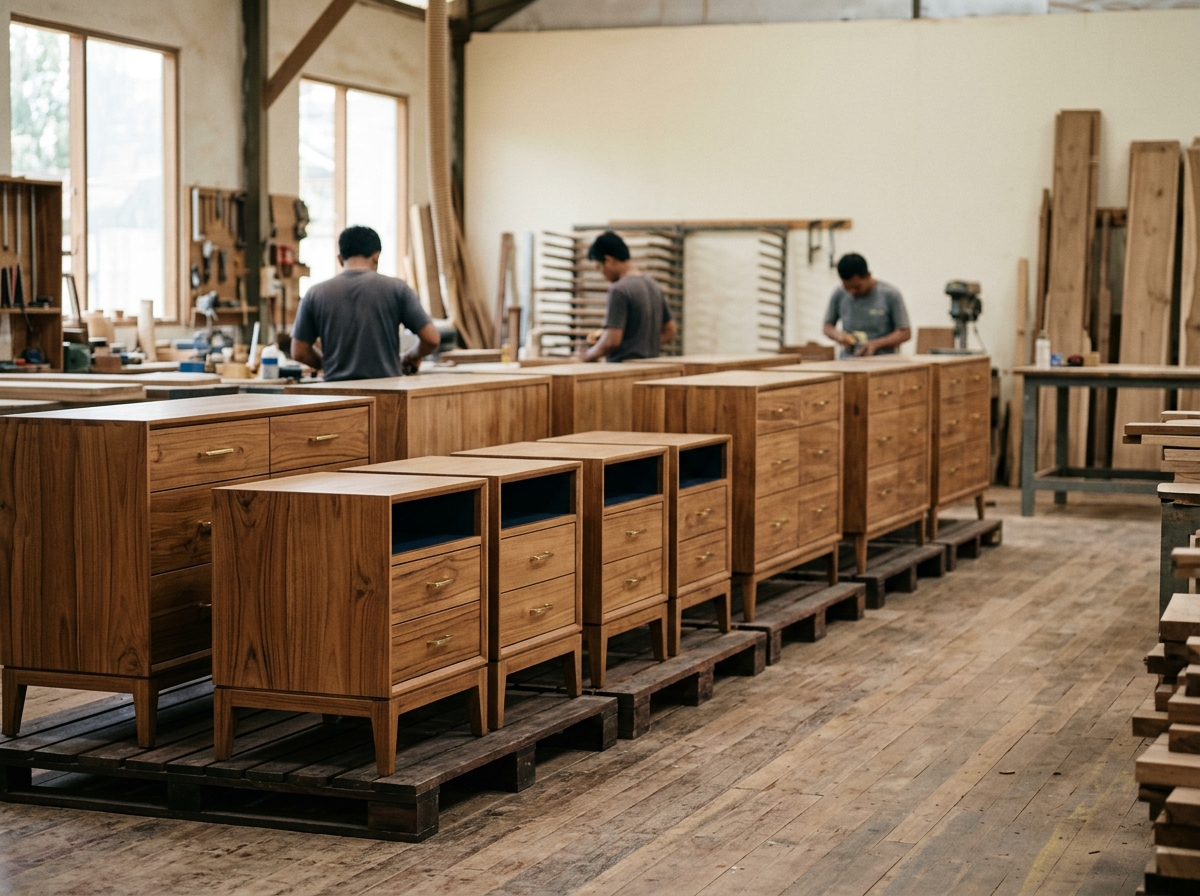
Jepara: Solid Wood and Teak Casegoods
Jepara in Central Java is Indonesia's largest furniture production cluster. It specialises in solid teak and mahogany casegoods — dressers, nightstands, desks, credenzas, and headboards. Many factories serve export markets and have experience with hospitality specifications. MOQs at Jepara factories typically start at 20–50 units per SKU (approximate). Lead times run 10– approximately 16 weeks from order confirmation to container loading.
Key supplier signals to look for: ISO 9001 certification, SVLK timber legality certification (Indonesia's mandatory timber legality assurance system), and demonstrated hospitality project references.
Bali: Resort, Artisan, and Decorative Pieces
Bali's producer base serves luxury villas and boutique hotels globally. Artisan workshops in and around Denpasar and Gianyar produce decorative furniture, rattan lounge pieces, carved headboards, and bespoke lighting. This cluster is appropriate for upper upscale and luxury FF&E packages where design distinctiveness matters. MOQs are lower — often 5–15 units per design — but per-unit pricing is higher than Jepara commercial production.
Bali producers frequently work through merchant exporters who handle freight forwarding, fumigation certificates, and export documentation. Build this intermediary cost into your landed cost model.
Surabaya: Mid-Market Commercial Hospitality
Surabaya (East Java) hosts a cluster of mid-market commercial furniture manufacturers producing upholstered seating, contract-grade beds, and modular casegoods. This cluster suits select-service and midscale hotel programmes where volume consistency matters more than bespoke design. Factories here often have higher production capacity than artisan Jepara workshops and can handle larger purchase orders for 100+ room hotels.
Trade-Offs to Manage When Sourcing from Indonesia
| Factor | Detail |
|---|---|
| Lead time | 10–16 weeks FOB; add 4–6 weeks for ocean freight to US West Coast |
| MOQ | 20–50 units per SKU at Jepara commercial factories; lower at Bali artisan workshops |
| Quality auditing | Factory pre-shipment inspection is essential; use a third-party QC firm or appoint a local agent |
| Tariff profile | Indonesia benefits from lower US duty rates than China on most furniture HS codes — verify with a customs broker |
| Timber certification | SVLK certification is mandatory for Indonesian wood product exports; request certificates with every order |
| Shipping logistics | FOB Tanjung Priok (Jakarta) or Tanjung Perak (Surabaya); allow for port congestion buffer |
You now have the per-room benchmarks and the sourcing framework. The logical next step is to put real factory quotes against your line items. Request a direct-source FF&E quote from Indonesian manufacturers and see exactly where your per-room budget lands against current production costs.
Request an Indonesia FF&E Quote →FF&E Budget Contingency Norms and Common Budgeting Mistakes
Industry-Standard Contingency Allowances
| Project Type | Recommended Contingency |
|---|---|
| New-build | 10–15% of total FF&E budget |
| Renovation / PIP | 15–20% of total FF&E budget |
Renovation projects carry higher contingency because existing conditions are unpredictable. Hidden structural issues, updated brand standard releases mid-project, and scope creep during demolition all absorb contingency faster than most developers expect.
Common Budgeting Errors
- Excluding installation and freight-in. Product cost is not landed cost. Freight, customs duties, drayage, and installation labor are separate line items that routinely add 15–25% to FOB product cost (approximate). - Ignoring tariff exposure. As noted above, sourcing country selection affects landed cost materially. Budget for duties before selecting a sourcing origin. - Using flat per-key averages without adjusting for room mix. A suite-heavy programme will exceed a flat average by a wide margin. - Skipping phased procurement planning. FF&E must be delivered in sequence with construction milestones. Ordering everything at once creates storage costs and cash flow strain. A phased schedule tied to construction milestones — typically guestrooms first, public areas second — preserves working capital.
Value-Engineering Without Violating Brand Compliance
Value-engineering FF&E within brand standards requires understanding which specifications are mandatory versus aspirational. Work with your interior designer and brand representative to identify items where material substitution (veneer for solid wood, engineered stone for natural marble) is permitted. Document every substitution with brand sign-off before placing orders. Unapproved substitutions discovered at brand inspection create expensive rework.
FF&E Renovation vs. New-Build: Budget Differences and PIP Implications
Renovation FF&E budgets typically run 60–80% of new-build equivalents (approximate). Retained structural elements — fixed bathroom tile, built-in millwork that meets current brand standards, HVAC grilles — reduce the scope of replacement.
PIPs issued by Marriott International, Hilton Hotels, IHG, and other brand flags specify mandatory replacement items on a room-by-room basis. PIP scope directly determines renovation FF&E cost. A light PIP focused on soft goods and artwork may cost $3,000–$6,000 per key. A full PIP requiring complete casegood replacement may approach $15,000–$25,000 per key for a midscale property (approximate).
Demolition and disposal costs are a line item that renovation budgets frequently omit. Industry cost-estimating resources commonly reference disposal costs in the range of $400–$600 per room for a full room renovation (approximate). These costs include dumpster fees, labor for removal, and disposal of regulated materials such as fluorescent lamp ballasts.
Selective replacement strategy: Prioritize items that fail brand inspection first. Beds, headboards, and case goods are typically the highest-visibility items in brand inspections. Window treatments and artwork are often lower priority unless specifically flagged in the PIP letter. Allocate budget to mandatory items before optional upgrades.
Building Your FF&E Procurement Team and Process
Core Roles
| Role | Function |
|---|---|
| Interior Designer of Record | Specifies all FF&E items, produces specification sheets and finish schedules |
| FF&E Purchasing Agent (PA) | Solicits bids, manages vendor relationships, issues POs, tracks delivery |
| Project Manager | Coordinates FF&E delivery schedule with construction milestones |
| QC / Factory Auditor | Inspects production at origin before shipment (critical for overseas sourcing) |
When to Use a Purchasing Agent vs. Direct Factory Sourcing
A dedicated hospitality purchasing agent adds value on full-service hotel projects where FF&E scope exceeds 200 line items. Their vendor relationships and specification management systems reduce procurement errors. Their fee — typically 8–12% of FF&E product cost (approximate) — is often offset by vendor discounts and avoided rework.
Direct factory sourcing from Indonesia or other origins makes economic sense when your programme is concentrated in a few high-volume categories. These include casegoods, beds, and upholstered seating, where meaningful MOQ orders are achievable. You must also be able to absorb logistics management internally or through a freight forwarder with hospitality experience.
Structuring an RFQ Package for Apples-to-Apples Comparison
An effective RFQ package must include finish specifications such as wood species and stain sample reference. It should also cover dimensional drawings, quantity per SKU, required delivery date, and requested Incoterm — typically CIF US port or DDP. Finally, include quality standard references and required certifications such as CARB Phase 2, SVLK, and fire-retardant treatment documentation. Suppliers who cannot respond to a structured RFQ are not ready for a hospitality project.
- ✓Interior designer of record appointed and specifications issued
- ✓Purchasing agent or direct sourcing strategy confirmed
- ✓RFQ package prepared with dimensions, finishes, and quantity schedule
- ✓Factory audit plan in place for overseas suppliers
- ✓SVLK and CARB Phase 2 certification requirements communicated to suppliers
- ✓Phased delivery schedule mapped to construction milestones
- ✓Contingency budget line established at 10–20% of FF&E total
- ✓Customs broker appointed and HS codes pre-classified
Frequently Asked Questions
How do you calculate FF&E cost per room for a hotel project? Divide total FF&E budget by number of keys. Build the total from a room-mix-weighted line item budget — not a flat average. Include public areas, F&B, and back-of-house. Add 10– approximately 20% contingency and calculate landed cost, not FOB product cost.
What is included in hotel FF&E versus OS&E? FF&E covers furniture, fixtures, and equipment that appear on the capital budget: casegoods, beds, seating, lighting, window treatments, artwork. OS&E covers operating supplies replenished regularly: linens, toiletries, tableware, cleaning supplies.
How much does it cost to furnish a 100-room hotel? At midscale (3-star), approximately $1.1–$1.7 million total FF&E before contingency. At upscale (4-star), approximately $2.5–$3.5 million. At upper upscale, approximately $4–$7 million or higher. All figures approximate; room mix, brand flag, and common area programme affect the final number significantly.
What FF&E budget should I allocate for a 4-star hotel renovation? A 4-star PIP-driven renovation typically costs $12,000–$22,000 per key for a full room refresh (approximate). A targeted soft goods and artwork replacement may fall to $4,000–$7,000 per key. Budget 15– approximately 20% contingency on top of product cost.
How much can I save by sourcing hotel FF&E directly from Indonesia? Approximately 30–55% on solid-wood casegoods and upholstered pieces compared to domestic US procurement (approximate). After US tariffs, freight, and logistics, net savings on landed cost typically fall to 15–35% depending on product category and sourcing hub.
What contingency percentage should I add to a hotel FF&E budget? 10– approximately 15% for new-build projects. 15– approximately 20% for renovation and PIP projects. Higher contingency is warranted when sourcing internationally for the first time or when brand standards are still being negotiated.
Getting the hotel FF&E budget cost per room right at the planning stage prevents the two most damaging outcomes in hotel development: cost overruns that erode investor returns and under-specification that fails brand inspection. The benchmarks in this guide give you a starting framework; direct supplier quotes — especially from Indonesian manufacturers — will sharpen your per-key numbers into actionable procurement targets.
You now have the cost structure, the sourcing logic, and the team framework to build a defensible FF&E budget. The next step is converting benchmarks into live quotes from verified factory sources.
Request a direct-source FF&E quote from Indonesian manufacturers and benchmark your per-room budget against current factory pricing for teak casegoods, upholstered seating, and resort-grade decorative pieces. Qualified manufacturers in Jepara, Bali, and Surabaya are available to quote against your specification package.
Request Your FF&E Quote →Supplying a complete project from Asia?
MTS runs turnkey procurement — sourcing, contracting, production, QC and consolidated delivery across furniture and building materials.
Related services
Related articles
Receive furniture sourcing insights across Asia.
One email per week. No spam.